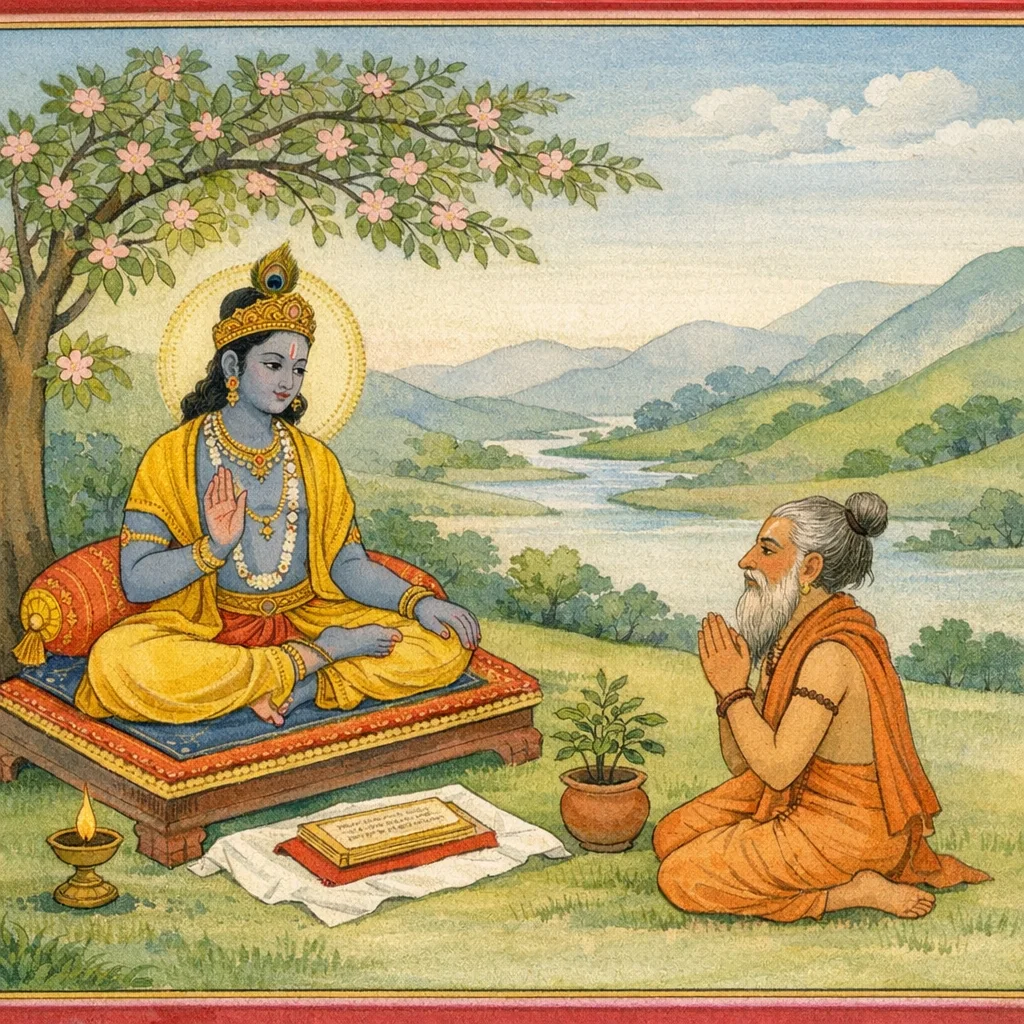
Adhyaya 21
Viśokā Dvādaśī Vow, Guḍa-Dhenū (Jaggery-Cow) Gift, and Śaila-Dāna (Mountain-Charity) Rites
Chapter 21 first praises a radiant, dharma-abiding king and his queen Bhānumatī, then unfolds a karmic backstory: Vasiṣṭha explains that devotion in a former life and the refusal to accept payment—connected with the courtesan Līlāvatī’s worship of Śiva—have ripened in the present as sovereignty, splendor, and good fortune. The teaching then turns to ritual dharma. Viśokā Dvādaśī in the month of Āśvayuja is prescribed with fasting, worship of Lakṣmī–Viṣṇu, a night vigil, altar construction, and concluding gifts, including a bed and the guḍa-dhenū (a “cow” fashioned from jaggery). The chapter expands into a systematic guide to dhenus—ten sin-destroying symbolic “cows”—and to śaila-dāna, the donation of symbolic “mountains” (grain, salt, jaggery, gold, sesame, cotton, ghee, jewels, silver, sugar), detailing measurements, iconography, lokapāla placements, mantras, and the fruits of merit. It concludes by adding solar saptamī observances—Kalyāṇa-, Viśoka-, Phala-, Śarkarā-, Kamala-, Mandāra-, and Śubha-saptamī—emphasizing sorrowlessness, health, prosperity, and liberation.
Shlokas
Verse 1
पुलस्त्य उवाच । आसीत्पुरा बृहत्कल्पे धर्ममूर्तिर्जनाधिपः । सुहृच्छक्रस्य निहता येन दैत्यास्सहस्रशः
Pulastya said: In ancient times, during the great aeon (Bṛhat-kalpa), there lived a king, an embodiment of righteousness (Dharma). He was a friend of Indra, and by him thousands of Daityas were slain.
Verse 2
सोमसूर्यादयो यस्य तेजसा विगतप्रभाः । भवंति शतशो येन दानवाश्च पराजिताः
By his radiance the Moon, the Sun, and the rest are stripped of their splendor; and by him the Dānavas are vanquished in their hundreds.
Verse 3
यथेच्छरूपधारी च मानुषोप्यपराजितः । तस्य भानुमती भार्या सती त्रैलोक्यसुंदरी
He could assume any form at will, and though appearing human, he was unconquered. His wife was Bhānumatī—virtuous, chaste, and the beauty of the three worlds.
Verse 4
लक्ष्मीसदृशरूपेण निर्जितामरसुंदरी । राज्ञस्तस्याग्रमहिषी प्राणेभ्योपि गरीयसी
With a beauty like Lakṣmī’s, she surpassed even the fairest of the celestial maidens. She was that king’s chief queen, dearer to him than his own life-breath.
Verse 5
दशनारीसहस्राणां मध्ये श्रीरिव राजते । नृपकोटिसहस्रेण न कदाचित्समुच्यते
Among ten thousand women, one shines like Śrī (Lakṣmī); yet even among thousands of crores of kings, such a one is never found—so rare is true excellence.
Verse 6
कदाचिदास्थानगतः पप्रच्छ स्वपुरोहितम् । विस्मयेनावृतो नत्वा वसिष्ठमृषिसत्तमम्
Once, having come to the royal court, he—overwhelmed with wonder—bowed to Vasiṣṭha, the foremost of sages, and questioned his own family priest.
Verse 7
भगवन्केन धर्मेण मम लक्ष्मीरनुत्तमा । कस्माच्च विपुलं तेजो मच्छरीरे सदोत्तमम्
O Lord, by what righteousness (dharma) have I attained this unsurpassed fortune? And why does such vast, ever-excellent radiance abide in my body?
Verse 8
वसिष्ठ उवाच । पुरा लीलावती नाम वेश्या शिवपरायणा । तया दत्तश्चतुर्दश्यां पुष्करे लवणाचलः
Vasiṣṭha said: Long ago there was a courtesan named Līlāvatī, wholly devoted to Śiva. On the fourteenth lunar day, she made a gift at Puṣkara—an offering as great as Mount Lavaṇācala.
Verse 9
हेमवृक्षामरैः सार्द्धं यथावद्विधिपूर्वकं । शूद्रः सुवर्णकारश्च कर्मकृत्सोऽभवत्तदा
Then, together with the divine beings of the golden trees, in due order and according to the prescribed rites, the Śūdra and the goldsmith took up their appointed work.
Verse 10
भृत्यो लीलावतीगेहे तेन हैमा विनिर्मिताः । तरवो हेमपुष्पाश्च श्रद्धायुक्तेन पार्थिव
O king, in Līlāvatī’s house, her attendant—endowed with faith—caused golden works to be fashioned; even trees bearing golden blossoms appeared.
Verse 11
अतिरूपेण संपन्ना घटितास्ते सुशोभनाः । धर्मकार्यमिति ज्ञात्वा न गृहीतं च वेतनम्
Endowed with exceptional beauty and finely adorned, they shone splendidly. Knowing it to be a work of dharma, they accepted no payment.
Verse 12
उज्ज्वालिताश्च ते पत्न्या सुवर्णमयपादपाः । लीलावतीगृहे चापि परिचर्या च पार्थिव
And those golden trees were made to shine by your wife; and in Līlāvatī’s house too there was service and attendance, O king.
Verse 13
कृता ताभ्यामशाठ्येन द्विजशुश्रूषणादिका । सा च लीलावती वेश्या कालेन महतानघ
O sinless one, with sincerity and without guile she served those two, attending upon the brāhmaṇas and others; and in the course of much time, the courtesan Līlāvatī was transformed by such conduct.
Verse 14
सर्वपापविनिर्मुक्ता जगाम शिवमंदिरम् । योऽसौ सुवर्णकारश्च दरिद्रोप्यतिसत्त्ववान्
Freed from all sins, she went to Śiva’s temple. And that goldsmith—though poor—was exceedingly virtuous.
Verse 15
न मूल्यमादाद्वेश्यातः स भवानिह सांप्रतम् । सप्तद्वीपपतिर्जातः सूर्यायुतसमप्रभः
Because you did not accept any payment from the courtesan, you have now, here in the present, become the lord of the seven continents—radiant with a splendor equal to ten thousand suns.
Verse 16
यया सुवर्णकारस्य तरवो हेमनिर्मिताः । सम्यगुज्ज्वलिताः पत्न्या सेयं भानुमती तव
By whom the goldsmith’s trees were made of gold and caused to shine perfectly—she is your wife Bhānumatī.
Verse 17
तस्मान्नृलोकेष्वपराजितस्त्वमारोग्यसौभाग्ययुता च लक्ष्मीः । तस्मात्त्वमप्यत्र विधानपूर्वं धान्याचलादीन्नृपते कुरुष्व
Therefore, in the world of men you will be unconquered, and Lakṣmī—endowed with health and good fortune—will abide with you. Therefore, O king, you too should here, in the prescribed manner, perform the rites beginning with the offering of heaps of grain (dhānyācala) and the like.
Verse 18
त एव पूजने मंत्रास्त एवोपस्कराः स्मृताः । ग्रहाणां लोकपालानां ब्रह्मादीनां च सर्वतः
Those very (things) are regarded as the mantras for worship, and those very (things) are remembered as the required ritual implements—everywhere, for the planets, the guardians of the worlds, and Brahmā and the other deities.
Verse 19
पश्येद्यदीमानुपनीयमानान्स्पृशेन्मनुष्यैरिह दीयमानान् । शृणोति भक्त्याथ मतिं ददाति विकल्मषः सोपि दिवं प्रयाति
If one merely beholds these sacred offerings as they are brought, touches them as people bestow them here, listens with devotion, and then gives assent or counsel, even that person—cleansed of sin—attains heaven.
Verse 20
दुःस्वप्नप्रशममुपैति पठ्यमानैः शैलेंद्रैर्भवभयभेदनैर्मनुष्यः । यः कुर्यात्किमु नृपपुंगवेह सम्यक्शांतात्मा सकलगिरींद्रसंप्रदानम्
By the mere recitation of these “lords of mountains,” which cleave the fear of worldly existence, a person attains the calming that pacifies evil dreams. How much more, O best of kings, would one gain if, with a truly tranquil mind, one were to perform the complete dāna—the gifting of all the mountain-lords?
Verse 21
भीष्म उवाच । किमभीष्टवियोगशोकसंधानलमुद्धर्तुमुपोषणं व्रतं वा । विभवध्रुवकारिभूतलेस्मिन्भवभीतेरपि सूदनं च पुंसः
Bhīṣma said: Can fasting or some vow lift a man out of the dense accumulation of sorrow born of separation from what he loves? And in this earthly realm, where prosperity is unsteady, what can also destroy a person’s fear of worldly existence?
Verse 22
पुलस्त्य उवाच । परिपृष्टमिदं जगत्प्रियं ते विबुधानामपि दुर्लभं महत्त्वात् । तव भक्तिमतस्तथापि वक्ष्ये व्रतमिंद्रासुरमानवेषु गुह्यम्
Pulastya said: What you have asked is dear to the world and, by reason of its greatness, difficult to obtain even for the gods. Yet since you are devoted, I shall explain that vow—secret among Indra’s host, the asuras, and humankind.
Verse 23
पुण्यमाश्वयुजे मासि विशोकद्वादशीव्रतम् । दशम्यां लघुभुग्विद्वान्प्रारभेत यमेन तु
In the sacred month of Āśvayuja, one should undertake the auspicious vow of Viśokā Dvādaśī. A wise person should begin it on the tenth day, eating lightly and observing self-restraint.
Verse 24
उदङ्मुखः प्राङ्मुखो वा दंतधावनपूर्वकम् । एकादश्यां निराहारः सम्यगभ्यर्च्य केशवम्
Facing north or east, and after first cleansing the teeth, on Ekādaśī one should remain without food and duly worship Keśava (Viṣṇu).
Verse 25
श्रियं चाभ्यर्च्य विधिवद्भोक्ष्येऽहं चापरेहनि । एवं नियमकृत्सुप्त्वा प्रातरुत्थाय मानवः
Having duly worshipped Śrī (Lakṣmī), he should partake of his meal according to rule on the next day. Thus, having observed the prescribed restraint, the man sleeps and, rising in the morning, continues the observance.
Verse 26
स्नानं सर्वौषधैः कुर्यात्पंचगव्यजलेन तु । शुभ्रमाल्यांबरधरःपूजयेच्छ्रीशमुत्पलैः
He should bathe using all medicinal herbs, or else with water mixed with pañcagavya. Wearing a pure garland and clean garments, he should worship Śrīśa (Viṣṇu) with blue lotuses.
Verse 27
विशोकाय नमः पादौ जंघे च वरदाय वै । श्रीशाय जानुनी तद्वदूरू च जलशायिने
Salutations to the Sorrowless One—his feet; and to the Bestower of boons—his shanks. Salutations to the Lord of Lakṣmī—his knees; and likewise to the One who reclines upon the waters—his thighs.
Verse 28
कंदर्पाय नमो गुह्यं माधवाय नमः कटिं । दामोदरायेत्युदरं पार्श्वे च विपुलायवै
“Offer homage to Kandarpā at the secret part; homage to Mādhava at the waist; say ‘homage to Dāmodara’ at the belly; and at the sides, indeed, offer homage to Vipula.”
Verse 29
नाभिं च पद्मनाभाय हृदयं मन्मथाय वै । श्रीधराय विभोर्वक्षः करौ मधुभिदे नमः
Salutations: to Padmanābha for the navel; to Manmatha indeed for the heart; to Śrīdhara for the Lord’s chest; and to Madhubhid for the two hands.
Verse 30
वैकुण्ठाय नमः कंठमास्यं पद्ममुखायवै । नासामशोकनिधये वासुदेवाय चाक्षिणी
Salutation to Vaikuṇṭha—(may He be) the throat; to the Lotus-faced One indeed—(may He be) the mouth; the nose (is offered) to the treasure-house of freedom from sorrow; and the eyes to Vāsudeva.
Verse 31
ललाटं वामनायेति हरये च पुनर्भ्रुवौ । अलकं माधवायेति किरीटं विश्वरूपिणे
“(One should dedicate) the forehead to Vāmana; and again the eyebrows to Hari; the locks of hair to Mādhava; and the crown of the head to the Universal-Formed Lord (Viśvarūpin).”
Verse 32
नमः सर्वात्मने तद्वच्छिर इत्यभिपूजयेत् । एवं संपूज्य गोविंदं धूपमाल्यानुलेपनैः
One should worship (him) with the utterance, “Obeisance to the Self of all,” and similarly with (the mantra) “Śiraḥ (salutation to the head).” Thus, having duly worshipped Govinda, one should honour him with incense, garlands, and fragrant unguents.
Verse 33
ततस्तु मंडलं कृत्वा स्थंडिलं कारयेन्मृदा । चतुरश्रं समंताच्च रत्निमात्रमुदक्प्लवम्
Then, having drawn a ritual circle, one should prepare a raised altar-platform with earth—square on all sides, and elevated by the measure of a hand-span.
Verse 34
श्लक्ष्णं हृद्यं च परितो वप्रत्रयसमावृतम् । त्रिरंगुलोच्छ्रितावप्रास्तद्विस्तारो द्विरंगुलः
It was smooth and pleasing to the heart, and on every side it was enclosed by three embankments. Those embankments rose to a height of three finger-breadths, and their breadth was two finger-breadths.
Verse 35
स्थंडिलस्योपरिष्टात्तु भित्तिरष्टांगुला भवेत् । नदी वालुकया सूर्ये लक्ष्म्याः प्रतिकृतिं न्यसेत्
Above the prepared altar-ground, one should make a raised rim (a boundary wall) eight finger-breadths high. Then, using sand from a river, one should place an image (representation) of Lakṣmī in the sunlight.
Verse 36
स्थंडिले सूर्यमध्यस्थ लक्ष्मीमभ्यर्चयेद्बुधः । नमो देव्यै नमः शांत्यै नमो लक्ष्म्यै नमः श्रिये
Upon a purified ground, the wise person should worship Lakṣmī, who abides in the midst of the Sun, saying: “Salutations to the Goddess; salutations to Peace; salutations to Lakṣmī; salutations to Śrī.”
Verse 37
नमस्तुष्ट्यै नमः पुष्ट्यै सृष्ट्यै दृष्ट्यै नमो नमः । विशोका दुःखनाशा यविशोका वरदास्तु ते
Salutations to Satisfaction; salutations to Nourishment; salutations to Creation; salutations to Vision—again and again. O Sorrowless One, destroyer of suffering—may You, who are free from grief, be a bestower of boons to me.
Verse 38
विशोका मेस्तु संपत्त्यै विशोका सर्वसिद्धये । ततः शुभ्रांबरैः सूर्यं वेष्ट्य संपूजयेत्फलैः
“May this rite be sorrowless for my prosperity; may it be sorrowless for the attainment of all accomplishments. Then, wrapping the Sun with white cloth, one should worship him with fruits.”
Verse 39
भक्ष्यैर्नानाविधैस्तद्वत्सुवर्णकमलेन च । राजतीषु च पात्रीषु न्यसेद्दर्भोदकं बुधः
The wise should likewise arrange various kinds of edible offerings, together with a golden lotus; and in silver vessels he should place water with darbha grass.
Verse 40
ततस्तु नृत्यगीतानि कारयेत्सकलां निशाम् । यामत्रये व्यतीते तु तत उत्थाय मानवः
Then he should have dancing and singing performed throughout the entire night. When three watches of the night have passed, the man should then rise.
Verse 41
अभिगम्य च विप्राणां मिथुनानि च पूजयेत् । शक्तितस्त्रीणि चैकं वा वस्त्रमाल्यानुलेपनैः
Approaching the Brahmins, one should honor the couples among them; and, according to one’s capacity, one should worship three women—or at least one—by offering garments, garlands, and unguents.
Verse 42
शयनस्थानि पूज्यानि नमोस्तु जलशायिने । ततस्तु गीतवाद्येन रात्र्यां जागरणे कृते
The resting-places (of the Lord) are to be worshipped; obeisance be to the One who reclines upon the waters. Thereafter, keeping vigil at night is to be performed with singing and instrumental music.
Verse 43
प्रभाते च ततः स्नानं कृत्वा दांपत्यमर्चयेत् । भोजयेच्च यथाशक्ति वित्तशाठ्येन वर्जितः
Then, at dawn, having bathed, one should worship the divine marital pair, and feed (others) according to one’s capacity—free from deceit or stinginess regarding wealth.
Verse 44
भक्त्याश्रुत्वापुराणानितद्दिनंचातिवाहयेत् । अनेन विधिना सर्वं मासिमासि समाचरेत्
Having devoutly listened to the Purāṇas, one should pass that day in such observance; in this very manner, one should practice everything month after month.
Verse 45
व्रतांते शयनं दद्याद्गुडधेनुसमन्वितं । सोपधानं सविश्रामं स्वास्तरावरणं शुभं
At the conclusion of the vow, one should donate a bed, accompanied by a ‘jaggery-cow’ gift; it should be furnished with a pillow, complete with a support/bolster, and provided with one’s own auspicious bedding and coverlets.
Verse 46
यथालक्ष्मीर्नरेश त्वां न परित्यज्य गच्छति । तथा सुरूपतारोग्यमशोकं चास्तु मे सदा
O king, just as Lakṣmī does not abandon you and go elsewhere, so may beauty, health, and freedom from sorrow always remain with me.
Verse 47
यथा देवेन रहिता न लक्ष्मीर्जायते क्वचित् । तथा विशोकता मेऽस्तु भक्तिरग्य्रा च केशवे
Just as Lakṣmī is never found arising anywhere without the Lord, so may sorrowlessness be mine—and may I possess foremost devotion to Keśava.
Verse 48
मंत्रेणानेन शयनं गुडधेनुसमन्वितं । सूर्यश्च लक्ष्म्या सहितो दातव्यो भूतिमिच्छता
With this mantra, one who desires prosperity should donate a bed accompanied by a cow made of jaggery; and (also) an image of the Sun together with Lakṣmī.
Verse 49
उत्पलं करवीरं वाप्यम्लानं चैव कुंकुमं । केतकं सिंधुवारं च मल्लिकागंधपाटला
One should offer lotus-flowers, karavīra (oleander), and unfading blossoms, together with kunkuma (saffron), ketaka flowers, sindhuvāra, jasmine, fragrant flowers, and pāṭalā blossoms.
Verse 50
कदंबं कुब्जकं जाती शस्तान्येतानि सर्वदा । भीष्म उवाच । गुडधेनुविधानं च समाचक्ष्व मुनीश्वर
Kadamba, kubjaka, and jātī—these are always esteemed as commendable offerings. Bhīṣma said: “O great sage, explain to me as well the procedure for the guḍa-dhenu, the ‘cow’ gift fashioned of jaggery.”
Verse 51
किं रूपा केन मंत्रेण दातव्या तदिहोच्यतां । पुलस्त्य उवाच । गुडधेनुविधानस्य यद्रूपमिह यत्फलम्
“What is its form, and with what mantra should it be given? Please declare it here.” Pulastya said: “Here I shall explain the form and the meritorious fruit of the rite of the guḍa-dhenū (jaggery-cow).”
Verse 52
तदिदानीं प्रवक्ष्यामि सर्वपापविनाशनम् । कृष्णाजिनं चतुर्हस्तं प्राग्ग्रीवं विन्यसेद्भुवि
Now I shall explain that which destroys all sins: one should place upon the ground a black deerskin, four hands in measure, with its neck oriented toward the east.
Verse 53
गोमयेनानुलिप्तायां दर्भानास्तीर्य सर्वतः । लघ्वेणकाजिनं तद्वत्वत्सं च परिकल्पयेत्
On a surface plastered with cow-dung, one should spread darbha grass on all sides; then one should arrange a small deerskin there, and likewise prepare a calf in accordance with the prescription.
Verse 54
प्राङ्मुखीं कल्पयेद्धेनुं मृदा वा गां सवत्सकां । उत्तमा गुडधेनुः स्यात्सदा भारचतुष्टयं
One should fashion a cow facing east—either from clay or as a cow with her calf. The finest form is the “jaggery-cow” (guḍa-dhenu), whose prescribed measure is always four bhāras.
Verse 55
वत्सं भारेण कुर्वीत भाराभ्यां मध्यमा स्मृता । अर्द्धभारेण वत्सस्स्यात्कनिष्ठा भारकेण तु
One should make the calf with the weight of one bhāra; with two bhāras it is known as madhyamā (the medium). With half a bhāra it is a vatsa; and the smallest (kaniṣṭhā) is by a bhāraka.
Verse 56
चतुर्थांशे नवत्सः स्याद्गृहवित्तानुसारतः । धेनुवत्सौ कृतौ चोभौ सितसूक्ष्मांबरावृतौ
In the fourth portion, a new calf should be provided according to the wealth of the household; and both the cow and the calf should be prepared and covered with fine white cloth.
Verse 57
शुक्तिकर्णाविक्षुपादौ शुचिमुक्ताफलेक्षणौ । सितसूत्रसिराजालौ सितकंबलकंबलौ
Their ears were like oyster-shells and their feet like sugarcane; their eyes resembled pure pearls. Their veins and net-like channels were like white threads, and they were wrapped in white woolen blankets.
Verse 58
ताम्रगंडकपृष्ठौ द्वौ सितचामरलोमकौ । विद्रुमभ्रूयुगावेतौ नवनीतस्तनान्वितौ
Two maidens with coppery cheeks and backs, bearing white yak-tail-like hair; with a pair of coral-like eyebrows, and endowed with breasts like fresh butter.
Verse 59
काञ्चनाक्षियुगोपेताविन्द्रनीलकनीनिकौ । क्षौमपुच्छौ कांस्यदोहौ शुभ्रातिकमनीयकौ
They bore pairs of golden eyes, their pupils like blue sapphires; their tails were like fine linen, their udders like bronze, and they were dazzlingly white and exceedingly beautiful.
Verse 60
सुवर्णशृंगाभरणौ राजताढ्य खुरौ च तौ । नानाफलसमायुक्तौ घ्राणगंधकरंडकौ
Their horns were adorned with gold, and their hooves were plated with silver; they were laden with many kinds of fruits, and were like caskets of fragrance for the nose.
Verse 61
इत्येवं रचयित्वा तु धूपदीपैस्तथार्चयेत् । या लक्ष्मीस्सर्वभूतानां या च देवेष्ववस्थिता
Having arranged it in this manner, one should then worship with incense and lamps, invoking that Lakṣmī who abides in all beings and who is also established among the gods.
Verse 62
धेनुरूपेण सा देवी मम पापं व्यपोहतु । विष्णोर्वक्षसि या लक्ष्मीः स्वाहा या च विभावसौ
May that Goddess, in the form of a cow, remove my sin—she who is Lakṣmī upon Viṣṇu’s chest, and she who is Svāhā in the Fire, Vibhāvasu.
Verse 63
चंद्रार्कशक्रशक्तिर्या सा धेनुर्वरदास्तु मे । स्वधा त्वं पितृमुख्यानां स्वाहा यज्ञभुजां यतः
May that wish-granting Cow—who is the power of the Moon, the Sun, Indra, and Śakti—bestow boons upon me. You are Svadhā for the foremost of the Pitṛs, and you are Svāhā, through whom the oblations reach the eaters of sacrifice, the gods.
Verse 64
सर्वपापहरा धेनुस्तस्माद्भूतिं प्रयच्छ मे । एवमामंत्र्य तां धेनुं ब्राह्मणाय निवेदयेत्
“O cow who takes away all sins, therefore grant me prosperity.” Having thus addressed that cow, one should then offer and present her to a brāhmaṇa.
Verse 65
विधानमेतद्धेनूनां सर्वासामपि पठ्यते । यास्तु पापविनाशिन्यः पठ्यंते दश धेनवः
This is the prescribed ritual account that is recited for all the sacred dhenus; yet it is specifically the ten dhenus that destroy sin that are recited.
Verse 66
तासां स्वरूपं वक्ष्यामि नामानि च नराधिप । प्रथमा गुडधेनुः स्याद्घृतधेनुरथापरा
O king, I shall describe their forms and their names. The first is called Guḍa-dhenū, the “Molasses-Cow,” and the next is the Ghṛta-dhenū, the “Ghee-Cow.”
Verse 67
तिलधेनुस्तृतीया च चतुर्थी जलनामिका । क्षीरधेनुः पंचमी च मधुधेनुस्तथापरा
The third is the Tila-dhenū, the “Sesame-Cow,” and the fourth is called the Jala-dhenū, the “Water-Cow.” The fifth is the Kṣīra-dhenū, the “Milk-Cow,” and another is the Madhu-dhenū, the “Honey-Cow.”
Verse 68
सप्तमी शर्कराधेनुरष्टमी दधिकल्पिता । रसधेनुश्च नवमी दशमी स्यात्स्वरूपतः
The seventh is the Śarkarā-dhenū, the “Sugar-Cow”; the eighth is fashioned as Dadhi, the “Curd-Cow.” The ninth is the Rasa-dhenū, the “Cow of essence and savour.” The tenth, by its very nature, is of its own proper form.
Verse 69
कुंभास्स्यू रसधेनूनामितरासां स्वराशयः । सुवर्णधेनुं चाप्यत्र केचिदिच्छंति मानवाः
For the “rasa-cows” (cows of nourishing essence), the vessels should be pots; for the others, heaps of gold are prescribed. And here, some people also desire a golden cow.
Verse 70
नवनीतेन तैलैश्च तथान्येपि महर्षयः । एतदेवविधानं स्यात्त एवोपस्करास्स्मृताः
With fresh butter and with oils—and likewise with other substances as well, O great sages—this very procedure is to be followed; and those (items) are remembered as the requisite implements.
Verse 71
मंत्रावाहनसंयुक्ताः सदा पर्वणि पर्वणि । यथा श्राद्धं प्रदातव्या भुक्तिमुक्तिफलप्रदाः
At every sacred occasion and on each lunar rite-day, offerings accompanied by mantra-invocation should always be given—just as in the śrāddha rite—for they bestow the fruits of worldly enjoyment and liberation.
Verse 72
गुडधेनुप्रसंगेन सर्वास्तव मयोदिताः । अशेषयज्ञफलदाः सर्वपापहराः शुभाः
In the context of the jaggery-cow (guḍa-dhenu) rite, all these (observances) have been explained by me for you. They bestow the fruits of every sacrifice, remove all sins, and are auspicious.
Verse 73
व्रतानामुत्तमं यस्माद्विशोकद्वादशीव्रतम् । तदंगत्वेन चैवात्र गुडधेनुः प्रशस्यते
Because the Viśoka-dvādaśī observance is the best among vows, the offering called the “guḍa-dhenū” (a cow made of jaggery) is praised here as an integral part of that rite.
Verse 74
अयने विषुवे पुण्ये व्यतीपाते तथा पुनः । गुडधेन्वादयो देया उपरागादिपर्वसु
On the solstices, on the equinoxes, on the auspicious Vyatīpāta, and again on festival occasions such as eclipses, one should make gifts such as a jaggery-cow and the like.
Verse 75
विशोकद्वादशी चैषा सर्वपापहरा शुभा । यामुपोष्य नरो याति तद्विष्णोः परमं पदम्
This is the Viśokā Dvādaśī—auspicious and the remover of all sins. By fasting on it, a person attains that supreme abode of Viṣṇu.
Verse 76
इहलोके स सौभाग्यमायुरारोग्यमेव च । वैष्णवं पुरमाप्नोति मरणे स्मरणं हरेः
In this very world, one attains good fortune, long life, and health; and at death, through remembrance of Hari, one reaches the Vaishnava abode.
Verse 77
नवार्बुदसहस्राणि दश चाष्टौ च धर्मवित् । न शोकदुःखदौर्गत्यं तस्य संजायते नृप
O king, for the knower of dharma—for nine thousand arbuda, and ten, and eight—no sorrow, no suffering, and no misfortune arises.
Verse 78
नारी वा कुरुते या तु विशोकद्वादशीमिमां । नृत्यगीतपरा नित्यं सापि तत्फलमाप्नुयात्
Even a woman who observes this Viśokā Dvādaśī—though she is continually devoted to dancing and singing—also attains the same fruit of the observance.
Verse 79
यस्मादग्रे हरेर्नृत्यमनन्तं गीतवादनम् । इति पठति य इत्थं यः शृणोतीह सम्यक् । मधुमुरनरकारेरर्चनं वाथ पश्येत्
Whoever, in this manner, recites it or hears it here properly—this account in which, before Hari, there is endless dancing with singing and instrumental music—or whoever beholds the worship of the foe of Madhu, Mura, and Naraka, attains the intended sacred merit.
Verse 80
मतिमपि च जनानां यो ददातीन्द्रलोके । स वसति विबुधौघैः पूज्यते कल्पमेकम् । भीष्म उवाच । भगवन्श्रोतुमिच्छामि दानमाहात्म्यमुत्तमम्
Whoever bestows understanding upon people attains Indra’s world; there he dwells, honored by hosts of gods for a full kalpa. Bhīṣma said: “O Blessed One, I wish to hear the supreme greatness of charity.”
Verse 81
यदक्षयं परे लोके देवर्षिगणपूजितम् । पुलस्त्य उवाच । मेरोः प्रदानं वक्ष्यामि दशधा नृपसत्तम
That merit which is imperishable in the higher world and revered by hosts of divine seers—Pulastya said: “O best of kings, I shall explain the tenfold mode of making the gift of Meru.”
Verse 82
यत्प्रदातानंतलोकान्प्राप्नोति सुरपूजितान् । पुराणेषु च वेदेषु यज्ञेष्वायतनेषु च
The giver attains endless worlds, honored by the gods—so it is declared in the Purāṇas and the Vedas, and in the teachings concerning sacrifices (yajñas) and sacred abodes.
Verse 83
न तत्फलमधीतेषु कृतेष्विह यदश्नुते । तस्माद्दानं प्रवक्ष्यामि पर्वतानामनुक्रमात्
One does not obtain here that supreme result merely through study or through ritual acts. Therefore I shall explain, in due order, the practice of charitable giving in relation to the sacred mountains.
Verse 84
प्रथमो धान्यशैलः स्यादिद्वतीयो लवणाचलः । गुडाचलस्तृतीयस्तु चतुर्थो हेमपर्वतः
The first is the Mountain of Grain; the second, the Mountain of Salt; the third, the Mountain of Guda (jaggery); and the fourth, the Mountain of Gold.
Verse 85
पंचमस्तिलशैलस्स्यात्षष्टः कार्प्पासपर्वतः । सप्तमो घृतशैलः स्याद्रत्नशैलस्तथाष्टमः
The fifth is said to be the Mountain of Sesame; the sixth, the Mountain of Cotton. The seventh is the Mountain of Ghee, and likewise the eighth is the Mountain of Jewels.
Verse 86
राजतो नवमस्तद्वद्दशमः शर्कराचलः । वक्ष्ये विधानमेतेषां यथावदनुपूर्वशः
The ninth is the Mountain of Silver; likewise, the tenth is Śarkarācala, the Mountain of Sugar. I shall now explain their proper observances, correctly and in due order.
Verse 87
अयनो वेपुण्ये व्यतीपाते दिनक्षये । शुक्लपक्षे तृतीयायामुपरागेश शिक्षये
At the ayana (solstitial transition), at the sacred Vyatīpāta, at the close of the day, and on the third tithi of the bright fortnight—during an eclipse—one should undertake the prescribed discipline and instruction.
Verse 88
विवाहोत्सवयज्ञेषु द्वादश्यामथवा पुनः । शुक्लायां पंचदश्यां वा पुण्यर्क्षे वा विधानतः
For marriage ceremonies, festive observances, and yajña rites, one should perform them on the twelfth day, or again on the bright fortnight’s fifteenth day, or under an auspicious nakṣatra—according to prescribed rule.
Verse 89
धान्यशैलादयो देयाः कार्तिक्यां ज्येष्ठपुष्करे । तीर्थेष्वायतने वापि गोष्ठे वा भवनांगणे
Heaps of grain and the like should be given in the month of Kārtika, at Jyeṣṭha-Puṣkara—either at sacred tīrthas, within a temple precinct, in a cowshed, or in one’s own courtyard.
Verse 90
मंडपं कारयेद्भक्त्या चतुरश्रमुदङ्मुखम् । प्रागुदक्प्रवणं पुण्यं प्राङ्मुखं वा विधानतः
With devotion one should have a maṇḍapa constructed—square in form and facing north. It is auspicious if it slopes toward the east and north; or, according to proper rule, it may also face east.
Verse 91
गोमयेनानुलिप्तायां भूमावास्तीर्य वै कुशान् । तन्मध्ये पर्वतं कुयाद्विष्कंभं पर्वतान्वितम्
On ground that has been smeared with cow-dung, one should spread kuśa grass; in the middle of that, one should fashion a (model) mountain—broad in span and furnished with peaks.
Verse 92
धान्यद्रोणसहस्रेण भवेद्गिरिरिहोत्तमः । मध्यमः पंचशतकैः कनिष्ठश्च त्रिभिः शतैः
Here, a mound (of grain) made with a thousand droṇas is considered the best; one made with five hundred is middling; and one made with three hundred is the least.
Verse 93
मेरुर्महाव्रीहिमयस्तु मध्ये सुवर्णवृक्षत्रयसंयुतः स्यात् । मूर्द्धन्यवस्थानमथांबरेण कार्यं त्वनेकं च पुनर्द्विजाग्र्यैः
In the middle stands Mount Meru, formed of great vrīhi rice-grain and endowed with three golden trees. Its summit is said to extend into the sky; and again, O foremost of the twice-born, many further details are to be described.
Verse 94
चत्वारि शृंगाणि च राजतानि नितंबभागा अपि राजतास्स्युः । पूर्वेण मुक्ताफलवज्रयुक्तो याम्येन गोमेदकपद्मरागैः
Its four peaks are of silver, and even its flanks are of silver. On the eastern side it is adorned with pearls and diamonds, and on the southern side with gomeda (hessonite) and padmarāga (ruby).
Verse 95
पश्चाच्च गारुत्मतनीलरत्नैः सौम्येन वैडूर्यकपुष्परागैः । श्रीखंडखंडैरभितः प्रवालैर्लतान्वितो मौक्तिकप्रस्तराढ्यः
And on the western side it was adorned with Garuḍa-gems and blue jewels, and on the northern side with gentle vaidūrya (cat’s-eye) and puṣparāga (topaz). All around were fragments of sandalwood and coral, entwined with creepers, and richly set with slabs of pearls.
Verse 96
ब्रह्माथ विष्णुर्भगवान्पुरारिर्दिवाकरोप्यत्र हिरण्मयः स्यात् । तथेक्षुवंशावृतकंदरस्तु घृतोदकप्रस्रवणो दिशासु
Here, Brahmā, Lord Viṣṇu, Purāri (Śiva), and even the Sun become resplendent with golden radiance; likewise, the mountain’s caves, covered with sugarcane thickets, stream forth ghee-like water in all directions.
Verse 97
शुभ्रांबराण्यंबुधरावलिस्यात्पूर्वेण पीतानि च दक्षिणेन । वासांसि पश्चादथ कर्बुराणि रक्तानि चैवोत्तरतो घनानि
In the east there were rows of clouds like white garments; in the south, clouds like yellow garments. In the west, the garments were variegated, and in the north, dense clouds were red.
Verse 98
रौप्यान्महेंद्रप्रमुखांस्तथाऽष्टौ संस्थाप्य लोकाधिपतीन्क्रमेण । नानावनाली च समंततः स्यान्मनोरमम्माल्यविलेपनं च
Then, in due order, he installed the eight world-governors beginning with Mahendra, fashioned in silver; and all around there were rows of diverse forests, delightful garlands, and fragrant unguents.
Verse 99
वितानकं चोपरि पंचवर्णमम्लानपुष्पाभरणं सितं च । इत्थं निवेश्यामरशैलमग्र्यं मेरोस्तु विष्कंभगिरीन्क्रमेण
And above it he placed a five-coloured canopy, and a white adornment of unfading flowers. Thus, having arranged the foremost divine mountain, he then set in order, one by one, Meru’s supporting ranges.
Verse 100
तुरीयभागेन चतुर्दिशं च संस्थापयेत्पुष्पविलेपनाढ्यम् । पूर्वेण मंदरमनेकफलैश्चयुक्तं कामेन कांचनमयेन विराजमानम्
With a fourth portion, one should arrange offerings to the four directions, richly endowed with flowers and fragrant unguents. And on the eastern side, one should place the Mandara, furnished with many fruits, shining splendidly—adorned as desired and made of gold.
Verse 101
याम्येन गंधमदनो विनिवेशनीयो गोधूमसंचयमयः कलधौतवांश्च । हैमेन यज्ञपतिना घृतमानसेन वस्त्रेणराजतवनैश्च स संयुतः स्यात्
He should be installed in the southern direction as Gandhamadana, fashioned from a heap of wheat, adorned with pieces of refined gold, and furnished with a golden sacrificial implement, a mind intent on ghee offerings, garments, and groves of silver.
Verse 102
पश्चात्तिलाचलमनेकसुगंधपुष्पसौवर्णपिप्पलहिरण्मयहंसयुक्तम् । आकारयेद्रजतपुष्पवनेन तद्वद्वस्त्रान्वितं दधिसितोदसरस्तथाग्रे
After that, one should fashion the Tilācala, adorned with many fragrant flowers, with a golden pippala tree, and joined with golden swans. Likewise, one should form a grove of silver flowers, and in front place a lake furnished with cloths, containing curds, white milk, and clear water.
Verse 103
संस्थाप्यतं विपुलशैलमथोत्तरेण शैलं सुपार्श्वमपि माषमयं सवस्त्रम् । पुष्पैश्च हेमवटपादपशेखरं तमाकारयेत्कनककेतुविराजमानम्
After installing the great mountain, to its north one should also set up Mount Supārśva, fashioned from black gram (māṣa) and clothed; and one should decorate it with flowers, with Hemavaṭa as its foot and Pāśekhara as its crest—shining with a golden banner.
Verse 104
माक्षीकभद्रसरसा च वनेन तद्वद्रौप्येण भासुरवितानयुतं विधाय । होमश्चतुर्भिरथ वेदपुराणविद्भिर्दांतैरनिंद्यचरिताकृतिभिर्द्विजेंद्रैः
Likewise, in the forest by the auspicious Mākṣīkā lake, they set up a splendid pavilion of silver, radiant beneath a shining canopy; then a fire-offering (homa) was performed by four foremost Brahmin sages—self-controlled, learned in the Vedas and Purāṇas, and of blameless conduct and character.
Verse 105
पूर्वेण हस्तमितमत्र विधाय कुंडं कार्यस्तिलैर्यवघृतेन समित्कुशैश्च । रात्रौ च जागरमनुद्धतगीतरूपैरावाहनं च कथयामि शिलोच्चयानाम्
Here, to the east, one should prepare a fire-pit (kuṇḍa) measuring a cubit, and perform the rite with sesame, barley mixed with ghee, fuel-sticks, and kuśa grass. One should also keep vigil at night with gentle forms of singing; and I shall describe the invocation (āvāhana) of the sacred stone-heaps (śiloccaya).
Verse 106
त्वं सर्वदेवगणधामनिधे विरुद्धमस्मद्गृहेष्वमरपर्वत नाशयाशु । क्षेमं विधत्स्व कुरु शांतिमनुत्तमां च संपूजितः परमभक्तिमता मया हि
O treasure-house and abode of all the hosts of gods, O divine mountain—quickly destroy whatever is adverse within our homes. Bestow well-being and grant unsurpassed peace, for I have duly worshipped you with supreme devotion.
Verse 107
त्वमेव भगवानीशो ब्रह्मा विष्णुर्दिवाकरः । मूर्तामूर्तमयं बीजमतः पाहि सनातन
You alone are the Blessed Lord—Brahmā, Viṣṇu, and the Sun. You are the seed that is both with form and without form; therefore, protect me/us, O Eternal One.
Verse 108
यस्मात्त्वं लोकपालानां विश्वमूर्तेश्च मंदिरम् । रुद्रादित्यवसूनां च तस्माच्छान्तिं प्रयच्छ मे
Since you are the sanctuary of the Lokapālas and of the Lord of Universal Form, and also of the Rudras, Ādityas, and Vasus—therefore grant me peace.
Verse 109
यस्मादशून्यममरैर्नारीभिश्च शिरस्तव । तस्मान्मामुद्धरामुष्माद्दुःखसंसारसागरात्
Since your head is never without the gods and the celestial maidens, therefore lift me up from this ocean of sorrowful worldly existence.
Verse 110
एवमभ्यर्च्य तं मेरुं मंदरं चाभिपूजयेत् । यस्माच्चैत्ररथेन त्वं भद्राश्वेन च पर्वत
Thus, having duly worshipped Mount Meru, one should also venerate Mount Mandara—since you, O mountain, are associated with Caitraratha and Bhadrāśva.
Verse 111
शोभसे मंदर क्षिप्रमतस्तुष्टिकरो भव । यस्माच्चूडामणिर्जंबूद्वीपे त्वं गंधमादन
“O Mandara, you shine forth; therefore quickly become the giver of satisfaction, for in Jambūdvīpa you, O Gandhamādana, are like a crest-jewel.”
Verse 112
गंधर्वगणशोभावांस्ततः कीर्तिर्दृढास्तु मे । यस्मात्त्वं केतुमालेन वैभ्राजेन वनेन च
Therefore, may my fame be firm and radiant with the splendor of the hosts of Gandharvas—since you are associated with Ketumāla, with Vaibhrāja, and with the forest as well.
Verse 113
हिरण्मयाश्मशोभावांस्तस्मात्पुष्टिर्ध्रुवास्तु मे । उत्तरैः कुरुभिर्यस्मात्सावित्रेण वनेन च
Since this region shines with golden stones, may my prosperity be steadfast; for it is associated with the Northern Kurus and also with the Sāvitra forest.
Verse 114
सुपार्श्व राजसे नित्यमतः श्रीरक्षयास्तु मे । एवमामंत्र्य तान्सर्वान्प्रभाते विमले पुनः
“Therefore, through King Suparśva, may auspicious fortune and sacred protection ever be mine.” Having thus taken leave of them all, he again proceeded at the pure dawn.
Verse 115
स्नात्वा तु गुरवे दद्यान्मध्यमं पर्वतोत्तमं । विष्कंभपर्वतान्दद्यादृत्विग्भ्यः क्रमशो नृप
After bathing, he should present to the guru the excellent “middle” mountain; then, O king, he should give the Viṣkambha mountains to the officiating priests, in proper sequence.
Verse 116
गावो देयाश्चतुर्विंशदथवा दश पार्थिव । शक्तितः सप्तचाष्टौ वा पंच दद्यादशक्तिमान्
O king, one should donate twenty-four cows—or else ten. According to one’s means, one may give seven or eight; and if unable, one should give five.
Verse 117
एकापि गुरवे देया कपिलाथ पयस्विनी । पर्वतानामशेषाणामेष एव विधिः स्मृतः
Even a single kapilā cow—tawny and rich in milk—should be given to one’s teacher; this alone is remembered as the prescribed rule for all mountains without exception.
Verse 119
स्वमंत्रेणैव सर्वेषु होमः शैलेषु पठ्यते । उपवासी भवेन्नित्यमशक्तौ नक्तमिष्यते
In all these sacred mountain places, the homa, the fire-offering, is to be performed using one’s own mantra alone. One should regularly observe fasting; if one is unable, then a single meal at night is permitted.
Verse 120
विधानं सर्वशैलानां क्रमशः शृणु पार्थिव । दानेषु चैव ये मंत्राः पर्वतेषु यथा फलम्
O king, hear in due order the prescribed procedure concerning all mountains—together with the mantras to be used in acts of donation, and the fruits obtained in accordance with those mountains.
Verse 121
अन्नं ब्रह्म यतः प्रोक्तमन्नं प्राणाः प्रकीर्तिताः । अन्नाद्भवंति भूतानि जगदन्नेन वर्धते
Food is called Brahman; food is also proclaimed to be the vital breaths. From food beings arise, and by food the world is sustained and grows.
Verse 122
अन्नमेव यतो लक्ष्मीरन्नमेव जनार्दनः । धान्यपर्वतरूपेण पाहि तस्मान्नगोत्तम
For from food alone arises Lakṣmī, and food itself is Janārdana. Therefore, O best of mountains, protect us in the form of a mountain of grain.
Verse 123
अनेन विधिना यस्तु दद्याद्धान्यमयं गिरिम् । मन्वंतरशतं साग्रं देवलोके महीयते
Whoever, following this prescribed method, donates a mountain made of grain is honored in the world of the gods for a full hundred Manvantaras—and even more.
Verse 124
अप्सरोगणगंधर्वैराकीर्णेन विराजितः । विमानेन दिवः पृष्ठमायाति नृपसत्तम
Adorned and surrounded by hosts of Apsarases and Gandharvas, he comes, O best of kings, to the surface of heaven in a celestial vimāna, an aerial chariot.
Verse 125
कर्मक्षये राजराज्यमाप्नोतीह न संशयः । अथातः संप्रवक्ष्यामि लवणाचलमुत्तमम्
When the residue of past karma is exhausted, one attains imperial sovereignty here—of this there is no doubt. Now, therefore, I shall describe the excellent Lavaṇācala, the noble mountain.
Verse 126
यत्प्रदानान्नरो लोकमाप्नोति शिवसंयुतम् । उत्तमः षोडशद्रोणैः कर्तव्यो लवणाचलः
By giving that offering, a man attains a world united with Śiva. The best form is to fashion a “mountain of salt” using sixteen droṇas of salt.
Verse 127
मध्यमश्च तदर्धेन चतुर्भिरधमस्स्मृतः । वित्तहीनो यथाशक्ति द्रोणादूर्द्ध्वं च कारयेत्
The middling offering is said to be half of that; with four measures the lowest is recognized. One who lacks wealth should have it done according to his ability, even from a single droṇa measure upward.
Verse 128
चतुर्थांशेन विष्कंभपर्वतान्कारयेत्पृथक् । विधानं पूर्ववत्कुर्याद्ब्रह्मादीनां च सर्वदा
With one-fourth of the measure, one should separately fashion the Viṣkambha mountains. And one should always perform the ritual arrangement for Brahmā and the others in the same manner as before.
Verse 129
तद्वद्धेममयं सर्वलोकपालनिवेशनम् । सरांसि वनवृक्षादि तद्वच्चान्यान्निनिवेशयेत्
Likewise, one should fashion entirely of gold the abodes of all the guardians of the worlds (Lokapālas); and in the same manner one should also set in place lakes, forests, trees, and the other features.
Verse 130
कुर्याज्जागरमत्रापि दानमंत्रान्निबोधत । सौभाग्यरससंयुक्तो यतोयं लवणे रसः
Here too one should keep a sacred vigil; now understand the mantras of giving. For the taste found in salt is joined with the savor of good fortune.
Verse 131
तदात्मकत्वेन च मां पाह्यापन्नं नगोत्तम । यस्मादन्ये रसाः सर्वे नोत्कटा लवणं विना
O best of mountains, protect me who have sought refuge, by becoming of that very nature; for without salt, all other tastes are not pronounced.
Verse 132
प्रियश्च शिवयोर्नित्यं तस्माच्छांतिप्रदो भव । विष्णुदेहसमुद्भूतो यस्मादारोग्यवर्धनः
Be ever dear to Śiva and his consort; therefore become a bestower of peace. Since you have arisen from Viṣṇu’s body, you increase health and well-being.
Verse 133
तस्मात्पर्वतरूपेण पाहि संसारसागरात् । अनेन विधिना यस्तु दद्याल्लवणपर्वतम्
Therefore, in the form of a mountain, protect (me/us) from the ocean of worldly existence. Whoever, by this prescribed method, gives a ‘mountain of salt’ as a ritual gift…
Verse 134
उमालोके वसेत्कल्पं ततो याति परां गतिम् । अतः परं प्रवक्ष्यामि गुडपर्वतमुत्तमम्
One dwells in Umā’s world for a kalpa and thereafter attains the supreme state. Now, after this, I shall describe the excellent Mount Guḍa.
Verse 135
यत्प्रदानान्नरः स्वर्गं प्राप्नोति सुरपूजितः । उत्तमो दशभिर्भारैर्मध्यमः पंचभिर्मतः
By making that donation, a man attains heaven and is honored by the gods. The best gift is held to be of ten bhāras in measure, and the middling one of five.
Verse 136
त्रिभिर्भारैः कनिष्ठः स्यात्तदर्धेनाल्पवित्तवान् । तद्वदामंत्रणं पूजां हैमवृक्षान्सुरार्चनं
One who gives three bhāras is regarded as a lesser donor; with half that amount, one is counted among those of scant means. Likewise are graded the acts of invitation, worship, the offering of golden trees, and the worship of the gods.
Verse 137
विष्कंभपर्वतांस्तद्वत्सरांसि वनदेवताः । होमं जागरणं तद्वल्लोकपालाधिवासनम्
Likewise are spoken of the Viṣkambha mountains, the (cosmic) years, and the deities of the forests; and similarly the rites of fire-offering, sacred wakefulness, and the installation and invocation of the Lokapālas as presiding deities.
Verse 138
धान्यपर्वतवत्कुर्यादिमं मंत्रमुदीरयेत् । यथा देवेषु विश्वात्मा प्रवरोयं जनार्दनः
One should fashion it like a mountain of grain and recite this mantra: “Just as among the gods, Janārdana—the Universal Self—is the foremost.”
Verse 139
सामवेदस्तु वेदानां महादेवस्तु योगिनां । प्रणवः सर्वमंत्राणां नारीणां पार्वती यथा
Just as the Sāmaveda is foremost among the Vedas, Mahādeva foremost among yogins, and Praṇava (Oṁ) foremost among all mantras—so too is Pārvatī foremost among women.
Verse 140
तथा रसानां प्रवरः सदैवेक्षुरसो मतः । मम तस्मात्परां लक्ष्मीं ददातु गुडपर्वतः
Likewise, among all tastes, sugarcane juice is ever held to be the finest. Therefore, may the mountain of jaggery grant me supreme Lakṣmī—highest prosperity.
Verse 141
यस्मात्सौभाग्यदायिन्या धाम त्वं गुडपर्वत । निर्मितश्चासि पार्वत्या तस्मान्मां पाहि सर्वदा
O Guḍaparvata, since you are an abode that bestows good fortune, and since you were fashioned by Pārvatī, therefore protect me always.
Verse 142
अनेन विधिना यस्तु दद्याद्गुडमयं गिरिम् । संपूज्यमानो गंधर्वैर्गौरीलोके महीयते
Whoever, following this prescribed method, offers a mountain made of jaggery is honored in Gaurī’s realm, being worshipped by the Gandharvas.
Verse 143
पुनः कल्पशतांते च सप्तद्वीपाधिपो भवेत् । आयुरारोग्यसंपन्नः शत्रुभिश्चापराजितः
And again, at the end of a hundred kalpas, one becomes the sovereign of the seven continents—endowed with long life and health, and unconquered by enemies.
Verse 144
अथ पापहरं वक्ष्ये सुवर्णाचलमुत्तमम् । यस्य प्रदानाद्भवनं वैरिंचं यांति मानवाः
Now I shall describe the supreme Suvarṇācala, the remover of sins; by offering it as a gift, people attain the abode of Brahmā.
Verse 145
उत्तमः पलसाहस्रो मध्यमः पंचभिः शतैः । तदर्धेनाधमस्तद्वदल्पवित्तोपि मानवः
The highest offering is a thousand palas; the middling is five hundred. The lowest is half of that; likewise, even a man of little wealth should give according to his means.
Verse 146
दद्यादेकपलादूर्द्ध्वं यथाशक्ति विमत्सरः । धान्यपर्वतवत्सर्वं विदध्याद्राजसत्तम
O best of kings, free from envy, one should give according to one’s capacity, beginning with at least a single pala. Thus should all charity be arranged, as though building it up like a mountain of grain.
Verse 147
विष्कंभशैलांस्तद्वच्च ऋत्विग्भ्यः प्रतिपादयेत् । नमस्ते सर्वबीजाय ब्रह्मगर्भाय वै नमः
Likewise, he should present the Viṣkambha mountains to the officiating priests. Salutations to you, the source of all seeds; salutations indeed to the One who bears Brahmā within.
Verse 148
यस्मादनंतफलदस्तस्मात्पाहि शिलोच्चय । यस्मादग्नेरपत्यं त्वं यस्मात्पुत्रो जगत्पतेः
Since you bestow endless fruits, therefore protect me, O lofty mountain. Since you are the offspring of Agni, and since you are the son of the Lord of the world.
Verse 149
हेमपर्वतरूपेण तस्मात्पाहि नगोत्तम । अनेन विधिना यस्तु दद्यात्कनकपर्वतम्
Therefore, O best of mountains, protect me in the form of a golden mountain. Whoever, following this prescribed rite, donates a mountain of gold…
Verse 150
स याति परमं ब्रह्म लोकमानंदकारकम् । तत्र कल्पशतं तिष्ठेत्ततो याति परां गतिम्
He attains the supreme Brahman-world, the abode that bestows bliss. There he remains for a hundred kalpas; thereafter he proceeds to the highest state.
Verse 151
अथातः संप्रवक्ष्यामि तिलशैलं विधानतः । यत्प्रदानान्नरो याति विष्णुलोकमनुत्तमम्
Now I shall explain, according to proper procedure, the rite of the ‘mountain of sesame’ (tila-śaila); by offering it, a man attains the unsurpassed realm of Viṣṇu.
Verse 152
उत्तमो दशभिर्द्रोणैर्मध्यमः पंचभिः स्मृतः । त्रिभिः कनिष्ठो राजेंद्र तिलशैलः प्रकीर्तितः
O king, the Tilaparvata (sesame-mountain offering) is proclaimed to be of three grades: the best is made with ten droṇas, the middling with five, and the least with three.
Verse 153
पूर्ववच्चापरं सर्वं विष्कंभपर्वतादिकम् । दानमंत्रं प्रवक्ष्यामि यथा च नृपपुंगव
As before, everything else too—beginning with the Viṣkambha mountain and related matters—has been described. Now I shall declare the mantra for making gifts, exactly as it is, O bull among kings.
Verse 154
यस्मान्मधुवधे विष्णोर्देहस्वेदसमुद्भवाः । तिलाः कुशाश्च माषाश्च तस्माच्छांतिप्रदो भव
Since, at the slaying of Madhu by Viṣṇu, sesame seeds, kuśa grass, and black gram arose from the sweat of His body—therefore, be a giver of peace.
Verse 155
हव्यकव्येषु यस्माच्च तिला एव हि रक्षणम् । लक्ष्मीं च कुरु शैलेंद्र तिलाचल नमोस्तु ते
Since in offerings to the gods and to the ancestors sesame indeed serves as protection, O lord of mountains—Tilācala—bestow prosperity; salutations to you.
Verse 156
इत्यामंत्र्य च यो दद्यात्तिलाचलमनुत्तमम् । स वैष्णवं पदं याति पुनरावृत्तिदुर्लभम्
Thus, having duly invited the recipient, whoever donates the unsurpassed Tilācala attains the Vaishnava abode, from which return to rebirth is rare.
Verse 157
कार्पासपर्वतश्चैव विंशद्भारैरिहोत्तमः । दशभिर्मध्यमः प्रोक्तः कनिष्ठः पंचभिर्मतः
Likewise, a “mountain of cotton” is deemed superior here when it weighs twenty bhāras; it is said to be middling at ten, and inferior at five.
Verse 158
भारेणाल्पधनो दद्याद्वित्तशाठ्यविवर्जितः । धान्यपर्वतवत्सर्वमासाद्यं राजसत्तम
Even a man of little wealth should give according to his capacity, free from deceit about his riches. For one who acts thus, everything becomes attainable—like a mountain of grain, O best of kings.
Verse 159
प्रभातायां च शर्वर्यां दद्यादिदमुदीरयेत् । त्वमेवावरणं यस्माल्लोकानामिह सर्वदा
At daybreak, as the night comes to its close, one should give this offering and recite: “You alone are the ever-present shelter and protection of beings in this world.”
Verse 160
कार्पासाद्रे नमस्तस्मादघौघ ध्वंसनो भव । इति कार्पासशैलेंद्रं यो दद्याच्छर्वसंनिधौ
O Mount Kārpāsa, salutations to you; therefore become the destroyer of the multitude of sins. Thus, whoever offers a gift connected with the lordly Mount Kārpāsa in the presence of Śarva (Śiva) gains the merit that destroys sin.
Verse 161
रुद्रलोके वसेत्कल्पं ततो राजा भवेदिह । अथातः संप्रवक्ष्यामि घृताचलमनुत्तमम्
One who dwells in Rudra’s realm for a kalpa becomes a king here on earth. Now, therefore, I shall describe the unsurpassed Ghṛtācala, the mountain of ghee.
Verse 162
तेजोमयं घृतं पुण्यंमहापातकनाशनम् । विंशत्या घृतकुंभानामुत्तमः स्याद्घृताचलः
Ghee, formed of radiant essence, is sacred and destroys even great sins. Among twenty pots of ghee, the finest offering is the “mountain of ghee,” Ghṛtācala.
Verse 163
दशभिर्मध्यमः प्रोक्तः पंचभिस्त्वधमः स्मृतः । अल्पवित्तोपि कुर्वीत द्वाभ्यामिह विधानतः
Performed with ten (measures), it is said to be of the middle grade; with five, it is remembered as of the lower grade. Even one of little wealth should perform it here, according to the prescribed rule, with two (measures).
Verse 164
विष्कम्भपर्वतांस्तद्वच्चतुर्भागेन कल्पयेत् । शालितंडुलपात्राणि कुंभोपरि निवेशयेत्
In the same manner, one should fashion the supporting “mountains” in four parts, and place bowls of rice and grains upon the pot.
Verse 165
कारयेत्संहतानुच्चान्यथाशोभं विधानतः । वेष्टयेच्छुक्लवासोभिरिक्षुदंडफलादिकैः
One should have them made thick and tall, as is fitting, in the prescribed manner; and one should wrap them with white cloths, together with sugarcane-stalks, fruits, and the like.
Verse 166
धान्यपर्वतवत्संर्वं विधानमिह पठ्यते । अधिवासनपूर्वं हि तद्वद्धोमसुरार्चनम्
Here, the entire prescribed procedure is taught just as in the Dhānyaparvata rite. And indeed, after the preliminary consecration (adhivāsana), one should likewise perform the fire-offering (homa) and the worship of the deities.
Verse 167
प्रभातायां च शर्वर्यां गुरवे विनिवेदयेत् । विष्कंभपर्वतांस्तद्वदृत्विग्भ्यः शांतमानसः
At daybreak, when the night has ended, with a peaceful mind one should present these Viṣkambha mountains to the guru; and likewise present them to the officiating priests.
Verse 168
संयोगाद्घृतमुत्पन्नं यस्मादमृततेजसि । तस्माद्घृतार्चिर्विश्वात्मा प्रीयतामत्र शंकर
Since ghee is produced from union and shines with the splendor of amṛta, therefore may Śaṅkara—whose flame is ghee, the Soul of the universe—be pleased here.
Verse 169
यस्मात्तेजोमयं ब्रह्म घृते चैव व्यवस्थितम् । घृतपर्वतरूपेण तस्मान्नः पाहि भूधर
Since the radiant Brahman is indeed established in ghee, therefore, O Bearer of the earth, protect us—having taken the form of a mountain of ghee.
Verse 170
अनेन विधिना दद्याद्घृताचलमनुत्तमम् । महापातकयुक्तोपि लोकमायाति शांभवम्
If one donates the unsurpassed Ghṛtācala in this prescribed manner, then—even if burdened with great sins—one attains the world of Śambhu (Śiva).
Verse 171
हंससारसयुक्तेन किंकिणीजालमालिना । विमानेनाप्सरोभिश्च सिद्धविद्याधरैर्वृतः
Surrounded by Apsarās, Siddhas, and Vidyādharas, he rode in a celestial vimāna yoked with swans and cranes, adorned with garlands of tinkling bells.
Verse 172
विचरेत्पितृभिः सार्धं यावदाभूतसंप्लवम् । अथातः संप्रवक्ष्यामि रत्नाचलमनुत्तमम्
He would roam together with the Pitṛs (ancestral fathers) until the dissolution of all beings. Now, I shall expound the unsurpassed Ratnācala (the Jewel Mountain).
Verse 173
मुक्ताफलसहस्रेण पर्वतस्स्यादनुत्तमः । मध्यमः पंचशतिकस्त्रिशतेनाधमः स्मृतः
A mountain with a thousand pearls is considered unsurpassed; one with five hundred is middling; and one with three hundred is remembered as inferior.
Verse 174
चतुर्थांशेन विष्कंभ पर्वताः स्युः समन्ततः । पूर्वेण वज्रगोमेदैर्दक्षिणेनेंद्रनीलकैः
All around, the Viṣkambha mountains extend to a quarter (of the region’s measure); to the east they are of diamond and gomeda, and to the south of indranīla (sapphire).
Verse 175
पुष्यरागैर्युतः कार्यो विद्वद्भिर्गंधमादनः । वैडूर्यविद्रुमैः पश्चात्संमिश्रो विपुलाचलः
The wise should fashion Gandhamādana, adorned with puṣyarāga (topaz); thereafter, Vipulācala should be made as a mighty mountain blended with vaidūrya (beryl) and vidruma (coral).
Verse 176
पद्मरागैः स सौवर्णैरुत्तरेणापि विन्यसेत् । धान्यपर्वतवत्सर्वमत्रापि परिकल्पयेत्
He should also arrange, on the northern side, padmarāga—rubies of golden radiance; and here too he should fashion everything in the manner of the “mountain of grain.”
Verse 177
तद्वदावाहनं कृत्वा वृक्षान्देवांश्च कांचनान् । पूजयेत्पुष्पगन्धाद्यैः प्रभाते स्याद्विसर्जनम्
In the same manner, having performed the invocation (āvāhana), one should worship the trees and the golden deities with flowers, fragrances, and the like; and in the morning there should be the dismissal (visarjana).
Verse 178
पूर्ववद्गुरुऋत्विग्भ्य इमं मंत्रमुदीरयेत् । यथा देवगणाः सर्वे सर्वरत्नेष्ववस्थिताः
As before, he should recite this mantra to the guru and the officiating priests (ṛtvik), so that all the hosts of gods may be present—established amid every kind of jewel.
Verse 179
त्वं च रत्नमयो नित्यमतः पाहि महाचल । यस्माद्रत्नप्रदानेन तुष्टिमेति जनार्दनः
And you are ever made of jewels; therefore, O great mountain, protect me (or protect us). For by the gift of jewels, Janārdana (Viṣṇu) becomes pleased.
Verse 180
पूजामंत्रप्रसादेन तस्मान्नः पाहि पर्वत । अनेन विधिना यस्तु दद्याद्रत्नमयं गिरिम्
By the grace of the worship‑mantra, therefore protect us, O Mountain. And whoever, according to this rite, would donate a mountain made of jewels—
Verse 181
स याति वैष्णवं लोकममरेश्वरपूजितः । यावत्कल्पशतं साग्रं वसेत्तत्र नराधिप
O king, honored by the lords of the gods, he goes to the realm of Viṣṇu and dwells there for a full hundred kalpas.
Verse 182
रूपारोग्यगुणोपेतः सप्तद्वीपाधिपो भवेत् । ब्रह्महत्यादिकं किंचिदत्रामुत्राथवा कृतम्
Endowed with beauty, health, and virtues, one becomes sovereign over the seven continents; and even a sin such as brahmin‑slaying—whether committed in this world or another—is removed.
Verse 183
तत्सर्वं नाशमायाति गिरिर्वज्राहतो यथा । अथातः संप्रवक्ष्यामि रौप्याचलमनुत्तमम्
All of that meets destruction, just as a mountain struck by a thunderbolt. Now, therefore, I shall fully describe the unsurpassed Raupyācala, the Silver Mountain.
Verse 184
यत्प्रदानान्नरो याति सोमलोकं नरोत्तम । दशभिः पलसाहस्रैरुत्तमो रजताचलः
O best of men, by giving that gift a person goes to the world of Soma. The finest “Silver Mountain” is reckoned as ten thousand palas.
Verse 185
पंचभिर्मध्यमः प्रोक्तस्तदर्धेनाधमः स्मृतः । अशक्तो विंशतेरूर्द्ध्वं कारयेच्छक्तितः सदा
One who performs the rite with five offerings is called “middling”; with half of that he is deemed “inferior.” If one cannot go beyond twenty, one should always have it done according to one’s capacity.
Verse 186
विष्कंभपर्वतांस्तद्वत्तुरीयांशेन कल्पयेत् । पूर्ववद्राजतान्कुर्यान्मंदरादीन्विधानतः
In the same manner, one should conceive the Viṣkambha mountains as a fourth part in measure. As before, one should fashion the silver mountains, beginning with Mandara, in accordance with the prescribed procedure.
Verse 187
कलधौतमयांस्तद्वल्लोकेशान्कारयेद्बुधः । ब्रह्मविष्ण्वर्कवान्कार्यो नितंबोत्र हिरण्मयः
A wise person should likewise fashion the guardians of the worlds out of refined gold. Brahmā, Viṣṇu, and the Sun-god should be made in that form, and their lower portion here should be of gold.
Verse 188
राजतं स्यात्तदन्येषां पर्वतांना च कांचनम् । शेषं च पूर्ववत्कुर्याद्धोमजागरणादिकम्
For the others, it should be silver; and for the mountains, gold. The rest—such as the fire-offering (homa), keeping vigil, and related rites—should be performed as previously prescribed.
Verse 189
दद्यात्तद्वत्प्रभाते तु गुरवे रौप्यपर्वतम् । विष्कंभशैलानृत्विग्भ्यः पूज्य वस्त्रविभूषणैः
Likewise, at dawn one should present the guru with a “silver mountain”; and to the officiating priests one should give “Viṣkambha” mountains, honoring them with garments and ornaments.
Verse 190
इमं मंत्रं पठन्दद्याद्दर्भपाणिर्विमत्सरः । पितॄणां वल्लभं यस्मादिन्दोर्वा शंकरस्य च
Reciting this mantra, one should make the offering, holding kuśa-grass in hand and free from envy; for it is dear to the Pitṛs (ancestors), and also beloved of Indu (the Moon) and of Śaṅkara (Śiva).
Verse 191
रजतं पाहि तस्मान्नः शोकसंसारसागरात् । इत्थं निवेश्य यो दद्याद्रजताचलमुत्तमम्
“O Rajata (Silver), protect us from that ocean of saṃsāra filled with sorrow. Thus, whoever establishes it in this manner and donates an excellent ‘silver mountain’…”
Verse 192
गवामयुतसाहस्रफलमाप्नोति मानवः । सोमलोके सगंधर्वैः किन्नराप्सरसांगणैः
A person attains merit equal to the gift of ten thousand cows, and in the world of Soma he dwells together with Gandharvas, Kinnaras, and hosts of Apsarases.
Verse 193
पूज्यमानो वसेद्विद्वान्यावदाभूतसंप्लवम् । अथातः संप्रवक्ष्यामि शर्कराचलमुत्तमम्
Honoured in this way, the learned man should dwell there until the cosmic dissolution. Now, therefore, I shall explain the excellent Śarkarācala, the Sugar Mountain.
Verse 194
यस्य प्रदानाद्विष्ण्वर्करुद्रास्तुष्यंति सर्वदा । अष्टभिः शर्कराभारैरुत्तमः स्यान्महाचलः
By this gift Viṣṇu, the Sun, and Rudra are always pleased; measured as eight loads of sugar, it becomes an excellent great offering (mahācala).
Verse 195
चतुर्भिर्मध्यमः प्रोक्तो भाराभ्यामधमः स्मृतः । भारेण चार्द्धभारेणकुर्याद्यः स्वल्पवित्तवान्
He who gives four bhāras is declared to be of the middling kind; he who gives two bhāras is remembered as inferior. But one of little wealth should give according to his means—one bhāra, or even half a bhāra.
Verse 196
विष्कंभपर्वतान्कुर्यात्तुरीयांशेन मानवः । धान्यपर्वतवत्सर्वं हैमांबरसुसंयुतम्
With a quarter portion, a man should fashion the supporting mountains; everything should be made like the mountain of grain, well furnished with golden garments.
Verse 197
मेरोरुपरितः स्थाप्यं हैमं तत्र तरुत्रयम् । मंदारः पारिजातश्च तृतीयः कल्पपादपः
Upon the summit of Meru, a golden region is to be established; there three trees are set: the Mandāra, the Pārijāta, and as the third, the wish-fulfilling tree, the Kalpavṛkṣa.
Verse 198
एतद्वृक्षत्रयं मूर्ध्नि सर्वेष्वपि निवेशयेत् । हरिचंदनसंतानौ पूर्वपश्चिमभागयोः
This triad of trees should be placed at the top in all arrangements; and the Hari-tree and the sandalwood lineage should be set on the eastern and western sides.
Verse 199
निवेश्यौ सर्वशैलेषु विशेषाच्छर्कराचले । मंदरे कामदेवस्तु प्रत्यग्वक्त्रः सदा भवेत्
They should be installed upon all mountains—especially on Śarkarācala. And on Mount Mandara, Kāma-deva should always be established facing west.
Verse 200
गंधमादनशृंगे तु धनदः स्यादुदङ्मुखः । प्राङ्मुखो वेदमूर्त्तिस्तु हंसः स्याद्विपुलाचले
On the peak of Gandhamādana, Kubera, Lord of wealth, is stationed facing north; and on the broad mountain the Veda-incarnate Haṃsa abides, facing east.
Verse 201
हैमी भवेत्सुपार्श्वे तु सुरभी दक्षिणामुखी । धान्यपर्वतवत्सर्वमावाहनमखादिकम्
On the auspicious side there should be a golden representation, and Surabhī, the divine cow, should face south. All rites—invocation and the rest—should be performed as prescribed for the Dhānya-parvata, the grain-mountain offering.