Adhyaya 37: Yayati’s Fall from Heaven and the Greatness of the Righteous (Sat-saṅga)
ययातिपतनं सत्सङ्गमहिमा च
Speaker: Indra (Vāsava/Śakra), King Yayāti (son of Nahusha), Śaunaka, Royal Sage Aṣṭaka
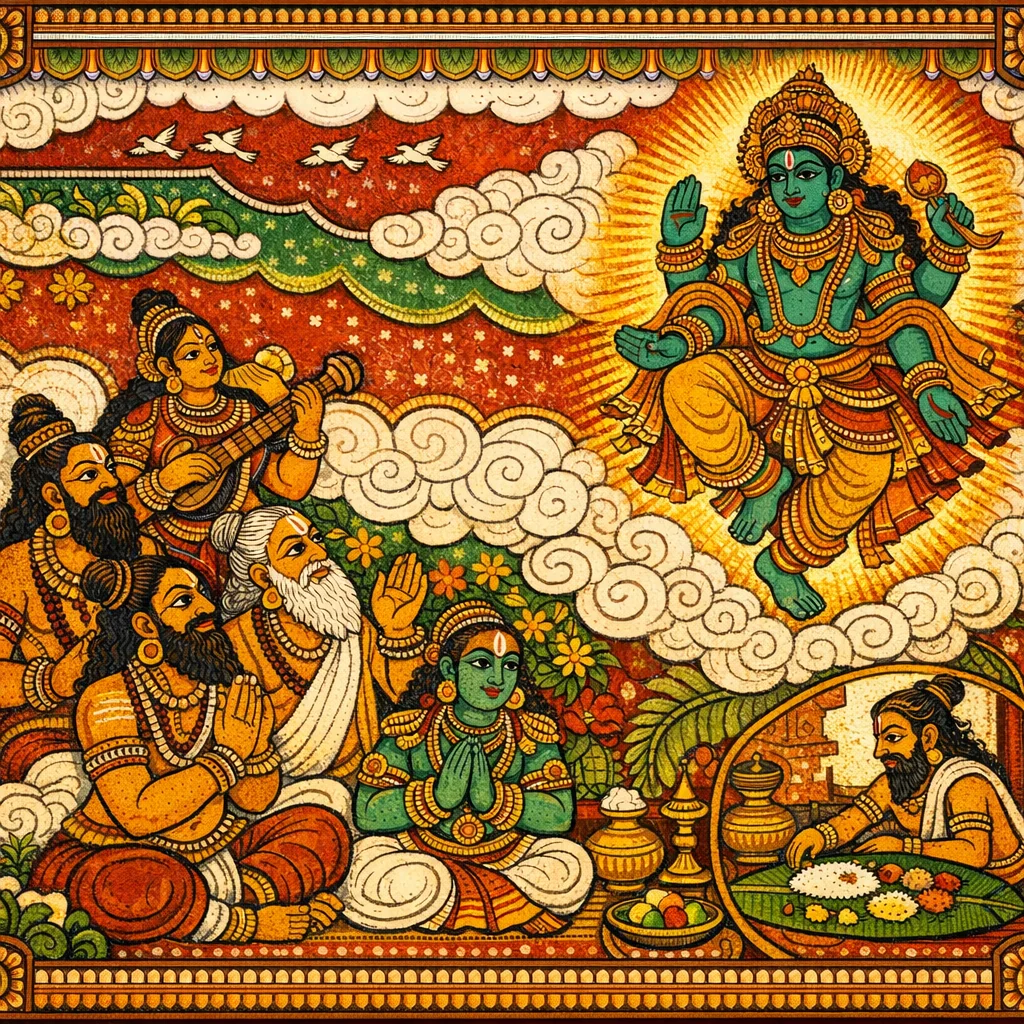
Indra questions Yayāti’s austerity after his renunciation. Yayāti claims no being equals the tapas he has performed by his own effort. Indra replies that Yayāti lacks true discernment—treating better and worse as the same—so his heavenly worlds are finite; when his merit is spent, he must fall. Yayāti accepts the cause and asks to descend among the righteous rather than seek other celestial stations. Indra warns him not to disdain the virtuous, for they are his equals in striving for the highest good. Śaunaka narrates Yayāti’s descent from the Indra-favored world of merit. Aṣṭaka and other righteous witnesses, astonished by Yayāti’s radiance, ask who he is and why he has come, then console him: among the good, fear and delusion fall away, and the virtuous are refuge for the fallen. The chapter ends by declaring the Lord’s immanence in cosmic functions and in the honored guest of the virtuous.
Key Concepts
Shlokas in Adhyaya 37
Verse 1
* इन्द्र उवाच सर्वाणि कार्याणि समाप्य राजन् गृहान्परित्यज्य वनं गतो ऽसि तत्त्वां पृच्छामि नहुषस्य पुत्र केनापि तुल्यस्तपसा ययाते //
Indra said: “O King, having completed all your duties and abandoning your home, you have gone to the forest. I ask you the truth, O son of Nahusha—O Yayāti, by what austerity (tapas) have you become equal to the greatest, unsurpassed by anyone?”
Verse 2
*ययातिरुवाच नाहं देवमनुष्येषु न गन्धर्वमहर्षिषु आत्मनस्तपसा तुल्यं कंचित्पश्यामि वासव //
Yayāti said: “O Vāsava (Indra), among the gods and men, nor among the Gandharvas and great sages, I see no one equal to me in the austerity (tapas) performed by my own self.”
Verse 3
*इन्द्र उवाच यदावमंस्थाः सदृशः श्रेयसश्च पापीयसश् चाविदितप्रभावः तस्माल्लोका ह्य् अन्तवन्तस्तवेमे क्षीणे पुण्ये पतितो ऽस्यद्य राजन् //
Indra said: Since you have judged as equal what is truly better and what is worse, not discerning their real power, therefore these worlds of yours are indeed finite; when your merit was exhausted, you have fallen today, O king.
Verse 4
*ययातिरुवाच सुरर्षिगन्धर्वनरावमानात् क्षयं गता मे यदि शक्रलोकाः इच्छाम्यहं सुरलोकाद्विहीनः सतां मध्ये पतितुं देवराज //
Yayāti said: “If, because I slighted the gods, the seers, the Gandharvas, and men, my stay in Śakra’s heaven has come to an end, then—bereft of the heavenly worlds—I desire, O king of the gods, to fall among the righteous.”
Verse 5
*इन्द्र उवाच सतां सकाशे पतितो ऽसि राजंश् च्युतः प्रतिष्ठां यत्र लब्धासि भूयः एवं विदित्वा तु पुनर्ययाते न ते ऽवमान्याः सदृशः श्रेयसे च //
Indra said: “O King, you have fallen into the presence of the righteous, having slipped from the station you had gained. Knowing this, O Yayāti, do not disdain them; for in seeking the highest good, they are your equals.”
Verse 6
*शौनक उवाच ततः पपातामरराजजुष्टात् पुण्याल्लोकात्पतमानं ययातिम् सम्प्रेक्ष्य राजर्षिवरो ऽष्टकस् तम् उवाच सद्धर्मविधानगोप्ता //
Śaunaka said: Then Yayāti, falling from that meritorious world cherished by Indra, was seen descending; and the royal sage Aṣṭaka—guardian of the ordinances of true dharma—addressed him.
Verse 7
*अष्टक उवाच कस्त्वं युवा वासवतुल्यरूपः स्वतेजसा दीप्यमानो यथाग्निः पतस्युदीर्णाम्बुधरप्रकाशः खे खेचराणां प्रवरो यथार्कः //
Aṣṭaka said: “Who are you, youthful one—of a form like Vāsava (Indra)—blazing with your own radiance like fire, shining with the splendour of a risen rain-cloud, and, in the sky, foremost among those who move through the heavens, like the sun?”
Verse 8
दृष्ट्वा च त्वां सूर्यपथात्पतन्तं वैश्वानरार्कद्युतिमप्रमेयम् किंनुस्विद् एतत् पततीव सर्वे वितर्कयन्तः परिमोहिताः स्मः //
Seeing you falling from the path of the Sun—immeasurable, blazing with the radiance of the Sun and of Vaiśvānara (the cosmic fire)—we all seem to be falling as well, as we debate and conjecture among ourselves, utterly bewildered: “What indeed is this?”
Verse 9
दृष्ट्वा च त्वाधिष्ठितं देवमार्गे शक्रार्कविष्णुप्रतिमप्रभावम् प्रत्युद्गतास्त्वां वयमद्य सर्वे तस्मात्पाते तव जिज्ञासमानाः //
Seeing you stationed upon the divine path, radiant with a splendor comparable to Indra, the Sun, and Viṣṇu, we have all come forth today to meet you. Therefore, O Protector, we seek to inquire of you.
Verse 10
न चापि त्वां धृष्णवः प्रष्टुम् अग्रे न च त्वमस्मान्पृच्छसि के वयं स्म तत्त्वां पृच्छामि स्पृहणीयरूपं कस्य त्वं वा किंनिमित्तं त्वमागाः //
We did not dare to question you at first; nor do you ask us who we are. But now, O one of desirable form, I ask you the truth: whose are you, and for what purpose have you come?
Verse 11
भयं तु ते व्येतु विषादमोहौ त्यजाशु देवेन्द्रसमानरूप त्वां वर्तमानं हि सतां सकाशे शक्रो न सोढुं बलहापि शक्तः //
Let your fear depart; cast off grief and delusion at once, O one whose form is like Indra’s. For while you stand present among the righteous, even Śakra (Indra)—though a slayer of Bala—is not able to endure or oppose you.
Verse 12
सन्तः प्रतिष्ठा हि सुखच्युतानां सतां सदैवामरराजकल्प ते संगताः स्थावरजङ्गमेशाः प्रतिष्ठितस्त्वं सदृशेषु सत्सु //
The virtuous are indeed the firm refuge and support of those who have fallen away from happiness, for the good are ever like the king of the gods. When the lords of the immovable and the moving beings (sthāvara and jaṅgama) enter such noble company, they become established; and you too are established among saints who are your equals in virtue.
Verse 13
प्रभुरग्निः प्रतपने भूमिरावपने प्रभुः प्रभुः सूर्यः प्रकाशाच्च सतां चाभ्यागतः प्रभुः //
The Lord is Agni in the very act of burning; the Lord is the Earth in the act of sowing. The Lord is the Sun in illumination, and the Lord is also the honored guest welcomed by the virtuous.
Frequently Asked Questions
The chapter teaches that pride and faulty discernment (treating what is truly higher and lower as ‘equal’) can exhaust merit and end even heavenly attainments. True stability is found in humility and sat-saṅga—seeking the company of the righteous—where fear and delusion subside and dharma becomes firmly established.
This adhyaya is primarily Dharma/ethics (Rajadharma-adjacent) through the Yayāti exemplar: the finitude of svarga due to puṇya-kṣaya, the danger of avamāna (disdain) toward gods/ṛṣis/gandharvas/men, the protective power of saints, and the theology of the Lord’s presence in cosmic functions and in the honored guest. It does not present Vastu measurements or architectural canons in these verses.