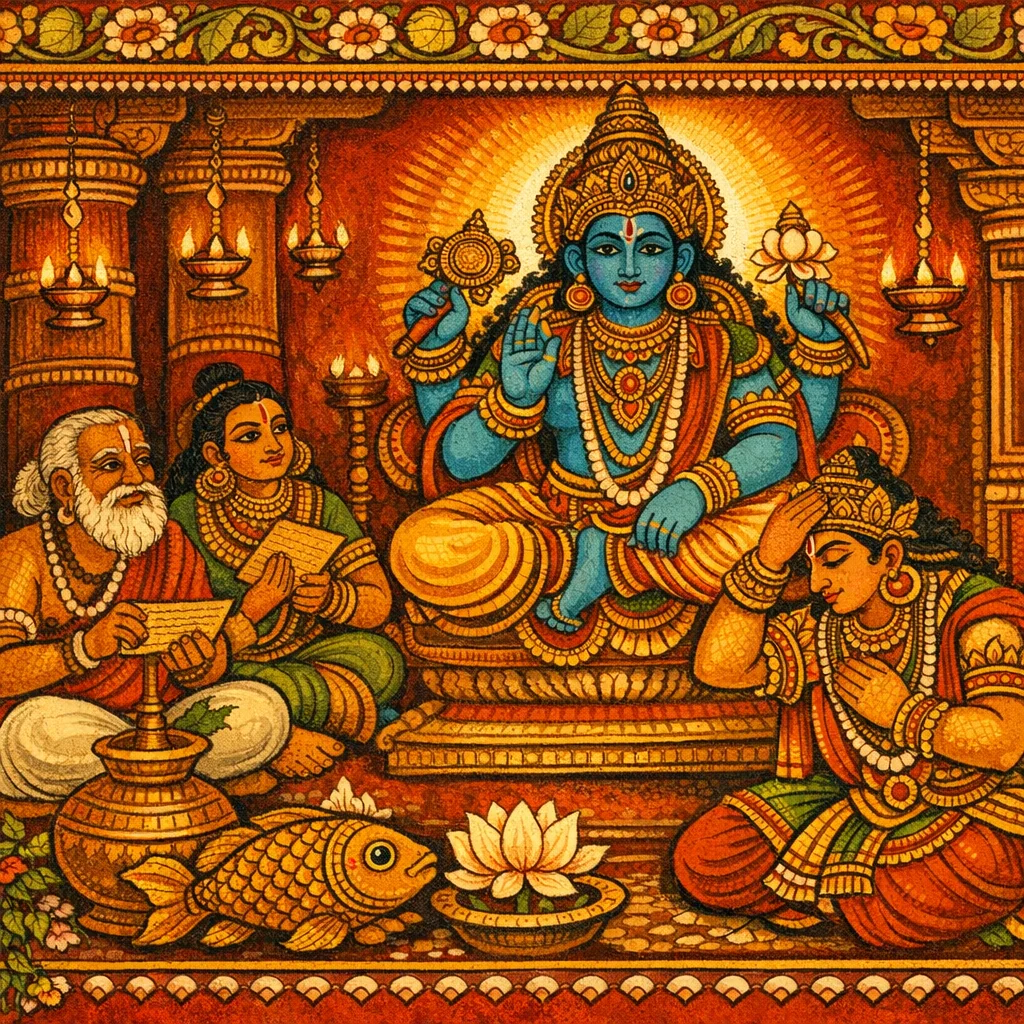
Adhyaya 99: The Rite of the Vibhūti-Dvādaśī Vow (Ekādaśī–Dvādaśī Observance with Nyāsa and Dāna)
विभूतिद्वादशीव्रतविधिः
Speaker: Nandikeśvara, Nārada
Nandikeśvara instructs Nārada on Viṣṇu’s supreme vow called Vibhūti-Dvādaśī. He states the calendrical eligibility (chosen months; beginning on Śukla Daśamī), the preparatory restraints after the evening sandhyā, and the Ekādaśī fast with worship of Janārdana. The votary keeps constant remembrance—uttering “Namo Nārāyaṇāya” even in sleep—rises at dawn for bath and japa, and worships with white offerings. He then teaches limb-by-limb nyāsa and the honorific naming of Viṣṇu’s form and weapons. The rite includes placing a golden fish icon with a golden lotus before a kumbha, preparing jaggery with sesame, and keeping an all-night vigil with sacred narratives. At daybreak the devotee donates the deity-image with golden lotus and water-pot to a householder brāhmaṇa, prays for release from saṃsāra, and extends the practice into monthly icon-dāna (the Daśāvatāra, plus Dattātreya and Vyāsa). The chapter ends with annual completion gifts to the guru and brāhmaṇas, allowances for the poor, and a phalaśruti promising freedom from sin, relief from disease/poverty/bondage, heaven, and rebirth as a king.
Key Concepts
Shlokas in Adhyaya 99
Verse 1
*नन्दिकेश्वर उवाच शृणु नारद वक्ष्यामि विष्णोर्व्रतमनुत्तमम् विभूतिद्वादशी नाम सर्वदेवनमस्कृतम् //
Nandikeśvara said: “Listen, Nārada; I shall tell you of Viṣṇu’s unsurpassed vow—called Vibhūti-Dvādaśī—revered and saluted by all the gods.”
Verse 2
कार्त्तिके चैत्रवैशाखे मार्गशीर्षे च फाल्गुने आषाढे वा दशम्यां तु शुक्लायां लघुभुङ्नरः कृत्वा सायन्तनीं संध्यां गृह्णीयान्नियमं बुधः //
In the months of Kārttika, Caitra, Vaiśākha, Mārgaśīrṣa, Phālguna, or Āṣāḍha—on the bright-fortnight tenth day (Śukla Daśamī)—a man who eats lightly, having performed the evening Sandhyā, should wisely undertake the prescribed niyama, the rule of religious observance.
Verse 3
एकादश्यां निराहारः समभ्यर्च्य जनार्दनम् द्वादश्यां द्विजसंयुक्तः करिष्ये भोजनं विभो //
“On the Ekādaśī day I shall remain without food and duly worship Janārdana; then, on the Dvādaśī day, in the company (and with the sanction) of Brahmins, I shall take my meal, O Lord.”
Verse 4
तदविघ्नेन मे यातु सफलं स्याच्च केशव नमो नारायणायेति वाच्यं च स्वपता निशि //
May that undertaking proceed for me without obstacles and become fruitful in success. O Keśava—even while sleeping at night, one should utter: “Namo Nārāyaṇāya.”
Verse 5
ततः प्रभात उत्थाय कृतस्नानजपः शुचिः पूजयेत्पुण्डरीकाक्षं शुक्लमाल्यानुलेपनैः //
Then, rising at dawn, having bathed and performed japa-recitation, and being purified, one should worship Puṇḍarīkākṣa (Viṣṇu) with white garlands and white fragrant unguents.
Verse 6
विभूतये नमः पादाव् अशोकाय च जानुनी नमः शिवायेत्यूरू च विश्वमूर्ते नमः कटिम् //
Salutation to the Lord as “Vibhūti” upon the feet; salutation to “Aśoka” upon the knees; salutation to “Śiva” upon the thighs; and salutation to “Viśvamūrti” upon the waist.
Verse 7
कन्दर्पाय नमो मेढ्रम् आदित्याय नमः करौ दामोदरायेत्युदरं वासुदेवाय च स्तनौ //
He should perform nyāsa by assigning the homage-mantra: “Namo Kandarpāya” upon the generative organ; “Namo Ādityāya” upon the hands; “(Namo) Dāmodarāya” upon the abdomen; and “Namo Vāsudevāya” upon the chest.
Verse 8
माधवायेत्युरो विष्णोः कण्ठम् उत्कण्ठिने नमः श्रीधराय मुखं केशान् केशवायेति नारद //
[One should touch and consecrate:] Viṣṇu’s chest with the name “Mādhava”; the throat with “Namo Utkaṇṭhine”; the face with “Śrīdhara”; and the hair with “Keśava”—thus, O Nārada.
Verse 9
पृष्ठं शार्ङ्गधरायेति श्रवणौ वरदाय वै स्वनाम्ना शङ्खचक्रासिगदाजलजपाणये शिरः सर्वात्मने ब्रह्मन् नम इत्यभिपूजयेत् //
One should worship by assigning and honoring the divine names: the back with the name “Śārṅgadhara” (Bearer of the Śārṅga bow), and the two ears with “Varada” (Bestower of boons). Then, with one’s own sacred formula, one should adore Him as the One who holds the conch, discus, sword, mace, and lotus; and thus worship the head with the salutation, “O Brahman, obeisance to the All-Self.”
Verse 10
मत्स्यमुत्पलसंयुक्तं हैमं कृत्वा तु शक्तितः उदकुम्भसमायुक्तम् अग्रतः स्थापयेद्बुधः //
According to one’s means, the wise person should make a golden figure of a fish adorned with a lotus, and place it in front together with a water-pot (kumbha).
Verse 11
गुडपात्रं तिलैर्युक्तं सितवस्त्राभिवेष्टितम् रात्रौ जागरणं कुर्याद् इतिहासकथादिना //
One should prepare a vessel of jaggery mixed with sesame seeds, wrap it in a white cloth, and keep a night-long vigil, passing the night with recitations of sacred histories and edifying narratives.
Verse 12
प्रभातायां तु शर्वर्यां ब्राह्मणाय कुटुम्बिने सकाञ्चनोत्पलं देवं सोदकुम्भं निवेदयेत् //
At daybreak, after the night has passed, one should present to a householder brāhmaṇa an image of the deity accompanied by a golden lotus, together with a water-pot (kumbha) filled with water.
Verse 13
यथा न मुच्यसे देव सदा सर्वविभूतिभिः तथा मामुद्धराशेषदुःखसंसारकर्दमात् //
O Lord, just as You are never separated from Your everlasting, all-encompassing divine powers, so too lift me up from the mire of saṃsāra, filled with unending sorrow and suffering.
Verse 14
दशावताररूपाणि प्रतिमासं क्रमान्मुने दत्तात्रेयं तथा व्यासम् उत्पलेन समन्वितम् दद्यादेवं समा यावत् पाषण्डानभिवर्जयेत् //
O sage, one should donate, month by month and in proper sequence, sacred images embodying the Ten Avatāras; likewise one should give images of Dattātreya and of Vyāsa, adorned with a lotus. Thus, throughout the year, by making these gifts one avoids association with heretical paths (pāṣaṇḍa).
Verse 15
समाप्यैवं यथाशक्त्या द्वादश द्वादशीः पुनः संवत्सरान्ते लवणपर्वतेन समन्विताम् शय्यां दद्यान्मुनिश्रेष्ठ गुरवे धेनुसंयुताम् //
Thus, having duly completed the twelve Dvādaśī observances to the best of one’s ability, at the end of the year, O best of sages, one should present to one’s guru a bed furnished with a “mountain of salt” (a heap of salt) and accompanied by a cow.
Verse 16
ग्रामं च शक्तिमान्दद्यात् क्षेत्रं वा भवनान्वितम् गुरुं सम्पूज्य विधिवद् वस्त्रालंकारभूषणैः //
A capable man should give in charity even a village, or a tract of land furnished with a dwelling; and, having duly honoured the guru according to proper rite, he should worship him with garments, ornaments, and jewellery.
Verse 17
अन्यानपि यथाशक्त्या भोजयित्वा द्विजोत्तमान् तर्पयेद् वस्त्रगोदानै रत्नौघधनसंचयैः अल्पवित्तो यथाशक्त्या स्तोकं स्तोकं समाचरेत् //
Having, according to one’s capacity, fed other foremost twice-born (brāhmaṇas) as well, one should satisfy them with gifts—such as garments and cows, or with stores of wealth and heaps of jewels. But a person of limited means should, according to his ability, practice giving little by little.
Verse 18
यश्चाप्यतीव निःस्वः स्याद् भक्तिमान्माधवं प्रति पुष्पार्चनविधानेन स कुर्याद्वत्सरद्वयम् //
Even one who is extremely destitute, if devoted to Mādhava (Viṣṇu), should perform worship by the prescribed method of offering flowers, and continue it for two years.
Verse 19
अनेन विधिना यस्तु विभूतिद्वादशीव्रतम् कुर्यात्पापविनिर्मुक्तः पितॄणां तारयेच्छतम् //
Whoever performs the Vibhūti-Dvādaśī vow according to this prescribed method is freed from sins and delivers a hundred of his forefathers.
Verse 20
जन्मनां शतसाहस्रं न शोकफलभाग्भवेत् न च व्याधिर्भवेत्तस्य न दारिद्र्यं न बन्धनम् वैष्णवो वाथ शैवो वा भवेज्जन्मनि जन्मनि //
For a hundred thousand births, one does not partake of the fruits of sorrow. Nor does disease befall that person—nor poverty, nor bondage. And in birth after birth, one becomes devoted either to Viṣṇu or to Śiva.
Verse 21
यावद्युगसहस्राणां शतमष्टोत्तरं भवेत् तावत्स्वर्गे वसेद्ब्रह्मन् भूपतिश्च पुनर्भवेत् //
O Brahman, for as long as one hundred and eight thousand yugas endure, so long does he dwell in heaven—and then he is born again as a king upon the earth.
Frequently Asked Questions
Adhyāya 99 instructs the full procedure (vidhi) of the Vibhūti-Dvādaśī vow: begin restraints on Śukla Daśamī after evening sandhyā, fast on Ekādaśī while worshipping Janārdana, maintain constant remembrance with “Namo Nārāyaṇāya,” and complete Dvādaśī with brāhmaṇa-sanctioned pāraṇa, night vigil, and prescribed donations. The chapter emphasizes that disciplined devotion (bhakti + niyama + dāna) purifies sin and leads to spiritual uplift.
This chapter is primarily Dharma in the form of vrata-dharma and pūjā-vidhi: fasting rules, nyāsa/mantra practice, vigil (jāgaraṇa), and graded charity (dāna) to brāhmaṇas and guru. It also touches iconography (golden fish with lotus; Daśāvatāra images) and soteriology (release from saṃsāra; pitṛ-tāraṇa). Vāstu and genealogy are not the focus in Adhyāya 99.
The text assigns divine names to bodily locations as part of worship: Vibhūti (feet), Aśoka (knees), Śiva (thighs), Viśvamūrti (waist), Kandarpāya (generative organ), Āditya (hands), Dāmodara (abdomen), Vāsudeva (chest/breasts), Mādhava (Viṣṇu’s chest), Utkaṇṭhin (throat), Śrīdhara (face), Keśava (hair), Śārṅgadhara (back), Varada (ears), and a salutation to the All-Self at the head.
The donation of a golden fish (matsya) adorned with a lotus, placed with a water-pot (kumbha), functions as a symbolic and ritual offering aligned with Viṣṇu’s protective power and the Purāṇa’s Matsya resonance. In the chapter’s ritual logic, such icon-dāna—performed according to one’s means—serves as a meritorious completion act supporting purification, ancestral benefit, and auspicious results.
The chapter states that the performer becomes freed from sins and “delivers a hundred forefathers,” avoids sorrow’s fruits for vast spans of births, and is protected from disease, poverty, and bondage. It further promises long residence in heaven and eventual rebirth as a king, along with enduring devotion to Viṣṇu or Śiva across lifetimes.