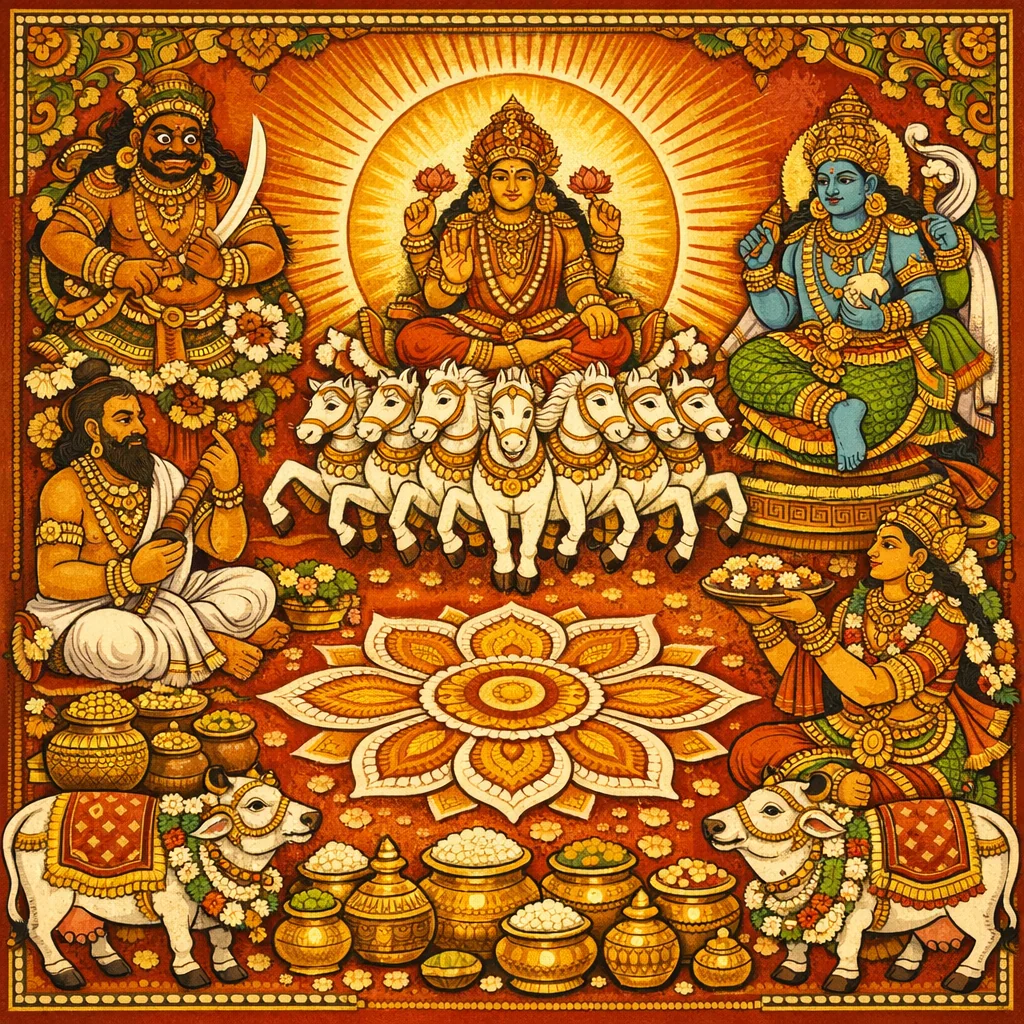
Adhyaya 98: Ravi-Saṅkrānti Vow: Udyāpana (Concluding Rite), Sun-Transit Worship, and Merit
रविसंक्रान्तिव्रतोद्यापनविधिः
Speaker: Nandikeśvara, Nārada
Nandikeśvara addresses Nārada and proclaims the fruits of completing the Ravi-Saṅkrānti observance. He specifies the proper time (ayana/viṣuva and the very moment of the Sun’s transit), the preparatory fasting pattern, and the central worship: draw an eight-petalled lotus with sandal paste, invoke Sūrya, and perform quarter-wise placement and salutations to the solar names, with Viṣṇu installed in the northeast. He then prescribes offerings and concluding gifts—pots, ghee, gold items, cows, and a donation of an earth-model—adding an ethical warning against deceit in dāna. The chapter ends with phala-śruti: honored in heaven by Gandharvas, later attaining sovereignty over the seven continents when karmic residue is exhausted, and gaining merit also by those who recite, hear, or teach this procedure.
Key Concepts
Shlokas in Adhyaya 98
Verse 1
*नन्दिकेश्वर उवाच अथान्यदपि वक्ष्यामि संक्रान्त्युद्यापने फलम् यदक्षयं परे लोके सर्वकामफलप्रदम् //
Nandikeśvara said: “Now I shall also describe the reward of performing the concluding rite (udyāpana) of Saṃkrānti—an imperishable merit in the next world, bestowing the fruits of all desired aims.”
Verse 2
अयने विषुवे वापि संक्रान्तिव्रतमाचरेत् पूर्वेद्युरेकभक्तेन दन्तधावनपूर्वकम् संक्रान्तिवासरे प्रातस् तिलैः स्नानं विधीयते //
On an ayana (solstitial turning) or on a viṣuva (equinox) as well, one should undertake the Saṃkrānti vow. On the previous day, having first cleansed the teeth, one should eat only once; and on the day of Saṃkrānti itself, an early-morning bath with sesame (tila) is prescribed.
Verse 3
रविसंक्रमणे भूमौ चन्दनेनाष्टपत्त्रकम् पद्मं सकर्णिकं कुर्यात् तस्मिन्नावाहयेद्रविम् //
At the time of the Sun’s transit (saṅkramaṇa), one should draw on the ground—using sandal paste—an eight-petalled lotus complete with its central pericarp; and upon that, one should invoke the Sun (Ravi).
Verse 4
कर्णिकायां न्यसेत्सूर्यम् आदित्यं पूर्वतस्ततः नम उष्णार्चिषे याम्ये नमो ऋङ्मण्डलाय च //
In the lotus-centre (karnikā) one should install Sūrya; then, in the eastern direction, place Āditya. In the southern quarter, offer the salutation “Obeisance to Uṣṇārcis,” and also “Obeisance to Ṛṅmaṇḍala.”
Verse 5
नमः सवित्रे नैरृत्ये वारुणे तपनं पुनः वायव्ये तु भगं न्यस्य पुनः पुनरथार्चयेत् //
In the south-west (nairṛta) quarter one should place (perform nyāsa of) “Salutation to Savitṛ”; again, in the Varuṇa quarter, place “Tapana”; and in the north-west (vāyavya) quarter, having placed “Bhaga,” one should worship again and again.
Verse 6
मार्तण्डमुत्तरे विष्णुम् ईशाने विन्यसेत्सदा गन्धमाल्यफलैर्भक्ष्यैः स्थण्डिले पूजयेत्ततः //
One should always place Mārtaṇḍa (the Sun) in the northern direction, and Viṣṇu in the north-east (Īśāna). Thereafter, on a prepared earthen altar (sthaṇḍila), one should worship them with perfumes, garlands, fruits, and edible offerings.
Verse 7
द्विजाय सोदकुम्भं च घृतपात्रं हिरण्मयम् कमलं च यथाशक्त्या कारयित्वा निवेदयेत् //
For a twice-born brāhmaṇa, one should—according to one’s means—have made and then offer a water-filled pot, a vessel of ghee, a golden (hiraṇmaya) receptacle, and a lotus.
Verse 8
चन्दनोदकपुष्पैश्च देवायार्घ्यं न्यसेद्भुवि विश्वाय विश्वरूपाय विश्वधाम्ने स्वयम्भुवे नमो ऽनन्त नमो धात्रे ऋक्सामयजुषां पते //
With sandal-water and flowers, one should place the arghya-offering upon the ground for the Deity—salutations to the All, to the One whose form is the universe, to the abode of the universe, to the Self-born. Salutations to the Infinite; salutations to Dhātṛ, the Sustainer and Creator, the Lord of the Ṛk, Sāma, and Yajus Vedas.
Verse 9
अनेन विधिना सर्वं मासि मासि समाचरेत् वत्सरान्ते ऽथवा कुर्यात् सर्वं द्वादशधा नरः //
By this prescribed method, one should perform the entire observance month after month; or else, at the end of the year, a man may complete it all in a twelvefold manner.
Verse 10
संवत्सरान्ते घृतपायसेन संतर्प्य वह्निं द्विजपुंगवांश्च कुम्भान्पुनर्द्वादश धेनुयुक्तान् सरत्नहैरण्मयपद्मयुक्तान् //
At the end of the year, having satisfied the sacred fire and the foremost of the twice-born with rice-pudding cooked in ghee, one should then give twelve water-pots, each accompanied by a cow, and each furnished with a golden lotus and jewels.
Verse 11
पयस्विनीः शीलवतीश्च दद्याद् धर्मैः शृङ्गैः रौप्यखुरैश्च युक्ताः गावो ऽष्ट वा सप्त सकांस्यदोहा माल्याम्बरा वा चतुरो ऽप्यशक्तः दौर्गत्ययुक्तः कपिलामथैकां निवेदयेद्ब्राह्मणपुंगवाय //
One should gift milk-yielding, well-behaved cows, furnished with (golden) horns and silvered hooves. Let there be eight or seven cows, milked into bronze vessels; or, if one lacks the means, even four—adorned with garlands and cloth. But one afflicted by poverty should present at least a single tawny (kapilā) cow to an eminent Brāhmaṇa.
Verse 12
हैमीं च दद्यात्पृथिवीं सशेषाम् आकार्य रूप्यामथ वा च ताम्रीम् पैष्टीमशक्तः प्रतिमां विधाय सौवर्णसूर्येण समं प्रदद्यात् न वित्तशाठ्यं पुरुषो ऽत्र कुर्यात् कुर्वन्नधो याति न संशयो ऽत्र //
One should give in charity a golden model of the earth complete with its appurtenances; or, having it made, one may give it in silver or else in copper. If unable, having fashioned a figure made of flour, one should give it, equal in rite and intent, together with a golden sun. In this matter a man should not practice deceit with wealth; for one who does so falls to a lower state—of this there is no doubt.
Verse 13
यावन्महेन्द्रप्रमुखैर्नगेन्द्रैः पृथ्वा च सप्ताब्धियुतेह तिष्ठेत् तावत्स गन्धर्वगणैर् अशेषैः सम्पूज्यते नारद नाकपृष्ठे //
So long as this earth—together with the seven oceans—endures, and so long as the great mountains headed by Mahendra remain, for that entire span, O Nārada, he is continually honored in the heavenly realm by all the hosts of Gandharvas.
Verse 14
ततस्तु कर्मक्षयमाप्य सप्तद्वीपाधिपः स्यात्कुलशीलयुक्तः सृष्टेर्मुखे ऽव्यङ्गवपुः सभार्यः प्रभूतपुत्रान्वयवन्दिताङ्घ्रिः //
Then, when the residue of former karmic consequences has been exhausted, he becomes the lord of the seven continents—endowed with noble lineage and good conduct. At the dawn of creation he is born with an unblemished body, together with a wife, and his feet are revered by a great line of descendants and many sons.
Verse 15
इति पठति शृणोति वाथ भक्त्या विधिमखिलं रविसंक्रमस्य पुण्यम् मतिमपि च ददाति सो ऽपि देवैर् अमरपतेर्भवने प्रपूज्यते च //
Thus, whoever with devotion recites or listens to this entire sacred procedure and merit of the Sun’s transit (Ravi-saṅkrānti)—and also imparts it as instruction—he too is honored by the gods and is duly worshipped in the abode of Indra, the lord of the immortals.
Frequently Asked Questions
Adhyāya 98 teaches the correct udyāpana (concluding performance) of the Ravi-Saṅkrānti vrata: observe restraint on the prior day, bathe with sesame on Saṅkrānti morning, worship Sūrya at the exact transit using an eight-petalled lotus maṇḍala, perform directional placements/salutations to Sūrya’s forms (with Viṣṇu in the northeast), and complete the rite through appropriate offerings and truthful charity (dāna) according to one’s means.
This chapter is primarily Dharma in the form of vrata-vidhi and pūjā-vidhi (ritual law and practice). It includes a spatial/architectonic logic akin to Vastu-style directionality through quarter-wise nyāsa on a ground-drawn lotus maṇḍala, but it does not discuss temple dimensions or construction. Genealogy is not a focus; instead, the emphasis is on ritual procedure, ethical dāna, and phala-śruti outcomes (heavenly honor and eventual sovereignty).