Adhyaya 64
Virāṭa’s Conciliation and Uttara’s Account of the Unseen Champion (Bṛhannadā/Arjuna)
Upa-parva: Gograhaṇa (Cattle-Raid) Upa-Parva
Vaiśaṃpāyana describes Uttara entering the court and finding Yudhiṣṭhira (as Dharma-rāja/Kanka) bloodied and seated apart with Sairandhrī nearby. Uttara urgently questions Virāṭa about who struck the blameless man. Virāṭa admits he did so, motivated by irritation that the disguised Yudhiṣṭhira praised a “ṣaṇḍha” (Bṛhannadā) while Uttara was being praised as a hero. Uttara warns that harming such a person can act like a severe ‘brahma-viṣa’ (a metaphor for destructive moral consequence), prompting Virāṭa to seek forgiveness; Yudhiṣṭhira accepts, stressing that if his blood had fallen to the ground it would imperil the king and realm—an articulation of the sacral-political stakes of unjust violence. Bṛhannadā then enters; Virāṭa praises Uttara for the battlefield outcome and asks how he met formidable Kuru leaders (Karna, Bhīṣma, Droṇa, Aśvatthāman, Kṛpa, Duryodhana). Uttara denies personal credit, attributing the victory to a ‘devaputra’-like youth who halted his flight, stood on the chariot, repelled the Kauravas, and seized their garments—describing Arjuna’s concealed prowess without naming him. Virāṭa seeks to honor this champion, but Uttara claims he has vanished and may reappear later. The narrator notes Virāṭa still does not recognize Arjuna living there in disguise. Finally, Arjuna, with Virāṭa’s permission, gives the captured garments to Virāṭa’s daughter Uttarā; he privately consults with Uttara and then with Yudhiṣṭhira on next steps, concluding the episode with orderly planning and controlled secrecy.
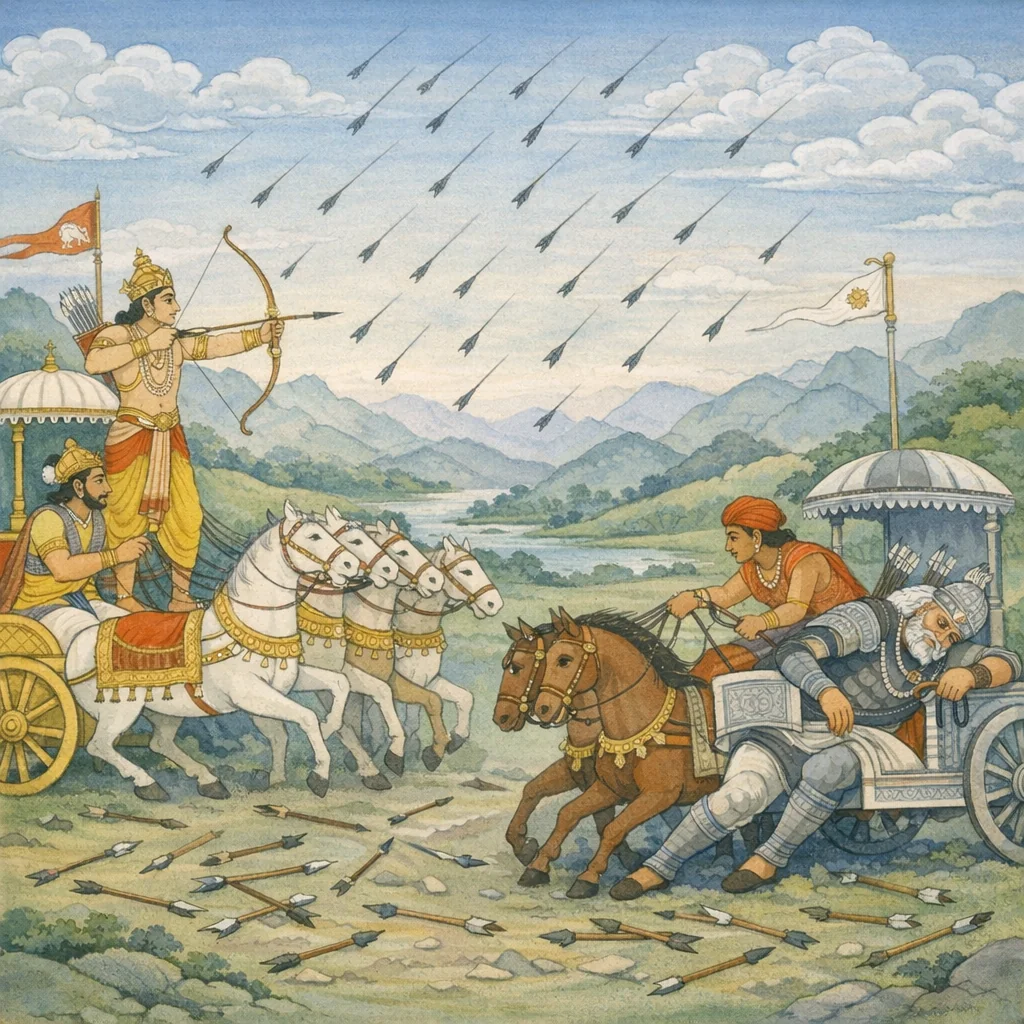
Chapter Arc: वैशम्पायन के वचन से रणभूमि का द्वार खुलता है—शान्तनुनन्दन भीष्म श्वेत छत्र से शोभित, सुवर्ण-परिष्कृत धनुष धारण कर सिंह-गर्जना-सा पराक्रम दिखाते हैं; सामने पाण्डुपुत्र अर्जुन गाण्डीव उठाकर दिव्यास्त्रों की तैयारी करता है। → दोनों महात्मा—भीष्म और अर्जुन—एक-दूसरे पर शरवर्षा करते हुए प्राजापत्य, ऐन्द्र, आग्नेय, रौद्र, वारुण, वायव्य आदि अस्त्रों का प्रयोग करते हैं; कटे हुए बाणों के जाल अर्जुन के रथ पर टूट-टूटकर गिरते हैं और क्षण-क्षण में युद्ध की गति असाधारण हो उठती है। → अर्जुन की गति ऐसी कि ‘कब बाण निकालते, कब चढ़ाते, कब छोड़ते और कब गाण्डीव खींचते’—यह अंतर ही नहीं दिखता; फिर वह भीष्म के वक्षस्थल में दस तीक्ष्ण बाणों से प्रतिवेध करता है, जिससे रणदुर्धर्ष भीष्म आहत होकर रथकूबर पकड़कर दीर्घकाल तक निश्चेष्ट/मूर्च्छित-सा हो जाता है। → भीष्म के सारथि (रथवाजियों का संयन्ता) उपदेश/मर्यादा का स्मरण कर मूर्च्छित भीष्म को रणभूमि से हटाता है—युद्ध का प्रवाह क्षण भर को थमता है और भीष्म की रक्षा प्राथमिक बन जाती है। → भीष्म के हटते ही प्रश्न लटकता है—क्या यह केवल क्षणिक विराम है, या अगले प्रहार में युद्ध की दिशा और नेतृत्व बदल जाएगा?
Shlokas
Verse 1
अप८ा अपर () ऑतज अप चतु:षष्टितमो<5 ध्याय: अर्जुन और भीष्मका अदभुत युद्ध तथा मूर्च्छित भीष्मका सारथिद्वारा रणभूमिसे हटाया जाना वैशम्पायन उवाच तत: शान्तनवो भीष्मो भरतानां पितामह: । वध्यमानेषु योथेषु धनंजयमुपाद्रवत्,वैशम्पायनजी कहते हैं--जनमेजय! तदनन्तर भरतवंशके सुप्रसिद्ध वीर शान्तनुनन्दन पितामह भीष्म अपने पक्षके योद्धाओंका संहार होता देख अर्जुनकी ओर दौड़े इति श्रीमहा भारते विराटपर्वणि गोहरणपर्वणि भीष्मापयाने चतु:षष्टितमो<5ध्याय: ।। ध४ ।। इस प्रकार श्रीमह्याभारत विराटपर्वके अन्तर्गत योहरणपर्वमें भीष्मके रणभूमिसे हटाये जानेसे सम्बन्ध रखनेवाला चौंसठवाँ अध्याय पूरा हुआ ॥/ ६४ ॥। >> () है 2 पजञज्चषष्टितमो< ध्याय: अर्जुन और दुर्योधनका युद्ध, विकर्ण आदि योद्धा ओंसहित दुर्योधनका युद्धके मैदानसे भागना वैशम्पायन उवाच भीष्मे तु संग्रामशिरो विहाय पलायमाने धृतराष्ट्रपुत्र: । उत्सृज्य केतुं विनदन् महात्मा धनुर्विगृह्यार्जनमाससाद
Vaiśampāyana said: Then Bhīṣma, son of Śāntanu and grandsire of the Bharatas, seeing his own warriors being cut down, rushed straight toward Dhanañjaya (Arjuna).
Verse 2
प्रगृह्य कार्मुकश्रेष्ठ जातरूपपरिष्कृतम् । शरानादाय तीक्ष्णाग्रान् मर्मभेदान् प्रमाथिन:,उन्होंने हाथमें सुवर्णभूषित श्रेष्ठ धनुष और शत्रुओंको मथ डालनेवाले तीखे एवं मर्मभेदी बाण ले रखे थे
Having taken up the finest bow, adorned and refined with gold, he also took sharp-pointed arrows—piercing vital spots and capable of crushing the foe.
Verse 3
पाण्डुरेणातपत्रेण प्रियमाणेन मूर्थनि । शुशुभे स नरव्याप्रो गिरि: सूर्योदये यथा,उनके मस्तकपर श्वेत छत्र तना हुआ था, जिससे वे नरश्रेष्ठ भीष्म सूर्योदयकालमें उदयाचलकी भाँति सुशोभित हो रहे थे
Vaiśampāyana said: With a white parasol held aloft above his head, that tiger among men shone splendidly—like a mountain at sunrise.
Verse 4
प्रध्माय शड्खं गाड़ेयो धार्तराष्ट्रान् प्रहर्षपन् । प्रदक्षिणमुपावृत्य बीभत्सुं समवारयत्,गंगानन्दन भीष्मने शंख बजाकर धुृतराष्ट्रपुत्रोंका हर्ष बढ़ाया और दाहिनी ओर मुड़कर अर्जुनको आगे बढ़नेसे रोका
Vaiśampāyana said: Having blown his conch, Bhīṣma—the son of the Gaṅgā—gladdened the sons of Dhṛtarāṣṭra. Then, turning to the right in a formal, auspicious movement, he checked Arjuna (Bībhatsu), restraining him from advancing.
Verse 5
तमुदीक्ष्य समायान्तं कौन्तेय: परवीरहा । प्रत्यगृह्नात् प्रह्षशत्मा धाराधरमिवाचल:,शत्रुवीरोंका हनन करनेवाले कुन्तीकुमार धनंजयने भीष्मको आते देख प्रसन्नचित्त होकर उनका सामना किया; ठीक उसी तरह, जैसे पर्वत अविचलभावसे खड़ा हो जल बरसानेवाले मेघका आघात सहन करता है
Vaiśampāyana said: Seeing Bhīṣma approaching, Arjuna—the son of Kuntī, famed as a slayer of enemy heroes—advanced to meet him with a heart uplifted and steady. He stood firm like an unmoving mountain that endures the impact of a rain-bearing cloud.
Verse 6
ततो भीष्म: शरानष्टौ ध्वजे पार्थस्य वीर्यवान् | समार्पयन्महावेगाउ्छवसमानानिवोरगान्
Vaiśampāyana said: Then the mighty Bhīṣma, directing eight arrows at Pārtha’s banner, hurled them with tremendous force—like swift, powerful serpents.
Verse 7
तब पराक्रमी भीष्मने पार्थकी ध्वजापर फुफकारते हुए सर्पोके समान अत्यन्त वेगशाली आठ बाण मारे ।। ते ध्वजं पाण्डुपुत्रस्य समासाद्य पतत्त्रिण: । ज्वलन्तं कपिमाजलण्नुर्ध्वजाग्रनिलयांश्व॒ तान्,उन बाणोंने पाण्डुनन्दन अर्जुनकी ध्वजाके समीप पहुँचकर वहाँ बैठे हुए तेजस्वी वानरको तथा ध्वजके अग्रभागमें निवास करनेवाले अन्य भूतोंको भी गहरी चोट पहुँचायी
Vaiśaṃpāyana said: Then the mighty Bhīṣma, like a hissing serpent, released eight arrows of tremendous speed at Arjuna’s banner. Those winged shafts struck the banner of the son of Pāṇḍu, wounding the blazing monkey-emblem and also the other beings said to dwell at the banner’s tip.
Verse 8
ततो भल्लेन महता पृथुधारेण पाण्डव: । छत्र॑ चिच्छेद भीष्मस्य तूर्ण तदपतद् भुवि,तब पाण्डुकुमारने मोटी धारवाले विशाल भल्लके द्वारा भीष्मका छत्र काट दिया, जिससे वह तुरंत ही पृथ्वीपर गिर पड़ा
Then the Pāṇḍava, with a great broad-edged arrow, swiftly cut down Bhīṣma’s parasol; it immediately fell to the ground.
Verse 9
ध्वजं चैवास्य कौन्तेय: शरैरभ्यहनद् भृशम् । शीघ्रकृद् रथवाहांश्व॒ तथोभौ पार्ष्णिसारथी,फिर कुन्तीनन्दनने शीघ्रता करते हुए उनकी ध्वजाको भी अपने बाणोंसे छेद डाला और रथके घोड़ों, पार्श्वरक्षकों तथा सारथिको भी बहुत घायल कर दिया
Vaiśampāyana said: Then the son of Kuntī, acting with swift precision, struck down his banner again and again with arrows. In the same rapid assault he grievously wounded the chariot’s horses, the flank-guards, and the charioteer.
Verse 10
अमृष्यमाणस्तद् भीष्मो जानन्नपि स पाण्डवम् | दिव्येनास्त्रेण महता धनंजयमवाकिरत्,भीष्मजी अपने सैनिकोंपर किये गये अर्जुनके उस पराक्रमको सह न सके। वे यह जानते हुए भी कि ये पाण्डुपुत्र धनंजय हैं, महान् दिव्यास्त्रद्वारा उनपर बाणोंकी वर्षा करने लगे
Vaiśampāyana said: Unable to endure that display of prowess, Bhīṣma—though fully aware that the warrior before him was the Pāṇḍava Dhanañjaya—unleashed a great celestial weapon and showered Arjuna with a torrent of arrows.
Verse 11
तथैव पाण्डवो भीष्मे दिव्यमस्त्रमुदीरयन् । प्रत्यगृह्लादमेयात्मा महामेघमिवाचल:,परंतु असीम आत्मबलसे सम्पन्न पाण्डुपुत्र अर्जुन जैसे पर्वत महामेघका सामना करता है, उसी प्रकार भीष्मपर दिव्यास्त्रोंका प्रयोग करते हुए उनका सामना करने लगे
Vaiśampāyana said: In the same manner, the Pāṇḍava (Arjuna), of immeasurable inner strength and unshakable resolve, began to confront Bhīṣma by releasing celestial missiles—like a mountain standing firm against a great storm-cloud.
Verse 12
तयोस्तदभवद् युद्ध तुमुलं लोमहर्षणम् । भीष्मस्य सह पार्थेन बलिवासवयोरिव,उन दोनोंका वह तुमुल युद्ध रोंगटे खड़े कर देनेवाला था। पार्थके साथ भीष्मका वह संग्राम बलि और इन्द्रके युद्धके समान था
Vaiśampāyana said: Then between those two there arose a tumultuous battle that made the hair stand on end. Bhīṣma’s combat with Pārtha was like the legendary clash between Bali and Vāsava (Indra).
Verse 13
प्रैक्षनतत कुरव: सर्वे योधाश्व॒ सहसैनिका: । भल््लैर्भल्ला: समागम्य भीष्मपाण्डवयोर्युधि । अन्तरिक्षे व्यराजन्त खटद्योता: प्रावषीव हि,समस्त कौरव-योद्धा अपने सैनिकोंके साथ खड़े-खडे तमाशा देखने लगे। रणभूमिमें भीष्म और पाण्डुकुमारके भल्ल एक-दूसरेसे टकराकर वर्षाकालके आकाशभमें जुगुनुओंकी भाँति चमक उठते थे
Vaiśampāyana said: Then all the Kurus—warriors standing with their troops—looked on as spectators. In the combat between Bhīṣma and the Pāṇḍava, their sharp arrows met and struck against one another, flashing in the sky like fireflies in the rainy season—showing how war turns even disciplined heroism into a dazzling yet perilous spectacle for onlookers.
Verse 14
अग्निचक्रमिवाविद्धं सव्यदक्षिणमस्यत: । गाण्डीवमभवद् राजन् पार्थस्य सृजत: शरान्,राजन! दाँयें-बाँयें बाण फेंकनेवाले पार्थके द्वारा घुमाया जाता हुआ गाण्डीव धनुष अलातचक्रके समान जान पड़ता था। तदनन्तर जैसे मेघ अपनी जलधाराओंसे पर्वतको भी आच्छादित कर देता है, उसी प्रकार अर्जुनने सैकड़ों पैने बाणोंसे भीष्मको ढँक दिया
Vaiśaṃpāyana said: “O King, as Pārtha loosed arrows to the left and to the right, the Gāṇḍīva bow in his hands looked like a whirling firebrand-circle. With unbroken speed and mastery, Arjuna’s archery poured forth like a storm, overwhelming his foe with a dense cover of shafts.”
Verse 15
ततः संछादयामास भीष्मं शरशतै: शितै: । पर्वतं वारिधाराभिश्छादयन्निव तोयद:,राजन! दाँयें-बाँयें बाण फेंकनेवाले पार्थके द्वारा घुमाया जाता हुआ गाण्डीव धनुष अलातचक्रके समान जान पड़ता था। तदनन्तर जैसे मेघ अपनी जलधाराओंसे पर्वतको भी आच्छादित कर देता है, उसी प्रकार अर्जुनने सैकड़ों पैने बाणोंसे भीष्मको ढँक दिया
Vaiśaṃpāyana said: Then Arjuna covered Bhīṣma with hundreds of sharp arrows—just as a rain-laden cloud veils a mountain with streaming sheets of water. The image underscores the overwhelming force of disciplined martial skill, while also hinting at the tragic ethical tension of war: even the most venerable elder can be struck down when duty and circumstance compel battle.
Verse 16
तां स वेलामिवोदभूतां शरवृष्टिं समुत्थिताम् । व्यधमत् सायकैर्भीष्म: पाण्डवं समवारयत्,जैसे समुद्रमें ज्वार आ गया हो, उसी प्रकार वहाँ प्रकट हुई उस बाणवर्षाको भीष्मने अपने सायकोंसे छिन्न-भिन्न कर दिया और पाण्डुपुत्र अर्जुनको कुण्ठित कर दिया
Vaiśaṃpāyana said: As though a tidal surge had risen in the ocean, that sudden storm of arrows burst forth. Bhīṣma shattered it with his own shafts and checked the Pāṇḍava (Arjuna), blunting his advance in the fight.
Verse 17
ततस्तानि निकृत्तानि शरजालानि भागश: । समरे च व्यशीर्यन्त फाल्गुनस्य रथं प्रति,तदनन्तर रणभूमिमें कटकर टुकड़े-टुकड़े हुए वे बाणसमूह अर्जुनके रथपर बिखरने लगे
Vaiśampāyana said: Thereupon, those volleys of arrows, having been cut down, broke apart into fragments; and on the battlefield they scattered in pieces toward Phālguna’s chariot. The scene underscores Arjuna’s disciplined mastery in war—force restrained by skill—where even deadly weapons are rendered harmless through controlled prowess rather than reckless fury.
Verse 18
तत:ः कनकपुड्खानां शरवृष्टिं समुत्थिताम् । पाण्डवस्य रथात् तूर्ण शलभानामिवायतिम् | व्यधमत् तां पुनस्तस्य भीष्म: शरशतै: शितै:,इसके बाद पुनः पाण्डुपुत्र अर्जुनके रथसे टिड्डियोंके दलकी भाँति तुरंत ही सोनेके पंखवाले बाणोंकी वर्षा प्रारम्भ हुई; किंतु भीष्मने सैकड़ों पैने बाणोंद्वारा उसे फिर शान्त कर दिया
Then, from the Pāṇḍava’s chariot, a swift shower of arrows with golden fletching rose up, spreading like a swarm of locusts. Yet Bhīṣma, with hundreds of keen shafts, again beat down and stilled that oncoming rain of missiles.
Verse 19
ततस्ते कुरव: सर्वे साधु साध्विति चाब्रुवन् । दुष्करं कृतवान् भीष्मो यदर्जुनमयोधयत्,उस समय समस्त कौरव साधुवाद देते हुए बोल उठे--“अहो! भीष्मजीने यह दुष्कर पराक्रम किया, जो कि अर्जुनके साथ युद्ध किया"
Then all those Kurus exclaimed, “Well done! Well done!” They declared that Bhīṣma had accomplished a difficult feat—namely, that he had engaged Arjuna in battle.
Verse 20
बलवांस्तरुणो दक्ष: क्षिप्रकारी धनंजय: । को<न्य: समर्थ: पार्थस्य वेगं धारयितुं रणे
Vaiśampāyana said: “Dhanañjaya (Arjuna) is strong, youthful, and highly capable—one who acts with swift effectiveness. Who else could possibly be able to withstand and hold back the onrush of Pārtha in battle?”
Verse 21
ऋते शान्तनवाद् भीष्मात् कृष्णाद् वा देवकीसुतात् । आचार्यप्रवराद् वापि भारद्वाजान्महाबलात्
Vaiśampāyana said: “Except for Bhīṣma, the son of Śāntanu, or Kṛṣṇa, the son of Devakī—or again, except for that foremost of teachers, the mighty Bhāradvāja—(there was none comparable).”
Verse 22
अर्जुन बलवान, तरुण, कुशल और शीघ्रतापूर्वक बाण चलानेवाले हैं। शान्तनुनन्दन भीष्म, देवकीनन्दन श्रीकृष्ण अथवा आचार्यप्रवर महाबली भरद्वाजनन्दन द्रोणके सिवा दूसरा कौन ऐसा है, जो संग्राममें पार्थका वेग रोक सके? ।। अस्त्रैरस्त्राणि संवार्य क्रीडन्ती भरतर्षभौ । चक्षूंषि सर्वभूतानां मोहयन्तीो महाबलौ,वे दोनों भरतकुलशिरोमणि महाबली वीर समस्त प्राणियोंके नेत्रोंमें मोह एवं आश्चर्य उत्पन्न करते हुए अस्त्रोंद्वारा एक-दूसरेके अस्त्रोंका निवारण करके खेल-सा कर रहे थे
Vaiśampāyana said: Arjuna is mighty, youthful, skilled, and swift in releasing arrows. Who else—apart from Bhīṣma, son of Śāntanu, Devakī’s son Śrī Kṛṣṇa, or the foremost teacher, the great and powerful Droṇa, son of Bharadvāja—could check Pārtha’s onrush in battle? Then those two bull-like heroes of the Bharata line, immensely strong, parried weapon with weapon as if in sport, astonishing and bewildering the eyes of all beings.
Verse 23
प्राजापत्यं तथैवैन्द्रमाग्नेयं रौद्रदारुणम् । कौबेरं वारुणं चैव याम्यं वायव्यमेव च । प्रयुञजजानौ महात्मानौ समरे तौ विचेरतु:,प्राजापत्य, ऐन्द्र, आग्नेय, भयंकर रौद्र, कौबेर, वारुण, याम्य तथा वायव्य अस्त्रोंका प्रयोग करते हुए वे दोनों महापुरुष समरभूमिमें विचर रहे थे
Vaiśampāyana said: Wielding in turn the Prājāpatya, the weapon of Indra, the Agneya, the dread and terrible Raudra, and also the Kaubera, the Vāruṇa, the Yāmya, and the Vāyavya missiles, those two great-souled warriors ranged across the battlefield. The scene shows how martial power, when loosed without restraint, becomes a force of dread—hinting that righteousness in war lies not merely in might, but in disciplined strength guided by dharma.
Verse 24
विस्मितान्यथ भूतानि तौ दृष्टवा संयुगे तदा । साधु पार्थ महाबाहो साधु भीष्मेति चाब्रुवन्,उस समय युद्धमें उन दोनोंकी ओर देखकर सब प्राणी आश्वर्यचकित हो बोल उठते थे --“महाबाहु पार्थ! साधुवाद, महाबाहु भीष्म! साधुवाद
Vaiśaṃpāyana said: Then, seeing those two in the thick of battle, all beings were struck with wonder and cried out in acclaim—“Well done, mighty-armed Pārtha! Well done, mighty-armed Bhīṣma!” The verse shows how extraordinary valor, displayed openly in war, draws spontaneous recognition, even as it reminds us of the grave, morally charged arena in which such excellence is revealed.
Verse 25
नायं युक्तो मनुष्येषु यो5यं संदृश्यते महान् । महास्त्राणां सम्प्रयोग: समरे भीष्मपार्थयो:,'भीष्म और पार्थके युद्धमें जो यह बड़े-बड़े दिव्यास्त्रोंका महान् प्रयोग देखा जा रहा है, यह मजनुष्योंमें अन्यत्र कहीं सम्भव नहीं है”
Vaiśampāyana said: “This mighty spectacle that is being witnessed is not something possible among ordinary men. In the battle between Bhīṣma and Pārtha, the tremendous deployment of great celestial weapons is taking place—an occurrence scarcely conceivable elsewhere in the human world.”
Verse 26
वैशम्पायन उवाच एवं सर्वास्त्रिविदुषोरस्त्रयुद्धमवर्तत । अस्त्रयुद्धे तु निर्वत्ते शरयुद्धमवर्तत,वैशम्पायनजी कहते हैं--जनमेजय! इस प्रकार सम्पूर्ण अस्त्रोंके ज्ञाता भीष्म और अर्जुनमें कुछ कालतक दिव्यास्त्रोंका युद्ध चलता रहा। उसके समाप्त हो जानेपर पुनः बाणयुद्ध प्रारम्भ हुआ
Vaiśampāyana said: “O Janamejaya, thus for some time a contest of divine weapons unfolded between Bhīṣma and Arjuna, both masters of every missile and counter-missile. When that exchange of weaponry came to its close, the battle resumed again as a direct duel of arrows.”
Verse 27
अथ जिष्णुरुपावृत्य क्षुरधारेण कार्मुकम् । चकर्त भीष्मस्य तदा जातरूपपरिष्कृतम्,तदनन्तर विजयशील अर्जुनने निकट आकर छुरेके समान धारवाले एक बाणसे भीष्मके सुवर्णभूषित धनुषको काट डाला
Vaiśampāyana said: Then Arjuna (Jishnu), drawing near and resetting his stance, with a razor-edged arrow cut down Bhīṣma’s bow, which at that time was adorned and refined with gold. The episode underscores the disciplined precision of a dharma-guided warrior: strength is shown not by cruelty, but by decisive skill that neutralizes an opponent’s power without needless excess.
Verse 28
निमेषान्तरमात्रेण भीष्मो<न्यत् कार्मुकं रणे । समादाय महाबाहु: सज्यं चक्रे महारथ: । शरांश्व सुबहून् क्रुद्धो मुमोचाशु धनंजये,किंतु विशाल भुजाओंवाले महारथी भीष्मने पलक मारते-मारते उस युद्धमें दूसरा धनुष ले उसपर प्रत्यंचा चढ़ा दी और क्रोधमें भरकर धनंजयपर बहुत-से बाणोंका प्रहार किया
Vaiśampāyana said: In no more than the space of a blink, Bhīṣma—mighty-armed and a great charioteer—took up another bow in the battle and strung it. Then, inflamed with wrath, he swiftly released many arrows at Dhanañjaya (Arjuna).
Verse 29
अर्जुनो5पि शरांस्तीक्ष्णान् भीष्माय निशितान् बहून् । चिक्षेप सुमहातेजास्तथा भीष्मश्न पाण्डवे,तब महातेजस्वी अर्जुनने भी भीष्मपर बहुत-से पैने बाण फेंके और भीष्मने भी पाण्डुपुत्रको अनेक तीखे बाण मारे
Vaiśampāyana said: Arjuna too, blazing with great energy, hurled many sharp, well-whetted arrows at Bhīṣma; and Bhīṣma likewise struck the son of Pāṇḍu with numerous keen shafts.
Verse 30
तयोर्दिव्यास्त्रविदुषोरस्यतोर्निशिताउछरान् । न विशेषस्तदा राजॉल्लक्ष्यते सम महात्मनो:,राजन! वे दोनों महात्मा दिव्यास्त्रोंके पण्डित थे और एक-दूसरेपर पैने बाण फेंक रहे थे। उस समय उन दोनोंमें कोई अन्तर नहीं दिखायी देता था
Vaiśampāyana said: Both of those great-souled warriors were masters of celestial weapons, and they kept hurling sharp arrows at one another. At that moment, O King, no distinction could be perceived between the two—so evenly matched were they in prowess and spirit.
Verse 31
अथावृणोद् दश दिश: शरैरतिरथस्तदा । किरीटमाली कौन्तेय: शूर: शान्तनवस्तथा,किरीटमाली कुन्तीकुमार अर्जुन और शान्तनुनन्दन भीष्म दोनों ही अतिरथी वीर थे। उन्होंने अपने बाणोंसे दसों दिशाओंको आच्छादित कर दिया
Then, at that moment, the great chariot-warrior covered the ten directions with a shower of arrows. The diademed son of Kuntī—Arjuna—and the heroic descendant of Śāntanu (Bhīṣma) were both foremost fighters, their prowess filling the battlefield on every side.
Verse 32
अतीव पाण्डवो भीष्म भीष्मश्नातीव पाण्डवम् | बभूव तस्मिन् संग्रामे राजंललोके तदद््भुतम्,राजा जनमेजय! उस युद्धमें कभी पाण्डुपुत्र अर्जुन भीष्मसे बढ़ जाते थे, तो कभी भीष्म ही अर्जुनको लाँघ जाते थे। जगत्में यह एक अद्भुत बात थी
Vaiśampāyana said: In that battle, O King Janamejaya, it was a marvel spoken of in the world—at times the Pāṇḍava (Arjuna) would surpass Bhīṣma, and at other times Bhīṣma would surpass the Pāṇḍava. Thus the encounter displayed an extraordinary balance of prowess and resolve, where neither excellence was absolute and each was tested by the other.
Verse 33
पाण्डवेन हता: शूरा भीष्मस्य रथरक्षिण: । शेरते सम तदा राजन् कौन्तेयस्याभितो रथम्,राजन! भीष्मके रथकी रक्षा करनेवाले शूरवीर सैनिक अर्जुनके द्वारा मारे जाकर उनके रथके दोनों ओर पड़े थे
Vaiśampāyana said: O King, the valiant warriors who served as Bhīṣma’s chariot-guards were slain by the Pāṇḍava (Arjuna). At that time they lay strewn all around the chariot of Kuntī’s son—an image of how martial duty and loyalty, when bound to a doomed cause, meet their end before superior skill and resolve in battle.
Verse 34
ततो गाण्डीवनिर्मुक्ता निरमित्रं चिकीर्षव: । आगच्छन् पुड्खसंश्लिष्टा: श्वेतवाहनपत्रिण:,तदनन्तर श्वेतवाहन अर्जुनके पंखधारी बाण गाण्डीव धनुषसे छूटकर संसारको शत्रुरहित करनेकी इच्छासे सब ओर आने लगे
Then the arrows released from the Gāṇḍīva—feathered shafts fitted with well-joined fletching—came flying forth, as if intent on making the world free of enemies, shot by Arjuna of the white chariot. The narration emphasizes the irresistible momentum of martial skill directed toward the removal of hostile forces.
Verse 35
निष्पतन्तो रथात् तस्य धौता हैरण्यवासस: । आकाशे समदृश्यन्त हंसानामिवपड्धक्तय:,उनके रथसे निकलते हुए सुनहरे पंखवाले श्वेत बाण आकाशमें हंसोंकी पंक्ति-से दिखायी देते थे
Vaiśampāyana said: As those arrows shot from his chariot flew forth—bright, gleaming, and as if clad in golden sheen—they appeared in the sky like orderly rows of swans. The image underscores the awe-inspiring skill and controlled force of the warrior: even in violence, the action is portrayed with discipline and precision rather than chaos.
Verse 36
तस्य तद् दिव्यमस्त्रं हि विगाढं चित्रमस्यत: । प्रेक्षन्ते स्मान्तरिक्षस्था: सर्वे देवा: सवासवा:,अर्जुन विचित्र ढंगसे मर्मभेदी दिव्यास्त्रोंका प्रयोग कर रहे थे और आकाशमें खड़े हुए इन्द्र आदि सम्पूर्ण देवता उनका वह अस्त्रकौशल देख रहे थे
As he discharged that wondrous, deeply penetrating divine weapon, all the gods—stationed in the sky, with Indra among them—looked on, witnessing the mastery of celestial arms. The scene underscores that power, when wielded with disciplined skill and rightful purpose, becomes an object of divine scrutiny rather than mere spectacle.
Verse 37
त॑ दृष्टवा परमप्रीतो गन्धर्वश्षित्रमद्भुतम् । शशंस देवराजाय चित्रसेन: प्रतापवान्
Seeing that wondrous and extraordinary spectacle, the Gandharva Citrāsena was filled with great delight. The mighty one then reported it to the king of the gods, Indra—presenting what he had witnessed as something worthy of divine notice.
Verse 38
उस समय प्रतापी चित्रसेन गन्धर्वने अर्जुनकी ओर देखकर अत्यन्त प्रसन्न हो देवराज इन्द्रसे उनके विचित्र एवं अद्भुत रणकौशलकी प्रशंसा करते हुए कहा-- ।। पश्येमान् पार्थनिर्मुक्तान् संसक्तानिव गच्छत: । चित्ररूपमिदं जिष्णोर्दिव्यमस्त्रमुदीर्यत:,'प्रभो! देखिये, ये पार्थके छोड़े हुए बाण परस्पर सटे हुए-से जा रहे हैं। दिव्यास्त्र प्रकट करनेवाले अर्जुनकी यह अस्त्र-संचालनकला विचित्र एवं अद्भुत है
Vaiśampāyana said: “O Lord, behold! The arrows released by Pārtha (Arjuna) seem to travel as though joined together, tightly contiguous. This is a wondrous and astonishing display of skill in weapon-handling by Jiṣṇu (Arjuna) as he brings forth a divine missile.” Thus the valiant Gandharva Citrasena, delighted at the sight, praised Arjuna’s extraordinary martial mastery before Indra.
Verse 39
नेदं मनुष्या: संदध्युर्न हीदं तेषु विद्यते । पौराणानां महास्त्राणां विचित्रो5यं समागम:,“दूसरे मनुष्य इस दिव्यास्त्रका संधान नहीं कर सकते; क्योंकि यह अस्त्र दूसरे मनुष्योंके पास है ही नहीं। यहाँ प्राचीनकालके बड़े-बड़े अस्त्रोंका यह अद्भुत समागम हुआ है
“Other men could not set and discharge this divine weapon, for such a missile is not found in their possession. Here, indeed, is a wondrous convergence of the great weapons of ancient times.”
Verse 40
आददानस्य हि शरान् संधाय च विमुड्चत: । विकर्षतश्न गाण्डीवं नानतरं समदृश्यत,“अर्जुन कब बाण निकालते हैं, कब चढ़ाते हैं, कब छोड़ते हैं और कब गाण्डीव धनुषको खींचते हैं तथा इन क्रियाओंमें कितना अन्तर पड़ता है; यह सब किसीको दिखायी ही नहीं देता था
Vaiśampāyana said: As Arjuna took up his arrows, set them to the bow, released them, and drew back the Gāṇḍīva, no interval between these actions could be perceived.
Verse 41
मध्यंदिनगतं सूर्य प्रतपन्तमिवाम्बरे । नाशवनुवन्त सैन्यानि पाण्डवं प्रति वीक्षितुम्,“आकाशमें दोपहरके समय प्रचण्ड किरणोंसे तपते हुए सूर्यकी ओर जैसे कोई देख नहीं सकता, उसी प्रकार प्रतापी पाण्डुपुत्रकी ओर कौरव-सैनिक आँख उठाकर देखनेमें भी असमर्थ हो गये हैं
“As no one can look up at the midday sun blazing in the sky with fierce rays, so the Kaurava soldiers became unable even to raise their eyes to gaze upon the mighty son of Pāṇḍu.”
Verse 42
तथैव भीष्म गाड़ेयं द्रष्टं नोत्सहते जन:,“इसी प्रकार गंगानन्दन भीष्मकी ओर भी कोई मनुष्य देखनेका साहस नहीं करता है
“In the same way, no one among the people dares even to look upon Bhīṣma, the son of the Gaṅgā.”
Verse 43
उभौ विश्लुतकर्माणावुभौ तीव्रपराक्रमौ । उभौ सदृशकर्माणावुभौ युधि सुददुर्जयौ,“दोनों वीर अपने अदभुत कार्योके लिये संसारमें प्रसिद्ध हैं। दोनोंके पराक्रम उग्र हैं। दोनों एक-सा पराक्रम दिखानेवाले तथा युद्धमें अत्यन्त दुर्जय हैं!
Vaiśampāyana said: Both of them are renowned in the world for their extraordinary deeds; both possess fierce valor. Alike in action and prowess, they are exceedingly hard to overcome in battle—an even match whose encounter tests the limits of martial dharma.
Verse 44
इत्युक्तो देवराजस्तु पार्थभीष्मसमागमम् | पूजयामास दिव्येन पुष्पवर्षेण भारत,जनमेजय! चित्रसेनके ऐसा कहनेपर देवराज इन्द्रने दिव्य पुष्पोंकी वर्षा करके अर्जुन और भीष्मके इस अदभुत संग्रामके प्रति आदर प्रकट किया
Vaiśampāyana said: Thus addressed, the king of the gods, Indra, honored that encounter between Pārtha (Arjuna) and Bhīṣma by showering divine flowers—signifying reverence for extraordinary valor and the solemn, dharma-laden gravity of their combat.
Verse 45
ततः: शान्तनवो भीष्मो वाम॑ पार्श्रमताडयत् । पश्यत: प्रतिसंधाय विध्यत: सव्यसाचिन:,तदनन्तर शान्तनुनन्दन भीष्मने (कौरवसेनाको) घायल करनेवाले सव्यसाची अर्जुनके देखते-देखते बाणसंधान करके उनका बायाँ पार्श्व बींध डाला
Vaiśampāyana said: Then Bhīṣma, the son of Śāntanu, struck Arjuna on his left side—before Arjuna’s very eyes—having carefully fixed his aim and shooting with precision. The episode underscores the grim ethics of battle: even the greatest warriors, bound by their chosen allegiance and kṣatriya-duty, employ consummate skill to wound a worthy opponent without hesitation.
Verse 46
ततः प्रहस्य बीभत्सु: पृथुधारेण कार्मुकम् । चिच्छेद गार्ध्रपत्रेण भीष्मस्यादित्यतेजस:,तब अर्जुनने भी हँसकर मोटी धार एवं गीधकी पाँखवाले बाणसे सूर्यके समान तेजस्वी भीष्मका धनुष फिर काट दिया
Then Arjuna (Bībhatsu), smiling, severed Bhīṣma’s bow—radiant like the sun—using a broad-edged arrow feathered with vulture-plumes. The moment underscores disciplined prowess in battle: Arjuna disables the opponent’s weapon rather than merely seeking a reckless kill, showing controlled force within the demands of warfare.
Verse 47
अथैनं दशभिर्बाणै: प्रत्यविध्यत् स्तनान्तरे । यतमानं पराक्रान्तं कुन्तीपुत्रो धनंजय:,तत्पश्चात् कुन्तीपुत्र धनंजयने विजयके लिये प्रयत्नशील पराक्रमी भीष्मकी छातीमें दस बाण मारकर गहरी चोट पहुँचायी
Vaiśampāyana said: Then Kuntī’s son Dhanañjaya (Arjuna) struck him in the space between the breasts with ten arrows, piercing him as he strove with great valor. The scene underscores the stern ethics of battle: even the most heroic effort meets its consequence when confronted by superior skill and resolve in war.
Verse 48
न 2 ५9 ( १) स पीडितो महाबाहुर्गृहीत्वा रथकूबरम् । गाड़ेयो युद्धदुर्धर्षस्तस्थौ दीर्घमिवान्तरम्
Though hard-pressed, the mighty-armed hero seized the chariot’s pole; firmly set and unassailable in battle, he held his ground—standing as if for a long stretch of time.
Verse 49
उससे पीड़ित हो रणदुर्धर्ष वीर महाबाहु भीष्म रथका कूबर पकड़कर बहुत देरतक निश्वेष्ट बैठे रह गये ।। त॑ विसंज्ञमपोवाह संयन्ता रथवाजिनाम् | उपदेशमनुस्मृत्य रक्षमाणो महारथम्,वे बेहोश थे। "ऐसी दशामें सारथिको रथीकी रक्षा करनी चाहिये" इस उपदेशका स्मरण करके महारथी भीष्मकी प्राणरक्षाके उद्देश्य्से उनके रथ और घोड़ोंको काबूमें रखनेवाला सारथि उन्हें संग्रामभूमिसे दूर हटा ले गया
Vaiśampāyana said: Remembering the instruction that, in such a crisis, the charioteer must protect the warrior, the driver—master of the chariot-horses—carried Bhīṣma away when he had fallen unconscious, restraining the horses and safeguarding that great chariot-warrior.
Frequently Asked Questions
A ruler’s impulsive violence against a seemingly low-status figure is weighed against dharma: the chapter frames unjust harm to the blameless as politically and ethically catastrophic, requiring immediate repair through apology and conciliation.
Power must be governed by discernment: praise, insult, and status markers can mislead; therefore a king should practice restraint, verify causes, and prioritize restitution when wrongdoing occurs, since governance depends on moral credibility.
No explicit phalaśruti appears; the meta-level lesson is conveyed narratively through consequences and warnings—ethical violation is depicted as self-destructive for ruler and realm, while controlled secrecy preserves higher dharmic commitments.