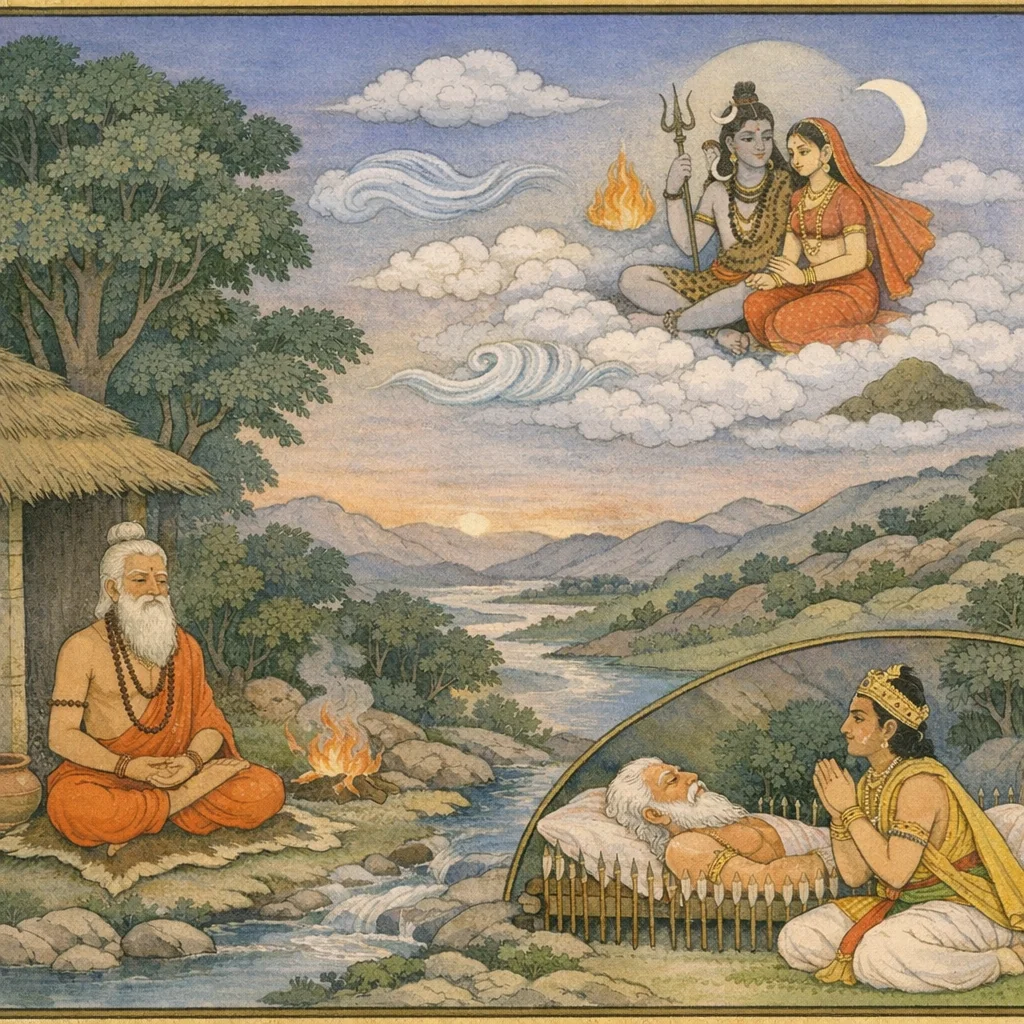
Adhyaya 323
अध्याय ३२३ — श्वेतद्वीपगमनम्, यज्ञभाग-विवादः, एकान्तिभक्त्या नारायणदर्शन-नियमः (Śvetadvīpa Journey; Dispute over Sacrificial Share; Rule of Nārāyaṇa-vision through Single-minded Devotion)
Upa-parva: Mokṣa-dharma (Liberation Teachings) — Śvetadvīpa / Nārāyaṇa-darśana Exemplum
Bhīṣma recounts an ancient cycle in which Bṛhaspati is born as the devas’ purohita and becomes renowned by epithets such as Bṛhadbrahma/Mahat. His foremost student is King Uparicara Vasu, who rules in an Indra-like manner and performs a great aśvamedha with Bṛhaspati as officiant. Numerous sages attend, and the rite is depicted as regulated and non-violent in orientation. Pleased, the ancient Devadeva appears only to Vasu and, invisibly, takes the sacrificial portion (puroḍāśa). Bṛhaspati reacts with anger, asserting priestly expectation of direct divine appearance; Vasu and the assembled sages pacify him, stating that the deity is not compelled by anger and is seen only by one who receives divine favor. Ekata, Dvita, and Trita then narrate their own quest: after severe tapas near Meru and the Kṣīroda, a bodiless voice directs them to Śvetadvīpa, where Nārāyaṇa’s exclusive devotees dwell—radiant, restrained, inwardly concentrated, and engaged in mental japa. The sages initially fail to perceive the deity, learning that insufficiently ripened tapas cannot yield darśana. After further discipline, they witness the luminous devotees offering bali with reverent acclamation, yet remain unable to see Nārāyaṇa due to māyā and lack of ekānta-bhakti. A bodiless instruction dismisses them: the deity is not seen by the non-devoted, though in time and with single-mindedness he may be approached; they are destined to assist the devas in a later age (Tretā). The chapter closes with Bṛhaspati reconciled and the ritual completed; Vasu later falls from heaven due to a brahma-śāpa, enters the earth, remains devoted to Nārāyaṇa, and by grace attains a higher station near Brahmā—an exemplum linking devotion, restraint, and final ascent.
Chapter Arc: युधिष्ठिर भीष्म से जिज्ञासा करते हैं—व्यास के यहाँ महातपस्वी, धर्मात्मा शुकदेव का जन्म कैसे हुआ और उन्होंने परम सिद्धि कैसे पाई; साथ ही यह भी कि उनकी माता कौन थीं और बाल्यावस्था में ही उनकी सूक्ष्म-ज्ञानमयी बुद्धि कैसे अद्वितीय बनी। → भीष्म उत्तर का सूत्र पकड़ते हैं और बताते हैं कि यह वृत्तान्त उन्हें स्वयं भगवान् मार्कण्डेय ने सुनाया था, जो देव-चरितों के कथन में नित्य प्रवृत्त रहते थे; कथा का अधिकार-प्रमाण (परम्परा) स्थापित होते ही व्यास की तपस्या, जटाओं की अग्नि-सदृश दीप्ति और महेश्वर की प्रसन्नता का प्रसंग उभरता है। → महेश्वर का वरदान—व्यास के पुत्र का स्वरूप पंचमहाभूतों (अग्नि, वायु, पृथ्वी, जल, आकाश) की तरह शुद्ध होगा; वह भगवद्भाव में रँगा, भगवान् में ही बुद्धि-आत्मा-आश्रय रखने वाला होगा और तेज से तीनों लोकों को व्याप्त कर यश प्राप्त करेगा—यही शुकदेव के अद्वितीय जन्म-गुण और सिद्धि का निर्णायक उद्घोष बनता है। → भीष्म शुकदेव के माहात्म्य, आत्मयोग और विज्ञान को ‘यथार्थ रीति से क्रमशः’ कहने की प्रतिज्ञा/भूमिका बाँधते हैं और व्यास-तपस्या तथा ईश्वर-कृपा से शुक के प्राकट्य का कारण-तत्त्व स्पष्ट करते हैं। → शुकदेव की माता/उत्पत्ति-विधि और बालक शुक के सूक्ष्मज्ञान-प्राप्ति का विस्तृत क्रम आगे के अध्यायों में विस्तार से खुलने का संकेत।
Shlokas
Verse 1
युधिष्ठिरने कहा--पितामह! व्यासजीके यहाँ महातपस्वी और धर्मात्मा शुकदेवजीका जन्म कैसे हुआ? तथा उन्होंने परम सिद्धि कैसे प्राप्त की? यह मुझे बताइये
Yudhiṣṭhira said: “Grandfather, how was the great ascetic and righteous Śukadeva born in the household of Vyāsa? And how did he attain the highest spiritual perfection? Please tell me this.”
Verse 2
कस्यां चोत्पादयामास शुकं व्यासस्तपोधन: । न हास्य जननीं विद्य जन्म चाग्र्यं महात्मन:,तपस्याके धनी व्यासजीने किस स्त्रीके गर्भसे शुकदेवजीको उत्पन्न किया? हमें उन महात्मा शुकदेवजीकी माताका नाम नहीं मालूम है और हम उनके श्रेष्ठ जन्मका वृत्तान्त भी नहीं जानते हैं
From which woman’s womb did Vyāsa, rich in ascetic power, bring forth Śuka? We do not know the name of that great soul’s mother, nor do we know the account of his noble birth.
Verse 3
कथं च बालस्य सतः: सूक्ष्मज्ञाने गता मतिः । यथा नान्यस्य लोके5स्मिन् द्वितीयस्येह कस्यचित्,शुकदेवजी अभी बालक थे तो भी सूक्ष्मज्ञानमें उनकी बुद्धि कैसे लगी? इस संसारमें उनके सिवा दूसरे किसीकी ऐसी बुद्धि नहीं देखी गयी
Yudhiṣṭhira said: “How did the mind of Śuka—though still a mere boy—come to rest in subtle, penetrating knowledge? In this world I have not seen anyone else, a second person, with such an intellect.”
Verse 4
एतदिच्छाम्यहं श्रोतुं विस्तरेण महामते । न हि मे तृप्तिरस्तीह शृण्वतो$मृतमुत्तमम्,महामते! मैं इस प्रसंगको विस्तारपूर्वक सुनना चाहता हूँ। आपका यह अमृतके समान उत्तम एवं मधुर प्रवचन सुनते हुए मुझे तृप्ति नहीं हो रही है
Yudhiṣṭhira said: “This is what I wish to hear in full detail, O great-minded one. For as I listen here to your supreme, nectar-like discourse, I find no satiety at all.”
Verse 5
माहात्म्यमात्मयोगं च विज्ञानं च शुकस्य ह । यथावदानुपूर्व्येण तन्मे ब्रूहि पितामह
Yudhiṣṭhira said: “O Grandfather, tell me—correctly and in due sequence—the greatness, the discipline of self-realization, and the true knowledge associated with Śuka.”
Verse 6
पितामह! आप मुझे शुकदेवजीका माहात्म्य, आत्मयोग और विज्ञान यथार्थ रीतिसे क्रमश: बताइये ।। भीष्म उवाच न हायनैर्न पलितैर्न वित्तैर्न च बन्धुभि: । ऋषयश्षक्रिरे धर्म योडनूचान: स नो महान्,भीष्मजीने कहा--राजन्! कोई अधिक वर्षोकी अवस्था हो जानेसे, बाल पक जानेसे, अधिक धन होनेसे तथा भाई-बन्धुओंकी संख्या बढ़ जानेसे भी बड़ा नहीं होता। ऋषियोंने यह नियम बनाया है कि हमलोगोंमेंसे जो वेदोंका प्रवचन कर सकेगा, वही महान् माना जायगा
Bhishma said: “A person does not become ‘great’ merely by advanced age, by grey hair, by wealth, or by the strength of relatives and allies. The sages established this rule of dharma among us: whoever is truly learned—able to recite and teach the Veda—he alone is to be regarded as great.”
Verse 7
तपोमूलमिदं सर्व यन्मां पृच्छसि पाण्डव । तदिन्द्रियाणि संयम्य तपो भवति नान्यथा,पाण्डुनन्दन! तुम मुझसे जिसके विषयमें पूछ रहे हो, उस सबकी जड़ तपस्या है। इन्द्रियोंका संयम करनेसे ही तपस्याकी सिद्धि होती है, अन्यथा नहीं
Bhīṣma said: “O Pāṇḍava, everything you are asking me about has austerity (tapas) as its very root. Austerity truly comes to fruition only when the senses are restrained; without self-control, it cannot be otherwise, O son of Pāṇḍu.”
Verse 8
इन्द्रियाणां प्रसड़रेन दोषमृच्छत्यसंशयम् । संनियम्य तु तान्येव सिद्धिमाप्रोति मानव:,इसमें संदेह नहीं कि मनुष्य इन्द्रियोंकी विषयासक्तिके कारण ही दोषको प्राप्त होता है और उन्हीं इन्द्रियोंको काबूमें कर लेनेपर वह सिद्धिका भागी होता है
Bhishma said: “There is no doubt that a person falls into fault and moral ruin through the senses’ entanglement with their objects. But when one restrains those very senses, one attains success and spiritual accomplishment.”
Verse 9
अश्वमेधसहस्रस्य वाजपेयशतस्य च । योगस्य कलया तात न तुल्य॑ विद्यते फलम्,तात! सहस्रों अश्वमेध और सैकड़ों वाजपेय यज्ञोंका जो फल है, वह योगकी सोलहवीं कलाके फलकी भी समानता नहीं कर सकता
Bhishma said: “Dear child, the merit gained from a thousand Aśvamedha sacrifices and a hundred Vājapeya rites is not equal even to a sixteenth part of the fruit of Yoga. Such is the surpassing power of inner discipline over mere ritual achievement.”
Verse 10
अन्न ते वर्तयिष्यामि जन्मयोगफलं तथा । शुकस्याग्रयां गतिं चैव दुर्विदामकृतात्मभि:,राजन! मैं तुम्हें शुकदेवजीका जन्म-वृत्तान्त, योगफल तथा अजितात्मा पुरुषोंकी समझमें न आनेवाली उनकी उत्कृष्ट गति बता रहा हूँ
Bhishma said: “O king, I shall recount to you the account of Śuka’s birth, the fruit attained through his yoga, and also his supreme destination—one that is difficult to comprehend for men who have not mastered themselves.”
Verse 11
मेरुशुज़े किल पुरा कर्णिकारवनायुते । विजहार महादेवो भीमैर्भूतगणैर्वृत:,कहते हैं, पूर्वकालमें कनेरके वनोंसे सुशोभित मेरुपर्वतके शिखरपर भगवान् शंकर भयानक भूतगणोंको साथ ले विहार करते थे
Bhīṣma said: In ancient times, on the peak of Mount Meru—adorned with forests of karṇikāra trees—Lord Mahādeva (Śiva) sported, surrounded by dreadful hosts of bhūtas.
Verse 12
शैलराजसुता चैव देवी तत्राभवत् पुरा । तत्र दिव्यं तपस्तेपे कृष्णद्वैयायनस्तदा,वहीं गिरिराजकुमारी उमादेवी भी उनके साथ ही निवास करती थीं। उन्हीं दिनों श्रीकृष्णद्वैपायन व्यास उस पर्वतपर दिव्य तपस्या कर रहे थे
Bhīṣma said: In that place, long ago, the goddess—the daughter of the Lord of Mountains—was indeed present. At that very spot, at that time, Kṛṣṇa Dvaipāyana (Vyāsa) was performing a divine austerity.
Verse 13
योगेनात्मानमाविश्य योगधर्मपरायण: । धारयन् स तप्स्तेपे पुत्रार्थ कुरुसत्तम,कुरुश्रेष्ठ॒ योगधर्मपरायण व्यास योगके द्वारा अपने मनको परमात्मामें लगाकर धारणापूर्वक तपका अनुष्ठान करते थे। उनके तपका उद्देश्य था पुत्रकी प्राप्ति
Bhīṣma said: Absorbing his self in the Supreme through yoga, steadfastly devoted to the discipline and law of yoga, he performed sustained austerities with concentrated resolve, O best of the Kurus, seeking the blessing of a son.
Verse 14
अन्नेर्भूमेरपां वायोरन्तरिक्षस्य वा विभो | धैर्येण सम्मित: पुत्रो मम भूयादिति सम ह,उन्होंने यह संकल्प लेकर कि मुझे अग्नि, भूमि, जल, वायु अथवा आकाशके समान धैर्यशाली पुत्र प्राप्त हो, तपस्या आरम्भ की थी
Bhīṣma said: “O mighty one, he began his austerities with this resolve: ‘May I be blessed with a son whose steadfastness is measured against that of fire, earth, water, wind, or the sky.’”
Verse 15
संकल्पेनाथ योगेन दुष्प्रापमकृतात्मभि: । वरयामास देवेशमास्थितस्तप उत्तमम्,उक्त संकल्प लेकर योगके द्वारा उत्तम तपस्यामें लगे हुए वेदव्यासजीने अजितात्मा पुरुषोंके लिये दुर्लभ देवेश्वर महादेवजीसे वर-प्रार्थना की
Bhīṣma said: Having formed a firm resolve and employing yogic discipline, Vyāsa—established in the highest austerity—sought a boon from Mahādeva, the Lord of the gods, who is difficult for the unmastered in self to attain.
Verse 16
अतिष्ठन्मारुताहार: शतं किल समा: प्रभु: । आराधयन्महादेवं बहुरूपमुमापतिम्,शक्तिशाली व्यासजी सौ वर्षोतक केवल वायुभक्षण करते हुए अनेक रूपधारी उमापति महादेवजीकी आराधनामें लगे रहे
Bhishma said: The mighty one is said to have lived for a hundred years, sustained only by air, continually worshipping Mahadeva—Uma’s lord—who manifests in many forms.
Verse 17
तत्र ब्रह्मर्षयश्चैव सर्वे राजर्षयस्तथा । लोकपालाश्च लोकेशं साध्याश्व बहुभि: सह,वहाँ सम्पूर्ण ब्रह्मर्षि, सभी राजर्षि, लोकपाल, बहुत-से अनुचरोंके सहित साध्य, आदित्य, रुद्र, सूर्य, चन्द्रमा, वसुगण, मरुद्गण, समुद्र, सरिताएँ, दोनों अश्विनीकुमार, देवता, गन्धर्व, नारद, पर्वत, गन्धर्वराज विश्वावसु, सिद्ध तथा अप्सराएँ भी लोकेश्वर महादेवजीकी आराधना करती थीं
There, all the Brahmarishis and likewise all the royal seers, together with the guardians of the worlds, worshipped the Lord of the worlds. The Sadhyas too, accompanied by many attendants, were engaged in adoration.
Verse 18
आदित्याश्रैव रुद्राक्ष दिवाकरनिशाकरीौ । वसवो मरुतश्चैव सागरा: सरितस्तथा,वहाँ सम्पूर्ण ब्रह्मर्षि, सभी राजर्षि, लोकपाल, बहुत-से अनुचरोंके सहित साध्य, आदित्य, रुद्र, सूर्य, चन्द्रमा, वसुगण, मरुद्गण, समुद्र, सरिताएँ, दोनों अश्विनीकुमार, देवता, गन्धर्व, नारद, पर्वत, गन्धर्वराज विश्वावसु, सिद्ध तथा अप्सराएँ भी लोकेश्वर महादेवजीकी आराधना करती थीं
Bhishma said: The Adityas and the Rudras, the Sun and the Moon, the Vasus and the Maruts, and likewise the oceans and the rivers—all these divine powers were engaged in worship of Mahadeva, the Lord of the worlds.
Verse 19
अश्विनौ देवगन्धर्वास्तथा नारदपर्वतौ । विश्वावसुश्न गन्धर्व: सिद्धाश्चाप्सरसस्तथा,वहाँ सम्पूर्ण ब्रह्मर्षि, सभी राजर्षि, लोकपाल, बहुत-से अनुचरोंके सहित साध्य, आदित्य, रुद्र, सूर्य, चन्द्रमा, वसुगण, मरुद्गण, समुद्र, सरिताएँ, दोनों अश्विनीकुमार, देवता, गन्धर्व, नारद, पर्वत, गन्धर्वराज विश्वावसु, सिद्ध तथा अप्सराएँ भी लोकेश्वर महादेवजीकी आराधना करती थीं
Bhishma said: “There too were the two Ashvins, the celestial Gandharvas, and likewise Narada and Parvata. Gandharva-king Vishvavasu was present, as were the Siddhas and the Apsarases.”
Verse 20
तत्र रुद्रो महादेव: कर्णिकारमयीं शुभाम् | धारयाण: स्रजं भाति ज्योत्स्नामिव निशाकर:,वहाँ महान् रुद्रदेव कनेर पुष्पोंकी मनोहर माला धारण किये चाँदनीसहित चन्द्रमाके समान शोभा पाते थे। देवताओं तथा देवर्षियोंसे भरे हुए उस दिव्य रमणीय वनमें पुत्र- प्राप्तिके लिये परम योगका आश्रय ले मुनिवर व्यास तपस्यामें प्रवृत्त थे और उससे विचलित नहीं होते थे
There, Rudra—Mahadeva—shone forth wearing an auspicious garland made of karnikara blossoms, radiant like the moon accompanied by its own moonlight. In that divine and delightful forest, filled with gods and divine seers, the great sage Vyasa, seeking the boon of a son, had taken refuge in the highest discipline of yoga and remained unwavering in his austerities.
Verse 21
तस्मिन् दिव्ये वने रम्ये देवदेवर्षिसंकुले । आस्थित: परमं योगमृषि: पुत्रार्थमच्युत:,वहाँ महान् रुद्रदेव कनेर पुष्पोंकी मनोहर माला धारण किये चाँदनीसहित चन्द्रमाके समान शोभा पाते थे। देवताओं तथा देवर्षियोंसे भरे हुए उस दिव्य रमणीय वनमें पुत्र- प्राप्तिके लिये परम योगका आश्रय ले मुनिवर व्यास तपस्यामें प्रवृत्त थे और उससे विचलित नहीं होते थे
Bhishma said: In that radiant, delightful forest—thronged with gods and divine seers—the sage, unwavering, had taken refuge in the highest discipline of yoga, practicing austerity with a single aim: the attainment of a son.
Verse 22
न चास्य हीयते प्राणो न ग्लानिरुपजायते । त्रयाणामपि लोकानां तदद्भुतमिवाभवत्,ऐसा कठोर तप करनेपर भी न तो उनके प्राण नष्ट हुए और न उन्हें थकान ही हुई। यह तीनों लोकोंके लिये अद्भुत-सी बात हुई
Bhishma said: Yet his life-breath did not diminish, nor did fatigue arise in him. In truth, this appeared almost miraculous to all the three worlds.
Verse 23
जटाश्न तेजसा तस्य वैश्वानरशिखोपमा: । प्रज्वलन्त्य: सम दृश्यन्ते युक्तस्यामिततेजस:,योगयुक्त हुए अमित तेजस्वी व्यासजीकी जटाएँ उनके तेजसे आगकी लपटोंके समान प्रज्वलित दिखायी देती थीं
Bhishma said: By the power of his inner radiance, his matted locks—resembling the flames of the sacred fire—appeared to blaze forth. Thus were seen the locks of that immeasurably brilliant sage, absorbed in yoga.
Verse 24
मार्कण्डेयो हि भगवानेतदाख्यातवान् मम । स देवचरितानीह कथयामास मे सदा
Bhishma said: The venerable sage Mārkaṇḍeya himself related this to me. Here, he would continually recount to me the deeds and sacred narratives of the gods.
Verse 25
मुझे तो यह वृत्तान्त भगवान् मार्कण्डेयजीने सुनाया था। वे मुझे सदा ही देवताओंके चरित्र सुनाया करते थे ।। एता अद्यापि कृष्णस्य तपसा तेन दीपिता: । अग्निवर्णा जटास्तात प्रकाशन्ते महात्मन:
Bhishma said: This account was told to me by the venerable Mārkaṇḍeya, who would always recount to me the deeds of the gods. Even today, O dear one, the matted locks of the great-souled Krishna—kindled and made radiant by his austerity—shine forth with the hue of fire.
Verse 26
तात! उसी तपस्यासे उद्दीप्त हुई महात्मा व्यासजीकी ये जटाएँ आज भी अग्निके समान प्रकाशित हो रही हैं ।। एवंविधेन तपसा तस्य भकत्या च भारत | महेश्वर: प्रसन्नात्मा चकार मनसा मतिम्,भारत! उनकी ऐसी तपस्या और भक्ति देखकर महादेवजी बड़े प्रसन्न हुए और उन्होंने मन-ही-मन उन्हें अभीष्ट वर देनेका विचार किया
Bhishma said: “Dear child, even today these matted locks of the great sage Vyasa shine like fire, kindled by that very austerity. O Bharata, seeing such austerity and devotion in him, Maheshvara (Shiva) became deeply pleased and, within his own mind, resolved to grant him the boon he desired.”
Verse 27
उवाच चैवं भगवांस्त्रयम्बक: प्रहसन्निव । एवंविधस्ते तनयो द्वैपायन भविष्यति,भगवान् शिव व्यासजीके सामने आये और हँसते हुए-से बोले--'द्वैपायन! तुम जैसा चाहते हो, वैसा ही पुत्र तुम्हें प्राप्त होगा
Bhishma said: Then the blessed Three-eyed Lord (Shiva), as if smiling, spoke: “O Dvaipayana, a son of exactly the kind you desire will be born to you.”
Verse 28
यथा हाग्निर्यथा वायुर्यथा भूमिर्यथा जलम् | यथा च खं तथा शुद्धों भविता ते सुतो महान्,'जैसे अग्नि, जैसे वायु, जैसे पृथ्वी, जैसे जल और जैसे आकाश शुद्ध है, तुम्हारा पुत्र भी वैसा ही शुद्ध एवं महान् होगा
Bhishma said: “As fire is pure, as wind is pure, as earth is pure, as water is pure, and as space is pure—so too will your son be: stainless in character and great in stature.”
Verse 29
तद्भावभावी तद्बुद्धिस्तदात्मा तदपाश्रय: । तेजसा<<वृत्य लोकांस्त्रीन् यश: प्राप्स्यति ते सुत:,“वह भगवद्धावमें रँगा होगा, भगवानमें ही उसकी बुद्धि होगी, भगवानमें ही उसका मन लगा रहेगा और एकमात्र भगवानको ही वह अपना आश्रय समझेगा। उसके तेजसे तीनों लोक व्याप्त हो जायँगे और तुम्हारा वह पुत्र महान् यश प्राप्त करेगा”
Bhishma said: “Your son will be wholly absorbed in the Lord’s being; his understanding will rest in the Lord, his inner self will be fixed in the Lord, and the Lord alone will be his refuge. By his spiritual radiance he will pervade the three worlds, and that son of yours will attain great renown.”
Verse 323
इति श्रीमहाभारते शान्तिपर्वणि मोक्षधर्मपर्वणि शुकोत्पत्तौ त्रयोविंशत्यधिकत्रिशततमो<ध्याय:
Thus, in the Śrī Mahābhārata, within the Śānti Parvan—specifically the Mokṣa-dharma section—ends the chapter on the birth/origin of Śuka, being the 323rd chapter.
Frequently Asked Questions
It contrasts priestly/ritual entitlement with humility before divine autonomy: Bṛhaspati’s anger at the unseen acceptance of the offering is corrected by the teaching that darśana is contingent on qualification and grace, not demand.
The chapter teaches that disciplined practice must mature into single-minded devotion and inner steadiness; without ekāntitva and prasāda, even intense tapas or correct ritual procedure may not yield spiritual perception.
Yes, implicitly: understanding the limits of ritual power, cultivating devotion and restraint, and orienting action toward Nārāyaṇa are presented as leading to uplift and higher attainment (illustrated by Vasu’s eventual ascent by grace).