Adhyaya 274
Jvarotpatti — The Origin and Distribution of Jvara (Fever)
Upa-parva: Mokṣa-dharma (Liberation Discourse) — Jvarotpatti (Etiology of Fever) Episode
Yudhiṣṭhira queries Bhīṣma about the reported delusion of Vṛtra by jvara and requests a precise account of jvara’s origin. Bhīṣma narrates a widely known cosmological account: on Meru’s famed peak, Śiva is attended by Umā, devas, sages, yakṣas, gandharvas, apsarases, siddhas, and fierce attendants. When Dakṣa undertakes a horse-sacrifice, the devas depart to attend it. Umā questions why Śiva does not go; Śiva states that in sacrifices his rightful share (bhāga) is not assigned by the devas. Perceiving Umā’s inner distress, Śiva commands Nandī to stand by and, employing yogic power, disrupts the sacrifice with formidable attendants. As the sacrifice flees in a deer-form, Śiva pursues; from Śiva’s wrath a terrifying sweat-drop falls, from which arises a dreadful being—Jvara—who burns the sacrifice and causes fear and tremors. Brahmā petitions Śiva, promising that the devas will grant Śiva his share, and asks for restraint, identifying the new being as “Jvara” who will move among worlds. Śiva accepts, gains his allotment, and then distributes Jvara into multiple forms for the pacification of beings: various afflictions in nāgas, mountains, waters, serpents, cattle, earth, animals, horses, peacocks, cuckoos, lotuses, parrots, tigers, and humans. The chapter closes by linking Vṛtra’s condition to this Jvara, explaining Indra’s vajra-strike, and adding a phalaśruti: recitation of this origin-account is said to confer freedom from illness and fulfillment of desired aims.
Chapter Arc: भीष्म ‘अनत्रैवोदाहरन्त…’ कहकर एक प्राचीन संवाद का द्वार खोलते हैं—नारद वृद्ध, बुद्धिमानों में श्रेष्ठ असितदेवल से पूछते हैं कि यह चराचर जगत् कहाँ से उत्पन्न हुआ और प्रलय में कहाँ लीन होता है। → असितदेवल सृष्टि-प्रलय के क्रम को ‘काल’ और तत्त्वों के संयोग-वियोग से जोड़ते हुए इन्द्रियों, विषयों (रूप-गन्ध-रस-स्पर्श-शब्द) और ‘क्षेत्रज्ञ’ (आत्म-साक्षी) के भेद को उभारते हैं; देहाभिमान की जड़ पर चोट पड़ती है—इन्द्रियाँ गुणों को नहीं जानतीं, जानने वाला तो क्षेत्रज्ञ है। → पञ्चभौतिक शरीर को तत्त्वों के ‘संनिपात’ (समुदाय) के रूप में दिखाकर असितदेवल निर्णायक बोध देते हैं: पुण्य-पाप के क्षय हेतु सांख्य/ज्ञान का विधान है; जब यह क्षय होता है तब साधक ब्रह्मभाव में परम गति को प्रत्यक्ष देखता है—देह से परे आत्मा की स्वतंत्र सत्ता का साक्षात्कार। → नारद के प्रश्न का उत्तर एक दिशा में स्थिर होता है—जगत् का उद्भव-लय तत्त्व-काल-गुणों के नियम से है, पर मुक्ति का मार्ग ‘क्षेत्रज्ञ’ की पहचान और देहाभिमान-त्याग से है; ज्ञानयोग का प्रयोजन कर्मफल-बंधन का क्षय है।
Shlokas
Verse 1
अपन क्ाता छा हर: 2 पज्चसप्तर्त्याधिकाद्वेशततमो< ध्याय: जीवात्माके देहाभिमानसे मुक्त होनेके विषयमें नारद और असितदेवलका संवाद भीष्म उवाच अनत्रैवोदाहरन्तीममितिहासं पुरातनम् | नारदस्य च संवादं देवलस्यासितस्य च,भीष्मजी कहते हैं--युधिष्ठिर! इस विषयमें देवर्षि नारद तथा ब्रह्मर्षि असितदेवलके संवादरूप प्राचीन इतिहासका विद्वान् पुरुष उदाहरण दिया करते हैं
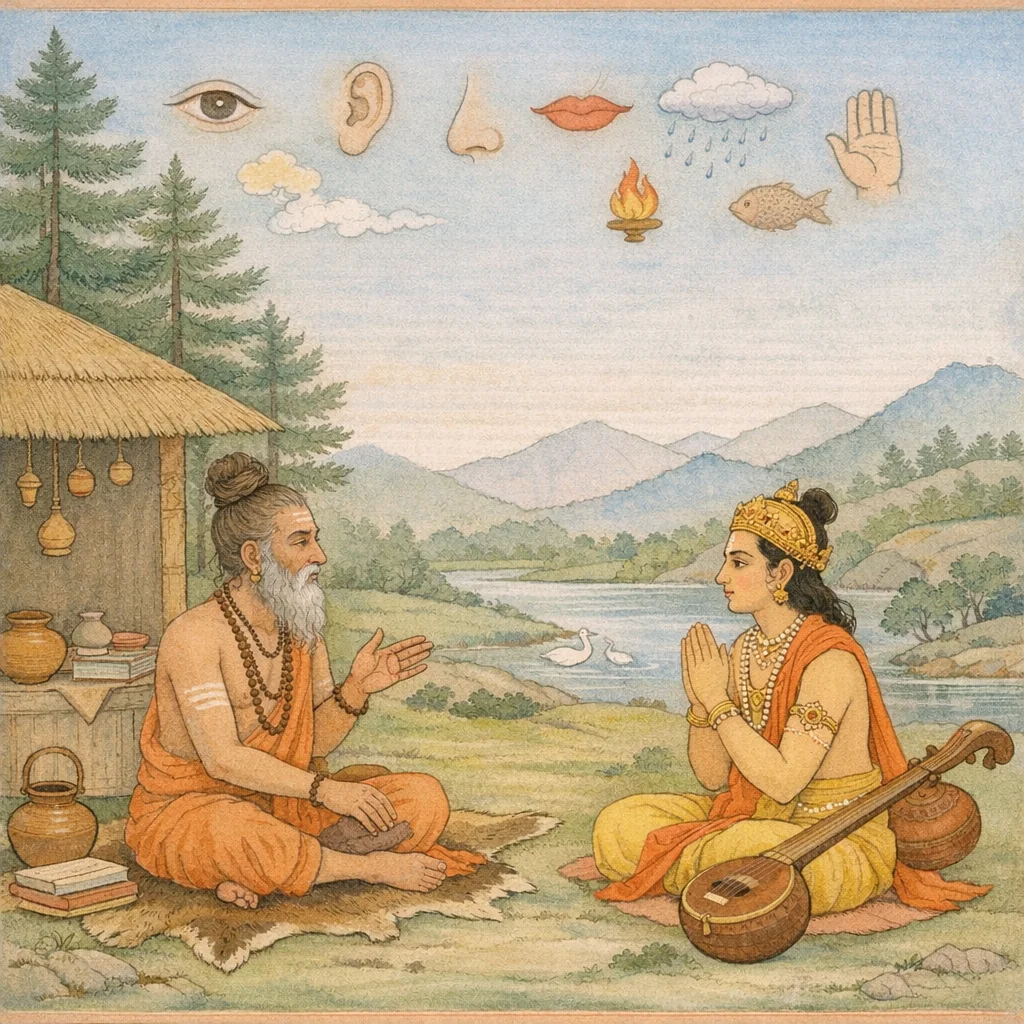
Bhishma said: “In this very connection, learned men cite an ancient historical example—the dialogue between the divine sage Narada and the brahmarshi Asita Devala. It is brought forward to illuminate how the embodied self can be freed from the delusion of identifying with the body.”
Verse 2
आसीने देवल वृद्ध बुद्ध्वा बुद्धिमतां वरम् । नारद: परिपप्रच्छ भूतानां प्रभवाप्पययम्,एक समयकी बात है, बुद्धिमानोंमें श्रेष्ठ बूढ़े असितदेवलको आसनपर बैठा हुआ जान नारदजीने उनसे सम्पूर्ण प्राणियोंकी उत्पत्ति और प्रलयके विषयमें प्रश्न किया
Bhishma said: Once, Narada, seeing the aged sage Asita Devala seated upon his seat and knowing him to be foremost among the wise, respectfully questioned him about the origin and dissolution of all beings.
Verse 3
नारद उवाच कुतः सृष्टमिदं विश्व ब्रह्मन् स्थावरजज्भमम् | प्रलये च कमभ्येति तद् भवान् प्रब्रवीतु मे,नारदजीने पूछा--ब्रह्मन! इस समस्त चराचर जगत्की सृष्टि किससे हुई है तथा यह प्रलयके समय किसमें लीन हो जाता है, यह आप मुझे बताइये?
Narada said: “O Brahman, from what source has this entire universe—both the immovable and the moving—been created? And at the time of dissolution, into what does it merge? Please explain this to me.”
Verse 4
असित उवाच येभ्य: सृजति भूतानि काले भावप्रचोदित: । महाभूतानि पज्चेति तान्याहुर्भूतचिन्तका:,असितदेवलने कहा--देवर्षे! सृष्टिके समय परमात्मा प्राणियोंकी वासनाओंसे प्रेरित हो समयपर जिन तत्त्वोंसे सम्पूर्ण भूतोंकी सृष्टि करते हैं, उन्हें भूतचिन्तक (भौतिक विज्ञानवादी) विद्वान पंचमहाभूत कहते हैं
Asita said: “At the time of creation, the Supreme—impelled by the latent dispositions (bhāvas) of living beings—brings forth all creatures from certain fundamental principles. Those who reflect on the nature of matter call these principles the ‘five great elements’ (pañca-mahābhūtas).”
Verse 5
तेभ्य: सृजति भूतानि काल आत्मप्रचोदित: । एतेभ्यो य: परं ब्रूयादसद् ब्रूयादसंशयम्
Asita said: “From these principles Time—impelled by its own inherent force—brings forth all beings. Whoever were to speak of something ‘higher’ than these would, without doubt, be speaking what is unreal.”
Verse 6
परमात्माकी प्रेरणासे काल इन पाँच तत्त्वोंद्वारा समस्त प्राणियोंकी सृष्टि करता है। जो इनसे भिन्न किसी अन्य तत्त्वको प्राणियोंके शरीरोंका उपादान कारण बताता है, वह निस्संदेह झूठी बात कहता है ।। विद्धि नारद पज्चैतान् शाश्वतानचलान ध्रुवान् महतस्तेजसो राशीन् कालषष्ठान् स्वभावत:
Asita said: “Know, O Nārada, these five to be eternal, unmoving, and steadfast—great masses of luminous energy. By their very nature, when joined with Time, they stand as the sixfold principle. It is through Time, impelled by the Supreme Self, that creation proceeds by means of these elements; whoever claims some other substance as the material cause of embodied beings speaks falsely.”
Verse 7
नारद! पाँच भूत और छठा काल--इन छ: तत्त्वोंको तुम प्रवाहरूपसे शाश्वत, अविचल और ध्रुव समझो। ये तेजोमय महत्तत्त्वकी स्वाभाविक कलाएँ हैं ।। आपश्चैवान्तरिक्षं च पृथिवी वायुपावकौ | नासीद्धि परम तेभ्यो भूतेभ्यो मुक्तसंशयम्
Asita said: “Nārada, understand the five great elements and, as the sixth, Time—these six principles—as an eternal, unbroken stream: steady, unmoving, and firm. They are natural portions of the luminous Great Principle (mahat). Indeed, beyond these elements—water, space, earth, wind, and fire—there is nothing further; be free of doubt.”
Verse 8
जल, आकाश, पृथ्वी, वायु और अग्नि--इन भूतोंसे भिन्न कोई तत्त्व कभी नहीं था; इसमें संशय नहीं है ।। नोपपत्त्या न वा युक्त्या त्वसद् ब्रूयादसंशयम् । वेत्थैतानभिनिर्वत्तान् षडेते यस्य राशय:,किसी भी युक्ति या प्रमाणसे इन छः:के अतिरिक्त और कोई तत्त्व नहीं बताया जा सकता। इसलिये जो कोई दूसरी बात कहता है, वह निस्संदेह झूठ बोलता है। तुम सभी कार्योमें अनुगत हुए इन छः तत्त्वोंकी और जिसके ये कार्य हैं, उस कारणको भी जानते हो
Asita said: “Water, space, earth, wind, and fire—apart from these elements no other principle has ever existed; of this there is no doubt. By no valid proof and by no sound reasoning can one establish any reality beyond these. Therefore, whoever asserts some other doctrine speaks falsely. You know these six principles as they manifest in all effects, and you also know the causal source to which these effects belong.”
Verse 9
पज्चैव तानि कालक्ष भावाभावौ च केवलौ । अष्टौ भूतानि भूतानां शाश्वतानि भवात्ययौ,पाँच महाभूत, काल तथा विशुद्ध भाव और अभाव अर्थात् नित्य आत्मतत्त्व और परिवर्तनशील महत्तत््व--ये आठ तत्त्व नित्य हैं। ये ही चराचर प्राणियोंकी उत्पत्ति और प्रलयके अधिष्ठान हैं
Asita said: “Those five (great elements), and Time, and pure Being and Non-being alone—these are the eight eternal principles. They stand as the underlying basis for the arising and dissolution of all beings, governing both their coming into existence and their passing away.”
Verse 10
अभावं यान्ति तेष्वेव तेभ्यश्व प्रभवन्त्यपि । विनष्टो5प्यनु तान्येव जन्तुर्भवति पठचधा,सब प्राणी उन्हींमें लीन होते हैं और उन्हींसे उनका प्राकट्य भी होता है। जीवोंका शरीर नष्ट हो जानेपर पाँच भागोंमें विभक्त होकर अपने-अपने कारणमें विलीन हो जाता है
Asit said: All beings pass into non-manifestation in those very causes, and from those same causes they arise again. Even when the body is destroyed, the living being—divided into five aspects—returns and merges into its respective causal sources.
Verse 11
तस्य भूमिमयो देह: श्रोत्रमाकाशसम्भवम् । सूर्याच्चक्षुरसुर्वायोरद्भ्यस्तु खलु शोणितम्,प्राणियोंका शरीर पृथ्वीका विकार है, श्रोत्रेन्द्रिय आकाशसे उत्पन्न हुई है, नेत्रेन्द्रिय सूर्यसे, प्राण वायुसे और रक्त जलसे उत्पन्न हुए हैं
Asita said: “The embodied being’s body is a modification of earth. Hearing arises from space; sight from the sun; the vital breath from wind; and blood, indeed, from water.”
Verse 12
चक्षुषी नासिकाकर्णो त्वक् जिद्वेति च पठचमी । इन्द्रियाणीन्द्रियार्थानां ज्ञानानि कवयो विदु:,विद्वान् पुरुष ऐसा मानते हैं कि नेत्र, नासिका, कर्ण, त्वचा और पाँचवीं जिह्ठा--से पाँच ज्ञानेन्द्रियाँ ही विषयोंको ग्रहण करनेवाली हैं
Asita said: “The learned declare that the five organs of knowledge—the two eyes, the nose, the two ears, the skin, and as the fifth the tongue—are the means by which a person apprehends their respective objects. Thus the wise understand sense-perception as the gateway through which the world is known, and therefore as something to be rightly understood and governed.”
Verse 13
दर्शनं श्रवर्णं घ्राणं स्पर्शनं रसन॑ तथा । उपपच्त्या गुणान् विद्धि पजच पठचसु पठचधा,बाह्य पदार्थोंको देखना, सुनना, सूँघना, छूना तथा रस लेना--ये क्रमश: नेत्र आदि पाँच इन्द्रियोंके कार्य हैं। उन्हें युक्तिसे तुम इन इन्द्रियोंक गुण ही समझो। पाँचों इन्द्रियाँ पाँचों विषयों में पाँच प्रकारसे (दर्शन आदि क्रियाओंके रूपमें) विद्यमान हैं
Asita said: Seeing, hearing, smelling, touching, and tasting—these are the respective functions of the five senses beginning with the eye. Understand, by sound reasoning, that these are the ‘qualities’ (operative capacities) of the senses. The five senses are present in relation to the five objects in five distinct ways, namely as these acts of perception.
Verse 14
रूप॑ गन्धो रस: स्पर्श: शब्दश्वैवाथ तद्गुणा: । इन्द्रियेरूपल भ्यन्ते पजचधा पड्च पञ्चभि:,नेत्र आदि पाँच इन्द्रियोंद्वारा रूप, गन्ध, रस, स्पर्श और शब्द--ये पाँच गुण दर्शन आदि पाँच प्रकारोंसे उपलब्ध किये जाते हैं
Asita said: Form, smell, taste, touch, and sound—these are the five sensory qualities. They are apprehended in five distinct ways by the five senses, beginning with the eye. Thus, experience is structured through the disciplined recognition of how each sense grasps its own object, a point meant to guide discernment and self-control in the pursuit of dharma.
Verse 15
रूप॑ गन्धं रसं स्पर्श शब्दं चैवाथ तद्गुणान् । इन्द्रियाणि न बुध्यन्ते क्षेत्रज्ञस्तैस्तु बुध्यते,रूप, गन्ध, रस, स्पर्श और शब्द--इन्द्रियोंके इन पाँचों गुणोंको स्वयं इन्द्रियाँ नहीं जानती हैं। उन इन्द्रियोंद्वारा क्षेत्रज्ञ (जीवात्मा) ही उनका अनुभव करता है
Form, smell, taste, touch, and sound—these five qualities of the senses are not known by the senses themselves. Rather, through those senses the kṣetrajña, the inner knower, experiences and knows them.
Verse 16
चित्तमिन्द्रियसंघातात् परं तस्मात् परं मन: । मनसस्तु परा बुद्धि: क्षेत्रज्ञो बुद्धित: पर:,शरीर और इन्द्रियोंके संघातसे चित्त श्रेष्ठ है, चित्तसे मन श्रेष्ठ है, मनसे बुद्धि श्रेष्ठ है और बुद्धिसे भी क्षेत्रज्ञ श्रेष्ठ है
Asita said: The inner awareness called citta is higher than the mere aggregate of the body and senses. Higher than citta is the mind (manas); higher than the mind is discernment (buddhi); and higher even than discernment is the kṣetrajña—the conscious knower within. The teaching directs one to seek the true self beyond the changing instruments of perception and thought, grounding ethical life in self-knowledge rather than sensory impulse.
Verse 17
पूर्व चेतयते जन्तुरिन्द्रियैर्विषयान् पृथक् विचार्य मनसा पश्चादथ बुद्धया व्यवस्यति । इन्द्रियेरुपलब्धार्थान् बुद्धिमांस्तु व्यवस्यति,जीव पहले तो इन्द्रियोंद्वारा उनके अलग-अलग विषयोंको प्रकाशित करता है, फिर मनसे विचार करके बुद्धिद्वारा उसका निश्चय करता है। बुद्धियुक्त जीव ही इन्द्रियोंद्वारा उपलब्ध विषयोंका निश्चितरूपसे अनुभव करता है
Asita said: First, the embodied being becomes aware of the sense-objects separately through the senses. Then, having reflected upon them with the mind, it subsequently determines them with the intellect. Indeed, it is the person endowed with intellect who decisively apprehends and experiences, in a settled way, the objects that have been presented by the senses.
Verse 18
चित्तमिन्द्रियसंघातं मनो बुद्धिस्तथाष्टमी । अष्टौ ज्ञानेन्द्रियाण्याहुरेतान्यध्यात्मचिन्तका:,अध्यात्मतत्त्वोंका चिन्तन करनेवाले पुरुष पाँच इन्द्रिय तथा चित्त, मन और आठवीं बुद्धि--इन आठोंको ज्ञानेन्द्रिय कहते हैं
Asita said: Those who contemplate the truth of the Self declare these to be the ‘organs of knowing’: the mind-stuff (citta), the aggregate of the senses, the mind (manas), and, as the eighth, the intellect (buddhi). In this teaching, inner faculties are counted along with the senses, emphasizing that ethical clarity and liberation depend on mastering the instruments of cognition.
Verse 19
पाणिपादं च पायुश्न मेहनं॑ पठचमं मुखम् । इति संशब्द्यमानानि शृणु कर्मेन्द्रियाण्यपि,हाथ, पैर, पायु और उपस्थ तथा पाँचवाँ मुख--ये सब-के-सब कर्मन्द्रिय कहे जाते हैं। तुम इनका भी विवरण सुनो
Asita said: “The hands and the feet, the anus and the organ of generation, and as the fifth, the mouth—these are all designated as the organs of action. Listen also as I describe them.”
Verse 20
जल्पनाभ्यवहारार्थ मुखमिन्द्रियमुच्यते । गमनेन्द्रियं तथा पादौ कर्मण: करणे करौ,मुख-इन्द्रियका उपयोग बोलने और भोजन करनेके लिये बताया जाता है। पैर चलनेकी और हाथ काम करनेकी इन्द्रियाँ हैं
Asita said: “The mouth is called a sense-organ because it serves for speech and for taking food. Likewise, the feet are the organ for movement, and the hands are the instruments for performing action.”
Verse 21
पायूपस्थं विसर्गार्थमिन्द्रिये तुल्यकर्मणी । विसर्गे च पुरीषस्य विसगे चापि कामिके,पायु और उपस्थ--ये दो इन्द्रियाँ क्रमश: मल और मूत्रका त्याग करनेके लिये हैं। इन दोनोंके त्यागरूप कर्म समान ही हैं। इनमेंसे पायु-इन्द्रिय मलका त्याग करती है और उपस्थ मैथुनके समय वीर्यका भी त्याग करता है
Asita said: “The anus and the generative organ are faculties meant for discharge; in their function they are alike. The anus effects the expulsion of feces, and the generative organ effects discharge in the act of sexual enjoyment.”
Verse 22
बलं॑ षष्ठं षडेतानि वाचा सम्यग्यथा मम । ज्ञानचेष्टेन्द्रियगुणा: सर्वेषां शब्दिता मया,इसके सिवा छठी कर्मेन्द्रिय बल अर्थात् प्राणसमूह है। इस प्रकार मैंने अपनी वाणीद्वारा तुम्हें समस्त इन्द्रियाँ और उनके ज्ञान, कर्म एवं गुण सुना दिये
The sixth power is called bala—the aggregate of prāṇa, the life-breath. Thus, by my speech, I have declared to you all the senses and their knowledge, their action, and their qualities.
Verse 23
इन्द्रियाणां स्वकर्मेभ्य: श्रमादुपरमो यदा । भवतीन्द्रियसंत्यागादथ स्वपिति वै नर:,जब अपने-अपने कर्मोंसे थककर इन्द्रियाँ शान्त हो जाती हैं, तब इन्द्रियोंका त्याग करके जीवात्मा सो जाता है
Asita said: When the senses, wearied by their own activities, grow calm and cease from fatigue, then—by relinquishing sensory engagement—a person truly falls asleep.
Verse 24
इन्द्रियाणां व्युपरमे मनो<व्युपरतं यदि । सेवते विषयानेव त॑ विद्यात् स्वप्नदर्शनम्,इन्द्रियोंके उपरत हो जानेपर भी यदि मन निवृत्त न होकर विषयोंका ही सेवन करता है तो उसे स्वप्नदर्शनकी अवस्था समझना चाहिये
Asita said: When the senses have ceased their outward activity, yet the mind has not withdrawn or grown quiet and continues to indulge in sense-objects, one should understand that condition as “dream-vision.”
Verse 25
साच्चिकाश्वैव ये भावास्तथा तामसराजसा: । कर्मयुक्तान् प्रशंसन्ति सात्त्विकानितरांस्तथा,जो सात्विक, राजस और तामसभाव प्रसिद्ध हैं, वे ही जब भोग प्रदान करनेवाले कर्मोसे संयुक्त होते हैं, तब उन सात्विक आदि भावोंकी मनुष्य प्रशंसा करते हैं
Asita said: The well-known dispositions—sattvic, rajasic, and tamasic—are praised by people when they become joined to actions that bestow enjoyments and rewards; thus they commend these states, whether sattva or the others.
Verse 26
आनन्द: कर्मणां सिद्धि: प्रतिपत्ति: परा गति: | सात््विकस्य निमित्तानि भावान् संश्रयते स्मृति:,आनन्द, सुख, कर्मोकी सिद्धि जाननेकी सामर्थ्य और उत्तम गति--ये चार सात्त्विक भाव हैं। सात्विक पुरुषकी स्मृति इन्हीं चार निमित्तोंका आश्रय लेती है अर्थात् सात्त्विक पुरुष जाग्रत् कालकी भाँति स्वप्नमें भी आनन्द आदि भावोंका ही स्मरण करता है
Asita said: “Joy (ānanda), well-being (sukha), the successful accomplishment of actions, right understanding, and the highest goal—these are the supports of a sāttvika disposition. The memory (smṛti) of a sāttvika person rests upon these; thus, even in dreams, as in waking life, one recalls joy and the like.”
Verse 27
जन्तुष्वेकतमेष्वेवं भावा ये विधिमास्थिता: । भावयोरीप्तितं नित्यं प्रत्यक्ष गमनं तयो:,इनसे भिन्न राजस और तामस--प्राणियोंमेंसे जिस किसी एक श्रेणीके जीवोंमें जो-जो भाव (वासनाएँ), विधि (कर्मगति) का आश्रय लेकर स्थित हैं, उन्हीं भावोंको उनकी स्मृति ग्रहण करती है। अर्थात् जाग्रत् और स्वप्न--दोनों ही अवस्थाओंमें उन मनुष्योंको अपनी- अपनी रुचिके अनुसार राजस और तामस पदार्थोका सदा प्रत्यक्ष दर्शन होता है
Asita said: Among living beings, whatever latent dispositions (bhāvas) have taken their stand upon “vidhi”—the determining course shaped by one’s karmic momentum—those very dispositions are continually seized and carried by memory. Therefore, in both waking and dreaming, the two sets of dispositions move toward what they desire and become directly manifest: people repeatedly encounter, in accordance with their own inclinations, the objects and experiences colored by rajas and tamas.
Verse 28
इन्द्रियाणि च भावाश्च गुणा: सप्तदश स्मृता: । तेषामष्टादशो देही यः शरीरे स शाश्वत:,पाँच कर्मेन्द्रियाँ, पाँच ज्ञानेन्द्रियाँ, चित्त, मन, बुद्धि, प्राण तथा सात््विक आदि तीन भाव--ये सत्रह गुण माने गये हैं। इनका अधिष्ठाता देहाभिमानी जीवात्मा अठारहवाँ है, जो इस शरीरके भीतर निवास करता है। उसे सनातन माना गया है। अथवा शरीरसहित वे सभी गुण देहधारियोंके आश्रित रहते हैं। जब जीवका वियोग हो जाता है, तब शरीर और उसमें रहनेवाले वे तत्त्व भी नहीं रह जाते
Asita said: “The senses and the inner dispositions are remembered as seventeen ‘constituents’ (guṇas). Over them stands the eighteenth—the embodied self (dehī) who dwells within the body and is held to be everlasting. The teaching points to moral responsibility: the instruments of experience and action are many, but the enduring agent who presides over them is one; when that agent departs, the body and its functioning principles no longer remain as a living person.”
Verse 29
अथवा सशरीरास्ते गुणा: सर्वे शरीरिणाम् । संश्रितास्तद् वियोगे हि सशरीरा न सन्ति ते,पाँच कर्मेन्द्रियाँ, पाँच ज्ञानेन्द्रियाँ, चित्त, मन, बुद्धि, प्राण तथा सात््विक आदि तीन भाव--ये सत्रह गुण माने गये हैं। इनका अधिष्ठाता देहाभिमानी जीवात्मा अठारहवाँ है, जो इस शरीरके भीतर निवास करता है। उसे सनातन माना गया है। अथवा शरीरसहित वे सभी गुण देहधारियोंके आश्रित रहते हैं। जब जीवका वियोग हो जाता है, तब शरीर और उसमें रहनेवाले वे तत्त्व भी नहीं रह जाते
Or again: all those qualities and faculties, together with the body, depend upon the embodied being. For when the living self departs, neither the body nor those body-bound principles remain as they were. The teaching underscores that the psycho-physical apparatus is contingent and perishable, while the ethical focus is to loosen identification with the body and its functions, recognizing their dependence on the indwelling self.
Verse 30
अथवा संनिपातो<यं शरीरं पाञज्चभौतिकम् । एकश्न दश चाष्टौ च गुणा: सह शरीरिणा,अथवा इन सबका समुदाय ही पाञज्चभौतिक शरीर है। एक महत्तत््व और जीवसहित पूर्वोक्त अठारह गुण--ये सभी इस समुदायके अन्तर्गत हैं
Asita said: Or again, this body is a composite—made of the five great elements. Within this aggregate are included the one principle (the Mahat), the ten (the sense-faculties), and the eight (subtle constituents), together with the embodied self. Thus, what we call the “body” is not a single, independent entity but a gathered assemblage of constituents, and understanding this loosens attachment and clarifies right discernment.
Verse 31
ऊष्मणा सह विंशो वा संघात: पाउ्चभौतिक: । महान् संधारयत्येतच्छरीरं वायुना सह,जठरानलके साथ-साथ उक्त तत्त्वोंकी गणना करनेपर यह पाउ्चभौतिक संघात बीस तत्त्वोंका समूह है। महत्तत्त्व प्राणवायुके साथ इस शरीरको धारण करता है। यह वायु शरीरका भेदन करनेमें प्रभावशाली महत्तत््वका उपकरणमात्र है
Asita said: “This bodily aggregate, constituted of the five elements, is—when counted together with heat—either a set of twenty principles. The Great Principle (mahat) sustains this body along with the vital wind (vāyu). That wind, powerful in piercing and pervading the body, functions merely as an instrument of mahat.”
Verse 32
तस्य प्रभावयुक्तस्य निमित्तं देहभेदने | यथैवोत्पद्यते किंचित् पञ्चत्वं गच्छते तथा
For one endowed with such spiritual potency, the occasion of the body’s breaking is of the same order as any other event: whatever is born, in due course, goes to the state of the five elements. The teaching underscores a sober ethical vision—do not cling to the body as the self, for dissolution is a natural law, not a catastrophe for the wise.
Verse 33
पुण्यपापविनाशान्ते पुण्यपापसमीरित: । देहं विशति कालेन ततो<यं कर्मसम्भवम्
Asita said: “When the effects of merit and sin have come to their end, the being—impelled by those very forces of merit and sin—enters a body in due course of time. Thus this embodied existence arises from one’s own karma.”
Verse 34
जैसे इस जगत्में घट आदि कोई वस्तु उत्पन्न होती और फिर नष्ट हो जाती है, उसी प्रकार प्रारब्ध, पुण्य और पापका क्षय होनेपर शरीर पज्चत्वको प्राप्त हो जाता है तथा संचित पुण्य और पापसे प्रेरित हो जीव समयानुसार कर्मजनित दूसरे शरीरमें प्रवेश करता है ।। हित्वा हित्वा हायं प्रैति देहाद् देहं कृताश्रय: । कालसंचोदितत: क्षेत्री विशीर्णाद् वा गृहाद् गृहम्,जिस प्रकार घरमें रहनेवाला पुरुष एक घरके गिरनेपर दूसरेमें और दूसरेके गिरनेपर तीसरेमें चला जाता है, उसी प्रकार कालसे प्रेरित हुआ जीव क्रमश: एक-एक शरीरको छोड़कर पूर्वसंकल्पके द्वारा निर्मित दूसरे-दूसरे शरीरमें जाता है
As in this world a pot and other objects come into being and then perish, so too, when the force of one’s begun destiny (prārabdha) and the stock of merit and sin are exhausted, the body returns to the five elements. Driven by accumulated merit and sin, the living self, in due course and under the impulse of Time, enters another body produced by its deeds. Thus, taking support again and again, it departs from body to body—like a dweller who, when one house collapses, moves into another, and when that too falls, into a third. In the same way, urged onward by Time, the embodied knower of the field leaves one body after another and reaches different bodies fashioned by prior intention and past action.
Verse 35
तत्र नैवानुतप्यन्ते प्राज्ञा निश्चितनिश्चया: । कृपणास्त्वनुतप्यन्ते जना: सम्बन्धदर्शिन:,विद्वान् पुरुष यह निश्चितरूपसे जानते हैं कि आत्मा शरीरसे सर्वथा भिन्न, असंग और अविनाशी है, अत: शरीरका वियोग होनेपर उन्हें तनिक भी संताप नहीं होता; परंतु अज्ञानीजन देहसे अपना सम्बन्ध मानते हैं; इसलिये देह छूटनेसे उन्हें बड़ा दुःख होता है
Asita said: In such a situation, the wise—firm in settled discernment—do not grieve at all. It is the petty and deluded, those who see (and cling to) worldly relations as the self, who fall into grief. The verse contrasts steady knowledge of the self’s separateness from the body with the sorrow born of bodily identification and attachment.
Verse 36
न हायं कस्यचित् कक्षिन्नास्य कश्नन विद्यते | भवत्येको हायं नित्यं शरीरे सुखदुः:खभाक्,यह जीव वास्तवमें किसीका कोई नहीं है और न कोई दूसरा ही उसका कुछ है। वास्तवमें यह तो सदा अकेला ही है। परंतु शरीरमें रहकर उसे अपना माननेके कारण ही यह सुख-दुःखका भागी होता है
Asita said: “This self truly belongs to no one, and no one else truly belongs to it. In reality it is ever alone. Yet, dwelling in a body and taking it as ‘mine’, it becomes a participant in pleasure and pain.”
Verse 37
नैव संजायते जन्तुर्न च जातु विपद्यते । याति देहमयं मुक्त्वा कदाचित्परमां गतिम्,जीव न कभी उत्पन्न होता है, न मरता है। जब कभी इसे तत्त्वज्ञान होता है, तब यह शरीर--अभिमान छोड़कर परमगतिको प्राप्त कर लेता है
Asita said: The living being is never truly born, nor does it ever perish at any time. When it attains knowledge of reality, it casts off identification with the body and, at last, reaches the supreme state. In this teaching, grief and fear are restrained by insight: ethical steadiness arises from knowing the Self to be untouched by bodily change.
Verse 38
पुण्यपापमयं देहं क्षपयन् कर्मसंक्षयात् । क्षीणदेह: पुनर्देही ब्रह्मत्वमुपगच्छति,यह शरीर पुण्य-पापमय है। देहधारी जीव प्रारब्ध कर्मोके क्षयके साथ-साथ इस शरीरको क्षीण करता रहता है। इस प्रकार शरीरका नाश हो जानेपर वह मुक्त पुरुष ब्रह्मभावको प्राप्त हो जाता है
This body is made of merit and demerit. As karma is exhausted, the embodied being steadily wears this body away; and when the body is spent, the liberated one attains the state of Brahman.
Verse 39
पुण्यपापक्षयार्थ हि सांख्यज्ञानं विधीयते । तत्क्षये हुस्य पश्यन्ति ब्रह्मुभावे परां गतिम्,पुण्य और पापोंके क्षयके लिये ही ज्ञानयोगको साधन बताया गया है। उनका क्षय हो जानेपर जब जीवात्माको ब्रह्मभावकी प्राप्ति हो जाती है, तब विद्वानुलोग उसकी परमगति मानते हैं
For the sake of exhausting merit and sin, the Sāṅkhya knowledge is prescribed. When they are exhausted and the self attains the state of Brahman, the wise behold that as the supreme destination.
Verse 274
इस प्रकार श्रीमहाभारत शान्तिपर्वके अन्तर्गत गोक्षधर्मपर्वमें योगसम्बन्धी आचारका वर्णन नामक दी सौ चौद्वत्तवाँ अध्याय पूरा हुआ
Thus ends the two-hundred-and-seventy-fourth chapter of the Śānti Parva of the Śrī Mahābhārata, within the Gokṣa-dharma section, entitled “The Description of Conduct Related to Yoga.” This closing colophon marks the completion of Bhīṣma’s instruction on yogic discipline as a component of dharma and right living.
Verse 275
इति श्रीमहाभारते शान्तिपर्वणि मोक्षधर्मपर्वणि नारदासितसंवादे पञ्चसप्तत्यधिकद्वधिशततमो<5ध्याय:
Thus, in the Śrī Mahābhārata, within the Śānti Parvan—specifically the Mokṣa-dharma section—ends the dialogue between Nārada and Asita, concluding the two-hundred-and-seventy-fifth chapter. This closing colophon frames the teaching as part of the Mahābhārata’s ethical and liberative instruction, situating the discourse within the tradition of guidance on peace, restraint, and spiritual freedom.
Frequently Asked Questions
The dilemma concerns exclusion from rightful shares in collective rites: when a principal stakeholder (Śiva) is denied ritual recognition, the resulting disorder escalates until mediated restoration of entitlement enables restraint and rebalancing.
The chapter models how intense power (tejas/krudha) must be converted into regulated, distributable form for the welfare of beings; stability is achieved through negotiated inclusion and calibrated dispersion rather than total suppression.
Yes. The closing verse states that one who regularly recites the account of Jvara’s origin with composure is said to become free from illness and attain desired objectives, functioning as a traditional phalaśruti validating the passage’s recitational efficacy.