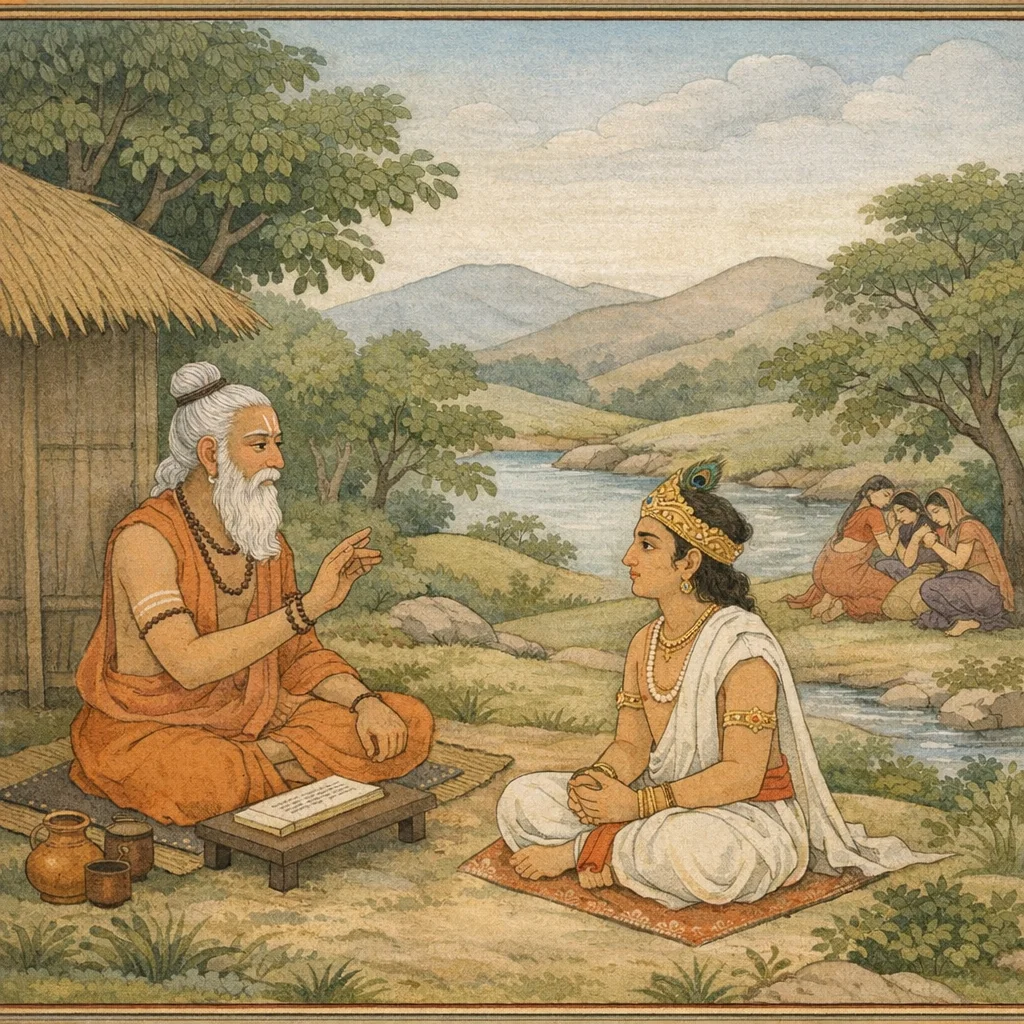
Adhyaya 25
राजधर्मः—राष्ट्ररक्षणं, दण्डनीतिः, हयग्रीवोपाख्यानम् (Royal Duty: Protection, Penal Policy, and the Hayagrīva Exemplum)
Upa-parva: Rājadharmānuśāsana Upa-Parva (राजधर्मानुशासन उपपर्व)
Vaiśaṃpāyana reports Vyāsa’s renewed counsel to Yudhiṣṭhira (Ajātaśatru). The instruction begins by urging the king to grant his forest-dwelling brothers the fruition of their aspirations and to govern the earth with steadiness, so that hardship culminates in welfare. The discourse links royal life to a sequence of obligations: experiencing dharma, artha, and kāma in due measure, repaying debts to guests, ancestors, and deities, and then pursuing higher ends. It recommends major sacrifices (including aśvamedha) as public-ritual instruments of legitimacy and renown. The chapter then turns to administrative ethics: taking revenue and exercising restraint must be balanced; a ruler who waits for the proper place and time, guided by śāstra-informed intelligence, does not incur fault. Conversely, a king who collects fiscal shares but fails to protect the realm inherits a portion of the resulting wrongdoing. The text outlines traits of disciplined rule—fearlessness grounded in dharmaśāstra, impartiality, and rejection of kāma and krodha—while warning that negligence, arrogance, and lack of protection generate culpability when subjects decline or are harmed by predation. Finally, Bhīṣma signals an illustrative narrative of the former royal sage Hayagrīva/Vājigrīva: a model of enemy-restraint and human protection whose valor is poetically recast as a sacrificial rite (weapons and chariot mapped to yajña implements). Through this metaphor, effective protection and self-sacrificing service are presented as a pathway to enduring fame and elevated posthumous attainment.
Chapter Arc: युद्ध-विजय के बाद भी युधिष्ठिर का मन राज्य और भोगों से नहीं भरता; शोक उसे जकड़े रहता है और वह व्यास से शांति का उपाय पूछता है। → युधिष्ठिर वीर-विहीनों, पुत्रहीन स्त्रियों और विलाप करती प्रजा की पीड़ा सुनकर और तीव्र व्याकुल हो उठता है—उसे लगता है कि राजधर्म भी इस शोक को नहीं काट पा रहा। → उपदेश का तीखा शिखर: कालचक्र की अजेयता और लोक-व्यवहार की कठोर सच्चाई—‘मनुष्य मनुष्यों को मारते हैं, फिर उन्हें भी दूसरे मारते हैं; वास्तव में न कोई मारता है न मारा जाता’—और सुख-दुःख का परस्पर-परिणाम (दुःखांत में सुख, सुखांत में दुःख) युधिष्ठिर के शोक पर सीधा प्रहार करता है। → व्यास (सेनजित् के उपदेश-उदाहरण सहित) शोक-निवारण का मार्ग बताते हैं: हानि (धन, दारा, पुत्र, पिता) पर ‘अहो दुःखम्’ में डूबने के बजाय दुःख की ‘अपचिति’—क्षय—का अभ्यास; और राजधर्म का शुद्ध पालन—बुद्धिपूर्वक नीति से राज्य-रक्षा, यज्ञशीलता, चातुर्वर्ण्य की स्थापना—जिससे कीर्ति और परलोक-कल्याण प्राप्त होता है। → शोक-शमन का सिद्धांत तो स्पष्ट होता है, पर युधिष्ठिर के भीतर यह प्रश्न शेष रहता है कि इतने रक्तपात के बाद वह स्वयं इस वैराग्य-युक्त राजधर्म को कैसे धारण करे।
Shlokas
Verse 1
(दाक्षिणात्य अधिक पाठके ९ श्लोक मिलाकर कुल ४३ श्लोक हैं।) ऑपन-माज बक। अस्त पञ्चविशो< ध्याय: सेनजित्के उपदेशयुक्त उद्घारोंका उल्लेख करके व्यासजीका युधिष्ठिरको समझाना वैशम्पायन उवाच द्वैषयायनवच: श्रुत्वा कुपिते च धनंजये । व्यासमामन्त्रय कौन्तेय: प्रत्युवाच युधिछ्िर:,वैशम्पायनजी कहते हैं--जनमेजय! व्यासजीकी बात सुनकर और अर्जुनके कुपित हो जानेपर कुन्तीनन्दन युधिष्ठिरने व्यासजीको आमन्त्रित करके उत्तर देना आरम्भ किया इस प्रकार श्रीमह्याभारत शान्तिपर्वके अन्तर्गत राजधर्मानुशासनपर्वमें सेनजित्का उपाख्यानविषयक पचीसवाँ अध्याय पूरा हुआ ॥/ २५ ॥। नल्लजा5 >> 7 जा षड्विशो<5ध्याय: युधिष्ठिरके द्वारा धनके त्यागकी ही महत्ताका प्रतिपादन वैशम्पायन उवाच अस्मिन्नेव प्रकरणे धनंजयमुदारधी: । अभिनीततरं वाक्यमित्युवाच युधिष्ठिर:
Vaiśampāyana said: “O Janamejaya, after hearing the words of Dvaipāyana (Vyāsa) and seeing Dhanañjaya (Arjuna) become angered, Kuntī’s son Yudhiṣṭhira invited Vyāsa to speak and began his reply.”
Verse 2
युधिषछ्िर उवाच न पार्थिवमिदं राज्यं न भोगाश्च पृथग्विधा: । प्रीणयन्ति मनो मे5द्य शोको मां रुन्धयत्ययम्,युधिष्ठटिर बोले--मुने! यह भूतलका राज्य और ये भिन्न-भिन्न प्रकारके भोग आज मेरे मनको प्रसन्न नहीं कर रहे हैं। यह शोक मुझे चारों ओरसे घेरे हुए है
Yudhiṣṭhira said: “O sage, neither this earthly sovereignty nor the many kinds of pleasures delight my mind today. This grief has hemmed me in on every side.”
Verse 3
श्रुत्वा वीरविहीनानामपुत्राणां च योषिताम् । परिदेवयमानानां शान्तिं नोपलभे मुने
Yudhiṣṭhira said: “O sage, when I hear the lamentations of women who have been left without their heroes and bereft of sons, I find no peace within myself.”
Verse 4
महर्षे! पति और पुत्रोंसे हीन हुई युवतियोंका करुण विलाप सुनकर मुझे शान्ति नहीं मिल रही है ।। इत्युक्त: प्रत्युवाचेदं व्यासो योगविदां वर: । युधिष्ठिरं महाप्राज्ञो धर्मज्ञो वेदपारग:,युधिष्ठिके ऐसा कहनेपर योगवेत्ताओंमें श्रेष्ठ और वेदोंके पारंगत दिद्वान् धर्मज्ञ महाज्ञानी व्यासने उनसे फिर इस प्रकार कहा
Yudhiṣṭhira said: “O great sage! Hearing the piteous lament of young women bereft of husbands and sons, I cannot find peace.” When he had spoken thus, Vyāsa—foremost among the knowers of yoga, profoundly wise, a knower of dharma, and one who had mastered the Vedas—replied to Yudhiṣṭhira again in these words.
Verse 5
व्यास उवाच न कर्मणा लभ्यते चिन्तया वा नाप्यस्ति दाता पुरुषस्य कश्रित् | पर्याययोगाद् विहितं विधात्रा कालेन सर्व लभते मनुष्य:,व्यासजी बोले--राजन्! न तो कोई कर्म करनेसे नष्ट हुई वस्तु मिल सकती है, न चिन्तासे ही। कोई ऐसा दाता भी नहीं है, जो मनुष्यको उसकी विनष्ट वस्तु दे दे। बारी- बारीसे विधाताके विधानानुसार मनुष्य समयपर सब कुछ पा लेता है
Vyāsa said: “O King, what has been lost is not regained merely by action, nor by anxious brooding. Nor is there any benefactor who can simply hand a person back what has perished. In due succession, according to the ordinance set by the Disposer, a human being obtains everything in its proper time.”
Verse 6
न बुद्धिशास्त्राध्ययनेन शक्यं प्राप्तुं विशेष॑ मनुजैरकाले । मूर्खोडपि चाप्रोति कदाचिदर्थान् कालो हि कार्य प्रति निर्विशेष:,बुद्धि अथवा शास्त्राध्ययनसे भी मनुष्य असमयमें किसी विशेष वस्तुको नहीं पा सकता और समय आनेपर कभी-कभी मूर्ख भी अभीष्ट पदार्थोंको प्राप्त कर लेता है; अतः काल ही कार्यकी सिद्धिमें सामान्य कारण है
Vyāsa said: “By intelligence or by the study of treatises, human beings cannot obtain a particular result before its proper time. Yet, when the time arrives, even a fool may sometimes gain the desired ends. Therefore, it is Time that stands as the common determining cause in the accomplishment of actions.”
Verse 7
नाभूतिकालेषु फलं ददन्ति शिल्पानि मन्त्राक्ष तथौषधानि । तान्येव कालेन समाहितानि सिद्धमन्ति वर्धन्ति च भूतिकाले,अवनतिके समय शिल्पकलाएँ, मन्त्र तथा औषध भी कोई फल नहीं देते हैं। वे ही जब उन्नतिके समय उपयोगमें लाये जाते हैं, तब कालकी प्रेरणासे सफल होते और वृद्धिमें सहायक बनते हैं
Vyāsa said: “In times of decline and misfortune, crafts and skills, sacred formulas and syllables, and even medicines do not yield their expected results. Those very same means, when gathered and applied in harmony with Time, succeed and bring increase when the season of prosperity arrives.”
Verse 8
कालेन शीघ्रा: प्रवहन्ति वाता: कालेन वृष्टिर्जलदानुपैति । कालेन पद्मोत्पलवज्जलं च कालेन पुष्यन्ति वनेषु वृक्षा:,समयसे ही तेज हवा चलती है, समयसे ही मेघ जल बरसाते हैं, समयसे ही पानीमें कमल तथा उत्पल उत्पन्न हो जाते हैं और समयसे ही वनमें वृक्ष पुष्ट होते हैं
Vyāsa said: “In due season the swift winds blow; in due season the rain-bearing clouds arrive and pour down. In due season, lotuses and blue lotuses arise in the waters; and in due season the trees in the forests grow strong and flourish. Thus, the world’s order is governed by Time, and wise conduct aligns itself with that ordained rhythm rather than impatience or despair.”
Verse 9
कालेन कृष्णाश्न सिताश्न रात्र्य: कालेन चन्द्र: परिपूर्णबिम्ब: । नाकालत: पुष्पफल द्रुमाणां नाकालवेगा: सरितो वहन्ति,समयसे ही अँधेरी और उजेली रातें होती हैं, समयसे ही चन्द्रमाका मण्डल परिपूर्ण होता है, असमयमें वृक्षोंमे फल और फूल भी नहीं लगते हैं और न असमयमें नदियाँ ही वेगसे बहती हैं
Vyāsa said: In due season come the dark nights and the bright nights; in due season the moon becomes a full orb. Out of season, trees do not bear flowers and fruits, and rivers do not rush with their proper force. Thus, all results arise from time and right occasion—one should act with patience and discernment, not in haste or against the natural order.
Verse 10
नाकालमत्ता: खगपन्नगाश्न मृगद्विपा: शैलमृगाश्न लोके । नाकालत: स्त्रीषु भवन्ति गर्भा नायान्त्यकाले शिशिरोष्णवर्षा:,लोकमें पक्षी, सर्प, जंगली मृग, हाथी और पहाड़ी मृग भी समय आये बिना मतवाले नहीं होते हैं। असमयमें स्त्रियोंके गर्भ नहीं रहते और बिना समयके सर्दी, गर्मी तथा वर्षा भी नहीं होती है
Vyāsa said: In this world, birds and serpents, wild beasts and elephants, and even the deer of the mountains do not become frenzied except in their proper season. Women do not conceive out of season, and winter, summer, and the rains do not arrive before their appointed time. Thus, the order of time governs all beings; one should act with patience and discernment, not in haste or disorder.
Verse 11
नाकालतो म्रियते जायते वा नाकालतो व्याहरते च बाल: । नाकालतो यौवनमभ्युपैति नाकालतो रोहति बीजमुप्तम्,बालक समय आये बिना न जन्म लेता है, न मरता है और न असमयमें बोलता ही है। बिना समयके जवानी नहीं आती और बिना समयके बोया हुआ बीज भी नहीं उगता है
Vyāsa said: No one dies before the appointed time, nor is anyone born before it; a child does not even begin to speak before its time. Youth, too, arrives only in due season, and a seed that has been sown sprouts only when its proper time has come. Thus, the world’s changes unfold under the governance of time, teaching patience and steadiness in the face of gain and loss.
Verse 12
नाकालतो भानुरुपैति योगं नाकालतो3स्तंगिरिमभ्युपैति | नाकालतो वर्धते हीयते च चन्द्र: समुद्रो5पि महोर्मिमाली,असमयमें सूर्य उदयाचलसे संयुक्त नहीं होते हैं, समय आये बिना वे अस्ताचलपर भी नहीं जाते हैं, असमयमें न तो चन्द्रमा घटते-बढ़ते हैं और न समुद्रमें ही ऊँची-ऊँची तरंगें उठती हैं
Vyāsa said: The sun does not join the horizon before its time, nor does it approach the mountain of setting before its time. Likewise, the moon does not wax or wane out of season, and even the ocean, crowned with mighty waves, does not surge at an improper time. Thus, the world’s great powers move under the governance of Time; therefore one should act with patience and propriety, not forcing outcomes against the ordained moment.
Verse 13
अत्राप्युदाहरन्तीममितिहासं पुरातनम् । गीत॑ राज्ञा सेनजिता दुः:खार्तेन युधिष्ठिर,युधिष्ठिर! इस विषयमें लोग एक प्राचीन इतिहासका उदाहरण दिया करते हैं। एक समय शोकसे आतुर हुए राजा सेनजितने जो उद्बार प्रकट किया था, वही तुम्हें सुना रहा हूँ
Here too, O Yudhiṣṭhira, people cite an ancient historical example. I shall relate to you the utterance once spoken by King Senajit when he was afflicted by sorrow—an illustration invoked to illuminate this very matter.
Verse 14
सवनिवैष पर्यायो मर्त्यान् स्पृशति दुःसह: । कालेन परिपक्तवा हि प्रियन्ते सर्वपार्थिवा:,(राजा सेनजितने मन-ही-मन कहा कि) “यह दुःसह कालचक्र सभी मनुष्योंपर अपना प्रभाव डालता है। एक दिन सभी भूपाल कालसे परिपक्व होकर मृत्युके अधीन हो जाते हैं
Vyāsa said: “This unbearable cycle of change and decline touches all mortals. In time, ripened by Kāla (Time), all kings—however dear and mighty—are carried away to death.”
Verse 15
घ्नन्ति चान्यान् नरा राजंस्तानप्यन्ये तथा नरा: । संज्ैषा लौकिकी राजन् न हिनस्ति न हन्यते,“राजन! मनुष्य दूसरोंको मारते हैं, फिर उन्हें भी दूसरे लोग मार देते हैं। नरेश्वर! यह मरना-मारना लौकिक संज्ञामात्र है। वास्तवमें न कोई मारता है और न मारा ही जाता है
Vyāsa said: “O King, men strike down others, and those very men are in turn struck down by other men. O ruler of men, this ‘killing and being killed’ is only a worldly designation. In truth, none truly kills, and none is truly killed.”
Verse 16
हन्तीति मन्यते वक्रिन्न हन्तीत्यपि चापर: । स्वभावतस्तु नियतौ भूतानां प्रभवाप्ययौं,“एक मानता है कि आत्मा मारता है।” दूसरा ऐसा मानता है कि “नहीं मारता है।' पाज्चभौतिक शरीरोंके जन्म और मरण स्वभावत: नियत हैं
Vyāsa said: “One person thinks, ‘It kills’; another, ‘It does not kill.’ Yet, by their very nature, the arising and passing away of embodied beings are fixed.”
Verse 17
नष्टे धने वा दारे वा पुत्रे पितरि वा मृते । अहो दुःखमिति ध्यायन् दुःखस्यापचितिं चरेत्,“धनके नष्ट होनेपर अथवा स्त्री, पुत्र या पिताकी मृत्यु होनेपर मनुष्य “हाय! मुझपर बड़ा भारी दुःख आ पड़ा” इस प्रकार चिन्ता करते हुए उस दुःखकी निवृत्तिकी चेष्टा करता है
“When wealth is lost, or when one’s wife, son, or father dies, a person thinks, ‘Alas, a heavy sorrow has fallen upon me!’ and strives to bring that sorrow to an end.”
Verse 18
स कि शोचसि मूढ: सन् शोच्यान् किमनुशोचसि । पश्य दु:खेषु दुःखानि भयेषु च भयान्यपि,“तुम मूढ़ बनकर शोक क्यों कर रहे हो? उन मरे हुए शोचनीय व्यक्तियोंका बारंबार स्मरण ही क्यों करते हो? देखो, शोक करनेसे दुःखमें दुःख तथा भयमें भयकी वृद्धि होगी
Vyāsa said: “Why do you grieve, being deluded? Why do you repeatedly lament those who are themselves objects of lamentation? See this clearly: indulging in grief only multiplies sorrow amid sorrow, and increases fear amid fear.”
Verse 19
आत्मापि चायं न मम सर्वापि पृथिवी मम । यथा मम तथान्येषामिति पश्यन् न मुहृति,“यह शरीर भी अपना नहीं है और सारी पृथ्वी भी अपनी नहीं है। यह जिस तरहसे मेरी है, उसी तरह दूसरोंकी भी है। ऐसी दृष्टि रखनेवाला पुरुष कभी मोहमें नहीं फँसता है
Vyāsa said: “Even this self (and body) is not ‘mine’; nor is the whole earth ‘mine’. Seeing that whatever is claimed as ‘mine’ is, in the same way, also ‘others’—a person who maintains this vision does not fall into delusion even for a moment.”
Verse 20
शोकस्थानसहस्राणि हर्षस्थानशतानि च । दिवसे दिवसे मूढमाविशन्ति न पण्डितम्,'शोकके सहसों स्थान हैं, हर्षके भी सैकड़ों अवसर हैं। वे प्रतिदिन मूढ़ मनुष्यपर ही प्रभाव डालते हैं, विद्वानूपर नहीं
Vyāsa said: “There are thousands of occasions for grief and hundreds of occasions for joy. Day after day they seize the foolish mind, but they do not overpower the wise.”
Verse 21
एवमेतानि कालेन प्रियद्वेष्पाणि भागश: । जीवेषु परिवर्तन्ते दुःखानि च सुखानि च,इस प्रकार ये प्रिय और अप्रिय भाव ही दुःख और सुख बनकर अलग-अलग सभी जीवोंको प्राप्त होते रहते हैं
Vyāsa said: Thus, in the course of time, what is felt as dear and what is felt as hateful—each in its own portion—keeps turning among living beings, appearing as sorrow and as happiness.
Verse 22
दुःखमेवास्ति न सुखं तस्मात् तदुपलभ्यते । तृष्णार्तिप्रभवं दुःखं दुःखार्तिप्रभवं सुखम्,'संसारमें केवल दुःख ही है, सुख नहीं, अतः दुःख ही उपलब्ध होता है। तृष्णाजनित पीड़ासे दु:ख और दुःखकी पीड़ासे सुख होता है अर्थात् दुःखसे आर्त हुए मनुष्यको ही उसके न रहनेपर सुखकी प्रतीति होती है
Vyāsa said: “In worldly existence there is only suffering, not true happiness; therefore it is suffering that is actually encountered. Suffering arises from the pain born of craving, and what is called ‘happiness’ arises from the pain of suffering—when one has been afflicted by misery, the mere absence of that misery is experienced as happiness.”
Verse 23
सुखस्यानन्तरं दुःखं दुःखस्यानन्तरं सुखम् | न नित्यं लभते दुःखं न नित्यं लभते सुखम्,“सुखके बाद दुःख और दुःखके बाद सुख आता है। कोई भी न तो सदा दुःख पाता है और न निरन्तर सुख ही प्राप्त करता है
Vyāsa said: After happiness comes sorrow, and after sorrow comes happiness. No one experiences sorrow forever, nor does anyone obtain unbroken happiness.
Verse 24
इस प्रकार श्रीमह्ाभारत शान्तिपर्वके अन्तर्गत राजधर्मानुशासनपर्वमें व्यासवाक्यविषयक चौबीसवाँ अध्याय पूरा हुआ,सुखमेव हि दुःखान्तं कदाचिद् दुःखत: सुखम् | तस्मादेतद् द्ववं जह्माद् य इच्छेच्छाश्वतं सुखम्
Thus, in the Mahābhārata, within the Śānti Parva, in the Rājadharmānuśāsana section, the twenty-fourth chapter concerning Vyāsa’s words is complete. Happiness indeed sometimes ends in sorrow, and sometimes happiness arises out of sorrow. Therefore, one who seeks enduring well-being should abandon this pair of opposites (pleasure and pain), remaining steady amid both.
Verse 25
यन्निमित्तो भवेच्छोकस्तापो वा भूशदारुण:,इति श्रीमहाभारते शान्तिपर्वणि राजधर्मानुशासनपर्वणि सेनजिदुपाख्याने पज्चविंशो&5 ध्याय:
Vyāsa said: “That very cause from which grief may arise—or an exceedingly dreadful torment—should be understood clearly and dealt with as is fitting.” Thus ends the twenty-fifth chapter of the Senajit episode in the Mahābhārata, in the Śānti Parva, within the section on instruction concerning the duties of kings.
Verse 26
आयासो वापि यन्मूलस्तदेकाड्मपि त्यजेत् । “जिसके कारण शोक और बढ़ा हुआ ताप होता हो अथवा जो आयासका भी मूल कारण हो, वह अपने शरीरका एक अंग भी हो तो भी उसको त्याग देना चाहिये ।। सुखं वा यदि वा दु:खं प्रियं वा यदि वाप्रियम् । प्राप्त प्राप्त्मुपासीत हृदयेनापराजित:,“सुख हो या दुःख, प्रिय हो अथवा अप्रिय, जब जो कुछ प्राप्त हो, उस समय उसे सहर्ष अपनावे। अपने हृदयसे उसके सामने पराजय न स्वीकार करे (हिम्मत न हारे)
Vyāsa said: Whatever becomes the source of grief and burning distress—or even the root of exhausting strain—should be abandoned, even if it is as dear and close as one’s own limb. Whether what comes is pleasure or pain, welcome or unwelcome, one should accept each occurrence as it arrives, without letting the heart be defeated—without surrendering inner courage.
Verse 27
ईषदप्यड् दाराणां पुत्राणां वा चराप्रियम् । ततो ज्ञास्यसि क: कस्य केन वा कथमेव च
Vyāsa said: “Even by doing something slightly disagreeable to your wife (or wives) or to your sons, you will then come to understand who truly belongs to whom—by whom, and in what manner.”
Verse 28
'प्रिय मित्र! स्त्री अथवा पुत्रोंका थोड़ा-सा भी अप्रिय कर दो, फिर स्वयं समझ जाओगे कि कौन किस हेतुसे किस तरह किसके साथ कितना सम्बन्ध रखता है? ।। ये च मूढतमा लोके ये च बुद्धेः परं गता: । त एव सुखमेधन्ते मध्यम: क्लिश्यते जन:,'संसारमें जो अत्यन्त मूर्ख हैं, अथवा जो बुद्धिसे परे पहुँच गये हैं, वे ही सुखी होते हैं; बीचवाले लोग कष्ट ही उठाते हैं!
Vyāsa said: “Dear friend, cause even a slight displeasure to a wife or to sons, and you will understand for yourself who stays connected with whom, in what manner, and to what extent—and for what motive. In this world, only the utterly foolish, or those who have gone beyond the reach of ordinary intellect, truly flourish in happiness; the middling person is the one who suffers.”
Verse 29
इत्यब्रवीन्महाप्राज्ञो युधिष्ठिर स सेनजित् । परावरज्ञो लोकस्य धर्मवित् सुखदुःखवित्,युधिष्ठिर! लोकके भूत और भविष्य तथा सुख एवं दुःखको जाननेवाले धर्मवेत्ता महाज्ञानी सेनजितने ऐसा ही कहा है
Vyāsa said: Thus spoke Senajit, a great sage of understanding, addressing Yudhiṣṭhira. He knew the world’s higher and lower truths, was a discerning authority on dharma, and understood the workings of happiness and sorrow—so he spoke to Yudhiṣṭhira in this manner.
Verse 30
येन दुःखेन यो दुःखी न स जातु सुखी भवेत् | दुःखानां हि क्षयो नास्ति जायते हापरात् परम्,जिस किसी भी दुःखसे जो दुखी है, वह कभी सुखी नहीं हो सकता; क्योंकि दुःखोंका अन्त नहीं है। एक दुःखसे दूसरा दुःख होता ही रहता है
Vyāsa said: One who is made sorrowful by a particular sorrow can never truly become happy, for sorrows do not come to an end; from one grief, another is continually born, succeeding it again and again.
Verse 31
सुखं च दुःखं च भवाभवौ च लाभालाभौ मरणं जीवितं च । पर्यायत: सर्वमवाप्रुवन्ति तस्माद् धीरो नैव हृष्येन्न शोचेत्,सुख-दुःख, उत्पत्ति-विनाश, लाभ-हानि और जीवन-मरण--ये समय-समयपर क्रमसे सबको प्राप्त होते हैं; इसलिये धीर पुरुष इनके लिये हर्ष और शोक न करे
Happiness and sorrow, coming-to-be and passing-away, gain and loss, death and life—these all reach everyone in their turn, in due sequence. Therefore, a steadfast person should neither exult over them nor grieve for them, but meet them with steady understanding.
Verse 32
दीक्षां राज्ञ: संयुगे युद्धमाहु- योग राज्ये दण्डनीत्यां च सम्यक् । वित्तत्यागो दक्षिणानां च यज्ञे सम्यग दानं पावनानीति विद्यात्,राजाके लिये संग्राममें जूझना ही यज्ञकी दीक्षा लेना बताया गया है। राज्यकी रक्षा करते हुए दण्डनीतिमें भलीभाँति प्रतिष्ठित होना ही उसके लिये योगसाधन है तथा यज्ञमें दक्षिणारूपसे धनका त्याग एवं उत्तम रीतिसे दान ही राजाके लिये त्याग है। ये तीनों कर्म राजाको पवित्र करनेवाले हैं, ऐसा समझे
Vyāsa said: For a king, they declare that the very act of striving in battle is his consecration for sacrifice. To protect the realm and to be firmly established in righteous governance and the science of punishment is his discipline of yoga. To relinquish wealth as sacrificial fees and to give properly—these are his true acts of renunciation. Know that these three duties are what purify a king.
Verse 33
रक्षन् राज्यं बुद्धिपूर्व नयेन संत्यक्तात्मा यज्ञशीलो महात्मा । सर्वाल्लॉकान् धर्मदृष्ट्या चरंश्वा- प्यूथ्व॑ देहान्मोदते देवलोके
Vyāsa said: Protecting the kingdom with prudent policy and disciplined intelligence, self-restrained and devoted to sacrifice, the great-souled ruler moves through all realms with a vision grounded in dharma. Even after leaving the body on earth, he rejoices in the world of the gods.
Verse 34
जो राजा अहंकार छोड़कर बुद्धिमानीसे नीतिके अनुसार राज्यकी रक्षा करता है, स्वभावसे ही यज्ञके अनुष्ठानमें लगा रहता है और धर्मकी रक्षाको दृष्टिमें रखकर सम्पूर्ण लोकोंमें विचरता है, वह महामनस्वी नरेश देहत्यागके पश्चात् देवलोकमें आनन्द भोगता है ।। जित्वा संग्रामान् पालयित्वा च राष्ट्र सोम॑ पीत्वा वर्धयित्वा प्रजाश्न । युक्त्या दण्डं धारयित्वा प्रजानां युद्धे क्षीणो मोदते देवलोके,जो संग्राममें विजय, राष्ट्रका पालन, यज्ञमें सोमरसका पान, प्रजाओंकी उन्नति तथा प्रजावर्गके हितके लिये युक्तिपूर्वक दण्डधारण करते हुए युद्धमें मृत्युको प्राप्त होता है, वह देवलोकमें आनन्दका भागी होता है
Vyāsa said: The king who, having conquered battles, protects the realm; who performs sacrifice and drinks the Soma in due rite; who causes his subjects to prosper; and who, with sound judgment, wields punishment for the welfare and order of the people—such a ruler, if he falls in war after being spent in duty, rejoices in the world of the gods. The teaching praises kingship grounded in humility, lawful governance, ritual responsibility, and protection of dharma, presenting a warrior’s death in righteous service as a meritorious end.
Verse 35
सम्यग वेदान् प्राप्य शास्त्राण्यधीत्य सम्यग राज्यं पालयित्वा च राजा | चातुर्वर्ण्य स्थापयित्वा स्वधर्मे पूतात्मा वै मोदते देवलोके,सम्यक् प्रकारसे वेदोंका ज्ञान, शास्त्रोंका अध्ययन, राज्यका ठीक-ठीक पालन तथा चारों वर्णोका अपने-अपने धर्ममें स्थापन करके जो अपने मनको पवित्र कर चुका है, वह राजा देवलोकमें सुखी होता है
Vyāsa said: A king who has properly attained knowledge of the Vedas, duly studied the authoritative treatises, governed his realm with integrity, and established the four social orders in their respective duties—having thus purified his inner self—rejoices in the world of the gods. The verse frames kingship as a moral discipline: learning, just rule, and the maintenance of dharma together become the path to spiritual merit and posthumous well-being.
Verse 36
यस्य वृत्तं नमस्यन्ति स्वर्गस्थस्यापि मानवा: । पौरजानपदामात्या: स राजा राजसत्तम:,स्वर्गलोकमें रहनेपर भी जिसके चरित्रको नगर और जनपदके मनुष्य एवं मन्त्री मस्तक झुकाते हैं, वही राजा समस्त नरपतियोंमें सबसे श्रेष्ठ है
Vyāsa said: Even when he dwells in heaven, the people of the city and countryside, along with the ministers, bow their heads to the memory of whose conduct—such a king is the best among rulers. The mark of true sovereignty is not mere power, but a character so righteous and beneficial that it commands reverence even after death.
Verse 243
सुखान्तप्रभवं दुःखं दुःखान्तप्रभवं सुखम् । “कभी दुःखके अन्तमें सुख और कभी सुखके अन्तमें दुःख भी आता है; अतः जो नित्य सुखकी इच्छा रखता हो, वह इन दोनोंका परित्याग कर दे; क्योंकि दुःख सुखके अन्तमें अवश्यम्भावी है, वैसे ही सुख भी दुःखके अन्तमें अवश्यम्भावी है
Sorrow arises from the ending of pleasure, and pleasure arises from the ending of sorrow. Sometimes, at the close of suffering there comes happiness, and sometimes, at the close of happiness there comes suffering. Therefore, one who longs for unbroken happiness should renounce both, for sorrow is sure to follow the end of pleasure, just as happiness is sure to follow the end of sorrow.
Frequently Asked Questions
How a ruler can legitimately collect revenue and exercise coercive restraint while remaining ethically blameless: the chapter argues legitimacy depends on śāstra-guided, context-sensitive action and, crucially, on effective protection of subjects.
Assume active, disciplined governance: protect the realm, appoint competent learned agents, honor worthy groups, restrain kāma and krodha, and treat public security as the king’s direct responsibility rather than a peripheral concern.
Yes, implicitly: righteous protection and properly ordered rule yield public welfare, durable fame (kīrti), and favorable posthumous attainment; negligence in protection transfers moral liability to the king, diminishing both legitimacy and merit.