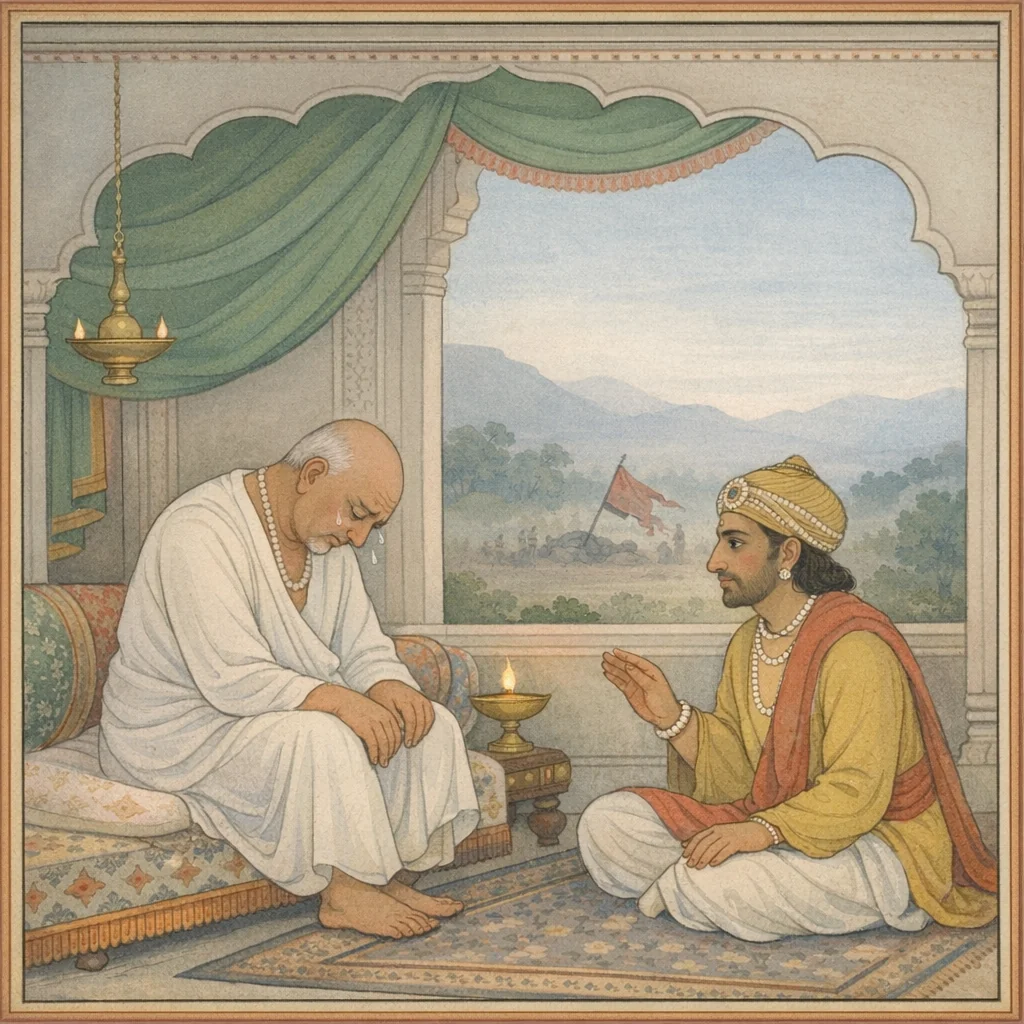
Adhyaya 9
धृतराष्ट्रस्य मूर्च्छा तथा द्रोणविषयकप्रश्नाः (Dhṛtarāṣṭra’s Fainting and Questions Concerning Droṇa)
Upa-parva: Droṇābhimukha-prayāṇa (Encirclement Queries and Approaches toward Droṇa)
Vaiśaṃpāyana narrates that Dhṛtarāṣṭra, overwhelmed by grief after questioning Sañjaya, collapses and is revived by attendants with cold water and fanning; palace women lift him and seat him. Regaining consciousness, the trembling king resumes interrogation, repeatedly asking who could restrain specific Pāṇḍava-aligned champions advancing toward Droṇa. The chapter builds a rhetorical inventory: Arjuna’s approach is described through storm-and-thunder imagery (Gāṇḍīva’s roar; arrow-rain; chariot-sound), while other figures—Bhīma, the twins, Sātyaki, Dhṛṣṭadyumna, Śikhaṇḍin, Abhimanyu, the Draupadeyas, allied kings, and Ghaṭotkaca—are praised via epithets stressing discipline, courage, and near-invincibility. The sequence culminates in a theological reassurance: Nārāyaṇa/Kṛṣṇa as the Pāṇḍavas’ support, implying that defeat is improbable when divine guidance aligns with their cause, and foreshadowing continued narration of Kṛṣṇa’s “divine deeds” for inner steadiness.
Chapter Arc: धृतराष्ट्र को रणभूमि से यह असह्य समाचार मिलता है कि आचार्य द्रोण—जिन्हें वह अजेय मानता था—मारे गए। राजा का हृदय शोक और अविश्वास से भर उठता है और वह संजय से बार-बार पूछता है: यह कैसे संभव हुआ? → धृतराष्ट्र द्रोण की अपराजेयता का स्मरण करता है—उनके दिव्यास्त्र, स्वर्ण-पंखों वाले बाणों की वर्षा, और शत्रुओं को रौंदती उनकी रथ-चाल। वह संभावनाएँ गिनता है: क्या रथ टूट गया, क्या धनुष खंडित हुआ, क्या वे प्रमत्त हुए? फिर वह युद्ध-व्यवस्था पर प्रश्न उठाता है—कौन-कौन वीर उनके आगे-पीछे रक्षा में लगे थे, और वे कैसे हटे? → राजा का शोक क्रोध में बदलता है: ‘सिंह-हाथी समान पराक्रमी द्रोण का वध मैं नहीं सह सकता।’ वह द्रोण-वध को केवल पराक्रम का नहीं, व्यवस्था-भंग और भाग्य-प्रहार का परिणाम मानने लगता है—और पुरुषार्थ को भी अनर्थ का कारण कहकर दैव को श्रेष्ठ ठहराता है। → अध्याय का निष्कर्ष धृतराष्ट्र के भीतर टूटते भरोसे में है: द्रोण के गिरने से कौरव-सेना की ढाल टूट गई, और राजा का मन भविष्य के अनिष्ट की ओर झुक जाता है। संजय के उत्तर की प्रतीक्षा में धृतराष्ट्र का विलाप और प्रश्न-श्रृंखला ही इस अध्याय का स्थायी स्वर बनती है। → संजय से धृतराष्ट्र का आग्रह बना रहता है—‘विस्तार से बताओ: द्रोण के निकट कौन थे, अर्जुन ने किसे रोका, और पार्षत (धृष्टद्युम्न) कैसे द्रोण तक पहुँचा?’
Shlokas
Verse 1
(दाक्षिणात्य अधिक पाठका १ श्लोक मिलाकर कुल ३७ “लोक हैं।) नवमो<्ध्याय: द्रोणाचार्यकी मृत्युका समाचार सुनकर धृतराष्ट्रका शोक करना धृतराष्ट उवाच कि कुर्वाणं रणे द्रोणं जघ्नु: पाण्डवसूंजया: । तथा निपुणमस्त्रेषु सर्वशस्त्रभूतामपि,धृतराष्ट्र बोले--संजय! रणक्षेत्रमें द्रोणाचार्य क्या कर रहे थे कि पाण्डव तथा सूंजय उनपर चोट कर सके? वे तो सम्पूर्ण शस्त्रधारियोंमें श्रेष्ठ और अस्त्र-विद्यामें निपुण थे
Dhṛtarāṣṭra said: “Sañjaya, what was Droṇa doing on the battlefield that the Pāṇḍavas and the Sṛñjayas were able to strike him down? He was supremely skilled in missile-weapons and, indeed, foremost among all who bear arms.”
Verse 2
रथभज़ो बभूवास्य थनुर्वाशीर्यतास्यत: । प्रमत्तो वाभवद् द्रोणस्ततो मृत्युमुपेयिवान्,उनका रथ टूट गया था या बाणोंका प्रहार करते समय धनुष ही खण्डित हो गया था अथवा द्रोणाचार्य असावधान थे, जिससे उनकी मृत्यु हो गयी?
Dhṛtarāṣṭra said: “Was his chariot shattered, or did his bow break while he was discharging arrows? Or was Droṇa inattentive—so that, as a result, he met with death?”
Verse 3
कथं नु पार्षतस्तात शत्रुभिर्दुष्प्रधर्षणम् किरन्तमिषुसंघातान् रुक्मपुड्खाननेकश:,तात! द्रोणाचार्य तो शत्रुओंके लिये सर्वथा दुर्जय थे। वे सुवर्णमय पंखवाले बाणसमूहोंकी बारंबार वर्षा करते थे। उनके हाथोंमें फुर्ती थी। वे विचित्र रीतिसे युद्ध करनेवाले और विद्वान थे। दूरतक बाण मारनेवाले और अस्त्र-युद्धमें पारंगत थे। फिर उन जितेन्द्रिय दिव्यास्त्रधारी और अपनी मर्यादासे कभी च्युत न होनेवाले द्विजश्रेष्ठ द्रोणाचार्यको पांचालराजकुमार धृष्टद्युम्नने कैसे मार दिया? वे तो रणक्षेत्रमें कठोर कर्म करनेवाले, विजयके लिये प्रयत्नशील और महारथी वीर थे
Dhṛtarāṣṭra said: “How, dear one, did the son of Pārṣata (Dhṛṣṭadyumna) manage to slay Droṇa—who was invincible to enemies—while he kept showering countless volleys of arrows with golden feathers? Droṇa was a disciplined Brahmin-warrior, steadfast in his own code, master of divine weapons and the science of arms, and a mighty chariot-fighter intent on victory. By what means, then, was such a formidable teacher brought down on the battlefield?”
Verse 4
क्षिप्रहस्तं द्विजश्रेष्ठ कृतिनं चित्रयोधिनम् दूरेषुपातिनं दान्तमस्त्रयुद्धेषु पारगम्,तात! द्रोणाचार्य तो शत्रुओंके लिये सर्वथा दुर्जय थे। वे सुवर्णमय पंखवाले बाणसमूहोंकी बारंबार वर्षा करते थे। उनके हाथोंमें फुर्ती थी। वे विचित्र रीतिसे युद्ध करनेवाले और विद्वान थे। दूरतक बाण मारनेवाले और अस्त्र-युद्धमें पारंगत थे। फिर उन जितेन्द्रिय दिव्यास्त्रधारी और अपनी मर्यादासे कभी च्युत न होनेवाले द्विजश्रेष्ठ द्रोणाचार्यको पांचालराजकुमार धृष्टद्युम्नने कैसे मार दिया? वे तो रणक्षेत्रमें कठोर कर्म करनेवाले, विजयके लिये प्रयत्नशील और महारथी वीर थे
Dhṛtarāṣṭra said: “O best of the twice-born, Droṇa was swift-handed, accomplished, and a warrior of varied and ingenious methods. He could strike from afar with his arrows, was self-controlled, and had mastered the science of fighting with weapons. How, then, did Dhṛṣṭadyumna, the prince of the Pāñcālas, manage to slay that foremost brāhmaṇa—unyielding in battle, ever striving for victory, a mighty chariot-warrior—who seemed in every way unconquerable to his enemies?”
Verse 5
पाज्चालपुत्रो न्यवधीद् दिव्यास्त्रधरमच्युतम् । कुर्वाणं दारुणं कर्म रणे यत्तं महारथम्,तात! द्रोणाचार्य तो शत्रुओंके लिये सर्वथा दुर्जय थे। वे सुवर्णमय पंखवाले बाणसमूहोंकी बारंबार वर्षा करते थे। उनके हाथोंमें फुर्ती थी। वे विचित्र रीतिसे युद्ध करनेवाले और विद्वान थे। दूरतक बाण मारनेवाले और अस्त्र-युद्धमें पारंगत थे। फिर उन जितेन्द्रिय दिव्यास्त्रधारी और अपनी मर्यादासे कभी च्युत न होनेवाले द्विजश्रेष्ठ द्रोणाचार्यको पांचालराजकुमार धृष्टद्युम्नने कैसे मार दिया? वे तो रणक्षेत्रमें कठोर कर्म करनेवाले, विजयके लिये प्रयत्नशील और महारथी वीर थे
Dhṛtarāṣṭra said: “How did the son of the Pāñcālas slay Droṇa—unyielding in his vows, a master of divine weapons—when that great chariot-warrior was striving in battle and performing fierce deeds? Droṇa seemed invincible to his foes; so by what means was such a disciplined, formidable teacher brought down?”
Verse 6
व्यक्त हि दैवं बलवत् पौरुषादिति मे मति: । यद् द्रोणो निहतः शूर: पार्षतेन महात्मना,निश्चय ही पुरुषार्थकी अपेक्षा दैव ही प्रबल है, ऐसा मेरा विश्वास है; क्योंकि द्रोणाचार्य- जैसे शूरवीर महामना धृष्टद्युम्नके हाथसे मारे गये
Dhṛtarāṣṭra said: “To me it is evident that destiny is stronger than human effort; for Droṇa—though a heroic warrior—has been slain by the great-souled son of Pṛṣata (Dhṛṣṭadyumna).”
Verse 7
अस्त्र॑ चतुर्विधं वीरे यस्मिन्नासीत् प्रतिष्तितम् तमिष्वस्त्रधराचार्य द्रोणं शंससि मे हतम्,जिन वीर सेनापतिमें चार प्रकारके अस्त्र प्रतिष्ठित थे, उन धनुर्धरोंके आचार्य द्रोणको तुम मुझे मारा गया बता रहे हो
Dhṛtarāṣṭra said: “In that heroic warrior in whom the fourfold science of weapons stood firmly established—Drona, the preceptor of archers and masters of missiles—you are telling me that he has been slain. How can such a pillar of martial discipline and duty have fallen in this war?”
Verse 8
श्रुत्वा हतं रुक्मरथं वैयातच्रपरिवारितम् । जातरूपशिरस्त्राणं नाद्य शोकमपानुदे,व्याप्रचर्मसे आच्छादित सुवर्णमय रथपर आरूढ़ हो सुनहरा शिरस्त्राण (टोप या पगड़ी) धारण करनेवाले द्रोणाचार्यको मारा गया सुनकर आज मैं अपने शोकको किसी प्रकार दूर नहीं कर पाता हूँ
“Hearing that Droṇa—mounted upon a golden chariot, surrounded by protective coverings, and wearing a golden helmet—has been slain, I find that today I cannot, by any means, drive away my sorrow.”
Verse 9
न नूनं परदु:खेन प्रियते कोडपि संजय । यत्र द्रोणमहं श्रुत्वा हतं जीवामि मन्दधी:,संजय! निश्चय ही कोई भी दूसरेके दुःखसे नहीं मरता है, तभी तो मैं मन्दबुद्धि मनुष्य द्रोणाचार्यको मारा गया सुनकर भी जी रहा हूँ इति श्रीमहाभारते द्रोणपर्वणि द्रोणाभिषेकपर्वणि धृतराष्ट्रशोके नवमो<ध्याय: ।। ९ || इस प्रकार श्रीमहाभारत द्रोणपर्वके अन्तर्गत द्रोणाभिषेकपर्वमें धृतराष्रका शोकविषयक नवाँ अध्याय पूरा हुआ
Dhṛtarāṣṭra said: “Surely no one dies from another’s suffering, Sañjaya—for I, dull-witted as I am, still remain alive even after hearing that Droṇa has been slain.”
Verse 10
दैवमेव परं मन्ये नन्वनर्थ हि पौरुषम् | अश्मसारमयं नून॑ हृदयं सुदृढे मम
Dhṛtarāṣṭra said: “I now regard fate alone as supreme; for human effort seems truly futile. Surely my heart must be made of stone-essence—unyielding and hard—for I have endured and persisted in this ruin.”
Verse 11
ब्राह्मे दैवे तथेष्वस्त्रे यमुपासन् गुणार्थिन:
Dhṛtarāṣṭra said: “Seeking excellence and mastery, they worshipped him through Brahmanic rites, divine observances, and the discipline of weapons.”
Verse 12
शोषणं सागरस्येव मेरोरिव विसर्पणम्
Dhṛtarāṣṭra speaks in a tone of foreboding, using stark similes: what is being attempted or unfolding seems as impossible and unnatural as drying up the ocean, or making Mount Meru slip from its place.
Verse 13
दुष्टानां प्रतिषेद्धा5डसीद् धार्मिकाणां च रक्षिता
Dhṛtarāṣṭra said: “He stood as a restrainer of the wicked and as a protector of the righteous.”
Verse 14
यो5हासीत् कृपणस्यार्थे प्राणानपि परंतप: । शत्रुओंको संताप देनेवाले द्रोणाचार्य दुष्टोंको दण्ड देनेवाले और धार्मिकोंके रक्षक थे। उन्होंने मुझ कृपणके लिये अपने प्राणतक दे दिये ।। १३ ई ।। मन्दानां मम पुत्राणां जयाशा यस्य विक्रमे
Dhṛtarāṣṭra said: “For my sake—wretched as I am—he was ready to give up even his life, O scorcher of foes. Droṇācārya, who tormented enemies, punished the wicked, and protected the righteous—on my account he sacrificed even his very life. And it was upon his prowess that my dull-witted sons fastened their hope of victory.”
Verse 15
बृहस्पत्युशनस्तुल्यो बुद्धथया स निहतः कथम् | मेरे मूर्ख पुत्रोंकोी जिनके ही पराक्रमके भरोसे विजयकी आशा बनी हुई थी तथा जो बुद्धिमें बृहस्पति और शुक्राचार्यके समान थे, वे द्रोणाचार्य कैसे मारे गये? ।। १४ इ ।। ते च शोणा बृहन्तो<श्वाश्छन्ना जालैहिरिण्मयै:,जिनके रंग लाल थे, जो विशाल एवं दृढ़ शरीरवाले थे, जिन्हें सोनेकी जालियोंसे आच्छादित किया जाता था, जो रथमें जोते जानेपर वायुके समान वेगसे चलते थे, संग्राममें सब प्रकारके शस्त्रोंद्वारा किये जानेवाले प्रहारको बचा जाते थे, जो बलवान, सुशिक्षित और रथको अच्छी तरह वहन करनेवाले थे, रणभूमिमें जो दृढ़तापूर्वक डटे रहते और जोर- जोरसे हिनहिनाते थे, धनुषोंकी टंकारके साथ होनेवाली बाणवर्षा तथा अस्त्र-शस्त्रोंके आधघातको सहन करनेमें समर्थ एवं शत्रुओंको जीतनेका उत्साह रखनेवाले थे, जो पीड़ा तथा श्वासको जीत चुके थे, वे सिन्धुदेशीय घोड़े युद्ध-स्थलमें चिग्घाड़ते हुए हाथियों और शंखों एवं नगाड़ोंकी आवाजसे घबराये तो नहीं थे?
Dhṛtarāṣṭra said: “How was he slain—he whose intellect was equal to Bṛhaspati and Uśanas (Śukrācārya)? On the strength of whose prowess my foolish sons still held their hope of victory—how could Droṇācārya be killed?”
Verse 16
रथे वातजवा युक्ता: सर्वशस्त्रातिगा रणे । बलिनो ह्वेषिणो दान्ता: सैन्धवा: साधुवाहिन:,जिनके रंग लाल थे, जो विशाल एवं दृढ़ शरीरवाले थे, जिन्हें सोनेकी जालियोंसे आच्छादित किया जाता था, जो रथमें जोते जानेपर वायुके समान वेगसे चलते थे, संग्राममें सब प्रकारके शस्त्रोंद्वारा किये जानेवाले प्रहारको बचा जाते थे, जो बलवान, सुशिक्षित और रथको अच्छी तरह वहन करनेवाले थे, रणभूमिमें जो दृढ़तापूर्वक डटे रहते और जोर- जोरसे हिनहिनाते थे, धनुषोंकी टंकारके साथ होनेवाली बाणवर्षा तथा अस्त्र-शस्त्रोंके आधघातको सहन करनेमें समर्थ एवं शत्रुओंको जीतनेका उत्साह रखनेवाले थे, जो पीड़ा तथा श्वासको जीत चुके थे, वे सिन्धुदेशीय घोड़े युद्ध-स्थलमें चिग्घाड़ते हुए हाथियों और शंखों एवं नगाड़ोंकी आवाजसे घबराये तो नहीं थे?
Dhṛtarāṣṭra said: “Were the Sindhu-bred horses—yoked to the chariots and swift as the wind—unharmed in battle, able to evade every kind of weapon-stroke? Strong, well-trained, and well-broken, bearing the chariot properly, did they stand firm on the field and neigh loudly, enduring the snap of bowstrings, the rain of arrows, and the clash of arms without losing heart?”
Verse 17
दृढा: संग्राममध्येषु कच्चिदासन्नविह्नला: । करिणां बूंहतां युद्धे शड्खदुन्दुभिनि:स्वनै:,जिनके रंग लाल थे, जो विशाल एवं दृढ़ शरीरवाले थे, जिन्हें सोनेकी जालियोंसे आच्छादित किया जाता था, जो रथमें जोते जानेपर वायुके समान वेगसे चलते थे, संग्राममें सब प्रकारके शस्त्रोंद्वारा किये जानेवाले प्रहारको बचा जाते थे, जो बलवान, सुशिक्षित और रथको अच्छी तरह वहन करनेवाले थे, रणभूमिमें जो दृढ़तापूर्वक डटे रहते और जोर- जोरसे हिनहिनाते थे, धनुषोंकी टंकारके साथ होनेवाली बाणवर्षा तथा अस्त्र-शस्त्रोंके आधघातको सहन करनेमें समर्थ एवं शत्रुओंको जीतनेका उत्साह रखनेवाले थे, जो पीड़ा तथा श्वासको जीत चुके थे, वे सिन्धुदेशीय घोड़े युद्ध-स्थलमें चिग्घाड़ते हुए हाथियों और शंखों एवं नगाड़ोंकी आवाजसे घबराये तो नहीं थे?
Dhṛtarāṣṭra said: “Were they steadfast and unshaken in the midst of battle? Amid the clash of war—when great elephants were trumpeting and conches and kettledrums resounded—did they remain undismayed?”
Verse 18
ज्याक्षेपशरवर्षाणां शस्त्राणां च सहिष्णव: । आशंसन्त: पराज्जेतुं जितश्वासा जितव्यथा:,जिनके रंग लाल थे, जो विशाल एवं दृढ़ शरीरवाले थे, जिन्हें सोनेकी जालियोंसे आच्छादित किया जाता था, जो रथमें जोते जानेपर वायुके समान वेगसे चलते थे, संग्राममें सब प्रकारके शस्त्रोंद्वारा किये जानेवाले प्रहारको बचा जाते थे, जो बलवान, सुशिक्षित और रथको अच्छी तरह वहन करनेवाले थे, रणभूमिमें जो दृढ़तापूर्वक डटे रहते और जोर- जोरसे हिनहिनाते थे, धनुषोंकी टंकारके साथ होनेवाली बाणवर्षा तथा अस्त्र-शस्त्रोंके आधघातको सहन करनेमें समर्थ एवं शत्रुओंको जीतनेका उत्साह रखनेवाले थे, जो पीड़ा तथा श्वासको जीत चुके थे, वे सिन्धुदेशीय घोड़े युद्ध-स्थलमें चिग्घाड़ते हुए हाथियों और शंखों एवं नगाड़ोंकी आवाजसे घबराये तो नहीं थे?
Dhṛtarāṣṭra said: “Those (Sindhu) horses—able to endure the snap of bowstrings and the rain of arrows, and also the blows of weapons; hoping to vanquish the foe; having mastered their breath and overcome pain—did they not lose heart on the battlefield?”
Verse 19
हया: पराजिता: शीघ्रा भारद्वाजरथोद्वहा: । ते सम रुक्मरथे युक्ता नरवीरसमास्थिता:
Dhṛtarāṣṭra said: “The swift horses that drew Bhāradvāja’s chariot have been overcome. Yet those very horses, harnessed again to a chariot adorned with gold, stand firm under the control of heroic warriors.”
Verse 20
जातरूपपरिष्कारमास्थाय रथमुत्तमम्
Dhṛtarāṣṭra said: “Having mounted an excellent chariot, richly adorned with worked gold…”
Verse 21
विद्यां यस्पोपजीवन्ति सर्वलोकधनुर्धरा:
Dhṛtarāṣṭra speaks of those master-archers renowned across the world who sustain themselves by their learning—living by the discipline and skill of their acquired knowledge, especially the science of arms.
Verse 22
दिवि शक्रमिव श्रेष्ठ महामात्र धनुर्भुताम्
Dhṛtarāṣṭra compares a foremost warrior—an eminent commander among archers—to Indra in heaven, highlighting the awe such martial excellence inspires even amid the moral darkness of war.
Verse 23
ननु रुक्मरथं दृष्टवा प्राद्रवन्ति सम पाण्डवा:
Dhṛtarāṣṭra said: “Surely, on seeing Rukmaratha, the Pāṇḍavas at once rushed forward.” The line conveys the king’s anxious attention to battlefield momentum—how the sight of a particular warrior can trigger immediate tactical movement and renewed engagement in the struggle for a righteous outcome amid war’s moral strain.
Verse 24
दिव्यमस्त्रं विकुर्वाणं रणे तस्मिन् महाबलम् | उस समरांगणमें दिव्य अस्त्रोंका प्रयोग करनेवाले तथा सुवर्णमय रथपर आरूढ़ हुए महाबली द्रोणाचार्यको देखकर तो समस्त पाण्डव-योद्धा भाग खड़े होते थे ।। उताहो सर्वसैन्येन धर्मराज: सहानुज:
Dhṛtarāṣṭra said: “In that battle, when the mighty one was unleashing celestial weapons, even Dharmarāja (Yudhiṣṭhira), together with his younger brothers and supported by the entire army, was shaken and compelled to respond…”
Verse 25
नूनमावारयत् पार्थों रथिनो<न्यानजिह्ागै:
Dhṛtarāṣṭra said: “Surely Pārtha (Arjuna) has checked the other chariot-warriors, holding them back as if with swift, unerring serpents.”
Verse 26
न हाहं परिपश्यामि वधे कज्चन शुष्मिण:
Dhṛtarāṣṭra said: “Alas, I do not see any man of fiery prowess who can bring about his death.”
Verse 27
तैर्वतः सर्वतः शूर: पाउ्चाल्यापसदस्तत:
Dhṛtarāṣṭra said: “Then that hero was hemmed in on all sides by them—by the low and ignoble men among the Pāñcālas.”
Verse 28
केक्यैश्रेदिकारूषैर्मस्स्यैरन्यैश्व भूमिपै: । व्याकुलीकृतमाचार्य पिपीलैरुरगं यथा
Dhṛtarāṣṭra said: “O Ācārya, you have been thrown into turmoil by the Kekayas, the Cedis, the Kāruṣas, the Matsyas, and other kings—just as a serpent is harried and agitated when swarmed by ants.”
Verse 29
कर्मण्यसुकरे सक्तं जघानेति मतिर्मम । केकय, चेदि, कारूष, मत्स्यदेशीय सैनिकों तथा अन्य भूमिपालोंने आचार्यको उसी प्रकार व्याकुल कर दिया होगा, जैसे बहुत-सी चींटियाँ सर्पको विह्नल कर देती हैं; उसी अवस्थामें उन पाण्डव सैनिकोंद्वारा सब ओरसे घिरे हुए नीच धृष्टद्युम्नने दुष्कर कर्ममें लगे हुए द्रोणाचार्यको मार डाला होगा, यही बात मेरे मनमें आती है || २७-२८ $ || यो<धीत्य चतुरो वेदान् साड्ानाख्यानपञ्चमान्
Dhṛtarāṣṭra said: “This is the thought that rises in my mind: while Droṇa was absorbed in a task hard to accomplish, the Kekayas, Cedis, Kārūṣas, the soldiers of the Matsya country, and other kings must have harried the Teacher on every side—just as a swarm of ants can bewilder a serpent. In that very condition, hemmed in from all directions by the Pāṇḍava forces, the base Dhṛṣṭadyumna must have slain Droṇācārya while he was engaged in that difficult duty.”
Verse 30
ब्राह्मणानां प्रतिष्ठा35सीत् स्रोतसामिव सागर: । क्षत्रं च ब्रह्म चैवेह यो5भ्यतिष्ठत् परंतप:
He was the firm support of the Brahmins, like the ocean that receives and steadies the rivers’ currents. Here he upheld both royal power and sacred knowledge together—he, the scorcher of foes.
Verse 31
स कथं ब्राह्म॒णो वृद्ध: शस्त्रेण वधमाप्तवान् । जो छहों अंगों तथा पंचम वेदस्थानीय इतिहास-पुराणोंसहित चारों वेदोंका अध्ययन करके ब्राह्मणोंके लिये उसी प्रकार आश्रय बने हुए थे, जैसे नदियोंके लिये समुद्र हैं। जो शत्रुओंको संताप देनेवाले तथा ब्राह्मण एवं क्षत्रिय दोनोंके धर्मोका अनुष्ठान करनेवाले थे, वे वृद्ध ब्राह्मण द्रोणाचार्य शस्त्रद्वारा कैसे मारे गये? ।। अमर्षिणा मर्षितवान् क्लिश्यमानान् सदा मया
Dhṛtarāṣṭra said: “How did that aged brāhmaṇa meet his death by a weapon? He who had mastered the Vedas together with the six auxiliaries and the fifth ‘Veda’—the Itihāsa and Purāṇa—who stood as a refuge for brāhmaṇas as the ocean is for rivers; he who tormented enemies and yet observed the duties of both brāhmaṇa and kṣatriya—how was that elder, Droṇācārya, slain by arms? And I, though not given to anger, have long endured this suffering.”
Verse 32
यस्य कर्मानुजीवन्ति लोके सर्वधनुर्भुतः
Dhṛtarāṣṭra said: “He whose deeds sustain the lives and livelihoods of all bow-bearing warriors in the world.”
Verse 33
स सत्यसंध: सुकृती श्रीकामैर्निहत: कथम् । जगतके सम्पूर्ण धनुर्धर जिनके शिक्षणरूपी कर्मका आश्रय लेकर जीवन-निर्वाह करते हैं, उन सत्यप्रतिज्ञ पुण्यात्मा द्रोणाचार्यको राजलक्ष्मीके लोभियोंने कैसे मार डाला? ।। ३२ ई || दिवि शक्र इव श्रेष्ठोी महासत्त्वो महाबल:
How was Droṇācārya—true to his vow and rich in merit—slain by those who coveted royal fortune? For all archers in the world make their living by relying on his work of instruction.
Verse 34
क्षिप्रहस्तश्न बलवान् दृढ्धन्वारिमर्दन:,ब्राह्मश्व वेदकामानां ज्याघोषश्न धनुष्मताम् । जो शीघ्रतापूर्वक हाथ चलानेवाले, बलवान, दृढ्धन्वा तथा शत्रुओंका मर्दन करनेवाले थे, कोई भी विजयाभिलाषी वीर जिनके बाणोंका लक्ष्य बन जानेपर जीवित नहीं रह सकता था, जिन्हें जीते-जी दो शब्दोंने कभी नहीं छोड़ा था--एक तो वेदाध्ययनकी इच्छावाले लोगोंके समक्ष वेदध्वनिका शब्द और दूसरा धनुर्धारियोंके बीचमें प्रत्यंचाकी टंकारका शब्द
Dhṛtarāṣṭra said: “He was swift-handed, powerful, firm in his bow, and a crusher of enemies. Before those who longed for sacred learning, he was like the very sound of the Veda; and among archers, he was the twang of the bowstring—ever a sign of disciplined mastery. Once he made someone the target of his arrows, little hope of survival remained for any hero who sought victory.”
Verse 35
न यस्य विजयाकाडूभक्षी विषयं प्राप्प जीवति । यं द्ौन जहत: शब्दौ जीवमानं कदाचन
Dhṛtarāṣṭra said: “He who, even after attaining the objects of desire, does not live as one hungry for victory—him Droṇa would never abandon, at any time, while he still lives.”
Verse 36
अदीनं पुरुषव्याघत्रं हवीमनतमपराजितम्
Dhṛtarāṣṭra said: “(I behold) that undaunted tiger among men—unbowed in spirit and unconquered.”
Verse 37
कथं संजय दुर्धर्षमनाधृष्यशोबलम्
Dhṛtarāṣṭra said: “How, O Sañjaya, could that formidable one—hard to withstand and radiant with unassailable splendor—be dealt with?”
Verse 38
पश्यतां पुरुषेन्द्राणां समरे पार्षतो5वधीत् । संजय! जिनके यश और बलका तिरस्कार होना असम्भव था, उन दुर्धर्ष वीर द्रोणाचार्यको समरभूमिमें सम्पूर्ण नरेशोंके देखते-देखते धृष्टद्युम्नने कैसे मार डाला? ।। के पुरस्तादयुध्यन्त रक्षन्तो द्रोणमन्तिकात्
Dhṛtarāṣṭra said: “Before the very eyes of the foremost kings on the battlefield, Pārṣata (Dhṛṣṭadyumna) slew Droṇācārya— that unassailable hero whose fame and strength could not be slighted. Sañjaya, how did Dhṛṣṭadyumna kill Droṇa on the field of war while all the rulers looked on? And who were those fighting in front, guarding Droṇa from close at hand?”
Verse 39
केडरक्षन् दक्षिणं चक्रं सव्यं के च महात्मन:,कौन वीर उन महात्माके दाहिने पहियेकी और कौन बायें पहियेकी रक्षा करते थे? कौन उस युद्धस्थलमें युद्धपरायण वीरवर द्रोणाचार्यके आगे थे और किन लोगोंने अपने शरीरका मोह छोड़कर विपक्षियोंका सामना करते हुए उस रणक्षेत्रमें मृत्युका वरण किया था
Dhṛtarāṣṭra said: “Who guarded the right wheel of that formation, and who the left, O noble one? Which heroes stood in front of Droṇa—ever intent on battle—upon that field? And which men, casting off attachment to their bodies, confronted the opposing warriors and chose death on that battlefield?”
Verse 40
पुरस्तात् के च वीरस्य युध्यमानस्य संयुगे | के च तस्मिंस्तनूंस्त्यकत्वा प्रतीपं मृत्युमाव्रजन्,कौन वीर उन महात्माके दाहिने पहियेकी और कौन बायें पहियेकी रक्षा करते थे? कौन उस युद्धस्थलमें युद्धपरायण वीरवर द्रोणाचार्यके आगे थे और किन लोगोंने अपने शरीरका मोह छोड़कर विपक्षियोंका सामना करते हुए उस रणक्षेत्रमें मृत्युका वरण किया था
Dhṛtarāṣṭra said: “Who stood in front of that hero as he fought in the thick of battle? Who guarded his right wheel and who his left? And who, casting off attachment to their bodies, faced the opposing warriors and chose death on that field?”
Verse 41
द्रोणस्य समरे वीरा: के5कुर्वन्त परां धृतिम् कच्चिन्नैनं भयान्मन्दा: क्षत्रिया व्यजहन् रणे
Dhṛtarāṣṭra said: “In Droṇa’s battle, which heroes are showing the highest steadfastness? Surely the Kṣatriyas—faint-hearted from fear—have not abandoned him on the battlefield?”
Verse 42
रक्षितारस्तत: शून्ये कच्चित् तैर्न हतः परै: । किन वीरोंने युद्धमें द्रोणाचार्यको उत्तम धैर्य प्रदान किया? उनकी रक्षा करनेवाले मूर्ख क्षत्रियोंने भयभीत होकर युद्धस्थलमें उन्हें अकेला तो नहीं छोड़ दिया? और इस प्रकार शत्रुओंने सूनेमें तो उन्हें नहीं मार डाला? ।। ४१ $ ।। न स पृष्ठमरेस्त्रासाद् रणे शौर्यात् प्रदर्शयेत्
Dhṛtarāṣṭra said: “When his protectors were no longer around and he was left in an open, unguarded situation, was Droṇācārya not struck down by the enemy? Which heroes in battle gave Droṇa the highest steadiness of courage? Or did the foolish kṣatriyas appointed to guard him, seized by fear, abandon him on the battlefield—so that the foes killed him when he stood alone? And surely a warrior, out of fear of enemies, should not turn his back in battle, but must display valor.”
Verse 43
परामप्यापदं प्राप्प स कथं निहत: परै: । जो बड़ी-से-बड़ी आपत्ति पड़नेपर भी रणमें अपने शौर्यके कारण शत्रुको भयवश पीठ नहीं दिखा सकते थे, वे विपक्षियोंद्वारा किस प्रकार मारे गये? || ४२ ई ।। एतदार्येण कर्तव्यं कृच्छास्वापत्सु संजय
Dhṛtarāṣṭra said: Even after encountering the gravest calamity, how was he slain by the enemy? He who, by the force of his valor, could not be made to show his back in battle out of fear—how did the opposing warriors manage to kill him? Tell me, Saṃjaya, what a noble man ought to do when pressed by harsh and desperate calamity.
Verse 44
पराक्रमेद् यथाशक्त्या तच्च तस्मिन् प्रतिष्ठितम् । संजय! बड़े भारी संकटमें पड़नेपर श्रेष्ठ पुरुषको यही करना चाहिये कि वह यथाशक्ति पराक्रम दिखावे; यह बात द्रोणाचार्यमें पूर्णरूपसे प्रतिष्ठित थी ।। ४३ $ ।। मुहाते मे मनस्तात कथा तावन्निवार्यताम् । भूयस्तु लब्धसंज्ञस्त्वां परिपृच्छामि संजय,तात! इस समय मेरा मन मोहित हो रहा है; अतः तुम यह कथा बंद करो! संजय! फिर होशमें आनेपर तुमसे यह समाचार पूछूँगा
Dhṛtarāṣṭra said: “In a great crisis, a noble man should display valor to the best of his ability; and this principle was firmly embodied in Droṇa. But now, dear one, my mind is overwhelmed—stop this account for the moment. When I regain composure, Sañjaya, I will question you again about these events.”
Verse 103
यच्छुत्वा निहतं द्रोणं शतधा न विदीर्यते । मैं तो दैवको ही श्रेष्ठ मानता हूँ। पुरुषार्थ तो अनर्थका ही कारण है। निश्चय ही मेरा यह अत्यन्त सुदृढ़ हृदय लोहेका बना हुआ है, जिससे द्रोणाचार्यको मारा गया सुनकर भी इसके सौ टुकड़े नहीं हो जाते
Dhṛtarāṣṭra said: “Hearing that Droṇa has been slain, my heart does not split into a hundred pieces. I regard fate alone as supreme; human effort seems only a cause of calamity. Surely this heart of mine is exceedingly hard—made of iron—for even on hearing that Droṇācārya has been killed, it does not break into a hundred fragments.”
Verse 116
ब्राह्मणा राजपुत्राश्न स कथं मृत्युना हृत: । गुणार्थी ब्राह्मण तथा राजकुमार ब्राह्म और दैव अस्त्रोंके लिये जिनकी उपासना करते थे, उन्हें मृत्यु कैसे हर ले गयी?
Dhṛtarāṣṭra said: “How could Death have taken him—one who was sought after by brāhmaṇas and princes alike, a brāhmaṇa devoted to excellence and virtue, and (as it were) a royal youth in dignity? How could such a man, revered for his spiritual power and honored by those who worship for divine weapons, be overcome?”
Verse 123
पतनं भास्करस्यथेव न मृष्ये द्रोणपातनम् । द्रोणका रणभूमिमें गिराया जाना समुद्रके सूखने, मेरु पर्वतके चलने-फिरने और सूर्यके आकाशसे टूटकर गिरनेके समान है। मैं इसे किसी प्रकार सहन नहीं कर पाता
Dhṛtarāṣṭra said: “I cannot endure Droṇa’s fall—just as one could not bear the sun itself falling. That Droṇa has been brought down on the battlefield seems to me like the ocean drying up, Mount Meru moving from its place, or the sun breaking from the sky and crashing down. I cannot, in any way, bear this.”
Verse 193
कथं नाभ्यतरंस्तात पाण्डवानामनीकिनीम् । क्या द्रोणाचार्यके रथको वहन करनेवाले वे शीघ्रगामी अश्व पराजित हो गये थे? तात! द्रोणाचार्यके सुवर्णमय रथमें जुते हुए और उन्हीं नरवीर आचार्यकी सवारीमें काम आनेवाले वे घोड़े पाण्डव-सेनाको पार कैसे नहीं कर सके?
Dhṛtarāṣṭra said: “How is it, dear one, that they could not break through and cross the Pandavas’ battle-array? Were those swift horses—yoked to Droṇācārya’s golden chariot and serving as the mount of that heroic teacher—somehow overcome, that they could not carry him through the Pandava host?”
Verse 206
भारद्वाज: किमकरोद् युधि सत्यपराक्रम: । उस सुवर्णभूषित उत्तम रथपर आरूढ़ हो सत्यपराक्रमी द्रोणाचार्यने युद्धस्थलमें क्या किया?
Dhṛtarāṣṭra said: “What did Bhāradvāja’s son—Droṇa, whose valor never fails—do in the battle? Mounted upon an excellent chariot adorned with gold, what action did the truth-steadfast, mighty Droṇācārya perform on the field of war?”
Verse 213
स सत्यसंधो बलवान् द्रोण: किमकरोदू युधि । समस्त जगतके धनुर्धर जिनकी विद्याका आश्रय लेकर जीवननिर्वाह करते हैं, उन सत्यपराक्रमी बलवान द्रोणाचार्यने युद्धमें क्या किया?
Dhṛtarāṣṭra said: “What did Droṇa do in the battle—Droṇa, steadfast in truth and mighty in strength? He is the powerful teacher of proven valor, upon whose martial knowledge the archers of the whole world depend for their livelihood; what, then, did Droṇācārya accomplish in the war?”
Verse 226
के नुतं रौद्रकर्माणं युद्धे प्रत्युद्ययू रथा: । स्वर्गमें देवराज इन्द्रके समान जो इस लोकमें श्रेष्ठ और समस्त धनुर्धरोंमें महान् थे, उन भयंकर कर्म करनेवाले द्रोणाचार्यका सामना करनेके लिये उस रणक्षेत्रमें कौन-कौनसे रथी गये थे?
Dhṛtarāṣṭra asked: “Who were the chariot-warriors that advanced in battle to confront Droṇācārya—he of fierce deeds, regarded in this world as foremost among all archers, and comparable to Indra, king of the gods, in heaven? On that battlefield, which champions went forth to face him?”
Verse 246
पाज्चाल्यप्रग्रहो द्रोणं सर्वतः समवारयत् । भाइयोंसहित धर्मराज युधिष्ठिरने अपनी सारी सेनाके साथ जाकर धृष्टद्युम्नरूपी डोरीकी सहायतासे द्रोणाचार्यको घेर तो नहीं लिया था?
Dhṛtarāṣṭra said: “Did the Pāñcāla forces not surround Droṇa on all sides—when Dharmarāja Yudhiṣṭhira, together with his brothers and the whole army, advanced and enclosed Droṇācārya with the aid of Dhṛṣṭadyumna, as though he were the restraining cord?”
Verse 266
धृष्टय्युम्नादृते रौद्रात् पाल्यमानात् किरीटिना । किरीटथधारी अर्जुनके द्वारा सुरक्षित भयंकर स्वभाववाले धृष्टद्युम्नको छोड़कर दूसरे किसीको मैं ऐसा नहीं देखता, जो अत्यन्त तेजस्वी द्रोणाचार्यके वधमें समर्थ हो
Dhṛtarāṣṭra said: “Except for the fierce Dhṛṣṭadyumna—who is being protected by the diadem-wearing Arjuna—I see no one else capable of slaying the supremely radiant Droṇācārya. Setting aside that formidable Dhṛṣṭadyumna, guarded by Arjuna, there is none whom I judge equal to the task of killing Droṇa.”
Verse 313
अनर्हमाणान् कौन्तेयान् कर्मणस्तस्य तत् फलम् | मैंने अमर्षमें भरकर सदा कष्ट भोगनेके अयोग्य कुन्तीकुमारोंको क्लेश ही दिया है; परंतु मेरे इस बर्तावको द्रोणाचार्यने चुपचाप सह लिया था। उनके उसी कर्मका यह वधरूपी फल प्राप्त हुआ है
Dhṛtarāṣṭra reflects with remorse: for a long time, out of smouldering resentment, he had inflicted only hardship upon the sons of Kuntī—men who did not deserve such suffering. Droṇācārya had silently endured that conduct; now Dhṛtarāṣṭra sees Droṇa’s death as the grim fruit of that very wrongdoing, returning as its consequence amid the war.
Verse 336
स कथं निहतः: पार्थ: क्षुद्रमत्स्यैर्यथा तिमि: । स्वर्गलोकमें इन्द्रके समान जो इस लोकमें सबसे श्रेष्ठ थे, उन महान् सत्त्वशाली, महाबली द्रोणाचार्यको कुन्तीके पुत्रोंने उसी प्रकार मार डाला, जैसे छोटे मत्स्योंने मिलकर तिमि नामक महामत्स्यको मार डाला हो। यह कैसे सम्भव हुआ?
Dhṛtarāṣṭra said: How was that Pārtha brought down—like the great fish Timi slain by a swarm of tiny fish? How could Kuntī’s sons kill Droṇācārya, that mighty and high-souled hero—Indra’s equal in heaven and the foremost among men in this world—just as small fish, joining together, might destroy a vast fish named Timi? How could such a thing be possible?
Verse 353
ब्राह्मश्व वेदकामानां ज्याघोषश्न धनुष्मताम् । जो शीघ्रतापूर्वक हाथ चलानेवाले, बलवान, दृढ्धन्वा तथा शत्रुओंका मर्दन करनेवाले थे, कोई भी विजयाभिलाषी वीर जिनके बाणोंका लक्ष्य बन जानेपर जीवित नहीं रह सकता था, जिन्हें जीते-जी दो शब्दोंने कभी नहीं छोड़ा था--एक तो वेदाध्ययनकी इच्छावाले लोगोंके समक्ष वेदध्वनिका शब्द और दूसरा धनुर्धारियोंके बीचमें प्रत्यंचाकी टंकारका शब्द
Dhṛtarāṣṭra said: “For those devoted to Vedic study there was the sound of Vedic recitation, and for the bowmen there was the twang of bowstrings.” The verse evokes two defining ‘sounds’ of a warrior’s world: sacred learning on one side and the relentless discipline of arms on the other—suggesting how, in this war, the ideals of knowledge and the force of battle stand side by side, each demanding unwavering commitment.
Verse 366
नाहं मृष्ये हतं द्रोणं सिंहद्विरदविक्रमम् । सिंह और हाथीके समान पराक्रमी, उदार, लज्जाशील और किसीसे पराजित न होनेवाले पुरुषसिंह द्रोणका वध मैं नहीं सहन कर सकता
Dhṛtarāṣṭra said: “I cannot endure that Droṇa has been slain—Droṇa whose prowess was like that of a lion and an elephant.” The lament underscores a king’s grief and attachment in the midst of war, where even the fall of a revered teacher becomes an unbearable moral and emotional shock.
Verse 383
के नु पश्चादवर्तन्त गच्छन्तो दुर्गमां गतिम् कौन-कौनसे वीर उस समय निकटसे द्रोणाचार्यकी रक्षा करते हुए उनके आगे रहकर युद्ध करते थे और कौन-कौन योद्धा दुर्गम मार्गपर पैर बढ़ाते हुए उनके पीछे रहकर रक्षा करते थे?
Dhṛtarāṣṭra asked: “As they advanced along that hard-to-traverse course, who fought in front to protect Droṇācārya, and who remained behind as the rear-guard, guarding him as they pressed on along that perilous path?”
Verse 2536
ततो द्रोणं समारोहत् पार्षत: पापकर्मकृत् । निश्चय ही अर्जुनने अपने सीधे जानेवाले बाणोंके द्वारा अन्य रथियोंको आगे बढ़नेसे रोक दिया था। इसीलिये पापकर्मा धृष्टद्युम्न द्रोणाचार्यपर चढ़ाई कर सका
Dhṛtarāṣṭra said: Then the son of Pṛṣata—Dṛṣṭadyumna, whose deeds are here branded as sinful—advanced against Droṇa. For Arjuna, with his straight-flying arrows, had decisively checked the other chariot-warriors from pressing forward; therefore Dṛṣṭadyumna, seizing that opening, was able to mount an assault upon Droṇācārya.
Frequently Asked Questions
The dilemma is interpretive and ethical: Dhṛtarāṣṭra’s paternal attachment drives him to seek assurances of Kaurava resistance, while the narrative exposes how emotional dependence can distort a ruler’s capacity to face consequences of prior choices.
The chapter illustrates that mental steadiness (dhṛti) is tested by adverse reports; disciplined inquiry must be paired with detachment, and reliance on higher principles (dharma/refuge in Nārāyaṇa) is presented as a stabilizing orientation.
A direct phalaśruti formula is not stated; however, a meta-narrative signal appears when the speaker indicates an intent to recount Nārāyaṇa’s divine deeds “with devotion” for personal steadiness, framing remembrance as spiritually and psychologically beneficial.