Adhyaya 48
अभिमन्युवधः (Abhimanyu’s Fall and the Battlefield Aftermath)
Upa-parva: Abhimanyu-vadha (Episode within Droṇa Parva)
Sañjaya reports a sequence of close-quarters engagements in which Abhimanyu (Saubhadra) advances with a raised gadā, striking down horses, charioteers, and multiple contingents, including notable allied groups and Duhśāsana’s chariot. Duhśāsana’s son counters with his own gadā; the two exchange heavy blows, collide, and fall, after which the Kaurava champion rises and strikes Abhimanyu on the head as he attempts to stand. Abhimanyu collapses unconscious and is described as a solitary hero overcome amid many. The chapter then shifts to collective reaction: Kauravas exult while Pāṇḍavas grieve; ominous sounds and nightfall imagery frame the field. Extended descriptive passages portray the battlefield as a terrifying landscape—strewn with weapons, bodies, broken standards, and animals—culminating in a metaphor of a fearsome river akin to Vaitaraṇī, where carrion beings feed. The closing verses return to the sight of Abhimanyu’s fallen, ornament-stripped form, emphasizing the moral dissonance between heroic radiance and the brutal materiality of war.
Chapter Arc: चक्रव्यूह के भीतर युवा अभिमन्यु अकेला पड़कर भी सिंहनाद करता है; कर्ण, शकुनि और अन्य महारथी उसे घेरते हैं, और युद्ध का स्वर एकाएक ‘एक बनाम अनेक’ हो उठता है। → कर्ण अभिमन्यु को प्रत्युत्तर में उतने ही तीखे बाणों से बेधता है; अभिमन्यु भी शत्रुंजय, चन्द्रकेतु, मेघवेग, सुवर्चस, सूर्यभास जैसे वीरों को गिराकर घेरा तोड़ता है। कर्ण के मन में भय और क्रोध साथ-साथ उठते हैं—वह स्वीकारता है कि इस कुमार के दारुण बाण उसके वक्ष को विदीर्ण कर रहे हैं और उसका कवच ‘अभेद्य’ है। → रक्त से रंगे वस्त्र, भ्रुकुटि-विकट मुख और सिंहनाद के साथ अभिमन्यु रण-मध्य में अद्भुत शोभा पाता है; परन्तु ‘छिद्रदर्शी’ योद्धा अवसर खोजते हैं और द्रोण तीव्रता से क्षुरप्र (रेज़र-तीर) चला कर अभिमन्यु के आयुध/सज्जा को क्षति पहुँचाने की दिशा में निर्णायक प्रहार करता है—घेरा कसता जाता है। → अध्याय का अंत अभिमन्यु की अपराजेय-सी उड़ान (गरुड़वत्) और शत्रुओं की संगठित, अवसरवादी रणनीति के आमने-सामने टिक जाने पर होता है—युद्ध का पलड़ा क्षण-क्षण डगमगाता है, पर अभिमन्यु अभी भी टूटता नहीं। → घोर घेराबंदी में आयुध-क्षय और ‘छिद्र’ खोजने वाले महारथियों के बीच अभिमन्यु पर अगला निर्णायक आघात आसन्न है—क्या उसका कवच और पराक्रम इस संयुक्त प्रहार को रोक पाएगा?
Shlokas
Verse 1
०: बछ। अकाल ज अष्टचत्वारिशो<् ध्याय: अभिमन्युद्वारा हैक भोज और कर्णके मन्त्री आदिका वध एवं छ: के साथ घोर युद्ध और उन महारथियोंद्वारा अभिमन्युके धनुष, रथ, ढाल और तलवारका नाश संजय उवाच स कर्ण कर्णिना कर्णे पुनर्विव्याध फाल्गुनि: । शरै: पञ्चाशता चैनमविध्यत् कोपयन् भूशम्,संजय कहते हैं--राजन्! तदनन्तर अर्जुनकुमार अभिमन्युने एक बाणद्दारा कर्णके कानमें पुनः चोट पहुँचायी और उसे क्रोध दिलाते हुए उसने पचास बाण मारकर अत्यन्त घायल कर दिया
Sanjaya said: O King, then Phālguni (Abhimanyu, the son of Arjuna) again pierced Karṇa in the ear with an arrow. Seeking to provoke him greatly, he struck Karṇa with fifty shafts, wounding him severely amid the fury of battle.
Verse 2
प्रतिविव्याध राधेयस्तावद्धिरथ त॑ पुन: । शरैराचितसर्वाड्रो बह्नशोभत भारत,भरतनन्दन! तब राधापुत्र कर्णने भी अभिमन्युको उतने ही बाणोंसे बींध डाला। उसका सारा अंग बाणोंसे व्याप्त होनेके कारण वह बड़ी शोभा पा रहा था
Sañjaya said: Then Rādheya (Karna) pierced him in return with just as many arrows, and again struck his chariot. Covered all over with arrows, he shone repeatedly—O Bhārata, O joy of the Bharatas. The scene underscores the grim reciprocity of battle: prowess answers prowess, and the very wounds that signal suffering become, in the warrior code, marks of fierce resolve and martial splendor.
Verse 3
कर्ण चाप्यकरोत् क्रुद्धो रुधिरोत्पीडवाहिनम् | कर्णोडपि विबभौ शूर: शरैश्छिन्नोडसृगाप्लुत:,(संध्यानुगतपर्यन्त: शरदीव दिवाकर: ।) फिर क्रोधमें भरे हुए अभिमन्युने कर्णको भी बाणोंसे क्षत-विक्षत करके उसे रक्तकी धारा बहानेवाला बना दिया। उस समय शूरवीर कर्ण भी बाणोंसे छिन्न-भिन्न और खूनसे लथपथ हो बड़ी शोभा पाने लगा, मानो शरत्कालका सूर्य संध्याके समय सम्पूर्णरूपसे लाल दिखायी दे रहा हो
Sañjaya said: Enraged, Abhimanyu struck Karṇa as well, wounding him so that streams of blood flowed. Even Karṇa, that heroic warrior—his body cut by arrows and drenched in blood—appeared resplendent at that moment, like the autumn sun glowing fully red at the edge of twilight. The verse frames the battlefield’s cruelty with a stark aesthetic simile, showing how valor and suffering are intertwined in the kṣatriya ordeal.
Verse 4
तावुभौ शरचित्राड्रौ रुधिरेण समुक्षितौ | बभूवतुर्महात्मानौ पुष्पिताविव किंशुकौ,उन दोनोंके शरीर बाणोंसे व्याप्त होनेके कारण विचित्र दिखायी देते थे। दोनों ही रक्तसे भींग गये तथा वे दोनों महामनस्वी वीर फूलोंसे भरे हुए पलाश-वृक्षके समान प्रतीत होते थे
Sañjaya said: Both of those great-souled warriors, their bodies made strangely patterned by a dense spread of arrows and drenched in blood, appeared like kiṃśuka (palāśa) trees in full bloom—beautiful to behold, yet born of the terrible harvest of battle.
Verse 5
अथ कर्णस्य सचिवान् षट् शूरांश्रित्रयोधिन: । साश्वसूतध्वजरथान् सौभद्रो निजघान ह,तदनन्तर सुभद्राकुमारने कर्णके विचित्र युद्ध करनेवाले छ: शूरवीर मन्त्रियोंको उनके घोड़े, सारथि, रथ तथा ध्वजसहित मार डाला
Sañjaya said: Then Abhimanyu, the son of Subhadrā, struck down six heroic ministers of Karṇa—fighters skilled with weapons—killing them together with their horses, charioteers, chariots, and standards.
Verse 6
तथेतरान् महेष्वासान् दशभिर्दशभि: शरै: । प्रत्यविध्यदसम्भ्रान्तस्तदद्भुतमिवाभवत्,इतना ही नहीं, उसने बिना किसी घबराहटके दस-दस बाणोंद्वारा अन्य महाधनुर्धरोंको भी आहत कर दिया। वह अद्भुत-सी बात थी
Sañjaya said: “And likewise, without the least agitation, he struck the other great bowmen too—ten arrows for each. The feat appeared almost wondrous.”
Verse 7
मागधस्य तथा पुत्र हत्वा षड़भिरजिद्वागै: । साश्वं ससूतं तरुणमश्वकेतुमपातयत्,इसी प्रकार उसने मगधराजके तरुण पुत्र अश्वकेतुको छ: बाणोंद्वारा मारकर उसे घोड़ों और सारथिसहित रथसे नीचे गिरा दिया
Sañjaya said: In the same manner, having struck down the son of the king of Magadha with six unfailing arrows, he felled the young Aśvaketu from his chariot—together with his horses and charioteer.
Verse 8
मार्तिकावतकं भोजं तत: कुज्जरकेतनम् | क्षुरप्रेण समुन्मथ्य ननाद विसृजन् शरान्,तत्पश्चात् हाथीके चिह्नसे युक्त ध्वजावाले मार्तिकावतक नरेश भोजको एक क्षुरप्रद्वारा नष्ट करके अभिमन्युने बाणोंकी वर्षा करते हुए सिंहनाद किया
Sañjaya said: Then Abhimanyu, striking down Bhoja of Mārtikāvata—whose banner bore the emblem of an elephant—by means of a razor-edged arrow, roared aloud like a lion while releasing a shower of shafts.
Verse 9
तस्य दौ:शासनिर्विद्ध्वा चतुर्भिश्नतुरों हयान् । सूतमेकेन विव्याध दशभिश्चार्जुनात्मजम्,तब दुःशासनकुमारने चार बाणोंद्वारा अभिमन्युके चारों घोड़ोंको घायल करके एकसे सारथिको और दस बाणोंद्वारा स्वयं अभिमन्युको बींध डाला
Sañjaya said: Then the son of Duḥśāsana, having struck him, wounded the four horses with four arrows; with a single arrow he pierced the charioteer, and with ten arrows he pierced Arjuna’s son, Abhimanyu.
Verse 10
ततो दौःशासरनिं कार्ष्णिविद्ध्वा सप्तभिराशुगै: । संरम्भाद् रक्तनयनो वाक्यमुच्चैरथाब्रवीत्,यह देख अर्जुनकुमारने क्रोधसे लाल आँखें करके सात बाणोंद्वारा दुःशासनपुत्रको बींध डाला और उच्च स्वरसे यह बात कही--
Sañjaya said: Then Kārṣṇi (Abhimanyu), striking the son of Duḥśāsana with seven swift arrows, and with eyes reddened in sudden fury, spoke aloud.
Verse 11
“अरे! तेरा पिता कायरकी भाँति युद्ध छोड़कर भाग गया है। सौभाग्यकी बात है कि तू भी युद्ध करना जानता है; किंतु आज तू जीवित नहीं छूट सकेगा”
“Hey! Your father fled the battle, abandoning it like a coward. It is fortunate, at least, that you know how to fight; but today you will not escape with your life.”
Verse 12
एतावदुक्त्वा वचन कर्मारपरिमार्जितम् । नाराचं विससर्जास्मै त॑ द्रौणिस्त्रिभिराच्छिनत्,यह वचन कहकर अभिमन्युने कारीगरके माँजे हुए एक नाराचको दुःशासनपुत्रपर चलाया; परंतु अश्वत्थामाने तीन बाण मारकर उसे बीचमें ही काट दिया
Sañjaya said: Having spoken only this much, Abhimanyu released at him a nārāca arrow, sharpened and polished like a smith’s finest work. But Aśvatthāman, son of Droṇa, struck it with three arrows and cut it down mid-flight.
Verse 13
पिता तवाह॒वं त्यक्त्वा गत: कापुरुषो यथा । दिष्ट्या त्वमपि जानीषे योर न त्वद्य मोक्ष्यसे,तस्यार्जुनिर्ध्वजं छित्त्वा शल्यं त्रेभिरताडयत् । त॑ं शल्यो नवभिर्बाणैर्गार्ध्रपत्रैरताडयत्
Sañjaya said: “Having abandoned the battle, your father has gone off like a coward. It is fortunate that you too understand this: ‘He will not escape today.’” With that resolve, Arjuna’s son cut down his banner and struck Śalya with three arrows. Śalya, in turn, retaliated by piercing him with nine arrows, feathered with vulture-plumes.
Verse 14
तस्यार्जुनिर्ध्वजं छित्त्वा हत्वोभौ पार्ष्णिसारथी
Sañjaya said: Arjuni (Abhimanyu), having cut down his banner, then slew both—his charioteer and the warrior who fought from the rear—thus pressing the battle forward with swift, uncompromising resolve amid the harsh ethics of war.
Verse 15
शत्रुंजयं चन्द्रकेतुं मेघवेगं सुवर्चसम्,तत्पश्चात् शत्रुंजय, चन्द्रकेतु, मेघवेग, सुवर्चा और सूर्यभास--इन पाँच वीरोंको मारकर अभिमन्युने सुबलपुत्र शकुनिको भी घायल कर दिया। तब शकुनिने भी तीन बाणोंसे अभिमन्युको घायल करके दुर्योधनसे इस प्रकार कहा--
Sañjaya said: Abhimanyu slew the warriors Śatruñjaya, Candraketu, Meghavega, and Suvarcas; and after that, having killed those five heroes—Śatruñjaya, Candraketu, Meghavega, Suvarcā, and Sūryabhāsa—he also wounded Śakuni, the son of Subala. Then Śakuni, in turn, struck Abhimanyu with three arrows and, addressing Duryodhana, spoke as follows.
Verse 16
सूर्यभासं च पज्चैतान् हत्वा विव्याध सौबलम् | त॑ सौबलस्त्रिभिविंद्ध्वा दुर्योधनमथाब्रवीत्,तत्पश्चात् शत्रुंजय, चन्द्रकेतु, मेघवेग, सुवर्चा और सूर्यभास--इन पाँच वीरोंको मारकर अभिमन्युने सुबलपुत्र शकुनिको भी घायल कर दिया। तब शकुनिने भी तीन बाणोंसे अभिमन्युको घायल करके दुर्योधनसे इस प्रकार कहा--
Sañjaya said: After slaying those five warriors—Śatruñjaya, Candraketu, Meghavega, Suvarcā, and Sūryabhāsa—Abhimanyu also pierced Saubala (Śakuni). Then Saubala, striking Abhimanyu with three arrows in return, addressed Duryodhana. The episode underscores the relentless reciprocity of violence on the battlefield, where prowess and retaliation eclipse kinship and counsel, and where tactical speech follows immediately upon injury.
Verse 17
सर्व एनं विमथ्नीम: पुरैकैकं हिनस्ति नः । अथाब्रवीत् पुनद्रोणं कर्णो वैकर्तनो रणे,“राजन! यह एक-एकके साथ युद्ध करके हमें मारे, इसके पहले ही हम सब लोग मिलकर इस अभिमन्युको मथ डालें।” तदनन्तर विकर्तनपुत्र कर्णने रणक्षेत्रमें पुनः द्रोणाचार्यसे पूछा--
Sañjaya said: “Before this warrior slays us one by one while fighting each of us in turn, let all of us together crush Abhimanyu.” After saying this, Karṇa, the son of Vikartana, again addressed Droṇācārya on the battlefield—revealing the Kauravas’ shift from single combat to collective force, driven by fear of Abhimanyu’s prowess and the moral tension between accepted rules of war and expedient survival.
Verse 18
पुरा सर्वान् प्रमथ्नाति ब्रूहस्य वधमाशु न: । ततो द्रोणो महेष्वास: सर्वास्तान् प्रत्यभाषत,“आचार्य! अभिमन्यु हमलोगोंको मार डाले' इसके पहले ही हमें शीघ्र यह बताइये कि इसका वध किस प्रकार होगा?” तब महाधनुर्धर द्रोणाचार्यने उन सबसे कहा--
Sañjaya said: “Before he crushes all of us, tell us quickly how he may be slain.” Then Droṇa, the great archer, replied to them all. The passage frames a grim wartime urgency: the Kaurava side seeks a means to stop Abhimanyu’s overwhelming assault, revealing how fear and strategic necessity can drive counsel toward lethal ends even against a youthful, valorous opponent.
Verse 19
अस्ति वास्यान्तरं किंचित् कुमारस्यथाथ पश्यत । अण्वप्यस्यान्तरं हाद्य चरत: सर्वतोदिशम्,“देखो, क्या इस कुमार अभिमन्युमें कहीं कोई दुर्बलता या छिठद्र है? सम्पूर्ण दिशाओंमें विचरते हुए अभिमन्युमें आज कोई छोटा-सा भी छिटद्र हो तो देखो
Sañjaya said: “See whether there is any small opening—any vulnerability at all—in this young prince. As he moves about in every direction today, look carefully: if there is even the tiniest gap in him, find it.”
Verse 20
शीघ्रतां नरसिंहस्य पाण्डवेयस्य पश्यत । धनुर्मण्डलमेवास्य रथमार्गेषु दृश्यते
Sañjaya said: “Behold the swiftness of that lion among men—the son of the Pāṇḍus. Along the tracks of his chariot, only the circling arc of his bow is seen.”
Verse 21
आरुजन्नपि मे प्राणान् मोहयन्नपि सायकैः,'शत्रुवीरोंका संहार करनेवाला सुभद्राकुमार अभिमन्यु यद्यपि अपने बाणोंद्वारा मेरे प्राणोंको अत्यन्त वष्ट दे रहा है, मुझे मूर्च्छित किये देता है, तथापि बारंबार मेरा हर्ष बढ़ा रहा है। रणक्षेत्रमें विचरता हुआ सुभद्राका यह पुत्र मुझे अत्यन्त आनन्दित कर रहा है
Sañjaya said: “Though he seems to tear at my very life and though he bewilders me with his arrows, Abhimanyu—the son of Subhadrā, a slayer of enemy-heroes—still makes my joy rise again and again. Even while his shafts grievously torment me and drive me into faintness, this son of Subhadrā, moving about the battlefield, fills me with profound delight.”
Verse 22
प्रहर्षषति मां भूय: सौभद्र: परवीरहा । अति मां नन्दयत्येष सौभद्रो विचरन् रणे,'शत्रुवीरोंका संहार करनेवाला सुभद्राकुमार अभिमन्यु यद्यपि अपने बाणोंद्वारा मेरे प्राणोंको अत्यन्त वष्ट दे रहा है, मुझे मूर्च्छित किये देता है, तथापि बारंबार मेरा हर्ष बढ़ा रहा है। रणक्षेत्रमें विचरता हुआ सुभद्राका यह पुत्र मुझे अत्यन्त आनन्दित कर रहा है
Sañjaya said: “Again and again Saubhadra—slayer of enemy heroes—fills me with exhilaration. Even as he ranges across the battlefield, this son of Subhadrā delights me exceedingly.”
Verse 23
अन्तरं यस्य संरब्धा न पश्यन्ति महारथा: । अस्यतो लघुहस्तस्य दिश: सर्वा महेषुभि:
Sañjaya said: The great chariot-warriors, though fully roused for battle, could not find any opening against him. For that swift-handed archer, as he shot, filled every direction with mighty arrows.
Verse 24
न विशेषं प्रपश्यामि रणे गाण्डीवधन्चन: । 'क्रोधमें भरे हुए महारथी इसके छिद्रको नहीं देख पाते हैं। यह शीघ्रतापूर्वक हाथ चलाता हुआ अपने महान् बाणोंसे सम्पूर्ण दिशाओंको व्याप्त कर रहा है। मैं युद्धस्थलमें गाण्डीवधारी अर्जुन और इस अभिमन्युमें कोई अन्तर नहीं देख पाता हूँ” ।। २३ $ ।। अथ कर्ण: पुनद्रोणमाहार्जुनिशराहत:
Sanjaya said: “In the battle I see no difference between Abhimanyu and Arjuna, the wielder of the Gāṇḍīva. The great chariot-warriors, their minds inflamed with anger, cannot even discern an opening in him. Swiftly plying his hands, he is filling all directions with his mighty arrows.” Then Karṇa, again struck by Arjuna’s shafts, addressed Droṇa.
Verse 25
तेजस्विन: कुमारस्य शरा: परमदारुणा:,“तेजस्वी कुमार अभिमन्युके ये अत्यन्त दारुण और अग्निके समान तेजस्वी घोर बाण आज मेरे वक्ष:स्थलको विदीर्ण किये देते हैं।! यह सुनकर द्रोणाचार्य ठहाका मारकर हँसते हुए-से धीरे-धीरे कर्णसे इस प्रकार बोले---
Sanjaya said: “The arrows of that radiant young prince are exceedingly dreadful. Those fierce shafts of the brilliant youth Abhimanyu—blazing like fire—seem today to be tearing open my very chest.” Hearing this, Drona, as though laughing with a loud guffaw, spoke slowly to Karna in this manner—
Verse 26
क्षिण्वन्ति हृदयं मेडद्य घोरा: पावकतेजस: । तमाचार्यो5ब्रवीत् कर्ण शनकै: प्रहसन्निव,“तेजस्वी कुमार अभिमन्युके ये अत्यन्त दारुण और अग्निके समान तेजस्वी घोर बाण आज मेरे वक्ष:स्थलको विदीर्ण किये देते हैं।! यह सुनकर द्रोणाचार्य ठहाका मारकर हँसते हुए-से धीरे-धीरे कर्णसे इस प्रकार बोले---
Sañjaya said: “Those dreadful arrows, blazing like fire, are piercing my heart and tearing my chest.” Hearing this, Droṇācārya—almost as if laughing—spoke slowly to Karṇa. The scene underscores the grim irony of war: even the greatest teachers and warriors, bound by their chosen loyalties, respond to suffering with a hard, strategic composure rather than tenderness, as Abhimanyu’s fierce valor forces his elders to acknowledge the cost of their own side’s tactics.
Verse 27
अभेद्यमस्य कवचं युवा चाशुपराक्रम: । उपदिष्टा मया चास्य पितु: कवचधारणा,“कर्ण! अभिमन्युका कवच अभेद्य है। यह तरुण वीर शीघ्रतापूर्वक पराक्रम प्रकट करनेवाला है। मैंने इसके पिताको कवच धारण करनेकी विधि बतायी है। शत्रुनगरीपर विजय पानेवाला यह वीर कुमार निश्चय ही वह सारी विधि जानता है (अत: इसका कवच तो अभेद्य ही है); परंतु मनोयोगपूर्वक चलाये हुए बाणोंसे इसके धनुष और प्रत्यंचाको काटा जा सकता है
Sanjaya said: “His armour is impenetrable, and he is a young warrior of swift and forceful prowess. Moreover, I myself instructed his father in the method of wearing that armour. Therefore this son—skilled and attentive—surely knows the entire procedure; his armour, then, is indeed unbreakable.”
Verse 28
तामेष निखिलां वेत्ति ध्रुवं परपुरंजय: । शक्यं त्वस्य धनुश्छेत्तुं ज्यां च बाणैः समाहितैः,“कर्ण! अभिमन्युका कवच अभेद्य है। यह तरुण वीर शीघ्रतापूर्वक पराक्रम प्रकट करनेवाला है। मैंने इसके पिताको कवच धारण करनेकी विधि बतायी है। शत्रुनगरीपर विजय पानेवाला यह वीर कुमार निश्चय ही वह सारी विधि जानता है (अत: इसका कवच तो अभेद्य ही है); परंतु मनोयोगपूर्वक चलाये हुए बाणोंसे इसके धनुष और प्रत्यंचाको काटा जा सकता है
Sañjaya said: “This conqueror of enemy strongholds surely knows that entire method in full. Yet, with well-aimed arrows, it is possible to cut his bow and even its bowstring.”
Verse 29
अभीषुंश्व हयांश्वनैव तथोभौ पार्ष्णिसारथी । एतत् कुरु महेष्वास राधेय यदि शक््यते,'साथ ही इसके घोड़ोंकी वागडोरोंको, घोड़ोंको तथा दोनों पार्श्वरक्षकोंको भी नष्ट किया जा सकता है। महाधनुर्धर राधापुत्र! यदि कर सको तो यही करो
Sañjaya said: “If it is possible, then strike down his reins and his horses, and also the two guards stationed at the sides of the chariot. O great archer, son of Rādhā—if you can, do precisely this.”
Verse 30
अथैनं विमुखीकृत्य पश्चात् प्रहरणं कुरु । सथनुष्को न शक््यो5यमपि जेतुं सुरासुरै:,“अभिमन्युको युद्धसे विमुख करके पीछे इसके ऊपर प्रहार करो, धनुष लिये रहनेपर तो इसे सम्पूर्ण देवता और असुर भी जीत नहीं सकते
Sañjaya said: “First turn him away—force him to face elsewhere—and then strike from behind. While he still has his bow in hand, this warrior cannot be conquered even by the gods and the asuras.”
Verse 31
विरथं विधनुष्कं च कुरुष्वैनं यदीच्छसि । तदाचार्यवच: श्रुत्वा कर्णो वैकर्तनस्त्वरन्,“यदि तुम इसे परास्त करना चाहते हो तो इसके रथ और धनुषको नष्ट कर दो।' आचार्यकी यह बात सुनकर विकर्तनपुत्र कर्णने बड़ी उतावलीके साथ अपने बाणोंद्वारा शीघ्रतापूर्वक हाथ चलाते हुए अस्त्रोंका प्रयोग करनेवाले अभिमन्युके धनुषको काट दिया। भोजवंशी कृतवर्माने उसके घोड़े मार डाले और कृपाचार्यने दोनों पार्श्वरक्षकोंका काम तमाम कर दिया
Sañjaya said: “If you truly wish to bring him down, make him without a chariot and without a bow.” Hearing the teacher’s counsel, Karṇa—the son of Vikarṭana—hurried to act, intent on stripping the young warrior of the means of combat.
Verse 32
अस्यतो लघुहस्तस्य पृषत्कैर्धनुराच्छिनत् । अश्वानस्यावधीद् भोजो गौतम: पार्ष्णिसारथी,“यदि तुम इसे परास्त करना चाहते हो तो इसके रथ और धनुषको नष्ट कर दो।' आचार्यकी यह बात सुनकर विकर्तनपुत्र कर्णने बड़ी उतावलीके साथ अपने बाणोंद्वारा शीघ्रतापूर्वक हाथ चलाते हुए अस्त्रोंका प्रयोग करनेवाले अभिमन्युके धनुषको काट दिया। भोजवंशी कृतवर्माने उसके घोड़े मार डाले और कृपाचार्यने दोनों पार्श्वरक्षकोंका काम तमाम कर दिया
Sañjaya said: As he swiftly plied his hand, his bow was cut down by a shower of arrows. Then the Bhoja warrior Kṛtavarmā slew his horses, and Gautama Kṛpa—acting as the protector of the flanks—brought the two side-guards to their end.
Verse 33
शेषास्तु च्छिन्नधन्वानं शरवर्षरवाकिरन् । त्वरमाणास्त्वराकाले विरथं षण्महारथा:
Sañjaya said: The remaining great chariot-warriors, seeing him with his bow cut down, swiftly—at that urgent moment—poured upon the now chariotless fighter a roaring rain of arrows.
Verse 34
स च्छिन्नथधन्वा विरथ: स्वधर्ममनुपालयन्
Sañjaya said: Even with his bow cut and his chariot lost, he continued to uphold his own duty—remaining steadfast in the warrior’s code amid the chaos of battle.
Verse 35
मार्गे: सकौशिकाद्यैश्व लाघवेन बलेन च
Sañjaya said: On the route, by means of the swift, agile tactics associated with Kauśika and others, and also through sheer strength, the warriors pressed their advantage—showing how, in war, success is pursued both by skillful stratagem and by raw force.
Verse 36
मय्येव निपतत्येष सासिरित्यूर्थ्वदृष्टय:
Sañjaya said: “This one is falling upon me alone—sword in hand,” thus he spoke, with his gaze lifted upward. The line conveys the immediacy of battlefield peril and the stark personal accountability felt in combat, where one confronts violence directly and without evasion.
Verse 37
तस्य द्रोणो$च्छिनन्मुष्टी खड्गं मणिमयत्सरुम्
Sañjaya said: Droṇa struck him down—severing his clenched fist—and cut away the sword whose hilt was adorned with gems. In the brutal ethics of battlefield duty, the teacher-warrior disables the opponent’s weapon-bearing hand, ending the immediate threat with decisive force.
Verse 38
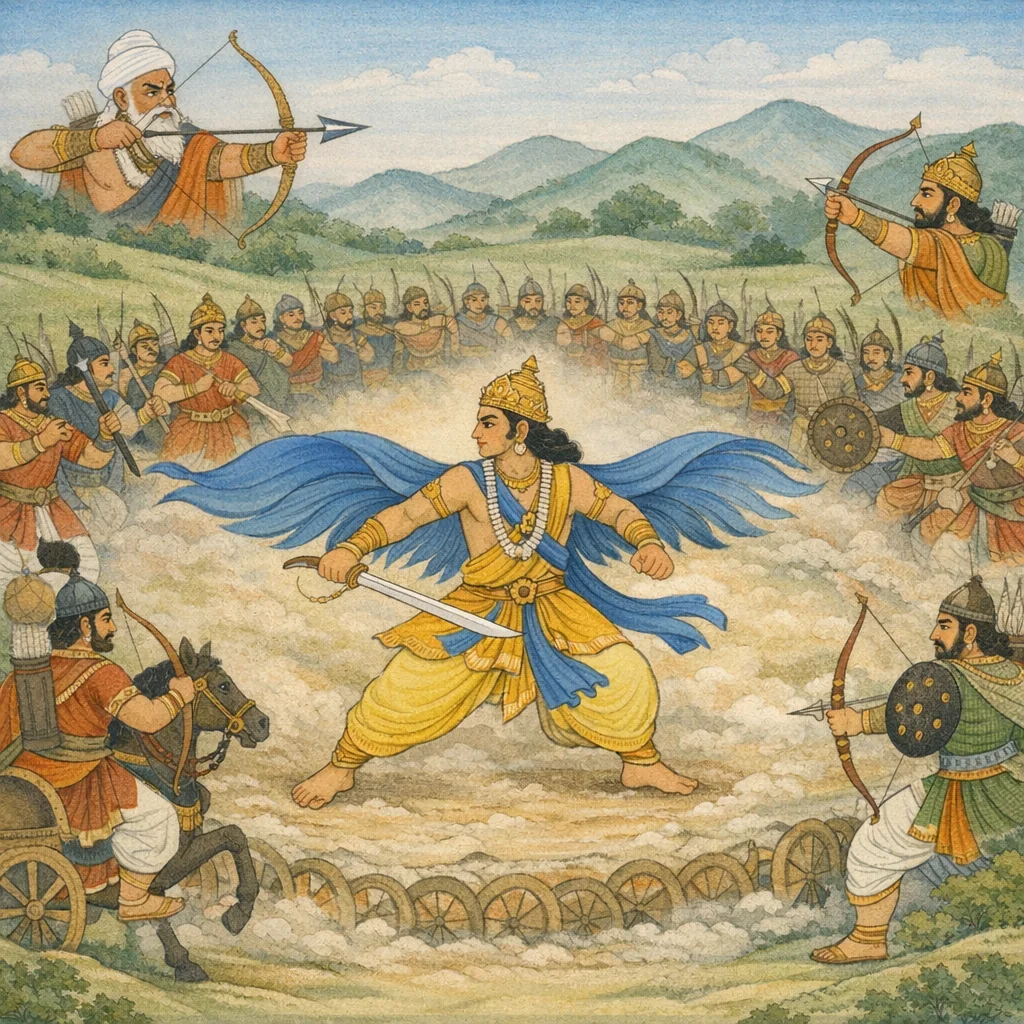
राधेयो निशितैर्बाणिव्यधमच्चर्म चोत्तमम्,राधानन्दन कर्णने अपने पैने बाणोंद्वारा उसके उत्तम ढालके टुकड़े-टुकड़े कर डाले। ढाल और तलवारसे वंचित हो जानेपर बाणोंसे भरे हुए शरीरवाला अभिमन्यु पुनः आकाशसे पृथ्वीपर उतर आया और चक्र हाथमें ले कुपित हो द्रोणाचार्ेुकी ओर दौड़ा
Sanjaya said: Karna, the son of Radha, with razor-sharp arrows, shattered Abhimanyu’s excellent shield. Deprived of shield and sword, Abhimanyu—his body bristling with arrows—descended again from the air to the earth. Seizing a wheel as a weapon, and burning with anger, he rushed toward Dronacharya. The scene underscores the brutal asymmetry of war: even when a young warrior is stripped of conventional arms, his resolve and kshatriya duty drive him to continue the fight with whatever lies at hand.
Verse 39
व्यसिचर्मेषुपूर्णाड़: सो<न्तरिक्षात् पुन: क्षितिम् । आस्थितश्षक्रमुद्यम्य द्रोणं क्रुद्धो& भ्यधावत,राधानन्दन कर्णने अपने पैने बाणोंद्वारा उसके उत्तम ढालके टुकड़े-टुकड़े कर डाले। ढाल और तलवारसे वंचित हो जानेपर बाणोंसे भरे हुए शरीरवाला अभिमन्यु पुनः आकाशसे पृथ्वीपर उतर आया और चक्र हाथमें ले कुपित हो द्रोणाचार्ेुकी ओर दौड़ा
Sañjaya said: His body bristling with arrows, he descended again from the sky to the earth. Seizing and raising a discus, he—angered—rushed straight at Droṇa. The scene underscores the warrior’s resolve amid deprivation: even when stripped of customary weapons and protection, he presses on, driven by duty and wrath in the chaos of battle.
Verse 40
अभिमन्युपर अनेक महारथियोंद्वारा एक साथ प्रहार स चक्ररेणूज्ज्वलशोभिताडज्रे बभावतीवोज्ज्वलचक्रपाणि: । रणे5भिमन्यु: क्षणमास रौद्र: स वासुदेवानुकृतिं प्रकुर्वन्,अभिमन्युका शरीर चक्रकी प्रभासे उज्ज्वल तथा धूलराशिसे सुशोभित था। उसके हाथमें तेजोमय उज्ज्वल चक्र प्रकाशित हो रहा था। इससे उसकी बड़ी शोभा हो रही थी। उस रफणक्षेत्रमें चक्रधारणद्वारा भगवान् श्रीकृष्णतणा अनुकरण करता हुआ अभिमन्यु क्षणभरके लिये बड़ा भयंकर प्रतीत होने लगा
Sañjaya said: As many great chariot-warriors struck at Abhimanyu all at once, he appeared resplendent—his body bright with the whirling discus and the dust of battle, as though he bore a radiant cakra in his hand. For a moment on that battlefield, imitating Vāsudeva (Kṛṣṇa) in his manner of wielding the discus, Abhimanyu looked fiercely terrible—an image of righteous valor standing alone amid overwhelming assault.
Verse 41
ख्रुतर॒ुधिरकृतैकरागवत्त्रो भ्रुकुटिपुटाकुटिलो5तिसिंहनाद: । प्रभुरमितबलो रणे5भिमन्यु- नपवरमध्यगतो भृशं व्यराजत्,अभिमन्युके वस्त्र उसके शरीरसे बहनेवाले एकमात्र रुधिरके रंगमें रँग गये थे। भौंहें टेढ़ी होनेसे उसका मुख-मण्डल सब ओरसे कुटिल प्रतीत होता था और वह बड़े जोर- जोरसे सिंहनाद कर रहा था। ऐसी अवस्थामें प्रभावशाली अनन्त बलवान् अभिमन्यु उस रणक्षेत्रमें पूर्वोक्त नरेशोंके बीचमें खड़ा होकर अत्यन्त प्रकाशित हो रहा था
Sañjaya said: His face, stained a single hue by the blood flowing from his wounds, looked fierce; with brows drawn into a hard frown his countenance seemed twisted on every side, and he roared again and again like a lion. In that state, the mighty Abhimanyu—lordly and of immeasurable strength—standing in the midst of the battle, amid the surrounding kings, shone forth with overwhelming brilliance, embodying steadfast courage even while grievously wounded.
Verse 47
इस प्रकार श्रीमह्ाभारत द्रोणपर्वके अन्तर्गत अभिमन्युवधपर्वमें ब॒हद्धलवधविषयक सैंतालीसवाँ अध्याय पूरा हुआ
Sañjaya said: Thus, in the Śrī Mahābhārata, within the Droṇa Parvan—specifically in the section concerning the slaying of Abhimanyu—the forty-seventh chapter, dealing with the killing of Bṛhaddhala, has come to its conclusion. The colophon marks the close of a narrative unit in which the relentless momentum of war is recorded with formal finality, reminding the listener that each death becomes a counted event within a larger moral and historical reckoning.
Verse 48
इति श्रीमहाभारते द्रोणपर्वणि अभिमन्युवधपर्वणि अभिमन्युविरथकरणे अष्टचत्वारिंशो5ध्याय:
Thus ends the forty-eighth chapter in the Droṇa Parva of the Śrī Mahābhārata, within the section on the slaying of Abhimanyu—specifically, the episode describing how Abhimanyu was deprived of his chariot. This colophon marks the close of a grim turning point in the war narrative, where collective aggression and tactical injustice culminate in the isolation of a young warrior.
Verse 133
हृद्यसम्भ्रान्तवद् राज॑स्तदद्भुतमिवा भवत् । तब अर्जुनकुमारने अश्वत्थामाका ध्वज काटकर शल्यको तीन बाण मारे। राजन! शल्यने भी मनमें तनिक भी सम्भ्रम या घबराहटका अनुभव न करते हुए-से गीधके पंखसे युक्त नौ बाणोंद्वारा अभिमन्युको आहत कर दिया। वह एक अद्भुत-सी बात हुई
O king, it seemed a marvel, as though hearts were thrown into sudden turmoil. Then Arjuna’s son cut down Aśvatthāmā’s banner and struck King Śalya with three arrows. Yet Śalya, showing not the least confusion or fear, wounded Abhimanyu with nine arrows fletched like a vulture’s wings. It was a wondrous sight indeed.
Verse 146
त॑ विव्याधायसै: षड्भि: सोपाक्रामद् रथान्तरम् | उस समय अभिमन्युने शल्यके ध्वजको काटकर उनके दोनों पार्श्वरक्षकोंको भी मार डाला और उनको भी लोहेके बने हुए छः: बाणोंसे बींध दिया; फिर तो शल्य भागकर दूसरे रथपर चले गये
Sañjaya said: Abhimanyu pierced Śalya with six iron-tipped arrows. Having cut down his banner and slain the two guards stationed at his flanks, he struck him again with those six iron shafts; and so Śalya fled, abandoning that chariot for another.
Verse 206
संदधानस्य विशिखान् शीघ्रं चैव विमुज्चत: । “इस पुरुषसिंह पाण्डवपुत्रकी शीघ्रता तो देखो। शीघ्रतापूर्वक बाणोंका संधान करते और छोड़ते समय रथके मार्गोंमें इसके धनुषका मण्डलमात्र दिखायी देता है
Sañjaya said: “Behold the swiftness of this bull among men, the Pāṇḍava prince. As he swiftly fits the arrows and releases them, along the chariot’s paths only the circular sweep of his bow is seen.”
Verse 246
स्थातव्यमिति तिष्ठामि पीड्यमानो5भिमन्युना । तदनन्तर कर्णने अभिमन्युके बाणोंसे आहत होकर पुनः द्रोणाचार्यसे कहा--“आचार्य! मैं अभिमन्युके बाणोंसे पीड़ित होता हुआ भी केवल इसलिये यहाँ खड़ा हूँ कि युद्धके मैदानमें डटे रहना ही क्षत्रियका धर्म है (अन्यथा मैं कभी भाग गया होता)
Sañjaya said: “I stand my ground, thinking, ‘I must not yield.’ Though I am being sorely pressed by Abhimanyu’s arrows, I remain here only because steadfastness on the battlefield is the kṣatriya’s duty—otherwise I would have fled.”
Verse 333
शरवर्षरकरुणा बालमेकमवाकिरन् । शेष महारथी धनुष कट जानेपर अभिमन्युके ऊपर बाणोंकी वर्षा करने लगे। इस प्रकार शीघ्रता करनेके अवसरपर शीघ्रता करनेवाले छः निर्दय महारथी एक रथहीन बालकपर बाणोंकी बौछार करने लगे
Sañjaya said: Without compassion they drenched the lone youth in a rain of arrows. The remaining great chariot-warriors, masters of the bow, began to pour down volleys upon Abhimanyu. Thus, at a moment that demanded swift action, six ruthless champions unleashed a storm of arrows against a single boy who had been deprived of his chariot—battlefield might turned into moral imbalance.
Verse 343
खड्गचर्म धर: श्रीमानुत्पपात विहायसा । धनुष कट जाने और रथ नष्ट हो जानेपर तेजस्वी वीर अभिमन्यु अपने धर्मका पालन करते हुए ढाल और तलवार हाथमें लेकर आकाशमें उछल पड़ा
Sañjaya said: When his bow had been cut and his chariot destroyed, the radiant hero Abhimanyu—steadfast in the observance of his own dharma—took up shield and sword and leapt upward into the sky, continuing the fight with unwavering resolve.
Verse 353
आर्जुनिर्व्यचरद् व्योम्नि भृशं वै पक्षिराडिव । अर्जुनकुमार अभिमन्यु कौशिक आदि मार्गों (पैतरों) द्वारा तथा शीघ्रकारिता और बल- पराक्रमसे पक्षिराज गरुड़की भाँति भूतलकी अपेक्षा आकाशमें ही अधिक विचरण करने लगा
Sañjaya said: Arjuni (Abhimanyu), moving with great speed and force, ranged through the sky like the king of birds. The image underscores his extraordinary martial agility—rising above ordinary ground-bound movement—suggesting both heroic prowess and the perilous intensity of the battle in which such brilliance is tested.
Verse 373
क्षुरप्रेण महातेजास्त्वरमाण: सपत्नजित् | उस समय शत्रुओंपर विजय पानेवाले महातेजस्वी द्रोणाचार्यने शीघ्रता करते हुए एक क्षुप्रके द्वारा अभिमन्युकी मुद्ठीमें स्थित हुए मणिमय मूठसे युक्त खड़गको काट डाला
Sañjaya said: The mighty and radiant Droṇācārya, eager to secure victory over his foes, swiftly struck with a razor-headed arrow and severed Abhimanyu’s sword—its hilt set with gems—while it was still clenched in his fist.
Verse 3636
विव्यधुस्तं महेष्वासं समरे छिद्रदर्शिन: । समरांगणमें छिद्र देखनेवाले योद्धा 'जान पड़ता है यह मेरे ही ऊपर तलवार लिये टूटा पड़ता है” इस आशंकासे ऊपरकी ओर दृष्टि करके महाधनुर्धर अभिमन्युको बींधने लगे
Sañjaya said: In the thick of battle, those warriors skilled at spotting openings struck and pierced that mighty archer. Suspecting, “He seems to be rushing at me with sword raised,” they looked upward in alarm and began to wound the great bowman Abhimanyu—an image of how, in war, fear and opportunism drive men to exploit even a momentary vulnerability rather than uphold fair combat.
Frequently Asked Questions
The chapter foregrounds the dilemma of legitimacy in wartime method: Abhimanyu’s singular valor is juxtaposed with coordinated opposition and opportunistic timing, raising questions about whether effectiveness can be equated with righteousness when customary reciprocity is strained.
It underscores that heroic intention and disciplined effort do not guarantee outcomes; dharma is narrated as steadfastness in action amid uncertainty, while the aftermath imagery warns that violence—however justified—produces enduring ethical and psychological consequences.
No explicit phalaśruti is stated; instead, the meta-commentary is implicit in Sañjaya’s framing and the extended battlefield similes, which function as reflective apparatus prompting the listener to evaluate war, duty, and grief within a broader soteriological horizon.