Adhyaya 28
Bhagadatta’s Astra and the Fall of the Prāgjyotiṣa King (भगदत्त-वधः / वैष्णवास्त्र-प्रसङ्गः)
Upa-parva: Bhagadatta–Arjuna Saṃgrāma (Strategic Engagement with Prāgjyotiṣa)
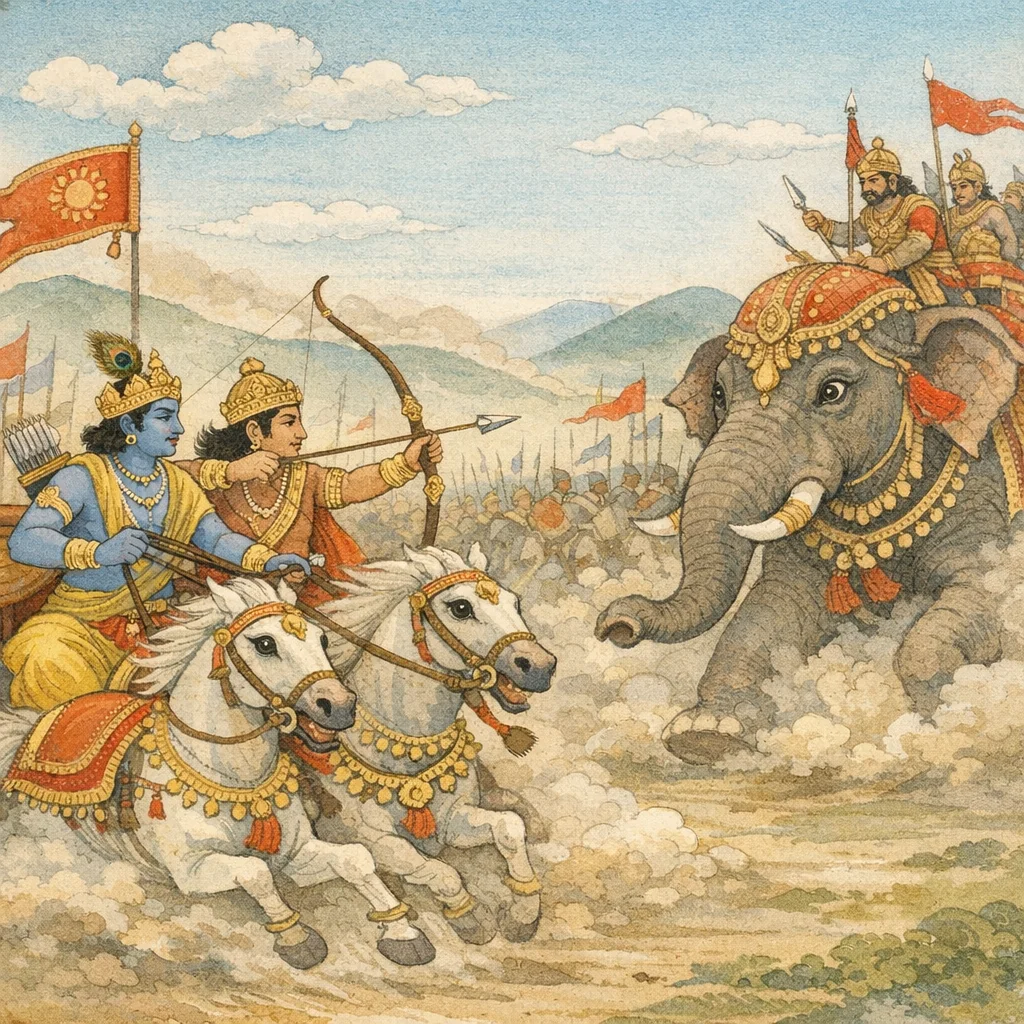
Dhṛtarāṣṭra requests a precise account of Arjuna’s actions against Bhagadatta. Saṃjaya describes a high-intensity exchange: Bhagadatta, positioned on an elephant, rains arrows and hurls heavy missiles; Arjuna counters by cutting weapons and insignia, injuring the king, and breaking incoming projectiles. Bhagadatta escalates by invoking the Vaiṣṇava astra and releasing a consecrated implement toward Arjuna. Kṛṣṇa intervenes by shielding Arjuna and receiving the weapon’s impact upon his chest, where it is rendered non-lethal and is described as becoming an ornament-like garland (a narrative sign of neutralization rather than destruction). Arjuna questions this intervention in light of prior assurances; Kṛṣṇa responds with a doctrinal explanation of his multi-modal activity (caturmūrti) and recounts an earlier bestowal of the Vaiṣṇava astra for the protection of Naraka, explaining why Bhagadatta possessed it and why it could not be met by ordinary means. With the exceptional threat contained, Arjuna resumes decisive action: he strikes the elephant fatally and then pierces Bhagadatta’s heart, leading to the king’s collapse and the dispersal of opposing fighters.
Chapter Arc: संजय धृतराष्ट्र से कहते हैं—जब पार्थ युद्ध-क्षेत्र में आगे बढ़ते हैं, कृष्ण रथ को साधते हुए उन्हें उस दिशा में ले जाते हैं जहाँ कौरव-सेना घनी है; उसी समय संशप्तक-प्रतिज्ञा की ज्वाला फिर भड़क उठती है। → द्रोणाचार्य के दबाव से व्याकुल त्रिगर्त-नरेश सुशर्मा अपने भाइयों सहित अर्जुन को ललकारता है; अर्जुन (श्वेतहय-रथी) कृष्ण से संकेत करता है कि यह शत्रु उसे युद्ध के लिए पुकार रहा है। अर्जुन त्वरित बाण-वर्षा से सुशर्मा और उसके निकटस्थों को घायल कर ध्वज-धनुष काटता है, और त्रिगर्तों के एक भाई को रथ-सारथी सहित यमलोक भेज देता है। कौरव-सैनिक अर्जुन के इन्द्र-सदृश शरौघ-वेग को सह नहीं पाते। → रण में भगदत्त का महागज (क्रुद्ध अन्तक-सा) रथों-घोड़ों को रौंदता हुआ अर्जुन-कृष्ण के रथ पर टूट पड़ता है। जनार्दन रथ को चक्राकार (अपसव्य) घुमाकर टक्कर से बचाते हैं; अर्जुन धर्म-स्मरण करते हुए निकट आए गजराज को लौटाने/वश में करने का उपाय खोजता है, पर हाथी उन्मत्त होकर मृत्यु-लोक की ओर अनेक रथ-हय-समूहों को धकेलता चला जाता है और अर्जुन क्रोध से भर उठता है। → अध्याय का अंत अर्जुन के प्रतिशोध-उद्यम पर टिकता है—वह भगदत्त के हाथी की उग्रता देखकर संयमित-क्रोध में शस्त्र-प्रयोग का संकल्प करता है, जबकि कृष्ण रथ-चालन से तत्काल प्राण-रक्षा और रण-स्थितियों का संतुलन बनाए रखते हैं। → उन्मत्त गज के आगे बढ़ते संहार के बीच—क्या अर्जुन भगदत्त और उसके महागज को रोक पाएगा, या कौरव-सेना को यह गज-प्रलय और अधिक क्षति पहुँचाएगा?
Shlokas
Verse 1
अष्टाविशोश् ध्याय: संशप्तकोंका संहार करके अर्जुनका कौरव-सेनापर आक्रमण तथा भगदत्त और उनके हाथीका पराक्रम संजय उवाच यियासतस्तत: कृष्ण: पार्थस्याश्वान् मनोजवान् | सम्प्रैषीद्धेमसंछन्नान् द्रोणानीकाय सत्वरन्,संजय कहते हैं--महाराज! तदनन्तर द्रोणकी सेनाके समीप जानेकी इच्छावाले अर्जुनके सुवर्णभूषित एवं मनके समान वेगशाली अश्वोंको भगवान् श्रीकृष्णने बड़ी उतावलीके साथ द्रोणाचार्यकी सेनातक पहुँचनेके लिये हाँका
Sañjaya said: O King, then Śrī Kṛṣṇa, seeing Arjuna (Pārtha) eager to press ahead, swiftly urged on Arjuna’s horses—gold-adorned and as fast as the mind—driving them straight toward Droṇa’s battle-array.
Verse 2
त॑ प्रयान्तं कुरुश्रेष्ठ स्वान् भ्रातृन् द्रोणतापितान् | सुशर्मा भ्रातृभि: सार्ध युद्धार्थी पृष्ठतोडन्वयात्,द्रोणाचार्यके सताये हुए अपने भाइयोंके पास जाते हुए कुरुश्रेष्ठ अर्जुनको भाइयोंसहित सुशमनि युद्धकी इच्छासे ललकारा और पीछेसे उनपर आक्रमण किया
As Arjuna—the foremost of the Kurus—was moving toward his own brothers, hard-pressed by Droṇa, Suśarmā, with his brothers at his side, eager for battle, challenged him and attacked from the rear.
Verse 3
ततः श्वेतहयः कृष्णमब्रवीदजितं जय: । एष मां भ्रातृभि: सार्थ सुशर्मा55ह्वयतेडच्युत,तब श्वेतवाहन अर्जुनने अपराजित श्रीकृष्णसे इस प्रकार कहा, “अच्युत! यह भाइयोंसहित सुशर्मा मुझे पुनः युद्धके लिये बुला रहा है
Then Arjuna, the unconquered hero whose chariot bore white horses, addressed Kṛṣṇa: “O Acyuta, Suśarmā, together with his brothers, is challenging me again to battle.”
Verse 4
दीर्यते चोत्तरेणैव तत् सैन्यं मधुसूदन । द्वैधीभूतं मनो मेड्द्य कृतं संशप्तकैरिदम्,“उधर उत्तर दिशाकी ओर अपनी सेनाका नाश किया जा रहा है। मधुसूदन! इन संशप्तकोंने आज मेरे मनको दुविधामें डाल दिया है
“O Madhusūdana, that army is being torn apart, especially on the northern side. Today these Saṃśaptakas have thrown my mind into a painful dilemma.”
Verse 5
कि नु संशप्तकान् हन्मि स्वान् रक्षाम्यहितार्दितान् । इति मे त्वं मतं वेत्सि तत्र कि सुकृतं भवेत्,'क्या मैं संशप्तकोंका वध करूँ अथवा शत्रुओंद्वारा पीड़ित हुए अपने सैनिकोंकी रक्षा करूँ। इस प्रकार मेरा मन संकल्प-विकल्पमें पड़ा है, सो आप जानते ही हैं। बताइये, अब मेरे लिये क्या करना अच्छा होगा”
“Should I strike down the Saṃśaptakas, or should I protect my own men who are being harried by the enemy? My mind wavers between these two resolves—you already know it. Tell me: what course would be truly right and beneficial for me now?”
Verse 6
एवमुक्तस्तु दाशार्ह: स्यन्दनं प्रत्यवर्तयत् । येन त्रिगर्ताधिपति: पाण्डवं समुपाह्दयत्,अर्जुनके ऐसा कहनेपर भगवान् श्रीकृष्णने अपने रथको उसी ओर लौटाया, जिस ओससे त्रिगर्तराज सुशर्मा उन पाण्डुकुमारको युद्धके लिये ललकार रहा था
Sañjaya said: Thus addressed, Dāśārha (Śrī Kṛṣṇa) turned the chariot back toward the direction from which the lord of the Trigartas, Suśarmā, was challenging the Pāṇḍava to battle. The scene underscores the warrior’s obligation to meet a direct summons in war, while also showing Kṛṣṇa’s steady, disciplined response—guiding action without agitation.
Verse 7
ततोडर्जुनः सुशर्माणं विद्धवा सप्तभिराशुगै: । ध्वजं धनुश्नास्य तथा क्षुराभ्यां समकृन्तत,तत्पश्चात् अर्जुनने सुशर्माको सात बाणोंसे घायल करके दो छुरोंद्वारा उसके ध्वज और धनुषको काट डाला
Sañjaya said: Then Arjuna, having pierced Susarman with seven swift arrows, next severed his banner and his bow with two razor-edged shafts. In the ethics of battle, this act both asserts Arjuna’s mastery and checks the opponent’s capacity to continue harm, shifting the contest from mere killing to the controlled disabling of a belligerent’s means of aggression.
Verse 8
त्रिगर्ताधिपतेश्लापि भ्रातरं पड़भिराशुगै: । साश्वं ससूतं त्वरित: पार्थ: प्रैषीद् यमक्षयम्,साथ ही त्रिगर्तमजके भाईको भी छः: बाण मारकर अर्जुनने उसे घोड़े और सारथिसहित तुरंत यमलोक भेज दिया
Sañjaya said: Arjuna, acting with swift resolve, struck down even the brother of the Trigarta king with six rapid arrows, and promptly dispatched him—together with his horses and charioteer—to the abode of Yama. In the harsh ethic of battlefield duty, this depicts the uncompromising execution of a warrior’s task amid lethal combat.
Verse 9
ततो भुजगसंकाशां सुशर्मा शक्तिमायसीम् | चिक्षेपार्जुनमादिश्य वासुदेवाय तोमरम्,तदनन्तर सुशर्माने सर्पके समान आकृतिवाली लोहेकी बनी हुई एक शक्तिको अर्जुनके ऊपर चलाया और वसुदेवनन्दन श्रीकृष्णपर तोमरसे प्रहार किया
Sañjaya said: Then Suśarmā hurled an iron spear-weapon, gleaming like a serpent, aiming it at Arjuna; and he also struck at Vāsudeva (Kṛṣṇa) with a tomara. In the fierce ethics of battle, the scene shows the escalation of hostility—targeting both the foremost warrior and his charioteer—revealing how wrath can drive combatants to ever more perilous acts, even against one who is primarily a guide and protector.
Verse 10
शक्ति त्रिभि: शरैश्छित्त्वा तोमरं त्रिभिरजुन: । सुशर्माणं शरव्रातैर्मोहयित्वा न्यवर्तयत्,अर्जुनने तीन बाणोंद्वारा शक्ति तथा तीन बाणोंद्वारा तोमरको काटकर सुशर्माको अपने बाणसमूहोंद्वारा मोहित करके पीछे लौटा दिया
Sañjaya said: Arjuna, with three arrows, cut down the śakti-weapon, and with three more he severed the tomara. Then, bewildering King Suśarmā with a dense volley of shafts, he forced him to turn back—displaying controlled prowess in battle rather than needless slaughter.
Verse 11
त॑ वासवमिवायान्तं भूरिवर्ष शरौघधिणम् | राजंस्तावकसैन्यानां नोग्रं कश्चिदवारयत्,राजन! इसके बाद वे इन्द्रके समान बाण-समूहोंकी भारी वर्षा करते हुए जब आपकी सेनापर आक्रमण करने लगे, उस समय आपके सैनिकोंमेंसे कोई भी उन उमग्ररूपधारी अर्जुनको रोक न सका
Sañjaya said: “O King, when he advanced like Vāsava (Indra), pouring down a dense rain of volleys of arrows and launching his assault upon your army, not a single one among your troops could check that fierce Arjuna.”
Verse 12
ततो धनंजयो बाणै: सवनिव महारथान् । आयाद् विनिषघ्नन् कौरव्यान् दहन् कक्षमिवानल:,तत्पश्चात् जैसे अग्नि घास-फूँसके समूहको जला डालती है, उसी प्रकार अर्जुन अपने बाणोंद्वारा समस्त कौरव महारथियोंको क्षत-विक्षत करते हुए वहाँ आ पहुँचे
Sañjaya said: Then Dhanañjaya (Arjuna), with his arrows, came there, striking down and mangling the Kaurava great chariot-warriors—burning them like a fire consumes dry brushwood.
Verse 13
तस्य वेगमसहां त॑ कुन्तीपुत्रस्य धीमत: । नाशबवनुवंस्ते संसोढुं स्पर्शमग्नेरिव प्रजा:,परम बुद्धिमान् कुन्तीपुत्रके उस असहा वेगको कौरव-सैनिक उसी प्रकार नहीं सह सके, जैसे प्रजा अग्निका स्पर्श नहीं सहन कर पाती
Sañjaya said: The Kuntī-born hero, wise and formidable, surged forward with such irresistible force that the Kaurava soldiers could not endure it—just as ordinary people cannot bear the touch of fire.
Verse 14
संवेष्टयन्ननीकानि शरवर्षेण पाण्डव: । सुपर्णपातवद् राजन्नायात् प्राग्ज्योतिषं प्रति,राजन! अर्जुनने बाणोंकी वर्षसे कौरव-सेनाओंको आच्छादित करते हुए गरुड़के समान वेगसे भगदत्तपर आक्रमण किया
Sañjaya said: O King, the Pāṇḍava hero (Arjuna), enveloping the enemy battle-formations with a downpour of arrows, rushed toward the lord of Prāgjyotiṣa (Bhagadatta) with the speed and plunge of Garuḍa.
Verse 15
यत् तदानामयज्जिष्णुर्भरतानामपापिनाम् । धनु: क्षेमकरं संख्ये द्विषतामश्रुवर्धनम्,महाराज! विजयी अर्जुनने युद्धमें शत्रुओंकी अश्रुधाराको बढ़ानेवाले जिस धनुषको कभी निष्पाप भरतवंशियोंका कल्याण करनेके लिये नवाया था, उसीको कपटटद्यूत खेलनेवाले आपके पुत्रके अपराधके कारण सम्पूर्ण क्षत्रियोंका विनाश करनेके लिये हाथमें लिया
Sañjaya said: “O King, that very bow which the unconquerable Arjuna once bent for the welfare and protection of the sinless Bharatas—bringing safety in battle for his own—has now become, in the clash of armies, a cause for swelling the tears of enemies.”
Verse 16
तदेव तव पुत्रस्य राजन् दुर्द्यृतदेविन: । कृते क्षत्रविनाशाय धनुरायच्छदर्जुन:,महाराज! विजयी अर्जुनने युद्धमें शत्रुओंकी अश्रुधाराको बढ़ानेवाले जिस धनुषको कभी निष्पाप भरतवंशियोंका कल्याण करनेके लिये नवाया था, उसीको कपटटद्यूत खेलनेवाले आपके पुत्रके अपराधके कारण सम्पूर्ण क्षत्रियोंका विनाश करनेके लिये हाथमें लिया
Sañjaya said: O King, it was because of your son—whose fate was bound up with crooked gambling—that Arjuna took up that very bow, now for the destruction of the kṣatriyas. The weapon once bent for the welfare of the blameless Bharatas is, through the wrongdoing born of deceitful dice-play, turned toward a ruinous war.
Verse 17
तथा विक्षो भ्यमाणा सा पार्थेन तव वाहिनी । व्यशीर्यत महाराज नौरिवासाद्य पर्वतम्,नरेश्वर! कुन्तीकुमार अर्जुनके द्वारा मथी जाती हुई आपकी वाहिनी उसी प्रकार छिजन्न- भिन्न होकर बिखर गयी, जैसे नाव किसी पर्वतसे टकराकर टूक-टूक हो जाती है
Sañjaya said: Thus, O great king, your army—being violently churned and shaken by Pārtha (Arjuna)—was shattered and scattered, just as a boat breaks into pieces when it strikes a mountain.
Verse 18
ततो दशसहस्राणि न्यवर्तन्त धनुष्मताम् | मतिं कृत्वा रणे क्रूरां वीरा जयपराजये,तदनन्तर दस हजार धनुर्धर वीर जय अथवा पराजयके हेतुभूत युद्धका क्रूरतापूर्ण निश्चय करके लौट आये
Sañjaya said: Then ten thousand bowmen withdrew. Having steeled their minds in that fierce battlefield resolve—fixed upon victory or defeat—they turned back, ready to stake everything on the brutal logic of war.
Verse 19
व्यपेतहृदयत्रासा आवत्र॒ुस्तं महारथा: | आर्च्छत् पार्थो गुरु भारं सर्वभारसहो युधि,उन महारथियोंने अपने हृदयसे भयको निकालकर अर्जुनको वहाँ घेर लिया। युद्धमें समस्त भारोंको सहन करनेवाले अर्जुनने उनसे लड़नेका भारी भार भी अपने ही ऊपर ले लिया
Sañjaya said: Casting fear out of their hearts, the great chariot-warriors closed in around him. Then Pārtha—steadfast in battle and able to bear every burden—took upon himself the heavy responsibility of facing that formidable press of foes.
Verse 20
यथा नलवन क्रुद्धः प्रभिन्न: षष्टिहायन: । मृदनीयात् तद्वदायस्त: पार्थो5मृद्नाच्चमूं तव,जैसे साठ वर्षका मदस्रावी हाथी क्रोधमें भरकर नरकुलोंके जंगलको रौंदकर धूलमें मिला देता है, उसी प्रकार प्रयत्नशील पार्थने आपकी सेनाको मटियामेट कर दिया
Sañjaya said: “Just as a sixty-year-old elephant, in musth and enraged, tramples a thicket of reeds and crushes it into dust, so did Pārtha—striving with relentless effort—grind down your army.”
Verse 21
तस्मिन् प्रमथिते सैन्ये भगदत्तो नराधिप: । तेन नागेन सहसा धनंजयमुपाद्रवत्
Sañjaya said: When the army had been thrown into confusion, King Bhagadatta, mounting that elephant, suddenly charged at Dhanañjaya (Arjuna). In the midst of a collapsing battle-line, the seasoned ruler sought to turn the tide through a direct, forceful assault—showing how war again and again tests steadiness, leadership, and restraint under pressure.
Verse 22
उस सेनाके मथ डाले जानेपर राजा भगदत्तने उसी सुप्रतीक हाथीके द्वारा सहसा धनंजयपर धावा किया ।। त॑ रथेन नरव्याप्र: प्रत्यगृह्नाद् धनंजय: । स संनिपातस्तुमुलो बभूव रथनागयो:
Sañjaya said: Dhanañjaya (Arjuna), the tiger among men, met him head-on with his chariot. Then a deafening, tumultuous clash arose between the chariot and the war-elephant—each driven by unwavering resolve in the fury of battle.
Verse 23
नरश्रेष्ठ अर्जुनने रथके द्वारा ही उस हाथीका सामना किया। रथ और हाथीका वह संघर्ष बड़ा भयंकर था ।। कल्पिताभ्यां यथाशास्त्रं रथेन च गजेन च । संग्रामे चेरतुर्वीरी भगदत्तधनंजयौ,शास्त्रीय विधिके अनुसार निर्मित और सुसज्जित रथ तथा सुशिक्षित हाथीके द्वारा वीरवर अर्जुन और भगदत्त संग्रामभूमिमें विचरने लगे
Sañjaya said: Arjuna, the best of men, faced that elephant with his chariot alone; and dreadful was the struggle between chariot and elephant. And in accordance with the prescribed martial science, with a chariot duly fashioned and arrayed and with a well-trained elephant, the two heroes—Bhagadatta and Dhanañjaya—moved about the battlefield and engaged one another, showing that kṣatriya warfare, even amid terrifying violence, is bound by discipline and rule.
Verse 24
ततो जीमूतसंकाशाजन्नागादिन्द्र इव प्रभु: । अभ्यवर्षच्छरौघेण भगदत्तो धनंजयम्,तदनन्तर इन्द्रके समान शक्तिशाली राजा भगदत्त अर्जुनपर मेघ-सदृश हाथीसे बाणसमूहरूपी जलराशिकी वर्षा करने लगे
Sañjaya said: Then King Bhagadatta—mighty like Indra—advanced upon his elephant, which looked like a mass of rain-clouds, and showered Arjuna (Dhanañjaya) with a dense torrent of arrows. The verse heightens the battlefield’s moral tension: power and prowess are displayed at their peak, yet directed toward destruction, testing resolve and adherence to kṣatriya-dharma amid overwhelming violence.
Verse 25
स चापि शरवर्ष तं शरवर्षेण वासवि: । अप्राप्तमेव चिच्छेद भगदत्तस्य वीर्यवान्,इधर पराक्रमी इन्द्रकुमार अर्जुनने अपने बाणोंकी वृष्टिसे भगदत्तकी बाण-वर्षाको अपने पासतक पहुँचनेके पहले ही छिन्न-भिन्न कर दिया
Sañjaya said: And Arjuna, the mighty son of Indra, met that shower of arrows with a counter-shower of his own, cutting Bhagadatta’s missile-rain to pieces before it could even reach him—showing disciplined mastery in battle rather than reckless fury.
Verse 26
ततः प्राग्ज्योतिषो राजा शरवर्ष निवार्य तत् शरैर्जघ्ने महाबाहुं पार्थ कृष्णं च मारिष
Sañjaya said: Then the king of Prāgjyotiṣa, having checked that shower of arrows, struck the mighty-armed Pārtha and Kṛṣṇa as well with his own shafts, O revered one. In the relentless ethics of battle, defense is immediately followed by counterstroke, and even the foremost heroes are made to face the consequences of unceasing martial resolve.
Verse 27
आर्य! तदनन्तर प्राग्ज्योतिषनरेश राजा भगदत्तने भी विपक्षीकी उस बाण-वर्षाका निवारण करके महाबाहु अर्जुन और श्रीकृष्णको अपने बाणोंसे घायल कर दिया ।। ततस्तु शरजालेन महताभ्यवकीर्य तौ । चोदयामास तं नागं वधायाच्युतपार्थयो:,फिर उनके ऊपर बाणोंका महान् जाल-सा बिछाकर श्रीकृष्ण और अर्जुन दोनोंके वधके लिये उस गजराजको आगे बढ़ाया
Sanjaya said: Then King Bhagadatta, having covered both Krishna (Acyuta) and Arjuna (Pārtha) with a vast net-like shower of arrows, urged his great war-elephant forward, intent on slaying them. The episode highlights how, in the frenzy of battle, martial prowess is directed toward decisive violence, while the listener is left to weigh the ethical tension between duty in war and the deliberate pursuit of killing revered opponents.
Verse 28
तमापतत्तं द्विरदं दृष्टवा क्रुद्धमिवान्तकम् | चक्रेडपसव्यं त्वरित: स्यन्दनेन जनार्दन:,क्रोधमें भरे हुए यमराजके समान उस हाथीको आक्रमण करते देख भगवान् श्रीकृष्णने तुरंत ही रथद्वारा उसे अपने दाहिने कर दिया इति श्रीमहाभारते द्रोणपर्वणि संशप्तकवधपर्वणि भगदत्तयुद्धे अष्टाविंशो5ध्याय: ।। २८ ।। इस प्रकार श्रीमह्या भारत द्रोणपर्वके अन्तर्गत संशप्तकवधपर्वमें भयदत्तका युद्धाविषयक अद्वाईसवाँ अध्याय पूरा हुआ
Sañjaya said: Seeing that enraged elephant charging—like Death himself—Janārdana (Kṛṣṇa) swiftly maneuvered the chariot so as to keep it to his right, taking immediate evasive action amid the press of battle. The verse highlights alertness and restraint in war: even in fury and danger, the charioteer’s disciplined judgment protects life and preserves the warrior’s capacity to act according to dharma rather than panic.
Verse 29
त॑ प्राप्तमपि नेयेष परावृत्तं महाद्विपम् सारोहें मृत्युसात्कर्तु स्मरन् धर्म धनंजय:,यद्यपि वह महान् गजराज आक्रमण करते समय अपने बहुत निकट आ गया था, तो भी अर्जुनने धर्मका स्मरण करके सवारोंसहित उस हाथीको मृत्युके अधीन करनेकी इच्छा नहीं की-
Sañjaya said: Although the great elephant had come very near in its charge, Arjuna (Dhanañjaya), mindful of dharma, did not wish to bring that turned-back mighty beast—together with its riders—under the sway of death. The moment underscores his restraint in battle and his ethical hesitation to kill when the opponent is no longer pressing the attack.
Verse 30
स तु नागो द्विपरथान् हयांश्षामृद्य मारिष | प्राहिणोन्मृत्युलोकाय ततः क्रुद्धो धनंजय:,आदरणीय महाराज! उस हाथीने बहुत-से हाथियों, रथों और घोड़ोंको कुचलकर यमलोक भेज दिया। यह देख अर्जुनको बड़ा क्रोध हुआ
Sañjaya said: “O revered one, that elephant trampled down many elephants, chariots, and horses, sending them to the realm of Death. Seeing this slaughter, Dhanañjaya (Arjuna) was seized by fierce anger.”
Frequently Asked Questions
The chapter frames the tension between individual martial agency and protective obligation: Arjuna’s capacity to respond is temporarily subordinated to Kṛṣṇa’s intervention because the incoming astra is narratively positioned as exceptional, requiring containment rather than symmetrical retaliation.
Kṛṣṇa articulates a model of distributed divine activity (caturmūrti) oriented to lokatrāṇa (world-protection), implying that intervention can be compatible with order-preservation and does not negate human responsibility; it recontextualizes battlefield events within longer ethical-causal histories.
No formal phalaśruti is presented in this passage; the meta-commentary function is served instead by the embedded origin narrative of the Vaiṣṇava astra, which explains significance through provenance, constraints, and appropriate countermeasures.