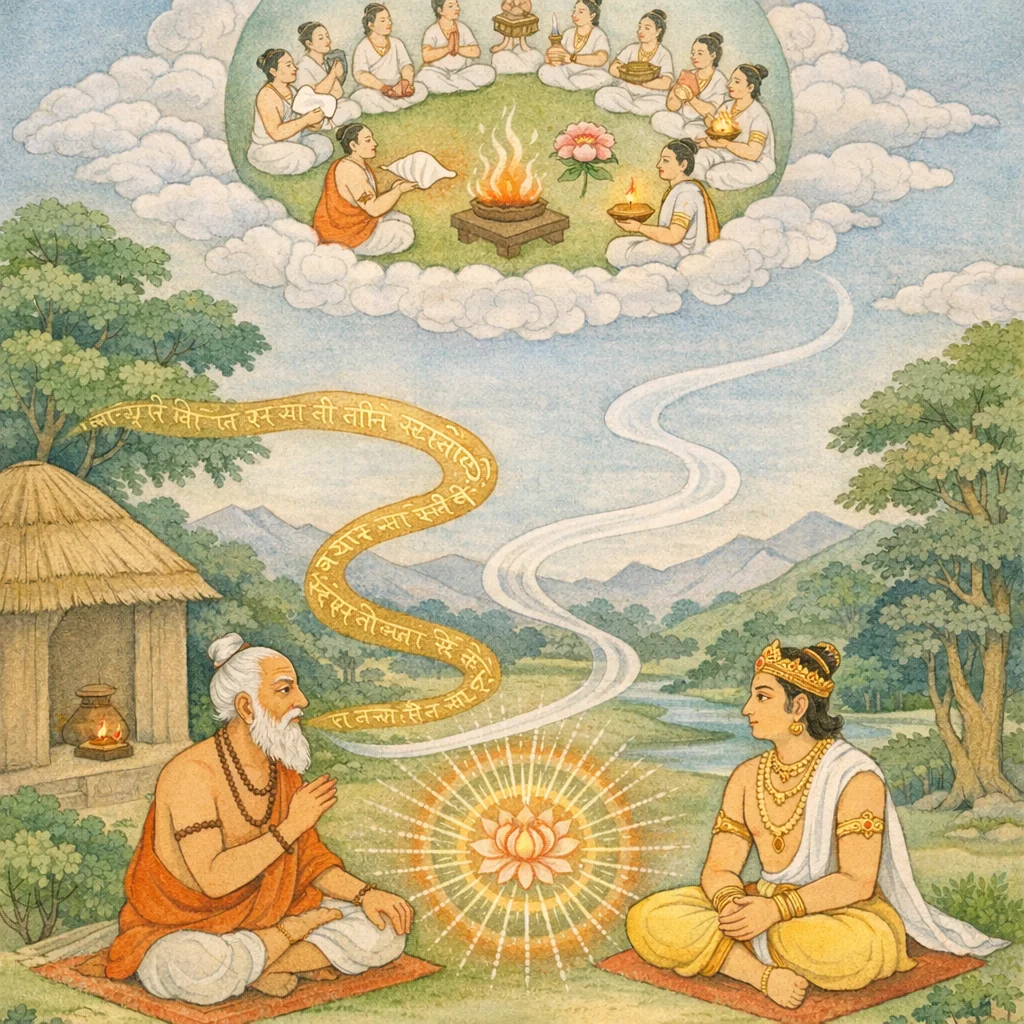
Adhyaya 21
Vāc–Manas Saṃvāda: Prāṇa-Apāna and the Primacy Debate (वाक्–मनस् संवादः)
Upa-parva: Anugītā / Brahmaṇa–Brāhmaṇī Saṃvāda (Didactic Discourse Segment)
A Brahmaṇa introduces an ancient exemplum and proceeds to describe a subtle model of cognition and embodiment, linking citta (mind-stuff), jñāna (knowing), and the embodied knower. The discourse employs ritual imagery (gārhapatya and āhavanīya fires; offering of haviṣ) to suggest ordered transformation from embodied support to articulated action. A Brāhmaṇī then questions the apparent sequence and causality between speech (vāc) and mind (manas), asking by what cognitive integration (vijñāna-yoga) intention becomes effective and what restrains it. The Brahmaṇa replies by explaining the role of apāna and its governance, situating mati (intellect/intent) in relation to manas. The narrative shifts to a formal dispute: vāc and manas approach Bhūtātman to decide superiority. Bhūtātman assigns mind a foundational status while acknowledging speech’s domain over the mobile (jaṅgama) through mantra, phoneme, and intonation. Speech is portrayed as dependent on breath—standing between prāṇa and apāna—and unable to function without inhalation/exhalation, leading to an account of prāṇa, apāna, udāna, and vyāna as systemic supports. The chapter concludes by distinguishing mind’s ‘stability’ (sthāvara) and speech’s ‘mobility’ (jaṅgama), presenting a complementary hierarchy rather than a simple exclusion.
Chapter Arc: ब्राह्मण देवता प्रिये से कहते हैं कि विद्वान इस रहस्य को समझाने हेतु एक प्राचीन इतिहास का उदाहरण देते हैं—जैसे दस होता मिलकर यज्ञ का अनुष्ठान करते हैं। → वे ‘दस होताओं’ को देह-इन्द्रियों के रूप में स्थापित करते हैं—कान, त्वचा, नेत्र, जिह्वा/वाक्, नासिका, चरण, कर, उपस्थ, और वायु/प्राण—और बताते हैं कि इनके ‘दस हवि’ हैं: शब्द, स्पर्श, रूप, रस, गन्ध, वाणी, क्रिया, गति, तथा रेत-मूत्र-पुरीष का त्याग। फिर मन के दो पक्षों (स्थावर/जंगम; जड़/अजड़) और वाणी के सूक्ष्म भेदों की ओर संवाद बढ़ता है। → वाणी के दो रूप—घोषिणी (स्पष्ट, श्रव्य) और निर्घोषा (अश्रव्य/अन्तर्वाणी)—का निर्णायक विवेचन होता है; ब्राह्मण देवता सूक्ष्म प्रवाहमान वाणी के अन्तर को दिखाते हुए निर्घोषा को अधिक ‘गरीयसी’ ठहराते हैं, और बताते हैं कि वाक् प्राण-अपान-उदान-व्यान-समान के क्रम से देह में स्थित होकर कार्य करती है। → अध्याय का निष्कर्ष यह बनता है कि बाह्य कर्म-इन्द्रिय-यज्ञ के पीछे एक सूक्ष्म यज्ञ चल रहा है—जहाँ मन और वाणी के स्तर (स्थावर/जड़ बनाम सूक्ष्म/निर्घोष) साधक की आन्तरिक श्रेष्ठता का मानदण्ड हैं; इन्द्रियों के हवि-त्याग और प्राण-चक्र की समझ से आत्मानुशासन का मार्ग स्पष्ट होता है।
Shlokas
Verse 1
ब्राह्मण कहते हैं--प्रिये! इस विषयमें विद्वान् पुरुष इस प्राचीन इतिहासका उदाहरण दिया करते हैं। दस होता मिलकर जिस प्रकार यज्ञका अनुष्ठान करते हैं, वह सुनो
The Brahmin said: “Beloved, on this matter learned men cite an ancient historical example. Listen to how ten officiating priests, gathered together, carried out the performance of a sacrifice.”
Verse 2
श्रोत्रं त्वक् चक्षुषी जिह्नवा नासिका चरणौ करौ । उपस्थ॑ वायुरिति वा होतृणि दश भामिनि,भामिनि! कान, त्वचा, नेत्र, जिह्ला (वाक् और रसना), नासिका, हाथ, पैर, उपस्थ और गुदा--से दस होता हैं
The Brahmin said: “Hearing, touch, sight, the tongue, the nose, the two feet, the two hands, and the organ of generation—thus (these are) the ten ‘hotṛs’ (officiating agents), O fair one.”
Verse 3
शब्दस्पर्शों रूपरसौ गन्धो वाक्य क्रिया गति: । रेतोमूत्रपुरीषाणां त्यागो दश हवींषि च,शब्द, स्पर्श, रूप, रस, गन्ध, वाणी, क्रिया, गति, वीर्य, मूत्रका त्याग और मल-त्याग-- ये दस विषय ही दस हविष्य हैं
The Brahmin said: “Sound and touch; form and taste; and smell; speech, action, and movement; and the discharge of semen, urine, and feces—these ten are to be regarded as the ten oblations. In other words, the disciplines of sense-control and bodily restraint are themselves the offerings by which one performs an inner sacrifice, turning ordinary impulses into a path of ethical self-mastery.”
Verse 4
दिशो वायू रविश्वन्द्र: पृथ्व्यग्नी विष्णुरेव च । इन्द्र: प्रजापतिर्मित्रमग्नयो दश भामिनि,भामिनि! दिशा, वायु, सूर्य, चन्द्रमा, पृथ्वी, अग्नि, विष्णु, इन्द्र, प्रजापति और मित्र--ये दस देवता अनिनि हैं
The Brahmin said: “O fair lady, the ten divine witnesses are these—the Directions, the Wind, the Sun, the Moon, the Earth, Fire, Viṣṇu, Indra, Prajāpati, and Mitra.” In ethical context, the verse underscores that one’s actions are never truly hidden: the cosmos itself—its powers and guardians—stands as witness, urging truthfulness, restraint, and accountability.
Verse 5
दशेन्द्रियाणि होतृणि हवींषि दश भाविनि । विषया नाम समिधो हूयन्ते तु दशाग्निषु,भाविनि! दस इन्द्रियरूपी होता दस देवतारूपी अग्निमें दस विषयरूपी हविष्य एवं समिधाओंका हवन करते हैं (इस प्रकार मेरे अन्तरमें निरन्तर यज्ञ हो रहा है; फिर मैं अकर्मण्य कैसे हूँ?)
The Brāhmaṇa said: “O noble lady, the ten senses are the officiating priests; the offerings are tenfold. The sense-objects, serving as the fuel-sticks, are poured as oblations into the ten fires. Thus an inner sacrifice is continually proceeding within me—how, then, could I be accused of being inactive or shirking action?”
Verse 6
चित्तं ख्रुवश्न वित्तं च पवित्र ज्ञानमुत्तमम् । सुविभक्तमिदं सर्व जगदासीदिति श्रुतम्,इस यज्ञमें चित्त ही खुवा तथा पवित्र एवं उत्तम ज्ञान ही धन है। यह सम्पूर्ण जगत् पहले भलीभाँति विभक्त था--ऐसा सुना गया है
The Brahmin said: “In this sacrifice, the mind is the fixed foundation, and pure, supreme knowledge is the true wealth. It is heard that this entire world once existed in a well-ordered, properly differentiated state.”
Verse 7
सर्वमेवाथ विज्ञेयं चित्तं ज्ञानमवेक्षते | रेत:शरीरभृत्काये विज्ञाता तु शरीरभूृत्,जाननेमें आनेवाला यह सारा जगत् चित्तरूप ही है, वह ज्ञानकी अर्थात् प्रकाशककी अपेक्षा रखता है तथा वीर्यजनित शरीर-समुदायमें रहनेवाला शरीरधारी जीव उसको जाननेवाला है
The Brāhmaṇa said: “All that is to be known is, in truth, of the nature of mind; it depends upon knowledge—the illuminator—for its disclosure. And the embodied self, dwelling in the aggregate of bodies produced from semen, is the knower of it.”
Verse 8
शरीरभद् गार्हपत्यस्तस्मादन्य: प्रणीयते । मनश्नलाहवनीयस्तु तस्मिन् प्रक्षिप्पते हवि:,वह शरीरका अभिमानी जीव गार्हपत्य अग्नि है। उससे जो दूसरा पावक प्रकट होता है, वह मन है। मन आहवनीय अग्नि है। उसीमें पूर्वोक्त हविष्यकी आहुति दी जाती है
The embodied self, identifying with the body, is spoken of as the Gārhapatya fire. From that arises another fire—namely the mind. The mind is the Āhavanīya fire; into it the previously described oblation is to be cast.
Verse 9
ततो वाचस्पतिर्जज्ञे त॑ं मन: पर्यवेक्षते । रूपं भवति वैवर्ण समनुद्रवते मन:,उससे वाचस्पति (वेदवाणी)-का प्राकट्य होता है। उसे मन देखता है। मनके अनन्तर रूपका प्रादुर्भाव होता है, जो नील-पीत आदि वर्णोंसे रहित होता है। वह रूप मनकी ओर दौड़ता है
Then Vācaspati—the lord of speech, the Vedic utterance—comes into manifestation. The mind beholds it attentively. After the mind, form itself arises—form that is without the differentiations of color such as blue or yellow. That form then hastens toward the mind.
Verse 10
ब्राह्मण्युवाच कस्माद् वागभवत् पूर्व कस्मात् पश्चान्मनो5भवत् | मनसा चिन्तितं वाक्यं यदा समभिपद्यते,ब्राह्मणी बोली--प्रियतम! किस कारणसे वाक्की उत्पत्ति पहले हुई और क्यों मन पीछे हुआ? जब कि मनसे सोचे-विचारे वचनको ही व्यवहारमें लाया जाता है
The Brahmin woman said: “Beloved, for what reason did speech arise first, and why did the mind come afterward? For it is the word that has been thought out by the mind that one finally adopts and puts into practical use.”
Verse 11
केन विज्ञानयोगेन मतिक्षित्तं समास्थिता । समुन्नीता नाध्यगच्छत् को वै तां प्रतिबाधते,किस विज्ञानके प्रभावसे मति चित्तके आश्रित होती है? वह ऊँचे उठायी जानेपर विषयोंकी ओर क्यों नहीं जाती? कौन उसके मार्गमें बाधा डालता है?
The brāhmaṇa said: “By what union with true knowledge does the mind, resting upon the field of consciousness, become firmly established? And when it is lifted upward, why does it not run out toward sense-objects? Who, indeed, blocks its path and restrains it?”
Verse 12
ब्राह्मण उवाच तामपान: पतिर्भूत्वा तस्मात् प्रेषत्यपानताम् । तां गतिं मनसः प्राहुर्मनस्तस्मादपेक्षते,ब्राह्मणने कहा--प्रिये! अपान पतिरूप होकर उस मतिको अपानभावकी ओर ले जाता है। वह अपानभावकी प्राप्ति मनकी गति बतायी गयी है, इसलिये मन उसकी अपेक्षा रखता है
The brāhmaṇa said: “Beloved, Apāna, becoming as it were the lord, directs that faculty of mind toward the state of apāna. That attainment is called the course of the mind; therefore the mind depends upon it.”
Verse 13
प्रश्न॑ तु वाइमनसोर्मा यस्मात् त्वमनुपृच्छसि । तस्मात् ते वर्तयिष्यामि तयोरेव समाह्दयम्,परंतु तुम मुझसे वाणी और मनके विषयमें ही प्रश्न करती हो, इसलिये मैं तुम्हें उन्हीं दोनोंका संवाद बताऊँगा
But since you are asking me specifically about Mind and Speech, I will therefore recount to you the very substance of their dialogue—what lay at the heart of the exchange between those two.
Verse 14
उभे वाड्मनसी गत्वा भूतात्मानमपृच्छताम् | आवयो: श्रेष्ठमाचश्व छिन्धि नौ संशयं विभो,मन और वाणी दोनोंने जीवात्माके पास जाकर पूछा--'प्रभो! हम दोनोंमें कौन श्रेष्ठ है? यह बताओ और हमारे संदेहका निवारण करो”
Mind and Speech, both approaching the indwelling Self, asked: “O mighty one, tell us which of us is superior, and cut through our doubt.”
Verse 15
मन इत्येव भगवांस्तदा प्राह सरस्वती । अहं वै कामधुक् तुभ्यमिति तं प्राह वागथ,तब भगवान् आत्मदेवने कहा--“मन ही श्रेष्ठ है।। यह सुनकर सरस्वती बोलीं--*मैं ही तुम्हारे लिये कामधेनु बनकर सब कुछ देती हूँ।” इस प्रकार वाणीने स्वयं ही अपनी श्रेष्ठता बतायी
Then the Blessed One said to Sarasvatī, “Mind alone is supreme.” Hearing this, Sarasvatī—embodying Speech—replied, “I am indeed your wish-fulfilling cow; I provide everything for you.” Thus Speech asserted her own excellence.
Verse 16
ब्राह्मण उवाच स्थावरं जड़म॑ चैव विद्धयुभे मनसी मम । स्थावरं मत्सकाशे वै जड़मं विषये तव,ब्राह्मण देवता कहते हैं--प्रिये! स्थावर और जंगम ये दोनों मेरे मन हैं। स्थावर अर्थात् बाह्य इन्द्रियोंसे गृहीत होनेवाला जो यह जगत् है, वह मेरे समीप है और जंगम अर्थात् इन्द्रियातीत जो स्वर्ग आदि है, वह तुम्हारे अधिकारमें है
The Brahmin said: “Know that these two—‘the fixed’ and ‘the inert’—are both within my mind. The ‘fixed’ (the world grasped by the outer senses) is near to me; but the ‘inert’—that which lies beyond the senses, such as heaven and the like—falls within your domain.”
Verse 17
यस्तु तं विषयं गच्छेन्मन्त्रो वर्ण: स्वरोडपि वा | तन्मनो जड़मो नाम तस्मादसि गरीयसी,जो मन्त्र, वर्ण अथवा स्वर उस अलौकिक विषयको प्रकाशित करता है, उसका अनुसरण करनेवाला मन भी यद्यपि जंगम नाम धारण करता है तथापि वाणीस्वरूपा तुम्हारे द्वारा ही मनका उस अतीन्द्रिय जगतमें प्रवेश होता है। इसलिये तुम मनसे भी श्रेष्ठ एवं गौरवशालिनी हो
The Brāhmaṇa said: “That transcendent object which is reached—whether through mantra, through articulated syllables, or even through mere intonation—has a mind that follows it, though that mind is spoken of as inert. Since it is through you, who are of the nature of speech and sound, that the mind gains entry into that suprasensory realm, therefore you are greater and more venerable even than the mind.”
Verse 18
यस्मादपि समाधिस्ते स्वयमभ्येस्त शो भने । तस्मादुच्छवासमासाद्य प्रवक्ष्यामि सरस्वति,क्योंकि शोभामयी सरस्वति! तुमने स्वयं ही पास आकर समाधान अर्थात् अपने पक्षकी पुष्टि की है। इससे मैं उच्छवास लेकर कुछ कहूँगा
Since, O radiant Sarasvatī, you yourself have come forward and supplied the very resolution—confirming the point at issue—therefore, taking heart and drawing a free breath, I shall now speak.
Verse 19
प्राणापानान्तरे देवी वाग् वै नित्यं सम तिष्ठति । प्रेयमाणा महाभागे विना प्राणमपानती । प्रजापतिमुपाधावत् प्रसीद भगवज्निति,महाभागे! प्राण और अपानके बीचमें देवी सरस्वती सदा विद्यमान रहती हैं। वह प्राणकी सहायताके बिना जब निम्नतम दशाको प्राप्त होने लगी, तब दौड़ी हुई प्रजापतिके पास गयी और बोली--“भगवन्! प्रसन्न होइये”
The brāhmaṇa said: “O goddess, Speech (Vāk) ever abides between the in-breath and the out-breath. But when, without the support of prāṇa and apāna, she began to sink toward her lowest condition, she hurried to Prajāpati and pleaded, ‘O Blessed Lord, be gracious!’”
Verse 20
ततः प्राण: प्रादुरभूद् वाचमाप्याययन् पुनः । तस्मादुच्छवासमासाद्य न वाग् वदति कहिचित्,तब वाणीको पुष्ट-सा करता हुआ पुन: प्राण प्रकट हुआ। इसीलिये उच्छवास लेते समय वाणी कभी कोई शब्द नहीं बोलती है
Then the vital breath manifested again, restoring and nourishing speech. Therefore, at the moment of taking an inhalation, speech does not utter any sound.
Verse 21
घोषिणी जातनिर्घोषा नित्यमेव प्रवर्तते । तयोरपि च घोषिण्या निर्घोषैव गरीयसी,वाणी दो प्रकारकी होती है--एक घोषयुक्त (स्पष्ट सुनायी देनेवाली) और दूसरी घोषरहित, जो सदा सभी अवस्थाओंमें विद्यमान रहती है। इन दोनोंमें घोषयुक्त वाणीकी अपेक्षा घोषरहित ही श्रेष्ठतम है (क्योंकि घोषयुक्त वाणीको प्राणशक्तिकी अपेक्षा रहती है और घोषरहित उसकी अपेक्षाके बिना भी स्वभावत: उच्चरित होती रहती है)
The Brāhmaṇa said: “Speech is of two kinds—one that is voiced and clearly heard, and another that is unvoiced. The unvoiced form operates continually, present in every condition. Of these two, the unvoiced speech is superior to the voiced, for voiced speech depends upon the support of the vital breath, whereas the unvoiced arises naturally without such dependence.”
Verse 22
गौरिव प्रसवत्यर्थान् रसमुत्तमशालिनी । सतत स्यन्दते होषा शाश्रृतं ब्रह्मवादिनी,शुचिस्मिते! घोषयुक्त (वैदिक) वाणी भी उत्तम गुणोंसे सुशोभित होती है। वह दूध देनेवाली गायकी भाँति मनुष्योंके लिये सदा उत्तम रस झरती एवं मनोवांछित पदार्थ उत्पन्न करती है और ब्रह्मका प्रतिपादन करनेवाली उपनिषद्वाणी (शाश्वत ब्रह्म)-का बोध करानेवाली है। इस प्रकार वाणीरूपी गौ दिव्य और अदिव्य प्रभावसे युक्त है। दोनों ही सूक्ष्म हैं और अभीष्ट पदार्थका प्रस्रव करने-वाली हैं। इन दोनोंमें क्या अन्तर है, इसको स्वयं देखो
The Brahmin said: “Like a cow, speech brings forth meanings and yields the finest essence. It flows unceasingly, proclaiming the eternal Brahman. O you of pure smile! Even the Vedic voice, resonant with sacred sound, is adorned with excellent qualities. Like a milk-giving cow, it continually pours out a supreme nectar for human beings and produces the objects they desire; and as the Upaniṣadic voice, it awakens understanding of the everlasting Brahman. Thus this cow in the form of speech possesses both divine and non-divine efficacy. Both are subtle, both can pour forth what is sought. See for yourself what the difference between them is.”
Verse 23
दिव्यादिव्यप्र भावेण भारती गौ: शुचिस्मिते । एतयोरन्तरं पश्य सूक्ष्मयो: स्यन्दमानयो:,शुचिस्मिते! घोषयुक्त (वैदिक) वाणी भी उत्तम गुणोंसे सुशोभित होती है। वह दूध देनेवाली गायकी भाँति मनुष्योंके लिये सदा उत्तम रस झरती एवं मनोवांछित पदार्थ उत्पन्न करती है और ब्रह्मका प्रतिपादन करनेवाली उपनिषद्वाणी (शाश्वत ब्रह्म)-का बोध करानेवाली है। इस प्रकार वाणीरूपी गौ दिव्य और अदिव्य प्रभावसे युक्त है। दोनों ही सूक्ष्म हैं और अभीष्ट पदार्थका प्रस्रव करने-वाली हैं। इन दोनोंमें क्या अन्तर है, इसको स्वयं देखो
The Brahmin said: “O fair-smiling one, Bhāratī—speech—like a milk-giving cow, is endowed with both divine and non-divine efficacy. Now discern for yourself the difference between these two, for both are subtle and both stream forth the desired results.”
Verse 24
ब्राह्मण्युवाच अनुत्पन्नेषु वाक्येषु चोद्यमाना विवक्षया । किन्नु पूर्व तदा देवी व्याजहार सरस्वती,ब्राह्मणीने पूछा--नाथ! जब वाक्य उत्पन्न नहीं हुए थे, उस समय कुछ कहनेकी इच्छासे प्रेरित की हुई सरस्वती देवीने पहले क्या कहा था?
The Brahmin woman said: “When words had not yet arisen, and the goddess Sarasvatī—impelled by the wish to speak—was being prompted, what indeed did she utter first at that time?”
Verse 25
ब्राह्मण उवाच प्राणेन या सम्भवते शरीरे प्राणादपानं प्रतिपद्यते च । उदानभूता च विस्ज्य देहं व्यानेन सर्व दिवमावृणोति,ब्राह्मणने कहा--प्रिये! वह वाक् प्राणके द्वारा शरीरमें प्रकट होती है, फिर प्राणसे अपानभावको प्राप्त होती है। तत्पश्चात् उदानस्वरूप होकर शरीरको छोड़कर व्यानरूपसे सम्पूर्ण आकाशको व्याप्त कर लेती है। तदनन्तर समान वायुमें प्रतिष्ठित होती है। इस प्रकार वाणीने पहले अपनी उत्पत्तिका प्रकार बताया था।” इसलिये स्थावर होनेके कारण मन श्रेष्ठ है और जंगम होनेके कारण वाग्देवी श्रेष्ठ हैं
The Brāhmaṇa said: “Beloved, that power of speech first manifests within the body through the vital breath (prāṇa). From prāṇa it then assumes the mode of apāna. Thereafter, becoming udāna, it departs the body; and as vyāna it pervades the whole expanse of the sky.”
Verse 26
तत: समाने प्रतितिष्ठतीह इत्येव पूर्व प्रजजल्प वाणी । तस्मान्मन: स्थावरत्वाद् विशिष्ट तथा देवी जड़मत्वाद् विशिष्टा,ब्राह्मणने कहा--प्रिये! वह वाक् प्राणके द्वारा शरीरमें प्रकट होती है, फिर प्राणसे अपानभावको प्राप्त होती है। तत्पश्चात् उदानस्वरूप होकर शरीरको छोड़कर व्यानरूपसे सम्पूर्ण आकाशको व्याप्त कर लेती है। तदनन्तर समान वायुमें प्रतिष्ठित होती है। इस प्रकार वाणीने पहले अपनी उत्पत्तिका प्रकार बताया था।” इसलिये स्थावर होनेके कारण मन श्रेष्ठ है और जंगम होनेके कारण वाग्देवी श्रेष्ठ हैं
The Brāhmaṇa said: “Finally, it comes to rest in samāna—so speech had declared of old. Therefore, the mind is held superior insofar as it is steady and unmoving, while the goddess Speech is held superior insofar as she is moving and operative.”
Verse 231
इति श्रीमहाभारते आश्वमेधिके पर्वणि अनुगीतापर्वणि ब्राह्मणगीतासु एकविंशो<5ध्याय:
Thus, in the Śrī Mahābhārata, within the Aśvamedhika Parva, in the Anugītā section, among the teachings known as the Brāhmaṇa-gītās, this is the twenty-first chapter.
Frequently Asked Questions
It examines how intention (mati/citta) becomes effective in action and communication, and whether mind or speech should be treated as primary in regulating conduct.
Speech is depicted as powerful yet conditional: it requires prāṇa-apāna support and should be governed by mind, implying that disciplined breath and cognition are prerequisites for responsible articulation.
Yes. By framing the debate as an ancient exemplum and tying it to ritual order and vital functions, it presents the doctrine as practically relevant for self-regulation—linking inner hierarchy (mind/breath) to outward dharmic behavior.