Adhyaya 37
Gāndhārī’s Petition for a Vision of the Departed (गान्धार्याः प्रार्थना—दिव्यदर्शनप्रसङ्गः)
Upa-parva: Gāndhārī-śoka-prasaṅga (Episode of Gāndhārī’s Grief and Petition to Vyāsa)
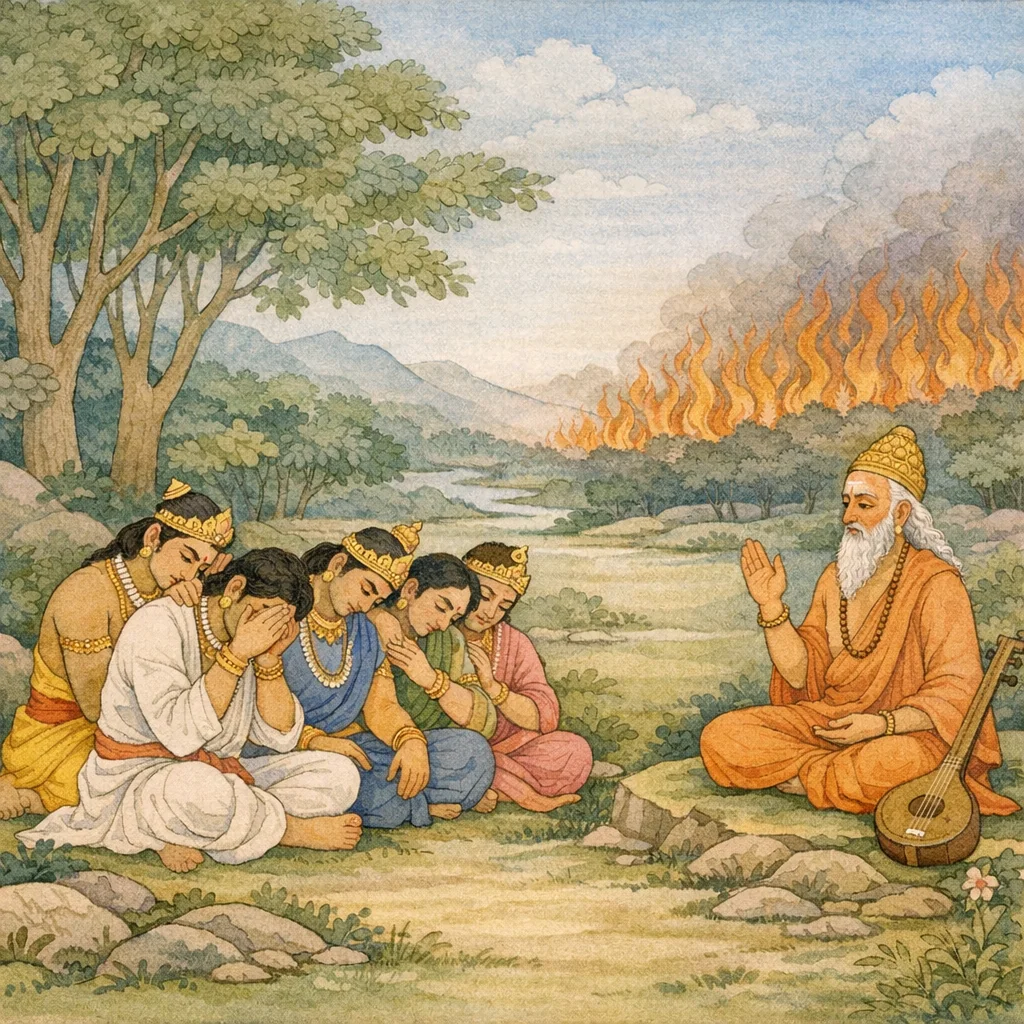
Vaiśaṃpāyana reports that Gāndhārī’s sorrow intensifies after hearing varied lamentation. The chapter enumerates the shared grief of Kuntī, Draupadī, Subhadrā, and other eminent women, including the wife of Bhūriśravas, emphasizing the breadth of familial devastation. Gāndhārī, blindfolded and standing with folded hands, addresses the sage with a time-marker—sixteen years have passed—yet Dhṛtarāṣṭra’s grief for his slain sons remains unpacified; he sighs continually and cannot find rest. She acknowledges Vyāsa’s ascetic potency to create and reveal realms, and therefore requests that the king be shown his sons who have gone to other worlds, aiming at the cessation of sorrow for herself, Kuntī, and the household. The scene then pivots to Kuntī’s internal recollection of her concealed firstborn (Karna, “Āditya-saṃbhava”), while Vyāsa, endowed with distant hearing and sight, perceives her distress and invites her to state what is in her mind. Kuntī, after bowing to her elders, begins to disclose the long-held matter with modest reluctance, setting up a consequential revelation in the continuing narrative.
Chapter Arc: नारद के सम्मुख युधिष्ठिर का हृदय फट पड़ता है—धृतराष्ट्र, गांधारी और कुन्ती का वनाग्नि में दग्ध हो जाना सुनकर वह मनुष्यों की ‘गति’ को दुर्विज्ञेय कहकर विलाप करता है। → युधिष्ठिर एक-एक कर स्मृतियों और असंगतियों को जोड़ता है: जिस धृतराष्ट्र के पास सौ पुत्र, बाहुबल और राजवैभव था, वह दावानल में भस्म हो गया; और इससे भी कठोर यह कि महावन में मन्त्रपूत यज्ञाग्नियाँ उपस्थित थीं, फिर भी ‘लौकिक’ अग्नि ने सबको ग्रस लिया। कुन्ती की कृशता, काँपता शरीर, और भयाक्रान्त पुकारें मन में उभरती हैं; पाण्डवों के भीतर अपराध-बोध और असहायता बढ़ती जाती है। → विलाप चरम पर पहुँचता है—युधिष्ठिर ‘हा तात! धर्मराज!’ जैसी करुण पुकारों के साथ उस दृश्य को मन में देखता है जहाँ कुन्ती चारों ओर घिरी हुई ‘भीमसेन! बचाओ’ कहती है, और दावानल उसे भस्म कर देता है; उसी क्षण पाँचों पाण्डव प्रलयकाल के पाँच भूतों की भाँति पीड़ित होकर एक-दूसरे से लिपटकर रो पड़ते हैं। → नारद के सामने शोक का आवेग सामूहिक शोक में बदलता है—भाइयों का आलिंगन, आँसुओं का प्रवाह, और यह स्वीकार कि राजधर्म, तपोवन और यज्ञ—सबके बीच भी काल की गति अटल है। → शोक के बाद प्रश्न शेष रह जाता है: यह दग्ध होना केवल दुर्घटना था या किसी गूढ़ नियति/प्रायश्चित्त का संकेत—और पाण्डव इस समाचार के बाद क्या कर्म-मार्ग चुनेंगे?
Shlokas
Verse 1
पम्प बछ। अं: अष्टात्रिशो&् ध्याय: नारदजीके सम्मुख युधिष्ठिरका धृतराष्ट्र आदिके लौकिक अग्निमें दग्ध हो जानेका वर्णन करते हुए विलाप और अन्य पाण्डवोंका भी रोदन युधिछिर उवाच तथा महात्मनस्तस्य तपस्युग्रे च वर्ततः । अनाथस्थेव निधन तिष्ठत्स्वास्मासु बन्धुषु,युधिष्ठिर बोले--भगवन्! हम-जैसे बन्धु-बान्धवोंके रहते हुए भी कठोर तपस्यामें लगे हुए महामना धृतराष्ट्रकी अनाथके समान मृत्यु हुई, यह कितने दुःखकी बात है?
Yudhiṣṭhira said: “O revered one, it is a grievous sorrow that the great-souled Dhṛtarāṣṭra—while engaged in severe austerities—met his end as though he were without protectors, even though we, his own kinsmen, were still alive.”
Verse 2
दुर्विज्ञेया गतिर्ब्रह्मन् पुरुषाणां मतिर्मम । यत्र वैचित्रवीर्योडसौ दग्ध एवं वनाग्निना,ब्रह्म! मेरा तो ऐसा मत है कि मनुष्योंकी गतिका ठीक-ठीक ज्ञान होना अत्यन्त कठिन है; जब कि विचित्रवीर्यकुमार धृतराष्ट्रको इस तरह दावानलसे दग्ध होकर मरना पड़ा
Yudhiṣṭhira said: “O Brāhmaṇa, in my view the course and destiny of human beings is exceedingly hard to discern—when even that son of Vicitravīrya, Dhṛtarāṣṭra, had to meet his end, burned in a forest conflagration.”
Verse 3
यस्य पुत्रशतं श्रीमदभवद् बाहुशालिन: । नागायुतबलो राजा स दग्धो हि दवाग्निना
Yudhiṣṭhira said: “That king—glorious, strong-armed, and possessed of the strength of ten thousand elephants—who had a splendid hundred sons, was nevertheless burned to death by a forest conflagration. Thus even the mightiest and most prosperous are not beyond the reach of fate; one should therefore restrain pride and cling to dharma with humility.”
Verse 4
जिन बाहुबलशाली नरेशके सौ पुत्र थे, जो स्वयं भी दस हजार हाथियोंके समान बलवान थे, वे ही दावानलसे जलकर मरे हैं, यह कितने दुःखकी बात है? ।। यं पुरा पर्यवीजन्त तालवृन्तैर्वरस्त्रिय: । त॑ गृध्रा: पर्यवीजन्त दावाग्निपरिकालितम्,पूर्वकालमें सुन्दरी स्त्रियाँ जिन्हें सब ओरसे ताड़के पंखोंद्वारा हवा करती थीं, उन्हें दावानलसे दग्ध हो जानेपर गीधोंने अपनी पाँखोंसे हवा की है
Yudhiṣṭhira said: “That king with a hundred sons, himself as strong as ten thousand elephants, was burned to death by the wildfire—what sorrow! He whom, in former days, noble women fanned on every side with palm-leaf fans—him the vultures now ‘fan’ with their wings, scorched by the forest fire. Alas, what a grievous reversal of fortune!”
Verse 5
सूतमागधसंघैश्व शयानो यः प्रबोध्यते । धरण्यां स नृपः शेते पापस्य मम कर्मभि:,जो बहुमूल्य शय्यापर सोते थे और जिन्हें सूत तथा मागधोंके समुदाय मधुर गीतोंद्वारा जगाया करते थे, वे ही महाराज मुझ पापीकी करतूतोंसे पृथ्वीपर सो रहे हैं
Yudhiṣṭhira said: “He who used to be awakened while reclining on a costly bed by the assembled bards—Sūtas and Māgadhas—now that very king lies upon the bare earth, brought to this state by the sinful consequences of my own deeds.”
Verse 6
न च शोचामि गान्धारीं हतपुत्रां यशस्विनीम् । पतिलोकमनुप्राप्तां तथा भर्तृव्रते स्थिताम्,मुझे पुत्रहीना यशस्विनी गान्धारीके लिये उतना शोक नहीं है, क्योंकि वे पातिव्रत्य- धर्मका पालन करती थीं; अत: पतिलोकमें गयी हैं
Nor do I grieve greatly for the illustrious Gāndhārī, bereft of her sons; for she remained steadfast in the vow of fidelity to her husband (pativratā), and thus has attained the world of her lord.
Verse 7
पृथामेव च शोचामि या पुत्रैश्चर्यमृद्धिमत् । उत्सृज्य सुमहद् दीप्तं वनवासमरोचयत्,मैं तो उन माता कुन्तीके लिये ही अधिक शोक करता हूँ, जिन्होंने पुत्रोंके समृद्धिशाली एवं परम समुज्ज्वल ऐश्वर्यको ठुकराकर वनमें रहना पसंद किया था
It is for Pṛthā (Kuntī) that I grieve the most—she who, though her sons possessed wondrous prosperity and radiant sovereignty, cast aside that great splendor and chose instead the life of the forest.
Verse 8
धिग् राज्यमिदमस्माकं धिग् बल॑ धिक् पराक्रमम् । क्षत्रधर्म च धिग् यस्मान्मृता जीवामहे वयम्
Shame on this kingship of ours—shame on our strength, shame on our valor, and shame even on the warrior’s code (kṣatriya-dharma)—since, though we are as good as dead, we still go on living.
Verse 9
हमारे इस राज्यको धिक्कार है, बल और पराक्रमको धिककार है तथा इस क्षत्रिय- धर्मको भी धिक््कार है! जिससे आज हमलोग मृतकतुल्य जीवन बिता रहे हैं ।। सुसूक्ष्मा किल कालस्य गतिर्द्धिजवरोत्तम | यत् समुत्सृज्य राज्यं सा वनवासमरोचयत्,विप्रवर! कालकी गति अत्यन्त सूक्ष्म है, जिससे प्रेरित होकर माता कुन्तीने राज्य त्यागकर वनमें ही रहना ठीक समझा
Shame upon our kingdom; shame upon strength and heroism; shame even upon this so‑called kṣatriya duty—by which today we are forced to live as though we were already dead. O best of Brahmins, the movement of Time (Kāla) is indeed exceedingly subtle: impelled by it, Mother Kuntī abandoned the kingdom and chose life in the forest instead.
Verse 10
युधिष्ठटिस्थ जननी भीमस्य विजयस्य च । अनाथवत् कथं दग्धा इति मुह्यामि चिन्तयन्,युधिष्ठिर, भीमसेन और अर्जुनकी माता अनाथकी भाँति कैसे जल गयी, यह सोचकर मैं मोहित हो जाता हूँ
As I reflect, I am bewildered: how could my mother—mother of Bhīma and of Vijaya (Arjuna)—be burned like one without protection? The thought confounds me.
Verse 11
वृथा संतर्पितो वह्निः खाण्डवे सव्यसाचिना । उपकारमजानन् स कृतघ्न इति मे मति:,सव्यसाची अर्जुनने जो खाण्डववनमें अग्निदेवको तृप्त किया था, वह व्यर्थ हो गया। वे उस उपकारको याद न रखनेके कारण कृतष्न हैं--ऐसी मेरी धारणा है
Yudhiṣṭhira said: “In the Khāṇḍava forest, the Fire-god was once satisfied by Savyasācin (Arjuna); yet that favor has proved futile. Since he does not acknowledge that benefaction, I judge him to be ungrateful.”
Verse 12
यत्रादहत् स भगवान् मातरं सव्यसाचिन: । कृत्वा यो ब्राह्मणच्छद्म भिक्षार्थी समुपागत:
Yudhiṣṭhira said: “At that place, the revered one burned the mother of Savyasācin (Arjuna)—having assumed the disguise of a brāhmaṇa and approaching as if seeking alms.”
Verse 13
इदं कष्टतरं चान्यद् भगवन् प्रतिभाति मे
Yudhiṣṭhira said: “Revered sir, another matter—still more painful—presents itself to my mind.”
Verse 14
तथा तपस्विनस्तस्य राजर्षे: कौरवस्य ह
Yudhiṣṭhira said: “So it was with that ascetic royal sage of the Kuru line as well.”
Verse 15
तिष्ठत्सु मन्त्रपूतेषु तस्याग्निषु महावने
Yudhiṣṭhira said: “While those fires—sanctified by sacred mantras—were standing there in that great forest….”
Verse 16
मन्ये पृथा वेपमाना कृशा धमनिसंतता
Yudhiṣṭhira said: “I think Pṛthā (Kuntī) is trembling; she has grown emaciated, her veins standing out.”
Verse 17
भीम पर्यप्रुहि भयादिति चैवाभिवाशती
Yudhiṣṭhira said: “Bhīma, speak fully—tell me everything.” Saying this, she cried out in fear, her voice breaking under the weight of dread and uncertainty.
Verse 18
सहदेव: प्रियस्तस्या: पुत्रेभ्योईधिक एव तु
Yudhiṣṭhira said: “Sahadeva was dear to her—indeed, even more than her own sons.” In the ethical frame of the Āśramavāsika narrative, the line underscores how affection and trust can transcend mere blood ties, revealing the quiet power of character and service in sustaining relationships amid grief and renunciation.
Verse 19
तच्छुत्वा रुरुदु: सर्वे समालिड्ग्य परस्परम्
Hearing that, they all broke into tears and, embracing one another, shared their grief together—an expression of mutual compassion and solidarity in the face of sorrow.
Verse 20
तेषां तु पुरुषेन्द्राणां रुवतां रुदितस्वन:,वहाँ रोदन करते हुए उन पुरुषप्रवर पाण्डवोंके रोनेका शब्द महलके विस्तारसे अवरुद्ध हुए भूतल और आकाशकमें गूँजने लगा
But the sound of weeping—raised by those bull-like kings, the foremost among men—though checked and muffled by the vast expanse of the palace, still spread out and echoed across the earth and into the sky. The scene underscores how grief, born of duty-bound lives and irreversible loss, cannot be contained by walls or royal grandeur; it becomes a public, cosmic lament.
Verse 21
प्रासादाभोगसंरुद्धे अन्वरौत्सीत् स रोदसी,वहाँ रोदन करते हुए उन पुरुषप्रवर पाण्डवोंके रोनेका शब्द महलके विस्तारसे अवरुद्ध हुए भूतल और आकाशकमें गूँजने लगा
Yudhiṣṭhira said: “Confined by the vast expanse of the palace, their lamentation could not flow outward as it usually would; yet the sound of weeping from those foremost of men—the Pāṇḍavas—reverberated and spread, filling both earth and sky.”
Verse 37
इस प्रकार श्रीमह्ााभारत आश्रमवासिकपर्वके अन्तर्गत नारदागमनपर्वनें धतराष्ट््र आदिका दावाग्निसे दाहविषयक सैंतीसवाँ अध्याय पूरा हुआ
Thus, in the Śrī Mahābhārata, within the Āśramavāsika Parva, in the section concerning Nārada’s arrival, the thirty-seventh chapter—describing how Dhṛtarāṣṭra and others were consumed by a forest fire—comes to an end.
Verse 38
इति श्रीमहाभारते आश्रमवासिके पर्वणि नारदागमनपर्वणि युधिष्ठिरविलापे अष्टात्रिंशोडध्याय:
Thus, in the Śrī Mahābhārata, within the Āśramavāsika Parva—specifically the section describing Nārada’s arrival—this concludes the thirty-eighth chapter, centered on Yudhiṣṭhira’s lament.
Verse 123
धिगग्निं धिक् च पार्थस्य विश्रुतां सत्यसंधताम् । जो एक दिन ब्राह्मणका वेश बनाकर अर्जुनसे भीख माँगने आये थे, उन्हीं भगवान् अग्निदेवने अर्जुनकी माँको जलाकर भस्म कर दिया। अग्निदेवको धिक्कार है! अर्जुनकी जो सुप्रसिद्ध सत्यप्रतिज्ञता है, उसको भी धिक्कार है!
Accursed be the fire—and accursed too be Pārtha’s (Arjuna’s) famed vow of truth! For that very Agni, the god of Fire, who once came in a brahmin’s guise to beg alms from Arjuna, has burned Arjuna’s mother to ashes. Accursed be Agni! Accursed as well be Arjuna’s renowned pledge of truth!
Verse 133
वृथाग्निना समायोगो यदभूत् पृथिवीपते: । भगवन! राजा धृतराष्ट्रके शरीरको जो व्यर्थ (लौकिक) अग्निका संयोग प्राप्त हुआ, यह दूसरी अत्यन्त कष्ट देनेवाली बात जान पड़ती है
Yudhiṣṭhira said: “O revered one, that the lord of the earth—King Dhṛtarāṣṭra—came into contact with a futile, merely worldly fire, seems to me a second event of extreme anguish. It is grievous that one who had already endured so much should meet such an end, and it deepens the moral sorrow that follows the ruin of a dynasty.”
Verse 143
कथमेवंविधो मृत्यु: प्रशास्प पृथिवीमिमाम् । जिन्होंने पहले इस पृथ्वीका शासन करके अन्तमें वैसी कठोर तपस्याका आश्रय लिया था, उन कुरुवंशी राजर्षिको ऐसी मृत्यु क्यों प्राप्त हुई?
Yudhiṣṭhira said: “How could such a death befall those who once ruled this very earth with authority and, in the end, took refuge in such severe austerity? Why did the royal sages of the Kuru line—after governing first and then embracing hard tapas—meet with a death of this kind?”
Verse 153
वृथाग्निना समायुक्तो निष्ठां प्राप्त: पिता मम । हाय, उस महान् वनमें मन्त्रोंसे पवित्र हुई अग्नियोंके रहते हुए भी मेरे ताऊ लौकिक अग्निसे दग्ध होकर क्यों मृत्युको प्राप्त हुए?
Yudhiṣṭhira said: “Alas! My father had attained steadfastness and was united with the sacred fire. Yet how is it that, in that great forest—where fires sanctified by mantras were present—my uncle met his death, burned by an ordinary, worldly fire? What is the meaning of this?”
Verse 186
न चैनां मोक्षयामास वीरो माद्रवतीसुतः । सहदेव मेरी माताको अपने सभी पुत्रोंसे अधिक प्रिय था; परंतु वह वीर माद्रीकुमार भी माँको उस संकटसे बचा न सका
Yudhiṣṭhira said: “Nor could the heroic son of Mādrī—Sahadeva—deliver her from that peril. Though he was dearer to his mother than all her sons, even that valiant prince was unable to rescue her.”
Verse 196
पाण्डवा: पज्च दु:खार्ता भूतानीव युगक्षये । यह सुनकर समस्त पाण्डव एक-दूसरेको हृदयसे लगाकर रोने लगे। जैसे प्रलयकालमें पाँचों भूत पीडित हो जाते हैं, उसी प्रकार उस समय पाँचों पाण्डव दुःखसे आतुर हो उठे
Yudhiṣṭhira said: “The five Pāṇḍavas, tormented by grief, became like the five great elements at the end of an age.” Hearing this, all the Pāṇḍavas embraced one another from the heart and began to weep—overwhelmed by sorrow, as if the very foundations of the world were shaken.
Verse 1636
हा तात! धर्मराजेति समाक्रन्दन्महाभये । मैं तो समझता हूँ कि अत्यन्त दुर्बल हो जानेके कारण जिनके शरीरमें फैली हुई नस- नाड़ियाँतक स्पष्ट दिखायी देती थीं, वे मेरी माता कुन्ती अग्निका महान् भय उपस्थित होनेपर “हा तात! हा धर्मराज!” कहकर कातर पुकार मचाने लगी होंगी
Yudhiṣṭhira said: “Alas, my father! ‘O Dharmarāja!’—thus she must have cried out, wailing in that great terror. I think my mother Kuntī, grown so exceedingly frail that the very veins and sinews stood out upon her body, when the dreadful fear of fire arose, would have lamented and called: ‘Alas, my father! Alas, O Dharmarāja!’”
Verse 1736
समन्ततः परिक्षिप्ता माताभून्मे दवाग्निना । 'भीमसेन! इस भयसे मुझे बचाओ, ऐसा कहकर चारों ओर चीखती-चिल्लाती हुई मेरी माताको दावानलने जलाकर भस्म कर दिया होगा
Yudhiṣṭhira said: “My mother was surrounded on every side by the forest-fire. Crying out, ‘Bhīmasena! Save me from this terror!’ and wailing in all directions, she must have been burned by the wildfire and reduced to ashes.”
Frequently Asked Questions
The chapter stages the dilemma of seeking relief from grief without violating dhārmic boundaries: whether and how extraordinary ascetic means (a vision of the dead) can be pursued as legitimate consolation rather than attachment-driven disturbance.
Sorrow is shown as persistent and socially contagious; the text implies that pacification requires structured, ethically sanctioned interventions—counsel, remembrance, and disciplined spiritual authority—rather than mere passage of time.
No explicit phalaśruti is stated in these verses; the chapter functions as narrative and ethical preparation, positioning Vyāsa’s authority and Kuntī’s disclosure as interpretive keys for later consolatory events.