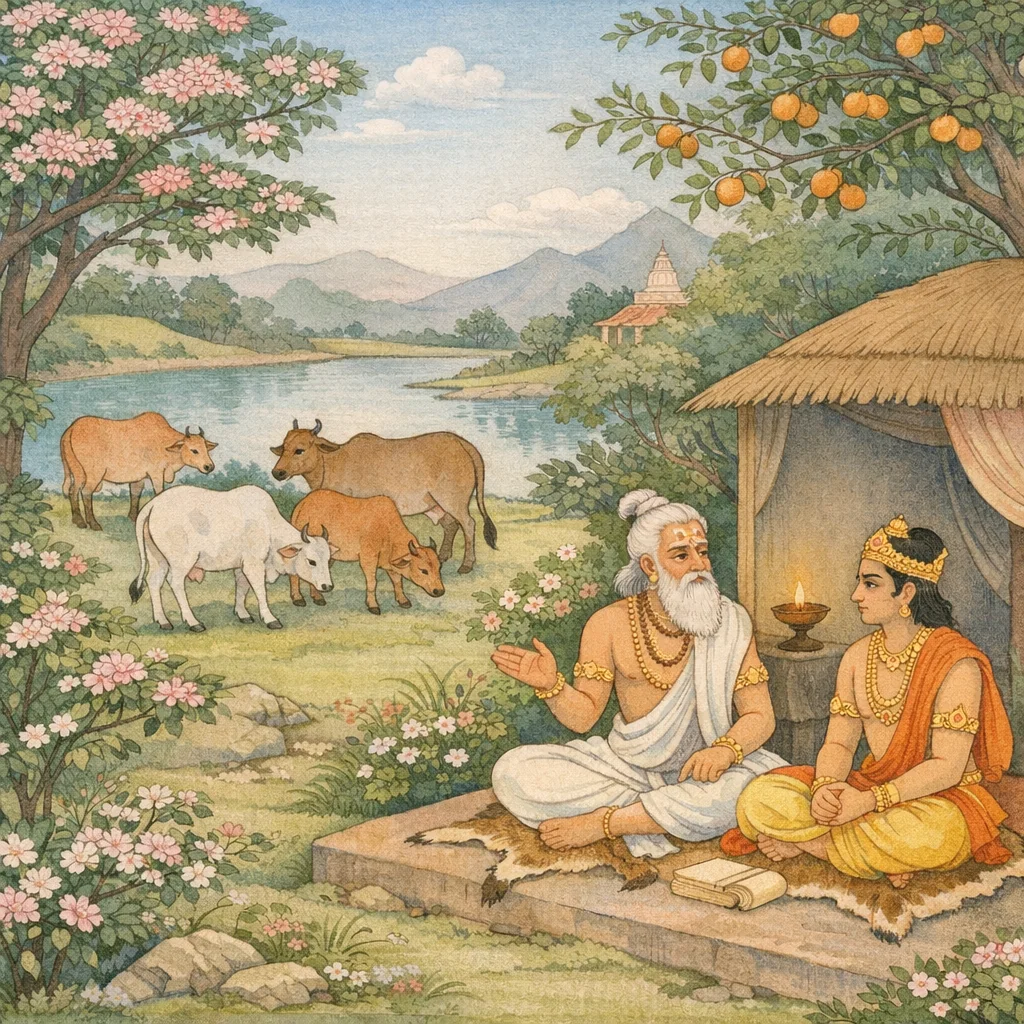
Adhyaya 84
Chapter 84: Brahmā’s Counsel on Tāraka, the Search for Agni, and the Genesis of Skanda (Kārttikeya)
Upa-parva: Agni–Gaṅgā–Skanda (Tārakavadha-upāya) Narrative Unit
The gods petition Brahmā to address the asura Tāraka, empowered by a boon and afflicting devas and ṛṣis. Brahmā affirms impartiality yet rejects adharma, declaring Tāraka’s destruction necessary for the preservation of Veda and dharma, and reveals a prior arrangement: Agni will generate an offspring capable of slaying the enemy despite constraints created by Rudrāṇī’s curse that deprives the gods of progeny. The devas and sages search the three worlds for the concealed Agni. A frog from Rasātala discloses Agni’s watery concealment; Agni curses the frog’s taste (rasa) and the gods grant compensatory boons (vocalization, nocturnal movement, earth’s support). An elephant indicates Agni’s presence in an aśvattha; Agni curses elephants with an adverse tongue, then hides in the śamī. A parrot reveals this; Agni curses it with impaired speech, mitigated by the gods into a sweet but indistinct voice. The gods establish the śamī as a sacred locus for fire-production. Agni agrees to their request and proceeds to Gaṅgā, producing a tejas-laden embryo. Overwhelmed, Gaṅgā releases it on Meru; the embryo’s radiance transforms surrounding matter into gold (jātarūpa), and the child grows in a divine reed-bed, nurtured by the Kṛttikās, becoming Skanda/Kārttikeya/Guhā. The chapter concludes with an explicit valuation of gold as supremely purifying and auspicious, described as Agni–Soma in essence.
Chapter Arc: Yudhishthira, ever hungry for the surest purifier, asks of that which is most pavitra among all gifts—what act lifts a mortal beyond stain and fear. → Bhishma answers with sweeping certainty: nothing surpasses the cow in sanctity and benefit. The narration gathers force—cows sustain sacrifice through havis, nourish through milk, uphold prosperity, and become a bridge for humans across peril. → Veda-Vyasa’s voice crowns the teaching: cows are the very ‘pratishtha’ and ‘parayana’ of beings; their forms and wondrous horns appear as if shaped by desire itself, and the giver of cows attains the radiant, flower-and-fruit-laden realm of cows—Goloka—deemed difficult even for gods. → The chapter seals the promise of Go-dana with exemplars—kings famed for gifting lakhs of cows (Mandhata, Nahusha, Yayati and others) who reached the supreme station. The listener is left with a clear ladder of merit: reverence for cows, gifting with faith, and ascent to blessed worlds. → The discourse implies further gradations—how, when, and with what intention gifts should be made—inviting the next instruction in the chain of Danadharma.
Shlokas
Verse 1
ऑपन-माज बक। अत एकाशीतितमो<ध्याय: गौओंका माहात्म्य तथा व्यासजीके द्वारा शुकदेवसे गौओंकी, गोलोककी और गोदानकी महत्ताका वर्णन युधिछिर उवाच पवित्राणां पवित्र यच्छिष्टं लोके च यद् भवेत् । पावन परमं चैव तनमे ब्रूहि पितामह,युधिष्ठिरने कहा--पितामह! संसारमें जो वस्तु पवित्रोंमें भी पवित्र तथा लोकमें पवित्र कहकर अनुमोदित एवं परम पावन हो, उसका मुझसे वर्णन कीजिये
Yudhiṣṭhira said: “Grandfather, please tell me of that which is the purest among all purifying things—what the wise and cultured approve in the world as truly pure, and what is held to be supremely sanctifying.”
Verse 2
भीष्म उवाच गावो महार्था: पुण्याश्ष॒ तारयन्ति च मानवान् | धारयन्ति प्रजाश्षेमा हविषा पयसा तथा,भीष्मजीने कहा--राजन! गौएँ महान प्रयोजन सिद्धू करनेवाली तथा परम पवित्र हैं। ये मनुष्योंको तारनेवाली हैं और अपने दूध-घीसे प्रजावर्गके जीवनकी रक्षा करती हैं
Bhishma said: “O king, cows are of great practical and spiritual value and are supremely pure. They help human beings cross over (from sin and distress), and by their milk and by ghee used in sacred offerings they sustain the welfare and security of living beings.”
Verse 3
न हि पुण्यतमं किंचिद् गो भ्यो भरतसत्तम । एता: पुण्या: पवित्राश्न त्रिषु लोकेषु सत्तमा:,भरतश्रेष्ठ। गौओंसे बढ़कर परम पवित्र दूसरी कोई वस्तु नहीं है। ये पुण्यजनक, पवित्र तथा तीनों लोकोंमें सर्वश्रेष्ठ हैं
Bhīṣma said: “O best of the Bharatas, nothing whatsoever is more supremely meritorious than cows. They are themselves sources of merit and purity, and are regarded as the foremost among beings across the three worlds.”
Verse 4
देवानामुपरिष्टाच्च गाव: प्रतिवसन्ति वै । दत्त्वा चैतास्तारयन्ते यान्ति स्वर्ग मनीषिण:,गौएँ देवताओंसे भी ऊपरके लोकोंमें निवास करती हैं। जो मनीषी पुरुष इनका दान करते हैं, वे अपने आपको तारते हैं और स्वर्गमें जाते हैं
Bhīṣma declares that cows dwell in realms even higher than those of the gods. Therefore, the wise who give cows in charity rescue themselves from peril and attain heaven—presenting go-dāna as a supremely meritorious act grounded in dharma and compassion.
Verse 5
मान्धाता यौवनाश्रवश्व ययातिर्नहुषस्तथा । गा वै ददनत: सततं सहस्रशतसम्मिता:
Bhīṣma said: “Māndhātā, Yauvanāśva, Yayāti, and likewise Nahuṣa—these kings, famed in ancient tradition, were continual givers of cows, their gifts amounting to hundreds of thousands.”
Verse 6
अपि चात्र पुरागीतां कथयिष्यामि तेडनघ,निष्पाप नरेश! इस विषयमें मैं तुम्हें एक पुराना वृत्तान्त सुना रहा हूँ। एक समयकी बात है, परम बुद्धिमान् शुकदेवजीने नित्यकर्मका अनुष्ठान करके पवित्र एवं शुद्धचित्त होकर अपने पिता--ऋषियोंमें उत्तम श्रीकृष्णद्वैपायन व्यासको, जो लोकके भूत और भविष्यको प्रत्यक्ष देखनेवाले हैं, प्रणाम करके पूछा--'पिताजी! सम्पूर्ण यज्ञोंमें कौन-सा यज्ञ सबसे श्रेष्ठ देखा जाता है?
Bhishma said: “Moreover, O sinless king, I shall recount here an ancient tradition. Once, the supremely wise Śukadeva, having performed his daily rites and become pure and clear-minded, bowed to his father—Śrī Kṛṣṇa Dvaipāyana Vyāsa, foremost of sages, who is said to behold directly what has been and what will be—and asked: ‘Father, among all sacrifices, which sacrifice is regarded as the highest?’”
Verse 7
ऋषीणामुत्तमं धीमान् कृष्णद्वैपायनं शुक: । अभिवाद्याह्विककृतः शुचि: प्रयतमानस:,निष्पाप नरेश! इस विषयमें मैं तुम्हें एक पुराना वृत्तान्त सुना रहा हूँ। एक समयकी बात है, परम बुद्धिमान् शुकदेवजीने नित्यकर्मका अनुष्ठान करके पवित्र एवं शुद्धचित्त होकर अपने पिता--ऋषियोंमें उत्तम श्रीकृष्णद्वैपायन व्यासको, जो लोकके भूत और भविष्यको प्रत्यक्ष देखनेवाले हैं, प्रणाम करके पूछा--'पिताजी! सम्पूर्ण यज्ञोंमें कौन-सा यज्ञ सबसे श्रेष्ठ देखा जाता है?
Bhishma said: “O sinless king, I shall relate to you an ancient account on this matter. Once, the supremely intelligent Śukadeva—having completed his daily rites, becoming pure and with a disciplined mind—approached his father, the foremost of sages, Kṛṣṇadvaipāyana Vyāsa, who is said to behold directly what has been and what will be in the world. After bowing to him, Śuka asked: ‘Father, among all sacrifices, which sacrifice is regarded as the highest?’”
Verse 8
पितरं परिपप्रच्छ दृष्टलोकपरावरम् | को यज्ञ: सर्वयज्ञानां वरिष्ठोडभ्युपलक्ष्यते,निष्पाप नरेश! इस विषयमें मैं तुम्हें एक पुराना वृत्तान्त सुना रहा हूँ। एक समयकी बात है, परम बुद्धिमान् शुकदेवजीने नित्यकर्मका अनुष्ठान करके पवित्र एवं शुद्धचित्त होकर अपने पिता--ऋषियोंमें उत्तम श्रीकृष्णद्वैपायन व्यासको, जो लोकके भूत और भविष्यको प्रत्यक्ष देखनेवाले हैं, प्रणाम करके पूछा--'पिताजी! सम्पूर्ण यज्ञोंमें कौन-सा यज्ञ सबसे श्रेष्ठ देखा जाता है?
Bhishma said: “He (Śuka) questioned his father, the seer who directly beholds the higher and lower realms of the world—past and future: ‘O sinless king, which sacrifice is recognized as the foremost among all sacrifices?’ In this connection I shall relate to you an ancient account: once, the supremely wise Śukadeva, having performed his daily rites and become purified in body and mind, bowed to his father—Kṛṣṇa Dvaipāyana Vyāsa, the best of sages, who sees what has been and what will be—and asked this question.”
Verse 9
किं च कृत्वा पर स्थान प्राप्रुवन्ति मनीषिण: । केन देवा: पवित्रेण स्वर्गमश्नन्ति वा विभो,'प्रभो! मनीषी पुरुष कौन-सा कर्म करके उत्तम स्थानको प्राप्त होते हैं तथा किस पवित्र कार्यके द्वारा देवता स्वर्गलोकका उपभोग करते हैं?
Bhīṣma said: “And by doing what do the wise attain the highest state? And by what purifying act do the gods enjoy heaven, O mighty lord?”
Verse 10
किं च यज्ञस्य यज्ञत्वं क्व च यज्ञ: प्रतिष्ठित: । देवानामुत्तमं कि च कि च सत्रमित: परम्,'यज्ञका यज्ञत्व क्या है? यज्ञ किसमें प्रतिष्ठित है? देवताओंके लिये कौन-सी वस्तु उत्तम है? इससे श्रेष्ठ यज्ञ क्या है?
Bhishma asks probing questions about the inner meaning of sacrifice: What truly makes a rite a “yajña”? Upon what foundation does yajña stand? What is held to be the highest good for the gods? And what sacrificial observance is considered superior even to this? The questions turn the discussion from mere ritual performance toward the principle and purpose that give ritual its moral and spiritual legitimacy.
Verse 11
पवित्राणां पवित्र च यत् तद् ब्रूहि पितर्मम । एतच्छुत्वा तु वचन व्यास: परमधर्मवित् पुत्रायाकथयत् सर्व तत्त्वेन भरतर्षभ,“पिताजी! पवित्रोंमें पवित्र वस्तु क्या है? इन सारी बातोंका मुझसे वर्णन कीजिये।” भरतश्रेष्ठ! पुत्र शुकदेवका यह वचन सुनकर परम धर्मज्ञ व्यासने उससे सब बातें ठीक-ठीक बतायीं
Bhishma said: “Father, tell me what is the most purifying among all purifiers. Describe all this to me.” O bull among the Bharatas, hearing these words of his son, Vyasa—knower of the highest dharma—explained everything to him truthfully and in full.
Verse 12
व्यास उवाच गाव: प्रतिष्ठा भूतानां तथा गाव: परायणम् । गाव: पुण्या: पवित्राश्व गोधनं पावनं तथा
Vyāsa said: “Cows are the very foundation of living beings, and likewise the ultimate refuge. Cows are meritorious and purifying; and the wealth of cattle too is purifying.”
Verse 13
व्यासजी बोले--बेटा! गौएँ सम्पूर्ण भूतोंकी प्रतिष्ठा हैं। गौएँ परम आश्रय हैं। गौएँ पुण्यमयी एवं पवित्र होती हैं तथा गोधन सबको पवित्र करनेवाला है ।। पूर्वमासन्नशृंगा वै गाव इत्यनुशुश्रुम शंगार्थे समुपासन्त ता: किल प्रभुमव्ययम्,हमने सुना है कि गौएँ पहले बिना सींगकी ही थीं। उन्होंने सींगके लिये अविनाशी भगवान् ब्रह्माकी उपासना की
Vyāsa said: “My son, cows are the very foundation of all living beings. They are the highest refuge. Cows are meritorious and purifying, and wealth in cattle purifies all. We have heard that in ancient times cows were indeed without horns. Seeking horns, they are said to have worshipped the imperishable Lord, Brahmā.”
Verse 14
ततो ब्रह्मा तु गा: प्रायमुपविष्टा: समीक्ष्य ह । ईप्सितं प्रददौ ताभ्यो गोभ्य: प्रत्येकश: प्रभु:,भगवान् ब्रह्माजीने गौओंको प्रायोपवेशन (आमरण उपवास) करते देख उन गौओंमेंसे प्रत्येकको उनकी अभीष्ट वस्तु दी
Then Lord Brahmā, seeing the cows seated in a fast unto death (prāyopaveśana), granted each of those cows—one by one—the boon each desired.
Verse 15
तासां शृंगाण्यजायन्त यस्या यादृड़मनोगतम् । नानावर्णा: शृंगवन्त्यस्ता व्यरोचन्त पुत्रक
Vyāsa said: “On those cows, horns grew in accordance with whatever form each one conceived in her mind. Bearing horns of many different colors, they shone forth beautifully, my child.”
Verse 16
बेटा! वरदान मिलनेके पश्चात् गौओंके सींग प्रकट हो गये। जिसके मनमें जैसे सींगकी इच्छा थी, उसके वैसे ही हो गये। नाना प्रकारके रूप-रंग और सींगसे युक्त हुई उन गौओंकी बड़ी शोभा होने लगी ।। ब्रह्मणा वरदत्तास्ता हव्यकव्यप्रदा: शुभा: | पुण्या: पवित्रा: सुभगा दिव्यसंस्थानलक्षणा:,ब्रह्माजीका वरदान पाकर गौएँ मंगलमयी, हव्य-कव्य प्रदान करनेवाली, पुण्यजनक, पवित्र, सौभाग्यवती तथा दिव्य अंगों एवं लक्षणोंसे सम्पन्न हुईं
Vyāsa said: “Having received Brahmā’s boon, the cows’ horns appeared. Whatever kind of horns each one desired in her mind, just so did they become. Endowed with many forms and colors and furnished with horns, those cows grew exceedingly splendid. By Brahmā’s gift they became auspicious and beneficent—able to provide offerings for the gods (havis) and for the ancestors (kavya). They were holy and purifying, blessed with good fortune, and marked by a divine form and distinctive signs.”
Verse 17
गावस्तेजो महद् दिव्यं गवां दान॑ प्रशस्यते । ये चैता: सम्प्रयच्छन्ति साधवो वीतमत्सरा:,गौएँ दिव्य एवं महान् तेज हैं। उनके दानकी प्रशंसा की जाती है। जो सत्पुरुष मात्सर्यका त्याग करके गौओंका दान करते हैं, वे पुण्यात्मा कहे गये हैं। वे सम्पूर्ण दानोंके दाता माने गये हैं। निष्पाप शुकदेव! उन्हें पुण्यमय गोलोककी प्राप्ति होती है
Vyāsa said: “Cows possess a great, divine radiance; therefore the gifting of cows is praised. Those good people who, free from jealousy and spite, give these cows away are regarded as truly meritorious. Such donors are counted among the givers of all gifts, and they attain the holy world of the cows (Goloka).”
Verse 18
ते वै सुकृतिन: प्रोक्ता: सर्वदानप्रदाश्न ते । गवां लोकं तथा पुण्यमाप्रुवन्ति च तेडनघ,गौएँ दिव्य एवं महान् तेज हैं। उनके दानकी प्रशंसा की जाती है। जो सत्पुरुष मात्सर्यका त्याग करके गौओंका दान करते हैं, वे पुण्यात्मा कहे गये हैं। वे सम्पूर्ण दानोंके दाता माने गये हैं। निष्पाप शुकदेव! उन्हें पुण्यमय गोलोककी प्राप्ति होती है
Vyāsa said: “Those who give cows are declared truly meritorious. Such donors are regarded as givers of all gifts, for the gift of cows is praised above others. O sinless one, they attain the holy world of the cows (Goloka), a realm of great purity and spiritual reward.”
Verse 19
यत्र वृक्षा मधुफला दिव्यपुष्पफलोपगा: । पुष्पाणि च सुगन्धीनि दिव्यानि द्विजसत्तम,द्विजश्रेष्ठ] गोलोकके सभी वृक्ष मधुर एवं सुस्वादु फल देनेवाले हैं। वे दिव्य फल- फूलोंसे सम्पन्न होते हैं। उन वृक्षोंके पुष्प दिव्य एवं मनोहर गन्धसे युक्त होते हैं
Vyāsa said: “There, the trees bear honey-sweet fruits and are adorned with celestial flowers and fruits. Their blossoms are divine and filled with exquisite fragrance, O best of the twice-born.”
Verse 20
सर्वा मणिमयी भूमि: सर्वकाज्चनवालुका । सर्वर्तुसुखसंस्पर्शा निष्पड़का निरजा: शुभा:,वहाँकी भूमि मणिमयी है। वहाँकी बालुका कांचनचूर्णरूप है। उस भूमिका स्पर्श सभी ऋतुओंमें सुखद होता है। वहाँ धूल और कीचड़का नाम भी नहीं है। वह भूमि सर्वथा मंगलमयी है
Vyāsa describes a supremely auspicious realm: the very ground is made of gems, and its sand is like powdered gold. To the touch it is pleasant in every season, never harsh or uncomfortable. There is neither dust nor mud there; the land is wholly pure and blessed—an image of a dharmic world where nature itself reflects inner purity and merit.
Verse 21
रक्तोत्पलवनैश्वैव मणिखण्डैर्हिरण्मयै: । तरुणादित्यसंकाशैर्भान्ति तत्र जलाशया:,वहाँके जलाशय लाल कमलवनोंसे तथा प्रातः-कालीन सूर्यके समान प्रकाशमान मणिजटित सुवर्णमय सोपानोंसे सुशोभित होते हैं
Vyāsa said: There, the lakes and ponds shine splendidly—adorned with groves of red lotuses and with golden stairways inlaid with gems, radiant like the rising sun. The description underscores a realm of ordered beauty and auspiciousness, suggesting the moral harmony that accompanies righteous conduct.
Verse 22
महार्हमणिपत्रैश्न काउचनप्रभकेसरै: । नीलोत्पलविमिश्रैश्व सरोभिर्बहुपड्कजै:,वहाँकी भूमि कितने ही सरोवरोंसे शोभा पाती है। उन सरोवरोंमें नीलोत्पलमिश्रित बहुत-से कमल खिले रहते हैं। उन कमलोंके दल बहुमूल्य मणिमय होते हैं और उनके केसर अपनी स्वर्णमयी प्रभासे प्रकाशित होते हैं
Vyāsa describes that region’s ground as beautified by many lakes. In those waters bloom abundant lotuses mingled with blue water-lilies; their petals are as if made of precious gems, and their filaments shine with a golden radiance—an image of auspicious, otherworldly splendor that frames the narrative in a mood of sanctity and moral elevation.
Verse 23
करवीरवनै: फुल्लै: सहस्रावर्तसंवृतै: । संतानकवनै: फुल्लैर्वक्षैश्ष समलंकृता:,उस लोकमें बहुत-सी नदियाँ हैं, जिनके तटोंपर खिले हुए कनेरोंके वन तथा विकसितसंतानक (कल्पवृक्ष-विशेष) के वन एवं अन्यान्य वृक्ष उनकी शोभा बढ़ाते हैं। वे वृक्ष और वन अपने मूल भागमें सहस्रों आवर्तोंसे घिरे हुए हैं
Vyāsa said: In that realm there are many rivers. Their banks are beautified by blossoming groves of karavīra (oleander) and by flourishing saṃtānaka-groves (a celestial wish-fulfilling tree), along with other trees. Around their bases the trees and woods are encircled by thousands of swirling eddies, enhancing the wondrous, otherworldly splendor of the scene.
Verse 24
निर्मलाभिश्न मुक्ताभिमणिभिश्न महाप्रभै: | उद्भूतपुलिनास्तत्र जातरूपैश्न निम्नगा:,उन नदियोंके तटोंपर निर्मल मोती, अत्यन्त प्रकाशमान मणिरत्न तथा सुवर्ण प्रकट होते हैं
Vyāsa said: There, the riverbanks rose up with fresh sandbars, and in those streams appeared pure pearls, exceedingly radiant gems, and gold—an image of nature’s abundance that underscores how sacred places are believed to yield auspicious, purifying treasures to the worthy.
Verse 25
सर्वरत्नमयैश्रित्रैरवगाढा द्रुमोत्तमै: । जातरूपमयैश्चान्यैहुताशनसमप्रभै:,कितने ही उत्तम वृक्ष अपने मूलभागके द्वारा उन नदियोंके जलमें प्रविष्ट दिखायी देते हैं। वे सर्वरत्नमय विचित्र देखे जाते हैं। कितने ही सुवर्णमय होते हैं और दूसरे बहुत-से वृक्ष प्रज्ज्वलित अग्निके समान प्रकाशित होते हैं
Vyāsa said: Many excellent trees are seen with their roots plunged deep into the waters of those rivers. Some appear wondrous and variegated, as though made entirely of every kind of jewel; some are made of gold; and many others shine with a radiance equal to blazing fire.
Verse 26
सौवर्णा गिरयस्तत्र मणिरत्नशिलोच्चया: । सर्वरत्नमयैर्भान्ति शंगैश्वारुभिरुच्छितै:,वहाँ सोनेके पर्वत तथा मणि और रत्नोंके शैलसमूह हैं, जो अपने मनोहर, ऊँचे तथा सर्वरत्नमय शिखरोंसे सुशोभित होते हैं
Vyāsa describes that region as adorned with golden mountains and lofty masses of rock made of gems and precious stones. Their beautiful, towering peaks—entirely resplendent with all kinds of jewels—shine brilliantly, evoking a vision of extraordinary splendor that underscores the otherworldly grandeur of the place being narrated.
Verse 27
नित्यपुष्पफलास्तत्र नगा: पत्ररथाकुला: | दिव्यगन्धरसै: पुष्पै: फलैश्न भरतर्षभ
Vyāsa said: “There, the trees are ever laden with blossoms and fruits, and they are filled with flocks of birds. Their flowers and fruits possess divine fragrance and sweetness of taste, O bull among the Bharatas.”
Verse 28
भरतश्रेष्ठ! वहाँके वृक्षोंमें सदा ही फ़ूल और फल लगे रहते हैं। वे वृक्ष पक्षियोंसे भरे होते हैं तथा उनके फूलों और फलोंमें दिव्य सुगन्ध और दिव्य रस होते हैं ।। रमन्ते पुण्यकर्माणस्तत्र नित्यं युधिष्ठिर । सर्वकामसमृद्धार्था नि:शोका गतमन्यव:,युधिष्ठिर! वहाँ पुण्यात्मा पुरुष ही सदा निवास करते हैं। गोलोकवासी शोक और क्रोधसे रहित, पूर्णकाम एवं सफलमनोरथ होते हैं
O best of the Bharatas, the trees there are ever laden with blossoms and fruits. They are filled with birds, and in their flowers and fruits abide celestial fragrance and celestial taste. There the doers of meritorious deeds delight continually, O Yudhiṣṭhira—fulfilled in every desire and purpose, free from sorrow, and with anger wholly gone.
Verse 29
विमानेषु विचित्रेषु रमणीयेषु भारत । मोदन्ते पुण्यकर्माणो विहरन्तो यशस्विन:,भरतनन्दन! वहाँके यशस्वी एवं पुण्यकर्मा मनुष्य विचित्र एवं रमणीय विमानोंमें बैठकर यथेष्ट विहार करते हुए आनन्दका अनुभव करते हैं
Vyāsa said: “O Bhārata, those of meritorious deeds—renowned and virtuous—rejoice there, moving about at will while enjoying delightful, wondrous aerial chariots.”
Verse 30
उपक्रीडन्ति तान् राजन् शुभाश्चाप्सरसां गणा: । एताल्लोॉकानवाप्रोति गां दत्त्वा वै युधिष्ठिर,राजन्! उनके साथ सुन्दरी अप्सराएँ क्रीड़ा करती हैं। युधिष्ठिर! गोदान करके मनुष्य इन्हीं लोकोंमें जाते हैं
Vyāsa said: “O King, radiant companies of Apsarases sport with them there. O Yudhiṣṭhira, by gifting a cow a person indeed attains these very worlds.”
Verse 31
येषामधिपति: पूषा मारुतो बलवान् बली । ऐश्वर्ये वरुणो राजा नाममात्र युगन्धरा:,नरेन्द्र! शक्तिशाली सूर्य और बलवान् वायु जिन लोकोंके अधिपति हैं, एवं राजा वरुण जिन लोकोंके ऐश्वर्यपर प्रतिष्ठित हैं, मनुष्य गोदान करके उन्हीं लोकोंमें जाता है। गौएँ युगन्धरा, सुरूपा, बहुरूपा, विश्वरूपा तथा सबकी माताएँ हैं। शुकदेव! मनुष्य संयम- नियमके साथ रहकर गौओंके इन प्रजापतिकथित नामोंका प्रतिदिन जप करे
Vyāsa said: “O king, the worlds over which Pūṣan (the Sun) and the mighty Wind preside, and the worlds whose prosperity is founded upon King Varuṇa—by giving cows in charity a person attains those very realms. Cows are called Yugandharā, Surūpā, Bahurūpā, Viśvarūpā, and ‘Mothers of all.’ O Śukadeva, living with self-restraint and observance, one should daily recite these names of the cows as declared by Prajāpati.”
Verse 32
सुरूपा बहुरूपाश्न विश्वरूपाश्व मातर: । प्राजापत्यमिति ब्रह्मन् जपेन्नित्यं यतव्रतः,नरेन्द्र! शक्तिशाली सूर्य और बलवान् वायु जिन लोकोंके अधिपति हैं, एवं राजा वरुण जिन लोकोंके ऐश्वर्यपर प्रतिष्ठित हैं, मनुष्य गोदान करके उन्हीं लोकोंमें जाता है। गौएँ युगन्धरा, सुरूपा, बहुरूपा, विश्वरूपा तथा सबकी माताएँ हैं। शुकदेव! मनुष्य संयम- नियमके साथ रहकर गौओंके इन प्रजापतिकथित नामोंका प्रतिदिन जप करे
Vyāsa said: “O Brāhmaṇa, one who is disciplined in vows should daily recite the Prajāpati-given names of the cows—Surūpā, Bahurūpā, Viśvarūpā, and ‘Mātaraḥ’ (the Mothers). By honoring and giving cows, a person attains those exalted worlds presided over by the mighty Sun and the powerful Wind, and those realms whose prosperity rests under King Varuṇa. Thus, reverence for the cow—expressed through gift and remembrance—becomes a dharmic path to merit and higher destiny.”
Verse 33
गाश्च शुश्रूषते यश्व समन्वेति च सर्वश: । तस्मै तुष्टा: प्रयच्छन्ति वरानपि सुदुर्लभान्,जो पुरुष गौओंकी सेवा और सब प्रकारसे उनका अनुगमन करता है, उसपर संतुष्ट होकर गौएँ उसे अत्यन्त दुर्लभ वर प्रदान करती हैं
Vyāsa said: Whoever serves the cows and follows after them in every way—attending to their needs and keeping them safe—upon him the cows, being pleased, bestow even boons that are exceedingly hard to obtain.
Verse 34
द्रहोन्न मनसा वापि गोषु नित्यं सुखप्रद: । अर्चयेत सदा चैव नमस्कारैश्व पूजयेत्,गौओंके साथ मनसे भी कभी द्रोह न करे, उन्हें सदा सुख पहुँचाये, उनका यथोचित सत्कार करे और नमस्कार आदिके द्वारा उनका पूजन करता रहे
Vyāsa said: One should never bear malice toward cows, not even in one’s mind. One should continually act for their welfare and comfort, honor them appropriately, and keep worshipping them through reverent salutations and acts of veneration.
Verse 35
दान्तः प्रीतमना नित्यं गवां व्युष्टिं तथाश्रुते । त्र्यहमुष्णं पिबेन्मूत्रं 5यहमुष्णं पिबेत् पय:,जो मनुष्य जितेन्द्रिय और प्रसन्नचित्त होकर नित्य गौओंकी सेवा करता है, वह समृद्धिका भागी होता है। मनुष्य तीन दिनोंतक गरम गोमूत्र पीकर रहे, फिर तीन दिनतक गरम गोदुग्ध पीकर रहे
Vyāsa said: A self-controlled person, ever cheerful at heart, who regularly attends upon cattle and listens attentively to the prescribed observances, becomes a sharer in prosperity. As a discipline, one should drink warm cow’s urine for three days, and then drink warm cow’s milk for three days.
Verse 36
गवामुष्णं पय: पीत्वा ऋयहमुष्णं घृतं पिबेत् । त्रयहमुष्णं घृतं पीत्वा वायुभक्षो भवेत् ऋ यहम्,गरम गोदुग्ध पीनेके पश्चात् तीन दिनोंतक गरम-गरम गोघृत पीये। तीन दिनतक गरम घी पीकर फिर तीन दिनोंतक वह वायु पीकर रहे
Vyāsa said: “After drinking warm milk from cows, one should drink warm ghee for three days. Having drunk warm ghee for three days, one should then live for three days subsisting only on air.” In context, this describes a graded regimen of austerity and purification—emphasizing disciplined self-restraint and bodily regulation as part of dharmic observance.
Verse 37
येन देवा: पवित्रेण भुज्जते लोकमुत्तमम् । यत् पवित्र पवित्राणां तद् घृतं शिरसा वहेत्,देवगण भी जिस पवित्र घृतके प्रभावसे उत्तम-उत्तम लोकका पालन करते हैं तथा जो पवित्र वस्तुओंमें सबसे बढ़कर पवित्र है, उससे घृतको शिरोधार्य करे
Vyāsa said: “By that purifying substance through which the gods partake of and sustain the highest worlds—and which is the purest among all that is pure—one should bear ghee upon one’s head as a sacred, reverential act.”
Verse 38
घृतेन जुहुयादग्निं घृतेन स्वस्ति वाचयेत् । घृतं प्राशेद् घृतं दद्याद् गवां पुष्टि तथाश्रुते,गायके घीके द्वारा अग्निमें आहुति दे। घृतकी दक्षिणा देकर ब्राह्मणोंद्वारा स्वस्तिवाचन कराये। घृत भोजन करे तथा गोघृतका ही दान करे। ऐसा करनेसे मनुष्य गौओंकी समृद्धि एवं अपनी पुष्टिका अनुभव करता है
Vyāsa said: One should offer oblations into the fire with ghee, and have auspicious benedictions (svasti) recited with ghee as the sacrificial fee. One should partake of ghee and also give ghee in charity. By such observance, a person is said to experience the flourishing of cattle and one’s own nourishment and strength.
Verse 39
नि्तैश्व यवैगोभिमासं प्रश्नितयावक: । ब्रह्महत्यासमं पाप॑ सर्वमेतेन शुध्यते,गौओंके गोबरसे निकाले हुए जौकी लप्सीका एक मासतक भक्षण करे। इससे मनुष्य ब्रह्महत्या-जैसे पापसे भी छुटकारा पा जाता है
Vyāsa says: One should, with steady discipline, live for a month on a gruel of barley prepared with cow-products. By undertaking this observance, a person becomes purified even from sins as grave as brahmin-slaying. The verse frames cow-derived purity and regulated diet as a means of moral cleansing and restoration to dharmic life.
Verse 40
पराभवाच्च दैत्यानां देवैः शौचमिदं कृतम् । ते देवत्वमपि प्राप्ता: संसिद्धाक्ष महाबला:,जब दैत्योंने देवताओंको पराजित कर दिया, तब देवताओंने इसी प्रायश्चित्तका अनुष्ठान किया। इससे उन्हें पुनः (नष्ट हुए) देवत्वकी प्राप्ति हुई तथा वे महाबलवान् और परम सिद्ध हो गये
When the Daityas had brought defeat upon the gods, the Devas performed this very rite of purity and expiation. By its power they regained their lost divinity, becoming mighty and perfectly accomplished in spiritual attainment.
Verse 41
गाव: पवित्रा: पुण्याश्व॒ पावनं परमं महत् | ताश्च दत्त्वा द्विजातिभ्यो नर: स्वर्गमुपाशुते,गौएँ परम पावन, पवित्र और पुण्यस्वरूपा हैं। वे महान् देवता हैं। उन्हें ब्राह्मणोंको देकर मनुष्य स्वर्गका सुख भोगता है
Cows are pure and sacred, supremely purifying and greatly meritorious. One who gives them in charity to the twice-born (dvija—especially Brāhmaṇas) reaches heaven and enjoys its bliss.
Verse 42
गवां मध्ये शुचिर्भूत्वा गोमतीं मनसा जपेत् । पुताभिरद्धिराचम्य शुचिर्भवति निर्मल:,पवित्र जलसे आचमन करके पवित्र होकर गौओंके बीचमें गोमतीमन्त्र (गोमाँ अग्नेविमाँ अश्वि इत्यादि) का मन-ही-मन जप करे। ऐसा करनेसे वह अत्यन्त शुद्ध एवं निर्मल (पापमुक्त) हो जाता है
Having sipped pure water in ācamana and become clean, let one stand amid the cows and mentally recite the Gomatī mantra. By doing so, one becomes exceedingly pure and spotless, freed from sin.
Verse 43
अग्निमध्ये गवां मध्ये ब्राह्मणानां च संसदि | विद्यावेदव्रतस्नाता ब्राह्मुणा: पुण्यकर्मिण:,विद्या और वेददव्रतमें निष्णात पुण्यात्मा ब्राह्मणोंको चाहिये कि वे अग्नियों और गौओंके बीचमें तथा ब्राह्मणोंकी सभामें शिष्योंको यज्ञतुल्य गोमतीविद्याकी शिक्षा दें। जो तीन राततक उपवास करके गोमती-मन्त्रका जप करता है, उसे गौओंका वरदान प्राप्त होता है
Amid the sacred fires, among the cows, and in the assembly of Brāhmaṇas, those Brāhmaṇas—purified by learning, Vedic study, and vowed discipline, and devoted to meritorious deeds—should impart instruction and transmit sacred knowledge.
Verse 44
अध्यापयेरन् शिष्यान् वै गोमतीं यज्ञसम्मिताम् | त्रिरात्रोपोषितो भूत्वा गोमतीं लभते वरम्,विद्या और वेददव्रतमें निष्णात पुण्यात्मा ब्राह्मणोंको चाहिये कि वे अग्नियों और गौओंके बीचमें तथा ब्राह्मणोंकी सभामें शिष्योंको यज्ञतुल्य गोमतीविद्याकी शिक्षा दें। जो तीन राततक उपवास करके गोमती-मन्त्रका जप करता है, उसे गौओंका वरदान प्राप्त होता है
Vyāsa said: “Let learned Brāhmaṇas, well-trained in sacred knowledge and Vedic observances, teach their disciples the Gomatī-vidyā, a discipline held equal to a sacrifice (yajña)—taught before the sacred fires, between the fires and the cows, and within assemblies of Brāhmaṇas. One who fasts for three nights and recites the Gomatī mantra obtains the boon of cows.”
Verse 45
पुत्रकामश्न लभते पुत्रं धनमथापि वा | पतिकामा च भर्तरं सर्वकामांश्ष मानव: । गावस्तुष्टा: प्रयच्छन्ति सेविता वै न संशय:,पुत्रकी इच्छावाला पुत्र और धन चाहनेवाला धन पाता है। पतिकी इच्छा रखनेवाली सत्रीको मनके अनुकूल पति मिलता है। सारांश यह है कि गौओंकी आराधना करके मनुष्य सम्पूर्ण कामनाओंको प्राप्त कर लेता है। गौएँ मनुष्योंद्वारा सेवित और संतुष्ट होकर उन्हें सब कुछ देती हैं, इसमें संशय नहीं है
Vyāsa said: A person who longs for a son obtains a son, and one who longs for wealth obtains wealth. A woman who desires a husband gains a husband according to her heart’s wish. In sum, by honoring and serving cows, a human being attains all desired ends. Cows, when attended upon and made content, bestow these boons—of this there is no doubt.
Verse 46
एवमेता महाभागा यज्ञिया: सर्वकामदा: । रोहिण्य इति जानीहि नैताभ्यो विद्यते परम्,इस प्रकार ये महाभाग्यशालिनी गौएँ यज्ञका प्रधान अंग हैं और सबको सम्पूर्ण कामनाएँ देनेवाली हैं। तुम इन्हें रोहिणी समझो। इनसे बढ़कर दूसरा कुछ नहीं है
Vyāsa said: “Thus these highly blessed cows are integral to sacrificial rites and are bestowers of every desired good. Know them as ‘Rohiṇīs’; nothing surpasses them.”
Verse 47
इत्युक्त: स महातेजा: शुक: पित्रा महात्मना । पूजयामास गां नित्यं तस्मात् त्वमपि पूजय,युधिष्ठिर! अपने महात्मा पिता व्यासजीके ऐसा कहनेपर महातेजस्वी शुकदेवजी प्रतिदिन गौकी सेवा-पूजा करने लगे; इसलिये तुम भी गौओंकी सेवा-पूजा करो
Vyāsa said: Thus addressed by his great-souled father, the radiant Śuka began to honor and serve the cow every day. Therefore you too, O Yudhiṣṭhira, should honor and care for cows.
Verse 53
गता: परमकं स्थान देवैरपि सुदुर्लभम् । युवनाश्वके पुत्र राजा मान्धाता, (सोमवंशी) नहुष और ययाति--ये सदा लाखों गौओंका दान किया करते थे; इससे वे उन उत्तम स्थानोंको प्राप्त हुए हैं, जो देवताओंके लिये भी अत्यन्त दुर्लभ हैं
Bhishma said: They attained the highest abode, a state exceedingly difficult to reach even for the gods. King Mandhata, son of Yuvanashva, and the Somavamsi kings Nahusha and Yayati—these rulers were ever engaged in gifting cows by the hundreds of thousands. By the power of such continual generosity, they reached those excellent realms that are rare even for the divine beings.
Verse 80
इस प्रकार श्रीमह्ााभारत अनुशासनपर्वके अन्तर्गत दानधर्मपर्वमें गोदानविषयक अस्सीवाँ अध्याय पूरा हुआ
Thus concludes the eightieth chapter on the gift of cows (godāna) within the Dānadharma section of the Anuśāsana Parva of the Śrī Mahābhārata.
Verse 81
इति श्रीमहा भारते अनुशासनपर्वणि दानधर्मपर्वणि गोप्रदानिके एकाशीतितमो<ध्याय:
Thus ends the eighty-first chapter—the section on the gift of cows—within the “Dāna-dharma” subdivision of the Anuśāsana Parva of the sacred Mahābhārata. This closing colophon places the teaching within Bhīṣma’s ethical instruction on righteous giving (dāna) and its merits.
Frequently Asked Questions
The dilemma is how to neutralize a harmful agent protected by a legitimate boon without violating cosmic fairness: the solution must both restrain adharma and respect the rule-structure of boons, curses, and authorized means.
Efficacy is not merely force-based; it is procedure-based. When direct action is barred, dharmic outcomes emerge through sanctioned intermediaries, disciplined intention (saṃkalpa), and alignment with cosmic order.
Yes, the concluding valuation of jātarūpa (gold) functions as a normative meta-statement: gold is declared supremely purifying and auspicious, framed as Agni–Soma in nature, thereby linking the narrative to ritual theology and ethical valuation.