Adhyaya 135
आदि पर्व — जातुगृह-प्रसङ्गः: विदुरप्रेषित-खनकस्य सूचना तथा पलायन-मार्ग-निर्माणम् (Adi Parva 135: The Miner’s Warning and Construction of the Escape Passage)
Upa-parva: Jatugṛha-dāha (Lākṣāgṛha) Episode — Vidura’s Covert Warning and the Miner’s Tunnel
Vaiśaṃpāyana reports that a skilled miner, a trusted associate of Vidura, privately approaches the Pāṇḍavas and states he has been dispatched to act for their welfare. He conveys operational intelligence: on the fourteenth night of the dark fortnight, Purocana will set fire at the door of the residence, intending to burn the Pāṇḍavas along with their mother. The miner notes that Vidura has already used coded language (mleccha-vāc) to establish trust and to signal the need for discreet action. Yudhiṣṭhira recognizes the envoy as Vidura’s loyal friend and requests urgent deliverance from the imminent fire, observing that their destruction would fulfill Duryodhana’s aims. The miner then undertakes the counter-operation: he excavates a large subterranean passage, creates a concealed, door-fitted opening within the house, levels it with the ground, and keeps it hidden due to fear of Purocana’s surveillance. The Pāṇḍavas maintain a posture of apparent trust while actually remaining vigilant, living armed at night and ranging by day, so that the townspeople remain unaware—except for Vidura’s agent and the miner—thereby preserving secrecy until escape becomes necessary.
Chapter Arc: रंगभूमि में उत्सव-सा कोलाहल उठता है—जनता ‘वीर कुरुराज!’ और ‘भीम!’ कहकर गर्जना करती है; सभा एक क्षुब्ध महासागर-सी हिलोरें लेने लगती है। → द्रोणाचार्य अपने प्रिय पुत्र अश्वत्थामा से संकेतात्मक वाणी कहते हैं और शिष्य-प्रतिस्पर्धा का ताप बढ़ता है; अर्जुन के लक्ष्य-भेदन के अद्भुत प्रदर्शन (घूमते लोहे के वराह पर एक साथ पाँच बाण, हिलते रस्सी-लटके लक्ष्य में अनेक बाण) से दर्शक विस्मय में डूबते हैं और पक्षधरता तीखी होती जाती है। → अर्जुन की अचूकता और भीम-प्रशंसा के बीच दुर्योधन अपने भाइयों सहित, अश्वत्थामा के साथ, शस्त्र उठाकर खड़ा हो जाता है—मानो देवगणों से घिरा इन्द्र; रंगभूमि का उत्सव क्षण भर में संघर्ष की देहरी पर आ टिकता है। → धृतराष्ट्र भीतर-ही-भीतर स्वयं को ‘रक्षित’ अनुभव करता है—कुन्ती-रूपी अरणि से प्रकट ‘तीन पाण्डव-अग्नियों’ (तीन प्रमुख तेजस्वी पुत्रों) को देखकर उसे राज्य-रक्षा का भरोसा और साथ ही अनकहा भय दोनों मिलता है; सभा औपचारिक रूप से अभी युद्ध में नहीं फूटती, पर वैर का बीज स्पष्ट हो जाता है। → दुर्योधन का सशस्त्र उठ खड़ा होना संकेत देता है कि यह प्रदर्शन अब केवल कला नहीं—आगामी वैमनस्य और टकराव का पूर्वाभ्यास है।
Shlokas
Verse 1
(दाक्षिणात्य अधिक पाठके ७३ श्लोक मिलाकर कुल ४२३ शलोक हैं) #ीी#ीि 2 हज श्रीस-शसीस > जो उत्सव या नाटक आदिको सुविधापूर्वक देखनेके उद्देश्यसे बनाया गया हो, उसे प्रेक्षागृह या प्रेक्षाभवन कहते हैं। चतुस्त्रिंशर्दाधिकशततमो< ध्याय: भीमसेन, दुर्योधन तथा अर्जुनके द्वारा अस्त्र-कौशलका प्रदर्शन वैशम्पायन उवाच कुरुराजे हि रड़स्थे भीमे च बलिनां वरे । पक्षपातकृतस्नेह: स द्विधेिवाभवज्जन:,वैशम्पायनजी कहते हैं--जनमेजय! जब कुरुराज दुर्योधन और बलवानोंमें श्रेष्ठ भीमसेन रंगभूमिमें उतरकर गदायुद्ध कर रहे थे, उस समय दर्शक जनता उनके प्रति पक्षपातपूर्ण स्नेह करनेके कारण मानो दो दलोंमें बँट गयी
Vaiśampāyana said: “O Janamejaya, when the Kuru prince Duryodhana and Bhīmasena—foremost among the strong—entered the arena and engaged in mace-combat, the assembled people, swayed by partisan affection, seemed as though divided into two opposing camps.”
Verse 2
ही वीर कुरुराजेति ही भीम इति जल्पताम् | पुरुषाणां सुविपुला: प्रणादा: सहसोत्थिता:,कुछ कहते, “अहो! वीर कुरुराज कैसा अद्भुत पराक्रम दिखा रहे हैं।” दूसरे बोल उठते, “वाह! भीमसेन तो गजबका हाथ मारते हैं।! इस तरहकी बातें करनेवाले लोगोंकी भारी आवाजें वहाँ सहसा सब ओर गूँजने लगीं
As people cried out, “Bravo! What a hero—the king of the Kurus!” and “Bravo! Bhīma!”—great, swelling shouts suddenly arose, resounding all around.
Verse 3
ततः क्षुब्धार्णवनिभं रंगमालोक्य बुद्धिमान् । भारद्वाज: प्रियं पुत्रमश्चत्थामानमब्रवीत्,फिर तो सारी रंगभूमिमें क्षुब्ध महासागरके समान हलचल मच गयी। यह देख बुद्धिमान् द्रोणाचार्यने अपने प्रिय पुत्र अश्वत्थामासे कहा
Then, seeing the arena in tumult—like a storm-tossed ocean—the wise Bhāradvāja (Droṇa) addressed his beloved son Aśvatthāmā.
Verse 4
द्रोण उदाच वारयैतौ महावीरयों कृतयोग्यावुभावपि । मा भूद् रज्भप्रकोपो5यं भीमदुर्योधनोद्धव:,द्रोण बोले--वत्स! ये दोनों महापराक्रमी वीर अस्त्र-विद्यामें अत्यन्त अभ्यस्त हैं। तुम इन दोनोंको युद्धसे रोको, जिससे भीमसेन और दुर्योधनको लेकर रंगभूमिमें सब ओर क्रोध न फैल जाय
Droṇa said, “Restrain these two great heroes—both fully trained and fit for combat. Let there not arise a tumult in the arena born of Bhīma and Duryodhana, lest anger spread on all sides.”
Verse 5
वैशम्पायन उवाच (तत उत्थाय वेगेन अश्वत्थामा न्यवारयत् । गुरोराज्ञा भीम इति गान्धारे गुरुशासनम् | अलं योग्यकृतं वेगमलं साहसमित्युत ।।) ततस्तावुद्यतगदौ गुरुपुत्रेण वारितौ । युगान्तानिलसंक्षुब्धी महावेलाविवार्णवी,वैशम्पायनजी कहते हैं--जनमेजय! तदनन्तर अभ्र॒त्थामाने बड़े वेगसे उठकर भीमसेन और दुर्योधनको रोकते हुए कहा--'भीम! तुम्हारे गुरुकी आज्ञा है, गान्धारीनन्दन! आचार्यका आदेश है, तुम दोनोंका युद्ध बंद होना चाहिये। तुम दोनों ही योग्य हो, तुम्हारा एक-दूसरेके प्रति वेगपूर्वक आक्रमण अवांछनीय है। तुम दोनोंका यह दु:साहस अनुचित है। अतः इसे बंद करो।” इस प्रकार कहकर प्रलयकालीन वायुसे विक्षुब्ध उत्ताल तरंगोंवाले दो समुद्रोंकी भाँति गदा उठाये हुए दुर्योधन और भीमसेनको गुरुपुत्र अश्वत्थामाने युद्धसे रोक दिया
Vaiśampāyana said: Then Aśvatthāmā sprang up swiftly and restrained them, saying, “Bhīma—this is the command of your teacher; and you, son of Gāndhārī—this is the teacher’s injunction. Enough of this forceful onslaught; enough of this rashness. You are both worthy, and such violent aggression against one another is not fitting. Stop this.” Having spoken thus, the teacher’s son checked Duryodhana and Bhīmasena as they stood with maces raised—like two oceans whose towering waves are churned by the end-of-age winds.
Verse 6
ततो रड्जराड़णगतो द्रोणो वचनमत्रवीत् | निवार्य वादित्रगणं महामेघनिभस्वनम्,तत्पश्चात् द्रोणाचार्यने महान् मेघोंके समान कोलाहल करनेवाले बाजोंको बंद कराकर रंगभूमिमें उपस्थित हो यह बात कही--
Then Droṇa entered the arena and spoke. First he had the troupe of instruments—whose sound was like a great thundercloud—silenced. After the loud, cloud-like clamor of the music had been stopped at Droṇācārya’s command, he, standing in the arena, addressed the assembly.
Verse 7
यो मे पुत्रात् प्रियतर: सर्वशस्त्रविशारद: । ऐन्द्रिरिन्द्रानुजसम: स पार्थो दृश्यतामिति,“दर्शकगण! जो मुझे पुत्रसे भी अधिक प्रिय है, जिसने सम्पूर्ण शस्त्रोंमें निपुणता प्राप्त की है तथा जो भगवान् नारायणके समान पराक्रमी है, उस इन्द्रकुमार कुन्तीपुत्र अर्जुनका कौशल आपलोग देखें"
Vaiśampāyana said: “Behold that Pārtha—dearer to me than my own son, fully accomplished in every weapon, and equal in prowess to Indra’s younger brother. Let him be seen (in display).”
Verse 8
आचार्यवचनेनाथ कृतस्वस्त्ययनो युवा । बद्धगोधाडलुलित्राण: पूर्णतूण: सकार्मुक:,तदनन्तर आचार्यके कहनेसे स्वस्तिवाचन कराकर तरुण वीर अर्जुन गोहके चमड़ेके बने हुए हाथके दस्ताने पहने, बाणोंसे भरा तरकस लिये धनुषसहित रंगभूमिमें दिखायी दिये। वे श्याम शरीरपर सोनेका कवच धारण किये ऐसे सुशोभित हो रहे थे, मानो सूर्य, इन्द्रधनुष, विद्युत् और संध्याकालसे युक्त मेघ शोभा पाता हो
Vaiśampāyana said: Then, at the teacher’s command, after the auspicious benedictions had been recited, the young hero appeared—his hands protected with gloves of iguana-hide, his quiver filled, and his bow in hand. Thus equipped and disciplined under his preceptor’s word, he entered the arena as one who acts in accordance with proper rite and training, ready to display skill without transgressing the bounds of conduct.
Verse 9
काज्चनं कवचं बिश्रत् प्रत्यदृश्यत फाल्गुन: । सार्क: सेन्द्रायुधतडित् ससंध्य इव तोयद:,तदनन्तर आचार्यके कहनेसे स्वस्तिवाचन कराकर तरुण वीर अर्जुन गोहके चमड़ेके बने हुए हाथके दस्ताने पहने, बाणोंसे भरा तरकस लिये धनुषसहित रंगभूमिमें दिखायी दिये। वे श्याम शरीरपर सोनेका कवच धारण किये ऐसे सुशोभित हो रहे थे, मानो सूर्य, इन्द्रधनुष, विद्युत् और संध्याकालसे युक्त मेघ शोभा पाता हो
Vaiśampāyana said: Then Phālguna (Arjuna) came into view, wearing a golden cuirass. He shone like a rain-cloud adorned with the sun, Indra’s rainbow, lightning, and the hues of twilight.
Verse 10
ततः सर्वस्य रज्गस्य समुत्पिउजलको<5भवत् | प्रावाद्यन्त च वाद्यानि सशड्खानि समन्ततः,फिर तो समूचे रंगमण्डपमें हर्षोल्लास छा गया। सब ओर भाँति-भाँतिके बाजे और शंख बजने लगे
Then the entire arena was suffused with jubilant excitement. All around, various musical instruments were sounded, and conch-shells too were blown on every side—an outward sign of collective delight and auspicious celebration in the assembly.
Verse 11
एष कुन्तीसुत: श्रीमानेष मध्यमपाण्डव: । एष पुत्रो महेन्द्रस्य कुरूणामेष रक्षिता
Vaiśaṃpāyana said: “This is the illustrious son of Kuntī; this is the middle Pāṇḍava. This is the son of Mahendra (Indra)—the protector of the Kurus.”
Verse 12
एषो<अस्त्रविदुषां श्रेष्ठ एब धर्मभूृतां वर: । एष शीलवतां चापि शीलज्ञाननिधि: पर:
Vaiśampāyana said: “This one is the foremost among those skilled in weapons; this one is the best among the upholders of dharma. And among the well-conducted too, he is supreme—a highest treasury of character and wisdom.”
Verse 13
इत्येवं तुमुला वाच: शृण्वत्या: प्रेक्षकेरिता: । कुन्त्या: प्रस्रवसंयुक्तैरस्रै: क्लिन्नमुरो5भवत्
Vaiśampāyana said: As she listened to those tumultuous cries raised by the onlookers, Kuntī’s breast became drenched with tears that streamed forth—an outward sign of her inner anguish at what she was witnessing and hearing.
Verse 14
'ये कुन्तीके तेजस्वी पुत्र हैं। ये ही पाण्डुके मझले बेटे हैं। ये देवराज इन्द्रकी संतान हैं। ये ही कुरुवंशके रक्षक हैं। अस्त्र-विद्याके विद्वानोंमें ये सबसे उत्तम हैं। ये धर्मात्माओं और शीलवानोंमें श्रेष्ठ हैं। शील और ज्ञानकी तो ये सर्वोत्तम निधि हैं।! उस समय दर्शकोंके मुखसे तुमुल ध्वनिके साथ निकली हुई ये बातें सुनकर कुन्तीके स्तनोंसे दूध और नेत्रोंसे स्नेहके आँसू बहने लगे। उन दुग्धमिश्रित आँसुओंसे कुन्तीदेवीका वक्ष:स्थल भीग गया || ११-- १३ || तेन शब्देन महता पूर्णश्रुतिरथाब्रवीत् । धृतराष्ट्रो नरश्रेष्ठो विदुरं हृष्टमानस:,वह महान् कोलाहल धृतराष्ट्रके कानोंमें भी गूँज उठा। तब नरश्रेष्ठ धृतराष्ट्र प्रसन्नचित्त होकर विदुरसे पूछने लगे--
“These are Kuntī’s radiant sons; this is Pāṇḍu’s middle son. This is the offspring of Indra, king of the gods; this is the protector of the Kuru line. Among masters of the science of weapons he is the finest; among the righteous and the well-conducted he is the best; he is the supreme treasury of character and knowledge!” At that time, hearing these words pour from the spectators’ mouths amid a roaring din, milk flowed from Kuntī’s breasts and tears of love streamed from her eyes; with those milk-mingled tears her bosom was drenched. That great tumult echoed even in Dhṛtarāṣṭra’s ears. Then Dhṛtarāṣṭra—foremost among men—his heart gladdened, began to question Vidura.
Verse 15
क्षत्त: क्षुब्धार्णवनिभ: किमेष सुमहास्वन: । सहसैवोत्थितो रज्ढे भिन्दन्निव नभस्तलम्,“विदुर! विक्ष॒ब्ध महासागरके समान यह कैसा महान् कोलाहल हो रहा है? यह शब्द मानो आकाशको विदीर्ण करता हुआ रंगभूमिमें सहसा व्यक्त हो उठा है”
Vaiśampāyana said: “O Kṣattā (Vidura)! What is this tremendous roar, like the surge of a storm-tossed ocean? It has suddenly arisen in the arena, as though splitting the very vault of the sky.”
Verse 16
विदुर उवाच एष पार्थो महाराज फाल्गुन: पाण्डुनन्दन: । अवतीर्ण: सकवचस्तत्रैष सुमहास्वन:,विदुरने कहा--महाराज! ये पाण्डुनन्दन अर्जुन कवच बाँधकर रंगभूमिमें उतरे हैं। इसी कारण यह भारी आवाज हो रही है
Vidura said: “O great king, this is Pārtha—Phālguna, the beloved son of Pāṇḍu—who has descended into the arena wearing his armour. It is from him that this mighty, resounding noise is arising.”
Verse 17
धृतराष्ट उवाच धन्यो>स्म्यनुगृहीतो5स्मि रक्षितो5स्मि महामते । पृथारणिसमुद्धूतैस्त्रिभि: पाण्डववह्निभि:,धृतराष्ट्र बोले--महामते! कुन्तीरूपी अरणिसे प्रकट हुए इन तीनों पाण्डवरूपी अग्नियोंसे मैं धन्य हो गया। इन तीनोंके द्वारा मैं सर्वथा अनुगृहीत और सुरक्षित हूँ
Dhṛtarāṣṭra said: “O great-minded one! I am blessed, I am shown favor, I am protected—by these three Pāṇḍava fires kindled from the arani that is Kuntī. Through these three, I am wholly graced and kept safe.”
Verse 18
वैशम्पायन उवाच तस्मिन् प्रमुदिते रज़्े कथंचित् प्रत्युपस्थिते । दर्शयामास बीभत्सुराचार्यायास्त्रलाघवम्,वैशम्पायनजी कहते हैं--जनमेजय! इस प्रकार आनन्दातिरेकसे मुखरित हुआ वह रंगमण्डप जब किसी तरह कुछ शान्त हुआ, तब अर्जुनने आचार्यको अपनी अस्त्र- संचालनकी फुर्ती दिखानी आरम्भ की। उन्होंने पहले आग्नेयास्त्रसे आग पैदा की, फिर वारुणास्त्रसे जल उत्पन्न करके उसे बुझा दिया। वायव्यास्त्रसे आँधी चला दी और पर्जन्यास्त्रसे बादल पैदा कर दिये
Vaiśampāyana said: When that arena, resounding with overflowing delight, had with some effort settled into order again, Arjuna (Bībhatsu) began to display to his teacher the swift mastery of weapons—demonstrating disciplined skill meant to honor instruction and prove readiness, not mere spectacle.
Verse 19
आग्नेयेनासूजद् वल्लिं वारुणेनासृजत् पय: । वायव्येनासृजद् वायुं पार्जन्येनासूजद् घनान्,वैशम्पायनजी कहते हैं--जनमेजय! इस प्रकार आनन्दातिरेकसे मुखरित हुआ वह रंगमण्डप जब किसी तरह कुछ शान्त हुआ, तब अर्जुनने आचार्यको अपनी अस्त्र- संचालनकी फुर्ती दिखानी आरम्भ की। उन्होंने पहले आग्नेयास्त्रसे आग पैदा की, फिर वारुणास्त्रसे जल उत्पन्न करके उसे बुझा दिया। वायव्यास्त्रसे आँधी चला दी और पर्जन्यास्त्रसे बादल पैदा कर दिये
Vaiśampāyana said: By the Agneya weapon he caused a blazing line of fire to arise; by the Vāruṇa weapon he produced water and quenched it. By the Vāyavya weapon he stirred up fierce winds, and by the Pārjanya weapon he brought forth rain-clouds. Thus, in the midst of the assembly’s excitement, Arjuna began to display to his teacher the swift mastery and disciplined control with which he could wield celestial missiles—power shown not for harm, but as a demonstration of trained restraint and command.
Verse 20
भौमेन प्राविशद् भूमिं पार्वतेनासृजद् गिरीन् । अन्तधनिन चास्त्रेण पुनरन्तर्हितो&भवत्,उन्होंने भौमास्त्रसे पृथ्वी और पार्वतास्त्रसे पर्वतोंको उत्पन्न कर दिया; फिर अन्तर्धानास्त्रके द्वारा वे स्वयं अदृश्य हो गये
Vaiśampāyana said: By the Bhāuma weapon he made the earth open and swallow what lay upon it; by the Pārvatā weapon he caused mountains to rise. Then, employing the Antardhāna weapon, he once again vanished from sight—showing that power can reshape the world and yet evade account, and that force without restraint unsettles the order of dharma.
Verse 21
क्षणात् प्रांशु: क्षणाद् हस्व: क्षणाच्च रथधूर्गत: । क्षणेन रथमध्यस्थ: क्षणेनावतरन्महीम्,वे क्षणभरमें बहुत लंबे हो जाते और क्षणभरमें ही बहुत छोटे बन जाते थे। एक क्षणमें रथके धुरेपर खड़े होते तो दूसरे क्षण रथके बीचमें दिखायी देते थे। फिर पलक मारते-मारते पृथ्वीपर उतरकर अस्त्र-कौशल दिखाने लगते थे
Vaiśaṃpāyana said: “In an instant he would appear tall, and in an instant short. One moment he was seen standing upon the chariot’s pole, the next moment in the very middle of the chariot; and in the blink of an eye he would descend to the earth, displaying his mastery of weapons.”
Verse 22
सुकुमारं च सूक्ष्मं च गुरुं चापि गुरुप्रिय: । सौष्ठवेनाभिसंक्षिप्त: सोडविध्यद् विविधै: शरै:,अपने गुरुके प्रिय शिष्य अर्जुनने बड़ी फुर्ती और खूबसूरतीके साथ सुकुमार, सूक्ष्म और भारी निशानेको भी बिना हिलाये-डुलाये नाना प्रकारके बाणोंद्वारा बींध दिया
Vaiśaṃpāyana said: Arjuna, the beloved disciple of his teacher, with poised elegance and swift precision, struck the delicate target, the minute target, and even the heavy one—piercing them steadily with many kinds of arrows. The episode shows disciplined skill guided by reverence for the guru, mastery displayed not for vanity but as the fruit of focused training and obedience.
Verse 23
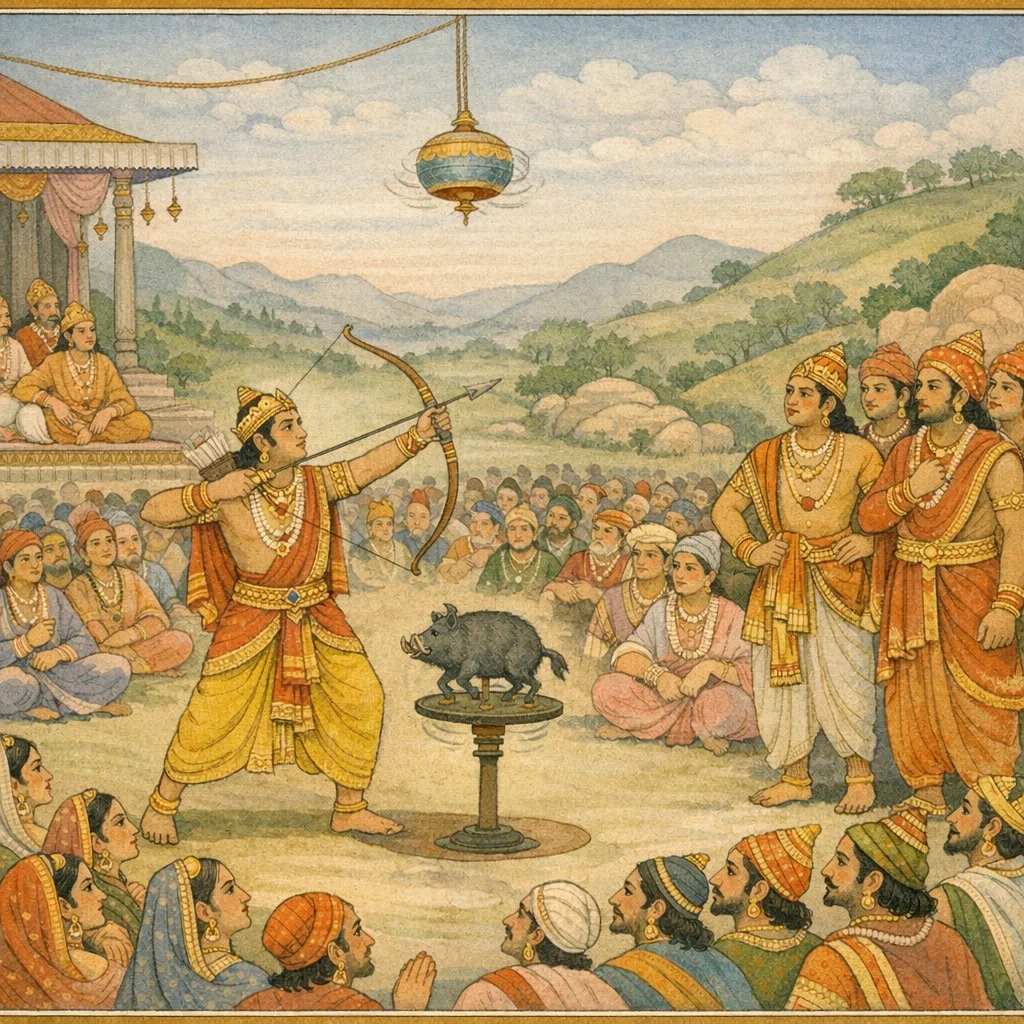
भ्रमतश्न॒ वराहस्य लोहस्य प्रमुखे समम् । पज्च बाणानसंयुक्तान् सम्मुमोचैकबाणवत्,रंगभूमिमें लोहेका बना हुआ सूअर इस प्रकार रखा गया था कि वह सब ओर चक्कर लगा रहा था। उस घूमते हुए सूअरके मुखमें अर्जुनने एक ही साथ एक बाणकी भाँति पाँच बाण मारे। वे पाँचों बाण एक-दूसरेसे सटे हुए नहीं थे
Vaiśampāyana said: As the iron boar kept whirling about, Arjuna released five arrows together, as if they were a single shaft, striking squarely at its mouth. Though discharged in one instant, the five arrows did not cling together; each found its mark with distinct precision—displaying disciplined mastery rather than reckless force.
Verse 24
गव्ये विषाणकोषे च चले रज्ज्ववलम्बिनि । निचखान महावीर्य: सायकानेकविंशतिम्,एक जगह गायका सींग एक रस्सीमें लटकाया गया था, जो हिल रहा था। महापराक्रमी अर्जुनने उस सींगके छेदमें लगातार इक्कीस बाण गड़ा दिये
Vaiśampāyana said: In the perforated horn set for the contest—hung by a rope and swaying—Arjuna, a man of great prowess, drove in twenty-one arrows in succession. The feat shows disciplined concentration and mastery of skill even under unstable conditions, a hallmark of kṣatriya excellence when directed toward rightful aims.
Verse 25
इत्येवमादि सुमहत् खड्गे धनुषि चानघ । गदायां शस्त्रकुशलो मण्डलानि हाादर्शयत्,निष्पाप जनमेजय! इस प्रकार उन्होंने बड़ा भारी अस्त्र-कौशल दिखाया। खड्ग, धनुष और गदा आदिके भी शस्त्र-कुशल अर्जुनने अनेक पैंतरे और हाथ दिखलाये
Vaiśaṃpāyana said: “Thus, and in many other ways, he displayed great mastery—O blameless one—over the sword and the bow; and, skilled in weapons, he demonstrated the circular manoeuvres and patterns with the mace as well. O sinless Janamejaya!”
Verse 26
ततः समाप्तभूयिष्ठे तस्मिन् कर्मणि भारत । मन्दीभूते समाजे च वादित्रस्य च नि:स्वने,भारत! इस प्रकार अस्त्र-कौशल दिखानेका अधिकांश कार्य जब समाप्त हो चला, मनुष्योंका कोलाहल और बाजे-गाजेका शब्द जब शान्त होने लगा, उसी समय दरवाजेकी ओरसे किसीका अपनी भुजाओंपर ताल ठोंकनेका भारी शब्द सुनायी पड़ा; मानो वज्र आपसमें टकरा रहे हों। वह शब्द किसी वीरके माहात्म्य तथा बलका सूचक था
Vaiśampāyana said: Then, O Bhārata, when that display of martial skill had for the most part come to its close, and when the assembly’s clamor and the resonance of the musical instruments had begun to subside, a heavy sound was heard from the direction of the gate—someone striking his own arms in challenge, as though thunderbolts were colliding. That sound proclaimed the prowess and strength of a heroic man.
Verse 27
द्वारदेशात् समुद्धूतो माहात्म्यबलसूचक: । वज्रनिष्पेषसदृश: शुश्रुवे भुजनि:स्वन:,भारत! इस प्रकार अस्त्र-कौशल दिखानेका अधिकांश कार्य जब समाप्त हो चला, मनुष्योंका कोलाहल और बाजे-गाजेका शब्द जब शान्त होने लगा, उसी समय दरवाजेकी ओरसे किसीका अपनी भुजाओंपर ताल ठोंकनेका भारी शब्द सुनायी पड़ा; मानो वज्र आपसमें टकरा रहे हों। वह शब्द किसी वीरके माहात्म्य तथा बलका सूचक था
Vaiśaṃpāyana said: From the direction of the gate there arose a sound proclaiming heroic greatness and strength—a resounding clap of arms, heard like the grinding clash of thunderbolts, O Bhārata. It signaled the arrival of a formidable warrior just as the public tumult and the noise of instruments were beginning to subside after the display of martial skill.
Verse 28
दीर्यन्ते कि नु गिरयः किंस्विद् भूमिर्विदीर्यते । किंस्विदापूर्यते व्योम जलधाराघनैर्घनी:,उसे सुनकर लोग कहने लगे, “कहीं पहाड़ तो नहीं फट गये! पृथ्वी तो नहीं विदीर्ण हो गयी! अथवा जलकी धारासे परिपूर्ण घनीभूत बादलोंकी गम्भीर गर्जनासे आकाशमण्डल तो नहीं गूँज रहा है?”
Vaiśaṃpāyana said: Hearing that sound, people began to wonder in alarm: “Have the mountains split apart? Has the earth been rent asunder? Or is the vault of the sky resounding with the deep roar of dense clouds, swollen with torrents of rain?”
Verse 29
रड्गस्यैवं मतिरभूत् क्षणेन वसुधाधिप । द्वारं चाभिमुखा: सर्वे बभूवु: प्रेक्षकास्तदा,राजन्! उस रंगमण्डपमें बैठे हुए लोगोंके मनमें क्षणभरमें उपर्युक्त विचार आने लगे। उस समय सभी दर्शक दरवाजेकी ओर मुँह घुमाकर देखने लगे
Vaiśaṃpāyana said: “O lord of the earth, in that arena the minds of those seated there, in a single moment, turned to the thought just described. Then, O King, all the spectators faced toward the doorway, turning their attention to what was about to appear.”
Verse 30
पज्चभि भ्रीतिभि: पार्थद्रोण: परिवृतो बभौ | पञ्चतारेण संयुक्त: सावित्रेणेव चन्द्रमा:,इधर कुन्तीकुमार पाँचों भाइयोंसे घिरे हुए आचार्य द्रोण पाँच तारोंवाले हस्त नक्षत्रसे संयुक्त चन्द्रमाकी भाँति शोभा पा रहे थे
Vaiśampāyana said: Surrounded by the five brothers, Droṇa—the teacher of Pṛthā’s sons—shone like the moon joined with the five-star asterism Hasta under the presiding Savitṛ.
Verse 31
अश्वत्थाम्ना च सह्िितं भ्रातृणां शतमूर्जितम् । दुर्योधनममित्रघ्नमुत्थितं पर्यवारयत्,शत्रुहन्ता बलवान् दुर्योधन भी उठकर खड़ा हो गया। अश्वत्थामासहित उसके सौ भाइयोंने आकर उसे चारों ओरसे घेर लिया। हाथोंमें आयुध उठाये खड़े हुए अपने भाइयोंसे घिरा हुआ गदाधारी दुर्योधन पूर्वकालमें दानवसंहारके समय देवताओंसे घिरे देवराज इन्द्रके समान शोभा पाने लगा
Vaiśampāyana said: Duryodhana—the slayer of foes—rose up, and, accompanied by Aśvatthāmā, his hundred mighty brothers came and formed a protective ring around him. Surrounded by his weapon-bearing brothers, the mace-wielding Duryodhana shone like Indra encircled by the gods of old at the time of the demons’ destruction.
Verse 32
स तैस्तदा भ्रातृभिरुद्यतायुधै- गदाग्रपाणि: समवस्थितैर्वृत: । बभौ यथा दानवसंक्षये पुरा पुरन्दरो देवगणै: समावृत:,शत्रुहन्ता बलवान् दुर्योधन भी उठकर खड़ा हो गया। अश्वत्थामासहित उसके सौ भाइयोंने आकर उसे चारों ओरसे घेर लिया। हाथोंमें आयुध उठाये खड़े हुए अपने भाइयोंसे घिरा हुआ गदाधारी दुर्योधन पूर्वकालमें दानवसंहारके समय देवताओंसे घिरे देवराज इन्द्रके समान शोभा पाने लगा
Vaiśampāyana said: Then Duryodhana, mighty and a slayer of foes, rose and stood firm. Surrounded on all sides by his brothers—who had lifted their weapons and taken their positions—he, with mace in hand, shone like Indra of old, encircled by the hosts of gods at the time of the demons’ destruction.
Verse 134
इति श्रीमहाभारते आदिपर्वणि सम्भवपर्वणि अस्त्रदर्शने चतुस्त्रिंशदाधिकशततमो<ध्याय:
Thus ends the one-hundred-and-thirty-fourth chapter of the Sambhava section within the Ādi Parva of the Śrī Mahābhārata, in the episode concerning the display of weapons.
Frequently Asked Questions
The Pāṇḍavas must balance transparency and civic order against survival under covert threat: whether to publicly accuse the plot (risking escalation and disbelief) or to adopt discreet self-protection through secrecy and escape.
Dharma in governance includes proactive protection: prudent action, verified trust, and measured secrecy can be ethically justified when preventing wrongful harm and safeguarding dependents.
No explicit phalaśruti occurs here; the chapter functions as narrative-ethical documentation, emphasizing how correct counsel and timely, skillful action preserve life and enable later dharmic resolution.