Adhyaya 18
Preta-mārga Supports (Dāna), Chitragupta’s Accounting, and the Enumeration of Narakas
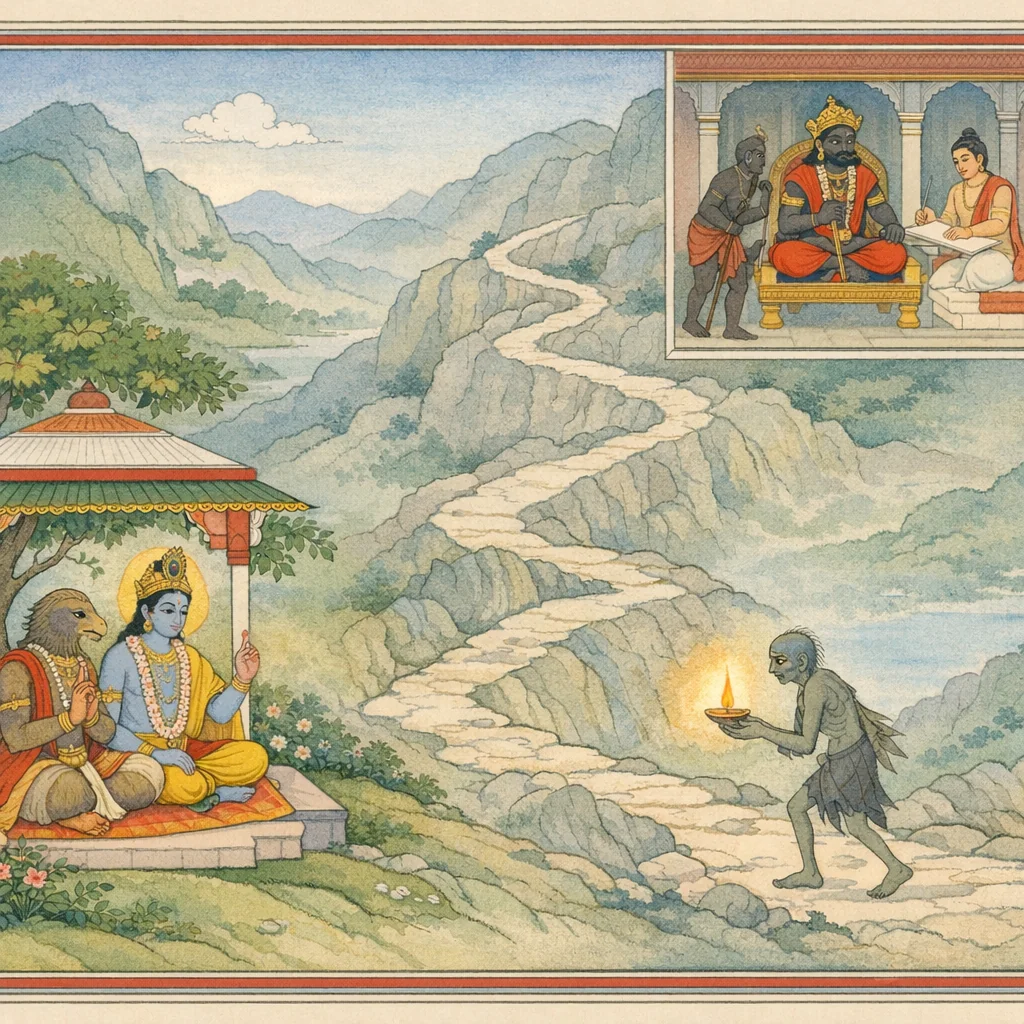
Continuing the account of the preta’s road and its resting-stations, Kṛṣṇa/Vishnu reaffirms the inevitability of karma: deeds of mind, speech, and body ripen into lived experience, and Chitragupta submits a complete record to Yama. The teaching then turns practical—offerings made in remembrance of the departed become real supports on the “great road”: a lamp dispels terrifying darkness; vṛṣotsarga and piṇḍa rites refine the preta’s condition; and specific dānas (umbrella, footwear, garments, ring/token, water-pot, seat, vessels, bed, and more) bring corresponding relief such as shade, safe passage, protection from Yama’s messengers, and comfort amid thirst and fatigue. Garuḍa asks who receives household offerings; the Lord explains divine mediation through Varuṇa and Bhāskara. The chapter broadens into eschatology by naming principal narakas and linking extreme suffering to vikarma and the severing of lineage. It closes with metaphors of transmigration—thumb-sized travel, leech-like movement, and changing garments—preparing for the next section’s deeper inquiry into post-mortem states and karmic destinations.
Shlokas
Verse 1
नाम सप्तदसो ऽध्यायः श्रीकृष्ण उवाच / श्रवणानां वचः श्रुत्वा क्षणं ध्यात्वा पुनस्ततः / यत्कृतं तु मनुष्यैश्चपुण्यं पापमहर्निशम्
Śrī Kṛṣṇa said: Having heard the words of those who speak of what is to be heard, and reflecting again for a moment, one should consider what human beings do—merit and sin—day and night.
Verse 2
तत्सर्वं च परिज्ञाय चित्रगुप्तो निवेदयेत् / चित्रगुप्तस्ततः सर्वं कर्म तस्मै वदत्यथ
Having fully ascertained all of that, Chitragupta submits the report; then Chitragupta tells Yama the entirety of the being’s deeds.
Verse 3
वाचैव यत्कृतं कर्म कृतं चैव तु कायिकम् / मानसं च तथा कर्म कृतं भुङ्क्ते शुभाशुभम्
Whatever action is done by speech, whatever is done by the body, and likewise whatever is done by the mind—one must experience the results of those deeds, whether auspicious or inauspicious.
Verse 4
एवं ते कथितस्तार्क्ष्य प्रेतमार्गस्य निर्णयः / विश्रान्ति दानि सर्वाणि स्थानानि कथितानि ते
Thus, O Tārkṣya (Garuda), I have explained to you the determination of the path traveled by the departed (preta). All the resting-places that grant respite along that route have also been described to you.
Verse 5
तमुद्दिश्य ददात्यन्नं सुखं याति महाध्वनि / दिवा रात्रौ तमुद्दिश्य स्थाने दीपप्रदो भवेत्
When one offers food with that departed person in mind, the departed travels comfortably on the great path. Likewise, if one gives a lamp in a fixed place, dedicating it to the departed both by day and by night, it becomes a provider of light for the journey.
Verse 6
अन्धकारे महाघोरे श्वपूर्णे लक्ष्यवर्जिते / दीप्ते ऽध्वनि च ते यान्ति दीपो दत्तश्च यैर्नरैः
In dense and dreadful darkness—on a path filled with dogs and without any visible landmark—those for whom a lamp has been given proceed safely on the shining road.
Verse 7
कार्तिके च चतुर्दश्यां दीपदानं सुखाय वै / अथ वक्ष्यामि संक्षेपाद्यममार्गस्य निष्कृतिम्
On the fourteenth lunar day (caturdaśī) in the month of Kārtika, the offering of a lamp (dīpa-dāna) truly brings comfort and well-being. Now I shall explain, in brief, the niṣkṛti—the expiatory remedy—concerning the path to Yama (the after-death journey).
Verse 8
वृषोत्सर्गस्य पुण्येन पितृलोकं स गच्छति / एकादशाहपिण्डेन शुद्धदेहो भवेत्ततः
By the merit of vṛṣotsarga (the ritual gifting or releasing of a bull), he attains Pitṛloka, the realm of the Ancestors. Then, through the piṇḍa offering on the eleventh day (ekādaśāha), he becomes endowed with a purified body.
Verse 9
उदकुम्भप्रदानेन किङ्करास्तृप्तिमाप्नुयुः
By the gifting of a water-pot (udakumbha), the kiṅkaras—the attendants of Yama—become satisfied.
Verse 10
शय्यादानाद्बिमानस्थो याति स्वर्गेषु मानवः / तदह्नि दीयते सर्वं द्वादशाहे विशेषतः
By gifting a bed (śayyā-dāna), a person ascends seated in a vimāna, a celestial chariot, and reaches the heavenly worlds. Such gifts may be given on that very day, and with special emphasis during the twelve-day rites (dvādaśāha).
Verse 11
पदानि सर्ववस्तूनि वरिष्ठानि त्रयोदशे / यो ददाति मृतस्येह जीवन्नप्यात्महेतवे
Whoever, on the thirteenth day (trayodaśa), gives for the departed here the finest of all necessities—such as footwear and other essential items—, even while living, does so for the welfare of his own soul.
Verse 12
तदाश्रितो महामार्गे वैनतेय स गच्छति / एक एवास्ति सर्वत्रे व्यवहारः खगाधिप
Relying on that, he proceeds upon the Great Road, O Vainateya. Truly, everywhere there is but one steadfast rule of conduct, O lord of birds.
Verse 13
उत्तमाधममध्यानां तत्तदावर्जनं भवेत् / यावद्भाग्यं भवेद्यस्य तावन्मार्गे ऽतिरिच्यते
For the superior, the inferior, and the middling, there arises avoidance or diversion according to each one’s condition. And as long as a person’s fortune (bhāgya) endures, so long is he borne further along the path.
Verse 14
स्वयं स्वस्येन यद्दत्तं तत्तत्राधिकरोति तम् / मृते यद्बान्धवैर्दत्तं तदाश्रित्य सुखी भवेत्
Whatever a person gives by one’s own means, that very gift becomes one’s rightful support there (after death). And whatever is given by relatives for the deceased, relying upon that, the departed one becomes comforted and at ease.
Verse 15
गरुड उवाच / कस्मात्पदानि देयानि किंविधानि त्रयोदश / दीयते कस्य देवेश तद्वदस्व यथातथम्
Garuda said: “Why are the ritual ‘padas’ to be given, and of what kind are these thirteen? To whom are they to be offered, O Lord of the gods? Tell me this correctly, just as it truly is.”
Verse 16
श्रीभगवानुवाच / छत्त्रोपानहवस्त्राणि मुद्रिका च कमण्डलुः / आसनं भाजनं चैव पदं सप्तविधं स्मृतम्
The Blessed Lord said: “An umbrella, footwear, garments, a signet-ring (mudrikā), a water-pot (kamaṇḍalu), a seat, and a vessel—these are remembered as the sevenfold set of ‘pada’ provisions to be offered.”
Verse 17
आतपस्तत्र यो रौद्रो दह्यते येन मानवः / छत्रदानेन सुच्छाया जायते प्रेततुष्टिदा
There, the fierce heat scorches a person. By the gift of an umbrella, excellent shade is obtained—bringing satisfaction and comfort to the preta, the departed spirit.
Verse 18
असिपत्रवनं घोरं सो ऽतिक्रामति वै ध्रुवम् / अश्वारूढाश्च गच्छन्ति ददते य उपानहौ
He surely crosses the dreadful Asipatravana, the forest of sword-like leaves. Those who give footwear travel mounted on horses.
Verse 19
आसने स्वागते (भोजने) चैव दत्तं तस्मै द्विजायते / सुखेन भुङ्क्ते स प्रेतः पथि गच्छञ्छनैः शनैः
When a seat, a reverent welcome, and food are given to that dvija (brāhmaṇa), that very offering is enjoyed with ease by the preta as it proceeds slowly along the path after death.
Verse 20
बहुधर्मसमाकीर्णे निर्वाते तोयवर्जिते / कमण्डलुप्रदानेन सुखी भवति निश्चितम्
In a place crowded with many duties of dharma, yet without breeze and bereft of water, one surely becomes happy by the gift of a kamaṇḍalu, a water-pot.
Verse 21
मृतोद्देशेन यो दद्यादुदपात्रं तु ताम्रजम् / प्रपादानसहस्रस्य तत्फलं सो ऽश्नुते ध्रुवम्
Whoever, in the name of the departed, gives a copper water-vessel for offering water, surely attains the very merit that comes from donating a thousand watering-rests for travelers.
Verse 22
यमदूता महारौद्राः करालाः कृष्णपिङ्गलाः / न पीडयन्ति दाक्षिण्याद्वस्त्राभारणदानतः
Yama’s messengers—most terrifying, grim, and dark-yellow-eyed—do not torment that person, because of his generosity, especially through gifts of clothing and ornaments.
Verse 23
सायुधा धावमानाश्च न मार्गे दृष्टिगोचराः / प्रयान्ति यमदूतास्ते मुद्रिकायाः प्रदानतः
Armed and rushing along, those messengers of Yama are not visible on the road; by the merit of granting the authorizing token-ring (mudrikā), they proceed on their way.
Verse 24
भाजनासनदानेन आमान्नभोजनेन च / आज्ययज्ञोपवीताभ्यां पदं सम्पूर्णतां व्रजेत्
By gifting vessels and a seat, by eating uncooked food, and by offering ghee and the sacred thread (yajñopavīta), one attains fullness and completion of one’s destined state in the after-death journey.
Verse 25
एवं मार्गे गच्छमानस्तृषार्तः श्रमपीडितः / महिषीरथ (दुग्ध) दानाच्च सुखी भवति निश्चितम्
Thus, while travelling along the path—afflicted by thirst and oppressed by fatigue—one becomes happy indeed, certainly, through the gift of a she-buffalo and a cart (and through the donation of milk).
Verse 26
गरुड उवाच / मृतोद्देशेन यत्किञ्चिद्दीयते स्वगृहे विभो / स गच्छति महामार्गे तद्दत्तं केन गृह्यते
Garuḍa said: O Lord, whatever is given at one’s own home with the dead person in mind—when that person is travelling on the great path after death—by whom is that offering received?
Verse 27
श्रीभगवानुवाच / गृह्णाति वरुणो दानं मम हस्ते प्रयच्छति / अहं च भास्करे देवे भास्करात्सो ऽश्नुते सुखम्
The Blessed Lord said: Varuṇa receives the gift of charity and places it into My hand; and when it is offered to the deity Bhāskara, the Sun, that person partakes of happiness through Bhāskara.
Verse 28
विकर्मणः प्रभावेण वंशच्छेदे क्षिताविह / सर्वे ते नरकं यान्ति यावत्पापस्य संक्षयः
By the force of vikarma—forbidden and sinful acts—when a family line is cut off here on earth, all those involved go to hell and remain there until their sin is exhausted.
Verse 29
कस्मिंश्चित्समये पूर्णे महिषासनसंस्थितः / नरकान्वीक्ष्य धर्मात्मा नानाक्रन्दसमाकुलान्
At an appointed time, seated upon his buffalo-throne, the righteous one beheld the hells, tumultuous with many kinds of wailing and cries.
Verse 30
चतुरशीतिलक्षाणां नरकाणां स ईश्वरः / तेषां मध्ये श्रेष्ठतमा घोरा या एकविंशतिः
He is the sovereign over the eighty-four lakh hell-realms; and among them, the most eminent—yet terrifying—are the twenty-one.
Verse 31
तामिस्त्रं लोहशङ्कुश्च महारौरवशाल्मली / रौरवं कुड्वलं कालसूत्रकं पूतिमृतिका
Tāmistra, Lohaśaṅku, Mahāraurava, Śālmalī, Raurava, Kuḍvala, Kālasūtraka, and Pūtimṛtikā—these are the named hell-realms spoken of here.
Verse 32
सङ्घातं लोहतोदं च सविषं सम्प्रतापनम् / महानरककालोलः सजीवनमहापथः
[There are hells named] Saṅghāta, Lohatoda, and Saviṣa, as well as Sampratāpana; also (the regions called) Mahānaraka, Kālola, Sajīvana, and the great path, Mahāpatha.
Verse 33
अवीचिरन्धता मिस्त्रः कुम्भोपाकस्तथैव च / असिपत्रवनं चैव पतनश्चैकविंशतिः
Also (there are the hells named) Avīci, Andhatāmisra, Kumbhīpāka, and Asipatravana; and Patana—these make up the twenty-first in the enumeration.
Verse 34
येषां तु नरके घोरे बह्वब्दानि गतानि वै / सन्तातर्नैव विद्यते दूतत्वं ते तु (प्रेत्य) यान्ति हि
But those who have spent many years in the dreadful hell, and for whom there is no lineage (no progeny/continuation), indeed—after death—go on to the state of being messengers of Yama.
Verse 35
यमेन प्रेषितास्ते वै मानुषस्य मृतस्य तु / दिनेदिने प्रगृह्णन्ति दत्तमन्नाद्यपानकम्
Indeed, those messengers, dispatched by Yama on behalf of the deceased human, day after day receive in his name the food and drink that have been offered.
Verse 36
प्रेतस्यैव विलुण्ठन्ति मध्ये मार्गे बुभुक्षिताः / मासान्ते भोजनं पिण्डमेके यच्छन्ति तत्र वै
On the very road of the after-death journey, the hungry plunder the preta (departed spirit). Only at the end of the month do some provide him there a food-offering in the form of a piṇḍa.
Verse 37
तृप्तिं प्रयान्ति ते सर्वे प्रत्यहं चैव वत्सरम् / एवमादिकृतैः पुण्यैः क्रमात्सौरिपुरं व्रजेत्
All of them attain satisfaction each day, indeed, for a full year. By the merits gained through such acts and similar rites, one gradually proceeds to Sauripura, the city of Yama.
Verse 38
ततः संवत्सरस्यान्ते प्रत्यासन्ने यमालये / बहुभीतकरे प्रेतो हस्तमात्रं समुत्सृजेत्
Then, at the end of a year, when Yama’s abode draws near, the preta—overwhelmed by many terrors—can advance only a hand’s length at a time.
Verse 39
दिवसैर्दशभिर्जातं तं देहं दशपिण्डजम् / जामदग्न्यस्येव रामं दृष्ट्वा तेजः प्रसर्पति
That body, born in ten days and produced from ten piṇḍa offerings, begins to radiate and spread its brilliance—just as the splendor of Rāma, son of Jamadagni, surged forth when he was beheld.
Verse 40
कर्मजं देहमाश्रित्य पूर्वदेहं समुत्सजेत् / अङ्गुष्ठमात्रो वायुश्च शमीपत्रंसमारुहेत्
Taking refuge in a body shaped by karma, the being abandons the former body. Becoming thumb-sized and borne along by the wind, it mounts upon a leaf of the śamī tree.
Verse 41
व्रजंस्तिष्ठन्पदैकेन यथैवैकेन गच्छति / यथा तृणजलौकेव देही कर्मानुगो ऽवशः
Just as a leech clings to a blade of grass and, holding on with one end, moves forward by releasing and advancing with the other—so too the embodied soul, helpless and compelled, proceeds along its course, driven by its own karma.
Verse 42
वासांसि जीर्णानि यथा विहाय नवानि गृह्णाति नरो ऽपराणि / तथा शरीराणि विहाय जीर्णान्यन्यानि संयाति नवानि देही
Just as a person casts off worn-out garments and takes up other, new ones, so the embodied soul abandons old, decayed bodies and attains other, new bodies.
Frequently Asked Questions
Umbrella, footwear, garments, signet-ring/token (mudrikā), water-pot, seat, and vessel. They are presented as direct functional supports on the preta’s road—shade from heat, protection in harsh terrain, relief from thirst, and authorization/safety from Yama’s messengers.
The chapter depicts the road as dense, landmarkless darkness with dangers (dogs, terror). A lamp dedicated to the departed—by day and night—becomes literal ‘light’ on the path, enabling safe progress on a shining road.
The text links generosity (especially clothing/ornaments) with reduced torment from Yama-dūtas, portraying dāna as a dharmic counter-force that softens punitive encounters during the preta’s transit.
It states the jīva takes refuge in a karma-shaped body, abandons the former body, and proceeds compelled by karma—illustrated by a leech’s incremental movement and by the analogy of discarding worn garments for new ones.