Adhyaya 55
Jambūdvīpa Orientation: Meru-Centered Varṣas, Dvīpas, Kulaparvatas, Rivers, and Janapadas
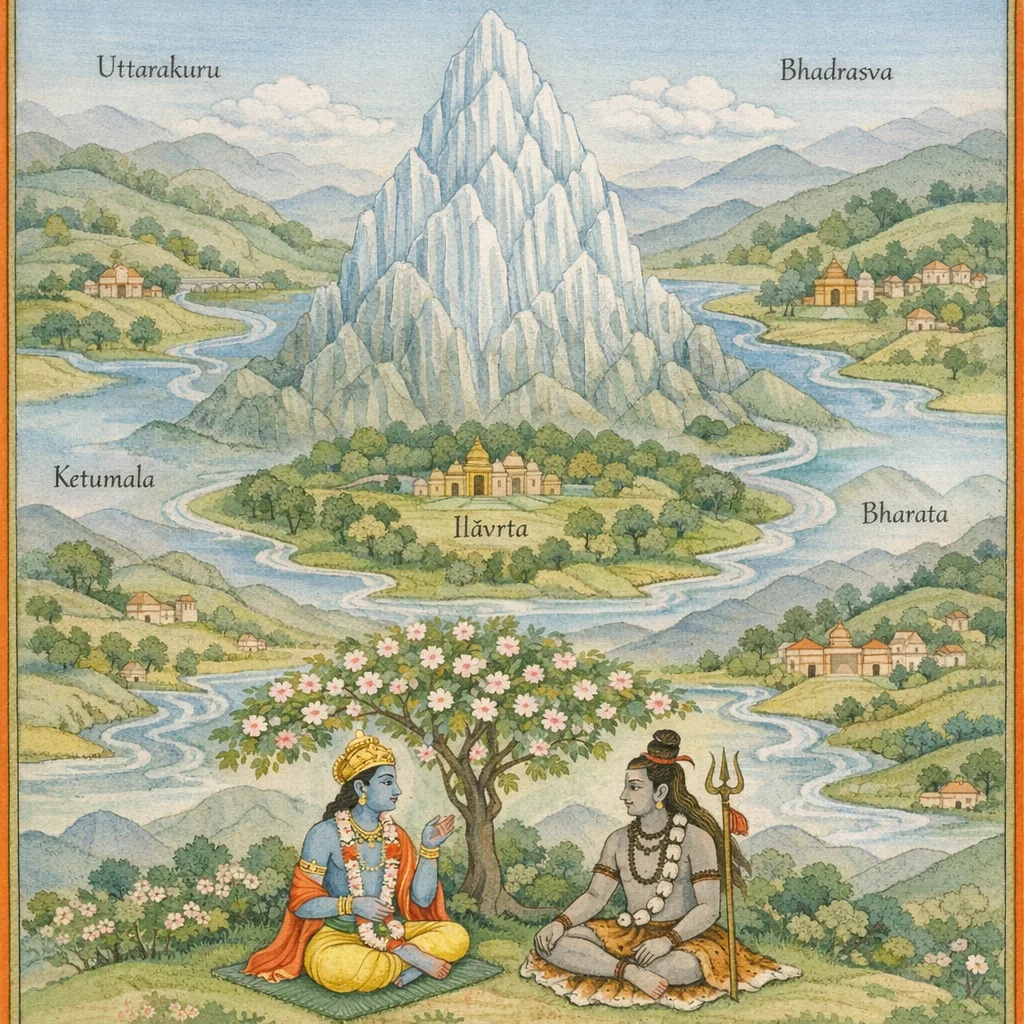
Continuing the Purāṇic account of world-order, Hari (Viṣṇu) instructs Rudra on Jambūdvīpa’s Meru-centered orientation. Ilāvṛta stands at the center, encircled by direction-named varṣas—Bhadrāśva, Hiraṇvān, Kimpuruṣa, Bhārata, Harivarṣa, Ketumāla, Ramyaka, and Kuru—revealing a structured cosmic geography. The narration then extends beyond Bhārata to the island-regions (dvīpas) and to border peoples arranged by the cardinal quarters (Kirātas, Yavanas, Andhras, Turaṣkas, and others), weaving social memory into cosmology. Next come the kulaparvatas (notably Vindhya, Pāriyātra, etc.) and a wide catalogue of sacred rivers—Narmadā, Tāpi, Godāvarī, Sarasvatī, Kāverī, and more—honored as purifiers and bearers of merit. Finally, the chapter enumerates the janapadas and peoples of Madhyadeśa and surrounding regions (Pāñcālas, Kurus, Kaliṅga, Vaṅga, Draviḍas, Gāndhāra, Kāśmīra, etc.). In this way it lays a geographic-theological foundation for later discussions of tīrthas, dharma-practices, and Bhārata as the primary field of karmic action.
Shlokas
Verse 1
नाम चतुः पञ्चशत्तमो ऽध्यायः हरिरुवाच / मध्ये त्विलावृतो वर्षो भद्राश्वः पूर्वतो ऽद्भुतः / पूर्वदक्षैणतो वर्षो हिरण्वान्वृषभध्वज
Chapter Fifty-Five begins. Hari said: “In the middle lies the region called Ilāvṛta; to the east is the wondrous Bhadrāśva; and to the southeast is the land known as Hiraṇvān, O you whose banner bears the bull.”
Verse 2
ततः किम्पुरुषो वर्षो मेरोर्दक्षिणतः स्मृतः / भारतो दक्षिणे प्रोक्तो हरिर्दक्षिणपाश्चिमे
Then, to the south of Mount Meru is said to lie the region of Kimpuruṣa; to the south is declared Bhārata, and to the south‑west is Hari (Harivarṣa).
Verse 3
पश्चिमे केतुमालश्च रम्यकः पश्चिमोत्तरे / उत्तरे च कुरोर्वर्षः कल्पवृक्षसमावृतः
To the west lies Ketumāla, and in the northwest is Ramyaka; and to the north is the land of Kuru, covered all around with wish‑fulfilling trees (kalpavṛkṣas).
Verse 4
सिद्धिः स्वाभाविकी रुद्र ! वर्जयित्वा तु भारतम् / इन्द्रद्वीपः कशेरुमांस्ताम्रवर्णो गभस्तितमान्
O Rudra, the cosmic order is natural and self‑established. Excluding Bhārata, there are other regions such as Indradvīpa—rich in the kaśeru plant—copper‑hued and radiant with beams of light.
Verse 5
नागद्वीपः कटाहश्च सिंहलो वारुणस्तथा / अयं तुनवमस्तेषां द्वीपः सागरसंवृतः
Nāgadvīpa, Kaṭāha, Siṃhala, and likewise Vāruṇa—this is the ninth among those islands, an island encircled by the ocean.
Verse 6
पूर्वे किरातास्तस्यास्ते पश्चिमे यवनाः स्थिताः / अन्ध्रा दक्षिणतो रुद्र ! तुरष्कास्त्वपि चोत्तरे
To its east dwell the Kirātas; to its west are settled the Yavanas. To the south are the Andhras, O Rudra; and to the north are the Turaṣkas as well.
Verse 7
ब्राह्मणाः क्षत्त्रिया वैश्याः सूद्राश्चान्तरवासिनः / महेन्द्रो मलयः सह्यः शुक्तिमानृक्षपर्वतः
Brāhmaṇas, Kṣatriyas, Vaiśyas, and Śūdras—together with the dwellers of the inner regions—are mentioned; likewise the mountains Mahendra, Malaya, Sahya, Śuktimān, and Ṛkṣaparvata are enumerated.
Verse 8
विन्ध्यश्च पारियात्रश्च सप्तात्र कुलपर्वताः / वेदस्मृतिर् नर्मदा च वरदा सुरसा शिवा
Vindhya and Pāriyātra are counted here among the seven clan-mountains (kulaparvatas). Also named are the sacred rivers: Veda-smṛti, Narmadā, Varadā, Surasā, and Śivā.
Verse 9
तापी पयोष्णी सरयूः कावेरी गोमती तथा / गोदावरी भीमरथी कृष्णवेणी महानदी
The rivers Tāpi, Payoṣṇī, Sarayū, Kāverī, and also Gomatī; Godāvarī, Bhīmarathī, Kṛṣṇaveṇī, and Mahānadī are likewise named.
Verse 10
केतुमाला ताम्रपर्णो चन्द्रभागा सरस्वती / ऋषिकुल्या च कावेरी मत्तगङ्गा पयस्विनी
Ketumālā, Tāmraparṇī, Candrabhāgā, Sarasvatī; Ṛṣikulyā and Kāverī; Mattagaṅgā and Payasvinī—these sacred streams are named.
Verse 11
विदर्भा च शतद्रूश्च नद्यः पापहराः शुभाः / आसां पिबन्ति सलिलं मध्यदेशादयो जनाः
Vidarbhā and Śatadrū are auspicious rivers that remove sin. People from Madhyadeśa and other regions drink their waters.
Verse 12
पाञ्चालाः कुरवो मत्स्या यौधेयाः सपटच्चराः / कुन्तयः शूरसेनाश्च मध्यदेशजनाः स्मृताः
The Pāñcālas, the Kurus, the Matsyas, the Yaudheyas together with the Sapaṭaccaras, the Kuntis, and the Śūrasenas are remembered as the peoples of Madhyadeśa, the Middle Country.
Verse 13
वृषध्वज ! जनाः पाद्माः सूतमागधचेदयः / काशय (षाया) श्च विदेहाश्च पूर्वस्यां कोसलास्तथा
O Vṛṣadhvaja, in the eastern quarter dwell the Janas, the Pādmās, the Sūtas, the Māgadhas, the Cedis, the Kāśayas (reading uncertain), the Videhas, and likewise the Kosalas.
Verse 14
कलिङ्गवङ्गपुण्ड्राङ्गा वैदर्भा मूलकास्तथा / विन्ध्यान्तर्निलया देशाः पूर्वदक्षिणतः स्मृताः
Kaliṅga, Vaṅga, Puṇḍra, Aṅga, as well as Vidarbha and Mūlaka—and the regions lying within the Vindhya ranges—are traditionally known as the countries situated in the eastern-southern direction.
Verse 15
पुलन्दाश्मकजीमूतनयराष्ट्रनिवासिनः / कर्णार्(ना)टकम्बोजघणा दक्षिणापथवासिनः
Those dwelling in the lands of Pulinda, Aśmaka, Jīmūta, Naya, and Rāṣṭra; likewise the peoples of Karṇāṭa, Kamboja, and the Ghaṇas—all these are inhabitants of Dakṣiṇāpatha, the southern region.
Verse 16
अम्बष्ठद्रविडा लाटाः काम्भोजा स्त्रीमुखाः शकाः / आनर्तवासिनश्चैव ज्ञेया यक्षिणपश्चिमे
The Ambaṣṭhas, Draviḍas, Lāṭas, Kāmbhojas, the Strīmukhas, the Śakas, and also the inhabitants of Ānarta—these are to be known as dwelling in the Yakṣiṇa, the south‑western region.
Verse 17
स्त्रीराज्याः सैन्धवा म्लेच्छा नास्ति का यवनास्तथा / पश्चिमेन च विज्ञेया माथुरा नैषधैः सह
To the west are to be recognized the lands of Strī-rājya (the “women’s kingdom”), the Saindhavas, the Mlecchas, the Kambojas, and likewise the Yavanas; and farther west are known Mathurā together with the Naiṣadhas.
Verse 18
माण्डव्याश्च तुषाराश्च मूलिकाश्वमुखाः खशाः / महाकेशा महानासा देशास्तूत्तरपश्चिमे
And the Māṇḍavyas, the Tuṣāras, the Mūlikas, the Aśvamukhas, and the Khaśas—along with the lands of the Mahākeśas and the Mahānāsas—are situated in the northwestern direction.
Verse 19
लम्ब (म्पा) का स्तननागाश्च माद्रगान्धारबाह्लिकाः / हिमाचलालया म्लेच्छा उदीचीं दिशमाश्रिताः
The Lambā (and Kampā), the Stananāgas, and the peoples of Mādrā, Gāndhāra, and Bāhlika—together with the Mlecchas dwelling in the Himālaya—are those who inhabit the northern direction.
Verse 20
त्रिगर्तनीलकोलात (भ) ब्रह्मपुत्राः सटङ्कणाः / अभीषाहाः सकाश्मीरा उदक्पर्वेण कीर्तिताः
The peoples known as the Trigartas, Nīlas, Kolātas, Brahmaputras, Saṭaṅkaṇas, and Abhīṣāhas—together with the Kāśmīras—are described as belonging to the northern mountainous region.
Frequently Asked Questions
The chapter places Ilāvṛta at the center and names surrounding regions by direction: Bhadrāśva (east), Hiraṇvān (southeast), Kimpuruṣa (south of Meru), Bhārata (further south), Hari/Harivarṣa (southwest), Ketumāla (west), Ramyaka (northwest), and Kuru (north). This directional framing expresses a Meru-centered cosmology used across Purāṇic geography.
In Purāṇic usage, mountains and rivers are not only physical features but also carriers of sacred power (pavitratā). River lists operate like a tīrtha-map: remembering or reciting them is tied to purification ideals, pilgrimage imagination, and the idea that Bhārata-varṣa is structured for dharma through accessible sacred landscapes.