Adhyaya 182
Ṛtucaryā, Āhāra–Aushadha Prayoga, Viṣa-haraṇa, and Mantra Procedures
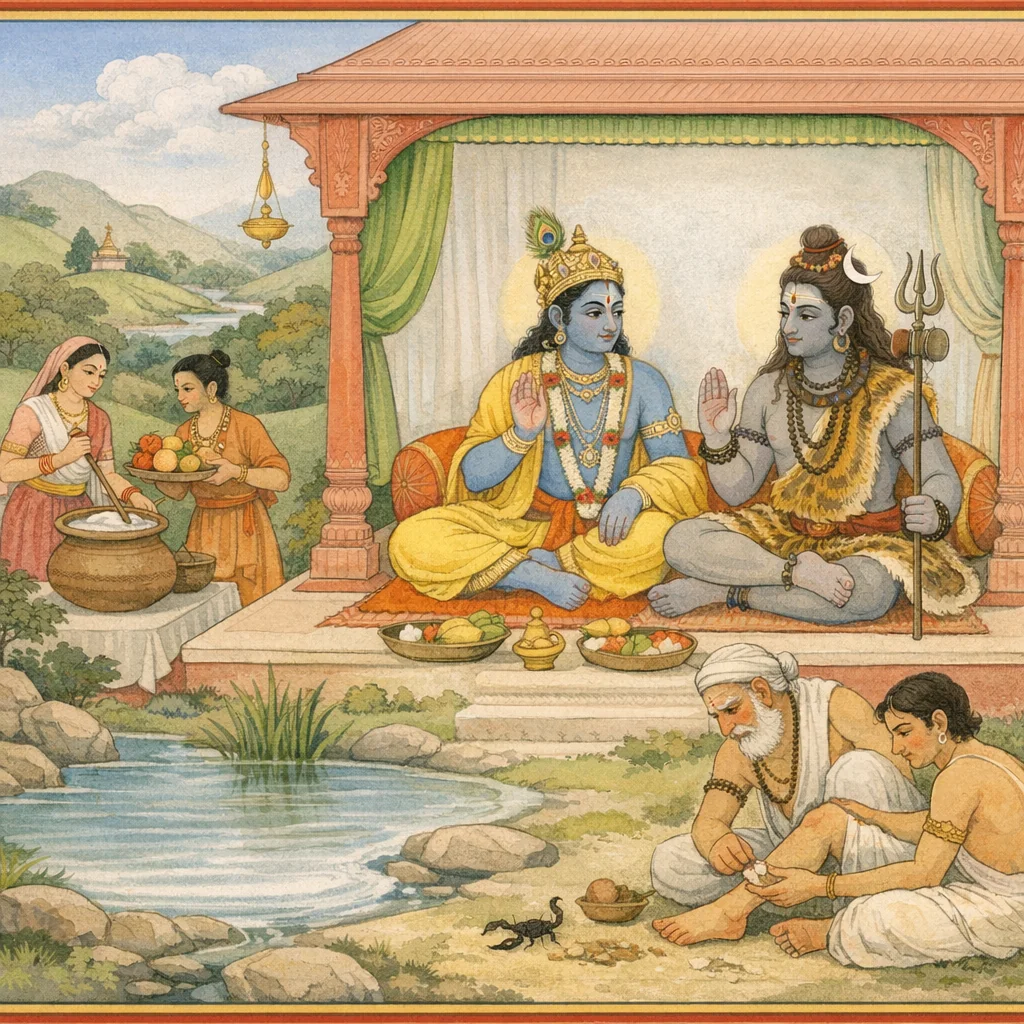
Continuing the Brahma Khanda’s practical ācāra emphasis, Hari instructs Hara on seasonal regimen and applied remedies that unite diet, medicine, and ritual power. It begins with guidance on curd intake by season, then describes foods that enhance intellect and strength and rejuvenative uses for complexion, hair, and vitality. It gives specific treatments for indigestion and pariṇāma colic, wasting ailments, and depilatory preparations. The teaching then turns to protective and controlling rites: easing burning sensations, ritual means to suppress fire, and a mantra to still moving waters. Auspicious conduct is reinforced by warning against burying impure or ominous items at the doorway, and by prescribing red-flower offerings and tilaka meant to influence others. The chapter closes with viṣa-haraṇa (poison removal), especially for scorpion venom, combining herbal/mineral ingredients with mantra, and ends with remedies for gulma/obstructions, bleeding disorders, aid in childbirth, and bloody diarrhoea—preparing for adjacent chapters of practical dharma and remedial prayogas.
Shlokas
Verse 1
ऽध्यायः हरिरुवाच / शरद्ग्रीष्मवसन्तेषु प्रायशो दधि गर्हितम् / हेमन्ते शिशिरे चैव वर्षासु दधि शस्यते
Hari said: In autumn, summer, and spring, curd (dadhi) is generally censured and should be avoided; but in hemanta (early winter), in śiśira (winter), and in the rainy season, curd is praised as beneficial and is recommended.
Verse 2
भुक्ते तु शर्करा पीता नवनीतेन बुद्धिकृत् / गुडस्य तु पुराणस्य पलमेकन्तु भक्षयेत् / स्त्रीसहस्रञ्च संगच्छेत्पुमान्बलयुतो हर !
O Hara, if one consumes sugar taken with fresh butter (navanīta), it is said to sharpen the intellect. And if one eats a pala measure of old jaggery (guḍa), a man becomes endowed with strength and can enjoy union with a thousand women.
Verse 3
कुष्ठं संचूर्णितं कृत्वा घृतमाक्षिकसंयुतम् / भक्षयेत्स्वप्नवेलायां बलीपलितनाशनम्
Powdering kuṣṭha (costus) and mixing it with ghee (ghṛta) and honey, one should consume it at bedtime; it is said to remove wrinkles and the greying of hair.
Verse 4
अतसीमाषगोधूमचूर्णं कृत्वा तु पिप्पली / घृतेन लेपयेद्गत्रमोभिः सार्धं विचक्षणः / कन्दर्पसदृशो मर्त्यो नित्यं भवति शङ्कर !
O Śaṅkara, a discerning person should make a powder of atasī (flax), māṣa (black gram), and godhūma (wheat), mix it with pippalī (long pepper), and apply it to the body together with ghee (ghṛta) and the body-hair; then a mortal continually becomes handsome like Kandarpa (Kāma).
Verse 5
यवास्तिलाश्वगन्धा च मुशली सरला गुडम् / एभिश्च रचितां जग्ध्वा तरुणो बलवान्भवेत्
By eating a preparation made from yava (barley), tila (sesame), aśvagandhā, musalī, saralā (resin of the śāla tree), and guḍa (jaggery), a young man becomes strong and vigorous.
Verse 6
हिङ्गु सौवर्चलं शुण्ठीं पीत्वा तु क्वथितोदकैः / परिणामाख्यशूलञ्च अजीर्णञ्चैव नश्यति
By drinking hingu (asafoetida), black salt, and dry ginger mixed with boiled water, the colic called pariṇāma and indigestion are destroyed.
Verse 7
धातकीं सोमराजीञ्च क्षीरेण सह पेषयेत् / दुर्बलश्च भवेत्स्थूलो नात्र कार्या विचारणा
One should grind dhātakī and somarājī together with milk; even a weak person becomes stout—there is no need for doubt.
Verse 8
शर्करामधुसंयुक्तं नवनीतं बली लिहेत् / क्षीराशी च क्षयी पुष्टिं मेधाञ्चैवातुलां व्रजेत्
Let the strong person lick fresh butter mixed with sugar and honey; and the consumptive who lives on milk attains nourishment and an incomparable increase of intellect as well.
Verse 9
कुलीरचूर्णं सक्षीरं पीतञ्च क्षयरेगनुत् / भल्लातकं विडङ्गञ्च यवक्षारञ्च सैन्धवम्
Crab-shell powder taken with milk, when drunk, alleviates wasting (consumption) and disorders of the channels; likewise, marking-nut, vidanga, barley-alkali, and rock-salt (saindhava) are prescribed as remedial ingredients.
Verse 10
मनः शिला शङ्खचूर्णं तैलपक्वं तथैव च / लोमानि शातयत्येव नात्र कार्या विचारणा
Realgar (manah-śilā), conch-shell powder, and a depilatory prepared by cooking in oil—these indeed remove the hairs; there is no need for further deliberation.
Verse 11
मालूरस्य रसं गृह्य जलौकां तत्र पेषयेत् / हस्तौ संलेपयेत्तेन त्वग्निस्तम्भनमुत्तमम्
Taking the juice of the mālūra plant, one should grind a leech in it; smearing the hands with that mixture is said to be an excellent means of arresting the burning sensation in the skin.
Verse 12
शाल्मलीरसमादाय खरमूत्रे निधाय तम् / अग्नयादौ विक्षिपेत्तेन ह्यग्निस्तम्भनमुत्तमम्
Taking the sap of the śālmalī tree and placing it in donkey’s urine, one should sprinkle it upon fire and the like; by that, an excellent means of arresting (or quenching) fire is achieved.
Verse 13
वायस्या उदरं गृह्य मण्डूकवसया सह / गुटिकां कारयेत्तेन ततो ऽग्नौ संक्षैपेत्सुधीः / एवमेतत्प्रयोगेण ह्यग्निस्तम्भनमुत्तमम्
Taking the belly portion of a crow and mixing it with the fat of a frog, the wise person should make a small pellet from it and then cast it into the fire. By this application, the stopping of fire is said to be excellent.
Verse 14
मुण्डीत्वक्च वचा मुस्तं मरिचं तगरं तथा / चर्वित्वा च त्विमं सद्यो जिह्वया ज्वलनं लिहेत्
Chew muṇḍī-bark, vacā, musta, marica (black pepper), and tagara; by chewing them, one at once ‘licks the fire with the tongue’—that is, the burning sensation is quickly subdued.
Verse 15
गोरोचनां भृङ्गराजं चूर्णोकृत्यघृतं समम् / दिव्याम्भसः स्तम्भनं स्यान्मन्त्रेणानेन वै तथा / ॐ अग्निस्तम्भनं कुरु कुरु
Having powdered gorocanā and bhṛṅgarāja and mixing them equally with ghee, one may bring about the arrest of the ‘divine waters’ by this very mantra: “Oṁ—agni-stambhanaṃ kuru kuru” (“Oṁ—perform the stopping of fire, perform it, perform it”).
Verse 16
ॐ नमो भगवते जलं स्तम्भय सं सं सं केक केकः चरचर / जलस्तम्भनमन्त्रो ऽयं जलं स्तम्भयते शिव !
Om—salutations to the Blessed Lord. “Stop the water, stop—saṃ saṃ saṃ—keka keka; upon the moving and the unmoving!” This is the water-stilling mantra; O Śiva, by it the water is made motionless.
Verse 17
गृध्रास्थिञ्च गवास्थिञ्च तथा निर्माल्यमेव च / अरेर्यो निखनेद्द्वारे पञ्चत्वमु पयाति सः
Whoever buries at the doorway the bone of a vulture, the bone of a cow, or nirmālya (discarded remnants of worship), meets destruction; he soon comes to death.
Verse 18
पञ्चरक्तानि पुष्पाणि पृथग्जात्या समालभेत् / कुङ्कुमेन समायुक्तमात्मरक्तसमन्वितम्
One should procure five red flowers, each of a different kind, and offer them—made fragrant and auspicious with kuṅkuma (saffron)—together with one’s own red, sacred offering-substance.
Verse 19
पुष्पेण तु समं पिष्ट्वा रोचनायाः पलैकतः / स्त्रिया पुंसा कृतो रुद्र ! तिलको ऽयं वशीकरः
Grinding an equal measure of rocanā together with a flower and making it into a paste—O Rudra—this tilaka is called vashīkara; when applied by woman or man, it is said to bring another under one’s influence.
Verse 20
ब्रह्मदण्डी तु पुष्येण भक्ष्ये पाने वशीकरः / यष्टि मधु पलैकेन पक्वमुष्णोदकं पिबेत्
Brahmadaṇḍī (a ritual preparation) is said to confer vashīkara when used in food and drink, especially under the asterism Puṣya. One should drink warm boiled water mixed with one pala of yaṣṭī-madhu (licorice).
Verse 21
विष्टम्भिकाञ्च हृच्छूलं हरत्येव महेश्वर ! / ॐ ह्रूं जः / मन्त्रो ऽयं हरते रुद्र ! सर्ववृश्चिकजं विषम्
O Maheśvara, it truly removes obstruction and the stabbing pain within the heart. “Oṃ hrūṃ jaḥ”—this mantra, O Rudra, removes all poison born of scorpions.
Verse 22
पिप्पली नवनीतञ्च शृङ्गवेरं च सैन्धवम् / मरिचं दधि कुष्ठञ्च नस्ये पाने विषं हरेत्
Long pepper, fresh butter, dry ginger, and rock-salt—together with black pepper, curd (dadhi), and kuṣṭha—when used as a nasal remedy or taken as a drink, remove poison.
Verse 23
त्रिफलार्द्रककुष्ठं च चन्दनं घृतसंयुतम् / एतत्पानाच्च लेपाच्च विषनाशो भवेच्छिव !
Triphala, fresh ginger, kuṣṭha (costus), and sandalwood—mixed with ghṛta (ghee): by drinking it and also applying it as a paste, the poison is destroyed, O Śiva.
Verse 24
पारावतस्य चाक्षीणि हरितालं मनः शिला / एतद्योगाद्विषं हन्ति वैनतेय इवोरगान्
The eyes of a dove, together with haritāla (yellow orpiment) and manaḥśilā (realgar)—combined in this prescribed preparation—destroy poison, just as Vainateya (Garuda) destroys serpents.
Verse 25
सैन्धवं त्र्यूषणं चैव दधिमध्वाज्यसंयुतम् / वृश्चिकस्य विषं हन्ति लेपो ऽयं वृषभध्वज !
Rock-salt and tryūṣaṇa (the three pungents), mixed with curd (dadhi), honey, and ghṛta (ghee): this paste destroys the poison of a scorpion, O Vṛṣabhadhvaja, bearer of the bull-banner!
Verse 26
ब्रह्मदण्डीतिलान्क्वाथ्य चूर्णं त्रिकटुकं पिबेत् / नाशयेद्रुद्र ! गुल्मानि निरुद्धं रक्तमेव च
Having boiled brahmadaṇḍī with sesame seeds, one should drink that decoction together with powdered trikaṭuka. O Rudra, it destroys abdominal masses (gulma) and also releases obstructed blood.
Verse 27
पीत्वा क्षीरं क्षौद्रयुतं नाशयेदसृजः स्त्रुतिम् / आटरूपकमूलेन भगं नाभिं च लेपयेत् / सुखं प्रसूयते नारी नात्र कार्या विचारणा
By drinking milk mixed with honey, the flow of blood is checked. With the root of āṭarūpaka, one should apply a paste to the vulva and the navel. Then the woman delivers comfortably—of this there is no need for further doubt.
Verse 28
शर्करां मधुसंयुक्तां पीत्वा तण्डुलवारिणा / रक्तातिसारशमनं भवतीति वृषध्वज !
O Vṛṣadhvaja (Śiva), by drinking sugar mixed with honey along with rice-washed water, the affliction of bloody diarrhoea is pacified—so it is said.
Frequently Asked Questions
The passage reflects ṛtucaryā logic: foods are evaluated by seasonally shifting doṣa tendencies and digestive power (agni). Curd—often heavy, sour, and mucus-forming in later Ayurveda—may be discouraged in seasons where kapha-like qualities accumulate, while permitted or praised when climate and digestion can better accommodate it. The Purāṇic instruction functions as seasonal conduct (ācāra) rather than a universal rule.
Within Purāṇic prayoga literature, such mantras and procedures are protective applications meant to restore order (śānti) in emergencies or disturbances—symbolically asserting dharma’s stabilizing power over volatile elements. They also demonstrate the Purāṇic integration of mantra with material supports (herbs, pastes, offerings), where efficacy is framed through purity, correct utterance, and auspicious intent.