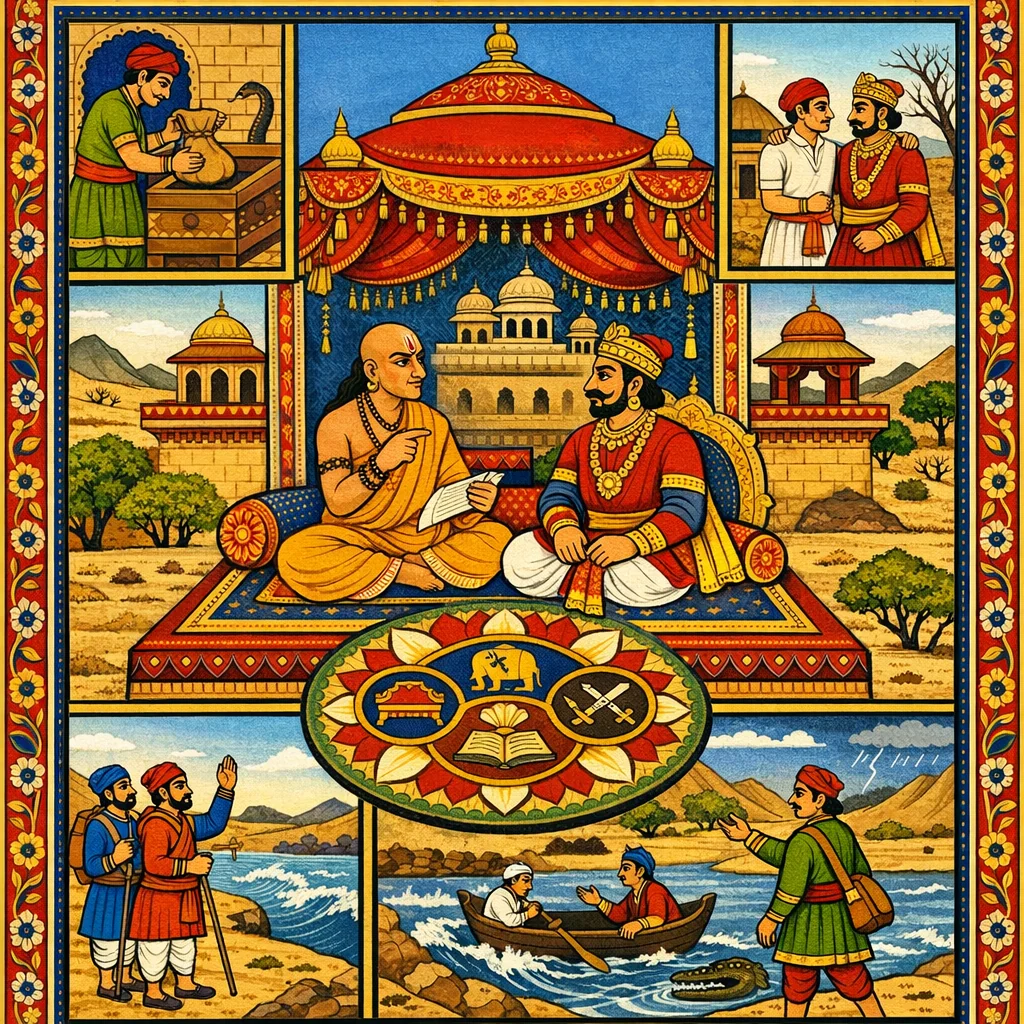
Chapter 1: Adhyaya 1 — Foundational Aphorisms on Prudence, Social Relations, and Security
अध्याय १
Foundations of Learning and Righteous Behaviour
Adhyaya 1 serves as a programmatic opening typical of Sanskrit didactic wisdom literature (subhāṣita/nīti), beginning with an invocation and a claim to distill political-ethical teachings from multiple śāstras. The verses present a pragmatic moral sociology: knowledge is framed as a tool for discriminating between auspicious and inauspicious action, while social life is mapped through risks embedded in household, friendship, service, and governance. Several aphorisms treat association as consequential—interaction with unreliable dependents, deceitful allies, or hazardous environments is described as destabilizing even for the learned. Wealth appears as an emergency reserve and as a volatile asset, prompting a hierarchy of protections (wealth, family, self) articulated as situational strategy. The chapter also catalogs indicators of a viable place to reside (status, livelihood, kin networks, learning, and key civic actors), reflecting historical assumptions about mobility and patronage. Interpersonal evaluation is emphasized through “testing” relations under stress (calamity, scarcity, conflict, royal courts, funerary spaces). Archaic social observations concerning marriage, women, and trust are recorded as period-specific norms and metaphors within early political-ethical discourse.
Key Concepts
Key Principles
Strategic Themes
Shlokas in Chapter 1
Verse 1
प्रणम्य शिरसा विष्णुं त्रैलोक्याधिपतिं प्रभुम् । नानाशास्त्रोद्धृतं वक्ष्ये राजनीतिसमुच्चयम् ॥
Having bowed my head to Viṣṇu, lord and sovereign of the three worlds, I shall set forth a compendium of rāja-nīti (statecraft), drawn from various śāstras.
Verse 2
अधीत्येदं यथाशास्त्रं नरो जानाति सत्तमः । धर्मोपदेशविख्यातं कार्याकार्यं शुभाशुभम् ॥
Whoever studies this work in accordance with śāstra comes to know, through dharma-based instruction, what should and should not be done, and what is auspicious and inauspicious.
Verse 3
तदहं सम्प्रवक्ष्यामि लोकानां हितकाम्यया । येन विज्ञातमात्रेण सर्वज्ञात्वं प्रपद्यते ॥
For the welfare of people I shall expound this; by merely understanding it, one is said to attain comprehension of all relevant knowledge.
Verse 4
मूर्खशिष्योपदेशेन दुष्टस्त्रीभरणेन च । दुःखितैः सम्प्रयोगेण पण्डितोऽप्यवसीदति ॥
Even a learned person may be brought low by teaching a foolish student, supporting a wicked wife, and associating with the distressed.
Verse 5
दुष्टा भार्या शठं मित्रं भृत्यश्चोत्तरदायकः । ससर्पे च गृहे वासो मृत्युरेव न संशयः ॥
A wicked wife, a deceitful friend, a back-talking servant, and living in a house with a snake—this is death itself, without doubt.
Verse 6
आपदर्थे धनं रक्षेद्दारान् रक्षेद्धनैरपि । आत्मानं सततं रक्षेद्दारैरपि धनैरपि ॥
In calamity, guard wealth for emergencies; to protect one’s family, spend wealth if needed; but always protect one’s own life, even at the cost of family and wealth.
Verse 7
आपदर्थे धनं रक्षेच्छ्रीमतां कुत आपदः । कदाचिच्चलते लक्ष्मीः सञ्चितोऽपि विनश्यति ॥
Guard wealth for times of calamity; even the prosperous are not free from misfortune. Fortune (Lakṣmī) sometimes wavers, and even what is amassed can perish.
Verse 8
यस्मिन्देशे न सम्मानो न वृत्तिर्न च बान्धवाः । न च विद्यागमोऽप्यस्ति वासं तत्र न कारयेत् ॥
In a land with no honor, no livelihood, no relatives, and no access to learning, one should not make one’s home.
Verse 9
धनिकः श्रोत्रियो राजा नदी वैद्यस्तु पञ्चमः । पञ्च यत्र न विद्यन्ते न तत्र दिवसं वसेत् ॥
A place is fit to live in when five are present: a wealthy patron, a learned scholar, a king (ruler), a river, and a physician. Where these five are absent, do not stay even a day.
Verse 10
लोकयात्रा भयं लज्जा दाक्षिण्यं त्यागशीलता । पञ्च यत्र न विद्यन्ते न कुर्यात्तत्र संस्थितिम् ॥
Social order, fear as restraint, modesty, kindness, and a spirit of giving and renunciation—where these five are absent, do not settle there.
Verse 11
जानीयात्प्रेषणे भृत्यान्बान्धवान् व्यसनागमे । मित्रं चापत्तिकालेषु भार्यां च विभवक्षये ॥
A servant is known when sent on an errand, kinsmen when calamity arrives, a friend in distress, and a wife when prosperity declines.
Verse 12
आतुरे व्यसने प्राप्ते दुर्भिक्षे शत्रुसङ्कटे । राजद्वारे श्मशाने च यस्तिष्ठति स बान्धवः ॥
He who stays by you in illness, when calamity strikes, in famine, amid enemy danger, at the king’s gate (court), and at the cremation ground—he is a true kinsman.
Verse 13
यो ध्रुवाणि परित्यज्य अध्रुवं परिषेवते । ध्रुवाणि तस्य नश्यन्ति चाध्रुवं नष्टमेव हि ॥
Whoever abandons the stable and pursues the unstable loses the stable; and the unstable is, in truth, already lost.
Verse 14
वरयेत्कुलजां प्राज्ञो विरूपामपि कन्यकाम् । रूपशीलां न नीचस्य विवाहः सदृशे कुले ॥
A wise man should choose a maiden of good family even if she is not beautiful; even a beautiful, well-conducted woman is not a fit match for a low man—marriage suits comparable families.
Verse 15
नदीनां शस्त्रपाणीनांनखीनां शृङ्गिणां तथा । विश्वासो नैव कर्तव्यः स्त्रीषु राजकुलेषु च ॥
Do not place trust in rivers, in those who bear weapons, in creatures with claws, in those with horns; likewise, do not trust women or royal households.
Verse 16
विषादप्यमृतं ग्राह्यममेध्यादपि काञ्चनम् । अमित्रादपि सद्वृत्तं बालादपि सुभाषितम् ॥
The verse describes a traditional maxim that what is beneficial may be accepted even from undesirable sources: nectar even from poison, gold even from impurity, good conduct even from an enemy, and well-spoken words even from a child.
Verse 17
स्त्रीणां द्विगुण आहारो लज्जा चापि चतुर्गुणा । साहसं षड्गुणं चैव कामश्चाष्टगुणः स्मृतः ॥
The text describes women as having food intake considered ‘twofold’, modesty ‘fourfold’, daring ‘sixfold’, and desire ‘eightfold’, according to the remembered tradition.
Frequently Asked Questions
The text frames nīti as practical discriminative knowledge—an applied ethical-political intelligence used to classify actions and outcomes (kārya/akārya; śubha/aśubha) and to manage uncertainty in social and political life through prudence, contingency planning, and evaluative judgment.
Relationships are described through reliability under conditions of stress: servants are evaluated in assigned tasks, kin during misfortune, friends during crisis, and spouses during loss of resources. Association is also classified by perceived hazard (deceitful friends, adversarial dependents), and by contexts that reveal loyalty (famine, enemy threat, royal courts, and funerary grounds).
The chapter aligns with broader South Asian strategic literature by emphasizing contingency (āpada), testing of allies, and situational protection hierarchies—motifs also prominent in the Arthaśāstra’s pragmatic statecraft and the Pañcatantra’s alliance-and-risk narratives. Its aphoristic form situates it within the subhāṣita tradition, offering compressed social diagnostics rather than systematic theory.