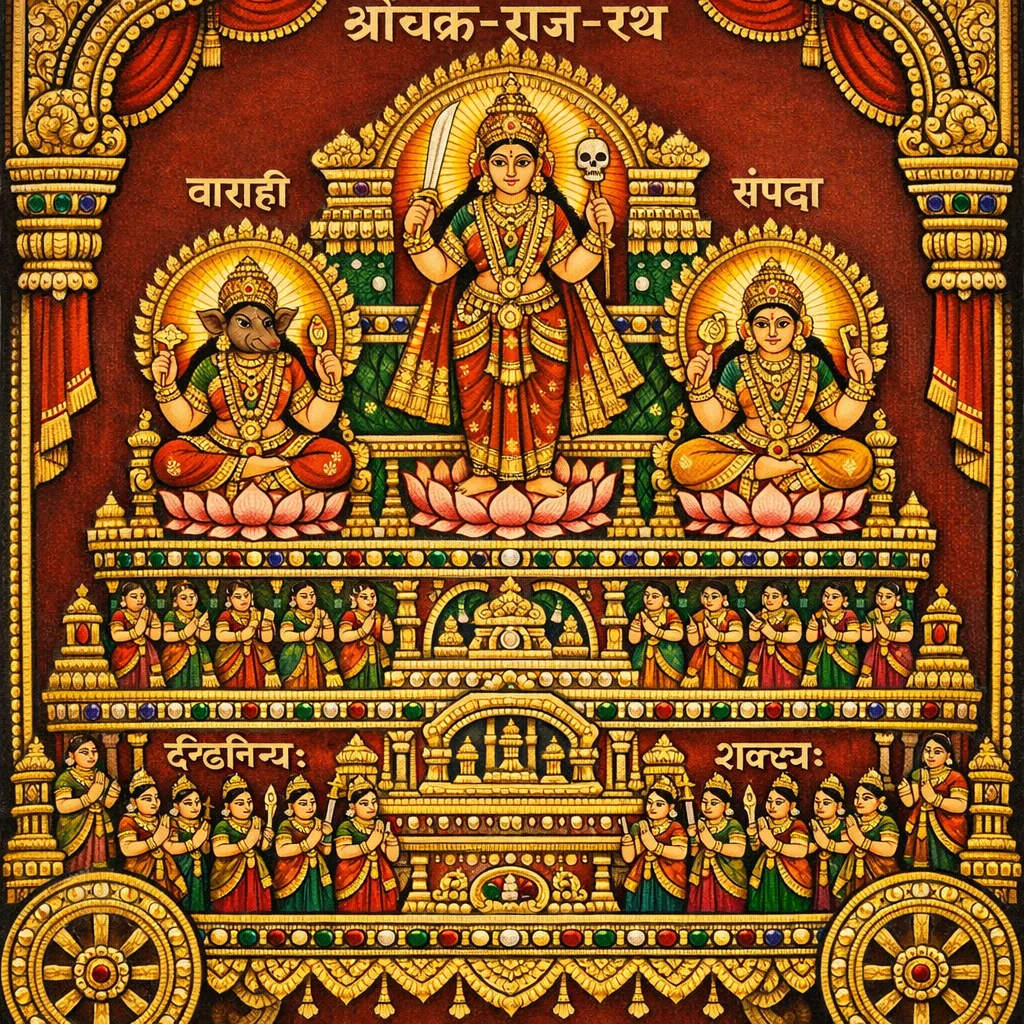
Adhyaya 20
श्रीचक्रराजरथ—पर्वस्थदेवतानाम् प्रकाशनम् (Revelation of the Deities Stationed on the Śrīcakra-Rāja-Ratha’s Sections)
This Adhyāya, in the Uttara-bhāga of the Hayagrīva–Agastya dialogue of the Lalitopākhyāna, serves as a technical catalogue of śakti-deployments within the Śrīcakra-Rāja-Ratha (the “royal chariot” identified with the Śrīcakra). Hayagrīva declares that the chariot’s form has five parvas (tiers/sections) and then enumerates the devatās stationed on each, describing their fierce iconography and their battlefield roles against Bhaṇḍāsura’s forces. The account samples: entry into the first parva (called Bindu) with Daṇḍanāyikā as a punitive, obstacle-devouring power; the second parva at the ratha-nābhi (chariot-nave) with three śaktis—Jṛmbhinī, Mohinī, Staṃbhinī—bearing weapons and blazing ornaments; the third parva with five devīs beginning with Andhinī, world-piercing energies like the fire of a kalpa. It further stresses the subordinates and attendants under Daṇḍanāthā/Daṇḍanāyikā’s command and places auxiliary śaktis such as Yakṣiṇī, Śaṅkhinī, Lākinī, Hākinī beneath a parva, revealing layered command-and-guard structures. Overall, the chapter maps name → location → role, turning theology into a navigable cosmological and ritual topology.
Shlokas
Verse 1
इति श्रीब्रह्माण्डमहापुराणे उत्तरभागे हयग्रीवागस्त्यसंवादे ललितोपख्याने श्रीचक्रराजरथज्ञेयचक्ररथपर्वस्थदेवतानामप्रकाशनं नामैकोनविंशो ऽध्यायः हयग्रीव उवाच किरिचक्ररथेन्द्रस्य पञ्चपर्वसमाश्रिताः / देवताश्च शृणु प्राज्ञ नाम यच्छृण्वतां जयः
Thus, in the Śrī Brahmāṇḍa Mahāpurāṇa, in the Uttara section, in the dialogue of Hayagrīva and Agastya, within the Lalitopākhyāna, is the nineteenth chapter, called “The Revelation of the Names of the Deities Abiding on the Sections of the Śrīcakra Royal Chariot (known as the Cakra-chariot).” Hayagrīva said: O wise one, hear of the deities established upon the five sections of the Kiri-cakra chariot-lord; by hearing their names, victory is attained.
Verse 2
प्रथमं पर्वबिन्द्वाख्यं संप्राप्ता दण्डनायिका / सा तत्र जगदुद्दण्डकण्टकव्रातघस्मरी
First, to the section called “Parva-bindu” came Daṇḍanāyikā; there she became the devourer of the hordes of unruly thorns that torment the world.
Verse 3
नानाविधाभिर्ज्वालाभिर्नर्तयन्ती जयश्रियम्
With flames of many kinds, she appeared as though making the Śrī of Victory (Jaya-śrī) dance.
Verse 4
उद्दण्डपोत्रनिर्घातनिर्भिन्नोद्धतदानवाः / दंष्ट्राबालमृगाङ्कांशुविभावनविभावरी
By the fierce blow of her “potra”, the arrogant Dānavas were shattered; with her fangs she shone like the night that reveals the rays of the young moon.
Verse 5
प्रावृषेण्यपयोवाहव्यूहनीलवपुर्ल्लता / किरिचक्ररथेन्द्रस्य सालङ्कारायते सदा / पोत्रिणी पुत्रिताशेषविश्वावर्तकदंबिका
Blue-bodied like gathered rain-season streams, that vine-like sacred Power ever adorns Kiricakra-Rathendra. She is Potriṇī, Putritā, and Dambikā who turns the wheel of the entire universe.
Verse 6
तस्यैव रथनाभस्य द्वितीयं पर्व संश्रिताः / जृंभिनी मोहिनी चैव स्तंभिनी तिस्र एव हि / उत्फुल्लदाडिमीप्रख्यं सर्वदानवमर्दनाः
On the second section of that rathanābha abide three Goddesses—Jṛmbhinī, Mohinī, and Stambhinī. Radiant like a blossomed pomegranate, they crush all dānava hosts.
Verse 7
मुसलं च हलं हालापात्रं मणिगणर्पितम् / ज्वलन्माणिक्यवलयैर्बि भ्राणाः पाणिपल्लवैः
They bear the mace and plough, and a hālā-cup inlaid with clusters of gems; upon their tender hands blaze bracelets of glowing rubies.
Verse 8
अतितीक्ष्णकरालाक्ष्यो ज्वालाभिर्दैत्यसैनिकान् / दहन्त्य इव निःशङ्कं सेवन्ते सूकराननाम्
With eyes exceedingly sharp and fearsome, by their flames they seem to burn the daitya armies; and without hesitation they render devoted service to the Goddess Sūkarānanā.
Verse 9
किरिचक्ररथेन्द्रस्य तृतीयं पर्व संश्रिताः / अन्धिन्याद्याः पञ्च देव्यो देवीयन्त्रकृतास्पदाः
On the third section of Kiricakra-Rathendra abide five Goddesses, beginning with Andhinī, established upon seats fashioned by the Goddess’s yantra.
Verse 10
कठोरेणाट्टहासेन भिन्दन्त्यो भुवनत्रयम् / ज्वाला इव तु कल्पग्नेरङ्गनावेषमाश्रिताः
With harsh peals of laughter they seemed to cleave the three worlds; like flames of the fire at the end of an age, they appeared, assuming the guise of maidens.
Verse 11
भण्डासुरस्य सर्वेषां सैन्यानां रुधिरप्लुतिम् / लिलिक्षमाणा जिह्वाभिर्लेलिहानाभिरुज्ज्वलाः
They longed to lick up the flood of blood of all Bhaṇḍāsura’s armies; blazing bright, their tongues kept lapping without cease.
Verse 12
सेवन्तें सततं दण्डनाथामुद्दण्डविक्रमाम् / किरिचक्ररथेन्द्रस्य चतुर्थं पर्व संश्रिताः
They ever attended Daṇḍanāthā, whose prowess was unbridled; and they took refuge in the fourth division of Kiricakrarathendra.
Verse 13
ब्रह्माद्याः पञ्चमीवर्ज्या अष्टमीरवर्जिता अपि / षडेव देव्यः षट्चक्रज्वलज्ज्वालाकलेवराः
Among the Goddesses beginning with Brahmā—excluding the fifth, and excluding the eighth as well—there were only six: their bodies were blazing flames of the six cakras.
Verse 14
महता विक्रमौघेण विबन्त्य इव दानवान् / आज्ञया दण्डनाथायास्तं प्रदेशमुपासते
With a mighty surge of valor they seemed to drink up the dānavas; and by Daṇḍanāthā’s command they remained, attending that region.
Verse 15
तस्यैव पर्वणो ऽधस्तात्त्वरिताः स्थानमाश्रिताः / यक्षिणी शङ्खिनी चैव लाकिनी हाकिनी तथा
Beneath that very joint they swiftly take their stations: Yakṣiṇī, Śaṅkhinī, Lākinī, and likewise Hākinī.
Verse 16
शाकिनी डाकिनी चैव तासामैक्यस्वरूपिणी / हाकिनी सप्तमीत्येताश्चण्डदोर्दण्डविक्रमाः
Śākinī and Ḍākinī as well; and Hākinī, embodying their unified essence, is spoken of as the seventh—terrible in the prowess of her mighty arms.
Verse 17
पिबन्त्य इव भूतानि पिबन्त्य इव मेदिनीम् / त्वचं रक्तं तथा मांसं मेदो ऽस्थि च विरोधिनाम्
They drink as though they drank up beings, as though they drank the very earth—skin, blood, flesh, fat, and bone of those who oppose them.
Verse 18
मज्जानमथ शुक्रं च पिबन्तयो विकटाननाः / निष्ठुरैः सिंहनादैश्च पूरयन्त्यो दिशो दश
With grotesque faces they drink even marrow and seed, and with harsh lion-roars they fill the ten directions.
Verse 19
धातुनाथा इति प्रोक्ता अणिमाद्यष्टसिद्धिदाः / मोहने मारणे चैव स्तंभने ताडने तथा
They are called Dhātunāthā, bestowers of the eight siddhis beginning with aṇimā; adept in mohana, māraṇa, stambhana, and tāḍana.
Verse 20
भक्षणे दुष्टदैत्यानामामूलं च निकृन्तने / पण्डिताः खण्डिताशेषविपदो भक्तिशालिषु
They are skilled in devouring the wicked Daityas and in cutting them down to the very root; for the bhakti-filled, they are sages who shatter every adversity.
Verse 21
धातुनाथा इतिप्रोक्ताः सर्वधातुषु संस्थिताः / सप्तापि वारिधीनूर्मिमालासंचुंबितांबरान्
They are called “Dhātunāthas,” established within all elements; even the seven oceans, with garlands of waves, seem to kiss their celestial raiment.
Verse 22
क्षणर्धेनैव निष्पातुं निष्पन्नबहुसाहसाः / शकटा कारदन्ताश्च भयङ्करविलोचनाः
In but half a moment they leap forth, accomplished in countless feats of daring—wagon-bodied, with dreadful fangs and fearsome eyes.
Verse 23
स्वस्वामिनीद्रोहकृतां स्वकीयसमयद्रुहाम् / वैदिकद्रोहणादेव द्रोहिणां वीरवैरिणाम्
Those who betray their own mistress and break their own pledged order and time—by treachery against Vedic dharma alone they become traitors, foes of the valiant.
Verse 24
यज्ञद्रोहकृतां दुष्टदैत्यानां भक्षणे समाः / नित्यमेव च सेवन्ते पोत्रिणीं दण्डनायिकाम्
In devouring the wicked Daityas who betray the yajña, they are all alike in readiness; and ever they serve Potriṇī, the mistress who leads in chastisement.
Verse 25
तस्यैव पर्वणः पार्श्वे द्वितीये दिव्यमन्दिरे / क्रोधिनी स्तंभिनी ख्याते वर्तेते देवते उभे
Beside that very peak, in the second celestial shrine, dwelt the two famed goddesses, Krodhinī and Stambhinī.
Verse 26
चामरे वीजयन्त्यौ च लोलकङ्कणदोर्लते / देवद्विषां चमूरक्तहालापानमहोद्धते
Both fanned with cāmaras; their vine-like arms bore swaying bangles, and they raged, as if intoxicated by the ‘wine’ of blood from the host of the gods’ foes.
Verse 27
सदा विघूर्णमानाक्ष्यौ सदा प्रहसितानने / अथ तस्य रथेन्द्रस्य किरिचक्राश्रितस्य च
Their eyes ever whirled, their faces ever smiled; then is told of that lordly chariot, resting upon the Kiri-cakra.
Verse 28
पार्श्वद्वयकृतावासमायुधद्वन्द्वमुत्तमम् / हलं च मुसलं चैव देवतारूपमास्थितम्
Dwelling on either side was the finest pair of weapons—hala and musala—having assumed the form of deities.
Verse 29
स्वकीयमुकुटस्थाने स्वकीयायुधविग्रहम् / आबिभ्राणं जग षिघस्मरं विबुधैः स्मृतम्
Bearing, upon the very place of his crown, the embodied form of his own weapon, the celestials remembered him as ‘Jagat-śīghra-smara’—he whom the world recalls with swiftness.
Verse 30
एतदायुधयुग्मेन ललिता दडनायिका / खण्डयिष्यति संग्रामं विषङ्गं नामदानहम्
With this pair of weapons, Lalitā, the Dandanāyikā, will shatter in battle the Dānava named Viṣaṅga.
Verse 31
तस्यैव पर्वणो दण्डनाथाया अग्रसीमनि / वर्त्तमानो महाभीमः सिंहो नादैर्ध्वनन्नभः
At the very front of that Dandanāthā’s host moved a most dreadful lion, whose roars made the heavens resound.
Verse 32
दंष्ट्राकटकटात्कार बधिरीकृतदिङ्मुखः / चण्डोच्चण्ड इति ख्यातश्चतुर्हस्तस्त्रिलोचनः
With the clacking of his fangs he deafened the faces of the quarters; famed as Caṇḍoccaṇḍa, he was four-armed and three-eyed.
Verse 33
शूलखड्गप्रेतपाशान्दधानो दीप्तविग्रहः / सदा संसेवते देवीं पश्यन्नेव हि पोत्रिणीम्
Bearing trident, sword, and the noose of the Pretas, radiant in form, he ever attends upon the Goddess, as though beholding Potriṇī (the Boar-formed One).
Verse 34
किरिचक्ररथेन्द्रस्य षष्टं पर्व समाश्रिताः / वार्त्ताल्याद्या अष्ट देव्यो दिक्ष्वष्टासूपविश्रुताः
Established in the sixth division of Kiricakrarathendra, the eight Goddesses—beginning with Vārttālī—were renowned and stationed in the eight directions.
Verse 35
अष्टपर्वतनिष्पातघोरनिर्घातनिःस्वनाः / अष्टनागस्फुरद्भूषा अनष्टबलतेजसः
Their roar is a dreadful thunder, as though eight mountains were crashing down; adorned with the flashing ornaments of eight Nāgas, their strength and sacred radiance never wane.
Verse 36
प्रकृष्टदोष्प्रकाण्डोष्महुतदानवकोटयः / सेवन्ते ललितां देव्यो दण्डनाथामहर्निशम्
Those Goddesses, whose mighty arms’ heat can burn away myriads of Dānavas, together with Daṇḍanāthā, serve the Lady Lalitā day and night.
Verse 37
तासामाख्याश्च विख्याताः समाकर्णय कुंभज / वार्ताली चैव वाराहीसा वाराहमुखी परा
O Kumbhaja, hear their renowned names: Vārtālī, Vārāhīsā, and the supreme Vārāhamukhī.
Verse 38
अन्धिनी रोधिनी चैव जृंभिणी चैव मोहिनी / स्तंभिनीति रिपुक्षोभस्तंभनोच्चाटनक्षमाः
Andhinī, Rodhinī, Jṛṃbhiṇī, Mohinī, and Staṃbhinī—able to agitate foes, they can perform stambhana (paralysis) and uccāṭana (banishment).
Verse 39
तासां च पर्वणो वामभागे सततसंस्थितिः / दण्डनाथोपवाह्यस्तु कासरो धूसराकृतिः
They abide ever on Parvaṇa’s left side; and Daṇḍanāthā’s attendant mount is Kāsara, of dusky grey form.
Verse 40
अर्धक्रोशायतः शृङ्गद्वितये क्रोशविग्रहः / खड्गवन्निष्ठुरैर्लोमजातैः संवृतविग्रहः
Its two horns stretched half a krośa, and its whole body measured a full krośa; its form was covered over with harsh, sword‑sharp hair.
Verse 41
कालदण्डवदुच्चण्डबालकाण्डभयङ्करः / नीलाञ्जनाचलप्रख्यो विकटोन्नतरुष्टभूः
Fierce like Kāla’s rod of punishment, terrifying as a savage young branch; dark-blue like Mount Nīlāñjana, it stood upon ground that rose up rugged and immense.
Verse 42
महानीलगिरिश्रेष्ठगरिष्ठस्कन्धमण्डलः / प्रभूतोष्मलनिश्वासप्रसराकंपितांबुधिः
The circle of its shoulders was weighty and supreme, like the foremost of the great Nīla mountains; the spread of its abundant, scorching breath made even the ocean tremble.
Verse 43
घर्घरध्वनिना कालमहिषं विहसन्निव / वर्त्तते खुरविक्षिप्तपुष्कलावर्तवारिदः
With a rumbling, grinding roar it seemed to mock the Buffalo of Time; it moved as rain-clouds, thick with mighty whirlpools, were flung up by the scattering of its hooves.
Verse 44
तस्यैव पर्वणो ऽधस्ताच्चित्रस्थानकृतालयाः / इन्द्रादयो ऽनेकभेदा दिशामष्टकदेवताः
Beneath the joints of that mountain, dwellings were fashioned in wondrous, variegated places; there abide the deities of the eight directions, of many kinds, with Indra and the rest at their head.
Verse 45
ललितायां कार्यसिद्धिं विज्ञापयितुमागताः / इन्द्रश्चाप्सरसश्चैव स चतुष्षष्टिकोटयः
To report to Lalitā the fulfillment of the undertaking, Indra and the apsarases came, along with sixty-four koṭis of divine hosts.
Verse 46
सिद्ध अग्निश्च साध्याश्च विश्वेदेवास्तथापरे / विश्वकर्मा मयश्चैव मातरश्च बलोन्नताः
The Siddhas, Agni, the Sādhyas, and other Viśvedevas came as well; and Viśvakarmā, Maya, and the Mātṛkās, exalted in might.
Verse 47
रुद्राश्च परिचाराश्च रुद्राश्चैव पिशाचकाः / क्रन्दञ्चिरक्षसां नाथा राक्षसा बहवस्तथा
The Rudras and their attendants came, and piśācas akin to the Rudras; and Krandañci, lord of the rākṣasas, with many rākṣasas besides.
Verse 48
मित्राश्च तत्र गन्धर्वाः सदा गानविशारदाः / विश्वावसुप्रभृतयो विख्यातास्तत्पुरोगमाः
There too were the gandharvas, friendly and ever skilled in song; the renowned Viśvāvasu and others stood foremost as leaders.
Verse 49
तथा भूतगणाश्चान्ये वरुणो वासवः परे / विद्याधराः किन्नराश्च मारुतेश्वर एव च
So too came other hosts of bhūtas, Varuṇa and other Vāsavas; and the vidyādharas, the kinnaras, and Māruteśvara as well.
Verse 50
तथा चित्ररथश्चैव रथकारक कारकाः / तुंबुरुर्नारदो यक्षः सोमोयक्षेश्वरस्तथा
Likewise were Citraratha and the makers of chariots; Tumburu, Narada, the Yakshas, and Soma, lord of the Yakshas, were also present there.
Verse 51
देवैश्च भगवांस्तत्र गोविन्दः कमलापतिः / ईशानश्च जगच्चक्रभक्षकः शूलभीषणः
With the gods there was Bhagavan Govinda, lord of Kamala; and also Isana, who devours the wheel of the world, dreadful with his trident.
Verse 52
ब्रह्मा चैवाश्विनीपुत्रो वैद्यविद्याविशारदौ / धन्वन्तरिश्च भगवानथान्ये गणनायकाः
There were Brahma and the sons of the Ashvins, both skilled in the science of healing; and Bhagavan Dhanvantari, along with other leaders of the ganas.
Verse 53
कटकाण्डगलद्दान संतर्पितमधुव्रताः / अनन्तो वासुकिस्तक्षः कर्केटः पद्म एव च
Those whose intoxicating ichor, dripping from their temples, satisfies swarms of bees—Ananta, Vasuki, Takshaka, Karkotaka, and Padma too were there.
Verse 54
महापद्मः शङ्खपालो गुलिकः सुबलस्तथा / एते नागेश्वराश्चैव नागकोटिभिरावृताः
Mahapadma, Shankhapala, Gulika, and Subala—these lords of the Nagas too were surrounded by crores upon crores of Nagas.
Verse 55
एवंप्रकारा बहवो देवतास्तत्र जाग्रति / पूर्वादिदिशमारभ्य परितः कृतमन्दिराः
Thus, many deities keep vigil there; beginning from the eastern and other quarters, their shrines have been built all around.
Verse 56
तत्रैव देवताश्चक्रे चक्राकारा मरुद्दिशः / आश्रित्य किल वर्तन्ते तदधिष्ठातृदेवताः
There itself the deities arranged the wind-quarters in the form of a wheel; resting upon them, the presiding guardian gods of those directions abide.
Verse 57
जृंभिणी स्तंभिनी चैव मोहिनी तिस्र एव च / तस्यैव पर्वणः प्रान्ते किरिचक्रस्य भास्वतः
Jṛmbhiṇī, Stambhiṇī, and Mohiṇī—these three—stand at the edge of a segment of that radiant Kiri-cakra.
Verse 58
कपालं च गदां बिभ्रदूर्ध्वकेशो महावपुः / पातालतलजंबालबहुला कारकालिमा
Bearing a skull and a mace, with hair standing upright and a vast form, she is thickly smeared with the mire of Pātāla’s floor, wrapped in dreadful blackness.
Verse 59
अट्टहासमहावज्रदीर्णब्रह्माण्डमण्डलः / भिन्दन्डमरुकध्वानै रोदसीकन्दरोदरम्
His thunderous aṭṭahāsa, like a mighty vajra, rends the sphere of the cosmos; and by the crashing cries of the bhinda-ḍamaru, the cavernous depths of Rodasī—the two worlds—resound.
Verse 60
फूत्कारीत्रिपुरायुक्तं फणिपाशं करे वहन् / क्षेत्रपालः सदा भाति सेवमानः किटीश्वरीम्
Kṣetrapāla, joined with Phūtkārī-Tripurā and bearing the serpent-noose in his hand, ever shines as he serves Kiṭīśvarī.
Verse 61
तस्यैव च समीपस्थस्तस्या वाहनकेसरी / यमा रुह्य प्रववृते भण्टासुरबधैषिणी
Close by stood her mount, the lion Kesari; mounting it, Yamā set forth, intent on the slaying of Bhaṇṭāsura.
Verse 62
प्रागुक्तमेव देवेशीवाहसिंहस्य लक्षण्म् / तस्यैव पर्वणो ऽधस्ताद्दण्डनाथासमत्विषः
The marks of the Goddess’s lion-mount have already been told; beneath its joints were those whose radiance matched Daṇḍanātha.
Verse 63
दण्डिनीसदृशाशेषभूषणायुधमण्डिताः / शम्याः क्रोडाननाश्चन्द्ररेखोत्तंसितकुन्तलाः
Like Daṇḍinī, they were adorned with every ornament and weapon; called Śamyā, boar-faced, their tresses crowned with a crescent line of moon.
Verse 64
हलं च मुसलं हस्ते घूर्णयन्त्यो मुहुर्मुहुः / ललिताद्रोहिणां श्यामाद्रोहिणां स्वामिनीद्रुहाम्
Again and again they whirled plough and pestle in their hands—against the rebels to Lalitā, the rebels to Śyāmā, and those who betray their Sovereign Lady.
Verse 65
रक्तस्रोतोभिरुत्कूलैः पूरयन्त्यः कपालकम् / निजभक्तद्रोहकृता मन्त्रमालाविभूषणाः
Those Goddesses, with surging streams of blood, filled the skull-bowl (kapāla); they were the chastisers of those who wrong and betray their own devotees, adorned with garlands of mantras (mantra-mālā).
Verse 66
स्वगोष्ठीसमायाक्षेपकारिणां मुण्डमण्डलैः / अखण्डरक्तविच्छर्दैर्बिभ्रत्यो वक्षसि क्रजः
They bore upon their breasts garlands of severed head-circles (muṇḍa-maṇḍala) of those who reviled their own company; with unbroken gushes of crimson blood, it lay upon the chest like an ornament.
Verse 67
सहस्रं देवताः प्रोक्ताः सेवमानाः किटीश्वरीम्
It is declared that a thousand deities abide in service to Kiṭīśvarī.
Verse 68
तासां नामानि सर्वासां दण्डिन्याः कुंभसंभव / सहस्रनामाध्याये तु वक्ष्यन्ते नाधुना पुनः
O Kumbhasambhava, the names of all those deities of Daṇḍinī will be spoken in the chapter of the Sahasranāma; not now again.
Verse 69
अथ तासां देवतानां कोलास्यानां समीपतः / वाहनं कृष्णसारङ्गो दण्डिन्याः समये स्थितः
Then, near those boar-faced deities (kolāsyā), there stood at that time Daṇḍinī’s mount—the kṛṣṇasāraṅga, the black antelope—present at the appointed moment.
Verse 70
क्रोशार्धार्द्धायतः शृङ्गे तदर्धार्धायतो मुखे / क्रोशप्रमाणापादश्च सदा चोद्धृतवालधिः
Its horns extend to half-and-half a krośa, and its muzzle to half of that half; its feet measure a krośa, and its tail is ever held aloft.
Verse 71
उदरे धवलच्छायो हुङ्कारेण महीयसा / हसन्मारुतवाहस्य हरिणस्य पराक्रमम्
A pale radiance shines upon its belly; with a mighty snort, as though laughing, it proclaims the valor of the deer that moves borne by the wind.
Verse 72
तस्यैव पर्वणो देशे वर्त्तते वाहनोत्तमम् / किरिचक्ररथेन्द्रस्य स्थितस्तत्रैव पर्वणि
In that very region of the mountain abides the most excellent of mounts; it belongs to the lord of the Kiri-cakra chariot and stands there upon that same peak.
Verse 73
वर्त्तते मदिरासिंधुर्देवतारूपमास्थिता / माणिक्यगिरिवच्छोणं हस्ते पिशितपिण्डकम्
There the Ocean of Madirā abides, assuming a divine form—red as the Manikya mountain, holding in its hand a lump of flesh.
Verse 74
दधाना घूर्णमा नाक्षी हेमांभोजस्रगावृता / मदशक्त्या समाश्लिष्टा धृतरक्तसरोजया
Her eyes seem to whirl; she is veiled in garlands of golden lotuses—embraced by the power of intoxication, bearing a red lotus.
Verse 75
यदायदा भण्डदैत्यः संग्रामे संप्रवर्तते / युद्धस्वेद मनुप्राप्ताः शक्तयः स्युः पिपासिताः
Whenever the daitya Bhaṇḍa rushes into battle, the Śaktis, drenched in the sweat of war, become parched with thirst.
Verse 76
तदातदा सुरासिंधुरात्मानं बहुधा क्षिपन् / रणे खेदं देवतानामञ्जसापाकरिष्यति
Then Surāsindhu, casting himself forth in many forms, will swiftly dispel the gods’ weariness in the fray.
Verse 77
तदप्यद्भुतमे वर्षे भविष्यति न संशयः / तदा श्रोष्यसि संग्रामे कथ्यमानं मया मुदा
In that year this too will be wondrous—without doubt; then, amid the battle, you shall hear with joy what I proclaim.
Verse 78
तस्यैव पर्वणो ऽधस्तादष्टदिक्ष्वघ एव हि / उपर्यपि कृतावासा हेतुकाद्या दश स्मृताः
Beneath that very peak, in all eight directions, stands Agha indeed; and above as well are remembered ten dwellers, beginning with Hetuka.
Verse 79
महान्तो भैरवश्रेष्ठाः ख्याता विपुलविक्रमाः / उद्दीप्तायुत तेजोभिर्द्दिवा दीपितभानवः
They are mighty—the foremost of the Bhairavas—renowned for vast prowess; with countless blazing splendors, they shine like suns even in daylight.
Verse 80
कल्पान्तकाले दण्डिन्या आज्ञया विश्वघस्मराः / अत्युदग्रप्रकृतयो रददष्टौष्ठसंपुटाः
At the end of the kalpa, by Dandini’s command, there arose the world-devourers—of exceedingly fierce nature, their lips clenched and bitten by their teeth.
Verse 81
त्रिशूलाग्रविनिर्भिन्नमहावारिदमण्डलाः / हेतुकस्त्रिपुरारिश्च तृतीयश्चाग्निभैरवः
Like vast circles of storm-clouds pierced by the trident’s tip: Hetuka, Tripurari, and the third—Agni Bhairava.
Verse 82
यमजिह्वैकपादौ च तथा कालकरालकौ / भीमरूपो हाटकेशस्तथैवाचलनामवान्
Yamajihva and Ekapada, and likewise Kalakarala; Bhimarupa, Hatakesha, and also the one named Achala.
Verse 83
एते दशैव विख्याता दशकोटिभटान्विताः / तस्यैव किरिचक्रस्य वर्तन्ते पर्वसीमनि
These ten alone are renowned, attended by ten koti of warriors; they abide on the mountain-frontier of that very Kiri-cakra.
Verse 84
एवं हि दण्डनाथायाः किरिचक्रस्य देवताः / जृंभिण्याद्यचलेन्द्रान्ताः प्रोक्तास्त्रैलोक्यपावनाः
Thus the deities of Dandanatha’s Kiri-cakra—from Jrambhini to Achalendra—are declared to be the purifiers of the three worlds.
Verse 85
तत्रत्यैर्देवतावृन्दैर्बहवस्तत्र संगरे / दानवा मारयिष्यन्ते पास्यन्ते रक्तवृष्टयः
There, amid the hosts of the gods, in that battle many Dānavas shall be slain, and the rains of blood shall be drunk.
Verse 86
इत्थं बहुविधत्राणं पर्वस्थैर्देवतागणैः / किरिचक्रं दण्डनेत्र्या रथरत्नं चचाल ह
Thus did the gods stationed upon the mountains grant manifold protection; then, by Daṇḍanetrī, the jewel-chariot named Kiricakra was set in motion.
Verse 87
चक्रराजरथो यत्र तत्र गेयरथोत्तमः / यत्र गेयरथस्तत्र किरिचक्ररथोत्तमः
Where the chariot of Cakrarāja stands, there the noble Geyaratha is supreme; and where Geyaratha stands, there the finest Kiricakra-chariot is supreme.
Verse 88
एतद्रथ त्रयं तत्र त्रैलोक्यमिव जङ्गमम् / शक्तिसेनासहस्रस्यान्तश्चचार तदा शुभम्
There those three chariots were like the moving Three Worlds; then, auspiciously, they coursed within the midst of the thousands of Śaktisenā’s host.
Verse 89
मेरुमन्दरविन्ध्यानां समवाय इवाभवत् / महाघोषः प्रववृते शक्तीनां सैन्यमण्डले / चचाल वसुधा सर्वा तच्चक्ररवदारिता
It was as though Meru, Mandara, and Vindhya had converged; within the circle of the Śaktis’ host a mighty roar arose, and all the earth trembled, as if torn by the thunder of that cakra.
Verse 90
ललिता चक्रराजाख्या रथनाथस्य कीर्तिताः / षट्सारथय उद्दण्डपाशग्रहणकोविदाः
For the Lord of the chariot they are praised as “Lalitā Cakrarāja”; six charioteers are skilled in wielding the mighty noose (pāśa).
Verse 91
यत्र गेयरथस्तत्र किरिचक्ररथोत्तमम् / इति देवी प्रथमतस्तथा त्रिपुरभैरवी
Where the Geyaratha stands, there too is the supreme Kiricakra chariot—so the Goddess declared first; and so did Tripurabhairavī.
Verse 92
संहारभैरवश्चान्यो रक्तयोगिनिवल्लभः / सारसः पञ्चमश्चैव चामुण्डा च तथा परा
There is another Saṃhārabhairava, beloved of Raktayoginī; the fifth is Sārasa, and likewise the supreme Cāmuṇḍā, Parā.
Verse 93
एतासु देवतास्तत्र रथसारथयः स्मृताः / गेयच क्ररथेन्द्रस्य सारथिस्तु हसंतिका
Among these deities are remembered the charioteers of the chariots there; the charioteer of Geyaratha–Cakrarathendra is Hasaṃtikā.
Verse 94
किरिचक्ररथेन्द्रस्य स्तंभिनी सारथिः स्मृता / दशयोजनमुन्नम्रो ललितारथपुङ्गवः
The charioteer of Kiricakrarathendra is remembered as Staṃbhinī; Lalitā’s foremost chariot rises to a height of ten yojanas.
Verse 95
सप्तयोजनमुच्छ्रायो गीतसक्ररथोत्तमः / षड्योजनसमुन्नम्रो किरिचक्ररथो मुने
O sage, the peerless chariot of Gītaśakra rose to seven yojanas in height, and the chariot of Kirīcakra stood uplifted to six yojanas.
Verse 96
महामुक्तातपत्रं तु दशयोजनविस्तृतम् / वर्तते ललितेशान्या रथ एव न चान्यतः
The great pearl-canopy, spread across ten yojanas, was found only upon the chariot of Laliteśānī, and nowhere else.
Verse 97
तदेव शक्तिसाम्राज्यसूचकं परिकीर्तितम् / सामान्यमातपत्रं तु तथद्वन्द्वेपि वर्तते
That alone is proclaimed as the emblem of Śakti’s sovereign empire; a common canopy, however, may be found on both sides even in such a contest.
Verse 98
अथ सा ललितेशानी सर्वशक्तिमहेश्वरी / महासाम्राज्यपदवीमारूढा परमेश्वरी
Then Laliteśānī, the Mahēśvarī of all powers, the Supreme Parameśvarī, ascended the rank of the great imperial sovereignty.
Verse 99
चचाल भण्डदेत्यस्य क्षयसिद्ध्यभिकाङ्क्षिणी / शब्दायन्ते दिशः सर्वाः कंपते च वसुंधरा
Yearning to accomplish the destruction of Bhaṇḍa the daitya, she set forth; all the quarters resounded, and the earth itself trembled.
Verse 100
क्षुभ्यन्ति सर्वभूतानि ललितेशाविनिर्गमे / देवदुन्दुभयो नेदुर्निपेतुः पुष्पवृष्टयः
As Laliteśvarī came forth in manifestation, all beings trembled; the devas’ celestial drums resounded, and showers of flowers fell.
Verse 101
विश्वावसुप्रभृतयो गन्धर्वाः सुरगायकाः / तुम्बुरुर्नारदश्चैव साक्षादेव सरस्वती
Viśvāvasu and the other Gandharvas, the devas’ singers—Tumburu and Nārada—and Sarasvatī Devī herself were present in person.
Verse 102
जयमङ्गल पद्यानि पठन्तः पटुगीतिभिः / हर्षसंफुल्लवदनाः स्फुरत्पुलकभूषणाः / मुहुर्जयजयेत्येवं स्तुवाना ललितेश्वरीम्
They chanted auspicious verses of victory in skilled song; their faces blossomed with delight, their bristling hairs like ornaments; again and again they praised Laliteśvarī, crying, “Jaya! Jaya!”
Verse 103
हर्षेणाढ्या मदोन्मत्ताः प्रनृत्यन्तः पदेपदे / सप्तर्षयो वशिष्ठाद्या ऋग्यजुः सामरूपिभिः
Filled with joy, as if intoxicated by bliss, they danced at every step; and the Seven Ṛṣis, led by Vasiṣṭha, appeared in the forms of the Ṛg, Yajur, and Sāma Vedas.
Verse 104
अथर्वरूपैर्मन्त्रैश्च वर्धयन्तो जयश्रियम् / हविषेव महावह्निशिखामत्यन्तपाविनीम्
Then, with mantras in the form of the Atharva Veda, they increased the auspicious glory of victory—like an oblation of havis that feeds the great flame of the sacred fire, supremely purifying.
Verse 105
आशीर्वादेन महता वर्धयामासुरुत्तमाः / तैः स्तूयमाना ललिता राजमाना रथोत्तमे
With a mighty benediction the exalted ones increased her glory. Praised by them, Lalitā shone forth, regal and radiant, upon the finest chariot.
Verse 106
भण्डासुरं विनिर्जेतुमुद्दण्डैः सह सैनिकैः
To vanquish Bhaṇḍāsura, she set forth with the army and its fierce warriors.
Frequently Asked Questions
The chapter presents the Śrīcakra-Rāja-Ratha as having five parvas (tiered sections). Their function is organizational: each parva is a stationing-zone for specific devatās/śaktis, forming a hierarchical battle-and-ritual map rather than a genealogical list.
Daṇḍanāyikā/Daṇḍanāthā embodies punitive command (daṇḍa = chastisement/discipline). Jṛmbhinī, Mohinī, and Staṃbhinī indicate expansion/rousing, delusion/enchantment, and immobilization—classic functional powers in Śākta/Mantra frameworks. Andhinī and the associated group signal obscuration and terror-as-transformation, depicted as kalpa-fire-like energies against demonic hosts.
It provides a placement-index: names and roles are anchored to locations on the ratha/Śrīcakra topology (parva, nābhi, beneath a parva), enabling later ritual imagination and recitation to be spatially coherent, even though procedural worship steps are not enumerated here.