Adhyaya 39
Kārttavīrya’s Allied Kings Confront Jāmadagnya Rāma (Bhārgava-Charita)
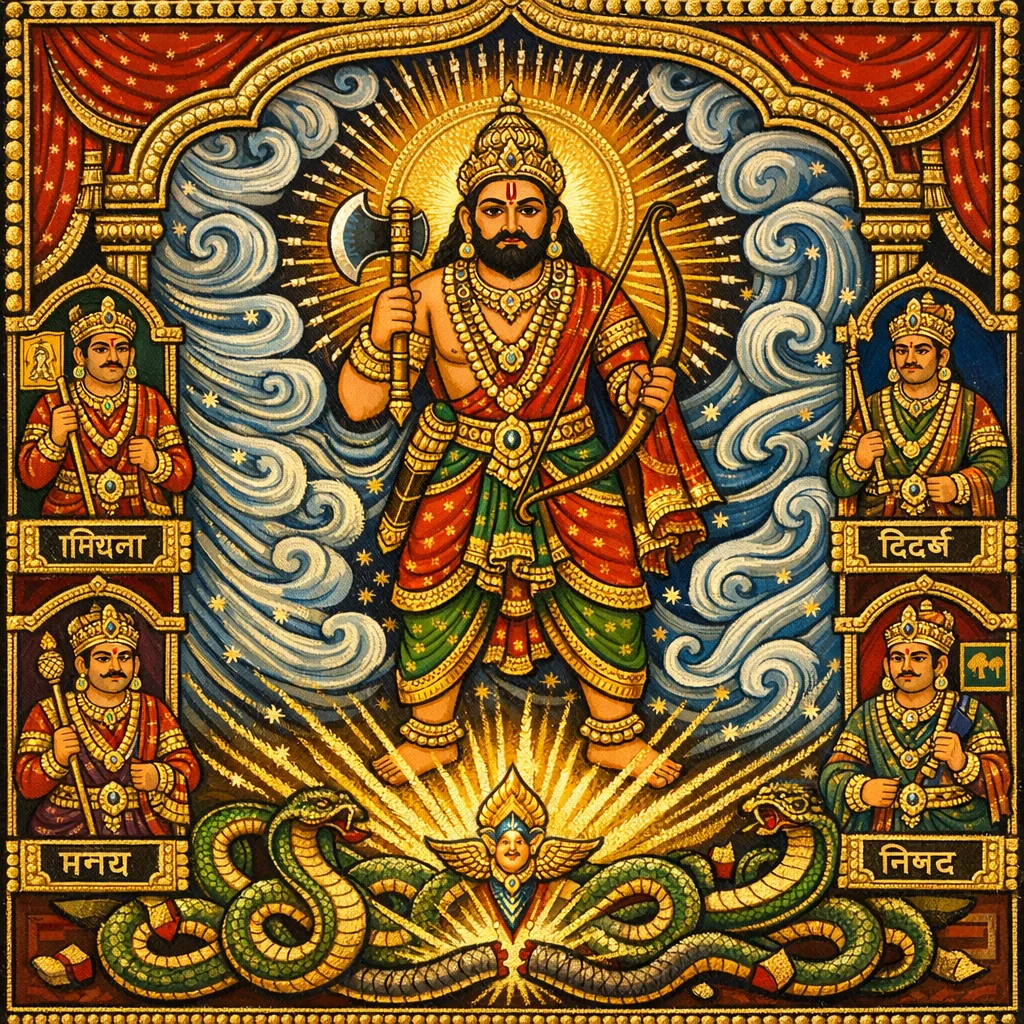
This adhyaya continues the Bhārgava-carita within Vasiṣṭha’s narration. After the fall of the “Matsya-rāja,” Kārttavīrya Arjuna, the mighty Haihaya ruler, rallies many rājendras (regional kings) for a coordinated stand in battle. The text then becomes a tactical roster, naming kings and realms—Bṛhadbala, Somadatta, Vidarbha, the lord of Mithilā, the Niṣadha ruler, the Magadha ruler—preserving a genealogical-political index of Kṣatriya alliances. In the astric combat, the nāgapāśa is loosed and cut by a gāruḍāstra; Jāmadagnya Rāma (Bhārgava Rāma/Paraśurāma), skilled in śastrāstra, escalates with Rudra-granted power (rudra-datta śūla) and other direct strikes. When arrows darken the field, Rāma disperses the śarajāla with a vāyavyāstra and reappears “like the sun from mist,” affirming his invulnerability and the inevitable defeat of the Haihayas. The chapter’s main value is its preserved list of allied kings, their geopolitical identifiers, and the logic of their subjugation under Bhārgava authority.
Shlokas
Verse 1
इति श्रीब्रह्माण्डे महापुराणे वायुप्रोक्ते मध्यम भागे तृतीय उपोद्धातपादे भार्गवचरिते अष्टात्रिंशत्तमो ऽध्यायः // ३८// वसिष्ठ उवाच मत्स्यराजे निपतिते राजा युद्धविशारदः / राजेन्द्रान्प्रेरयामास कार्त्तवीर्यो महाबलः
Thus ends the 38th chapter in the Sri Brahmanda Mahapurana... Vasistha said: When the King of Matsya had fallen, the mighty Karttavirya, skilled in warfare, sent forth other great kings.
Verse 2
बृहद्बलः सोमदत्तो विदर्भो मिथिलेश्वरः / निषधाधिपतिश्चैव मगधाधिपतिस्तथा
Brihadbala, Somadatta, Vidarbha, the Lord of Mithila, the Lord of Nishadha, and the Lord of Magadha.
Verse 3
आययुः समरे योद्धं भार्गवेद्रेण भूपते / वर्षन्तः शरजालानि नानायुद्धविशारदाः
O king, warriors skilled in many modes of battle came to the field against the foremost Bhārgava, raining down nets of arrows.
Verse 4
वीराभिमानिनः सर्वे हैहयस्याज्ञया तदा / पिनाकहस्तः स भृगुर्ज्वलदग्निशिखोपमः
Then, by Haihaya’s command, all who prided themselves on valor assembled. That Bhṛgu, holding the Pināka, blazed like a crest of living fire.
Verse 5
चिक्षेप नागपाशं च आभिमन्त्र्य शरोत्तमम् / तदस्त्रं भार्गवे द्रेण क्षिप्तं संग्राममूर्द्धनि
He empowered the finest arrow with mantra and hurled the Nāgapāśa weapon. That divine missile was cast by the foremost Bhārgava at the very crest of battle.
Verse 6
चकर्त्त गारुडास्त्रेण सोमदत्तो महाबलः / ततः क्रुद्धो महाभागो रामः शत्रुविदारणः
Mighty Somadatta severed it with the Garuḍāstra. Then the illustrious Rāma, rending his foes, flared up in wrath.
Verse 7
रुद्रदत्तेन शूलेन सोमदत्तं जघान ह / बृहद्बलं च गदया विदर्भं मुष्टिना तथा
With the trident bestowed by Rudra he struck down Somadatta; then he felled Bṛhadbala with a mace, and Vidarbha as well with a blow of his fist.
Verse 8
मैथिलं मुद्गरेणैव शक्त्या च निषधाधिपम् / मागधञ्चरणाघातैरस्त्रजालेन सैनिकान्
He struck down the man of Mithilā with a mace, the lord of Niṣadha with the śakti-spear, the Magadha with crushing foot-blows, and the soldiers with a net of weapons.
Verse 9
निहत्य निखिलां सेनां संहाराग्निसमीरणे / दुद्राव कार्त्तवीर्यं च जामदग्न्यो महाबलः
Having slain the entire host like a gust of the fire of dissolution, the mighty Jāmadagnya surged forth against Kārttavīrya as well.
Verse 10
दृष्ट्वा तं योद्धुमायान्तं राजानो ऽन्ये महारथाः / कार्य्याकार्यविधानज्ञाः पृष्टे कृत्वा च हैहयम्
Seeing him advance to battle, other kings—great chariot-warriors, versed in what should and should not be done—placed the Haihaya to the rear and stepped forth.
Verse 11
रामेण युयुधुश्चैव दर्शयन्तश्च सौहृदम् / कान्यकुब्जाश्च शतशः सौराष्ट्रावन्तयस्तथा
They fought with Rāma, yet displayed goodwill; there were hundreds of kings from Kānyakubja, and likewise from Saurāṣṭra and Avanti.
Verse 12
चक्रुश्च शरजालानि रामस्य च समन्ततः / शरजालावृतस्तेषां रामः संग्राममूर्द्धनि
They cast nets of arrows all around Rāma; though veiled by those arrow-nets, Rāma stood unmoved at the very crest of the battle.
Verse 13
न चादृश्यत राजेन्द्र तदा स त्वकृतव्रणः / सस्मार रामचरितं यदुक्तं हरिणेन वै
O king of kings, then he—unwounded—was no longer seen. He recalled the sacred deeds of Rama, as Hari had spoken of them.
Verse 14
कुशलं भार्गवेन्द्रस्य याचमानो हरिं मुनिः / एतस्मिन्नेव काले तु रामः शस्त्रास्त्रकोविदः
The sage, petitioning Hari, asked after the welfare of Bhargavendra. At that very time Rama, skilled in weapons and astras, was there.
Verse 15
विधूय शरजालानि वायव्यास्त्रेण मन्त्रवित् / उदतिष्ठद्रणाकाङ्क्षी नीहारादिव भास्करः
Rama, knower of mantras, shook off the nets of arrows with the Vayavyastra. Longing for battle, he rose like the sun emerging from mist.
Verse 16
त्रिरात्रं समरे रामस्तैः सार्द्धं युयुधे बली / द्वादशाक्षौहिणीस्तत्र चिच्छेद लघुविक्रमः
Mighty Rama fought with them in battle for three nights. There, swift in valor, he cut down twelve akshauhini armies.
Verse 17
रम्भास्तम्भवनं यद्वत् परश्वधवरायुधः / सर्वांस्तान्भूपवर्गांश्च तदीयश्च महाचमूः
He, wielding the supreme axe as his weapon, like one felling a forest of rambha-pillars, destroyed all those ranks of kings and their vast host.
Verse 18
दृष्ट्वा विनिहतां तेन रामेण सुमहात्मना / आजगाम महावीर्यः सुचन्द्रः सूर्यवंशजः
Seeing him slain by Rama, the great-souled one, Sucandra—mighty in valor, born of the Solar line—came there.
Verse 19
लक्षराजन्यसंयुक्तः सप्ताक्षौहिणिसंयुतः / तत्रानेकमहावीरा गर्जन्तस्तोयदा इव
With countless royal warriors and seven akṣauhiṇī armies, many great heroes there roared like thunderclouds.
Verse 20
कंपयन्तो भुवं राजन् युयुधुर्भार्गवेण च / तेः प्रयुक्तानि शस्त्राणि महास्त्राणि च भूपते
O king, shaking the earth, they fought with Bhārgava; O lord of men, weapons and mighty astras were unleashed.
Verse 21
क्षणेन नाशयामास भार्गवेन्द्रः प्रतापवान् / गृहीत्वा परशुं दिव्यं कालातकयमोपमम्
In an instant the mighty Bhārgavendra destroyed them, seizing the divine axe, like Yama who ends all at the close of time.
Verse 22
कालयन्सकला सेनां चिच्छेद भुगुनन्दनः / कर्षकस्तु यथा क्षेत्रे पक्वं धान्यं तथा तृणम्
Destroying the entire host, the son of Bhṛgu hewed them down, as a farmer in the field cuts ripe grain and grass alike.
Verse 23
निशेषयति दात्रेण तथा रामेण तत्कृतम् / लक्षराजन्यसैन्यं तददृष्ट्वा रामेण दारितम्
Rama, wielding the dātra (sacred axe), utterly destroyed them; and that host of kshatriya warriors, counted in lakhs, before it could even behold him, was cleft apart by Rama.
Verse 24
सुचन्द्रः पृथिवीपालो युयुधे संगरे नृप / तावुभौ तत्र संक्षुब्धौ नानाशस्त्रास्त्रकोविदौ
O king, Sucandra, the lord who guarded the earth, fought in the battle; there the two, stirred to fury and skilled in many weapons and astras, clashed together.
Verse 25
युयुधाते महावीरौ मुनीशनृपतीश्वरौ / रामो ऽस्मै यानि शस्त्राणि चिक्षेपास्त्राणि चापि हि
Those two great heroes—the lord of sages and the sovereign of kings—fought on; and Rama hurled at him whatever weapons and astras he possessed.
Verse 26
तानि सर्वाणि चिच्छेद सुचन्द्रो युद्ध पण्डितः / ततः क्रुद्धो रणे रामः सुचन्द्रं पृथिवीश्वरम्
Sucandra, skilled in the art of war, cut all of them down; then Rama, enraged in the fray, turned upon Sucandra, the lord of the earth.
Verse 27
कृतप्रतिकृताभिज्ञं ज्ञात्वोपस्पृश्य वार्यथ / नारायणास्त्रं विशिखे संदधे चानिवारितम्
Knowing him skilled in counterstroke, Rama purified himself by touching water; then, irresistible and unchecked, he set the Nārāyaṇāstra upon his arrow.
Verse 28
तदस्त्रं शतसूर्याभं क्षिप्तं रामेण धीमता / हृष्टोत्तीर्य रथात्सद्यः सुचन्द्रः प्रणनाम ह
Then wise Rama hurled that weapon, blazing like a hundred suns. Sucandra, delighted, at once descended from his chariot and bowed down in reverent homage.
Verse 29
सर्वास्त्रपूज्यं तच्चापि नारायणविनिर्मितम् / तमेवं प्रणतं त्यक्त्वा यथौ नारायमन्तिकम्
That weapon too was revered among all weapons, fashioned by Narayana Himself. Seeing him thus bowed in surrender, it left him and, as ordained, drew near to Narayana.
Verse 30
विस्मितो ऽभूत्तदा रामः समरे शत्रसूदनः / दृष्ट्वा व्यर्थं महास्त्रं तद्भूपं स्वस्थं विलोक्य च
Then Rama, slayer of foes in battle, was astonished. Seeing that mighty weapon rendered futile, and beholding the king unharmed and composed, he stood in wonder.
Verse 31
रामः शक्तिं च मुसलं तोमरं पट्टिशं तथा / गदां च परशुं कोपाच्छिक्षेप नृपमूर्द्धनि
In wrath, Rama hurled śakti and musala, tomara and paṭṭiśa, and also gada and paraśu—casting them upon the king’s head.
Verse 32
जग्राह तानि सर्वाणि सुचन्द्रो लीलयैव हि / चिक्षेप शिवशूलं च रामो नृपतये यदा
Sucandra seized them all as though it were mere sport. And when Rama cast even Shiva’s trident toward the king, it too was met the same way.
Verse 33
बभूव पुष्पमालां च तच्छूलं नृपतेर्गले / ददर्श च पुरस्तस्य भद्रकालीं जगत्प्रसूम्
That trident became a garland of flowers upon the king’s neck; and before him he beheld Bhadrakālī, the Mother who brings forth the worlds.
Verse 34
वहन्तीं मुण्डमालां च विकटास्यां भयङ्करीम् / सिंहस्थां च त्रिनेत्रां च त्रिशूलवरधारिणीम्
She bore a garland of skulls, with a dreadful and fearsome visage; seated upon a lion, three-eyed, holding the trident and the boon-bestowing hand.
Verse 35
दृष्ट्वा विहाय शस्त्रास्त्रं नमस्कृत्य समैडत / राम उवाच नमोस्तु ते शङ्करवल्लभायै जगत्सवित्र्यै समलङ्कृतायै
Seeing her, Rāma laid aside his weapons, bowed in reverence, and praised: “Homage to You—beloved of Śaṅkara, Sāvitrī of the worlds, O Goddess adorned in splendor.”
Verse 36
नानाविभूषाभिरिभारिगायै प्रपन्नरक्षाविहितोद्यमायै / दक्षप्रसूत्यै हिमवद्भवायै महेश्वरार्द्धङ्गसमास्थितायै
Homage to the Goddess adorned with many ornaments, seated upon the elephant’s foe—the lion; ever striving to protect those who seek refuge; daughter of Dakṣa, born of Himavān, abiding as the very half of Maheśvara.
Verse 37
काल्यै कलानाथकलाधरायै भक्तप्रियायै भुवनाधिपायै / ताराभिधायै शिवतत्परायै गणेश्वराराधितपादुकायै
Homage to Kālī, who bears the crescent of the Lord of the Moon; beloved of devotees, sovereign of the worlds; famed as Tārā, wholly devoted to Śiva; whose sacred sandals are worshiped by Gaṇeśvara.
Verse 38
परात्परायै परमेष्ठिदायै तापत्रयोन्मूलनचिन्तनायै / जगद्धितायास्तपुरत्रयायै बालादिकायै त्रिपुराभिधायै
Homage to the Supreme beyond the supreme, bestower of the Parameṣṭhi state, who uproots the threefold afflictions; benefactress of the world, destroyer of Tripura, appearing as Bālā and other forms, known as Tripurā.
Verse 39
समस्तविद्यासुविलासदायै जगज्जनन्यै निहिताहितायै / बकाननायै बहुसाख्यदायै विध्वस्तनानासुरदान्वायै
Homage to her who grants the radiant play of all knowledges, the Mother of the world who upholds what is beneficial; she of crane-like visage, giver of many branches and paths, destroyer of manifold asuras and dānavas.
Verse 40
वराभयालङ्कृतदोर्लतायै समस्तगीर्वाणनमस्कृतायै / पीतांबरायै पवनाशुगायै शुभप्रदायै शिवसंस्तुतायै
Homage to her whose vine-like arms are adorned with boon and fearlessness, bowed to by all the gods; clad in yellow, swift as the wind, bestower of auspiciousness, praised by Śiva.
Verse 41
नागारिगायै नवखण्डपायै नीलाचलाभां गलसत्प्रभायै / लघुक्रमायै ललिताभिधायै लेखाधिपायै लवणाकरायै
Homage to her who rides the foe of the nāgas (Garuḍa), protectress of the nine regions; radiant like Nīlācala, with a shining splendor at her throat; light in her stride, named Lalitā, sovereign of letters, whose nature is like the salt ocean.
Verse 42
लोलेक्षणायै लयवर्जितायै लाक्षारसालङ्कृतपङ्कजायै / रमाभिधायै रतिसुप्रियायै रोगापहायै रचिताखिलायै
Homage to her of wavering eyes, untouched by dissolution, imperishable; like a lotus adorned with crimson lākṣā, named Ramā, dearly beloved of Rati; remover of disease, creatress of all that is.
Verse 43
राज्यप्रदायै रमणोत्सुकायै रत्नप्रभायै रुचिरांबरायै / नमो नमस्ते परतः पुरस्तात् पार्श्वाधरोर्ध्वं च नमो नमस्ते
O Goddess who bestows sovereignty, who delights in bliss, who shines like a jewel and wears radiant garments—salutations, salutations to You; from behind and before, from the sides, below and above, salutations to You.
Verse 44
सदा च सर्वत्र नमो नमस्ते नमो नमस्ते ऽखिलविग्रहायै / प्रसीद देवेशि मम प्रतिज्ञां पुरा कृतां पालय भद्रकालि
Always and everywhere, salutations to You; salutations to You who embody all forms. Be gracious, O Sovereign Goddess, Bhadrakali; uphold the vow I made long ago.
Verse 45
त्वमेव माता च पिता त्वमेव जगत्त्रयस्यापि नमो नमस्ते / वसिष्ठ उवाच एवं स्तुता तदा देवी भद्रकाली तरस्विनी
You alone are Mother, and You alone are Father; salutations to You, the support of the three worlds. Vasiṣṭha said: thus praised, the mighty Goddess Bhadrakali then manifested.
Verse 46
उवाच भार्गवं प्रीता वरदानकृतोत्सवा / भद्रकाल्युवाच वत्स राम महाभाग प्रीतास्मि तव सांप्रतम्
The Goddess, delighted as though in a festival of boons, spoke to Bhārgava. Bhadrakali said: “Child, O most fortunate Rama, I am pleased with you now.”
Verse 47
वरं वरय मत्तो यस्त्वया चाभ्यर्थिता हृदि / राम उवाच मातर्यदि वरो देयस्त्वया मे भक्तव त्सले
“Choose from me the boon you have sought within your heart.” Rama said: “Mother, if you would grant me a boon—O You who cherish Your devotees!”
Verse 48
तत्सुचन्द्रं जये युद्धे तवानुग्रहभाजनम् / इति मे ऽभिहितं देवि कुरु प्रीतेन चेतसा
O Goddess, for victory in battle that Sucandra is worthy of your grace—thus have I spoken; do it with a pleased heart.
Verse 49
येन केनाप्युपायेन जगन्मातर्नमो ऽस्तु ते / भद्रकाल्युवाच आग्नेयास्त्रेण राजेन्द्रं सुचन्द्रं नय मद्गृहम्
O Mother of the world, by whatever means, obeisance be to you. Bhadrakali said: With the Agneyastra, bring King Sucandra to my abode.
Verse 50
ममातिप्रियमद्यैव पार्षदो मे भवत्वयम् / वसिष्ठ उवाच इत्युक्तमाकर्ण्य स भार्गवेन्द्रो देव्याः प्रियं कर्तुमथोद्यतो ऽभूत्
Let this, even today, be most dear to me: let him become my attendant. Vasistha said: Hearing these words, that foremost of the Bhargavas set himself to fulfill what was pleasing to the Goddess.
Verse 51
प्राणान्नियम्याचमनं च कृत्वा सुचन्द्रमुद्दिश्य च तत्समादधे / अस्त्रं प्रयुक्तं नृपतेर्वधाय रामेण राजन् प्रसभं तदा तत्
Having restrained his breath and performed acamana, he fixed his aim upon Sucandra and set that weapon in place; O King, then Rama forcefully discharged that astra to slay the ruler.
Verse 52
दग्ध्वा वपुर्भूतमयं तदीयं निनाय लोकं परदेवतायाः / ततस्तु रामेण कृतप्रणामा सा भद्रकालो जगदादिकर्त्री
Having burned his elemental body, she led him to the realm of the Supreme Deity. Then Rama bowed in reverence: that Bhadrakali is the primordial Creatrix of the world.
Verse 53
अन्तर्हिताभूदथ जामदग्न्यस्तस्थौ रणेभूपवधाभिकाङ्क्षी
Then Jāmadagnya (Paraśurāma) became hidden from sight and stood firm in battle, longing to slay the kings.
Frequently Asked Questions
Rather than a full vamsha list, the chapter preserves a coalition roster: Kārttavīrya (Haihaya) mobilizes kings identified by realms—Vidarbha, Mithilā, Niṣadha, Magadha—plus groups from Kānyakubja, Saurāṣṭra, and Avanti, mapping a Kṣatriya alliance network.
Nāgapāśa is launched; it is countered/cleaved with Gāruḍāstra; later the battlefield’s arrow-net (śarajāla) is dispersed by Vāyavyāstra, and Somadatta is slain with a Rudra-bestowed śūla (rudra-datta śūla).
It functions as historiographic metadata: named rulers and regions are anchored into a time-sequenced narrative of rise and defeat, showing how dynastic power realigns—i.e., Vamsha is expressed through political geography and conflict outcomes.