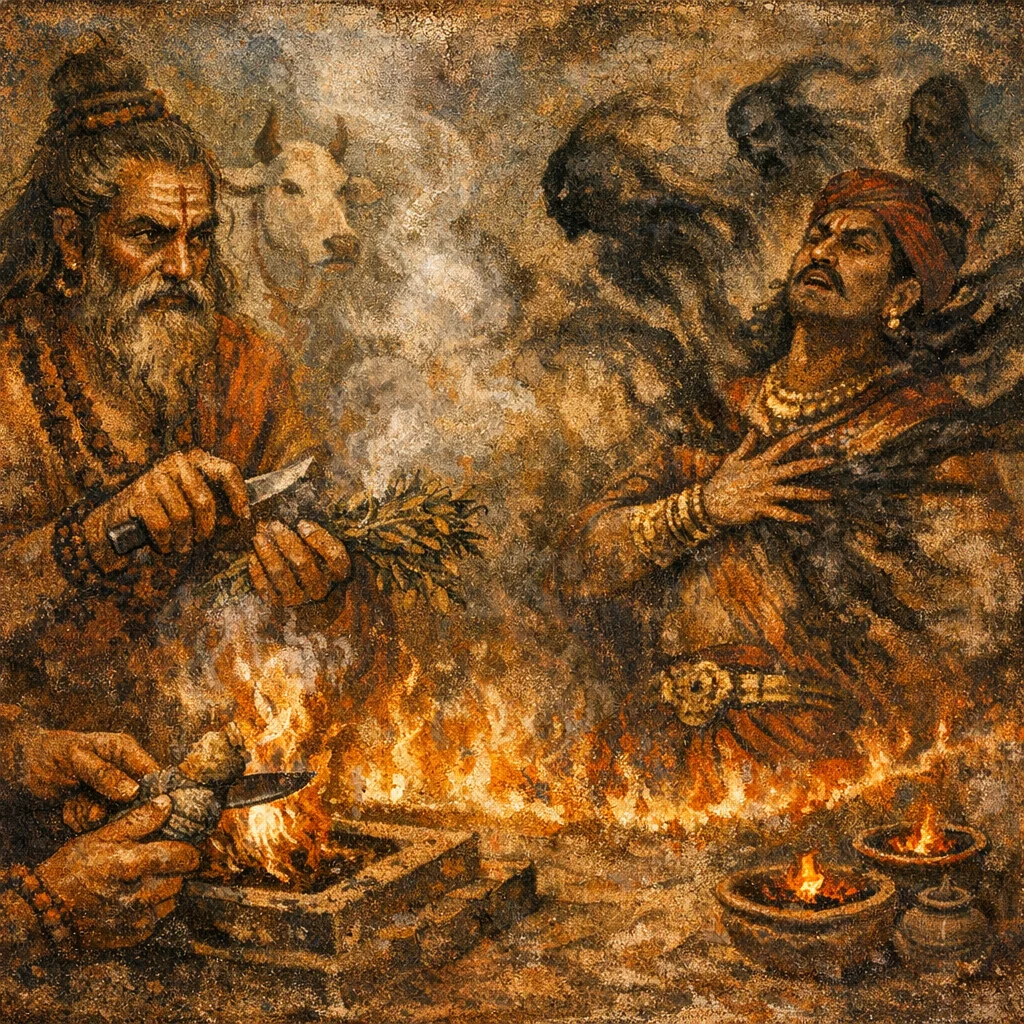
Sukta 5
Rishi: Traditionally Atharvanic/Angirasa attribution for this legal-protective material (hymn-level attribution varies by anukramaṇī tradition).
Devata: Go (Cow) as sacral power; Mṛtyu as punitive horizon; Brahman as weaponized sacred authority.
Chandas: Anuṣṭubh-like cadence (mixed/irregular in this legal-prose style section).
Mantras
Mantra 1
ब्रह्मगवी। ३ चतुष्पदा स्वराडुष्णिक्, ४ आसुर्यनुष्टुप्, ५ साम्नी पङ्क्तिः। श्रमेण तपसा सृष्टा ब्रह्मणा वित्तर्ते श्रिता
The Brahman-Cow—by labour and by holy heat created, by sacred power brought forth—on the ordered law of wealth she standeth firm.
Mantra 2
सत्येनावृता श्रिया प्रावृता यशसा परीवृता
With Truth encompassed, with Fortune well invested, with Glory round about enwrapped.
Mantra 3
स्वधया परिहिता श्रद्धया पर्यूढा दीक्षया गुप्ता यज्ञे प्रतिष्ठिता लोको निधनम्
With Svadhā set round about, with Faith encompassed, with Consecration guarded; in Sacrifice firmly founded—the World, its settled base.
Mantra 4
ब्रह्म पदवायं ब्राह्मणोऽधिपतिः
Brahman is the ordered footing; the Brāhmaṇa is lord thereof.
Mantra 5
तामाददानस्य ब्रह्मगवीं जिनतो ब्राह्मणं क्षत्रियस्य
That Brahman-cow—when a Kṣatriya, taking it to himself, would fain win it by mastery—(it touches) the Brahman (and his dread potency).
Mantra 6
अप क्रामति सूनृता वीर्यं१ पुण्या लक्ष्मीः
Away departs fair Truth of speech, away heroic might; away departs the holy Fortune, Lakṣmī, the auspicious.
Mantra 7
(2) (७-११) ७-९ आर्च्यनुष्टुप् (७ भुरिक्), १० उष्णिक्, (७-१७ एकपदा), ११ आर्ची निचृत्पङ्क्तिः। ओजश्च तेजश्च सहश्च बलं च वाक् चेन्द्रियं च श्रीश्च धर्मश्च
Force and fiery splendor, conquering might and strength; Speech and lordly faculty; Splendour and Law—(these too depart/are at stake).
Mantra 8
ब्रह्म च क्षत्रं च राष्ट्रं च विशश्च त्विषिश्च यशश्च वर्चश्च द्रविणं च
Brahman-power and royal power, the realm and the folk; brilliance and fame, lustre and wealth—(all these are imperilled and may depart).
Mantra 9
आयुश्च रूपं च नाम च कीर्तिश्च प्राणश्चापानश्च चक्षुश्च श्रोत्रं च
Life and comely form, name and fame; in-breath and out-breath, sight and hearing—(these too are lost when order is violated, and are to be secured by rite).
Mantra 10
पयश्च रसश्चान्नं चान्नाद्यं चर्तं च सत्यं चेष्टं च पूर्तं च प्रजा च पशवश्च
Milk and sap, and food, and foodful plenty; and Order, and Truth; and Sacrifice-offering, and Pious Fulfilment; and progeny, and cattle likewise.
Mantra 11
तानि सर्वाण्यप क्रामन्ति ब्रह्मगवीमाददानस्य जिनतो ब्राह्मणं क्षत्रियस्य
All those depart away from him who taketh the Brahmin’s cow, from the Kṣatriya who would overbear the Brahmin.
Mantra 12
(3) (१२-२७) १२ विराड् विषमा गायत्री, १३ आसुर्यनुष्टुप्, १४, २५ साम्नी उष्णिक्, १५ गायत्री, १६-१७, १९-२० प्राजापत्याऽनुष्टुप्, १८ याजुषी जगती, २१,२५ साम्न्यनुष्टुप्, २२ साम्नी बृहती, २३ याजुषी त्रिष्टुप्, २४ आसुरी गायत्री, २७ आर्च्युष्णिक्। सैषा भीमा ब्रह्मगव्य१घविषा साक्षात् कृत्या कूल्बजमावृता
This, dread indeed, the Brahmin’s Cow—ghee-rich—is in very truth a Kṛtyā, encompassed about with Kūlbaja.
Mantra 13
सर्वाण्यस्यां घोराणि सर्वे च मृत्यवः
In her are all terrors; and in her are all deaths.
Mantra 14
सर्वाण्यस्यां क्रूराणि सर्वे पुरुषवधाः
In her are all cruelties; in her are all man-slayings.
Mantra 15
सा ब्रह्मज्यं देवपीयुं ब्रह्मगव्याऽदीयमाना मृत्योः पद्वीश आ द्यति
She—Brahman’s bow-string, the gods’ own cherished draught, the Brahman’s cow—when she is being taken away, drives (the taker) forth into the pathways of Death.
Mantra 16
मेनिः शतवधा हि सा ब्रह्मज्यस्य क्षितिर्हि सा
For she is wrath, slaying in a hundred fashions; for she is the firm standing-ground of Brahman’s bow-string.
Mantra 17
तस्माद् वै ब्राह्मणानां गौर्दुराधर्षा विजानता
Therefore, verily, the Brahmins’ cow is not to be assailed—so should the man of understanding know.
Mantra 18
वज्रो धावन्ती वैश्वानर उद्वीता
A thunderbolt, rushing on—Vaiśvānara uplifted (to strike).
Mantra 19
हेतिः शफानुत्खिदन्ती महादेवो३ऽपेक्षमाणा
A weapon, tearing up along the hoof-tracks, while Mahādeva watches and waits (for the offender).
Mantra 20
क्षुरपविरीक्षमाणा वाश्यमानाभि स्फूर्जति
Razor-edged, she eyes her mark; roaring aloud she bursts and crackles forth against it.
Mantra 21
मृत्युर्हिङ्कृण्वत्यु१ग्रो देवः पुच्छं पर्यस्यन्ती
Death, the fierce god, crying ‘hiṅ,’ brandishes and flings his tail about.
Mantra 22
सर्वज्यानिः कर्णौ वरीवर्जयन्ती राजयक्ष्मो मेहन्ती
All-wasting Loss—she guards the ears, keeping harm away—(yet) rājayakṣma, the consumer, makes him void his water.
Mantra 23
मेनिर्दुह्यमाना शीर्षक्तिर्दुग्धा
Menī is being milked forth; the head-affliction is milked out.
Mantra 24
सेदिरुपतिष्ठन्ती मिथोयोधः परामृष्टा
Sedī draws near; in mutual combat she is brushed away, repelled by touch.
Mantra 25
शरव्या३ मुखेऽपिनह्यमान ऋतिर्हन्यमाना
Saravyā, being bound fast at the mouth—R̥ti, even as she is smitten down.
Mantra 26
अघविषा निपतन्ती तमो निपतिता
With evil poison she falls upon—darkness, cast down and fallen.
Mantra 27
अनुगच्छन्ती प्राणानुप दासयति ब्रह्मगवी ब्रह्मज्यस्य
Following after, she brings the breaths into bondage—(the) brahma-cow, (the doom) of the brahma-violator.
Mantra 28
(4) (२८-३८) आसुरी गायत्री, २९, ३७ आसुर्यनुष्टुप्, ३० साम्न्यनुष्टुप्, ३१ याजषी त्रिष्टुप्, ३२ साम्नी गायत्री, ३३-३४ साम्नी बृहती, ३५ भुरिक्साम्न्यनुष्टुप्, ३६ साम्न्युष्णिक्, ३८ प्रतिष्ठा गायत्री। वैरं विकृत्यमाना पौत्राद्यं विभाज्यमाना
Enmity, being distorted—progeny from grandsons onward, being parcelled out and divided.
Mantra 29
देवहेतिर्ह्रियमाणा व्यृद्धिर्हृता
The god-sent missile is borne away; prosperity—carried off, taken away.
Mantra 30
पाप्माधिधीयमाना पारुष्यमवधीयमाना
Evil, being laid upon (him),—harsh injury, being laid away (from him).
Mantra 31
विषं प्रयस्यन्ती तक्मा प्रयस्ता
Driving forth the poison,—Takman the Fever is driven forth.
Mantra 32
अघं पच्यमाना दुष्वप्न्यं पक्वा
Evil being ‘cooked,’—the evil dream, cooked through.
Mantra 33
मूलबर्हणी पर्याक्रियमाणा क्षितिः पर्याकृता
Root-tearing (power), being wrought all round,—the Earth is made an enclosure all about.
Mantra 34
असंज्ञा गन्धेन शुगुद्ध्रियमाणाशीविष उद्धृता
Unconsciousness—by fragrance; borne off with burning pain; the venomous (poison) is drawn forth.
Mantra 35
अभूतिरुपह्रियमाणा पराभूतिरुपहृता
Misfortune, brought hither; overpowering defeat, brought and laid upon (the man).
Mantra 36
शर्व क्रुद्धः पिश्यमाना शिमिदा पिशिता
Śarva, in wrath—crushed down, by the Śimidā besmeared and branded.
Mantra 37
अवर्तिरश्यमाना निरृतिरशिता
Perversion, unfed and wasting; Nirṛti herself, unfed—(a presence of) deprivation.
Mantra 38
अशिता लोकाच्छिनत्ति ब्रह्मगवी ब्रह्मज्यमस्माच्चामुष्माच्च
Fasting-deprivation cuts a man off from his world; the Brahman’s cow, the Brahman’s due—(it cuts off) from this one and from that one.
Mantra 39
(5) (३९-४६) ३९ साम्नी पङ्क्तिः, ४० याजुष्यनुष्टुप्, ४१, ४६ भुरिक् साम्न्यनुष्टुप्, ४२ आसुरी बृहती, ४३ साम्नी बृहती, ४४ पिपीलिकमध्याऽनुष्टुप्, ४५ आर्ची बृहती। तस्या आहननं कृत्या मेनिराशसनं वलग ऊबध्यम्
Her smiting-down is the Kṛtyā; her engine is the Menī; her intent is the wishing; the Valaga is to be bound fast.
Mantra 40
अस्वगता परिह्णुता
Wandering from the horse’s course, turned aside and foiled.
Mantra 41
अग्निः क्रव्याद् भूत्वा ब्रह्मगवी ब्रह्मज्यं प्रविश्यात्ति
Agni, become the flesh-devourer, entering into the brahmagavī-offense, consumeth it away.
Mantra 42
सर्वास्याङ्गा पर्वा मूलानि वृश्चति
All his limbs, his joints, his very roots it heweth off.
Mantra 43
छिनत्त्यस्य पितृबन्धु परा भावयति मातृबन्धु
It cutteth off his father-kin; it driveth away and estrangeth his mother-kin.
Mantra 44
विवाहां ज्ञातीन्त्सर्वानपि क्षापयति ब्रह्मगवी ब्रह्मज्यस्य क्षत्रियेणापुनर्दीयमाना
The marriage-alliances, the kinsmen—all likewise it wasteth away—when the brahmagavī, withheld from restitution by a Kṣatriya, belongeth to the brahmajya-offender.
Mantra 45
अवास्तुमेनमस्वगमप्रजसं करोत्यपरापरणो भवति क्षीयते
With houselessness he maketh him; kine-less, and void of offspring he maketh him: ever lower and yet lower doth he become; he wasteth and is diminished.
Mantra 46
य एवं विदुषो ब्राह्मणस्य क्षत्रियो गामादत्ते
Whoso, a Kṣatriya, thus from a knowing Brahman taketh a cow away—
Mantra 47
(6) (४७-६१) ४७, ४९, ५१-५३, ५७-५९, ६१ प्राजापत्याऽनुष्टुप्, ४८ आर्च्यनुष्टुप्, ५० साम्नी बृहती, ५४-५५ प्राजापत्योष्णिक्, ५६ आसुरी गायत्री, ६० गायत्री। क्षिप्रं वै तस्याहनने गृध्राः कुर्वत ऐलबम्
Swiftly, in very sooth, at her slaying the vultures work their ill-omened ailabá.
Mantra 48
क्षिप्रं वै तस्यादहनं परि नृत्यन्ति केशनीराघ्नानाः पाणिनोरसि कुर्वाणाः पापमैलबम्
Swiftly, in very sooth, about her unburning dance the long-haired ones, smiting with their hands—(thou) a blade—making evil, ill-omened ailabá.
Mantra 49
क्षिप्रं वै तस्य वास्तुषु वृकाः कुर्वत ऐलबम्
Swiftly, in very sooth, within his homesteads wolves work the ill-omened ailabá.
Mantra 50
क्षिप्रं वै तस्य पृच्छन्ति यत् तदासी३दिदं नु ता३दिति
Swiftly, in very truth, they question of him: ‘What was that?’—‘This now is that,’ (so is it said).
Mantra 51
छिन्ध्या च्छिन्धि प्र छिन्ध्यपि क्षापय क्षापय
Cut thou it off—cut it; cut it forth and away; moreover waste it, waste it utterly.
Mantra 52
आददानमाङ्गिरसि ब्रह्मज्यमुप दासय
Seizing (the foe), O Angiras, apply the brahma-weapon: bring him low to subjection.
Mantra 53
वैश्वदेवी ह्यु१च्यसे कृत्या कूल्बजमावृता
‘Vaiśvadevī’ indeed thou art called, (yet) kṛtyā—Kūlbaja—hath wrapped thee round.
Mantra 54
ओषन्ती समोषन्ती ब्रह्मणो वज्रः
Burning, wholly burning—this is the thunderbolt of brahman.
Mantra 55
क्षुरपविर्मृत्युर्भूत्वा वि धाव त्वम्
Razor-edged, become thou Death, and rush forth, scattering (the foe).
Mantra 56
आ दत्से जिनतां वर्च इष्टं पूर्तं चाशिषः
Thou bringest and bestowest the victor’s splendour—sacrifice-won merit, pious-earned merit, and blessings.
Mantra 57
आदाय जीतं जीताय लोके३ऽमुष्मिन् प्र यच्छसि
Having taken the winnings, thou assignest them forth to the winner in yonder world.
Mantra 58
अघ्न्ये पदवीर्भव ब्राह्मणस्याभिशस्त्या
O inviolable one, become a path (of escape) for the Brahmin from imprecation and accusation.
Mantra 59
मेनिः शरव्याऽ भवाघादघविषा भव
Be thou Wrath as an arrow; be thou poison against the evil (and) from harm.
Mantra 60
अघ्न्ये प्र शिरो जहि ब्रह्मज्यस्य कृतागसो देवपीयोरराधसः
O Aghnyā, smite forth the head of him, the Brahma-slayer—of the sinner who hath wrought the guilt, who hath drunk what is the Gods’, devoid of grace and rightful weal.
Mantra 61
त्वया प्रमूर्णं मृदितमग्निर्दहतु दुश्चितम्
Crushed and ground to powder by thee, let Agni burn the evil-minded one away.
Mantra 62
(7) (६२-७३) ६२-६४, ६६,६८-७० प्राजापत्याऽनुष्टुप्, ६५ गायत्री, ६७ प्राजापत्या गायत्री, ७१ आसुरी पङ्क्तिः, ७२ प्राजापत्या त्रिष्टुप् ७३ आसुर्युष्णिक्। वृश्च प्र वृश्च सं वृश्च दह प्र दह सं दह
Cut off—cut forth—cut wholly away; burn—burn forth—burn utterly up.
Mantra 63
ब्रह्मज्यं देव्यघ्न्य आ मूलादनुसंदह
The Brahma-slaying taint, O Goddess Aghnyā, burn thou completely—down from the very root.
Mantra 64
यथायाद् यमसादनात् पापलोकान् परावतः
So may he fare away—from Yama’s seat—unto the sinful worlds, the regions far remote.
Mantra 65
एवा त्वं देव्यघ्न्ये ब्रह्मज्यस्य कृतागसो देवपीयोरराधसः
Even so, O Goddess, O inviolate One, upon the Brahman-slayer—upon him that hath wrought sin, the profaner of the gods’ due, the unprosperous in worship—(do thou execute this).
Mantra 66
वज्रेण शतपर्वणा तीक्ष्णेन क्षुरभृष्टिना
With the thunderbolt of a hundred joints, keen, with razor-edge for its blade—
Mantra 67
प्र स्कन्धान् प्र शिरो जहि
Smite off the shoulders, smite off the head.
Mantra 68
लोमान्यस्य सं छिन्धि त्वचमस्य वि वेष्टय
Cut wholly away his hairs; his skin do thou unwrap and strip apart.
Mantra 69
मांसान्यस्य शातय स्नावान्यस्य सं वृह
Make waste his fleshes; tear forth together his sinews.
Mantra 70
अस्थीन्यस्य पीडय मज्जानमस्य निर्जहि
Crush thou his bones; smite forth his marrow from within.
Mantra 71
सर्वास्याङ्गा पर्वाणि वि श्रथय
Loosen apart all his limbs, all his joints asunder.
Mantra 72
अग्निरेनं क्रव्यात् पृथिव्या नुदतामुदोषतु वायुरन्तरिक्षान्महतो वरिम्णः
Let Agni drive him, the flesh-devourer, from the earth; let him burn him forth: let Vāyu, from the mid-air, from the mighty expanse, thrust him away.
Mantra 73
सूर्य एनं दिवः प्र णुदतां न्योऽषतु
Let Sūrya from the sky drive him forth; let him scorch him down and away.
Frequently Asked Questions
It is used to protect a Brahmin’s cow/property by ritually condemning seizure and projecting punitive consequences—expulsion, affliction, and deathward fate—onto the violator.
To state that the cow functions like a returning-force: the wrongdoing rebounds automatically on the taker, so misfortune is framed as the act’s built-in sacred consequence.
Sūrya provides a cosmic enforcement: he drives the offender away from the sky and scorches him, sealing the hymn’s expulsion and protective boundary.