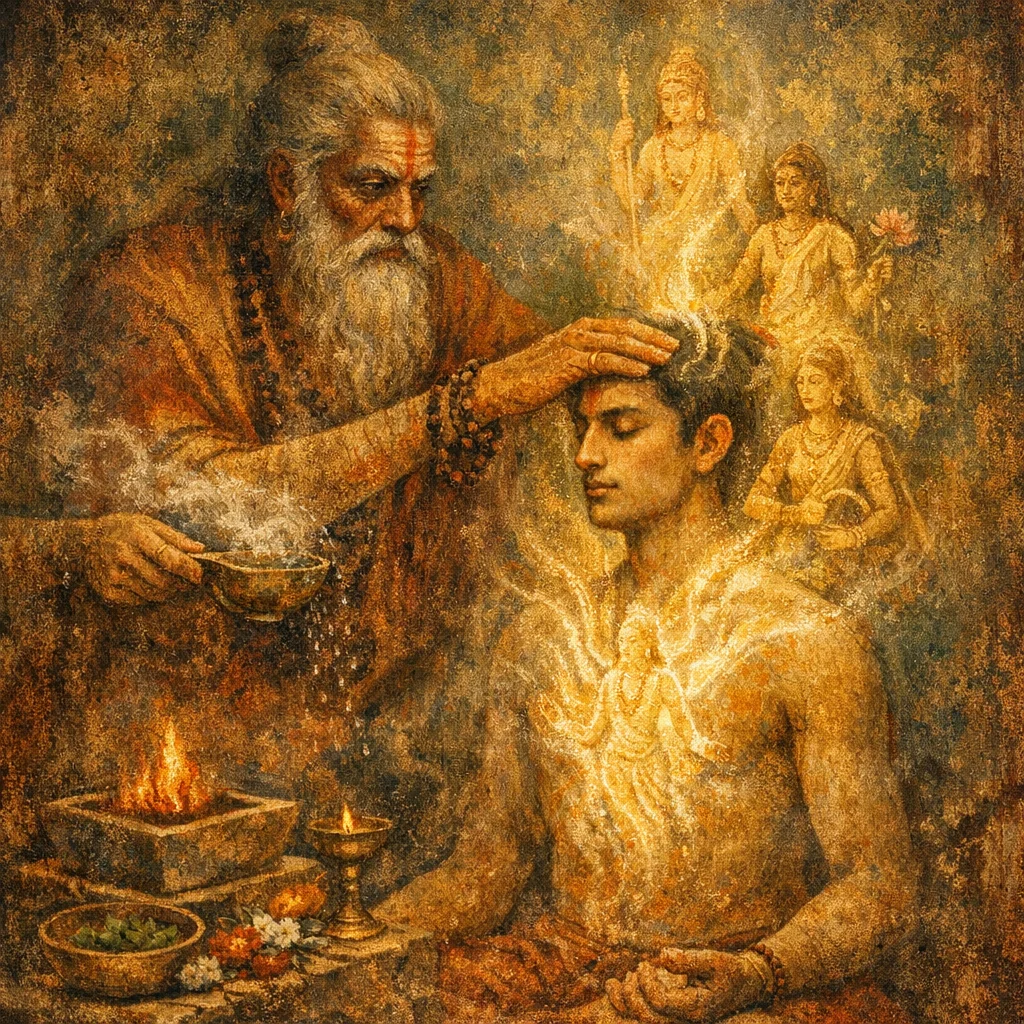
Sukta 8
Rishi: Atharvanic speculative seer-tradition (as transmitted in AV 11.8)
Devata: Manyu and Saṅkalpa (personified mental powers)
Chandas: Anuṣṭubh (with opening rubric ‘adhyātmam’ outside metrical count)
Mantras
Mantra 1
अध्यात्मम्। यन्मन्युर्जायामावहत् संकल्पस्य गृहादधि । क आसं जन्याः के वराः क उ ज्येष्ठवरोऽभवत्
In the inward sphere: when Wrath brought home a wife from the house of Resolve—who then were the kinsmen, who the suitors, and who indeed became the chiefest suitor?
Mantra 2
तपश्चैवास्तां कर्म चान्तर्महत्यऽर्णवे। त आसं जन्यास्ते वरा ब्रह्म ज्येष्ठवरोऽभवत्
Austerity and Act were there, within the mighty ocean: these were the kinsmen, these the suitors; Brahman became the chiefest suitor.
Mantra 3
दश साकमजायन्त देवा देवेभ्यः पुरा। यो वै तान् विद्यात् प्रत्यक्षं स वा अद्य महद् वदेत्
Ten, all together, were born as Gods from Gods in the olden time. Whoso in very deed should know them face to face, he even to-day would speak a mighty word.
Mantra 4
प्राणापानौ चक्षुः श्रोत्रमक्षितिश्च क्षितिश्च या। व्यानोदानौ वाङ् मनस्ते वा आकूतिमावहन्
In-breath and out-breath, sight and hearing, imperishableness and firm support; diffusive breath and upward breath, speech and mind—these verily brought hither settled purpose.
Mantra 5
अजाता आसन्नृतवोऽथो धाता बृहस्पतिः । इन्द्राग्नी अश्विना तर्हि कं ते ज्येष्ठमुपासत
Unborn were the Seasons; yea, Dhātṛ and Bṛhaspati; Indra with Agni, and the Aśvins: whom then did they attend as eldest and as chief?
Mantra 6
तपश्चैवास्तां कर्म चान्तर्महत्यर्णवे। तपो ह जज्ञे कर्मणस्तत् ते ज्येष्ठमुपासत
Austerity and Act were there, within the mighty flood. From Act, in sooth, was Austerity born: that did they wait upon as eldest and as chief.
Mantra 7
येत आसीद् भूमिः पूर्वा यामद्धातय इद् विदुः । यो वै तां विद्यान्नामथा स मन्येत पुराणवित्
That Earth which first of all existed, which the primal ordainers verily have known—whoso should know her by her name, he thereupon would deem himself a knower of the ancient lore.
Mantra 8
कुत इन्द्रः कुतः सोमः कुतो अग्निरजायत । कुतस्त्वष्टा समभवत् कुतो धाताजायत
Whence sprang Indra? whence Soma? whence was Agni born? Whence came Tvaṣṭṛ into being, and whence was Dhātṛ born?
Mantra 9
इन्द्रादिन्द्रः सोमात् सोमो अग्नेरग्निरजायत । त्वष्टा ह जज्ञे त्वष्टुर्धातुर्धाताजायत
From Indra Indra was born; from Soma Soma; from Agni Agni sprang. Tvaṣṭṛ, forsooth, was born; from Tvaṣṭṛ was Dhātṛ born.
Mantra 10
ये त आसन् दश जाता देवा देवेभ्यः पुरा। पुत्रेभ्यो लोकं दत्त्वा कस्मिंस्ते लोक आसते
Those ten Gods who were born of old, before the Gods—having bestowed their world upon their sons, in what realm do they now abide?
Mantra 11
यदा केशानस्थि स्नाव मांसं मज्जानमाभरत्। शरीरं कृत्वा पादवत् कं लोकमनु प्राविशत्
When he brought together hair, bone, sinew, flesh, and marrow—having made the body footed—into what world did he thereafter enter?
Mantra 12
कुतः केशान् कुतः स्नाव कुतो अस्थीन्याभरत्। अङ्गा पर्वाणि मज्जानं को मांसं कुत आभरत्
Whence brought he hair? whence sinew? whence fetched he bones? the limbs, the joints, the marrow—who brought the flesh, and whence brought he it?
Mantra 13
संसिचो नाम ते देवा ये संभारान्त्समभरन्। सर्वं संसिच्य मर्त्यं देवाः पुरुषमाविशन्
‘Sprinkler’ by name are those Gods of thine who gathered and brought the requisites together. Having wholly sprinkled the mortal frame, the Gods entered into the Person.
Mantra 14
ऊरू पादावष्ठीवन्तौ शिरौ हस्तावथो मुखम्। पृष्टीर्बर्जह्ये पार्श्वे कस्तत् समदधादृषिः
Thighs, feet with bones within them, head, hands, and moreover the mouth; the backs, the bedding, the sides—what Seer was he who fitted that together?
Mantra 15
शिरो हस्तावथो मुखं जिह्वां ग्रीवाश्च कीकसाः । त्वचा प्रावृत्य सर्वं तत् संधा समदधान्मही
Head, hands, and moreover the mouth; the tongue, the necks, and the vertebrae: covering all that with skin, the great Joiner set it firmly together.
Mantra 16
यत् तच्छरीरमशयत् संधया संहितं महत्। येनेदमद्य रोचते को अस्मिन् वर्णमाभरत्
That body which he laid down, a great thing compacted by joining—by whose power this now shines forth: who in this bestowed the colour (the fair complexion)?
Mantra 17
सर्वे देवा उपाशिक्षन् तदजानाद् वधूः सती। ईशा वशस्य या जाया सास्मिन् वर्णमाभरत्
All the Gods gave instruction; that the virtuous Bride came to know. The wife who is mistress of dominion—she it was who in this bestowed the colour (the comely hue).
Mantra 18
यदा त्वष्टा व्यतृणत् पिता त्वष्टुर्य उत्तरः । गृहं कृत्वा मर्त्यं देवाः पुरुषमाविशन्
When Tvaṣṭṛ, the Father—he who is later and higher of Tvaṣṭṛ—had set the parts asunder and in order, then, having made the mortal a house, the Gods entered into the Person.
Mantra 19
स्वप्नो वै तन्द्रीर्निरृतिः पाप्मानो नाम देवताः । जरा खालत्यं पालित्यं शरीरमनु प्राविशन्
Sleep, drowsiness, Nirṛti—Evils by name, as Powers—old age, baldness, and greyness: these entered after and into the body.
Mantra 20
स्तेयं दुष्कृतं वृजिनं सत्यं यज्ञो यशो बृहत्। बलं च क्षत्रमोजश्च शरीरमनु प्राविशन्
Theft, ill-deed, and crooked harm; and Truth, and Sacrifice, and lofty Glory; and Strength, and Kṣatra, and Vigor—these entered after and into the body.
Mantra 21
भूतिश्च वा अभूतिश्च रातयोऽरातयश्च याः । क्षुधश्च सर्वास्तृष्णाश्च शरीरमनु प्राविशन्
Prospering and un-prospering; gifts and non-gifts, whatsoever they be; and all hungers and all thirsts—these entered after and into the body.
Mantra 22
निन्दाश्च वा अनिन्दाश्च यच्च हन्तेति नेति च । शरीरं श्रद्धा दक्षिणाश्रद्धा चानु प्राविशन्
Blames and non-blames; and whatever is ‘Slayer,’ and ‘Not so’; into the body Faith entered, and the Dakṣiṇā, and Unfaith likewise after it.
Mantra 23
विद्याश्च वा अविद्याश्च यच्चान्यदुपदेश्यऽम्। शरीरं ब्रह्म प्राविशदृचः सामाथो यजुः
Knowledges and, yea, un-knowledges, and whatsoever else is meet to be imparted by instruction—Brahman entered the body: the Ṛc-verses, the Sāman, and moreover the Yajus.
Mantra 24
आनन्दा मोदाः प्रमुदोऽभिमोदमुदश्च ये। हसो नरिष्टा नृत्तानि शरीरमनु प्राविशन्
Blisses, pleasures, high rejoicing, exultant joy, and the gladnesses that are—laughter, unharmedness, and dances—these entered, following after, into the body.
Mantra 25
आलापाश्च प्रलापाश्चाभिलापलपश्च ये। शरीरं सर्वे प्राविशन्नायुजः प्रयुजो युजः
Converse and talk, and all the mutual speakings that there are—these all entered into the body: the joiners, the harnessers-on, the yokers.
Mantra 26
प्राणापानौ चक्षुः श्रोत्रमक्षितिश्च क्षितिश्च या। व्यानोदानौ वाङ् मनः शरीरेण त ईयन्ते
Prāṇa and Apāna, sight and hearing, imperishableness and steadfast abiding, and likewise Vyāna and Udāna—speech and mind: by means of the body do these move and have their course.
Mantra 27
आशिषश्च प्रशिषश्च संशिषो विशिषश्च याः । चित्तानि सर्वे संकल्पाः शरीरमनु प्राविशन्
Blessings and fore-blessings, concordant blessings and special blessings—whatsoever they be; all thoughts, all resolves—these entered, following after, into the body.
Mantra 28
आस्तेयीश्च वास्तेयीश्च त्वरणाः कृपणाश्च याः । गुह्याः शुक्रा स्थूला अपस्ता बीभत्सावसादयन्
Both those that are of the hearth and those that are of the house—those swift, those wretched, whatsoever are secret, bright, gross, cast down, and loathsome—these they pressed down and made to subside.
Mantra 29
अस्थि कृत्वा समिधं तदष्टापो असादयन्। रेतः कृत्वाज्यं देवाः पुरुषमाविशन्
Having made bone to be fuel, that the Eight Waters set firm in place. Having made seed to be ghee, the Gods entered into the Person.
Mantra 30
या आपो याश्च देवता या विराड् ब्रह्मणा सह। शरीरं ब्रह्म प्राविशच्छरीरेऽधि प्रजापतिः
What Waters there are, and what Divinities, and what Virāj together with Brahman—Brahman entered into the body; and in the body, over it, Prajāpati took his seat.
Mantra 31
सूर्यश्चक्षुर्वातः प्राणं पुरुषस्य वि भेजिरे । अथास्येतरमात्मानं देवाः प्रायच्छन्नग्नये
The Sun took to him the eye; the Wind took to him the breath of the Person, distributing them apart. Then the Gods delivered over his other self unto Agni.
Mantra 32
तस्माद् वै विद्वान् पुरुषमिदं ब्रह्मेति मन्यते । सर्वा ह्यऽस्मिन् देवता गावो गोष्ठ इवासते
Therefore the knower holds the Person to be this Brahman: for in him all the Divinities abide, as cows abide within the cattle-stall.
Mantra 33
प्रथमेन प्रमारेण त्रेधा विष्वङ् वि गच्छति । अद एकेन गच्छत्यद एकेन गच्छतीहैकेन नि षेवते
By the first measuring it goeth forth, threefold, spreading every way. Thence by one it passeth on; thence by one it passeth on; here by one it setteth itself down to dwell.
Mantra 34
अप्सु स्तीमासु वृद्धासु शरीरमन्तरा हितम्। तस्मिंछवोऽध्यन्तरा तस्माच्छवोऽध्युच्यते
In waters, in thickened steams, when they are grown full, the body is set within. Therein is strength laid over, within; therefore is it called ‘strength’ therefrom, as overlaid.
Frequently Asked Questions
It is an inward (adhyātma) hymn that treats anger (Manyu), resolve (Saṅkalpa), and the vital/sensory faculties as personified powers, so they can be understood and brought under control.
Both: its style is brahmavidyā (speculative) but it is functionally shāntika and bhaiṣajya-adjacent, aiming to steady breath, senses, speech, and mind—supporting calm, vitality, and longevity.
No explicit substances are required. The practice is primarily recitation with focused intention (saṅkalpa) and mindful attention to breath and faculties, treating them as the operative ‘deities’ within the body.