Adhyaya 65
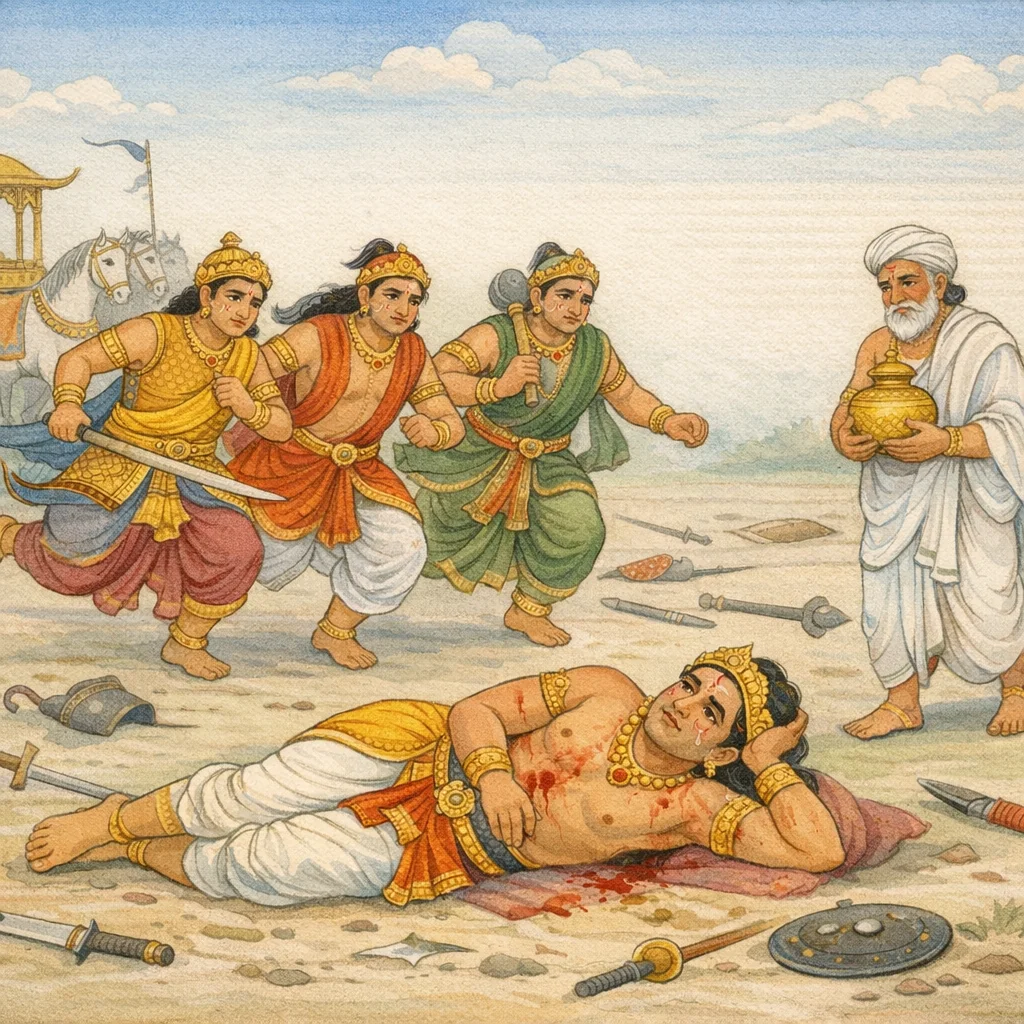
Chapter Arc: संजय धृतराष्ट्र से कहते हैं—दूतों के मुख से दुर्योधन के गिरने का समाचार सुनते ही जो कौरव-महारथी शेष बचे थे, वे बिजली-सी गति से रणभूमि की ओर दौड़े। → अश्वत्थामा, कृप और कृतवर्मा तीव्र वेग से पहुँचते हैं; बाण, गदा, तोमर, शक्ति से विदीर्ण रणभूमि का दृश्य उनके भीतर क्रोध और शोक को एक साथ भड़काता है। वे रथों से उतरकर राज-सन्निधि में भागते हैं और पृथ्वी पर पड़े दुर्योधन को देखकर मोह-वश हो जाते हैं। → दुर्योधन, आँसुओं से भरी आँखों के साथ, अपने बचे हुए रक्षकों से अंतिम संवाद करता है—अपने पराक्रम का स्मरण, छल से हुई पराजय का विषाद, और प्रतिशोध की ज्वाला। उसी क्षण वह कृपाचार्य से जल-पूर्ण कलश मँगाने का आदेश देता है—एक निर्णायक, रहस्यमय तैयारी। → कृपाचार्य राजा की आज्ञा मानकर जल से भरा कलश लेकर उसके समीप आते हैं; शेष महारथी शोक-क्रोध में डूबे हुए भी राजा के संकेत को समझने का प्रयत्न करते हैं। → जल-पूर्ण कलश का प्रयोजन क्या है—अभिषेक, संकल्प, या कोई अंतिम उपाय? अध्याय इसी अनिश्चितता और आसन्न कर्म के संकेत पर ठहरता है।
Shlokas
Verse 1
(दाक्षिणात्य अधिक पाठका ३ “लोक मिलाकर कुल ४३ ६ “लोक हैं।) न२्््स्निताय श््यु कर - आचार्य नीलकण्ठकी सम्मतिके अनुसार चार्वाक संन्यासी मुनिके वेषमें विचरनेवाला एक नास्तिक राक्षस था। पजञज्चषष्टितमो< ध्याय: दुर्योधनकी दशा देखकर अभश्वत्थामाका विषाद
Sañjaya said: Having heard from the messengers that Duryodhana had been slain, the great chariot-warriors of the Kauravas—those who still remained after the slaughter—were struck with grief and agitation, O King.
Verse 2
विनिर्भिन्ना: शितैर्बाणैर्गदातोमरशक्तिभि: । अश्वत्थामा कृपश्चैव कृतवर्मा च सात्वत:
Sañjaya said: Pierced through by sharp arrows, and struck by maces, tomara-spears, and śakti-javelins, Aśvatthāmā, Kṛpa, and Kṛtavarmā the Sātvata were left grievously wounded.
Verse 3
त्वरिता जवनैरश्वैरायोधनमुपागमन् । संजय कहते हैं--राजन! संदेशवाहकोंके मुखसे दुर्योधनके मारे जानेका समाचार सुनकर मरनेसे बचे हुए कौरव महारथी अश्वत्थामा
Sanjaya said: O King, when the surviving Kaurava great warriors—Aśvatthāmā, Kṛpa, and Kṛtavarmā of the Sātvata line—heard from the messengers that Duryodhana had been struck down, they, though themselves badly wounded by the blows of sharp arrows, maces, spears, and javelins, swiftly mounted chariots yoked with fast horses and hurried to the battlefield. Arriving there, they saw the high-souled son of Dhṛtarāṣṭra lying felled—like a mighty śāla tree in the forest snapped and thrown down by the force of the wind—blood-soaked and writhing upon the earth, like a huge elephant brought down by a hunter in the wild. The scene underscores the grim moral aftermath of war: even the mightiest fall, and the survivors are driven onward by loyalty, grief, and vengeance rather than by dharma’s calm restraint.
Verse 4
प्रभग्नं वायुवेगेन महाशालं यथा वने । भूमौ विचेष्टमानं तं रुधिरेण समुक्षितम्
Sañjaya said: Like a mighty śāla tree in a forest shattered by the force of the wind, he saw him—Duryodhana—lying on the ground, smeared all over with blood, writhing in pain. The image underscores the war’s grim moral aftermath: even the proud and powerful, once brought down by their own choices and the relentless logic of violence, are reduced to helpless suffering on the earth.
Verse 5
महागजमिवारण्ये व्याधेन विनिपातितम् । विवर्तमानं बहुशो रुधिरौघपरिप्लुतम्
Sañjaya said: “There they saw Duryodhana, the son of Dhṛtarāṣṭra, struck down—like a great elephant in the forest felled by a hunter. Flooded by streams of blood, he lay on the earth, writhing and turning again and again.”
Verse 6
यदृच्छया निपतितं चक्रमादित्यगोचरम् । महावातसमुत्थेन संशुष्कमिव सागरम्
Sañjaya said: “As though by sheer chance the sun’s disc had fallen from its course, as though the ocean had been dried up by a mighty wind—so did Duryodhana appear at that moment: his splendor and confidence shattered, his strength rendered futile by fate and the consequences of war.”
Verse 7
पूर्णचन्द्रमिव व्योम्नि तुषारावृतमण्डलम् | रेणुध्वस्तं दीर्घभुजं मातड्रमिव विक्रमे
Sañjaya said: “He looked like the full moon in the sky whose disc is veiled by winter mist; like a mighty elephant in the fury of battle, long-armed and powerful, yet now smeared and choked with dust. Such was Duryodhana’s condition at that moment—his former splendor obscured, his pride humbled by the harsh truth of war.”
Verse 8
वृतं भूतगणैघोरि: क्रव्यादैश्व समन््ततः । यथा धन लिप्समानैर्भुत्यै्नुपतिसत्तमम्
Sañjaya said: He was surrounded on every side by dreadful hosts of spirits and flesh-eating beings—just as servants greedy for wealth crowd around an excellent king.
Verse 9
भ्रुकुटीकृतवक्त्रान्तं क्रोधादुद्वृत्तचक्षुषम् । सामर्ष त॑ं नरव्याघ्रं व्याप्रं निपतितं यथा
Sañjaya said: His face was drawn into a frown, and his eyes, lifted in anger, blazed. That tiger among men stood there, filled with fierce resentment—like a tiger that has fallen upon its prey.
Verse 10
तेतं दृष्टवा महेष्वासं भूतले पतितं नूपम् । मोहमभ्यागमन् सर्वे कृपप्रभूतयो रथा:
Sañjaya said: Seeing that great archer—the king—fallen upon the ground, all the chariot-warriors, with Kṛpa foremost among them, were overcome by bewilderment and stunned grief.
Verse 11
महाधनुर्धर राजा दुर्योधनको पृथ्वीपर पड़ा हुआ देख कृपाचार्य आदि सभी महारथी मोहके वशीभूत हो गये ।।
Sañjaya said: Dismounting from their chariots, they ran to the king’s side. Seeing Duryodhana fallen, all of them sat down on the ground near him—overcome by shock and grief.
Verse 12
ततो द्रौणि्महाराज बाष्पपूर्णेक्षण: श्वसन् | उवाच भरतश्रेष्ठ सर्वलोकेश्चरेश्वरम्
Sañjaya said: Then Aśvatthāman (Drauṇi), O King, his eyes filled with tears and breathing in sobs, addressed Duryodhana—the foremost of the Bharatas, the sovereign among the lords of all the worlds.
Verse 13
न नूनं विद्यते सत्यं मानुषे किंचिदेव हि । यत्र त्वं पुरुषव्याप्र शेषे पांसुषु रूषित:
Sañjaya said: “Surely, in the human world there is nothing that can be called enduring truth; everything proves perishable. For see—where you, O tiger among men, lie at the end, smeared with dust.”
Verse 14
भूत्वा हि नृपति: पूर्व समाज्ञाप्य च मेदिनीम् । कथमेकोड्द्य राजेन्द्र तिषछ्ठसे निर्जने वने
Sañjaya said: “Formerly, O king, you were a sovereign who commanded the whole earth. How is it that today, O best of kings, you stand alone in this deserted forest?”
Verse 15
दुःशासनं न पश्यामि नापि कर्ण महारथम् । नापि तान् सुहृद: सर्वान् किमिदं भरतर्षभ
Sañjaya said: “I do not see Duḥśāsana, nor do I see Karṇa, that great chariot-warrior. Nor do I behold any of those friends at all. O bull among the Bharatas—what has happened?”
Verse 16
दुःखं नूनं कृतान्तस्य गतिं ज्ञातुं कथंचन । लोकानां च भवान् यत्र शेषे पांसुषु रूषित:,“निश्चय ही काल और लोकोंकी गतिको जानना किसी प्रकार भी कठिन ही है, जिसके अधीन होकर आप धूलमें सने हुए पड़े हैं
Sañjaya said: “Surely it is grievous—and in truth exceedingly hard in any way—to comprehend the course ordained by Death (Time) and the destinies of beings. For under that very power you now lie here at the end, angered, your body smeared with dust.”
Verse 17
एष मूर्थाभिषिक्तानामग्रे गत्वा परंतप: । सतृणं ग्रसते पांसुं पश्य कालस्य पर्ययम्
Sañjaya said: “Behold the reversal wrought by Time! This Duryodhana—once the ‘scorcher of foes,’ who used to ride at the head of consecrated kings—now lies forced to gulp dust along with bits of grass. Such is the turning of fortune in war, where pride and power collapse before the inexorable course of destiny.”
Verse 18
क्व ते तदमलं छत्र॑ व्यजनं क्व च पार्थिव । साच ते महती सेना क्व गता पार्थिवोत्तम,“नृपश्रेष्ठ॒ महाराज! कहाँ है आपका वह निर्मल छत्र, कहाँ है व्यजन और कहाँ गयी आपकी वह विशाल सेना?
Sañjaya said: “O king, where is that spotless royal parasol of yours, and where is the fan that once attended you? And where has your vast army gone, O best of rulers?”
Verse 19
दुर्विज्ञेया गतिर्नूनं कार्याणां कारणान्तरे । यद् वै लोकगुरुर्भूत्वा भवानेतां दशां गत:
Sañjaya said: Truly, the course of events—how one cause gives rise to a particular outcome—is exceedingly hard to discern. For even you, who stood as a revered guide and foremost king for the whole world, have now been brought to this condition.
Verse 20
अध्र॒वा सर्वमत्येंषु श्रीरुपालक्ष्यते भृशम् भवतो व्यसन दृष्टवा शक्रविस्पर्थधिनो भूशम्
Sañjaya said: “Among all mortals, prosperity is plainly seen to be unstable. Seeing this calamity that has befallen you—though you were a king whose royal fortune made you comparable to Indra—it becomes certain that no human wealth can be regarded as permanently secure.”
Verse 21
तस्य तद् वचन श्रुत्वा दु:खितस्य विशेषत: । उवाच राजन पुत्रस्ते प्राप्तकालमिदं वच:
Sañjaya said: Hearing those words—spoken in deep distress—your son, O King, replied with a timely statement. Overcome by grief, he gathered himself to speak what he felt was appropriate to the moment, addressing the assembled warriors and elders around him.
Verse 22
विमृज्य नेत्रे पाणिभ्यां शोकजं बाष्पमुत्सूजन् । कृपादीन् स तदा वीरान् सवनिव नराधिप:
Sañjaya said: Wiping his eyes with both hands and letting the grief-born tears fall, the king then addressed the heroes—Kṛpa and the others—with words suited to the moment.
Verse 23
ईदृशो लोकथधर्मो<यं धात्रा निर्दिष्ट उच्यते । विनाश: सर्वभूतानां कालपर्यायमागत:
Sañjaya said: “Such is the law of this mortal world; it is said to have been ordained by the Creator himself. Therefore, in the course of time, the hour of destruction inevitably comes upon all living beings.”
Verse 24
सो<यं मां समनुप्राप्त: प्रत्यक्ष भवतां हि यः । पृथिवीं पालयित्वाहमेतां निष्ठामुपागत:
Sañjaya said: “This very hour of ruin has come upon me as well—something you can plainly see with your own eyes. Once I governed and protected the whole earth; today I have been brought to this final condition.”
Verse 25
दिष्ट्या नाहं परावृत्तो युद्धे कस्यांचिदापदि । दिष्टयाहं निहतः पापैश्छलेनैव विशेषतः
Sañjaya said: “It is a blessing that, whatever crisis arose, I never turned back from battle. And it is a blessing too that, even though the wicked struck me down—especially by deceit—I did not abandon my warrior’s resolve.”
Verse 26
उत्साहश्व कृतो नित्यं मया दिष्ट्या युयुत्सता । दिष्ट्या चास्मिन् हतो युद्धे निहतज्ञातिबान्धव:
“It is a blessing that, with the will to fight, I always kept my spirit and ardor aflame. And it is a blessing too that I have been slain in this war, after my kinsmen and companions were struck down—so that I myself now lay down my life upon the field of battle, with deep contentment.”
Verse 27
दिष्ट्या च वो5हं पश्यामि मुक्तानस्माज्जनक्षयात् | स्वस्तियुक्तांश्व कल्यांश्व॒ तन्मे प्रियमनुत्तमम्
“It is a blessing that I see you all released from this slaughter of men. And that you are safe and whole, still able to act and accomplish what must be done—this is to me the dearest, the highest joy.”
Verse 28
मा भवन्तोअत्र तप्यन्तां सौहदान्निधनेन मे । यदि वेदा: प्रमाणं वो जिता लोका मयाक्षया:
Sañjaya said: “Let none of you grieve here on account of affection for me because of my death. If, in your view, the Vedas are authoritative, then know that by my passing I have attained victory over imperishable worlds.”
Verse 29
मन्यमान: प्रभावं च कृष्णस्यामिततेजस: । तेन न च्यावितश्नाहं क्षत्रधर्मात् स्वनुछितात्
Sañjaya said: “Recognizing the extraordinary power of Kṛṣṇa, whose splendor is immeasurable, I too was not shaken from the kṣatriya’s duty that I had undertaken as my own proper course.”
Verse 30
कृतं भवद्धि: सदृशमनुरूपमिवात्मन:
Sañjaya said: “What has been done is indeed in keeping with your own judgment—seemly and fitting, as though perfectly aligned with your very nature.”
Verse 31
एतावदुक्त्वा वचन बाष्पव्याकुललोचन:
Sañjaya said: Having spoken only this much, with eyes clouded and troubled by tears, he paused—overcome by emotion amid the grim unfolding of the war’s events.
Verse 32
तथा दृष्टवा तु राजानं बाष्पशोकसमन्वितम्
Sañjaya said: Having thus seen the king—overcome with tears and grief—the onlookers understood the depth of his sorrow amid the calamity of war.
Verse 33
स च क्रोधसमाविष्ट: पाणौ पा्णिं निपीड्य च
And he, seized by anger, pressed one hand tightly against the other—an outward sign of inner agitation and resolve amid the moral strain of the war.
Verse 34
पिता मे निहत: क्षुद्रै: सुनुशंसेन कर्मणा
Sañjaya said: “My father has been slain by base men—through the cruel deed of Sūnuśaṃsa.”
Verse 35
शृणु चेदं वचो महां सत्येन वदत: प्रभो
Sañjaya said: “O lord, listen to these weighty words spoken in truth. O lord, I speak under an oath of truth—hear me. Swearing by my sacrifices and public works, by my gifts, by dharma, and by other auspicious deeds, I make this vow: today, even as Śrī Kṛṣṇa looks on, by every possible means I will send all the Pāñcālas without remainder to the realm of Yama. O king, grant me your command for this.”
Verse 36
इष्टापूर्तेन दानेन धर्मेण सुकृतेन च । अद्याहं सर्वपञ्चालान् वासुदेवस्य पश्यत:
Sañjaya said: “By the merit of my sacrifices and public benefactions, by my gifts, by righteousness, and by every good deed I have done, I vow that today—before Vāsudeva’s very eyes—I shall send all the Pāñcālas to Yama’s realm by every means.”
Verse 37
सर्वोपायैहिं नेष्यामि प्रेतराजनिवेशनम् । अनुज्ञां तु महाराज भवान् मे दातुमरहति
Sañjaya said: “By every possible means I shall send them to the abode of the Lord of the Dead. But, O great king, you ought to grant me your permission.”
Verse 38
इति श्रुत्वा तु वचन द्रोणपुत्रस्य कौरव: । मनस: प्रीतिजननं कृपं वचनमत्रवीत्
Sañjaya said: Hearing these words of Droṇa’s son, the Kaurava (king) spoke to Kṛpa in a manner that gladdened his heart—addressing him with pleasing, conciliatory speech.
Verse 39
स तद् वचनमाज्ञाय राज्ञो ब्राह्मणसत्तम:
Sañjaya said: Having understood the king’s instruction, the foremost of Brahmins prepared to act in accordance with it—signaling prompt obedience to royal command and the weight such directives carry amid the moral strain of war.
Verse 40
तमब्रवीन्महाराज पुत्रस्तव विशाम्पते
Sañjaya said: “O great king, O lord of the people,” your son addressed him and said: “Best of Brahmins, may welfare be yours. If you wish to do what is dear to me, then, by my command, consecrate Droṇa’s son to the office of commander of the army.”
Verse 41
ममाज्ञया द्विजश्रेष्ठ द्रोणपुत्रोडभिषिच्यताम् । सैनापत्येन भद्रं ते मम चेदिच्छसि प्रियम्
“Best of Brahmins, by my command let Droṇa’s son be anointed as commander of the army; welfare to you, if you wish to do what is dear to me.”
Verse 42
राज्ञो नियोगाद् योद्धव्यं ब्राह्मणेन विशेषत: । वर्तता क्षत्रधर्मेण होव॑ धर्मविदो विदु:
Sañjaya said: “By the king’s command, a brāhmaṇa in particular ought to take up battle—conducting himself according to the kṣatriya code; thus do those who know dharma understand it.”
Verse 43
राज्ञस्तु वचन श्रुत्वा कृप: शारद्वतस्तथा । द्रौणिं राज्ञो नियोगेन सैनापत्ये5भ्यषेचयत्,राजाकी वह बात सुनकर शरद्वानके पुत्र कृपाचार्यने उसकी आज्ञाके अनुसार अश्वत्थामाका सेनापतिके पदपर अभिषेक किया
Sañjaya said: Hearing the king’s command, Kṛpa, the son of Śaradvat, in accordance with the king’s directive, consecrated Droṇa’s son Aśvatthāmā to the office of commander of the army.
Verse 44
सो$5भिषिक्तो महाराज परिष्वज्य नृपोत्तमम् | प्रययौँ सिंहनादेन दिश: सर्वा विनादयन्
Sañjaya said: “O King, after being anointed, he embraced that foremost of kings and then set out, roaring like a lion and making all the directions resound.”
Verse 45
महाराज! अभिषेक हो जानेपर अभश्वत्थामाने नृपश्रेष्ठ दुर्योधनको हृदयसे लगाया और अपने सिंहनादसे सम्पूर्ण दिशाओंको प्रतिध्वनित करते हुए वहाँसे प्रस्थान किया ।।
Sanjaya said: “O King! When the consecration was complete, Ashvatthama embraced Duryodhana with heartfelt affection. Then, roaring like a lion so that all directions echoed, he departed from that place. And Duryodhana too, O lord of kings, drenched in blood, passed that night there—an hour of darkness that struck fear into the hearts of all beings.”
Verse 46
अपक्रम्य तु ते तूर्ण तस्मादायोधनान्नूप । शोकसंविग्नमनसश्रिन्ताध्यानपराभवन्
Sanjaya said: “O king, those men, their minds shaken by grief, quickly withdrew from that battlefield. Overwhelmed by sorrow, they became absorbed in anxious reflection—pondering what ought to be done and what duty now required amid the ruin of war.”
Verse 65
इति श्रीमहाभारते शल्यपर्वणि गदापर्वणि अभश्वृत्थामसैनापत्याभिषेके पज्चषष्टितमो<5 ध्याय:
Sanjaya concludes: Thus, in the revered Mahābhārata, within the Śalya Parva—specifically the Gadā Parva—ends the sixty-fifth chapter, concerning the consecration of Aśvatthāmā to the office of commander of the army. The closing formula marks a formal transition in the war narrative, highlighting how leadership is ritually affirmed even amid moral collapse and escalating violence.
Verse 293
स मया समनुप्राप्तो नास्मि शोच्य: कथंचन । “मैं अमित तेजस्वी श्रीकृष्णके अद्भुत प्रभावको मानता हुआ भी कभी उनकी प्रेरणासे अच्छी तरह पालन किये हुए क्षत्रियधर्मसे विचलित नहीं हुआ। मैंने उस धर्मका फल प्राप्त किया है; अतः किसी प्रकार भी मैं शोकके योग्य नहीं हूँ
Sañjaya said: “This end has come upon me; yet I am in no way fit to be lamented. For I have not swerved from the kṣatriya-duty that was rightly followed—undertaken in full awareness of Śrī Kṛṣṇa’s wondrous power and guidance—and I have obtained the fruit of that dharma. Therefore, there is no ground for grief over me.”
Verse 303
यतितं विजये नित्य दैवं तु दुरतिक्रमम् । “आपलोगोंने अपने स्वरूपके अनुरूप योग्य पराक्रम प्रकट किया और सदा मुझे विजय दिलानेकी ही चेष्टा की; तथापि दैवके विधानका उल्लंघन करना किसीके लिये भी सर्वथा कठिन है”
Sañjaya said: “You strove constantly for victory; yet the decree of fate is exceedingly hard for anyone to overstep.”
Verse 313
तृष्णीं बभूव राजेन्द्र रुजासौ विद्वलो भृशम् । राजेन्द्र! इतना कहते-कहते दुर्योधनकी आँखें आँसुओंसे भर आयीं और वह वेदनासे अत्यन्त व्याकुल होकर चुप हो गया--उससे कुछ बोला नहीं गया
Sañjaya said: “O best of kings, he fell silent. Overwhelmed by intense pain and utterly shaken, he could not speak further.”
Verse 326
द्रौणि: क्रोधेन जज्वाल यथा वदल्विर्जगत्क्षये । राजा दुर्योधनको शोकके आँसू बहाते देख अश्वत्थामा प्रलयकालकी अग्निके समान क्रोधसे प्रजजलित हो उठा
Sañjaya said: Drauṇi (Aśvatthāmā), seeing King Duryodhana overwhelmed with grief and shedding tears, blazed up with wrath like the submarine fire at the end of the world. The scene underscores how sorrow and defeat can provoke a destructive, apocalyptic anger that eclipses restraint and dharma in the aftermath of war.
Verse 336
बाष्पविद्धलया वाचा राजानमिदमब्रवीत् । रोषके आवेशमें भरकर उसने हाथपर हाथ दबाया और अभश्रुगद्गद वाणीद्वारा उसने राजा दुर्योधनसे इस प्रकार कहा--
Sañjaya said: With a voice choked and blurred by tears, he addressed the king and spoke these words—his speech trembling under the pressure of grief and anger, as he began to report the hard truth of the war’s unfolding to Duryodhana.
Verse 343
न तथा तेन तप्यामि यथा राजंस्त्वयाद्य वै “राजन! नीच पाण्डवोंने अत्यन्त क्रूरतापूर्ण कर्मके द्वारा मेरे पिताका वध किया था; परंतु उसके कारण भी मैं उतना संतप्त नहीं हूँ, जैसा कि आज तुम्हारे वधके कारण मुझे कष्ट हो रहा है!
Sañjaya said: “O King, I did not burn with grief so much on account of that event, as I do today because of your death.”
Verse 383
आचार्य शीघ्रं कलशं जलपूर्ण समानय । द्रोणपुत्रका यह मनको प्रसन्न करनेवाला वचन सुनकर कुरुराज दुर्योधनने कृपाचार्यसे कहा--'आचार्य! आप शीघ्र ही जलसे भरा हुआ कलश ले आइये'
Sañjaya said: “O teacher, quickly bring a water-filled pitcher.” In the tense aftermath of counsel meant to steady the mind, the king’s command signals an urgent move toward a formal rite—seeking composure, legitimacy, and auspicious order amid the moral turbulence of war.
Verse 396
कलशं पूर्णमादाय राज्ञोडन्तिकमुपागमत् | राजाकी वह बात मानकर ब्राह्मणशिरोमणि कृपाचार्य जलसे भरा हुआ कलश ले उसके समीप आये
Sañjaya said: Taking a water-pot filled to the brim, he approached the king. The scene underscores the courtly ethic of service and ritual propriety—an act of respectful attendance that frames counsel and action within accepted dharmic decorum, even amid the pressures of war.
Read Mahabharata in the Vedapath app
Scan the QR code to open this directly in the app, with audio, word-by-word meanings, and more.