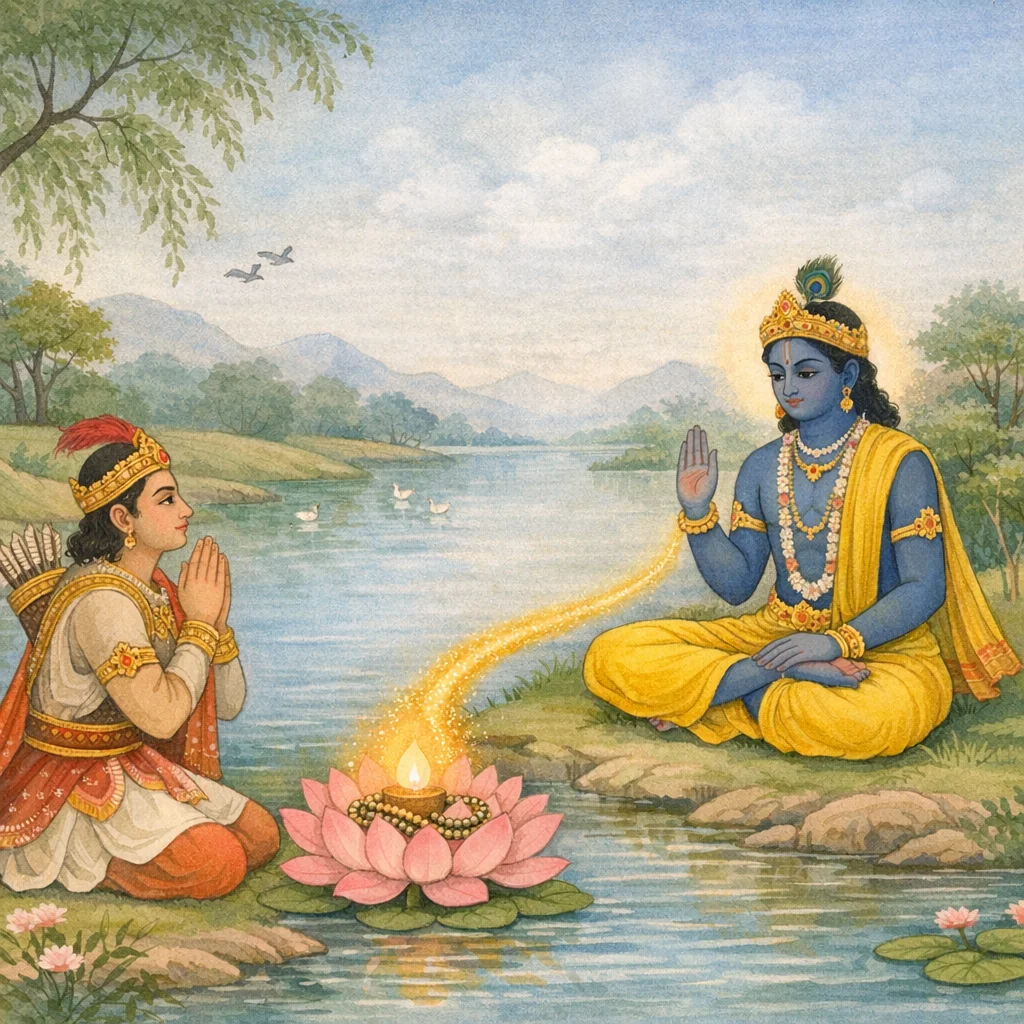
Chapter 12: Bhakti Yoga
भक्तियोग
The Yoga of Devotion
Chapter 12 frames a focused metaphysical inquiry: Arjuna asks which discipline is more accomplished—steady devotion to the personal Divine (saguṇa-bhakti) or contemplation of the imperishable, unmanifest Absolute (nirguṇa/avyakta-upāsanā). Krishna responds by ranking accessible practice over abstract attainment, affirming that loving, continuous worship with faith is a direct and effective yoga for embodied seekers. He acknowledges the legitimacy of unmanifest contemplation yet notes its greater difficulty for those living within bodily conditions. The chapter then presents a graded ladder of practice: fix the mind on the Divine; if unstable, cultivate disciplined repetition (abhyāsa); if that is hard, serve through God-oriented action; if even that fails, renounce attachment to results. The closing section defines the ethical-psychological profile of the beloved devotee—non-hatred, compassion, humility, equanimity, contentment, and steadiness—thereby integrating devotion with a rigorous moral and contemplative framework aimed at inner freedom.
Speakers
Key Concepts
Philosophical Constructs
Shlokas in Chapter 12
Verse 1
अर्जुन उवाच । एवं सततयुक्ता ये भक्तास्त्वां पर्युपासते । ये चाप्यक्षरमव्यक्तं तेषां के योगवित्तमाः ॥ १२.१ ॥
Arjuna said: Those devotees who, ever steadfast, worship You, and those who worship the imperishable unmanifest—who among them are the best knowers of yoga?
Verse 2
श्रीभगवानुवाच । मय्यावेश्य मनो ये मां नित्ययुक्ता उपासते श्रद्धया परयोपेतास्ते मे युक्ततमा मताः ॥ १२.२ ॥
The Blessed Lord said: Those who, ever steadfast, worship Me with supreme faith, fixing their mind on Me—those are considered by Me to be the most united in yoga.
Verse 3
ये त्वक्षरमनिर्देश्यमव्यक्तं पर्युपासते । सर्वत्रगमचिन्त्यं च कूटस्थमचलं ध्रुवम् ॥ १२.३ ॥
But those who worship the Imperishable—indefinable, unmanifest, all-pervading, unthinkable, unchanging, immovable, eternal—(they too are devoted).
Verse 4
संनियम्येन्द्रियग्रामं सर्वत्र समबुद्धयः । ते प्राप्नुवन्ति मामेव सर्वभूतहिते रताः ॥ १२.४ ॥
Having restrained the host of senses, even-minded everywhere, delighting in the welfare of all beings, they too attain Me alone.
Verse 5
क्लेशोऽधिकतरस्तेषामव्यक्तासक्तचेतसाम् । अव्यक्ता हि गतिर्दुःखं देहवद्भिरवाप्यते ॥ १२.५ ॥
Greater is the difficulty for those whose minds are attached to the unmanifest; for the goal of the unmanifest is hard to attain for embodied beings.
Verse 6
ये तु सर्वाणि कर्माणि मयि संन्यस्य मत्पराः । अनन्येनैव योगेन मां ध्यायन्त उपासते ॥ १२.६ ॥
But those who, dedicating all actions to Me, regarding Me as the Supreme, worship Me—meditating on Me with single-minded Yoga—(they are My devotees).
Verse 7
तेषामहं समुद्धर्ता मृत्युसंसारसागरात् । भवामि न चिरात्पार्थ मय्यावेशितचेतसाम् ॥ १२.७ ॥
Of those whose minds are absorbed in Me, O Pārtha, I soon become the deliverer from the ocean of death and saṃsāra.
Verse 8
मय्येव मन आधत्स्व मयि बुद्धिं निवेशय । निवसिष्यसि मय्येव अत ऊर्ध्वं न संशयः ॥ १२.८ ॥
Fix your mind on Me alone; place your intellect in Me. Thereafter you shall dwell in Me alone—of this there is no doubt.
Verse 9
अथ चित्तं समाधातुं न शक्नोषि मयि स्थिरम् । अभ्यासयोगेन ततो मामिच्छाप्तुं धनंजय ॥ १२.९ ॥
If you are unable to fix your mind steadily on Me, then seek to attain Me through the Yoga of practice, O Dhanañjaya.
Verse 10
अभ्यासेऽप्यसमर्थोऽसि मत्कर्मपरमो भव । मदर्थमपि कर्माणि कुर्वन्सिद्धिमवाप्स्यसि ॥ १२.१० ॥
If you are unable even to practice, then be devoted to performing actions for My sake; even by doing works for Me you shall attain perfection.
Verse 11
अथैतदप्यशक्तोऽसि कर्तुं मद्योगमाश्रितः । सर्वकर्मफलत्यागं ततः कुरु यतात्मवान् ॥ १२.११ ॥
If you are unable even to do this, then taking refuge in My Yoga, renounce the fruits of all actions; thus act with self-control.
Verse 12
श्रेयो हि ज्ञानमभ्यासाज्ज्ञानाद्ध्यानं विशिष्यते । ध्यानात्कर्मफलत्यागस्त्यागाच्छान्तिरनन्तरम् ॥ १२॥
Knowledge is superior to mere practice; meditation is superior to knowledge; renunciation of the fruits of action is superior to meditation; from such renunciation, peace follows immediately.
Verse 13
अद्वेष्टा सर्वभूतानां मैत्रः करुण एव च । निर्ममो निरहंकारः समदुःखसुखः क्षमी ॥ १२.१३ ॥
He who bears no hatred toward any being, who is friendly and compassionate; who is free from possessiveness and ego-sense; who is even-minded in sorrow and joy, and forgiving—such a one is dear to Me.
Verse 14
संतुष्टः सततं योगी यतात्मा दृढनिश्चयः । मय्यर्पितमनोबुद्धिर्यो मद्भक्तः स मे प्रियः ॥ १२.१४ ॥
Ever content, a yogin self-controlled and of firm resolve, whose mind and intellect are offered to Me—such a devotee is dear to Me.
Verse 15
यस्मान्नोद्विजते लोको लोकान्नोद्विजते च यः । हर्षामर्षभयोद्वेगैर्मुक्तो यः स च मे प्रियः ॥ १२.१५ ॥
He by whom the world is not disturbed, and who is not disturbed by the world; who is free from exultation, resentment, fear, and agitation—he is dear to Me.
Verse 16
अनपेक्षः शुचिर्दक्ष उदासीनो गतव्यथः । सर्वारम्भपरित्यागी यो मद्भक्तः स मे प्रियः ॥ १२.१६ ॥
He who is without expectation, pure, capable, impartial, free from distress, and who has renounced all self-centered undertakings—such a devotee is dear to Me.
Verse 17
यो न हृष्यति न द्वेष्टि न शोचति न काङ्क्षति । शुभाशुभपरित्यागी भक्तिमान्यः स मे प्रियः ॥ १२.१७ ॥
He who neither rejoices nor hates, neither grieves nor desires; who has renounced both the auspicious and the inauspicious—such a devoted one is dear to Me.
Verse 18
समः शत्रौ च मित्रे च तथा मानापमानयोः । शीतोष्णसुखदुःखेषु समः सङ्गविवर्जितः ॥ १२.१८ ॥
He who is even-minded toward foe and friend alike, and likewise in honor and dishonor; who is the same in cold and heat, in pleasure and pain; and who is free from attachment—
Verse 19
तुल्यनिन्दास्तुतिर्मौनी सन्तुष्टो येन केनचित् । अनिकेतः स्थिरमतिर्भक्तिमान्मे प्रियो नरः ॥ १२.१९ ॥
He to whom censure and praise are equal; who is silent (restrained in speech); content with whatever comes; without a fixed abode; of steady understanding—such a devoted person is dear to Me.
Verse 20
ये तु धर्म्यामृतमिदं यथोक्तं पर्युपासते । श्रद्दधाना मत्परमा भक्तास्तेऽतीव मे प्रियाः ॥ १२.२० ॥
But those devotees who, with faith, making Me their supreme goal, duly follow this dharma—this nectar-like teaching as declared—those are exceedingly dear to Me.
Frequently Asked Questions
The chapter offers a practical psychology of attention: stability comes from placing the mind in a single, value-saturated focus (devotion). When direct concentration fails, Krishna prescribes stepwise training—repetition, purposeful action, and finally letting go of outcomes—so the seeker can reduce anxiety, reactivity, and inner fragmentation.
Krishna validates two orientations to ultimate reality: the personal Divine approached through loving worship and the imperishable, unmanifest Absolute approached through contemplative insight. The metaphysical point is that the Absolute is real and worthy of pursuit, yet for embodied beings devotion provides a more accessible bridge to the same liberative end.
Arjuna’s uncertainty about the ‘best’ yoga is resolved by a hierarchy of methods matched to human capacity. Krishna identifies devotion as the most workable discipline, while also giving a scalable path—practice, consecrated work, and renunciation of results—so the seeker is never left without a viable route to steadiness and liberation.
Use the graded method as a stress-management and leadership framework: (1) begin the day with a clear, uplifting focus (prayer/meditation), (2) if the mind wanders, return through short, repeatable practices, (3) convert work into service by aligning tasks with higher values, and (4) reduce burnout by releasing obsessive attachment to results while maintaining excellence in effort.