
Bhagavad Gita — Bhakti Yoga, Shloka 6
Bhakti Yoga
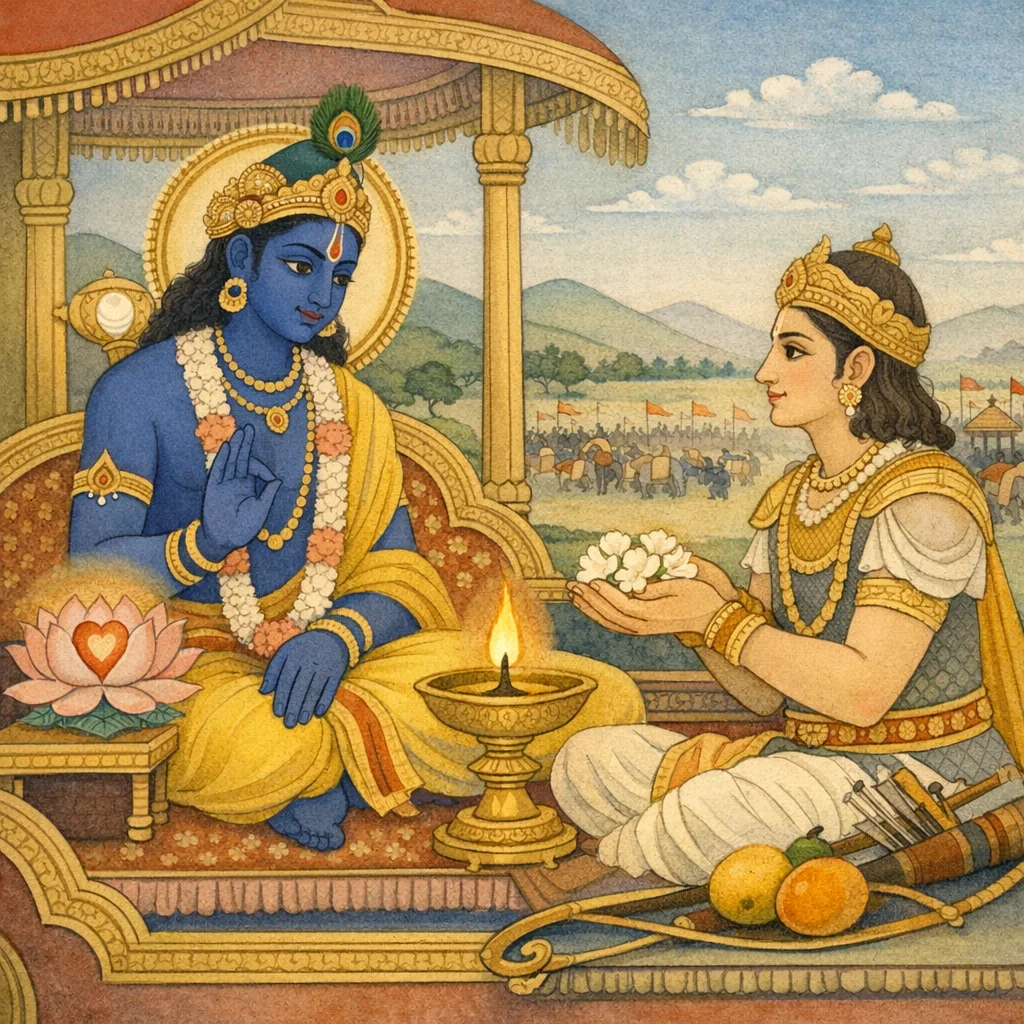
ये तु सर्वाणि कर्माणि मयि संन्यस्य मत्पराः । अनन्येनैव योगेन मां ध्यायन्त उपासते ॥ १२.६ ॥
ye tu sarvāṇi karmāṇi mayi saṁnyasya mat-parāḥ | ananyenaiva yogena māṁ dhyāyanta upāsate || 12.6 ||

But those who, dedicating all actions to Me, regarding Me as the Supreme, worship Me—meditating on Me with single-minded Yoga—(they are My devotees).
But those who, dedicating all actions to Me, regarding Me as the Supreme, worship Me, meditating on Me with single-minded Yoga—(they are My devotees).
But those who, having renounced/entrusted all actions in Me, intent on Me as the highest, worship Me—meditating with an exclusive (ananya) discipline—
‘Saṁnyasya’ is variously rendered as ‘renouncing’ or ‘placing/entrusting’; bhakti traditions often stress offering of action (īśvara-arpana), while academic translations keep the semantic range open between relinquishment of agency/ownership and devotional dedication.
FAQs
Reframing action as dedication reduces ego-involvement and performance anxiety, supporting sustained motivation and attentional coherence.
It presents a theistic soteriology: devotion expressed through action-offering and meditation becomes a direct means to communion with the divine.
After noting the difficulty of the unmanifest path, Krishna foregrounds a more accessible discipline: devotion that includes everyday duties.
Adopt an ‘offering’ mindset: perform responsibilities conscientiously while relinquishing possessiveness over outcomes and self-image.