
Bhagavad Gita — Bhakti Yoga, Shloka 7
Bhakti Yoga
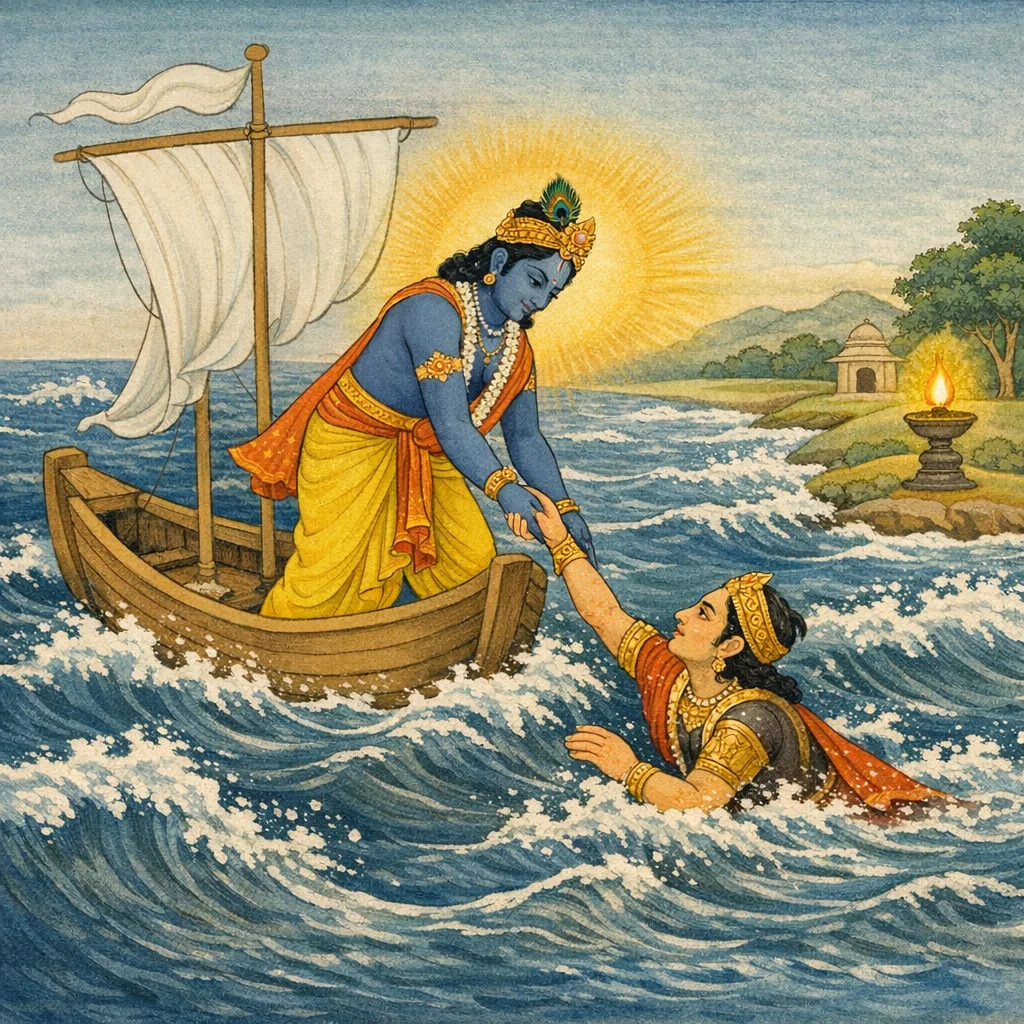
तेषामहं समुद्धर्ता मृत्युसंसारसागरात् । भवामि न चिरात्पार्थ मय्यावेशितचेतसाम् ॥ १२.७ ॥
teṣām ahaṁ samuddhartā mṛtyu-saṁsāra-sāgarāt | bhavāmi na cirāt pārtha mayy āveśita-cetasām || 12.7 ||

Of those whose minds are absorbed in Me, O Pārtha, I soon become the deliverer from the ocean of death and saṃsāra.
Of those whose minds are absorbed in Me, O Pārtha, I soon become the deliverer from the ocean of mortal worldly existence.
For them—those whose consciousness is immersed in Me—I become, before long, the one who lifts (them) from the sea of death-and-transmigration, O Pārtha.
Traditional bhakti readings stress divine grace and personal saving agency. Academic readings treat ‘ocean’ language as a common soteriological metaphor for cyclic existence (saṁsāra) rather than a literal cosmography.
FAQs
Assurance functions as affective support: trust in a benevolent ultimate reduces despair and strengthens perseverance during existential uncertainty.
Liberation is portrayed as enabled by the divine, with devotion serving as the condition for transformative ‘crossing over’ cyclic existence.
It reinforces Krishna’s preference for the devotional path by adding a promise of timely aid to those absorbed in him.
For practitioners, it encourages reliance on a stabilizing source of meaning—community, tradition, or the divine—especially during periods of change and loss.