
Bhagavad Gita — Bhakti Yoga, Shloka 12
Bhakti Yoga
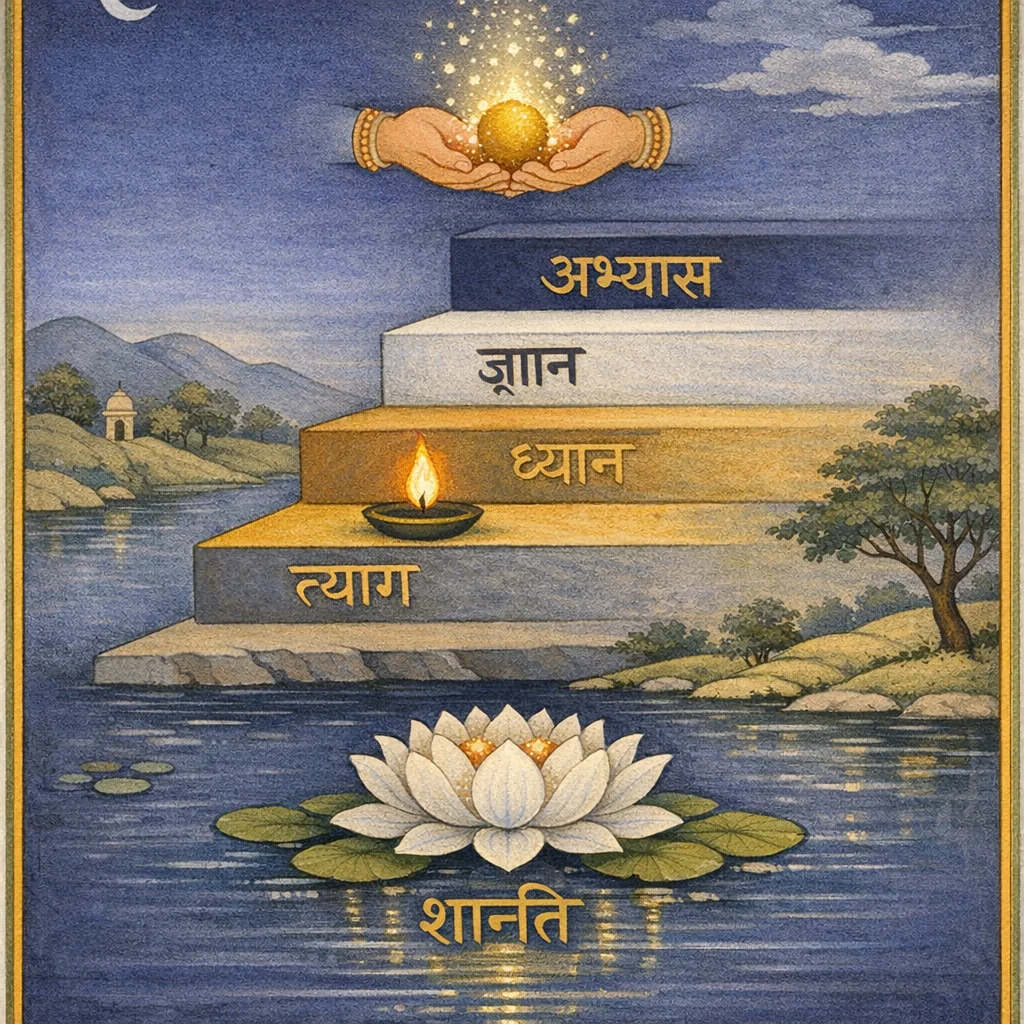
श्रेयो हि ज्ञानमभ्यासाज्ज्ञानाद्ध्यानं विशिष्यते । ध्यानात्कर्मफलत्यागस्त्यागाच्छान्तिरनन्तरम् ॥ १२॥
śreyo hi jñānam abhyāsāj jñānād dhyānaṃ viśiṣyate | dhyānāt karma-phala-tyāgas tyāgāc chāntir anantaram || 12 ||

Knowledge is superior to mere practice; meditation is superior to knowledge; renunciation of the fruits of action is superior to meditation; from such renunciation, peace follows immediately.
Knowledge is superior to mere practice; meditation is superior to knowledge; renunciation of the fruits of action is superior to meditation; from such renunciation, peace follows immediately.
For knowledge is better than repeated practice; meditation is distinguished as higher than knowledge; from meditation comes relinquishing the fruit of action; from relinquishment, peace comes thereafter (immediately/next).
The verse presents a graded sequence (abhyāsa → jñāna → dhyāna → karma-phala-tyāga → śānti). Traditional readings often emphasize a practical progression toward inner peace; academic-literal renderings keep the comparative structure and the compact causal link “from… comes…”. No major variant is implied here beyond interpretive emphasis on whether the sequence is strictly linear or pedagogically illustrative.
FAQs
The verse outlines a movement from effortful training to insight, then to sustained attention, culminating in reduced attachment to outcomes—framed as a direct condition for mental calm.
It links contemplative stabilization (dhyāna) with a loosening of possessiveness toward action’s fruits, aligning the practitioner with a less ego-centered mode of agency.
Within the bhakti chapter’s practical counsel, it offers a hierarchy of disciplines for those who struggle with steadiness, pointing toward renunciation as a workable bridge to peace.
Adopt process-oriented goals, practice focused attention, and consciously release fixation on results to reduce stress and improve resilience.