Adhyaya 61
दमयन्त्याः अरण्यविहारः — Damayantī’s Passage through the Wilderness
Upa-parva: Nalopākhyāna (The Narrative of Nala and Damayantī)
Bṛhadaśva describes Damayantī after killing a hunter: she proceeds alone through a fearsome, empty forest filled with predators, thieves, and varied flora and terrain. Overwhelmed by separation, she laments and repeatedly addresses Nala by recalling his assurances and the ethical weight of truth. She petitions an approaching ‘lord of the forest’ (a fierce beast) for knowledge of Nala and then turns to a prominent mountain, offering reverent praise and self-identification (as Bhīma’s daughter and Nala’s wife) while asking whether Nala has been seen. She reaches an ascetic hermitage populated by disciplined sages; they initially wonder if she is a deity, and she clarifies her human identity and marital crisis. The sages, through ascetic insight, predict an auspicious outcome: she will soon see Nala restored and ruling. When the hermitage and sages vanish, she questions whether it was dreamlike or extraordinary providence. Continuing, she addresses an aśoka tree as a symbolic agent of grief-removal. Finally, she encounters a large merchant caravan crossing a river; her disheveled appearance provokes fear, ridicule, and pity. The caravan questions her identity (deity/yakṣī/rākṣasī), and she asserts her human royal status, seeking news of Nala. The caravan leader, Śuci, states he has not seen Nala and identifies their destination as the land of the Cedi king Subāhu, framing the next movement of the episode.
Chapter Arc: पुष्कर राज्य-हरण के बाद हँसते हुए नल को फिर द्यूत के लिए उकसाता है—और दाँव अब धन-धान्य नहीं, स्वयं दमयन्ती तक पहुँच जाता है। → नल पर कलि-प्रभाव और पराजय का बोझ बढ़ता जाता है; वन-प्रस्थान में दम्पति भूख, थकान और अपमान झेलते हैं। मार्ग में स्वर्ण-पंखों वाले पक्षी दिखते हैं; नल उन्हें पकड़कर भोजन की आशा करता है। → पक्षी ‘अक्ष’ (जुए के पासे) रूप धारण कर नल के वस्त्र छीन लेते हैं और कहते हैं कि वे उसके वस्त्र हरने आए थे—नल नग्न, दीन और पूर्णतः असहाय खड़ा रह जाता है। → दमयन्ती नल को धैर्य देती है और विदर्भ की ओर सुरक्षित मार्गों का संकेत करती है; नल भी उसे त्यागने की इच्छा न होने की बात कहकर आश्वस्त करता है, पर परिस्थितियाँ उन्हें अलगाव की ओर धकेलती हैं। → दमयन्ती को विदर्भ-मार्ग पर भेजने की योजना बनती है—पर क्या नल साथ रह पाएगा, या कलि-ग्रस्त विवेक उन्हें अलग कर देगा?
Shlokas
Verse 1
हम () हि २ 7 एकषेष्टितमो< ध्याय: नलका जूएमें हारकर दमयन्तीके साथ वनको जाना और पक्षियोंद्वारा आपदग्रस्त नलके वस्त्रका अपहरण बृहृदश्च उवाच ततस्तु याते वार्ष्णेये पुण्यश्लोकस्य दीव्यत: । पुष्करेण हतं राज्यं यच्चान्यद् वसु किंचन,बृहदश्व मुनि कहते हैं--युधिष्ठिर! तदनन्तर वार्ष्णेयके चले जानेपर जूआ खेलनेवाले पुण्यश्लोक महाराज नलके सारे राज्य और जो कुछ धन था, उन सबका जूएमें पुष्करने अपहरण कर लिया
Bṛhadaśva said: “Then, after Vārṣṇeya had departed, while the illustrious King Nala was engaged in gambling, Puṣkara won away his kingdom—and whatever other wealth there was besides.”
Verse 2
ह्ृतराज्यं नलं राजन् प्रहसन् पुष्करो<ब्रवीत् | द्यूत॑ं प्रवर्ततां भूय: प्रतिपाणो5स्ति कस्तव,राजन! राज्य हार जानेपर नलसे पुष्करने हँसते हुए कहा कि “क्या फिर जूआ आरम्भ हो? अब तुम्हारे पास दाँवपर लगानेके लिये क्या है?”
Bṛhadaśva said: Smiling, Puṣkara addressed King Nala—now bereft of his kingdom—saying, “Shall the game of dice begin again? What stake do you have left to put down, O king?” The line underscores the moral cruelty of gambling: once a person is stripped of rightful power and possessions, the vice still demands a ‘stake,’ turning loss into humiliation and further bondage.
Verse 3
शिष्टा ते दमयन्त्येका सर्वमन्यज्जितं मया । दमयन्त्या: पण: साधु वर्ततां यदि मन्यसे,“तुम्हारे पास केवल दमयन्ती शेष रह गयी है और सब वस्तुएँ तो मैंने जीत ली हैं, यदि तुम्हारी राय हो तो दमयन्तीको दाँवपर रखकर एक बार फिर जूआ खेला जाय”
Bṛhadaśva said: “Only Damayantī remains to you; everything else I have won. If you agree, let Damayantī herself be set as the stake, and let the gambling proceed once more.”
Verse 4
पुष्करेणैवमुक्तस्य पुण्यश्लोकस्य मन्युना | व्यदीर्यतेव हृदयं न चैनं किंचिदब्रवीत्,पुष्करके ऐसा कहनेपर पुण्यश्लोक महाराज नलका हृदय शोकसे विदीर्ण-सा हो गया, परंतु उन्होंने उससे कुछ कहा नहीं
When Puṣkara spoke thus in anger, the heart of the illustrious King Nala—renowned for his virtue and fame—seemed to split with grief; yet he did not reply to him at all. The verse highlights restrained speech and inner suffering: Nala bears the sting of harsh words without retaliating, suggesting ethical self-control even amid provocation.
Verse 5
ततः पुष्करमालोक्य नलः परममन्युमान् | उत्सृज्य सर्वगात्रे भ्यो भूषणानि महायशा:,तदनन्तर महायशस्वी नलने अत्यन्त दुःखित हो पुष्करकी ओर देखकर अपने सब अंगोंके आभूषण उतार दिये और केवल एक अधोवस्त्र धारण करके चादर ओढ़े बिना ही अपनी विशाल सम्पत्तिको त्यागकर सुहृदोंका शोक बढ़ाते हुए वे राजभवनसे निकल पड़े
Then, seeing Puṣkara, the illustrious King Nala—overwhelmed with intense anger—cast off the ornaments from all his limbs. In deep distress, he renounced his royal splendor and departed from the palace, thereby increasing the sorrow of his well-wishers. The scene underscores how a ruler’s loss of self-mastery under the pressure of humiliation and rivalry can precipitate renunciation that is not born of spiritual clarity but of grief and wounded pride.
Verse 6
एकवासा हासंवीत: सुहृच्छोकविवर्धन: । निश्चक्राम ततो राजा त्यक्त्वा सुविपुलां श्रियम्,तदनन्तर महायशस्वी नलने अत्यन्त दुःखित हो पुष्करकी ओर देखकर अपने सब अंगोंके आभूषण उतार दिये और केवल एक अधोवस्त्र धारण करके चादर ओढ़े बिना ही अपनी विशाल सम्पत्तिको त्यागकर सुहृदोंका शोक बढ़ाते हुए वे राजभवनसे निकल पड़े
Bṛhadaśva said: Then the king, having abandoned his vast royal fortune, went forth wearing only a single garment, without a cloak—thus increasing the sorrow of his friends. The scene underscores how the loss of self-mastery and the grip of misfortune can strip a ruler of outward splendor, leaving behind the ethical weight of suffering borne not only by oneself but also by those who love and depend on one.
Verse 7
दमयन्त्येकवस्त्राथ गच्छन्तं पृष्ठतो5न्वगात् । स तया बाह्ुतः सार्थ त्रिरात्रं नैघधोडवसत्,दमयन्तीके शरीरपर भी एक ही वस्त्र था। वह जाते हुए राजा नलके पीछे हो ली। वे उसके साथ नगरसे बाहर तीन राततक टिके रहे
Bṛhadaśva said: Then Damayantī, clad in a single garment, followed behind as King Nala went on. The Niṣadha king, taking her along, stayed outside the city for three nights. The verse underscores steadfast marital fidelity and compassion amid abandonment and hardship: Damayantī does not retaliate or despair, but chooses loyal accompaniment even when her husband is diminished and displaced.
Verse 8
पुष्करस्तु महाराज घोषयामास वै पुरे । नले य: सम्यगातिछेत् स गच्छेद् वध्यतां मम,महाराज! पुष्करने उस नगरमें यह घोषणा करा दी--डुग्गी पिटवा दी कि “जो नलके साथ अच्छा बर्ताव करेगा, वह मेरा वध्य होगा”
Bṛhadaśva said: “O great king, Puṣkara had a proclamation made throughout the city: ‘Whoever treats Nala well—whoever shows him proper regard—shall be put to death by my order.’” This reveals Puṣkara’s fear-driven cruelty and his attempt to isolate Nala socially, turning ordinary civility into a punishable act.
Verse 9
पुष्करस्य तु वाक्येन तस्य विद्वेषणेन च | पौरा न तस्य सत्कारं कृतवन्तो युधिष्ठिर,युधिष्ठिर! पुष्करके उस वचनसे और नलके प्रति पुष्करका द्वेष होनेसे पुरवासियोंने राजा नलका कोई सत्कार नहीं किया
Bṛhadaśva said: “O Yudhiṣṭhira, because of Puṣkara’s words—and because of his hostility toward him—the citizens did not show King Nala the honor and welcome that were due.”
Verse 10
स तथा नगराभ्याशे सत्काराहों न सस्कृतः । त्रिरात्रमुषितो राजा जलमात्रेण वर्तयन्,इस प्रकार राजा नल अपने नगरके समीप तीन राततक केवल जलमात्रका आहार करके टिके रहे। वे सर्वथा सत्कारके योग्य थे तो भी उनका सत्कार नहीं किया गया
Thus King Nala stayed near his own city for three nights, sustaining himself on water alone. Though he was fully deserving of honor and hospitality, he was not received with due respect—highlighting how misfortune can strip even the worthy of recognition and how society’s duty of hospitality may fail when appearances deceive.
Verse 11
पीड्यमान: क्षुधा तत्र फलमूलानि कर्षयन् | प्रातिष्ठत ततो राजा दमयन्ती तमन्वगात्,वहाँ भूखसे पीड़ित हो फल-मूल आदि जुटाते हुए राजा नल वहाँसे अन्यत्र चले गये। केवल दमयन्ती उनके पीछे-पीछे गयी
Afflicted there by hunger, the king gathered fruits and roots for sustenance. Then King Nala set out from that place, and Damayantī alone followed after him—steadfast in her loyalty despite hardship.
Verse 12
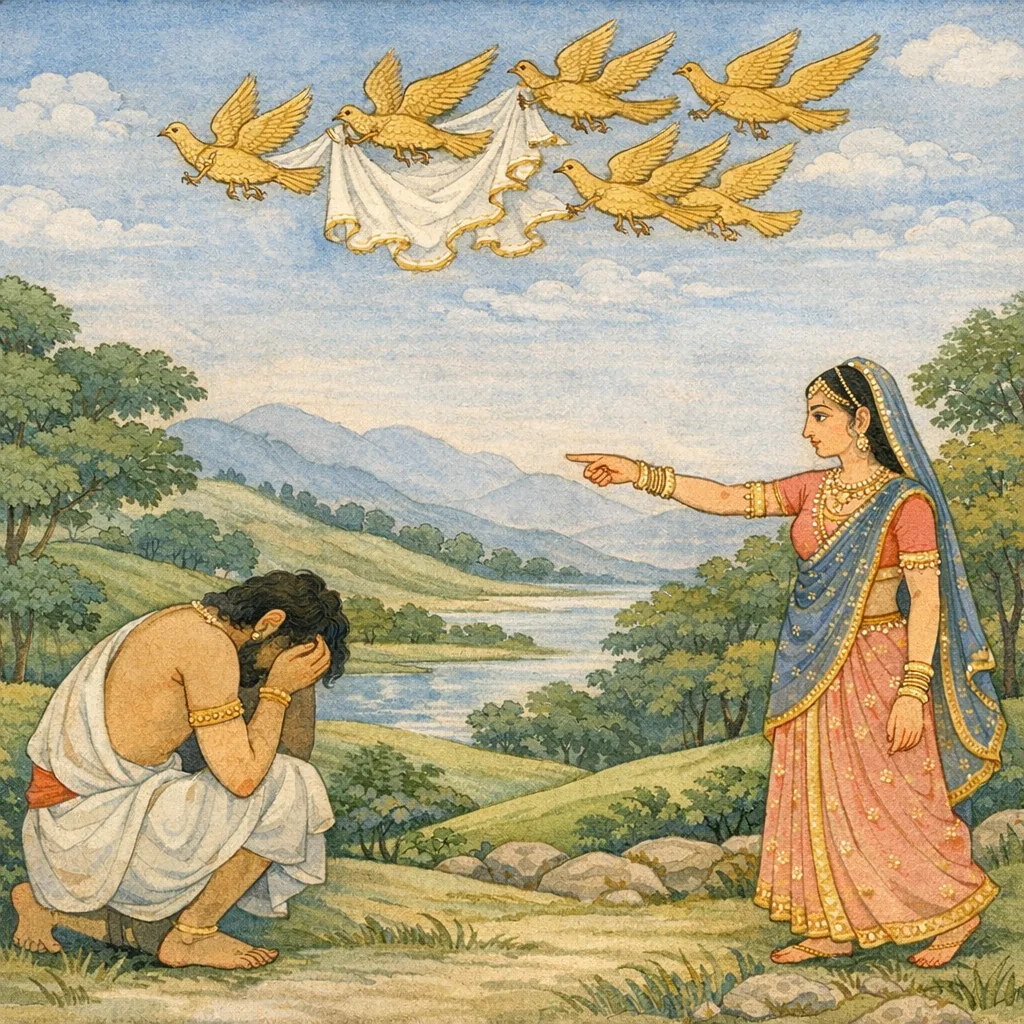
क्षुधया पीड्यमानस्तु नलो बहुतिथेडहनि । अपश्यच्छकुनान् कांश्रिद्धिरण्यसदृशच्छदान्,इसी प्रकार नल बहुत दिनोंतक क्षुधासे पीड़ित रहे। एक दिन उन्होंने कुछ ऐसे पक्षी देखे, जिनकी पाँखें सोनेकी-सी थीं
Bṛhadaśva said: Tormented by hunger for many days, Nala wandered on. One day he caught sight of certain birds whose wings shone like gold—an alluring sight that, in his desperate condition, would soon test his judgment and self-control.
Verse 13
स चिन्तयामास तदा निषधाधिपतिर्बली । अस्ति भक्ष्यो ममाद्यायं वसु चेदं भविष्यति,उन्हें देखकर (क्षुधातुर और आपत्तिग्रस्त होनेके कारण) बलवान् निषधनरेशके मनमें यह बात आयी कि “यह पक्षियोंका समुदाय ही आज मेरा भक्ष्य हो सकता है और इनकी ये पाँखें मेरे लिये धन हो जायँगी”
Verse 14
ततस्तान् परिधानेन वाससा स समावृणोत् | तस्य तद् वस्त्रमादाय सर्वे जम्मुर्विहायसा,तदनन्तर उन्होंने अपने अधोवस्त्रसे उन पक्षियोंको ढँक दिया। किंतु वे सब पक्षी उनका वह वस्त्र लेकर आकाशमें उड़ गये
Then he covered those birds with his lower garment as a cloth. But all of them seized that garment and flew away into the sky—setting up a test of his conduct, where compassion and readiness to protect come into tension with loss and inconvenience.
Verse 15
उत्पतन्तः खगा वाक्यमेतदाहुस्ततो नलम् | दृष्टवा दिग्वाससं भूमौ स्थितं दीनमधोमुखम्
Then the birds, taking flight, spoke these words to Nala, after seeing him on the ground—clad only in the directions, wretched, and with his face cast down. The scene underscores how a fall from fortune can strip a person of dignity, and how suffering, when met with humility rather than arrogance, becomes the beginning of moral awakening and endurance.
Verse 16
उड़ते हुए उन पक्षियोंने राजा नलको दीनभावसे नीचे मुँह किये धरतीपर नग्न खड़ा देख उनसे कहा-- ।। वयमक्षा: सुदुर्बुद्धे तव वासो जिहीर्षव: । आगता न हि न: प्रीति: सवाससि गते त्वयि,'“ओ खोटी बुद्धिवाले नरेश! हम (पक्षी नहीं,) पासे हैं और तुम्हारा वस्त्र अपहरण करनेकी इच्छासे ही यहाँ आये थे। तुम वस्त्र पहने हुए ही वहाँसे चले आये थे, इससे हमें प्रसन्नता नहीं हुई थी”
Bṛhadaśva said: “O foolish king! We are not birds at all—we are the dice, come here with the intent to seize your garments. When you departed still clothed, it did not please us.”
Verse 17
तान् समीपगतानक्षानात्मानं च विवाससम् | पुण्यश्लोकस्तदा राजन् दमयन्तीमथाब्रवीत्,राजन्! उन पासोंको नजदीकसे जाते देख और अपने-आपको नग्नावस्थामें पाकर पुण्यश्लोक नलने उस समय दमयन्तीसे कहा--'सती साध्वी रानी! जिनके क्रोधसे मेरा ऐश्वर्य छिन गया, मैं क्षुधापीड़ित एवं दु:खित होकर जीवन-निर्वाहके लिये अन्नतक नहीं पा रहा हूँ और जिनके कारण निषधदेशकी प्रजाने मेरा सत्कार नहीं किया, भीरु! वे ही ये पासे हैं, जो पक्षी होकर मेरा वस्त्र लिये जा रहे हैं
O king, when Nala—renowned in fame—saw those dice drawing near and found himself stripped of his garments, he then spoke to Damayantī. He identified them as the very dice whose wrath had robbed him of sovereignty: now, tormented by hunger and misery, he could not obtain even food to sustain life; and because of them the people of Niṣadha no longer honored him. ‘O timid one,’ he said, ‘these are those same dice—now taking the form of birds—carrying away my clothing.’
Verse 18
येषां प्रकोपादैश्वर्यात् प्रच्युतो5हमनिन्दिते । प्राणयात्रां न विन्देयं दु:खित: क्षुधयान्वित:,राजन्! उन पासोंको नजदीकसे जाते देख और अपने-आपको नग्नावस्थामें पाकर पुण्यश्लोक नलने उस समय दमयन्तीसे कहा--'सती साध्वी रानी! जिनके क्रोधसे मेरा ऐश्वर्य छिन गया, मैं क्षुधापीड़ित एवं दु:खित होकर जीवन-निर्वाहके लिये अन्नतक नहीं पा रहा हूँ और जिनके कारण निषधदेशकी प्रजाने मेरा सत्कार नहीं किया, भीरु! वे ही ये पासे हैं, जो पक्षी होकर मेरा वस्त्र लिये जा रहे हैं
Bṛhadaśva said: “O blameless lady, through the wrath of those (dice) I have been cast down from my royal fortune. Afflicted with sorrow and tormented by hunger, I cannot even find food to sustain my life.”
Verse 19
येषां कृते न सत्कारमकुर्वन् मयि नैषधा: । इमे ते शकुना भूत्वा वासो भीरु हरन्ति मे,राजन्! उन पासोंको नजदीकसे जाते देख और अपने-आपको नग्नावस्थामें पाकर पुण्यश्लोक नलने उस समय दमयन्तीसे कहा--'सती साध्वी रानी! जिनके क्रोधसे मेरा ऐश्वर्य छिन गया, मैं क्षुधापीड़ित एवं दु:खित होकर जीवन-निर्वाहके लिये अन्नतक नहीं पा रहा हूँ और जिनके कारण निषधदेशकी प्रजाने मेरा सत्कार नहीं किया, भीरु! वे ही ये पासे हैं, जो पक्षी होकर मेरा वस्त्र लिये जा रहे हैं
Bṛhadaśva said: “O King! Those very dice, because of whom the people of Niṣadha no longer honored me, have now become birds and are carrying away my garment, O timid one.” (In context, Nala, seeing the birds approach and finding himself suddenly stripped, speaks to Damayantī: the same agents of his ruin—his gambling dice—continue to torment him, turning even nature into an instrument of his humiliation and distress.)
Verse 20
वैषम्यं परम॑ प्राप्तो द:खितो गतचेतन: । भर्ता ते5हं निबोधेदं वचन हितमात्मन:,“मैं बड़ी विषम परिस्थितिमें पड़ गया हूँ। दुःखके मारे मेरी चेतना लुप्त-सी हो रही है। मैं तुम्हारा पति हूँ, अतः तुम्हारे हितकी बात बता रहा हूँ, इसे सुनो--
Bṛhadaśva said: “I have fallen into the gravest adversity; crushed by sorrow, my awareness is as though slipping away. Yet I am your husband—so understand this: I speak words meant for your welfare. Listen.”
Verse 21
एते गच्छन्ति बहव: पन्थानो दक्षिणापथम् | अवन्तीमृक्षवन्तं च समतिक्रम्य पर्वतम्,'ये बहुत-से मार्ग हैं, जो दक्षिण दिशाकी ओर जाते हैं। यह मार्ग ऋक्षवान् पर्वतको लाँघकर अवन्ती-देशको जाता है
Bṛhadaśva said: “There are many routes that lead toward the southern road. Passing beyond the Ṛkṣavat mountain, they go on to the land of Avanti.”
Verse 22
एष विन्ध्यो महाशैल: पयोष्णी च समुद्रगा । आश्रमाश्च महर्षीणां बहुमूलफलान्विता:,“यह महान् पर्वत विन्ध्य दिखायी दे रहा है और यह समुद्रगामिनी पयोष्णी नदी है। यहाँ महर्षियोंके बहुत-से आश्रम हैं, जहाँ प्रचुर मात्रामें फल-मूल उपलब्ध हो सकते हैं। यह विदर्भदेशका मार्ग है और वह कोसलदेशको जाता है। दक्षिण दिशामें इसके बादका देश दक्षिणापथ कहलाता है”
Bṛhadaśva said: “Behold the mighty Vindhya mountain, and the Payoshnī river flowing onward to the sea. Here too are the hermitages of great seers, rich in roots and fruits.”
Verse 23
एष पन्था विदर्भाणामसौ गच्छति कोसलान् | अतः परं च देशो<यं दक्षिणे दक्षिणापथ:,“यह महान् पर्वत विन्ध्य दिखायी दे रहा है और यह समुद्रगामिनी पयोष्णी नदी है। यहाँ महर्षियोंके बहुत-से आश्रम हैं, जहाँ प्रचुर मात्रामें फल-मूल उपलब्ध हो सकते हैं। यह विदर्भदेशका मार्ग है और वह कोसलदेशको जाता है। दक्षिण दिशामें इसके बादका देश दक्षिणापथ कहलाता है”
Bṛhadaśva said: “This is the road into Vidarbha; that other route goes on to Kosala. Beyond this, to the south, the country is known as the Dakṣiṇāpatha. Here you can see the great Vindhya mountain, and this is the Payoṣṇī river flowing toward the sea. In this region there are many hermitages of great seers, where fruits and roots may be obtained in abundance.”
Verse 24
एतद् वाक््यं नलो राजा दमयन्तीं समाहित: । उवाचासकृदार्तो हि भैमीमुद्दिश्य भारत,भारत! राजा नलने एकाग्रचित्त होकर बड़ी आतुरताके साथ दमयन्तीसे उपर्युक्त बातें बार-बार कहीं
King Nala, his mind gathered and intent, spoke these words to Damayantī. Indeed, distressed at heart, he addressed Bhīmī (Damayantī) again and again, O Bhārata—repeating his plea with urgent longing. The passage highlights how intense suffering can drive repeated speech, even as one strives to remain composed and focused.
Verse 25
ततः सा बाष्पकलया वाचा दु:खेन कर्शिता । उवाच दमयन्ती तं नैषधं करुणं वच:,तब दमयन्ती अत्यन्त दुःखसे दुर्बल हो नेत्रोंसे आँसू बहाती हुई गद्गद वाणीमें राजा नलसे यह करुण वचन बोली--
Then Damayantī—her voice choked with tears and her body worn down by grief—addressed the king of Niṣadha (Nala) with a compassionate, sorrow-laden appeal. The scene frames her speech as arising from suffering yet guided by tenderness and moral urgency.
Verse 26
उद्वेजते मे हृदयं सीदन्त्यड्रानि सर्वश:ः । तव पार्थिव संकल्पं चिन्तयन्त्या: पुन: पुन:
My heart is shaken with dread, and all my limbs grow faint. O king, as I reflect again and again on your resolve, I am overcome with anxiety.
Verse 27
ह्ृतराज्यं ह्ृतद्रव्यं विवस्त्र क्षुच्छूमान्वितम् । कथमुत्सृज्य गच्छेयमहं त्वां निर्जने वने
“You have been stripped of your kingdom and your wealth, left without clothing, and afflicted by hunger and hardship. How could I abandon you and go away, leaving you alone in this lonely forest?”
Verse 28
“महाराज! आपका मानसिक संकल्प क्या है, इसपर जब मैं बार-बार विचार करती हूँ, तब मेरा हृदय उद्विग्न हो उठता है और सारे अंग शिथिल हो उठते हैं। आपका राज्य छिन गया। धन नष्ट हो गया। आपके शरीरपर वस्त्रतक नहीं रह गया तथा आप भूख और परिश्रमसे कष्ट पा रहे हैं। ऐसी अवस्थामें इस निर्जन वनमें आपको असहाय छोड़कर मैं कैसे जा सकती हूँ? ।। भ्रान्तस्य ते क्षुधार्तस्य चिन्तयानस्यथ तत् सुखम् । वने घोरे महाराज नाशयिष्याम्यहं क्लमम्,“महाराज! जब आप भयंकर वनमें थके-माँदे भूखसे पीड़ित हो अपने पूर्व सुखका चिन्तन करते हुए अत्यन्त दुःखी होने लगेंगे, उस समय मैं सान्त्वनाद्वारा आपके संतापका निवारण करूँगी
‘O King! When I reflect again and again on what resolve you are forming in your mind, my heart grows anxious and my limbs go slack. Your kingdom has been taken away; your wealth is ruined; you have been left without even clothing, and you suffer from hunger and toil. In such a condition, how could I abandon you helpless in this lonely forest? When you, exhausted and tormented by hunger, wander in this dreadful wilderness and grieve while recalling your former happiness, then, O King, I will dispel your weariness and anguish through consolation.’
Verse 29
न च भार्यासमं किंचिद् विद्यते भिषजां मतम् | औषध॑ सर्वदु:खेषु सत्यमेतद् ब्रवीमि ते,“चिकित्सकोंका मत है कि समस्त दु:ःखोंकी शान्तिके लिये पत्नीके समान दूसरी कोई औषध नहीं है; यह मैं आपसे सत्य कहती हूँ”
“And, according to the considered view of physicians, there is nothing comparable to a wife. For all sorrows, she is a remedy—this I tell you in truth.”
Verse 30
नल उवाच एवमेतद् यथा55त्थ त्वं दमयन्ति सुमध्यमे । नास्ति भार्यासमं मित्र नरस्यार्तस्य भेषजम्,नलने कहा--सुमध्यमा दमयन्ती! तुम जैसा कहती हो वह ठीक है। दुःखी मनुष्यके लिये पत्नीके समान दूसरा कोई मित्र या औषध नहीं है
Nala said: “Yes—what you say is true, O Damayantī of slender waist. For a man in distress, there is no friend and no remedy equal to a wife.”
Verse 31
न चाहं त्यक्तकामस्त्वां किमलं भीरु शड्कसे । त्यजेयमहमात्मानं न चैव त्वामनिन्दिते,भीरु! मैं तुम्हें त्यागना नहीं चाहता, तुम इतनी अधिक शंका क्यों करती हो? अनिन्दिते! मैं अपने शरीरका त्याग कर सकता हूँ, पर तुम्हें नहीं छोड़ सकता
Nala said: “I have no desire to abandon you—why, O timid one, do you harbor such excessive doubt? O blameless lady, I could give up my own life, but I cannot and will not forsake you.”
Verse 32
दमयन्त्युवाच यदि मां त्वं महाराज न विहातुमिहेच्छसि । तत् किमर्थ विदर्भाणां पन्था: समुपदिश्यते,दमयन्तीने कहा--महाराज! यदि आप मुझे त्यागना नहीं चाहते तो विदर्भदेशका मार्ग क्यों बता रहे हैं?
Damayantī said: “O great king, if you do not wish to abandon me here, then why are you pointing out the road to Vidarbha?” In her question lies a moral appeal: words and actions must align, and guidance that prepares for separation contradicts a professed resolve to remain together.
Verse 33
अवैमि चाहं नृपते न तु मां त्यक्तुमहसि । चेतसा त्वपकृष्टेन मां त्यजेथा महीपते,राजन! मैं जानती हूँ कि आप स्वयं मुझे नहीं त्याग सकते, परंतु महीपते! इस घोर आपत्तिने आपके चित्तको आकर्षित कर लिया है, इस कारण आप मेरा त्याग भी कर सकते हैं
I know it well, O king: you are not one who ought to abandon me. Yet, O lord of the earth, with your mind dragged away and overpowered by this dreadful calamity, you may even come to cast me off.
Verse 34
पन्थानं हि ममाभीक्ष्णमाख्यासि च नरोत्तम । अतो निमित्तं शोकं मे वर्धयस्यमरोपम,नरश्रेष्ट! आप बार-बार जो मुझे विदर्भदेशका मार्ग बता रहे हैं। देवोपम आर्यपुत्र! इसके कारण आप मेरा शोक ही बढ़ा रहे हैं
Nala said: “O best of men, you keep telling me again and again the route (to my homeland). Because of that very reminder, O godlike, foremost of men, you only increase my sorrow.”
Verse 35
यदि चायमभिप्रायस्तव ज्ञातीन् व्रजेदिति । सहितावेव गच्छावो विदर्भान् यदि मन्यसे,यदि आपका यह अभिप्राय हो कि दमयन्ती अपने बन्धु-बान्धवोंके यहाँ चली जाय तो आपकी सम्मति हो तो हम दोनों साथ ही विदर्भदेशको चलें
Nala said: “If this is your intention—that Damayantī should go to her kinsfolk—then, if you approve, let us both go together to Vidarbha.”
Verse 36
विदर्भराजत्तत्र त्वां पूजयिष्यति मानद । तेन त्वं पूजितो राजन् सुखं वत्स्यसि नो गृहे,मानद! वहाँ विदर्भनरेश आपका पूरा आदर-सत्कार करेंगे। राजन्! उनसे पूजित होकर आप हमारे घरमें सुखपूर्वक निवास कीजियेगा
Nala said: “The king of Vidarbha will honor you there, O bestower of honor. Honored by him, O king, you will dwell happily in our home.” The verse underscores the ethic of hospitality: a worthy guest is to be received with respect, and such honor becomes the basis for peaceful, dignified residence and mutual goodwill.
Verse 61
इस प्रकार श्रीमहाभारत वनपर्वके अन्तर्गत नलोपाख्यानपर्वमें नलकी वनयात्राविषयक इकसठवाँ अध्याय पूरा हुआ
Thus ends the sixty-first chapter of the Nala episode within the Vana Parva of the Śrī Mahābhārata, describing Nala’s journey through the forest. The closing formula signals a transition in the narrative while underscoring the epic’s concern with endurance, right conduct, and the moral testing that accompanies exile and hardship.
Verse 63
इति श्रीमहा भारते वनपर्वणि नलोपाख्यानपर्वणि नलवनयात्रायामेकषष्टितमो< ध्याय:
Thus ends the sixty-first chapter in the Vana Parva of the Śrī Mahābhārata, within the section known as the Nala-episode, in the portion describing Nala’s journey through the forest. This is a concluding colophon marking the close of the chapter rather than a spoken narrative verse.
Frequently Asked Questions
The chapter stages a conflict between despair and dharma: whether Damayantī should relinquish life amid abandonment and danger, or persist in truthful, disciplined searching grounded in marital commitment and ethical endurance.
Ethical agency is maintained through satya and dhṛti even when social protections fail; respectful speech, self-identification, and seeking lawful aid become practical instruments for survival and meaning.
No explicit phalaśruti is stated here; the closest meta-level signal is the ascetics’ predictive assurance, functioning as narrative validation that endurance aligned with dharma leads toward restoration within the larger exemplum.