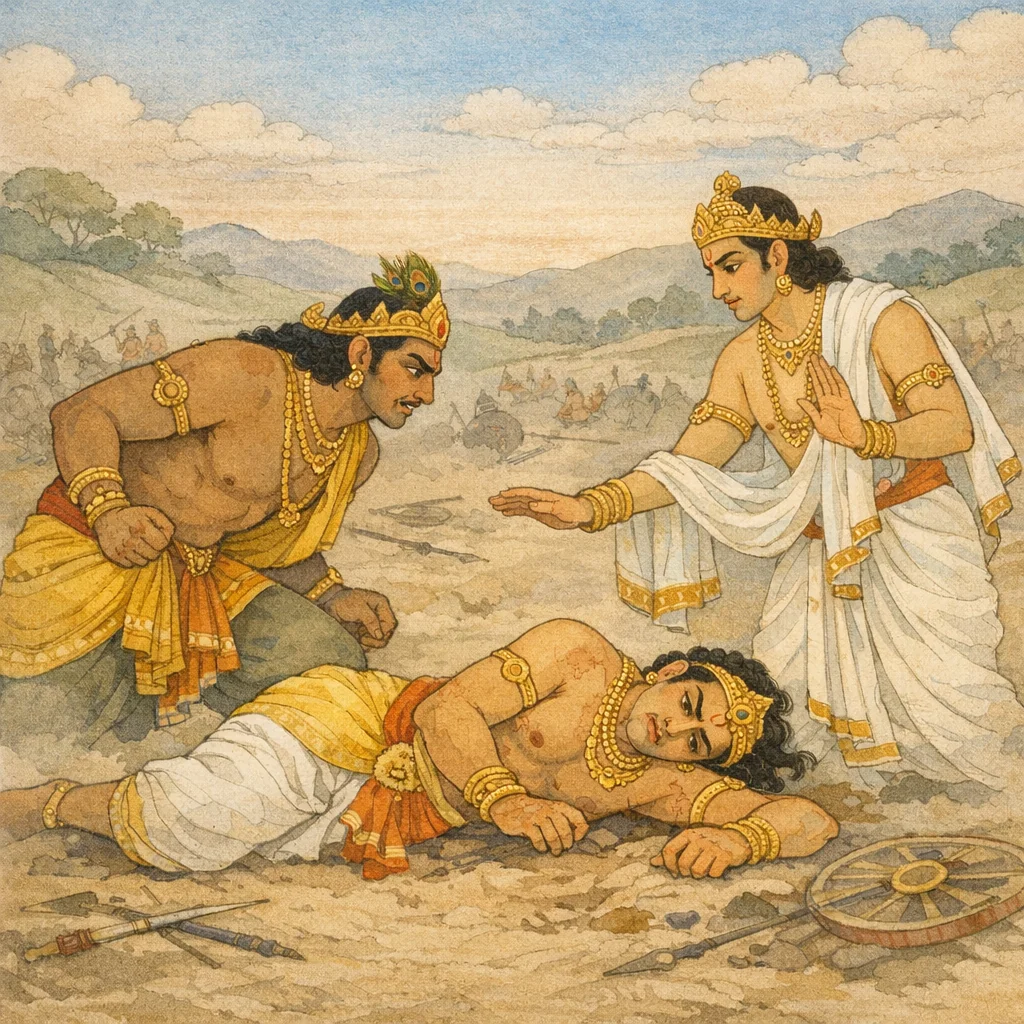
Adhyaya 59
Chapter 59: Baladeva’s Censure, Keśava’s Restraint, and Yudhiṣṭhira’s Moral Accounting
Upa-parva: Gadāyuddha-dharma-vimarśa (Baladeva–Keśava Saṃvāda) Upa-Parva
Dhṛtarāṣṭra asks Sañjaya how Baladeva responded upon seeing Duryodhana struck in a manner deemed improper. Sañjaya reports Baladeva’s anger and public denunciation: he asserts a rule of gada-yuddha that one should not strike below the navel, condemning Bhīma’s action as a breach of śāstra and moving to confront him with his plough-weapon. Keśava intervenes, restraining Baladeva and offering a layered justification grounded in political prudence and ethical contextualization: the Pāṇḍavas are presented as allied kin; vow-fulfillment is framed as kṣatriya duty; Bhīma’s prior oath to break Duryodhana’s thighs is recalled; and Maitreya’s earlier curse is cited as prefiguring the outcome. Baladeva remains dissatisfied, warning that the victor may gain a reputation for crooked fighting while Duryodhana, portrayed as straightforward in combat, attains a lasting posthumous course. Baladeva departs for Dvārakā, leaving the victors subdued rather than celebratory. Keśava then addresses Yudhiṣṭhira’s dejection, questioning why he tolerates harsh treatment of the fallen. Yudhiṣṭhira replies that he does not approve of the indignity but explains his forbearance as an accommodation of Bhīma’s accumulated suffering and the history of provocations. The chapter closes with Bhīma’s triumphant address to Yudhiṣṭhira, asserting that the realm is now secure, enemies removed, and governance should proceed according to svadharma, while Yudhiṣṭhira acknowledges the end of enmity under Keśava’s counsel.
Chapter Arc: संजय धृतराष्ट्र से कहते हैं—भीम के प्रहार से दुर्योधन विशाल शाल-वृक्ष की भाँति धराशायी पड़ा है; यह दृश्य देख पाण्डवों के मन में क्षणिक तृप्ति और विजय-हर्ष उठता है, और वे पास जाकर उसे देखते हैं। → गिरे हुए कौरव-राज के निकट भीमसेन अपने पुराने अपमानों की स्मृति (द्रौपदी के चीर-हरण/सभा-उपहास) को जगा कर दुर्योधन का तिरस्कार करता है और विजय का उन्मत्त प्रदर्शन करता है। यह उग्रता युद्ध-धर्म की मर्यादा को लाँघने लगती है; युधिष्ठिर भीतर से काँप उठते हैं कि विजय के क्षण में अधर्म का कलंक न लग जाए। → युधिष्ठिर भीमसेन को रोकते हैं—शत्रु-वध के बाद नाचना, बढ़-चढ़कर बोलना और गिरे हुए पर कटु वचन कहना क्षत्रिय-धर्म के विरुद्ध है। वे भीम की उग्र वाणी/आचरण को अन्याय मानकर उसे संयम का आदेश देते हैं, और स्वयं दुर्योधन के प्रति भी एक प्रकार की शोक-छाया और राजोचित मर्यादा दिखाते हैं। → युधिष्ठिर की सीख के बाद भीम का उन्माद शिथिल पड़ता है; दुर्योधन को भी (यद्यपि शत्रु है) अंतिम अवस्था में मनुष्य-धर्म के अनुरूप सांत्वना/संयत व्यवहार का संकेत मिलता है। युधिष्ठिर स्वयं दीर्घ श्वास लेकर विलाप करते हैं—विजय के साथ जो विधवाओं का सागर उमड़ेगा, उसे देखने का भय उन्हें भीतर से तोड़ देता है। → युद्ध समाप्ति के निकट है, पर युधिष्ठिर के मन में प्रश्न जलता रहता है—क्या यह विजय स्वर्ग का द्वार है या नरक-तुल्य शोक का आरम्भ? दुर्योधन के अंतिम क्षणों की वाणी/दृष्टि आगे के अध्यायों में निर्णायक रूप लेती है।
Shlokas
Verse 1
अपर बछ। ] अ्शऑका:<म एकोनषशष्टितमो< ध्याय: भीमसेनके द्वारा दुर्योधनका तिरस्कार, युधिष्ठटिरका भीमसेनको समझाकर अन्यायसे रोकना और दुर्योधनको सान्त्वना देते हुए खेद प्रकट करना संजय उवाच तं॑ पातितं ततो दृष्टवा महाशालमिवोद्गतम् । प्रहृषष्टमनस: सर्वे ददृशुस्तत्र पाण्डवा:
Sañjaya said: Then, seeing him fallen—like a great śāla tree brought down—the Pāṇḍavas there all looked on with hearts uplifted, rejoicing at the turn of events in the battle’s harsh moral landscape.
Verse 2
संजय कहते हैं--राजन्! दुर्योधनको ऊँचे एवं विशाल शालवृक्षके समान गिराया गया देख समस्त पाण्डव मन-ही-मन बड़े प्रसन्न हुए और निकट जाकर उसे देखने लगे ।। उन्मत्तमिव मातडुूं सिंहेन विनिपातितम् । ददृशुर्ह्डष्टरोमाण: सर्वे ते चापि सोमका:,समस्त सोमकोंने भी सिंहके द्वारा गिराये गये मदमत्त गजराजके समान जब दुर्योधनको धराशायी हुआ देखा तो हर्षसे उनके अंगोंमें रोमांच हो आया
Sañjaya said: O King, seeing Duryodhana felled—like a lofty, massive śāla tree—the Pāṇḍavas felt inward joy and drew near to look upon him. The Somakas too, beholding Duryodhana lying prostrate like a rut-maddened lordly elephant brought down by a lion, were thrilled with exultation, their bodies breaking into gooseflesh. The verse underscores the grim moral atmosphere of war: even the righteous side is not untouched by the surge of triumph when a formidable adversary falls.
Verse 3
ततो दुर्योधन हत्वा भीमसेन: प्रतापवान् । पातितं कौरवेन्द्रं तमुपगम्येदमब्रवीत्,इस प्रकार दुर्योधनका वध करके प्रतापी भीमसेन उस गिराये गये कौरवराजके पास जाकर बोले--
Then the mighty Bhīmasena, having slain Duryodhana, approached that fallen lord of the Kurus and spoke these words. The moment marks the grim culmination of a vow-driven feud, where victory in war is inseparable from moral tension—between personal oaths, righteous punishment, and the excesses that violence can unleash at the end of a fratricidal conflict.
Verse 4
गौर्गौरिति पुरा मन्द द्रौपदीमेकवाससम् | यत् सभायां हसन्नस्मांस्तदा वदसि दुर्मते
Sanjaya said: “O fool—earlier, in the royal assembly, you laughed at us and taunted Draupadī when she stood there in a single garment, crying ‘cow, cow!’; it is that very cruelty and perverse mind of yours that now speaks.”
Verse 5
एवमुक््त्वा स वामेन पदा मौलिमुपास्पृशत्
Sañjaya said: Having spoken thus, he touched the crown of his head with his left foot—an act that signals deliberate insult and contempt, intensifying the moral rupture amid the harsh codes of wartime conduct.
Verse 6
तथैव क्रोधसंरक्तो भीम: परबलार्दन:
Sañjaya said: In the same way, Bhīma—his mind inflamed with wrath—set himself to crush the enemy’s strength. The line underscores how anger, though a dangerous passion, is here harnessed in the battlefield toward the single-minded task of breaking the opposing force.
Verse 7
येअस्मान् पुरोपनृत्यन्त मूढा गौरिति गौरिति
Sañjaya said: “Those fools who used to dance before us, crying again and again, ‘A cow! a cow!’”
Verse 8
नास्माकं निकृतिर्वल्विनक्षिद्यूतं न वज्चना । स्वबाहुबलमश्रित्य प्रबाधामो वयं रिपून्,छल-कपट करना, घरमें आग लगाना, जूआ खेलना अथवा ठगी करना हमारा काम नहीं है। हम तो अपने बाहुबलका भरोसा करके शत्रुओंको संताप देते हैं
Sañjaya said: “Cunning is not our way—nor gambling, nor deceit. Relying on the strength of our own arms, we press and harass our enemies.”
Verse 9
सो<वाप्य वैरस्य परस्य पारं वृकोदर: प्राह शनै: प्रहस्य । युधिष्ठटिरं केशवसृज्जयांश्व धनंजयं माद्रवतीसुतीौ च,इस प्रकार भारी वैरसे पार होकर भीमसेन धीरे-धीरे हँसते हुए युधिष्ठिर, श्रीकृष्ण, सूंजयगण, अर्जुन तथा माद्रीकुमार नकुल-सहदेवसे बोले--
Sañjaya said: Even after crossing to the far shore of that fierce enmity, Vṛkodara (Bhīma) spoke—slowly, with a faint smile—to Yudhiṣṭhira, to Keśava (Kṛṣṇa), to the Sṛñjayas, to Dhanañjaya (Arjuna), and to the twin sons of Mādrī (Nakula and Sahadeva). The moment frames Bhīma’s controlled speech after violence: the war’s hatred has been endured and surpassed, yet the ethical weight of what has been done still hangs over the victors.
Verse 10
रजस्वलां द्रौपदीमानयन् ये ये चाप्यकुर्वन्त सदस्यवस्त्राम् । तान् पश्यध्वं पाण्डवैर्धार्तहराष्ट्रान् रणे हतांस्तपसा याज्ञसेन्या:,“जिन लोगोंने रजस्वला द्रौपदीको सभामें बुलाया, जिन्होंने उसे भरी सभामें नंगी करनेका प्रयत्न किया, उन्हीं धृतराष्ट्रपुत्रोंको द्रौषपदीकी तपस्यासे पाण्डवोंने रणभूमिमें मार गिराया, यह सब लोग देख लो
Sanjaya said: “Behold those very sons of Dhritarashtra—those who dragged Draupadi while she was in her season and those who sought to strip her in the royal assembly. By the Pandavas they have been struck down on the battlefield, brought to ruin by the power of Yajnaseni’s austerity and righteous resolve.”
Verse 11
ये न: पुरा षण्ढतिलानवोचन् क्रूरा राज्ञो धृतराष्ट्रस्य पुत्रा: । ते नो हता: सगणा: सानुबन्धा: काम स्वर्ग नरकं वा पताम:,*राजा धृतराष्ट्रके जिन क्रूर पुत्रोंने पहले हमें थोथे तिलोंके समान नपुंसक कहा था, वे अपने सेवकों और सम्बन्धियोंसहित हमारे हाथसे मार डाले गये। अब हम भले ही स्वर्गमें जायाँ या नरकमें गिरें, इसकी चिन्ता नहीं है”
Sanjaya said: Those cruel sons of King Dhritarashtra who once mocked us, calling us eunuchs and as worthless as huskless sesame—those very men have now been slain by us, together with their bands and their allies. Now, let it be as it may: whether we rise to heaven or fall into hell, we are no longer anxious about the consequence.
Verse 12
पुनश्च राज्ञ: पतितस्य भूमौ सतां गदां स्कन्धगतां प्रगृहा । वामेन पादेन शिर: प्रमृद्य दुर्योधनं नैकृतिकं न्यवोचत्,यों कहकर भीमसेनने पृथ्वीपर पड़े हुए राजा दुर्योधनके कंधेसे लगी हुई उसकी गदा ले ली और बायें पैरसे उसका सिर कुचलकर उसे छलिया और कपटी कहा
Sañjaya said: Then again, taking up the mace that lay against the shoulder of the king fallen on the ground, he pressed down Duryodhana’s head with his left foot and addressed him as a deceitful, treacherous man. The scene underscores how, at the war’s bitter end, moral accusation and humiliation accompany physical defeat, raising questions about righteous conduct amid vengeance.
Verse 13
हृष्टेन राजन् कुरुसत्तमस्य क्षुद्रात्मना भीमसेनेन पादम् । दृष्टवा कृतं मूर्थनि नाभ्यनन्दन् धर्मात्मान: सोमकानां प्रबर्हा:,राजन! क्षुद्र बुद्धिवाले भीमसेनने हर्षमें भरकर जो कुरुश्रेष्ठ राजा दुर्योधनके मस्तकपर पैर रखा, उनके इस कार्यको देखकर सोमकोंमें जो श्रेष्ठ एवं धर्मात्मा पुरुष थे, वे प्रसन्न नहीं हुए और न उन्होंने उनके इस कुकृत्यका अभिनन्दन ही किया
Sañjaya said: O King, when the mean-spirited Bhīmasena, exulting, set his foot upon the head of Duryodhana—the foremost of the Kurus—the noble and righteous leaders among the Somakas, seeing this done, did not approve it, nor did they applaud that wrongful act. The moment underscores that even in victory, conduct that violates dignity and dharma is censured by the virtuous.
Verse 14
तव पुत्र तथा हत्वा कत्थमानं वृकोदरम् । नृत्यमानं च बहुशो धर्मराजो<ब्रवीदिदम्,आपके पुत्रको मारकर बहुत बढ़-बढ़कर बातें बनाते और बारंबार नाचते-कूदते हुए भीमसेनसे धर्मराज युधिष्ठिरने इस प्रकार कहा--
Sañjaya said: After slaying your son, Bhīma—proudly boasting and repeatedly dancing in exultation—was addressed thus by King Yudhiṣṭhira, the upholder of dharma. The moment frames a moral tension: even in a righteous war, triumph expressed as gloating over the fallen is ethically troubling, and Yudhiṣṭhira’s response signals restraint and accountability in victory.
Verse 15
गतो<सि वैरस्यानृण्यं प्रतिज्ञा पूरिता त्वया । शुभेनाथाशुभेनैव कर्मणा विरमाधुना,'भीम! तुम वैरसे उऋण हुए। तुमने शुभ या अशुभ कर्मसे अपनी प्रतिज्ञा पूरी कर ली। अब तो इस कार्यसे विरत हो जाओ
Sañjaya said: “You have now discharged the debt of enmity; your vow has been fulfilled by you. Whether through an act deemed auspicious or through one deemed inauspicious, you have completed what you pledged—now desist from this deed, O Bhīma.”
Verse 16
मा शिरोअस्य पदा मार्दीर्मा धर्मस्तेडतिगो भवेत् | राजा ज्ञातिहतश्नायं नैतन्नन््याय्यं तवानघ,“तुम इसके मस्तकको पैरसे न ठुकराओ। तुम्हारे द्वारा धर्मका उल्लंघन नहीं होना चाहिये। अनघ! दुर्योधन राजा और हमारा भाई-बन्धु है; यह मार डाला गया, अब तुम्हें इसके साथ ऐसा बर्ताव करना उचित नहीं है
Sañjaya said: “Do not strike or kick his head with your foot; let no breach of dharma be committed by you. This man is a king, and also our slain kinsman. Now that he has been killed, such treatment is not proper for you, O blameless one.”
Verse 17
एकादशचमूनाथं कुरूणामधिपं तथा । मा स्प्राक्षीर्भीम पादेन राजानं ज्ञातिमेव च,'भीम! ग्यारह अक्षौहिणी सेनाके स्वामी तथा अपने ही बान्धव कुरुराज राजा दुर्योधनको पैरसे न ठुकराओ
Sañjaya said: “Bhīma, do not strike with your foot the king Duryodhana—lord of the Kurus and commander of the eleven armies—for he is also your own kinsman.”
Verse 18
हतबन्धुर्हतामात्यो भ्रष्टसैन्यो हतो मृथे । सर्वाकारेण शोच्यो5यं नावहास्यो5यमी श्वर:,“इसके भाई और मन्त्री मारे गये, सेना नष्ट-भ्रष्ट हो गयी और यह स्वयं भी युद्धमें मारा गया। ऐसी दशामें राजा दुर्योधन सर्वथा शोकके योग्य है, उपहासका पात्र नहीं है
Sañjaya said: “His kinsmen are slain, his ministers have been killed, his army has been shattered, and he himself has fallen in battle. In every respect King Duryodhana is one to be mourned, not one to be mocked.”
Verse 19
विध्वस्तो5यं हतामात्यो हतभ्राता हतप्रज: । उत्सन्नपिण्डो भ्राता च नैतन्न्याय्यं कृतं त्वया,“इसका सर्वथा विध्वंस हो गया, इसके मन्त्री, भाई और पुत्र भी मार डाले गये। अब इसे पिण्ड देनेवाला भी कोई नहीं रह गया है। इसके सिवा यह हमारा ही भाई है। तुमने इसके साथ यह न्यायोचित बर्ताव नहीं किया है
Sañjaya said: “This man has been utterly ruined—his ministers are slain, his brother is slain, and his people are slain. His line of funeral offerings has been cut off; there is no one left to offer him the piṇḍa. And besides, he is our own brother. What you have done to him is not just, not in keeping with what is right.”
Verse 20
धार्मिको भीमसेनो<सावित्याहुस्त्वां पुरा जना: । स कस्माद् भीमसेन त्वं राजानमधितिष्ठसि,“तुम्हारे विषयमें लोग पहले कहा करते थे कि भीमसेन बड़े धर्मात्मा हैं। भीम! वही तुम आज राजा दुर्योधनको क्यों पैरसे ठुकराते हो?”
Sanjaya said: “People once used to say of you, ‘This Bhimasena is truly righteous.’ If so, Bhimasena, why do you now trample upon the king (Duryodhana)?”
Verse 21
इत्युक्त्वा भीमसेनं तु साश्रुकण्ठो युधिष्ठिर: । उपसृत्याब्रवीद् दीनो दुर्योधनमरिंदमम्,भीमसेनसे ऐसा कहकर राजा युधिष्छिर दीनभावसे शत्रुदमन दुर्योधनके पास गये और अश्रुगद्गद कण्ठसे इस प्रकार बोले--
Sañjaya said: Having spoken thus to Bhīmasena, Yudhiṣṭhira—his voice choked with tears—approached the foe-subduing Duryodhana. In deep dejection, he addressed him, signaling a moment where grief and conscience press upon the victor even amid the aftermath of war.
Verse 22
तात मन्युर्न ते कार्यो नात्मा शोच्यस्त्वया तथा । नून॑ पूर्वकृतं कर्म सुघोरमनुभूयते,“तात! तुम्हें खेद या क्रोध नहीं करना चाहिये। साथ ही अपने लिये शोक करना भी उचित नहीं है। निश्चय ही सब लोग अपने पहलेके किये हुए अत्यन्त भयंकर कर्मोंका ही परिणाम भोगते हैं
Sanjaya said: “Dear child, you should not give way to anger or grief; nor is it right for you to lament for yourself. Surely, what is being endured now is the fruition of one’s own previously performed deeds—terribly severe in their consequence.”
Verse 23
धात्रोपदिष्टं विषमं नूनं फलमसंस्कृतम् । यद् वयं त्वां जिघांसामस्त्वं चास्मान् कुरुसत्तम,“कुरुश्रेष्ठी इस समय जो हमलोग तुम्हें और तुम हमें मार डालना चाहते थे, यह अवश्य ही विधाताका दिया हुआ हमारे ही अशुद्ध कर्मोंका विषम फल है
Sanjaya said: “Surely this harsh and uneven outcome—an unwholesome fruit—has been allotted by the Ordainer. For it has come to this: we seek to kill you, and you seek to kill us, O best of the Kurus.”
Verse 24
आत्मनो हाूपराधेन महद् व्यसनमीदृशम् | प्राप्ततानसि यल्लोभान्मदाद् बाल्याच्च भारत,“भरतनन्दन! तुमने लोभ, मद और अविवेकके कारण अपने ही अपराधसे ऐसा भारी संकट प्राप्त किया है
Sanjaya said: “O Bharata, it is through your own wrongdoing that you have fallen into so great a calamity—brought on by greed, by arrogance, and by childish lack of discernment.”
Verse 25
घातयित्वा वयस्यांश्व भ्रातृनथ पितृंस्तथा । पुत्रान् पौत्रांस्तथा चान्यांस्ततो5सि निधनं गत:,“तुम अपने मित्रों, भाइयों, पितृतुल्य पुरुषों, पुत्रों और पौत्रोंका वध कराकर फिर स्वयं भी मारे गये
Sañjaya said: “Having caused the slaughter of your friends, your brothers, and likewise your elders (fathers and father-like men), and also your sons and grandsons and others besides, you have thereafter yourself gone to destruction.” The line underscores the moral recoil of war: one who instigates or enables the killing of one’s own kin and intimates does not escape the consequences, but is finally consumed by the very violence he set in motion.
Verse 26
तवापराधादस्माभि भ्रातरस्ते निपातिता: । निहता ज्ञातयश्चापि दिएष्ट॑ मन्ये दुरत्ययम्,“तुम्हारे अपराधसे ही हमलोगोंने तुम्हारे भाइयोंको मार गिराया और कुटुम्बीजनोंका वध किया है, मैं इसे दैवका दुर्लड्घ्य विधान ही मानता हूँ
Sañjaya said: “Because of your wrongdoing, we have struck down your brothers, and your kinsmen too have been slain. I regard this as the inexorable ordinance of fate—something not easily overcome.”
Verse 27
आत्मा न शोचनीयस्ते श्लाध्यो मृत्युस्तवानघ । वयमेवाधुना शोच्या: सर्वावस्थासु कौरव
Sañjaya said: “Your self is not to be mourned, O sinless one; even your death is worthy of praise. It is we, rather, who are to be pitied now—at every stage and in every condition, O Kaurava.”
Verse 28
भ्रातृणां चैव पुत्राणां तथा वै शोकविह्लला:
Sañjaya said: They were overwhelmed by grief—lamenting alike for their brothers and for their sons—stunned by the sorrow that the war had brought upon their own kin.
Verse 29
त्वमेक: सुस्थितो राजन् स्वर्गे ते निलयो ध्रुव:
Sañjaya said: “O King, you alone stand firmly established; in heaven your abode is assured and unshakable.”
Verse 30
स््नुषाश्र प्रस्नुषाश्वैव धृतराष्ट्रस्य विद्धला: | गर्हयिष्यन्ति नो नूनं विधवा: शोककर्शिता:,*धृतराष्ट्रकी वे शोकातुर एवं व्याकुल विधवा पुत्रवधुएँ और पौत्रवधुएँ भी निश्चय ही हमलोगोंकी निन्दा करेंगी”
Sañjaya said: “The daughters-in-law and granddaughters-in-law of Dhṛtarāṣṭra—bereft and shattered—now widows, worn down by grief, will surely condemn us.”
Verse 31
संजय उवाच एवमुकक््त्वा सुदुःखार्तो निशश्वास स पार्थिव: । विललाप चिरं चापि धर्मपुत्रो युधिष्ठिर:,संजय कहते हैं--राजन्! ऐसा कहकर धर्मपुत्र राजा युधिष्ठिर अत्यन्त दुःखसे आतुर हो लंबी साँस छोड़ते हुए बहुत देरतक विलाप करते रहे
Sañjaya said: Having spoken thus, the king—Dharma’s own son, Yudhiṣṭhira—overwhelmed by intense sorrow, heaved a long sigh and lamented for a long time. The verse underscores the moral weight of war’s aftermath: even the righteous ruler, burdened by responsibility and grief, is shaken into prolonged mourning.
Verse 43
तस्यावहासस्य फलमप्य त्वं समवाप्नुहि | “खोटी बुद्धिवाले मूर्ख! तूने पहले मुझे “बैल, बैल” कहकर और एक वस्त्रधारिणी रजस्वला द्रौपदीको सभामें लाकर जो हमलोगोंका उपहास किया था तथा हम सबके प्रति कटुवचन सुनाये थे, उस उपहासका फल आज तू प्राप्त कर ले”
Sanjaya said: “Now you must receive the fruit of that mockery. O foolish man of perverse understanding! Earlier you derided me by calling me ‘ox, ox,’ and you brought Draupadi—wearing a single garment and in her season—into the royal assembly, making a spectacle of us all and hurling bitter words at everyone. Today, take the consequence of that insult and ridicule.”
Verse 56
शिरश्न राजसिंहस्य पादेन समलोडयत् | ऐसा कहकर भीमसेनने अपने बायें पैरसे उसके मुकुटको ठुकराया और उस राजसिंहके मस्तकपर भी पैरसे ठोकर मारा
Sañjaya said: Bhīmasena, speaking thus, struck down the crown with his left foot and then kicked the head of that ‘lion among kings’. The act underscores the brutal culmination of vengeance on the battlefield, where rage and retribution eclipse the courtesies traditionally owed to a fallen warrior.
Verse 59
इति श्रीमहाभारते शल्यपर्वणि गदापर्वणि युधिष्ठिरविलापे एकोनषष्टितमो5 ध्याय: ।। ५९ || इस प्रकार श्रीमह्याभारत शल्यपर्वके अन्तर्गत गदापर्वमें युधिष्ठिरका विलापविषयक उनसठवाँ अध्याय पूरा हुआ
Sañjaya said: “Thus, in the Śrī Mahābhārata, within the Śalya Parva—specifically in the section concerning the mace-battle—ends the fifty-ninth chapter, whose theme is Yudhiṣṭhira’s lament.” This closing colophon marks the completion of the chapter, framing the narrative as a moral and emotional reckoning amid the devastation of war.
Verse 63
पुनरेवाब्रवीद् वाक््यं यत् तच्छुणु नराधिप । नरेश्वर! इसी प्रकार शत्रुसेनाका संहार करनेवाले भीमसेनने क्रोधसे लाल आँखें करके फिर जो बात कही, उसे भी सुन लीजिये
Sañjaya said: O king, listen again to those very words. O lord of men, hear also what Bhīmasena—destroyer of the enemy’s forces—said once more, his eyes reddened with anger. The narration turns to Bhīma’s renewed speech, highlighting how wrath surges amid battle even in those fighting for a righteous cause.
Verse 73
तान् वयं प्रतिनृत्याम: पुनर्गौरिति गौरिति । जिन मूर्खोने पहले हमें “बैल-बैल' कहकर नृत्य किया था, आज उन्हें “बैल-बैल' कहकर उस अपमानका बदला लेते हुए हम भी प्रसन्नतासे नाच रहे हैं
Sanjaya said: “Now we are dancing back at them, again and again crying, ‘Ox! Ox!’—repaying the insult, for those foolish men had earlier mocked us by dancing and shouting ‘Ox! Ox!’; today, taking revenge for that humiliation, we too dance with satisfaction.”
Verse 283
कथं द्रक्ष्यामि विधवा वधू: शोकपरिप्लुता: । “भला, मैं भाइयों और पुत्रोंकी उन शोकविह्नलला और दु:खमें डूबी हुई विधवा बहुओंको कैसे देख सकूँगा
Sañjaya said: “How shall I bear to look upon those daughters-in-law—now widowed—overwhelmed and submerged in grief?”
Verse 293
वयं नरकसंज्ञ वै दु:खं प्राप्स्याम दारुणम् “राजन! तुम अकेले सुखी हो। निश्चय ही स्वर्गमें तुम्हें स्थान प्राप्त होगा और हमें यहाँ नरकतुल्य दारुण दु:ख भोगना पड़ेगा
Sañjaya said: “We, branded as hell-bound, shall surely meet with dreadful suffering. O King, you alone are fortunate; surely you will gain a place in heaven, while we must endure here a harsh misery like hell.”
Verse 2736
कृपणं वर्तयिष्यामस्तैहीना बन्धुभि: प्रियै: । “अनघ! तुम्हें अपने लिये शोक नहीं करना चाहिये, तुम्हारी प्रशंसनीय मृत्यु हो रही है। कुरुराज! अब तो सभी अवस्थाओंमें इस समय हमलोग ही शोचनीय हो गये हैं; क्योंकि उन प्रिय बन्धु-बान्धवोंसे रहित होकर हमें दीनतापूर्ण जीवन व्यतीत करना पड़ेगा
Sañjaya says: “Bereft of you and of our beloved kinsmen, we shall have to carry on a wretched life. O blameless one, you should not grieve for your own sake—your death is worthy of praise. O king of the Kurus, in every condition at this moment it is we who have become the truly pitiable, for without those dear relatives and companions we must live on in helplessness.”
Frequently Asked Questions
Whether a decisive action that violates a codified combat convention (no strike below the navel) can be ethically defended through vow-fulfillment, prior harms, and the necessity of concluding a destabilizing conflict.
Ethical judgment in Itihāsa often requires contextual reasoning: dharma is negotiated among rules, consequences, relational duties, and prior commitments, with restraint and legitimacy-management as core leadership virtues.
No formal phalaśruti is stated here; the meta-commentary operates implicitly through reputational outcomes and the narrative’s emphasis on how actions are publicly interpreted within dharma discourse.