Adhyaya 14
अरिष्टवृषभदैत्यवधः (गोव्रजत्राणम्)
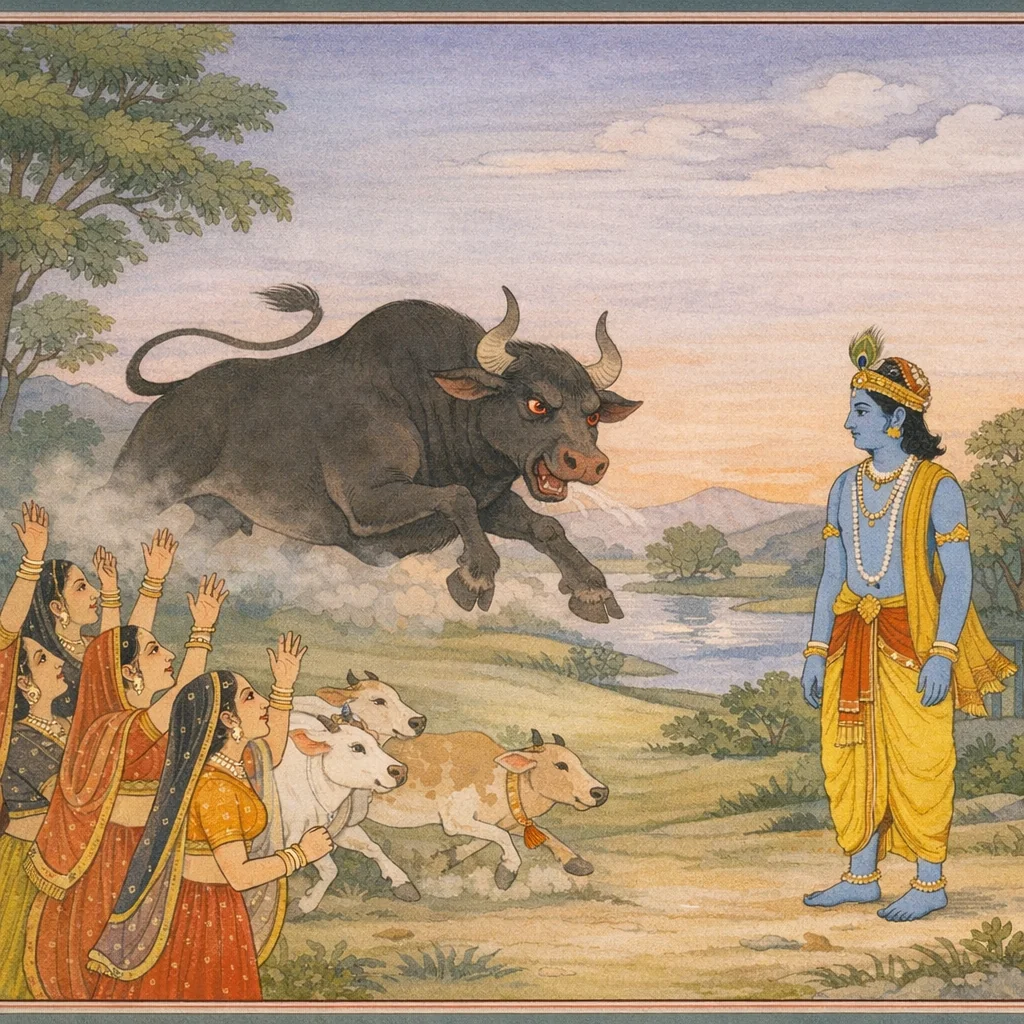
Parāśara narrates to Maitreya that during twilight, while Janārdana was engaged in the Rāsa dance, the bull-demon Ariṣṭa attacked the cow-pen, terrifying everyone. Hearing the cries of 'Kṛṣṇa! Kṛṣṇa!', the Lord responded with a roar and a clap. He seized the charging demon, crushed him effortlessly, tore off his horn, and killed him. The cowherds praised Kṛṣṇa as the gods praise Indra, highlighting the Lord's effortless power in protecting the devotees.
Shlokas
Verse 1
प्रदोषार्धे कदाचित् तु रासासक्ते जनार्दने त्रासयन् समदो गोष्ठम् अरिष्टः समुपागतः
Once, at the midpoint of twilight, while Janārdana was absorbed in the sacred rāsa-līlā, Ariṣṭa—the maddened bull-demon—came upon the cowherds’ settlement and terrorized the whole goṣṭha.
Verse 2
सतोयतोयदच्छायस् तीक्ष्णशृङ्गो ऽर्कलोचनः खुराग्रपातैर् अत्यर्थं दारयन् वसुधातलम्
Casting a dark sheen like deep waters, with razor-sharp horns and eyes blazing like the sun, he struck the earth with the tips of his hooves, rending the world’s surface with overwhelming force.
Verse 3
लेलिहानः सनिष्पेषं जिह्वयौष्ठौ पुनः पुनः संरम्भाविद्धलाङ्गूलः कठिनस्कन्धबन्धनः
Again and again he licked his tongue and lips as though grinding them; his tail lashed in fury, and his shoulders and frame grew taut and rigid—thus he stood, seized by a surge of wrath.
Verse 4
उदग्रककुदाभोगः प्रमाणाद् दुरतिक्रमः विण्मूत्रलिप्तपृष्ठाङ्गो गवाम् उद्वेगकारकः
With a high, swelling hump and massive shoulders, he surpassed all ordinary measure and was hard to restrain; his back and limbs were smeared with dung and urine, and he stirred fear and agitation among the cattle.
Verse 5
प्रलम्बकण्ठो ऽतिमुखस् तरुघाताङ्किताननः पातयन् स गवां गर्भान् दैत्यो वृषभरूपधृक्
Assuming the form of a bull, that Daitya—long-throated, huge-mouthed, his face scarred by blows from trees—went about causing the cows to miscarry, casting down their unborn calves.
Verse 6
सूदयंस् तापसान् उग्रो वनान्य् अटति यः सदा
Fierce by nature, he roamed the forests unceasingly, slaying the ascetics who dwelt there.
Verse 7
ततस् तम् अतिघोराक्षम् अवेक्ष्यातिभयातुराः गोपा गोपस्त्रियश् चैव कृष्ण कृष्णेति चुक्रुशुः
Then, seeing that being with eyes most terrifying, the cowherds and cowherd-women, overwhelmed by extreme fear, cried again and again, “Krishna! Krishna!”
Verse 8
सिंहनादं ततश् चक्रे तलशब्दं च केशवः तच्छब्दश्रवणाच् चासौ दामोदरमुखं ययौ
Then Keśava let out a lion-like roar and also sounded a sharp, resonant clap. Hearing that call, he came straight toward Dāmodara’s presence.
Verse 9
अग्रन्यस्तविषाणाग्रः कृष्णकुक्षिकृतेक्षणः अभ्यधावत दुष्टात्मा कृष्णं वृषभदानवः
Lowering the sharp tip of his horns in front and fixing his gaze upon Kṛṣṇa’s flank, that wicked-souled bull-demon charged straight at Kṛṣṇa.
Verse 10
आयान्तं दैत्यवृषभं दृष्ट्वा कृष्णो महाबलः न चचाल ततः स्थानाद् अवज्ञास्मितलीलया
Seeing the bull-like foremost of the Daityas advancing, mighty Kṛṣṇa did not move from his place at all, but remained with a calm, disdainful smile, as if in playful līlā.
Verse 11
आसन्नं चैव जग्राह ग्राहवन् मधुसूदनः जघान जानुना कुक्षौ विषाणग्रहणाचलम्
When the ass-demon rushed in close, Madhusūdana seized him at once; holding him fast like a crocodile’s deadly grip, the Lord drove His knee into the creature’s flank—like a mountain caught by its horn.
Verse 12
तस्य दर्पबलं भङ्क्त्वा गृहीतस्य विषाणयोः अपीडयद् अरिष्टस्य कण्ठं क्लिन्नम् इवाम्बरम्
Shattering his pride and brute strength, and seizing him by the horns, the Lord squeezed Ariṣṭa’s throat—crumpling it like cloth soaked and softened by water.
Verse 13
उत्पाट्य शृङ्गम् एकं तु तेनैवाताडयत् ततः ममार सहसा दैत्यो मुखाच् छोणितम् उद्वमन्
Tearing off one of his horns, He struck with it at once; in that very instant the Daitya collapsed and died, vomiting blood from his mouth.
Verse 14
तुष्टुवुर् निहते तस्मिन् दैत्ये गोपा जनार्दनम् जम्भे हते सहस्राक्षं पुरा देवगणा यथा
When that Daitya had been slain, the cowherds praised Janārdana—just as, in ancient times, when Jambha was killed, the hosts of gods extolled Sahasrākṣa (Indra).
Frequently Asked Questions
It juxtaposes intimate devotional play with sudden cosmic threat, showing that Bhagavān’s līlā contains both mādhurya (sweetness) and aiśvarya (sovereign power); protection of Vraja is inseparable from sustaining dharma.
As mahābala yet playful: He remains steady, acts decisively, and defeats the demon with effortless dominance—typical Purāṇic markers of the Supreme acting without strain (akliṣṭa).