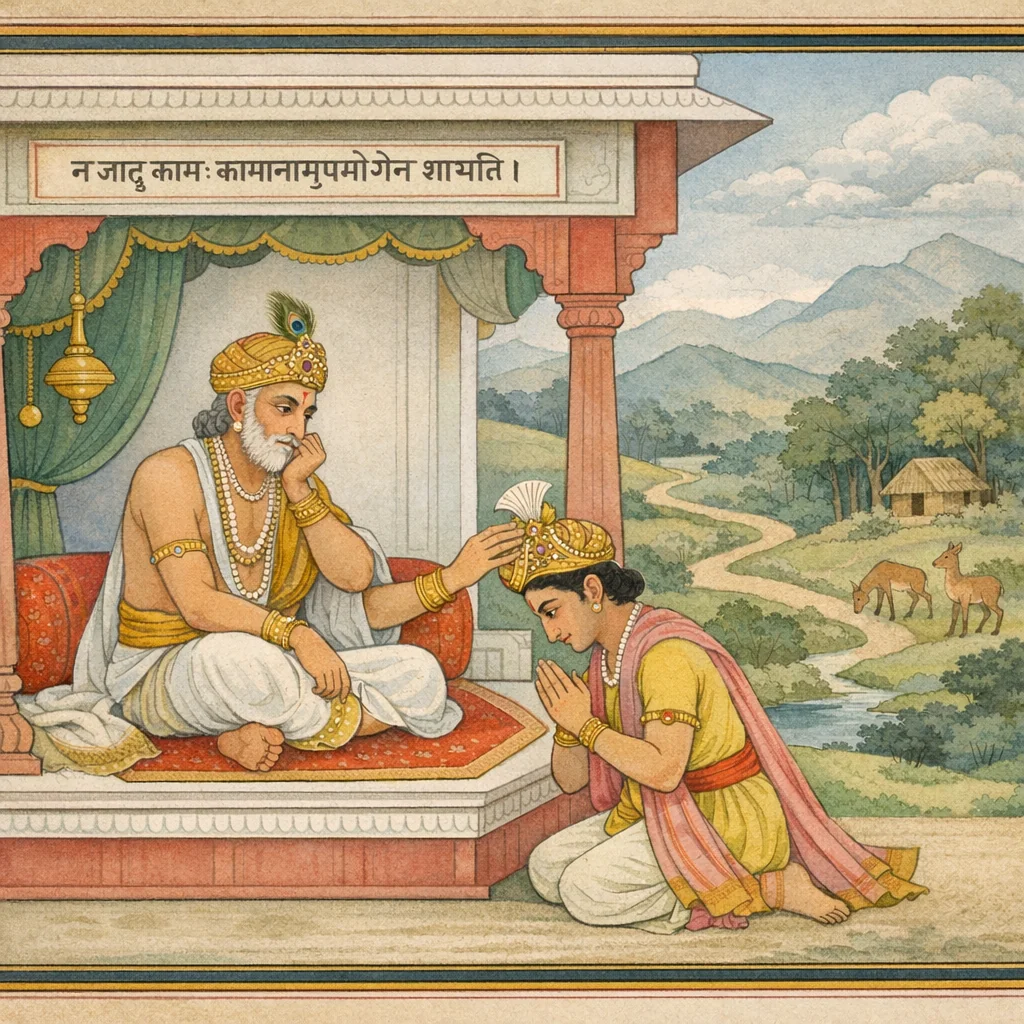
Adhyaya 10
कामतृष्णावैराग्योपदेशः तथा राज्यविभागः (Teaching on Desire & Renunciation; Delegation of Kingdoms)
Parāśara recounts a king of the Paurava line who, in the prime of youth, enjoys sense-objects without transgressing dharma and rules his subjects well. Yet after pleasures with Viśvācī and Devayānī, his mind clings to the notion that desire can be ended by satisfying it. Parāśara therefore teaches: kāma is never quenched by indulgence, but grows like fire fed with oblations; even the earth’s total wealth cannot satisfy a single person, so tṛṣṇā must be abandoned. He praises samadarśana—harboring no sinful intent toward any being—as the state in which all directions become peaceful. A renouncer in the narrative resolves to leave worldly life, fix the mind in Brahman, and wander free of dualities and possessiveness. The chapter culminates in a model political-ethical act: exchanging old age and youth with Pūru, consecrating Pūru as universal sovereign, assigning regions to Turvasu, Druhyu, Yadu, and Anu, and then departing to the forest for tapas—showing rightful rule and renunciation within the cosmic order upheld by Viṣṇu as the supreme cause.
Shlokas
Verse 10
सो ऽपि पौरवं यौवनम् आसाद्य धर्माविरोधेन यथाकामं यथाकालोपपन्नं यथोत्साहं विषयांश् चचार । सम्यक् च प्रजापालनम् अकरोत् ॥
He too, having reached the youthful prime befitting a scion of Puru, enjoyed the objects of sense without ever opposing dharma—according to desire, in due season, and in keeping with his strength. And he duly protected and governed his subjects in a righteous way.
Verse 11
विश्वाच्या देवयान्या च सहोपभोगं भुक्त्वा कामानाम् अन्तम् अवाप्स्यामीत्य् अनुदिनं तन्मनस्को बभूव ॥
Having enjoyed the pleasures of union with Viśvācī and with Devayānī, day after day he became absorbed in the same thought: “By exhausting enjoyment, I shall reach the very end of desire.”
Verse 13
न जातु कामः कामानाम् उपभोगेन शाम्यति हविषा कृष्णवर्त्मेव भूय एवाभिवर्धते
Desire for objects of desire is never quenched by indulgence; like a fire fed with oblations, it only blazes more fiercely and grows.
Verse 14
यत् पृथिव्यां व्रीहियवं हिरण्यं पशवः स्त्रियः एकस्यापि न पर्याप्तं तस्मात् तृष्णां परित्यजेत्
Even if one possessed all that is on the earth—rice and barley, gold, cattle, and women—it would still not suffice to satisfy even a single person; therefore one should renounce craving itself.
Verse 15
यदा न कुरुते भावं सर्वभूतेषु पापकम् समदृष्टेस् तदा पुंसः सर्वाः सुखमया दिशः
When a person no longer harbors any sinful intention toward any being, then—being equal-sighted—every direction becomes for him a realm of ease and well-being.
Verse 16
या दुस्त्यजा दुर्मतिभिर् या न जीर्यति जीर्यतः तां तृष्णां संत्यजेत् प्राज्ञः सुखेनैवाभिपूर्यते
That craving which the ill-judging find impossible to abandon—and which does not grow old even as one grows old—let the wise renounce that thirst; by relinquishing it alone, one becomes fulfilled with ease.
Verse 17
जीर्यन्ति जीर्यतः केशा दन्ता जीर्यन्ति जीर्यतः धनाशा जीविताशा च जीर्यतो ऽपि न जीर्यतः
Time wears all things away: hair turns grey and teeth decay. Yet even as the body ages, the thirst for wealth and the hope of more life do not grow old at all.
Verse 18
पूर्णं वर्षसहस्रं मे विषयासक्तचेतसः तथाप्य् अनुदिनं तृष्णा ममैतेष्व् एव जायते
Though a full thousand years have passed with my mind fastened upon sense-objects, still, day after day, my craving is born again for these very pleasures.
Verse 19
तस्माद् एताम् अहं त्यक्त्वा ब्रह्मण्य् आधाय मानसम् निर्द्वन्द्वो निर्ममो भूत्वा चरिष्यामि मृगैः सह
Therefore, abandoning this worldly life, I shall place my mind in Brahman; free from the pairs of opposites and without possessiveness, I will wander along with the deer.
Verse 20
पूरोः सकाशाद् आदाय जरां दत्त्वा च यौवनम् राज्ये ऽभिषिच्य पूरुं च प्रययौ तपसे वनम्
Taking old age from Pūru and granting him youth in return, he consecrated Pūru to the sovereignty of the kingdom; then he departed to the forest to undertake austerities.
Verse 21
दिशि दक्षिणपूर्वायां तुर्वसुं प्रत्य् अथादिशत् प्रतीच्यां च तथा द्रुह्युं दक्षिणायां ततो यदुम्
Then he assigned Turvasu to the south-eastern quarter, Druhyu to the west, and thereafter Yadu to the southern region—thus marking out the directions of their rule.
Verse 22
उदीच्यां च तथैवानुं कृत्वा मण्डलिनो नृपान् सर्वपृथ्वीपतिं पूरुं सो ऽभिषिच्य ययौ वनम्
Having likewise brought the circle of kings—both in the northern regions and among the Anu lineage—under his rule, he consecrated Pūru as sovereign of the whole earth; then, his royal duty fulfilled, he departed to the forest.
Frequently Asked Questions
It teaches that kāma does not subside through indulgence; like fire receiving oblations (havis), it increases. Therefore enjoyment cannot ‘complete’ desire—only restraint and insight can.
It states that even possessing all earthly goods—grain, gold, cattle, and women—would still not be sufficient to satisfy even one person; hence one should abandon craving (tṛṣṇā).
When one holds no sinful intention toward any being and becomes equal-sighted (samadṛṣṭi), one’s experience of the world becomes non-hostile and peaceful—symbolized as every direction becoming ‘sukhamayī.’
It models rājya-vibhāga as dharmic ordering: rule is delegated by rightful consecration and structured allotment (quarters/regions), culminating in Pūru’s universal sovereignty—followed by the elder’s withdrawal to tapas, indicating kingship as stewardship rather than possession.
By presenting moral causality, social order, and renunciation within a cosmos ultimately grounded in Viṣṇu’s supremacy: worldly rule operates within His kāla and niyati, while liberation-oriented counsel (vairāgya, brahmaṇi manaḥ) points beyond temporality to the Supreme reality.