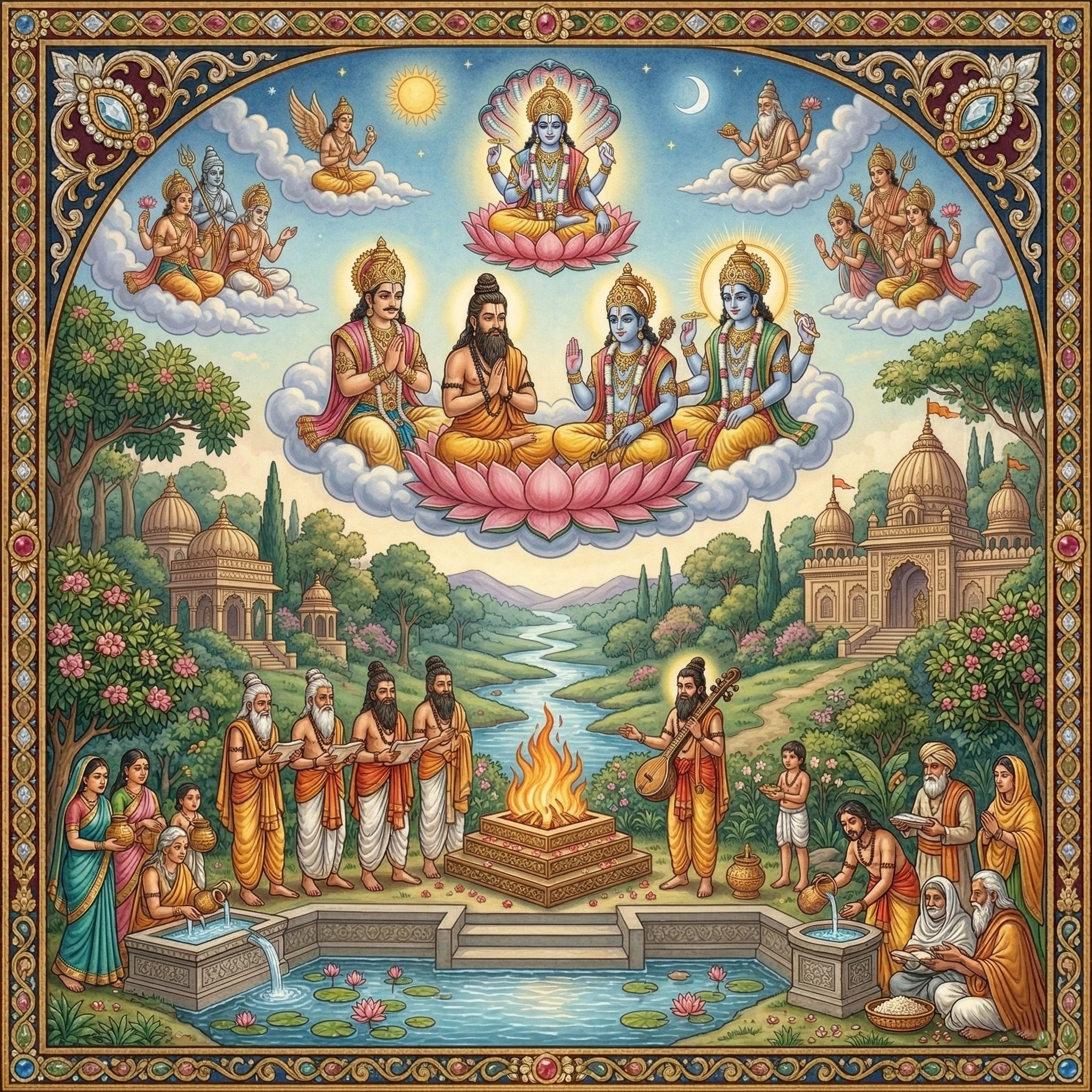
Vasudeva Mahatmya
Vasudeva Mahatmya
This section is primarily thematic rather than tied to a single pilgrimage site. Its sacred geography is conveyed through narrative movement across classical Purāṇic and epic locations—Kurukṣetra (as a memory-space of post-war ethical inquiry), Kailāsa (as a locus of divine-ṛṣi transmission), and Badarīāśrama (as an ascetic north-Himalayan setting associated with Nara-Nārāyaṇa). These place-references function as authority markers: Kurukṣetra anchors the teaching in dharma-debate, Kailāsa in revelatory relay, and Badarīāśrama in tapas and contemplative practice.
Adhyayas in Vasudeva Mahatmya
32 chapters to explore.
Adhyaya 1
देवतासंबन्धेन सुकरमोक्षसाधनम् | The Accessible Means to Liberation through Deity-Connection
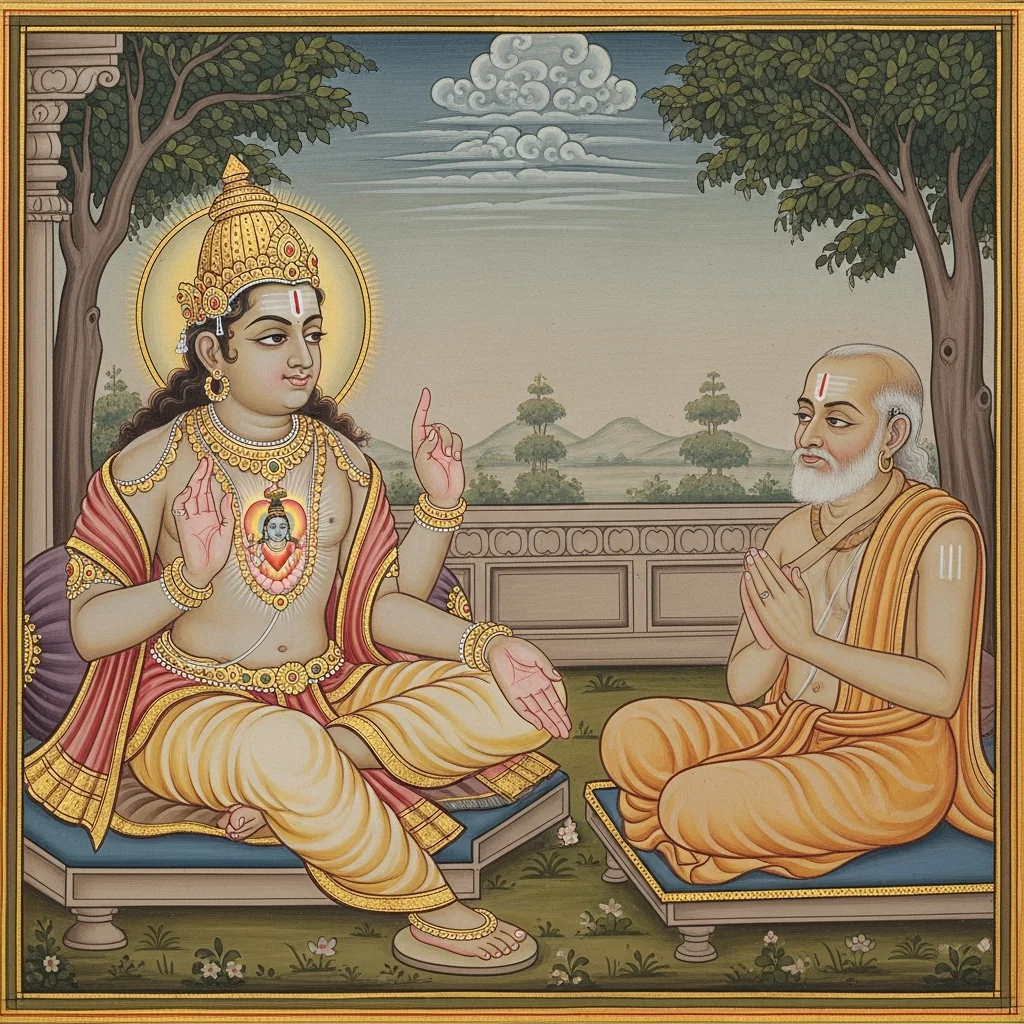
Chapter 1 begins with Śaunaka questioning Sūta: though dharma, knowledge, dispassion, and yogic disciplines are celebrated in many narratives, they are hard for most people because of obstacles and the long time needed for attainment. He therefore asks for a “su-karopāya”—a practicable, inclusive method that benefits even those without elite ascetic capacity, suited to varied social circumstances. Sūta recounts that the sage Sāvarṇi once posed a similar question to Skanda (Guhā/Kārttikeya). Skanda, after meditating on Vāsudeva within his heart, teaches that propitiation of the Deity is the most accessible means: even a small virtuous act, when done in explicit relation to the Lord, yields vast and unobstructed results. He adds that deeds for gods, ancestors, or duty become swiftly effective when connected to the Deity, and that difficult paths such as sāṅkhya, yoga, and vairāgya are made easier through this devotional anchoring. Sāvarṇi then sharpens the inquiry: since many gods and worship-methods grant time-bound fruits, he asks for the fearless Deity who bestows imperishable results, removes fear, and is devoted to devotees, along with a simple, authoritative procedure of worship. The chapter ends with Skanda preparing to answer in a favorable mood.
Adhyaya 2
वासुदेवपरब्रह्मनिर्णयः — Vāsudeva as Supreme Brahman and the Consecration of Action
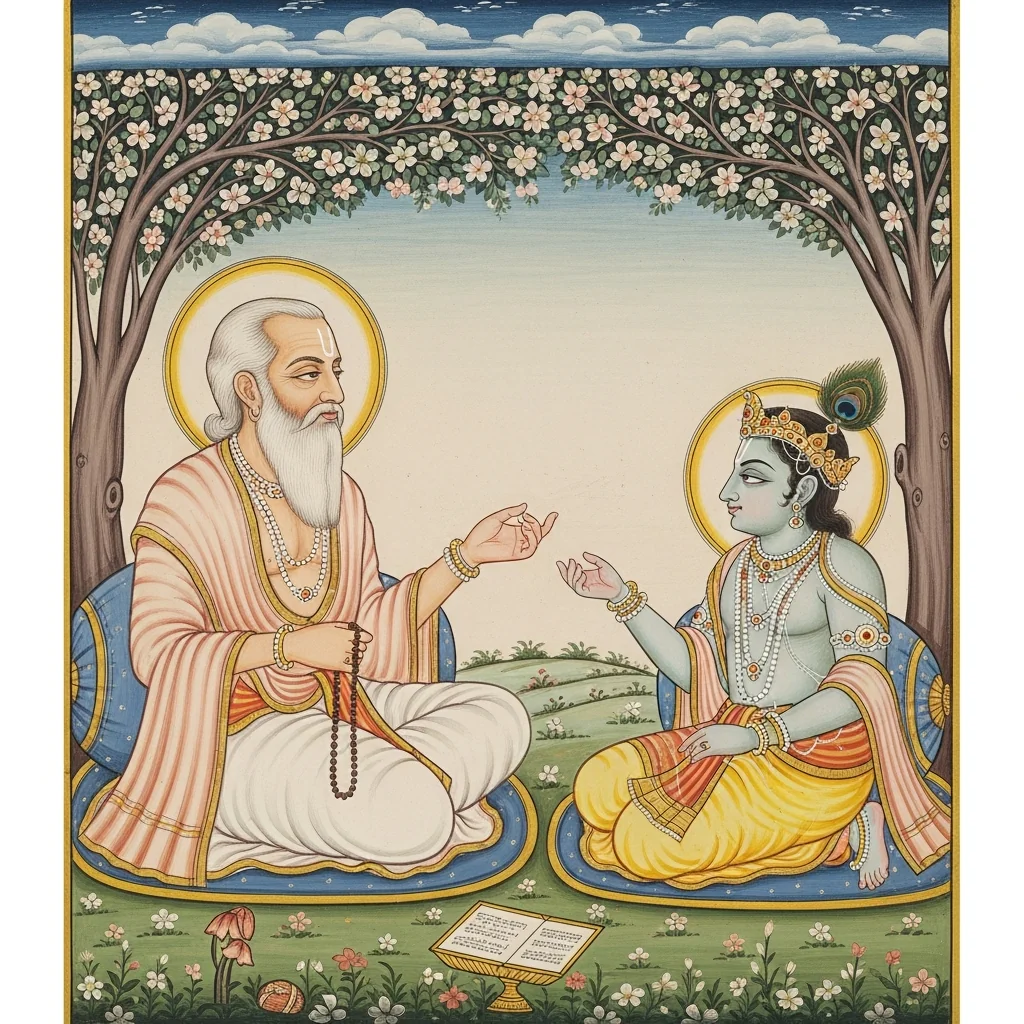
Chapter 2 is presented as an authorized disclosure: Skanda says the question is profound and cannot be answered by reasoning alone, but becomes speakable through divine grace and Vāsudeva’s favor. The narrative then recalls an epic precedent—after the Bhārata war, Yudhiṣṭhira asks Bhīṣma (absorbed in contemplation of Acyuta) which deity should be worshiped to attain the four aims of life for all varṇa and āśrama, how success may be gained quickly and without obstacles, and how even slight merit can lead to a great station. Skanda relates that Bhīṣma, prompted by Kṛṣṇa, teaches the “Śrī-Vāsudeva-māhātmya,” later transmitted by Nārada through Kurukṣetra and Kailāsa, establishing a chain of custodianship. The doctrinal core declares Vāsudeva/Kṛṣṇa to be para-brahman, worthy of worship by the desireless and the desirous alike; all social orders can please him through devotion while remaining within their own dharma. Actions—Vedic, ancestral, and worldly—done without relation to Kṛṣṇa are perishable and defect-prone, but when performed for Kṛṣṇa’s pleasure they become ‘nirguṇa’ in effect, yielding greater, non-decaying results as obstacles are neutralized by the Lord’s power. The chapter also introduces an itihāsa: Nārada’s visit to Nara-Nārāyaṇa at Badarīāśrama, where their exact daily rites move him to inquire, preparing further dialogue.
Adhyaya 3
Vāsudeva as the Supreme Recipient of Daiva–Pitṛ Rites; Pravṛtti–Nivṛtti Dharma and the Akṣaya Fruit of Viṣṇu-Sambandha
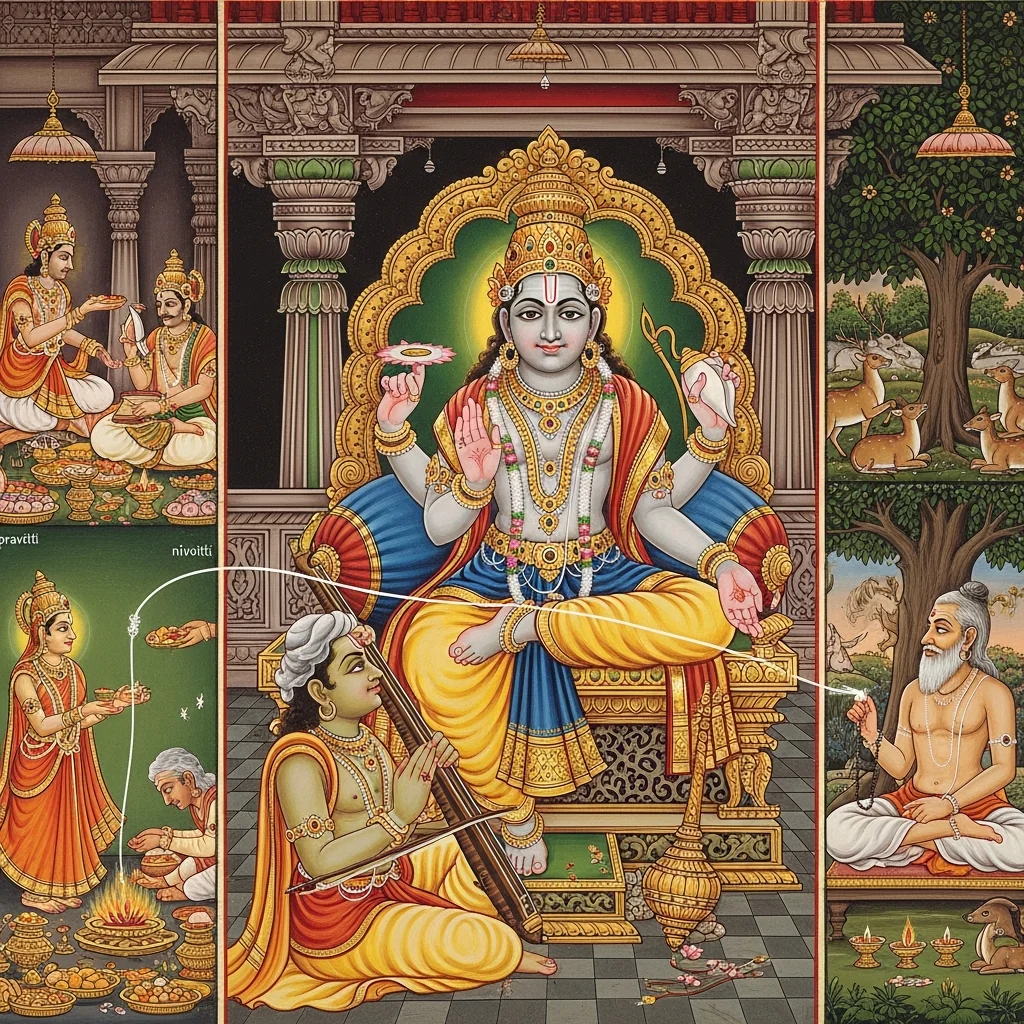
Adhyāya 3 unfolds as a doctrinal dialogue sparked by Nārada’s praise and question: if Vāsudeva is celebrated in the Vedas and Purāṇas as the eternal creator and ruler, and worshipped by all varṇas and āśramas in many forms, then which deity does even Vāsudeva worship as Father or God? Śrī Nārāyaṇa replies that the truth is subtle, and teaches in an Upaniṣadic vein that the Supreme is satya–jñāna–ananta brahman, beyond the three guṇas, manifest as the divine Puruṣa—Mahāpuruṣa—known as Vāsudeva, Nārāyaṇa, Viṣṇu, and Kṛṣṇa. He then sets forth the world’s “maryādā”: daiva and pitṛ duties should be performed, yet in their ultimate intent both are offered to the one Lord who is the Self of all. Vedic karma is classified into pravṛtti and nivṛtti: pravṛtti comprises social duties (marriage, lawful wealth, desire-based sacrifices, civic works) that yield finite heavenly rewards, ending when merit is exhausted and one returns to earth; nivṛtti comprises renunciation, self-control, tapas, and higher yajñas (brahma/yoga/jñāna/japa) leading to higher lokas beyond the tri-loka, though even these remain subject to cosmic dissolution. The decisive pivot is that karma, though guṇa-based, becomes “nirguṇa” when done as viṣṇu-sambandha—connected to Viṣṇu—producing imperishable (akṣaya) fruit and culminating in Bhagavān’s dhāma. Exemplars of pravṛtti (Prajāpatis, devas, ṛṣis) and nivṛtti (Sanaka and related sages, steadfast naiṣṭhika munis) are shown worshipping the same Lord within their respective disciplines. The chapter closes by stressing the Lord’s responsiveness: even small acts done with bhakti yield great, enduring results; exclusive devotees attain transcendent service with non-material bodies; and any genuine relation to Him arrests saṃsāra and supports success in karma-yoga and jñāna-yoga.
Adhyaya 4
Śvetadvīpa-Darśana and the Akṣara Devotees of Vāsudeva (श्वेतद्वीपदर्शनम् / अक्षराणां वासुदेवसेवा)
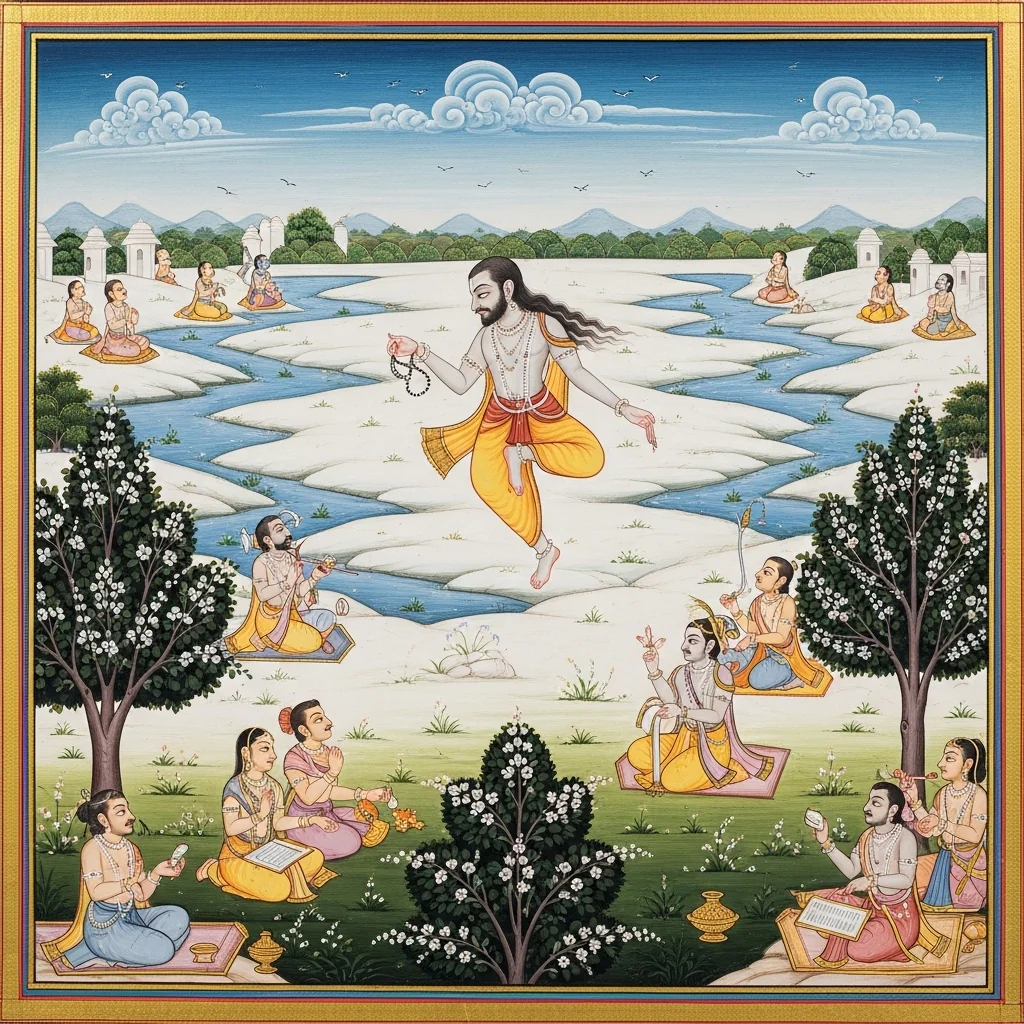
The chapter unfolds in two linked movements. (1) In dialogue, Nārada says that hearing the teaching has satisfied him, yet he longs to behold the Lord’s prior/supreme form. Nārāyaṇa declares that this vision is not gained by gifts, sacrifice, Vedic rites, or austerity alone, but is revealed only to those of exclusive devotion (ananyā-bhakti). Nārada is affirmed as qualified through knowledge, detachment, and fidelity to svadharma, and is instructed to journey to the “white inner island,” Śvetadvīpa. (2) Skanda then describes Nārada’s yogic flight and his vision of radiant Śvetadvīpa north of the Milk Ocean, abundant with auspicious trees, gardens, rivers, lotuses, birds, and animals. Its inhabitants are liberated and sinless, fragrant and ever-youthful, marked with auspicious signs—sometimes two-armed, sometimes four-armed—free from the six waves (ṣaḍ-ūrmi) and beyond fear of time. When Sāvarṇi asks how such beings arise and what their state is, Skanda explains that they are “Akṣara” persons who attained brahma-bhāva through single-minded worship of Vāsudeva in prior cycles, remaining independent of time and māyā and returning to the Akṣara-dhāman at dissolution. Others, though born perishable (kṣara) through māyā, may become like them through nonviolence, tapas, svadharma, detachment, knowledge of Vāsudeva’s greatness, constant devotion, association with the great, disinterest even in liberation and siddhis, and mutual hearing and recitation of Hari’s births and deeds. The chapter closes by promising a longer purāṇic narrative to show that even humans can attain that state.
Adhyaya 5
Amāvāsu’s Vāsudeva-bhakti and Pāñcarātra-Ordered Kingship (अमावसोर्वासुदेवभक्तिः पञ्चरात्रविधिश्च)
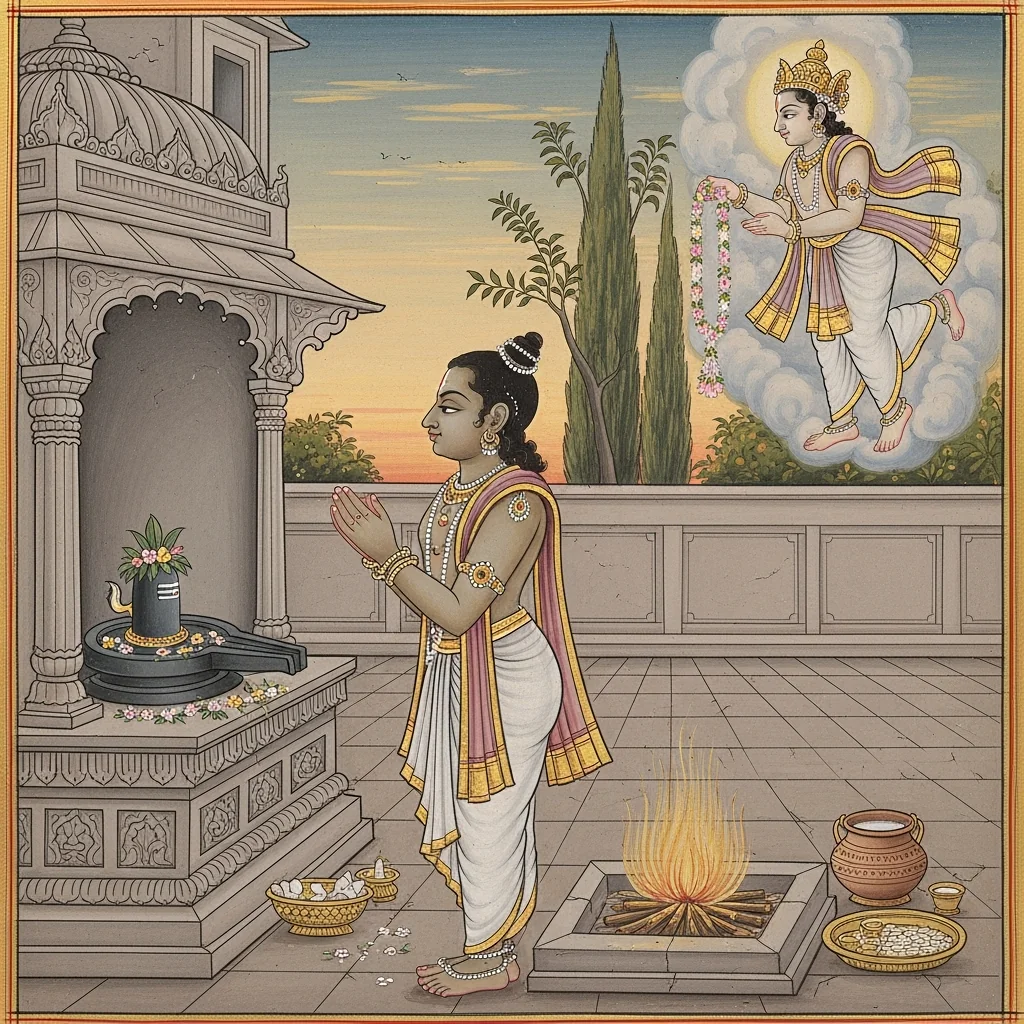
Skanda portrays the exemplary king Amāvāsu (connected with the Vasu royal line), distinguished by disciplined virtues—dharma, filial devotion, self-control, non-violence, humility, and steadiness of mind. He maintains unbroken japa of the Nārāyaṇa mantra and worships by a well-ordered regimen (including a fivefold daily schedule): he offers first to Vāsudeva, then distributes the consecrated remnants (prasāda) to gods, ancestors, Brahmins, and dependents, and only last consumes what remains, establishing an ethic of sanctified consumption. He treats harm to living beings through meat-eating as a grave moral fault and models governance in which falsehood, malice, and even subtle wrongdoing are minimized. Devotion is linked to ritual tradition: Pāñcarātra teachers are honored, and kāmya, naimittika, and regular obligatory rites are performed in a sāttvata/Vaiṣṇava mode. Celestial recognition follows (gifts from Indra), yet the narrative warns that even the virtuous may fall through partiality or ill-spoken words among the gods. By renewed steadfast mantra-practice and bhakti he regains heavenly status, is reborn due to a paternal curse, and finally ascends—strengthening Vāsudeva-worship among sages and attaining Vāsudeva’s fearless supreme state.
Adhyaya 6
अहिंसायज्ञविवेकः (Discerning Non-Violent Sacrifice) — Vasu and the Devas’ Yajña Debate
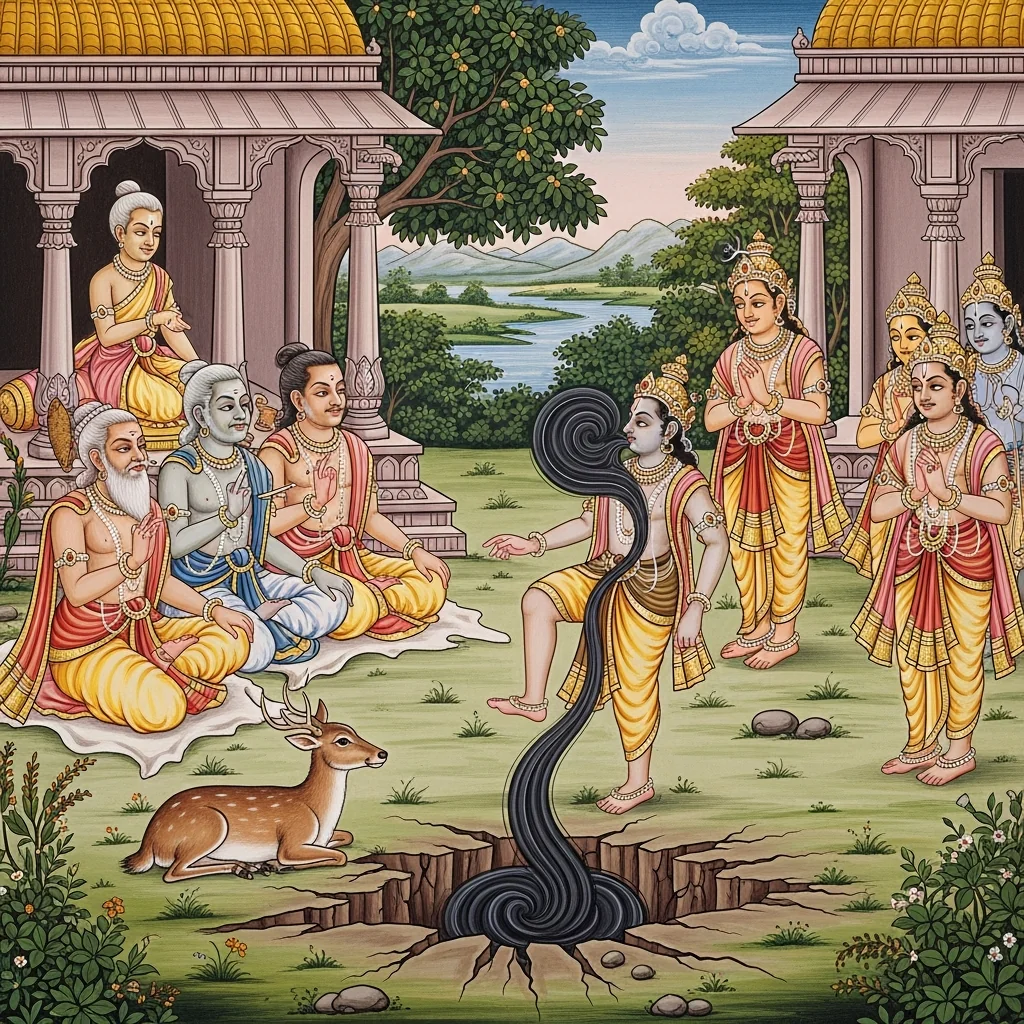
Chapter 6 begins with Sāvarṇi asking Skanda why King Mahān Vasu fell into the earth/underworld, and how his curse and release came about. Skanda answers by recalling an earlier episode: Indra (called Viśvajit) commences an Aśvamedha-like great sacrifice, binding many animals who cry out in distress. Radiant ṛṣis arrive, are duly honored, and then express astonishment and compassion at the violence embedded in the ritual’s expansion. The sages instruct the devas in sanātana-dharma: ahiṃsā is the higher principle, and direct animal slaughter is not the Veda’s true intent. The Veda aims to establish dharma’s “four feet,” not to destroy dharma through harm. They rebuke rajas/tamas-driven misreadings—such as taking “aja” to mean a goat rather than a technical sense of seed/ingredient—and affirm that sāttvika devas are aligned with Viṣṇu, whose worship accords with non-violent sacrifice. Yet the devas refuse the sages’ authority, and the openings of adharma—pride, anger, and delusion—widen. At that moment King Rājoparicara Vasu arrives; devas and sages ask him to judge whether sacrifice should be done with animals or with grains and medicinals. Knowing the devas’ preference, Vasu sides with them and declares that goats/animals should be used; the consequence is immediate: through the fault of speech (vāgdoṣa) he falls from the sky into the earth, though he retains memory by taking refuge in Nārāyaṇa. Fearing the repercussions of violence, the devas release the animals and depart, while the sages return to their hermitages. The chapter stands as a caution on scriptural interpretation, ritual ethics, and the karmic weight of authoritative words.
Adhyaya 7
वसोरुद्धारः, पितृशापः, श्वेतद्वीप-वैष्णवधाम-प्राप्तिः (Vasu’s Restoration, Ancestral Curse, and Attainment of Śvetadvīpa/Vaiṣṇava Dhāma)
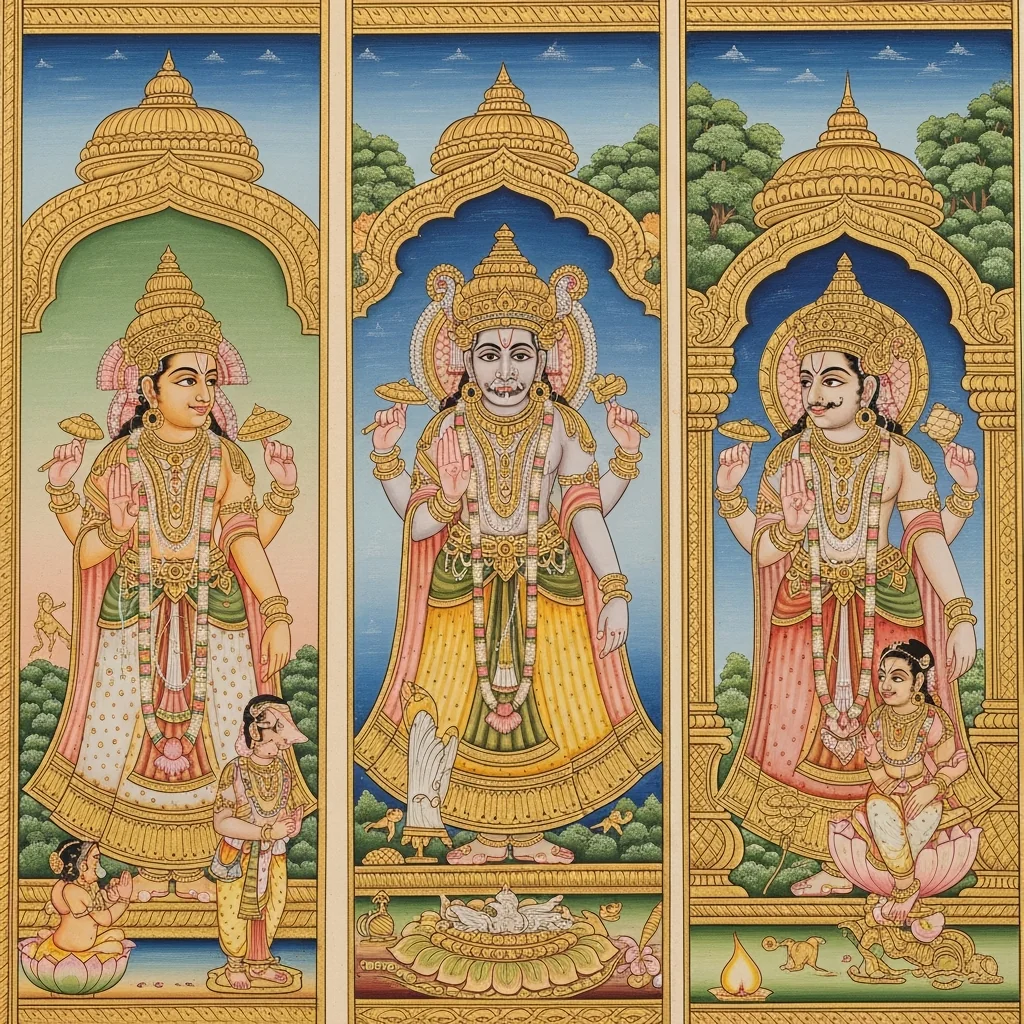
This chapter unfolds a multi-stage theological narrative on karmic consequence, devotional rectification, and the path toward liberation. (1) King Vasu, imprisoned within the earth for a transgression, sustains mental japa of a tri-syllabic Bhagavat-mantra and worships Hari with intense bhakti, observing pañcakāla discipline and practicing “according to time and śāstra.” (2) Pleased, Vāsudeva commands Garuḍa to draw Vasu out from the earth’s fissure and restore him to an exalted state, highlighting divine agency working through a celestial intermediary. (3) The text then teaches that offenses of speech and disrespect can yield severe results, yet exclusive service to Hari swiftly purifies and grants heavenly attainment; Vasu enjoys celestial honors. (4) A further episode introduces Acchodā (connected with the Pitṛs), mistaken identity, and the Pitṛs’ curse, which becomes a structured redemptive plan: future births in the Dvāpara age, continued excellence in devotion, Pañcarātra-mode worship, and eventual return to divine realms. (5) The conclusion turns from enjoyment to vairāgya: Vasu meditates on Ramāpati, relinquishes the deva-body through yogic concentration, reaches the solar sphere described as a “gateway of liberation” for accomplished yogins, and is guided by transitory deities to the wondrous Śvetadvīpa—portrayed as a threshold-domain for devotees seeking Goloka/Vaikuṇṭha. The chapter closes by defining “Śvetamuktas” as those who worship Nārāyaṇa through ekāntika-dharma, single-minded devotion.
Adhyaya 8
Kāla, Ritual Distortion, and the Durvāsā–Indra Episode (कालप्रभावः, हिंस्रयज्ञप्रवृत्तिः, दुर्वासा-इन्द्रोपाख्यानम्)
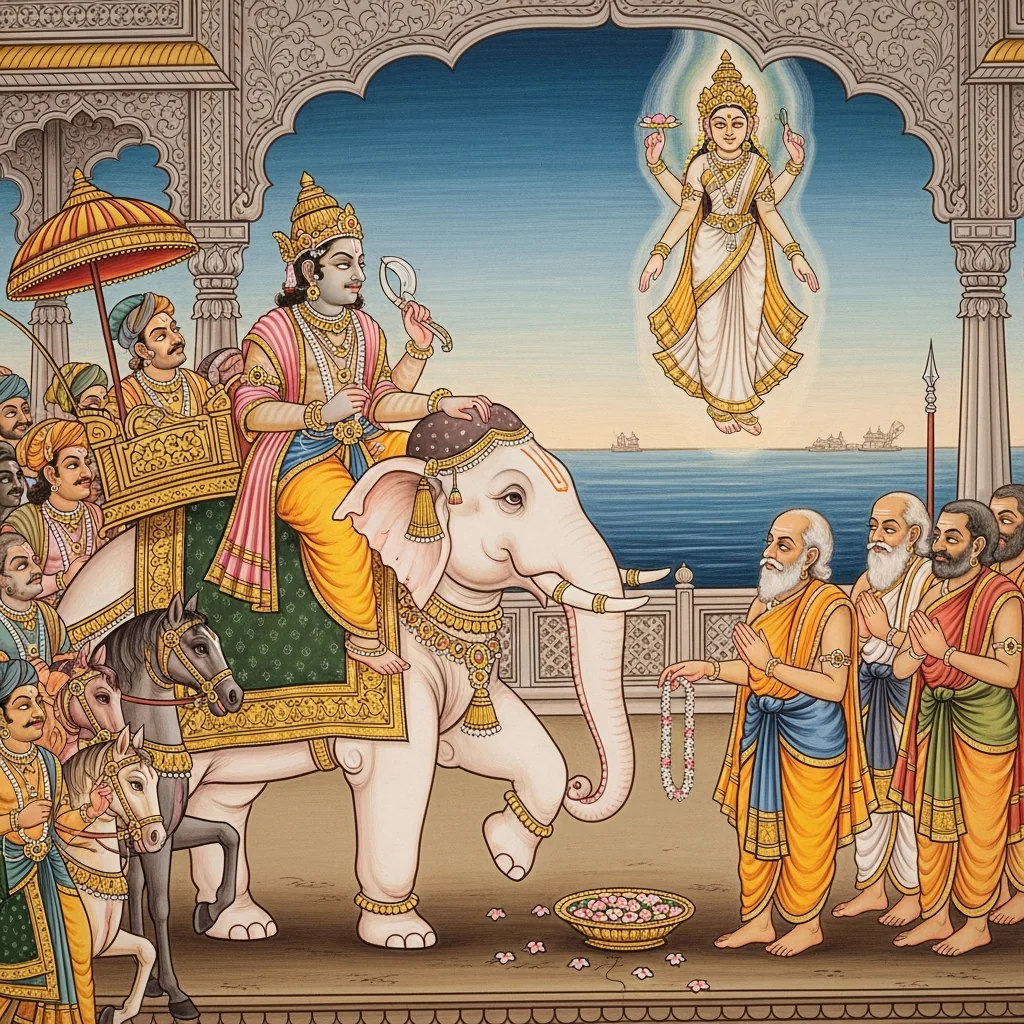
Chapter 8 begins with Sāvarṇi asking why violent sacrificial rites reappear even after sages and gods have restrained them, and how the eternal, pure dharma becomes inverted among beings of earlier and later times. Skanda explains the ethics of decline: kāla (time) unsettles discernment, and kāma, krodha, lobha, and māna—desire, anger, greed, and pride—corrode sound judgment even in the learned; but those who are sāttvata, with impulses worn away (kṣīṇavāsanā), remain unshaken. Skanda then recounts an ancient itihāsa to show how violent ritual tendencies return and to proclaim the greatness of Nārāyaṇa and Śrī. Durvāsā, an ascetic embodying an aspect of Śaṅkara, receives a fragrant garland from a celestial woman. Later he sees Indra in a triumphal procession; through inattentiveness and passion Indra has the garland placed on his elephant, where it falls and is trampled, provoking Durvāsā’s fierce rebuke. Durvāsā curses that Śrī—by whose grace Indra holds sovereignty over the three worlds—will abandon him and withdraw into the ocean, linking disrespect toward ascetic authority with the loss of auspicious power.
Adhyaya 9
धर्मविप्लवः, श्रीनिवृत्तिः, आपद्धर्मभ्रान्तिः च (Dharma Upheaval, Withdrawal of Śrī, and Misread Āpaddharma)
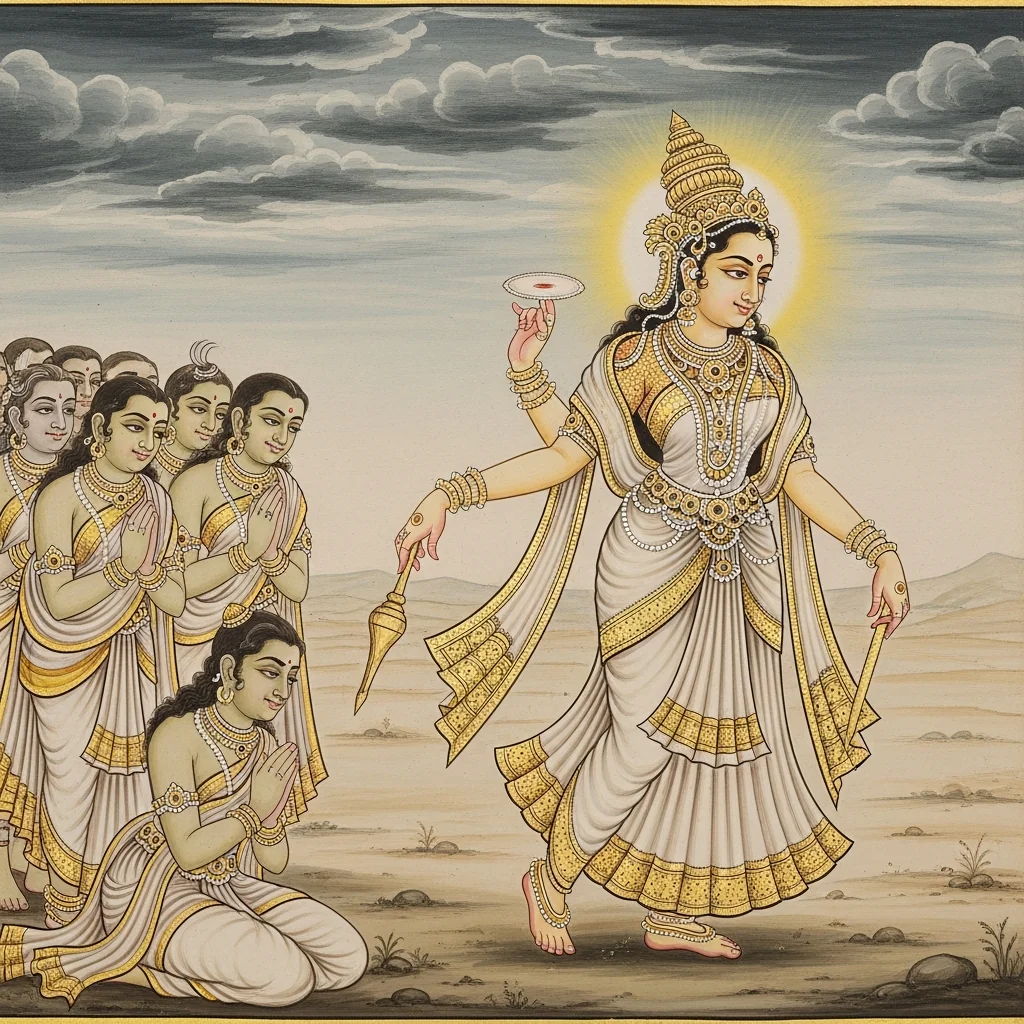
Skanda describes an age of dharma-viparyāsa, a reversal of righteousness driven by the power of Time, when prosperity (Śrī) withdraws from the three worlds and even the divine realms seem diminished. The supports of well-being—food, medicines, dairy, treasures, and comforts—wane, bringing famine and social upheaval. Pressed by hunger, many beings kill animals and eat meat; yet some sages steadfast in saddharma refuse such food even as they die. Elder ṛṣis then teach a Veda-grounded “āpaddharma” (emergency duty) to sustain life in calamity, but the narrative exposes interpretive slippage: ambiguous terms and indirect Vedic speech are taken literally, normalizing violent sacrifice. Ritual killing spreads, including emblematic “great” rites; sacrificial leftovers become a dietary justification, and motives shift toward wealth, household aims, and sheer survival. Downstream come the erosion of social norms, mixed marriages born of poverty and disruption, and the growth of adharma, along with later writings that treat this crisis-ethic as authoritative through tradition. After a long time, the lord of the gods regains prosperity by worshipping Vāsudeva; by Hari’s grace, saddharma is restored, though some still privilege the old emergency norm. The chapter closes by framing the spread of violent sacrifice as historically contingent, tied to times of calamity.
Adhyaya 10
Kṣīrasāgara-tapas and Vāsudeva’s Instruction for Samudra-manthana (क्षीरसागर-तपः तथा समुद्रमन्थन-उपदेशः)
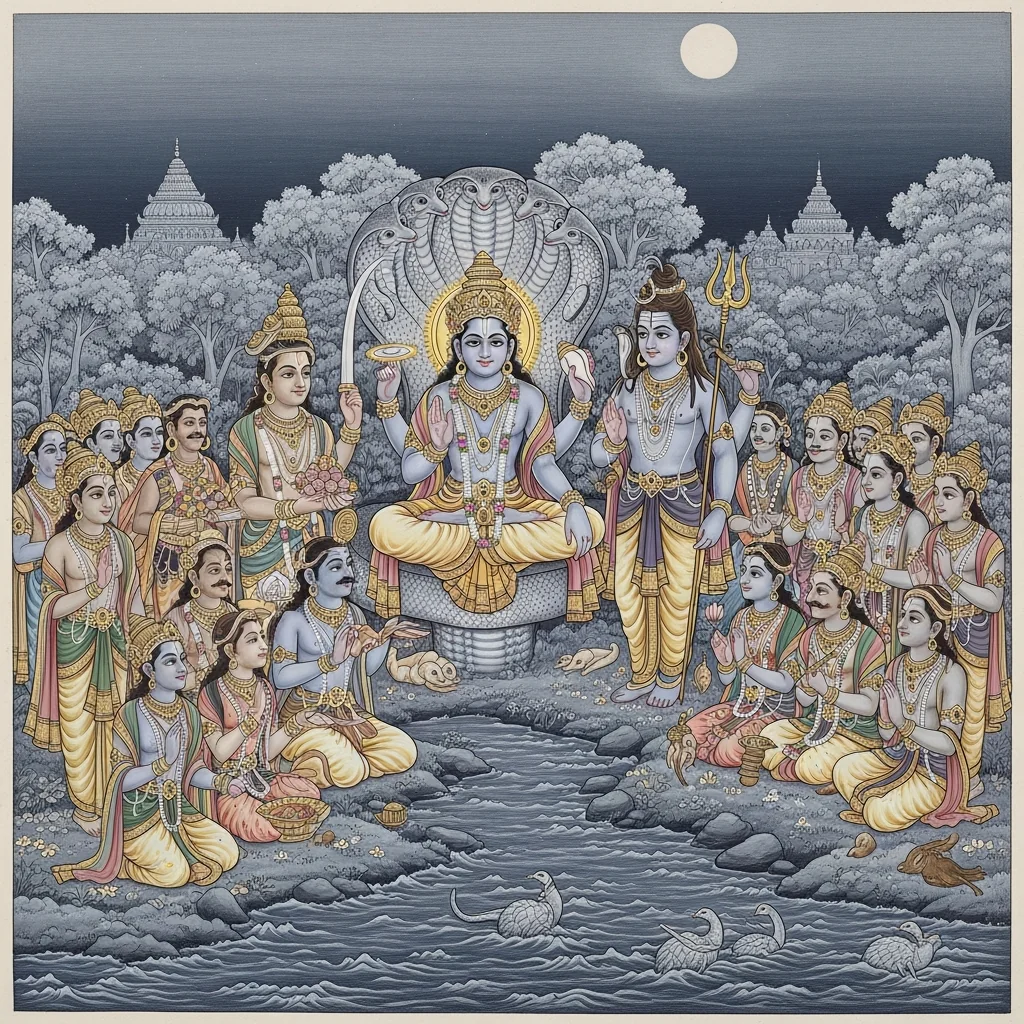
Sāvarṇi asks how Śrī (Lakṣmī), after departing from Indra, may be regained, requesting an account centered on Nārāyaṇa. Skanda describes the devas’ fallen state: defeat and loss of rank, ascetic-like wandering with the guardians of the directions, and a long season of drought, poverty, and scarcity. After enduring much misery, the devas take refuge at Mount Meru and approach Brahmā, with Śaṅkara present. Brahmā proposes a remedy to win Viṣṇu’s favor. The devas go to the northern shore of the Kṣīrasāgara (Ocean of Milk) and perform severe tapas, meditating single-mindedly on Keśava—Vāsudeva, the Lord of Lakṣmī. In time Viṣṇu manifests in radiant splendor. Brahmā and Śiva, followed by the assembled devas, prostrate and offer a formal stotra, praising Vāsudeva as Oṃkāra-brahma, nirguṇa, the inner ruler (antar-yāmin), and protector of dharma. The devas confess that their offense to Durvāsas caused Śrī’s absence and beg for restoration. Viṣṇu acknowledges their distress and prescribes a practical, cooperative means: cast medicinal herbs into the ocean, use Mandara as the churning rod and the Nāgarāja as the rope, and churn the sea in alliance with the asuras. He promises aid and foretells the results—amṛta will arise and Śrī’s “glance” will return to the devas, while the adversaries will be burdened with suffering. Viṣṇu then disappears, and the devas begin to carry out his instruction.
Adhyaya 11
मन्दर-समुद्रमन्थन-प्रारम्भः (Commencement of the Mandara Ocean-Churning)
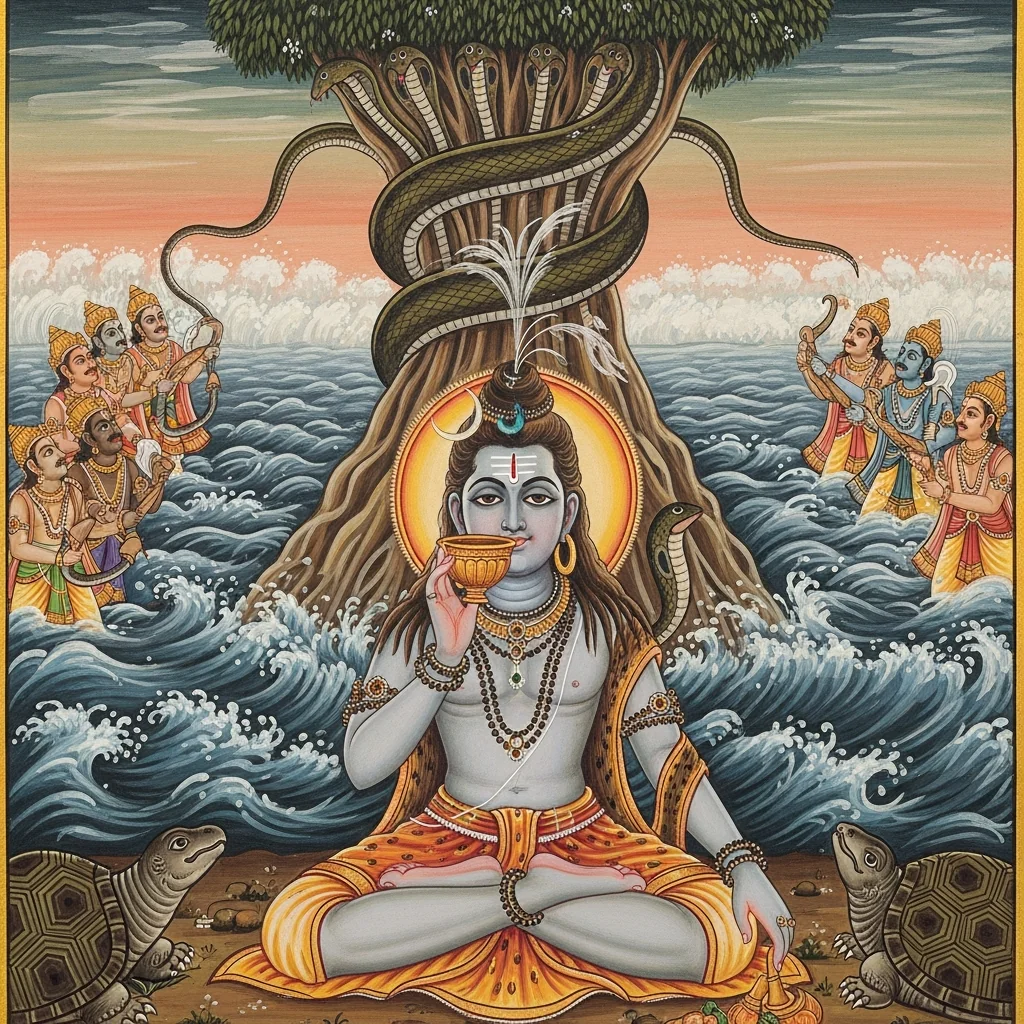
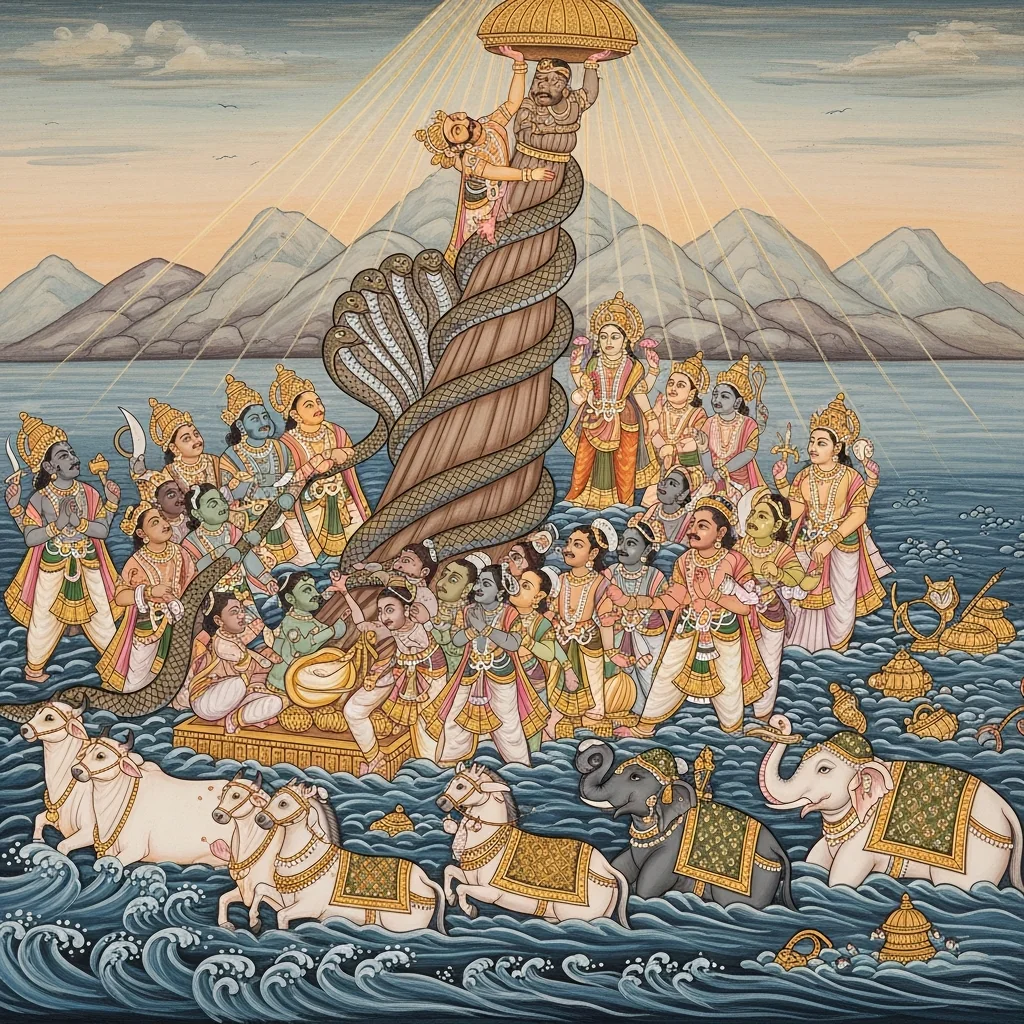
Skanda recounts how the devas and asuras, after forging a treaty, jointly commence the sacred enterprise of churning the Ocean. Gathering on the seashore, they collect potent herbs and strive to uproot and transport Mount Mandara, but its vast, deeply rooted weight defeats them. Saṅkarṣaṇa is then invoked; with a force like a single breath he dislodges the mountain and casts it aside. Garuḍa is commissioned to carry Mandara swiftly to the ocean’s edge. Vāsuki is invited with the promise of a share in the amṛta, and the churning begins as devas and asuras take their places on the serpent-rope—while Viṣṇu subtly orders the arrangement to safeguard the devas. When Mandara sinks for lack of support, Viṣṇu assumes the Kūrma (tortoise) form to bear the mountain and steady the work. The churning’s fierce friction crushes aquatic beings and raises a thunderous cosmic roar; as Vāsuki’s heat and venom intensify, Saṅkarṣaṇa endures and contains the toxic force. At last the halāhala (kālakūṭa) poison arises, threatening all worlds. The gods beseech Umāpati (Śiva), and by Hari’s sanction Śiva draws the poison into his palm and drinks it, becoming Nīlakaṇṭha; the remaining drops upon the earth are taken up by serpents, scorpions, and certain herbs.
Adhyaya 12
समुद्रमन्थनप्रसङ्गः (The Episode of the Churning of the Ocean)
Skanda recounts the renewed churning of the Ocean of Milk by the Kāśyapeya hosts—devas and asuras joined in the undertaking. At first fatigue and disorder arise: the churners weaken, Vāsuki is tormented, and Mount Mandara will not stand firm. With Viṣṇu’s consent, Pradyumna enters the gods, the asuras, and the serpent-king to infuse strength, while Aniruddha steadies Mandara like a second mountain. The churning resumes with greater force; by Nārāyaṇa’s anubhāva all are freed from exhaustion, and the pulling becomes balanced and harmonious. Many treasures then emerge: medicinal essences, the Moon, Kāmadhenu (Havirdhānī), the white divine horse, Airāvata, the Pārijāta tree, the Kaustubha gem, apsarases, Surā, the Śārṅga bow, and the Pāñcajanya conch. Appropriations follow: the asuras seize Vāruṇī and the horse; Indra takes Airāvata with Hari’s assent; the gem, bow, and conch go to Viṣṇu; and Kāmadhenu is bestowed upon ascetics. Śrī herself then manifests, dazzling the three worlds; none can approach her radiance, and the ocean seats her, calling her “my daughter.” Though the churning continues, nectar does not appear until the compassionate Lord personally churns in playful grace, praised by Brahmā and the sages; then Dhanvantari arises bearing the pot of amṛta and carries it toward Śrī.
Adhyaya 13
Mohinī and the Protection of Amṛta (मोहिनी-अमृत-रक्षणम्)
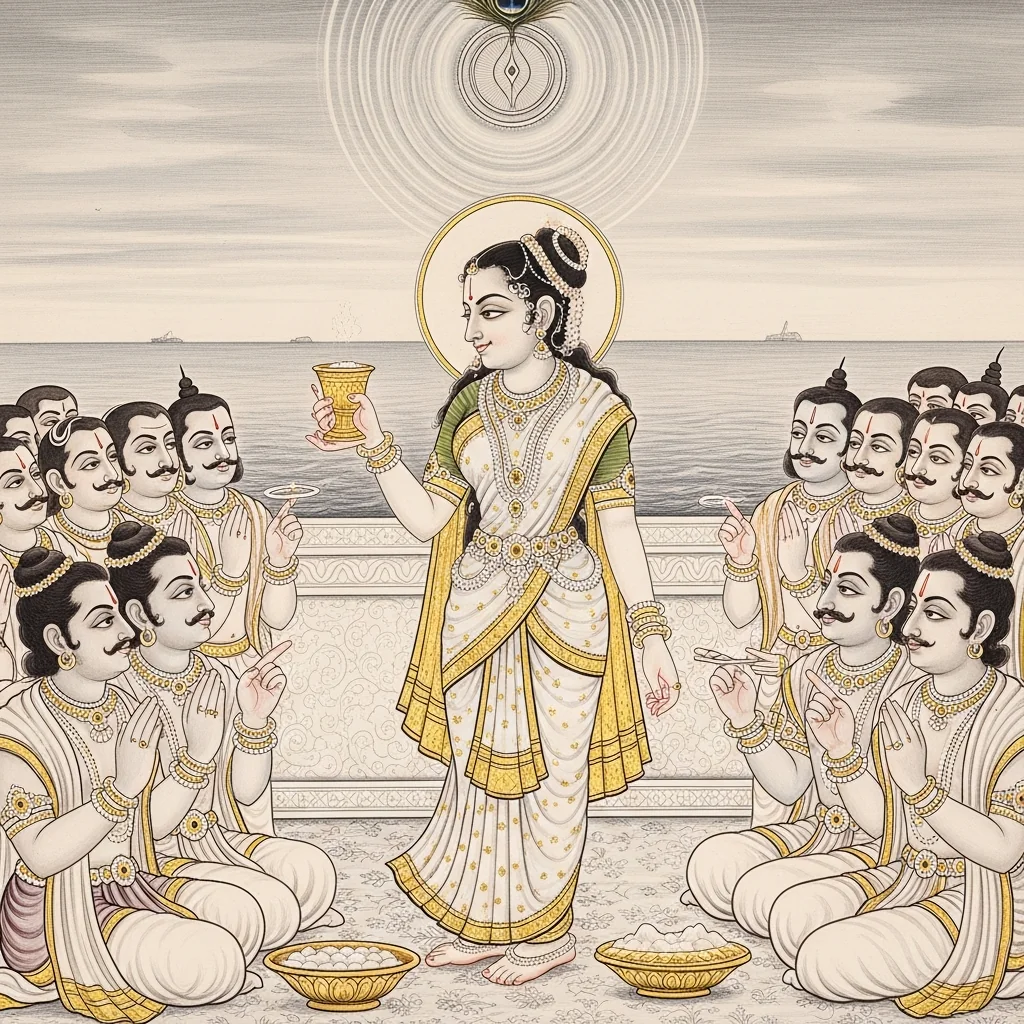
Skanda recounts the crisis that follows Dhanvantari’s appearance bearing the golden vessel of amṛta. The asuras seize it; though admonished with ethical counsel that rightful sharing with the devas accords with dharma, they fall into internal quarrels and fail to drink. Unable to prevail by force, the devas take refuge in Acyuta (Viṣṇu). Viṣṇu assumes the enchanting female form Mohinī, approaches the asuras, and wins their consent to let her distribute the nectar. Seated in rows, Mohinī favors the devas with amṛta. A further complication arises when Rāhu infiltrates the deva line between Sūrya and Candra; recognized, he is beheaded by Viṣṇu’s discus, and later established as a “graha” to stabilize the worlds. With the devas strengthened, battle breaks out on the ocean shore; supported by Viṣṇu and with Nara–Nārāyaṇa present (Nara actively recovering the vessel), the asuras are defeated and retreat. The chapter closes with the devas rejoicing and approaching Śrī, marking the restoration of auspicious order.
Adhyaya 14
Śrī–Nārāyaṇa Vivāha-mahotsavaḥ (The Ceremonial Wedding of Śrī and Nārāyaṇa)
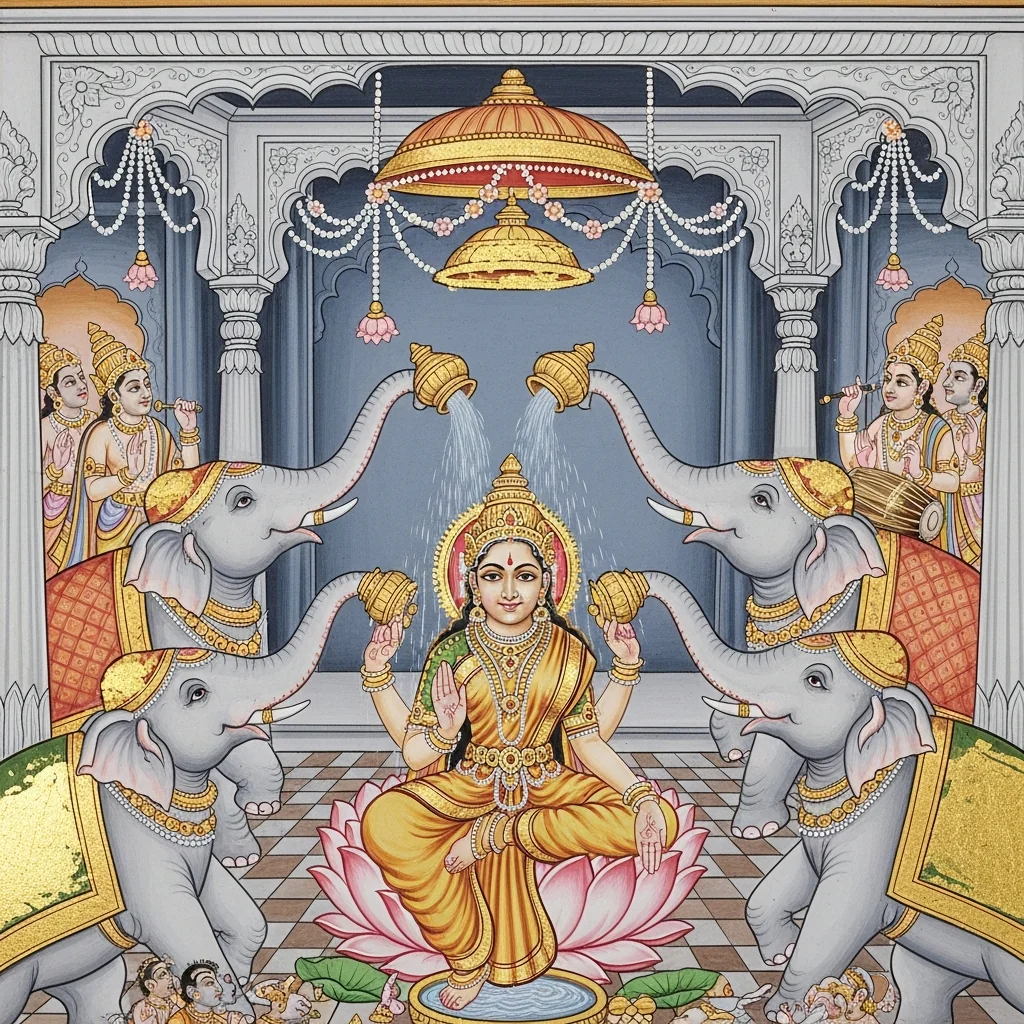
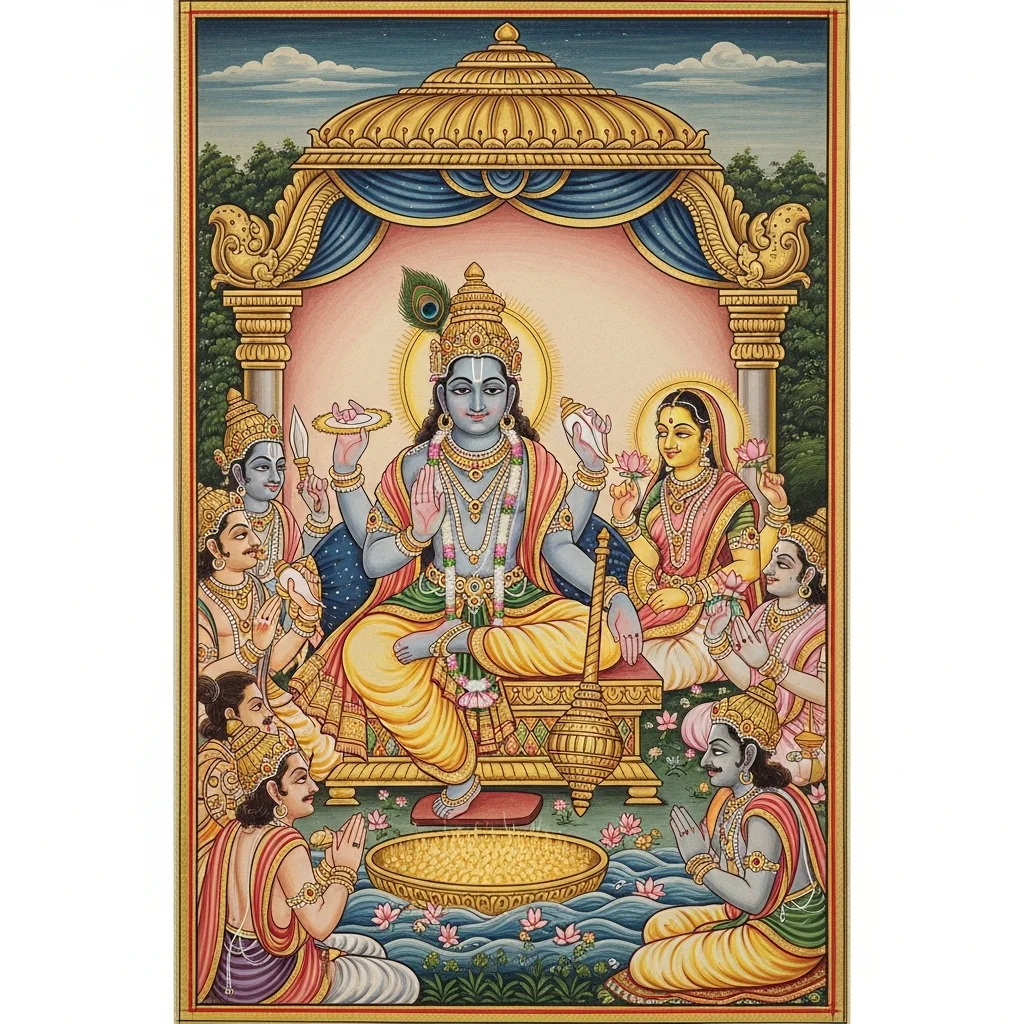
This chapter depicts a vast cosmic convocation that culminates in the wedding rites of Śrī (Lakṣmī) with Nārāyaṇa/Vāsudeva. Skanda recounts the arrival of Brahmā and Śiva, the Manus, Mahārṣis, Ādityas, Vasus, Rudras, Siddhas, Gandharvas, Cāraṇas, and many divine hosts, along with sacred rivers personified as attendant powers. At Brahmā’s command a radiant maṇḍapa is raised, adorned with jeweled pillars, lamps, and festoons. Śrī is ceremonially seated and consecrated; the diggajas bathe her with waters brought from the four oceans as Vedic recitations, music, dance, and auspicious hymns (with Śrī-sūkta allusions) accompany the rite. Deities then bestow gifts in sequence—garments, ornaments, and auspicious articles. The Ocean (Samudra), presented here as Śrī’s father, consults Brahmā about a worthy bridegroom, and Brahmā declares that only Vāsudeva, the supreme Lord, is her fitting spouse. The formal wedding acts—vākdāna and the fire ritual—are performed, with Dharma and Mūrti placed as parental figures by deliberation. The chapter ends with gods and goddesses honoring the divine couple, and with devotional praise that frames the marriage as a model of cosmic harmony and auspicious order.
Adhyaya 15
Adhyāya 15 — Vāsudeva-stutiḥ and Śrī–prasāda (Praise of Vāsudeva and the Restoration of Prosperity)
Chapter 15 unfolds as a polyphonic cycle of hymns within a theological discussion. Many voices—Brahmā, Śaṅkara, Dharma, Prajāpatis, Manus, Ṛṣis, and hosts of gods and beings, along with personified powers such as Sāvitrī, Durgā, the rivers, Earth, and Sarasvatī—offer complementary praises and arguments establishing Vāsudeva as the Supreme. It teaches that bhakti is the decisive cause of lasting enjoyment and liberation; that merit-driven ritual, when cut off from devotion, is limited; that Vāsudeva transcends māyā and even time as the ultimate regulator; and that even socially marginal beings are uplifted through connection with him. The narrative then turns to visible fruit: Vāsudeva acknowledges the gods and instructs Śrī, the Goddess of Prosperity, to cast her gracious gaze upon them. Prosperity is restored throughout the three worlds, and gifts and abundance flow—especially from the ocean’s treasury. The chapter closes with a phalaśruti: hearing or reciting this account grants prosperity to householders and desired attainment to renunciants, ripening bhakti, jñāna, and vairāgya.
Adhyaya 16
नारदस्य गोलोकयात्रा — Nārada’s Journey to Goloka
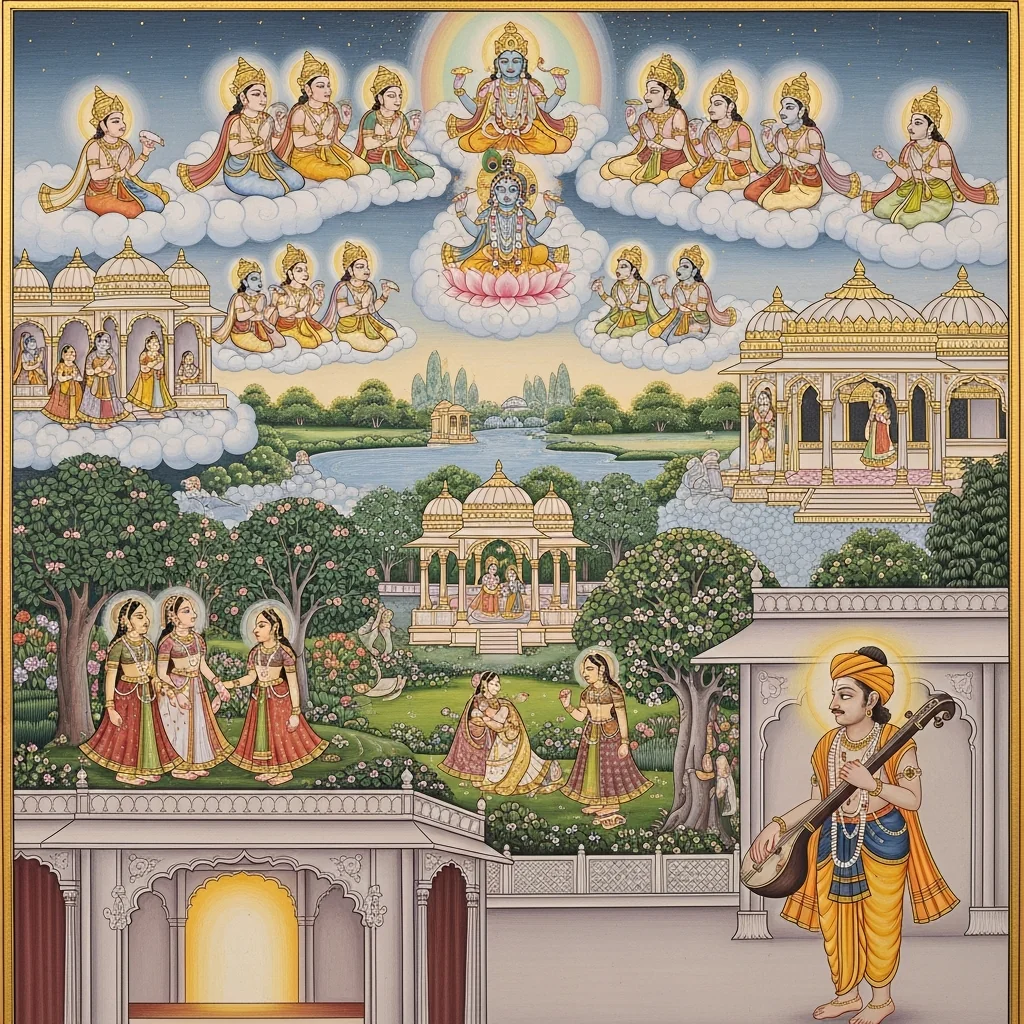
Chapter 16 has Skanda recount Nārada’s visionary ascent. From Mount Meru, Nārada beholds Śvetadvīpa and the liberated devotees (śvetamuktas); fixing his mind on Vāsudeva, he is instantly conveyed to the divine realm. The śvetamuktas recognize his ekāntika-bhakti—exclusive, one-pointed devotion—and respond to his longing to see Kṛṣṇa directly. A śvetamukta, inwardly impelled by Kṛṣṇa, guides him along the celestial route: past the abodes of the devas, beyond the Saptaṛṣis and Dhruva, through Maharloka, Janaloka, and Tapoloka, and even beyond Brahmaloka and the “eight coverings” of the cosmic elements. Nārada reaches an extraordinary Goloka, radiant with the Virajā river, jeweled banks, wish-fulfilling trees, and a many-gated, fortified splendor. The narration expands into a sacred catalogue of architecture and ecology—fragrant groves, divine animals, rāsa-maṇḍapas, innumerable ornamented gopīs, and the celestial Vṛndāvana as the beloved play-region of Kṛṣṇa and Rādhā. At last Nārada arrives at Kṛṣṇa’s wondrous temple complex with layered gates and named gatekeepers; admitted by permission, he beholds an immense inner effulgence, signaling nearness to direct darśana while emphasizing devotional qualification and divinely guided access.
Adhyaya 17
Adhyāya 17 — Nārada’s Vision of Vāsudeva’s Dhāma and Hymn of Praise (नारददर्शन-स्तुति)
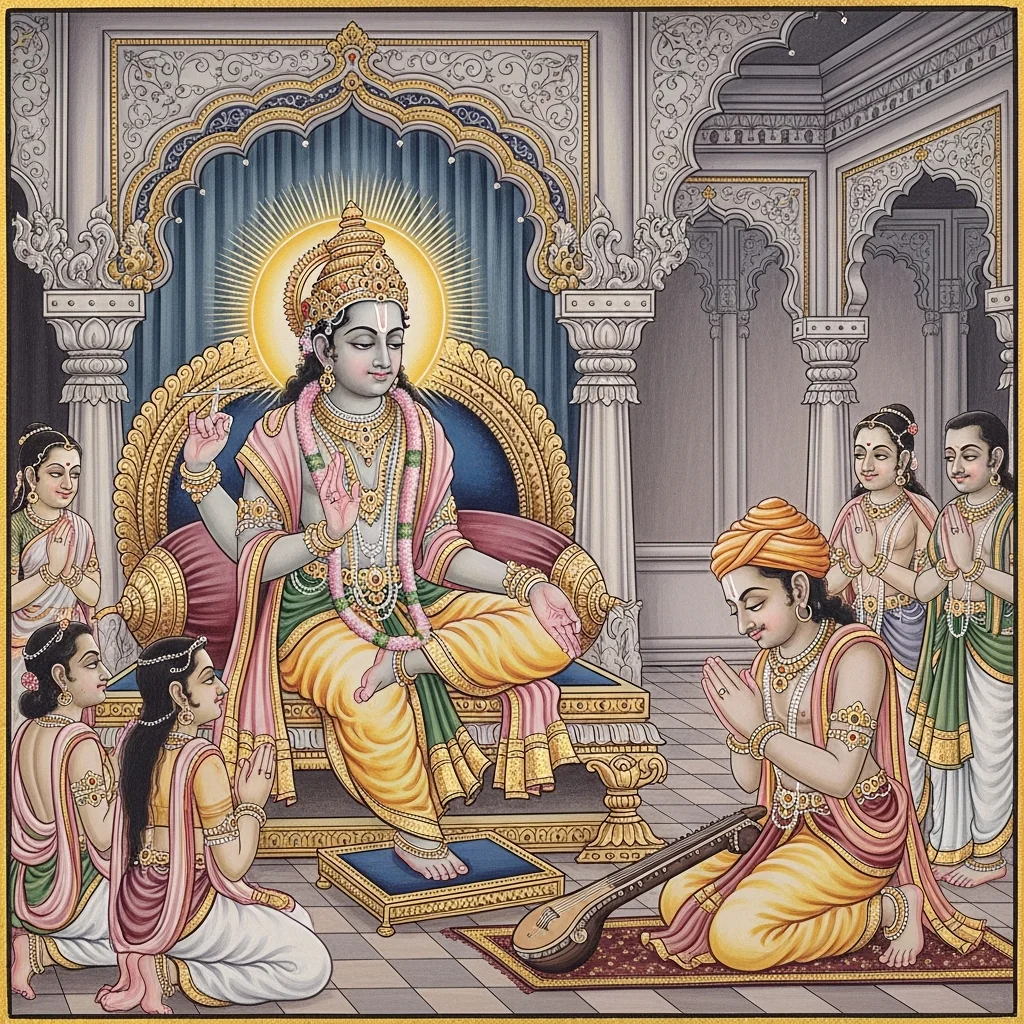
The chapter begins with Skanda describing an overwhelming, all-pervading divine radiance—akṣara-brahman—bearing the mark of sat-cit-ānanda. Yogic adepts are said to behold this reality after transcending the inner psycho-energetic centers (ṣaṭ-cakra) through the grace of Vāsudeva. The narrative then turns to a vivid vision of a wondrous temple and assembly hall, built of jewels and radiant pillars. There the seer beholds Kṛṣṇa/Nārāyaṇa established as the nirguṇa Lord, hailed by many sacred names such as paramātman, para-brahman, Viṣṇu, and Bhagavān. A lavish iconographic portrait follows—youthful beauty, ornaments and crown, lotus-like eyes, sandal fragrance, the Śrīvatsa mark, the flute, and the attendance of Rādhā and other revered beings—along with personified virtues and divine weapons. The chapter culminates in Nārada’s prostration and hymn of praise (stuti), declaring bhakti superior to other means for purification and liberation and praying for unwavering devotion; Skanda concludes by noting the Lord’s gracious reply in nectar-like speech.
Adhyaya 18
Vāsudeva-Darśana, Bhakti-Lakṣaṇa, and Avatāra-Pratijñā (वासुदेवदर्शन–भक्तिलक्षण–अवतारप्रतिज्ञा)
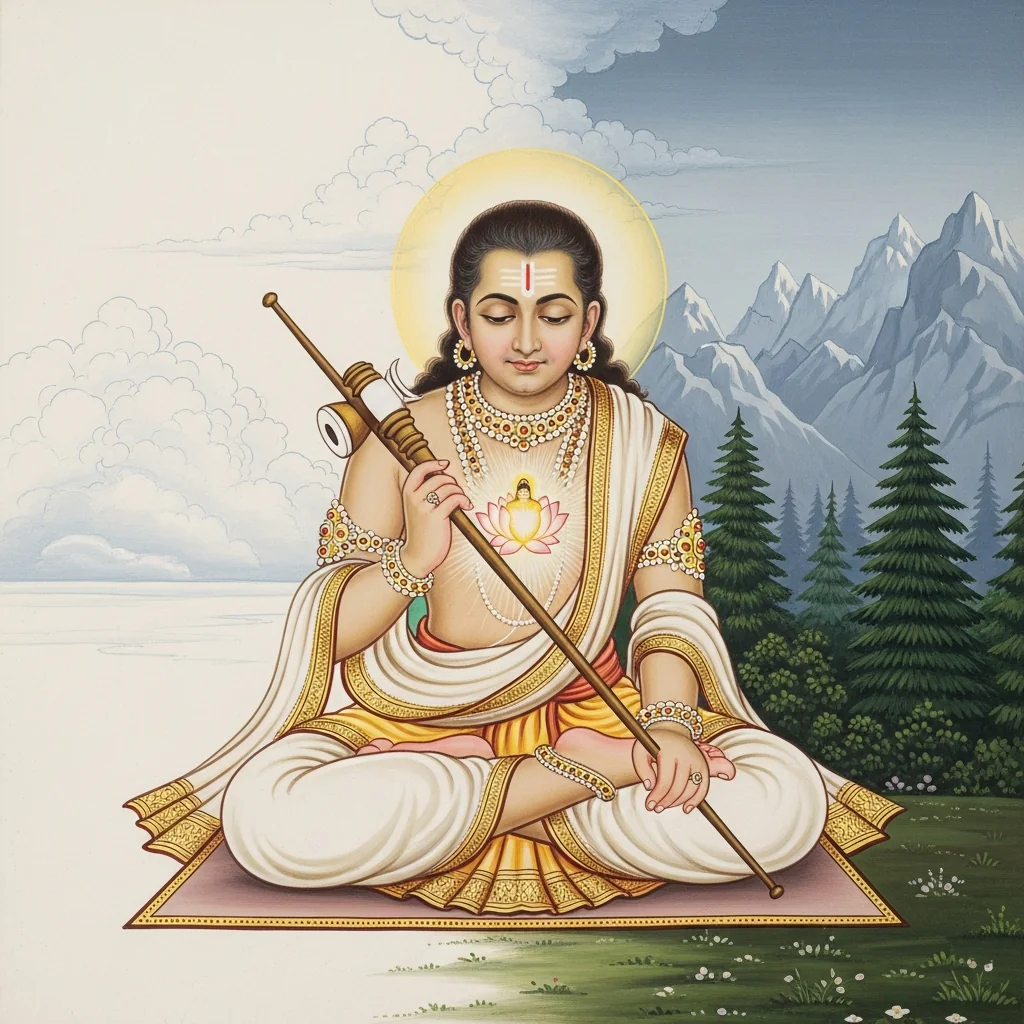
Chapter 18, as reported by Skanda, gives a layered theological instruction. Bhagavān tells Nārada that the granted darśana arises from nitya-ekāntika bhakti and humility free of pride, upheld by ethical disciplines—ahiṃsā, brahmacarya, svadharma, renunciation, self-knowledge, sat-saṅga, aṣṭāṅga-yoga, and restraint of the senses. Vāsudeva then reveals His identity across abodes and functions: as the giver of karmic fruits and the indwelling antaryāmin; as the four-armed Lord in Vaikuṇṭha with Lakṣmī and His attendants; and as the One who grants periodic vision to the devotees of Śvetadvīpa. The discourse unfolds an avatāra timeline: the creation of Brahmā and empowerment for cosmic rule, followed by manifestations—Varāha, Matsya, Kūrma, Narasiṃha, Vāmana, Kapila, Dattātreya, Ṛṣabha, Paraśurāma, Rāma, Kṛṣṇa with Rādhā and Rukmiṇī, Vyāsa, Buddha as a delusive strategy against adharmic forces, a dharma-restoring birth in Kali, and Kalki. Bhagavān promises to manifest again and again whenever Veda-grounded dharma declines. When offered a boon, Nārada asks for unceasing eagerness to sing the divine qualities. Bhagavān grants him a vīṇā and directs him to Badarī for worship, stressing that sat-saṅga and surrender are decisive means for liberation from bondage. The chapter closes with Nārada’s devotional journey through Śvetadvīpa and onward toward Meru and Gandhamādana, proceeding into the vast Badarī region.
Adhyaya 19
Nārada’s Reception by Nara-Nārāyaṇa and Instruction on Ekāntikī Bhakti and Tapas (नरनारायण-नारद-संवादः)
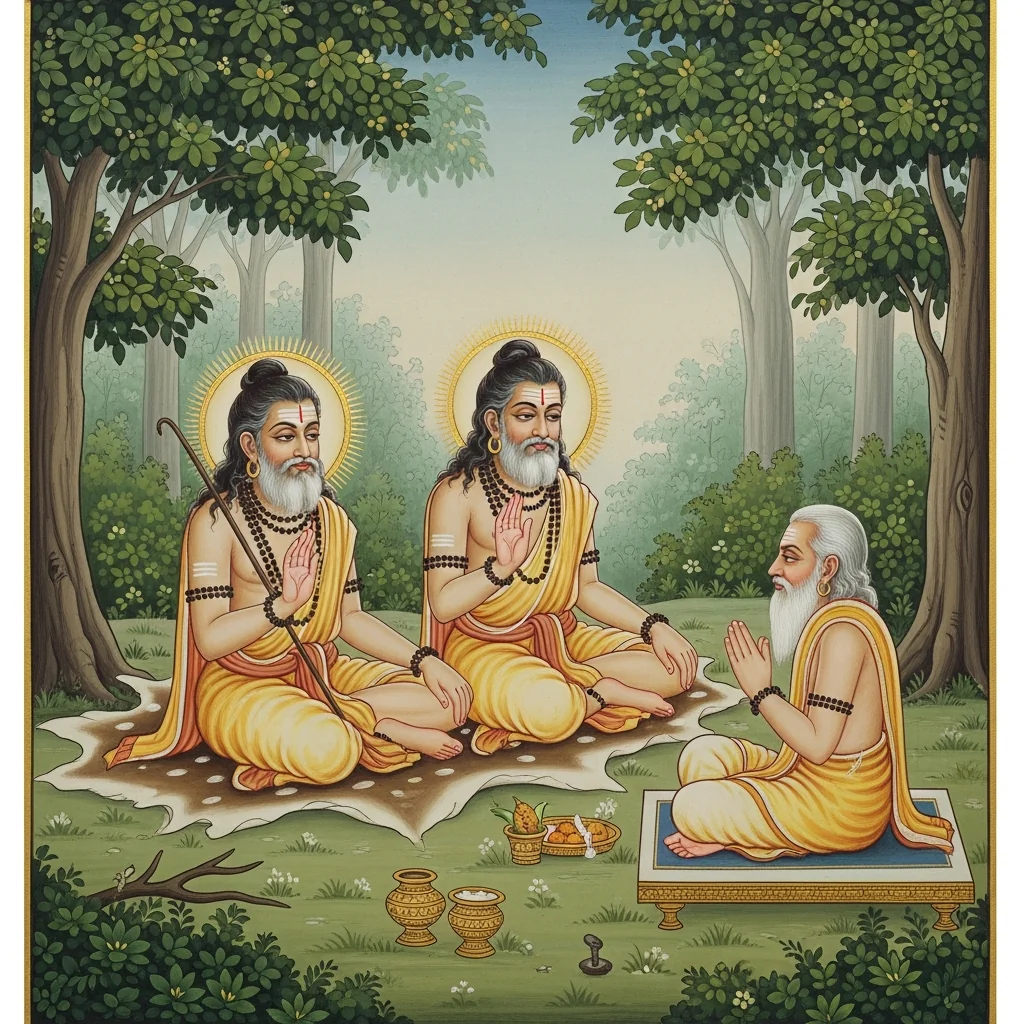
Skanda recounts Nārada’s meeting with the ancient ascetic pair Nara and Nārāyaṇa, radiant beyond measure and marked by sacred signs such as the Śrīvatsa, lotus and discus emblems, and matted locks. Approaching with vinaya (humility), Nārada circumambulates and prostrates; the two ṛṣis complete their morning observances, honor him with pādya and arghya, and offer him a seat—an ideal of ritual hospitality and righteous decorum. Nārāyaṇa then asks about Nārada’s vision of the supreme Paramātman in the Brahma-realm. Nārada attributes his sight of Vāsudeva in the imperishable abode (akṣaradhāman) to divine grace and says he was sent to serve them. Nārāyaṇa affirms how rare such a vision is, teaching that ekāntikī bhakti—exclusive, single-pointed devotion—grants access to the all-causal Lord, who is guṇātīta, eternally pure, and beyond material categories of form, color, age, or condition. The discourse ends with a practical command: Nārada should undertake dharmic, one-pointed tapas to become purified and understand the Lord’s greatness more fully. Tapas is declared the heart of attainment, and the Lord is not “reached” without intense ascetic effort. Skanda closes by noting Nārada’s joyful resolve to perform austerities.
Adhyaya 20
Ekāntika-dharma and Varṇāśrama-Sadācāra (एकान्तिकधर्मः वर्णाश्रमसदाचारश्च)
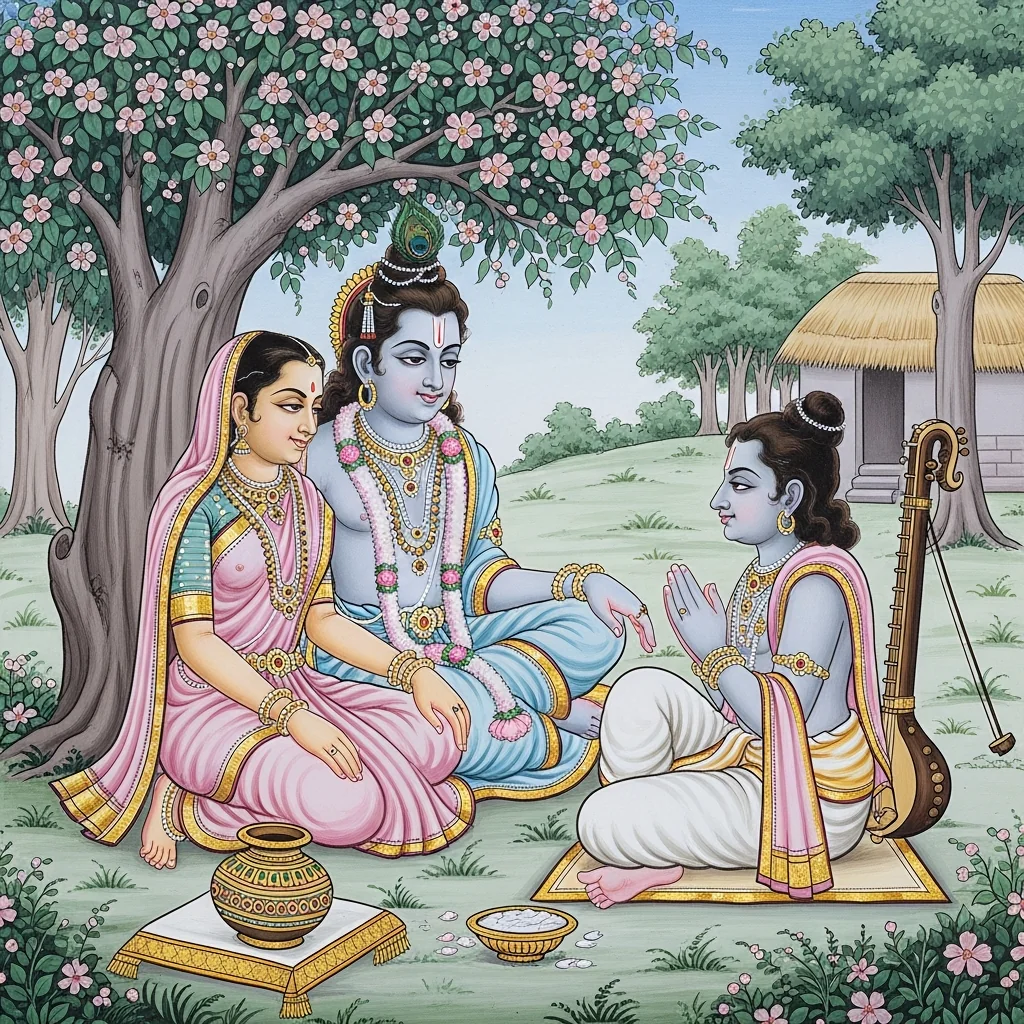
Chapter 20 begins with Nārada asking for the Lord-approved “ekānta” dharma—what always pleases Vāsudeva. Śrī Nārāyaṇa affirms the purity of Nārada’s intent and teaches this as a timeless doctrine, defining ekāntika-dharma as exclusive devotion (bhakti) to Īśvara together with Lakṣmī, upheld by svadharma, true knowledge, and detachment. Nārada then inquires into the distinct marks of svadharma and allied principles, acknowledging Nārāyaṇa as the root of all śāstra. The chapter sets forth dharma in two registers: (1) universal virtues for all people—ahiṃsā, non-hostility, truthfulness, tapas, inner and outer purity, non-stealing, restraint of the senses, avoidance of intoxicants and misconduct, Ekādaśī fasting with the yamas, observance of Hari’s birth festivals, straightforwardness, service to the good, sharing of food, and bhakti; and (2) varṇa-specific duties for brāhmaṇa, kṣatriya, vaiśya, and śūdra, including norms of livelihood and conduct in emergencies. It extols sat-saṅga as liberative, warns against keeping company with the unethical, and declares the grave consequences of harming sādhus, brāhmaṇas, and cows—honoring them as seats of sacred worth like tīrthas. The chapter closes by indicating a transition to the dharmas of the āśramas.
Adhyaya 21
ब्रह्मचारिधर्मनिरूपणम् (Brahmacāri-dharma: Normative Guidelines for the Student Stage)
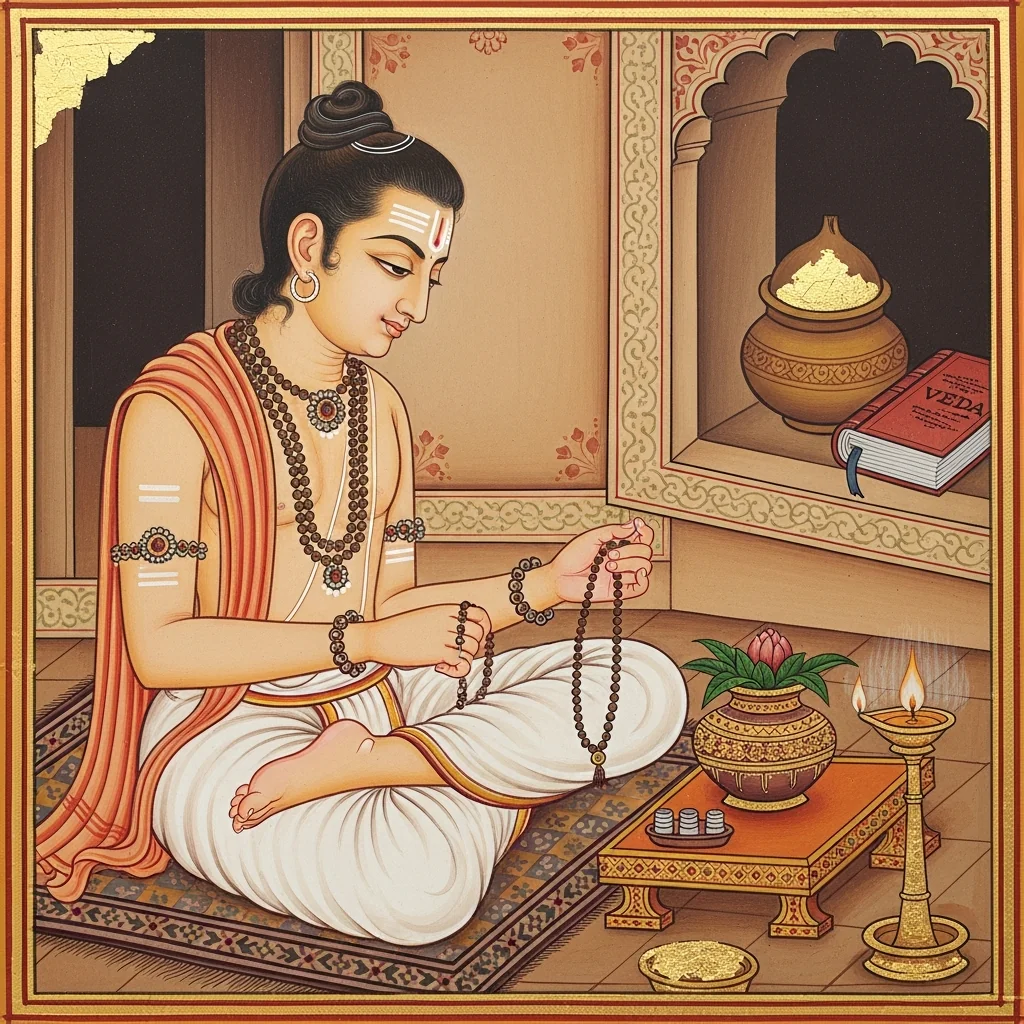
This chapter, spoken by Śrī Nārāyaṇa, classifies the four āśramas (brahmacārin, gṛhastha, vānaprastha, yati) and then sets forth the dharma of the brahmacārin as a dvija refined by the saṃskāras. It prescribes study and residence—Veda study while living in the guru’s house—and commends virtues such as śauca (purity), self-control, truthfulness, and humility. It enumerates daily duties: morning and evening homa, a regulated alms-round, tri-kāla sandhyā, and daily worship of Viṣṇu. Obedience to the guru, moderation in food, and conduct-rules that uphold restraint and purity are detailed, including silence during bathing, eating, homa, and japa; limits on grooming and display; and avoidance of intoxicants and meat. A substantial section lays down strict boundaries against eroticized attention—avoiding looking at, touching, conversing with, or mentally dwelling on women with desire—while still maintaining respectful behavior toward the guru’s wife. The chapter closes with guidance on life transitions after study (renunciation or continued disciplined studentship), notes that certain lifelong-student vows are not eligible in Kali-yuga, and lists four forms of brahmacarya (prājāpatya, sāvitra, brāhma, naiṣṭhika) to be adopted according to one’s capacity.
Adhyaya 22
गृहस्थ-स्त्रीधर्म-दान-तीर्थकाल-नियमाः (Householder and Women’s Dharma; Charity; Sacred Places and Times)
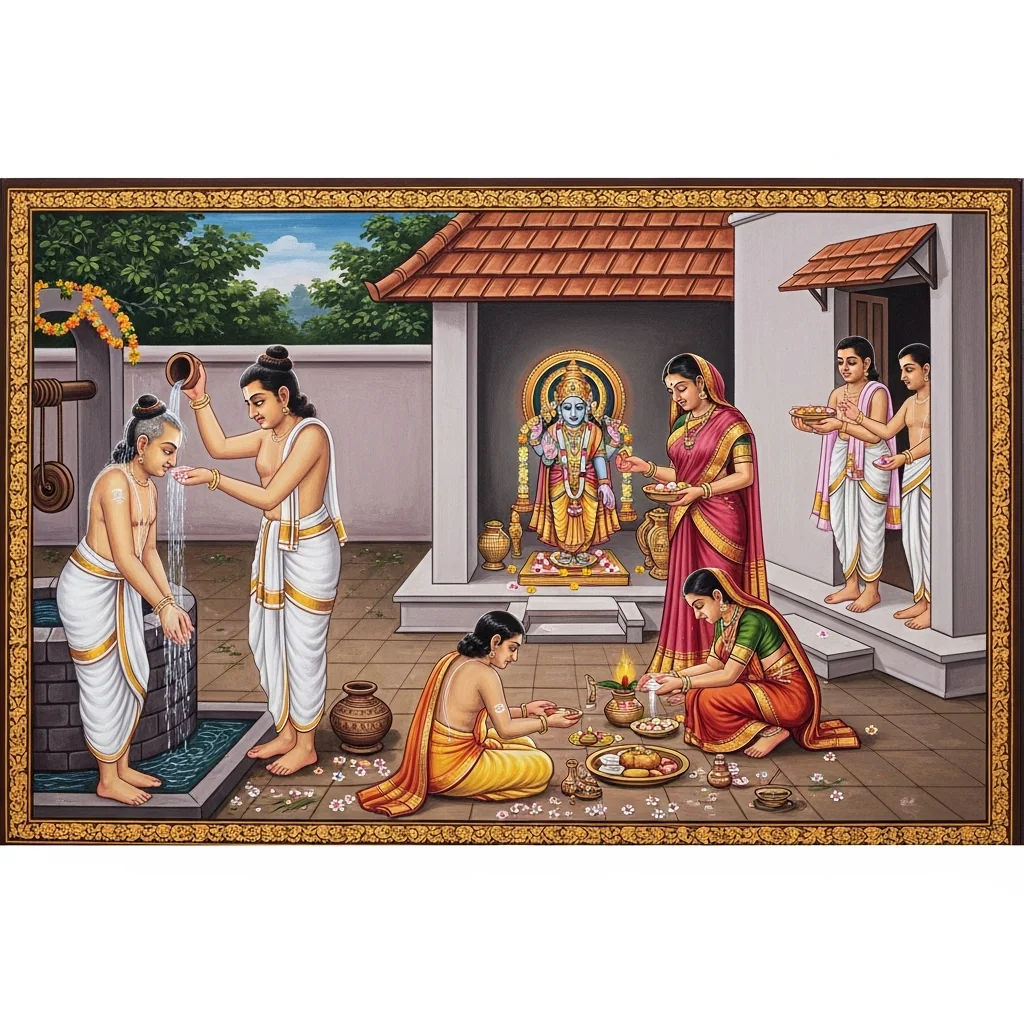
Chapter 22 records Nārāyaṇa’s normative instruction to Nārada, arranging Vaiṣṇava household life as a graded set of duties directed to Kṛṣṇa/Vāsudeva. It opens with the student’s return to worldly life: offering guru-dakṣiṇā and entering gṛhastha through a socially sanctioned marriage. It then details nitya-karma—bathing, sandhyā, japa, homa, svādhyāya, Viṣṇu-pūjā, tarpaṇa, vaiśvadeva, and hospitality—together with ethical restraints: ahiṁsā, avoidance of intoxicants and gambling, and discipline of speech and conduct. Norms of association are given: seek sādhus and bhāgavatas, and avoid exploitative or destabilizing company. A major portion treats purity and socio-ritual caution, including śrāddha guidelines (few invitees, vegetarian offerings, emphasis on ahiṁsā) and the triad deśa–kāla–pātra, listing tīrthas, rivers, and auspicious times (ayana, viṣuva, grahaṇa, ekādaśī/dvādaśī, manvādī/yugādī, amāvāsyā, pūrṇimā, aṣṭakā, birth stars, and festival days). It defines the satpātra as a devotional recipient in whom Viṣṇu is conceptually present, and commends public-benefit Vaiṣṇava works—temples, water reservoirs, gardens, and feeding. The chapter concludes with a concise delineation of women’s dharma: pativratā ideals, a widow’s devotional discipline, and avoidance of risky private situations, framed as ethical guidance within the broader regulation of household life.
Adhyaya 23
वानप्रस्थ-यति-धर्मनिर्णयः | Vānaprastha and Yati Dharma: Norms of Forest-Dwelling and Renunciation
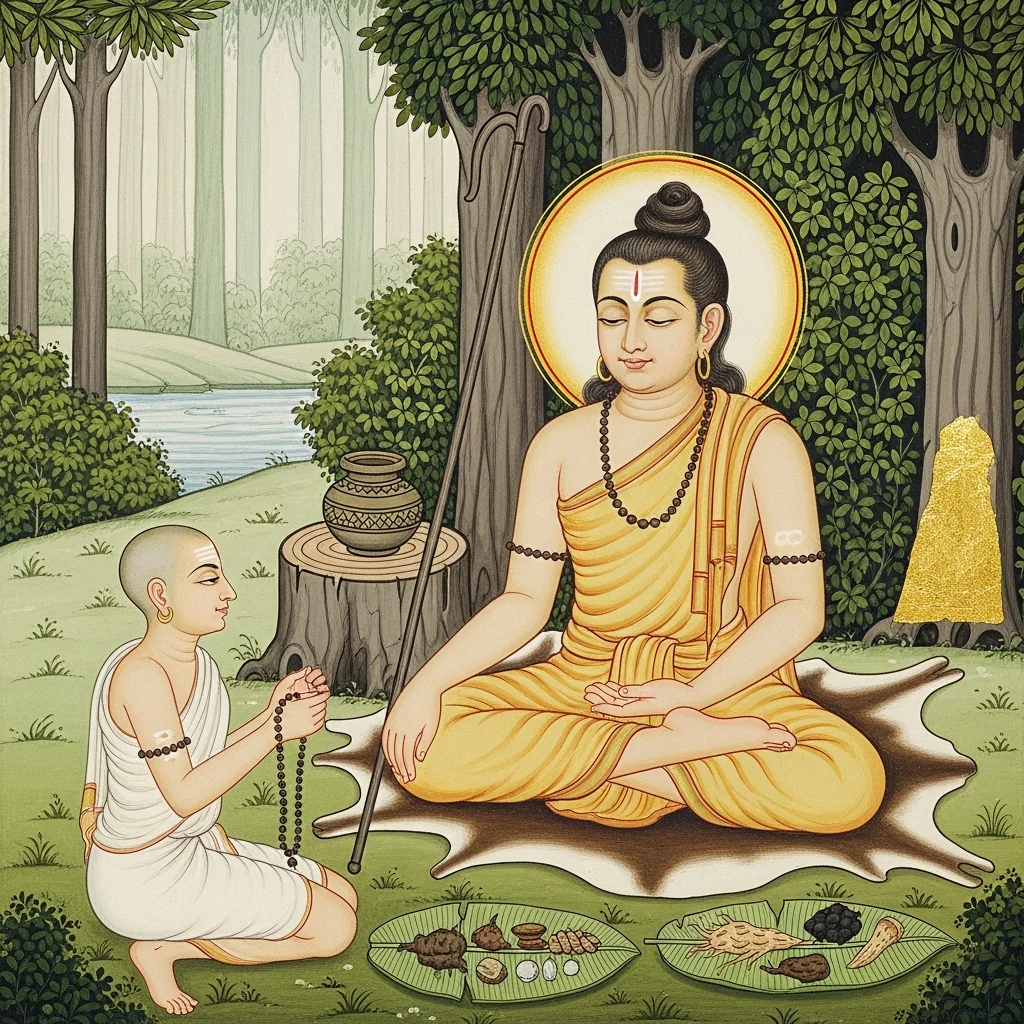
Chapter 23 records Śrī Nārāyaṇa’s prescriptive teaching on the third and fourth āśramas: vānaprastha (forest-dweller) and saṃnyāsa/yati (renunciant). It defines vānaprastha as the third life-stage, gives conditions for entering the forest, and explains the spouse’s role—she may accompany if spiritually fit; otherwise her support and protection should be duly arranged. It then lays out forest austerities and rules of subsistence: fearlessness with vigilance, simple shelter, seasonal disciplines (heat-penance, winter exposure, monsoon observances), clothing of bark/skins/leaves, and reliance on forest produce and ṛṣi-grains. Regulations are given for cooking, the timing of food collection, and avoiding cultivated food except in necessity. The chapter also prescribes care of ascetic implements (daṇḍa, kamaṇḍalu, agnihotra items), minimal grooming, sleeping on the ground, and adapting austerity to place, time, and bodily capacity. Forest-dwellers are classified into four types (phenapa, audumbara, vālakhīlya, vaikhanasa), with possible durations before taking saṃnyāsa, and permission for immediate renunciation when dispassion is intense. The renunciant code follows: minimal clothing, regulated alms-round, freedom from taste-addiction, purity disciplines, daily Viṣṇu-pūjā, mantra-japa of the dvādaśākṣara and/or aṣṭākṣara, rejection of false speech and livelihood-based storytelling, study of sound śāstra on bondage and liberation, non-accumulation (even monasteries not as possessions), and abandonment of egoism and possessiveness. Strong cautions are given against women, wealth, adornment, fragrances, and sensory temptations; six defects—kāma, lobha, rasa-āsvāda, sneha, māna, krodha—are named as saṃsāra-producing and to be abandoned. Concluding with āśrama/varṇa outcomes, it affirms that those who practice these disciplines with devotion to Śrī Viṣṇu attain Viṣṇuloka at death.
Adhyaya 24
अध्याय २४: ज्ञानस्वरूप-वर्णनम्, वैराजपुरुष-सृष्टि, ब्रह्मणो तपः-वैष्णवदर्शनम् (Chapter 24: On the Nature of Knowledge, Virāṭ-Puruṣa Cosmogenesis, and Brahmā’s Tapas with the Vision of Vāsudeva)
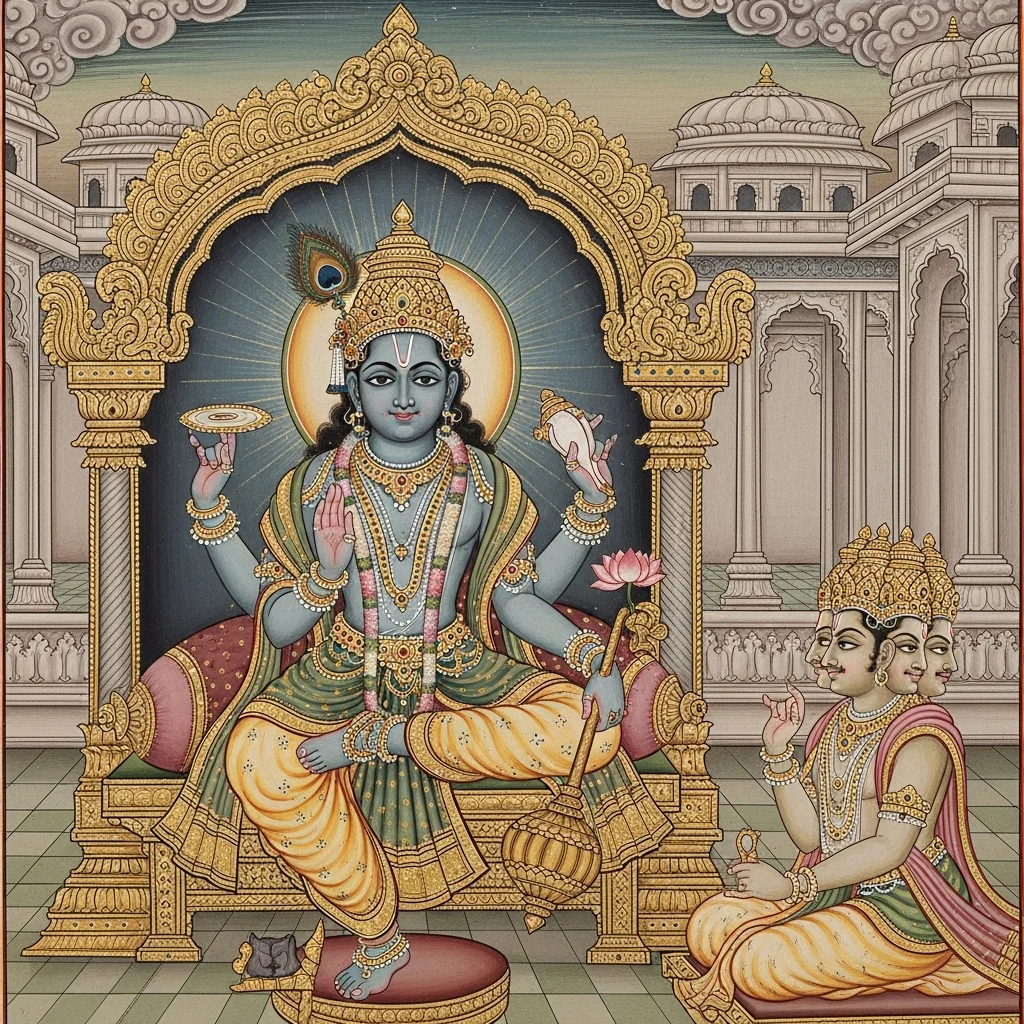
Nārāyaṇa defines “knowledge” as discriminative understanding (viveka) by which kṣetra and its related categories are rightly known. He then proclaims Vāsudeva as the supreme brahman—originally one, non-dual, nirguṇa—and describes the arising of māyā with kāla-śakti; from their agitation countless cosmic eggs come forth. Within a single brahmāṇḍa, evolution proceeds through mahat, ahaṅkāra, and the tri-guṇa arrangement, producing tanmātras, mahābhūtas, indriyas, and divine functions; together these constitute the Virāṭ body, the support of the moving and unmoving world. From Virāṭ arise Brahmā (rajas), Viṣṇu (sattva), and Hara (tamas), along with their śaktis—Durgā, Sāvitrī, and Śrī—whose partial manifestations proliferate. Brahmā, at first bewildered upon the lotus in the single ocean, undertakes long inquiry and tapas in response to the imperceptible command “tapo tapo,” and is granted a vision of Vaikuṇṭha where guṇas and māyā-born fear do not operate. There he beholds four-armed Vāsudeva with divine attendants, receives the boon of prajā-visarga-śakti, and is instructed to create while maintaining meditative identity with Virāṭ. Brahmā then orders creation: sages, Rudra’s emergence from anger, prajāpatis, the Vedas, varṇas and āśramas, beings and worlds, and the proper allotment of sustenance and offerings (havis/kavya) for devas, pitṛs, and other classes. The chapter closes by stressing cyclical variation across kalpas, Vāsudeva’s avatāra principle for restoring disrupted boundaries, and a final definition of knowledge as discerning the marks of kṣetra, kṣetrajña, prakṛti–puruṣa, māyā, kāla-śakti, akṣara, and paramātman.
Adhyaya 25
वैराग्यलक्षण-प्रलयचतुष्टय-नवधा भक्त्युपदेशः (Marks of Dispassion, Fourfold Dissolution, and Instruction in Ninefold Devotion)
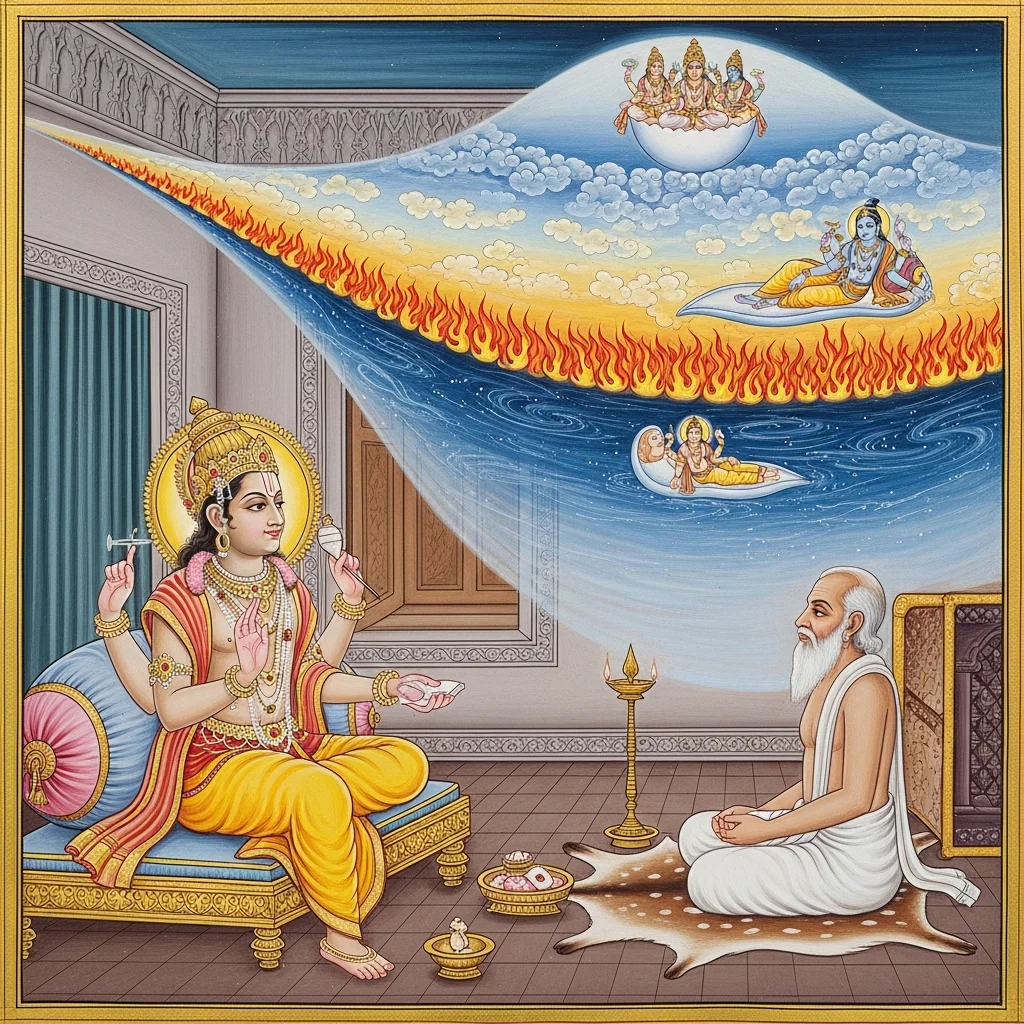
Chapter 25 is a tightly structured theological teaching delivered by Śrī Nārāyaṇa to a sage. It opens by defining vairāgya (dispassion) as a sustained lack of interest in perishable objects, supported by multiple pramāṇas—perception, inference, and scriptural testimony—showing the unreliability of conditioned forms. It then sets out four time-governed dissolutions (pralaya): (1) the “daily” or constant decay seen in bodily change and recurring suffering; (2) naimittika pralaya aligned with Brahmā’s day–night cycle, describing the succession of fourteen Manus, the drying of worlds, cosmic fire, and the ensuing inundation; (3) prākṛtika pralaya as the stepwise reabsorption of elements and faculties into prakṛti; and (4) ātyantika pralaya as the final cessation in which māyā, puruṣa, and time withdraw into the imperishable, leaving the One Lord alone. Having established impermanence and cosmic retraction, the chapter turns to practice: exclusive devotion to Vāsudeva is defined, the nine modes of bhakti are enumerated, and “ekāntika dharma” is praised as the most effective liberation-oriented discipline. It concludes with a strong Vāsudeva-centered fruit statement affirming the salvific power of the divine Name even when uttered imperfectly.
Adhyaya 26
Kriyāyoga and the Procedure of Vāsudeva-Pūjā (क्रियायोगः—वासुदेवपूजाविधिः)
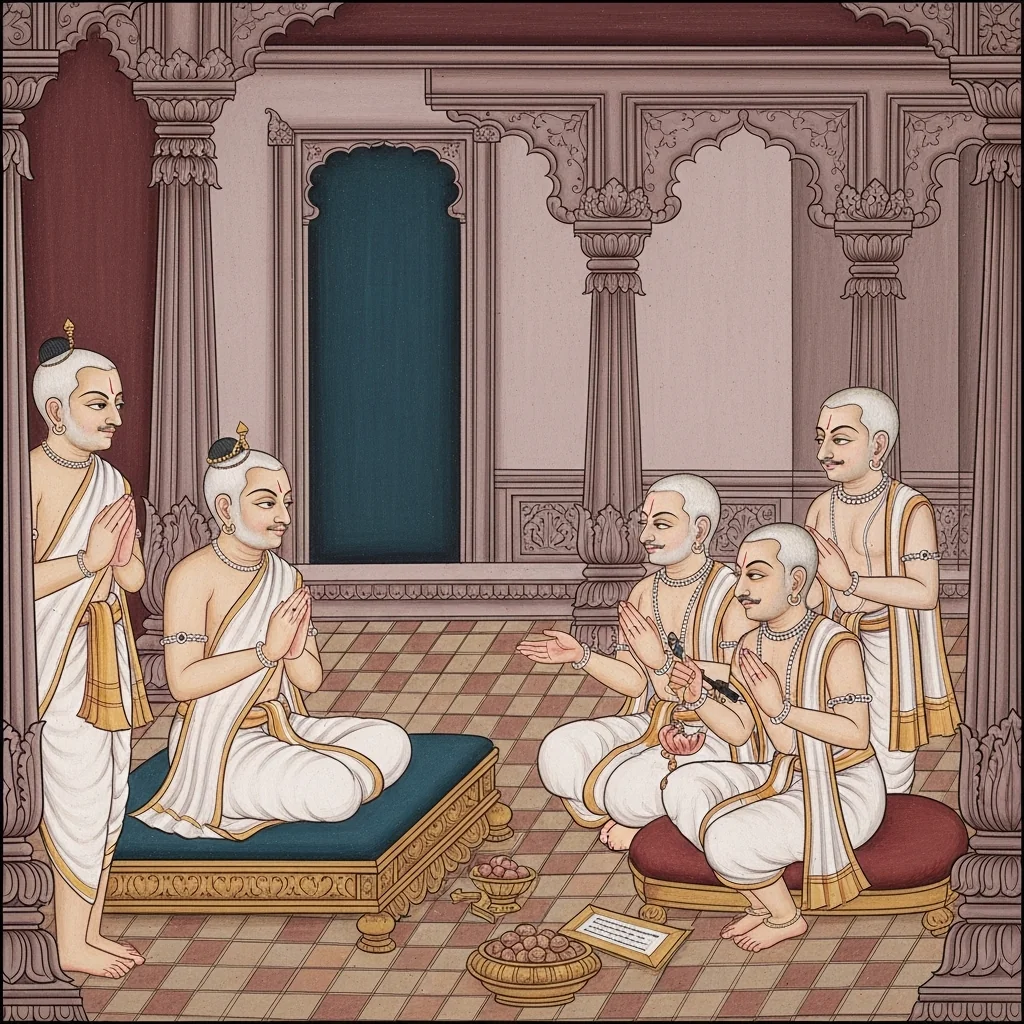
Chapter 26 begins with Skanda recounting Nārada’s renewed question after hearing the teaching on ekāntika-dharma. Nārada asks for a clear account of the practical discipline (kriyā-yoga) that leads to spiritual attainment. Nārāyaṇa replies that kriyā-yoga is specifically the procedure of worship of Vāsudeva (Vāsudeva-pūjā-vidhi), well attested in Veda, Tantra, and Purāṇa, and adaptable according to a devotee’s capacity and inclination. The chapter explains eligibility for Vaiṣṇava dīkṣā across varṇas and āśramas, the use of the root-mantra (mūla-mantra) identified as Śrī Kṛṣṇa’s six-syllable mantra, and the need for sincere, non-deceptive bhakti while continuing one’s social-religious duties. It gives criteria for choosing a guru, prescribes outward marks such as tulasī-mālā and ūrdhva-puṇḍra with gopīcandana, and sets out a daily regimen: rising early, inward meditation on Keśava, cleanliness and bathing, sandhyā/homa/japa, and careful procurement of pure offerings. It further details iconographic choices for Vāsudeva/Kṛṣṇa images—materials, colors, two-armed or four-armed forms, attributes like flute, cakra, śaṅkha, gadā, and padma—and the placement of Śrī (Lakṣmī) or Rādhā. Fixed (acala) and movable (cala) images are distinguished, with guidance on when invocation/dismissal (āvāhana/visarjana) is not performed and cautions for handling certain types. The conclusion stresses that devotion and faith are decisive: even simple water offered with sincerity pleases the indwelling Lord, whereas lavish gifts without faith do not yield spiritual joy; therefore daily arcana to Kṛṣṇa is recommended for the devotee’s welfare.
Adhyaya 27
Pīṭha-Padma-Maṇḍala: Vāsudeva-Sthāpanākrama (Ritual Layout for Installing Vāsudeva)
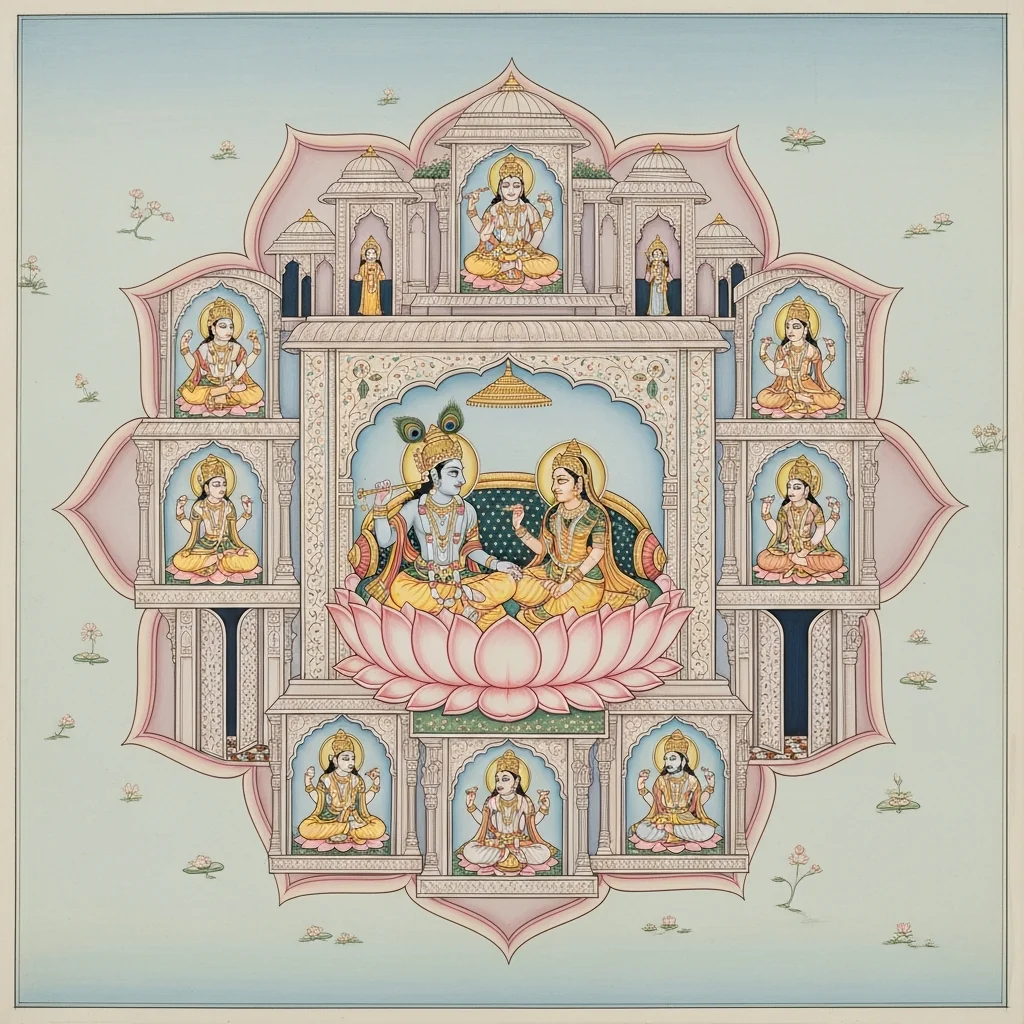
Chapter 27 sets out a technical ritual map for constructing and populating a consecrated worship-field. After purifying the ground, the officiant installs a four-footed pedestal (pīṭha), assigns directional supports and the principles Dharma, Jñāna, Vairāgya, and Aiśvarya, and then correlates the inner faculties (manas, buddhi, citta, ahaṅkāra) and the three guṇas with the pīṭha’s structure. A series of śaktis beginning with Vimalā is installed in paired, ornamented, musically characterized, direction-based placements. Above the pīṭha a “white island” field is formed, and an eight-petaled lotus is drawn with concentric divisions, gates, and color-coded directional architecture. At the center Śrī Kṛṣṇa is स्थापित with Rādhā, with Saṅkarṣaṇa, Pradyumna, and Aniruddha arranged around, followed by the systematic placement of sixteen avatāra-figures along eight lotus filaments. The chapter proceeds to install attendants (pārṣadas), the eight siddhis, personified Vedas and śāstras, paired sages with their consorts, and then outer rings of dikpālas and grahas in their respective directions. It concludes with the placement of Vāsudeva’s aṅga-devatās and related icon-forms, completing the sacred mandala of worship.
Adhyaya 28
वासुदेवपूजाविधिः तथा राधाकृष्णध्यानवर्णनम् / Procedure of Vāsudeva Worship and the Visualization of Rādhā-Kṛṣṇa
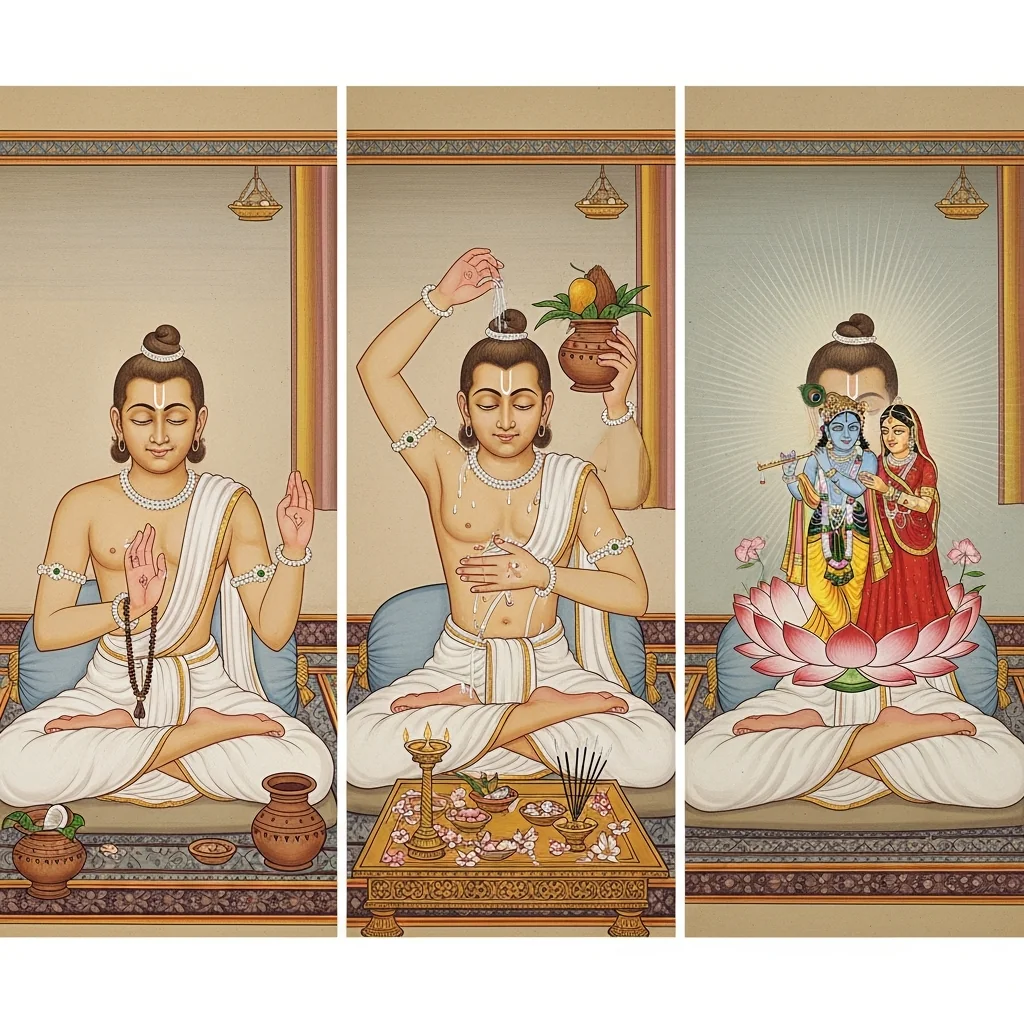
Chapter 28 lays out a step-by-step liturgical structure for worship of Vāsudeva. It opens with preparatory purification—ācamana and prāṇāyāma—followed by steadiness of mind, the formal declaration of deśa-kāla (ritual place and time), and salutations to one’s chosen deity. The worshipper then makes a saṅkalpa to perform the rite for the focused fulfillment of dharma, and undertakes nyāsa with prescribed Vaiṣṇava mantras. The text distinguishes mantra options by eligibility, giving sets for dvijas and an alternative triad for others, and affirms their use for both nyāsa and homa. The rite proceeds with nyāsa upon the icon and upon one’s own body, cleansing the arcā, placing a kalaśa to the left, invoking tīrthas, and offering upacāras with gandha and puṣpa. After sprinkling (prokṣaṇa), honoring conch and bell, and completing bhūtaśuddhi, the practitioner internalizes purification by “burning” the sin-constituted embodiment through inner fire and wind, and contemplates unity with brahman. The chapter then turns to dhyāna: visualization of the heart-lotus, the upward drawing of energies, and a detailed iconographic meditation on Śrī Kṛṣṇa as Rādhikāpati, followed by meditation on Rādhā. It culminates in worship of the Lord together with her.
Adhyaya 29
महापूजाविधानम् (Mahāpūjā-vidhāna) — The Prescribed Sequence of Great Worship
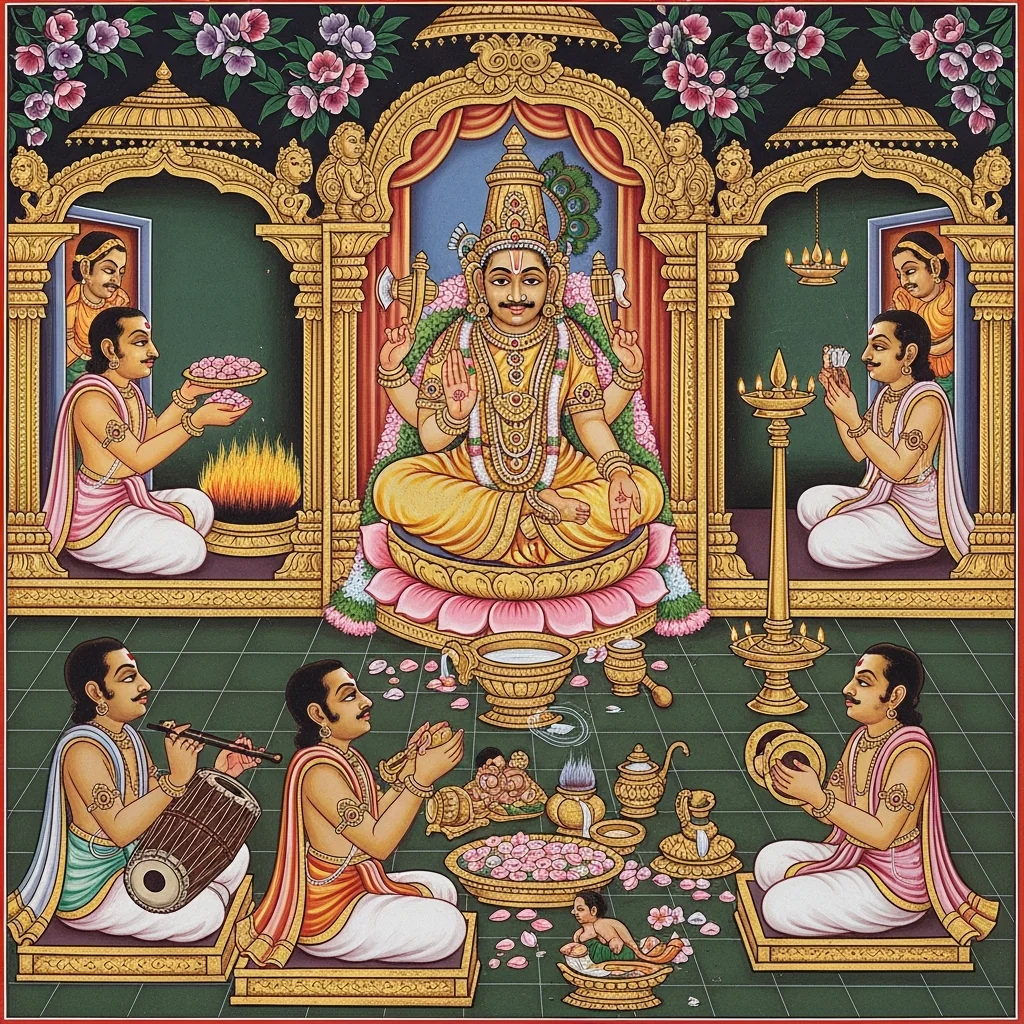
This chapter sets out a step-by-step liturgical order for the Great Worship (Mahāpūjā) of Hari, explicitly including Rādhā–Kṛṣṇa. It begins with inward reverence, formal invocation and installation in the icon (āvāhana, sthāpana), and the calling of attendant limb-deities (aṅga-devatā). Auspicious sound is raised with bell and instruments, followed by hospitality-style services—pādya, arghya, ācamana—and the preparation of arghya substances. A structured bathing sequence follows: scented water, oil massage, uḍvartana, and multi-substance abhiṣeka with milk, curd, ghee, honey, and sugar, accompanied by mantras and Vedic/Purāṇic hymns such as the Śrī-sūkta and Viṣṇu-sūkta, along with the Mahāpuruṣa-vidyā. The rite then prescribes clothing, sacred thread, ornaments, seasonal tilaka, and flower/tulasī worship with recitation of divine names. Worship continues with incense, lamps, major naivedya (with a catalog of foods), water offerings, handwashing, handling of remnants (prasāda), tāmbūla, fruit, dakṣiṇā, and ārati with music. It concludes with praise, kīrtana, dance, circumambulation, and prostrations (aṣṭāṅga/pāñcāṅga, with gender-specific guidance), ending with prayers for protection from saṃsāra, daily svādhyāya, ritual dismissal (visarjana) of invoked forms, and resting the icon. Phala statements promise nearness to Viṣṇu as a pārṣada, ascent to Goloka, and attainment of dharma–kāma–artha–mokṣa even when worship is desire-motivated. Extra merit is assigned to temple building and endowments that sustain worship, with karmic participation shared among patron, performer, helper, and approver, and a warning against misusing endowed offerings. The closing stresses that without a focused mind external ritual bears diminished fruit, and that even learned ascetics do not reach siddhi without Hari’s worship.
Adhyaya 30
मनोनिग्रह-उपायः — वासुदेवभक्त्या अष्टाङ्गयोग-संग्रहः (Chapter 30: Mind-Discipline through Vāsudeva Devotion and the Aṣṭāṅga-Yoga Compendium)
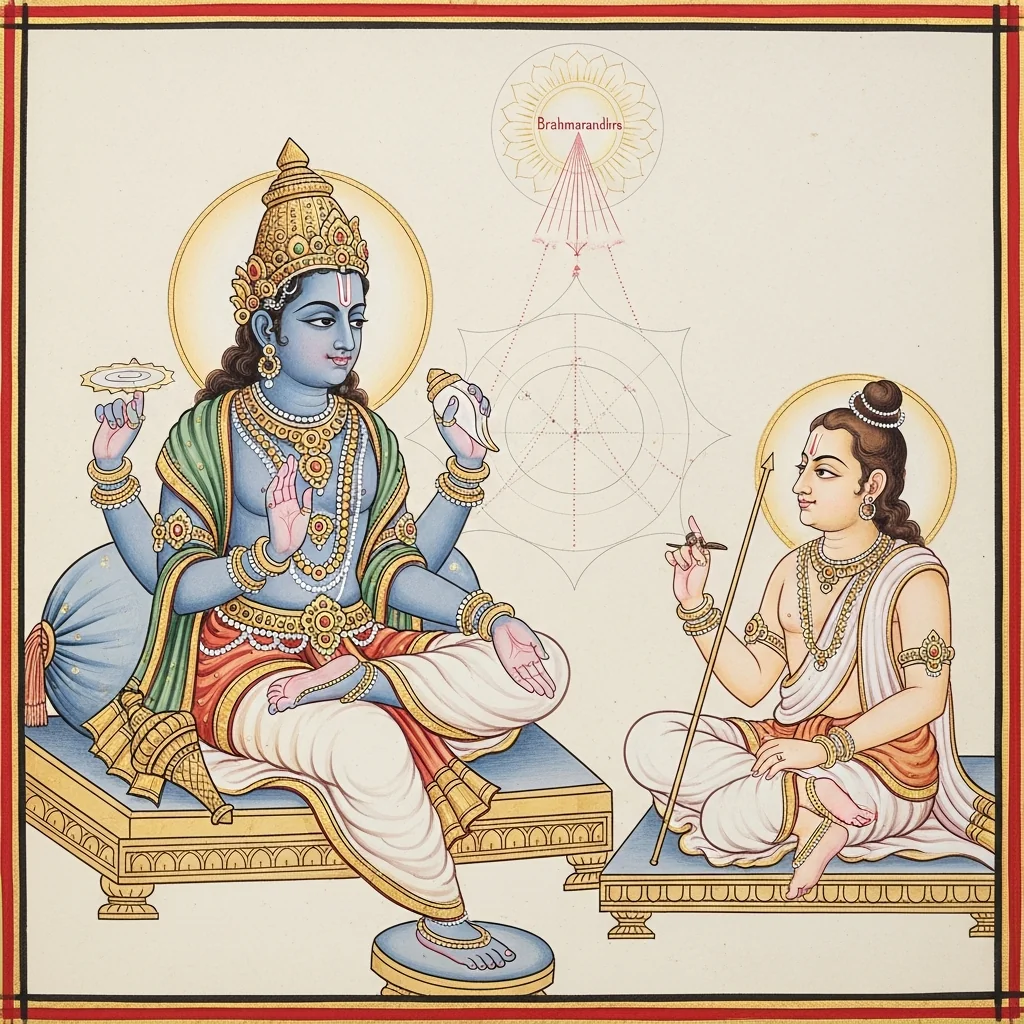
Skanda relates that after hearing the procedure of Vāsudeva worship, Nārada—seeking practical attainment—asks the supreme Teacher how the mind may be restrained, admitting that mental control is difficult even for the learned and is essential if worship is to yield the desired fruit. Śrī Nārāyaṇa replies that the mind is the foremost enemy of embodied beings, and prescribes as a faultless means of pacification the steady practice of meditation on Viṣṇu (Viṣṇu-dhyāna-abhyāsa), upheld by vairāgya (dispassion) and disciplined methods. He then gives a structured compendium of aṣṭāṅga-yoga—yama, niyama, āsana, prāṇāyāma, pratyāhāra, dhāraṇā, dhyāna, and samādhi—explaining the five yamas and five niyamas (including Viṣṇu-pūjana). Defining each limb with technical clarity, he emphasizes steady breath and withdrawal of the senses, and concludes with a liberation-directed yogic departure: guiding prāṇa through inner stations, sealing the apertures, reaching the brahmarandhra, abandoning māyā-born vāsanās, and leaving the body with single-minded focus on Vāsudeva to attain the divine abode of Śrī Kṛṣṇa. The chapter closes by calling this a concise summary of yoga-śāstra and urging continual worship after conquering one’s own mind.
Adhyaya 31
श्री-नरनारायण-स्तुति-निरूपणम् (Exposition of the Nara–Nārāyaṇa Hymn)
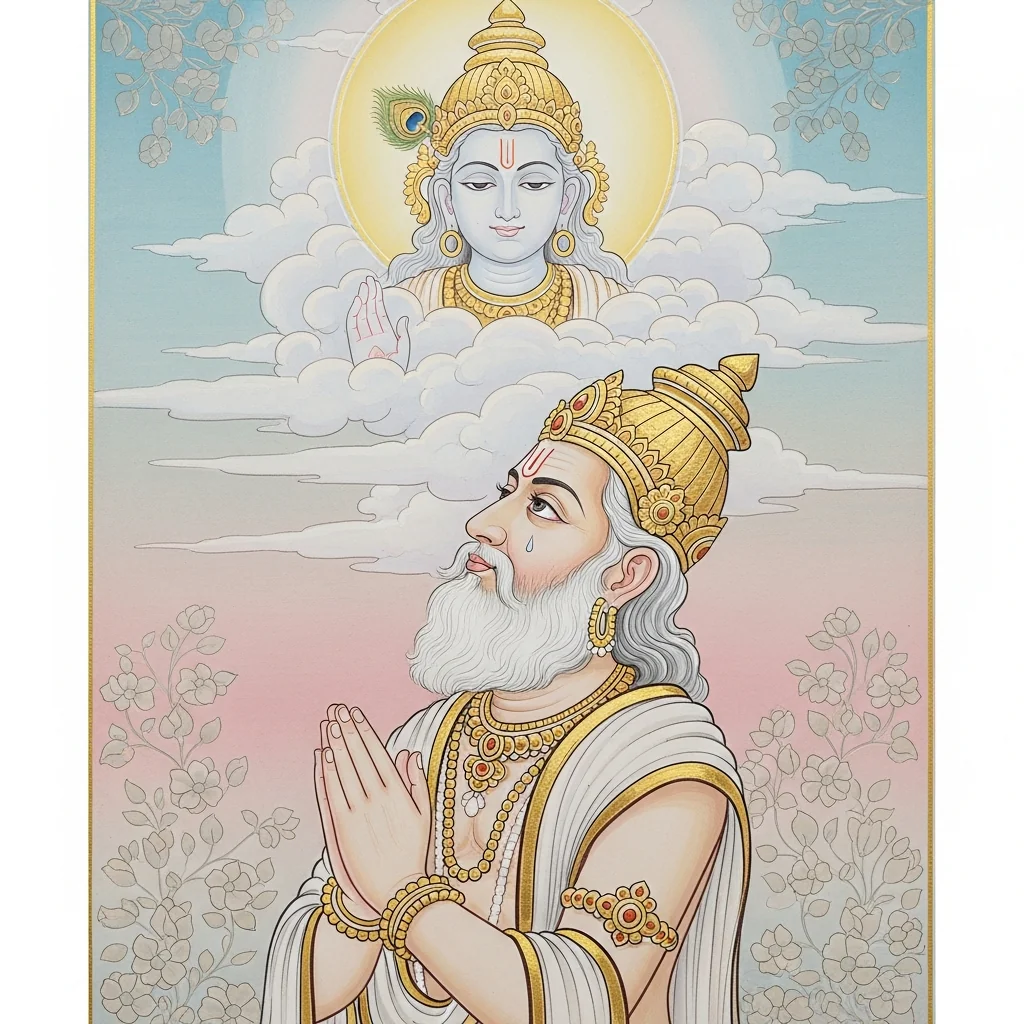
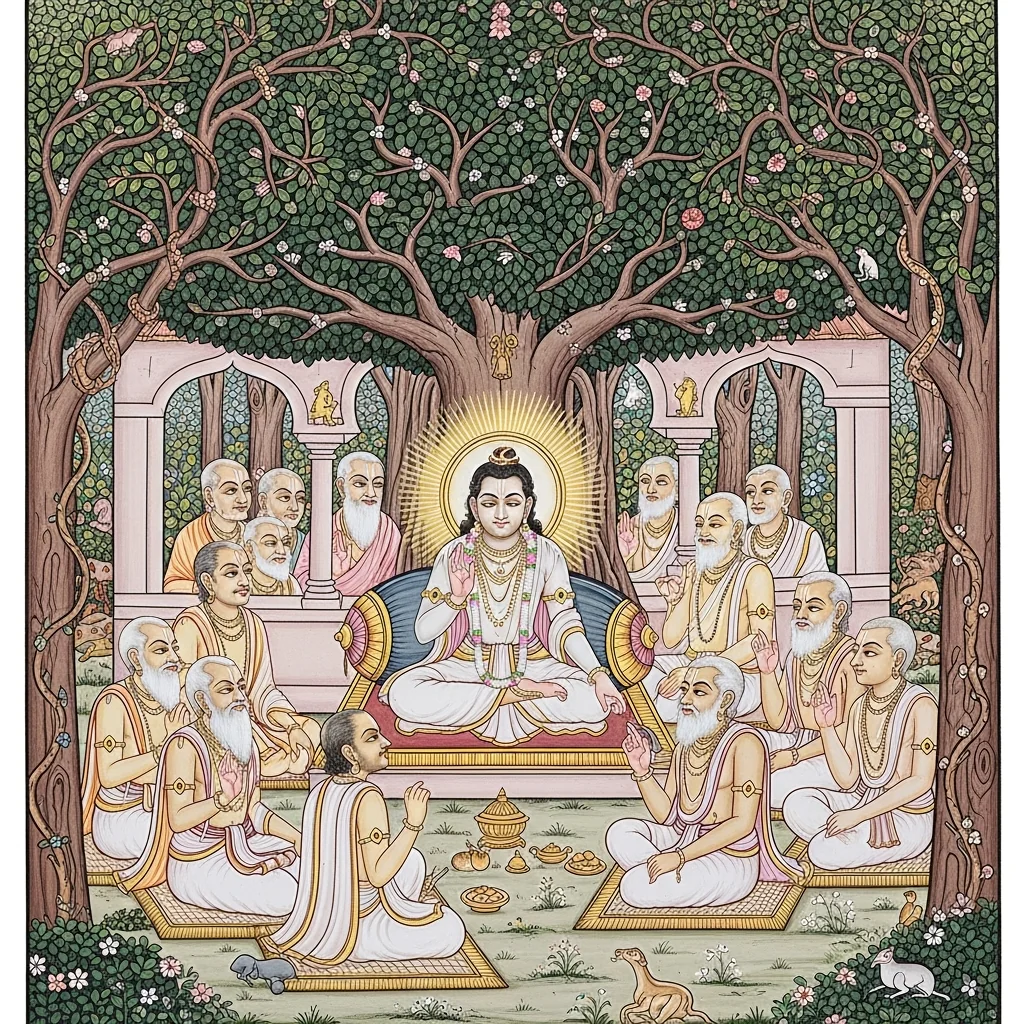
Chapter 31 concludes a teaching arc: having heard Skanda’s dharmic exposition of Vāsudeva’s greatness, Nārada declares his doubts completely destroyed (saṃśaya-nāśa) and vows to continue ascetic practice (tapas) while receiving knowledge daily. Skanda relates that Nārada remains for a thousand divine years, engaged in tapas and hearing Hari’s instruction at proper times, until he attains spiritual “ripening” (pakvatā) and a deepened love for Śrī Kṛṣṇa as the all-Self (akhilātman). Recognized as a siddha-yogin established in superior devotion, Nārāyaṇa commissions him to travel for the welfare of the world (lokahita) and to spread “ekānta-dharma” everywhere. Nārada then offers an extended hymn (stuti) portraying Nārāyaṇa/Vāsudeva as the cosmic abode, lord of yoga, supreme witness, transcendent beyond the guṇas and agency, and the compassionate protector from fear and saṃsāra. The hymn contrasts liberating remembrance of the Divine—even at death—with the delusion of attachment to body, kin, and wealth, and ends by affirming exclusive reliance and gratitude toward the Divine refuge.
Adhyaya 32
Śrī-Vāsudevamāhātmya—Śravaṇa-Kīrtana-Phalaśruti and Transmission Lineage (Chapter 32)
Chapter 32 consolidates the Vāsudeva-centered teaching through a formal chain of speakers and listeners. Skanda relates that Nārada, after praising Īśāna, goes to Vyāsa’s āśrama (Śamyāprāsa) and teaches an “ekāntika dharma” to a questioner. The discourse is then set in Brahmā’s assembly, where gods, Pitṛs, and sages are instructed; Bhāskara (Sūrya) is said to hear again what Nārada had earlier heard from Nārāyaṇa. The teaching continues by successive transmission—among the Vālakhilyas, to Indra and the devas gathered on Meru, then through Asita to the Pitṛs, onward to King Śantanu, to Bhīṣma, and finally to Yudhiṣṭhira at the close of the Bhārata war. The chapter explains that hearing this māhātmya generates supreme bhakti aimed at liberation, and it identifies Vāsudeva as the ultimate cause and the source behind the vyūhas and avatāras. It culminates in a dense phalaśruti: the text is called the extracted “essence” of Purāṇic narration and the “rasa” of the Veda–Upaniṣads, Sāṅkhya–Yoga, Pañcarātra, and Dharmaśāstra. It promises purity of mind, destruction of inauspiciousness, and both worldly and liberative fruits (dharma, kāma, artha, mokṣa), including role-specific benefits and auspicious results for rulers and women. Sūta closes by urging learned listeners to worship the one Vāsudeva, ending with salutations to Vāsudeva as lord of Goloka and as a luminous principle that increases devotional joy.
FAQs about Vasudeva Mahatmya
It presents Vāsudeva as the supreme principle (para-brahman) and argues that actions dedicated to him become spiritually efficacious, reducing obstacles and stabilizing outcomes within an ethical framework.
Rather than listing site-specific merits, it stresses merit through sambandha—linking one’s prescribed duties and rituals to Vāsudeva—thereby amplifying results and orienting practice toward enduring spiritual benefit.
It leverages epic-era inquiry (Yudhiṣṭhira questioning Bhīṣma) and an older itihāsa involving Nārada and Nara-Nārāyaṇa at Badarīāśrama to demonstrate how doctrine is validated through exemplary dialogues.