Adhyaya 24
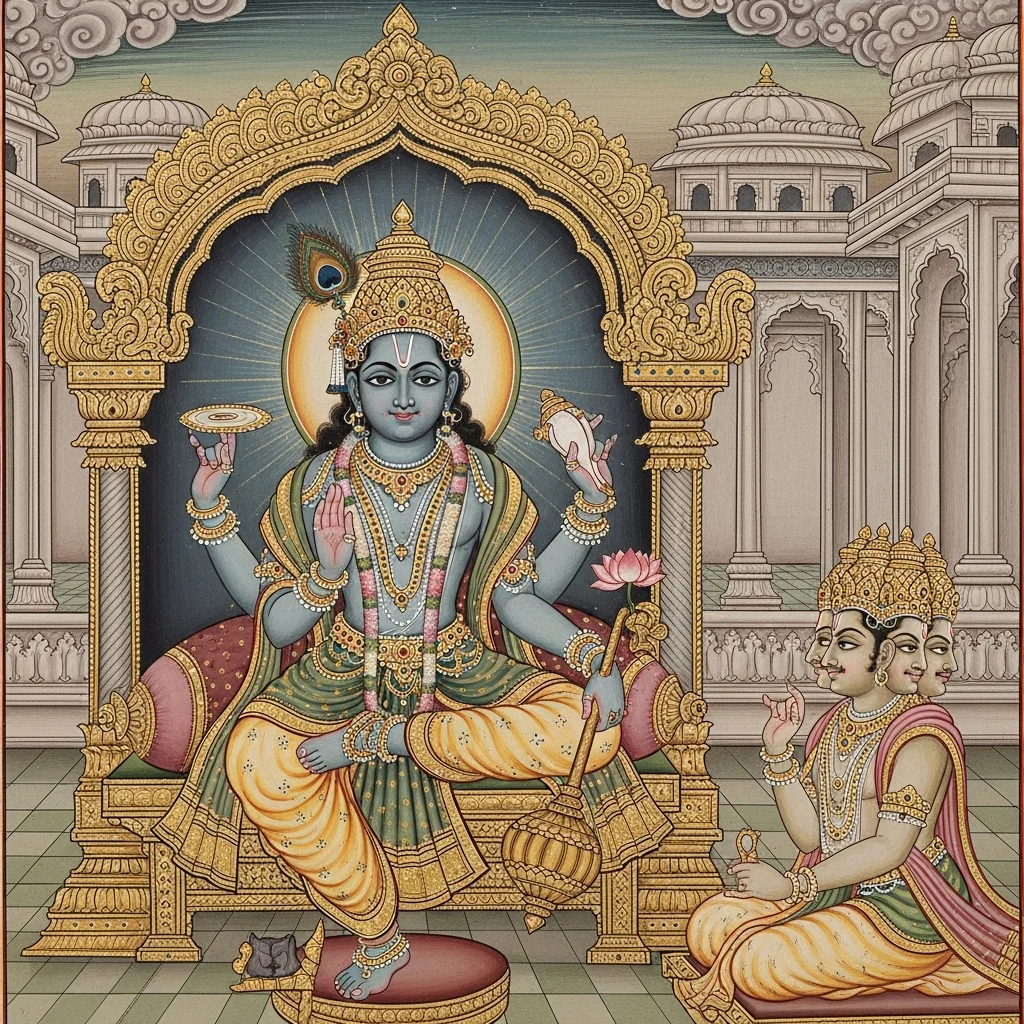
Nārāyaṇa defines “knowledge” as discriminative understanding (viveka) by which kṣetra and its related categories are rightly known. He then proclaims Vāsudeva as the supreme brahman—originally one, non-dual, nirguṇa—and describes the arising of māyā with kāla-śakti; from their agitation countless cosmic eggs come forth. Within a single brahmāṇḍa, evolution proceeds through mahat, ahaṅkāra, and the tri-guṇa arrangement, producing tanmātras, mahābhūtas, indriyas, and divine functions; together these constitute the Virāṭ body, the support of the moving and unmoving world. From Virāṭ arise Brahmā (rajas), Viṣṇu (sattva), and Hara (tamas), along with their śaktis—Durgā, Sāvitrī, and Śrī—whose partial manifestations proliferate. Brahmā, at first bewildered upon the lotus in the single ocean, undertakes long inquiry and tapas in response to the imperceptible command “tapo tapo,” and is granted a vision of Vaikuṇṭha where guṇas and māyā-born fear do not operate. There he beholds four-armed Vāsudeva with divine attendants, receives the boon of prajā-visarga-śakti, and is instructed to create while maintaining meditative identity with Virāṭ. Brahmā then orders creation: sages, Rudra’s emergence from anger, prajāpatis, the Vedas, varṇas and āśramas, beings and worlds, and the proper allotment of sustenance and offerings (havis/kavya) for devas, pitṛs, and other classes. The chapter closes by stressing cyclical variation across kalpas, Vāsudeva’s avatāra principle for restoring disrupted boundaries, and a final definition of knowledge as discerning the marks of kṣetra, kṣetrajña, prakṛti–puruṣa, māyā, kāla-śakti, akṣara, and paramātman.
Shlokas
No shlokas available for this adhyaya yet.