Adhyaya 4
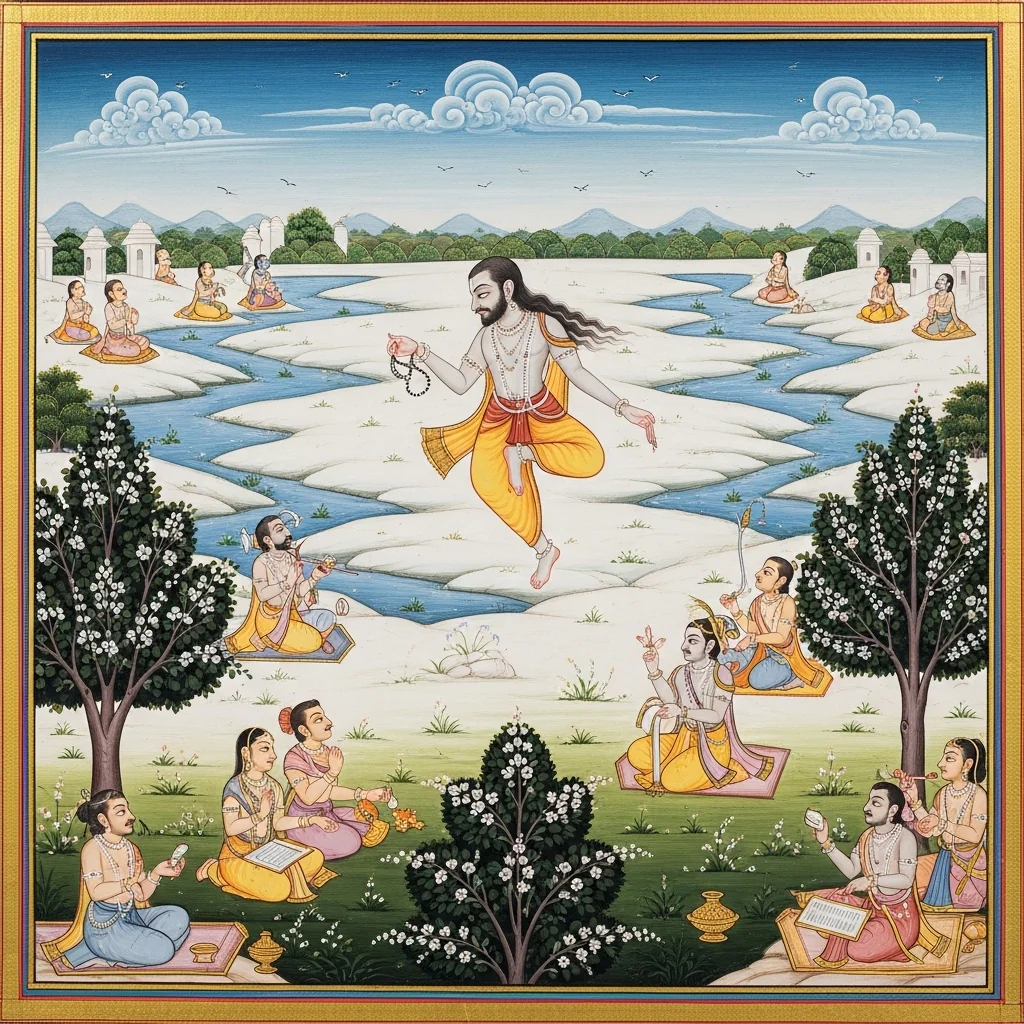
The chapter unfolds in two linked movements. (1) In dialogue, Nārada says that hearing the teaching has satisfied him, yet he longs to behold the Lord’s prior/supreme form. Nārāyaṇa declares that this vision is not gained by gifts, sacrifice, Vedic rites, or austerity alone, but is revealed only to those of exclusive devotion (ananyā-bhakti). Nārada is affirmed as qualified through knowledge, detachment, and fidelity to svadharma, and is instructed to journey to the “white inner island,” Śvetadvīpa. (2) Skanda then describes Nārada’s yogic flight and his vision of radiant Śvetadvīpa north of the Milk Ocean, abundant with auspicious trees, gardens, rivers, lotuses, birds, and animals. Its inhabitants are liberated and sinless, fragrant and ever-youthful, marked with auspicious signs—sometimes two-armed, sometimes four-armed—free from the six waves (ṣaḍ-ūrmi) and beyond fear of time. When Sāvarṇi asks how such beings arise and what their state is, Skanda explains that they are “Akṣara” persons who attained brahma-bhāva through single-minded worship of Vāsudeva in prior cycles, remaining independent of time and māyā and returning to the Akṣara-dhāman at dissolution. Others, though born perishable (kṣara) through māyā, may become like them through nonviolence, tapas, svadharma, detachment, knowledge of Vāsudeva’s greatness, constant devotion, association with the great, disinterest even in liberation and siddhis, and mutual hearing and recitation of Hari’s births and deeds. The chapter closes by promising a longer purāṇic narrative to show that even humans can attain that state.
Shlokas
No shlokas available for this adhyaya yet.