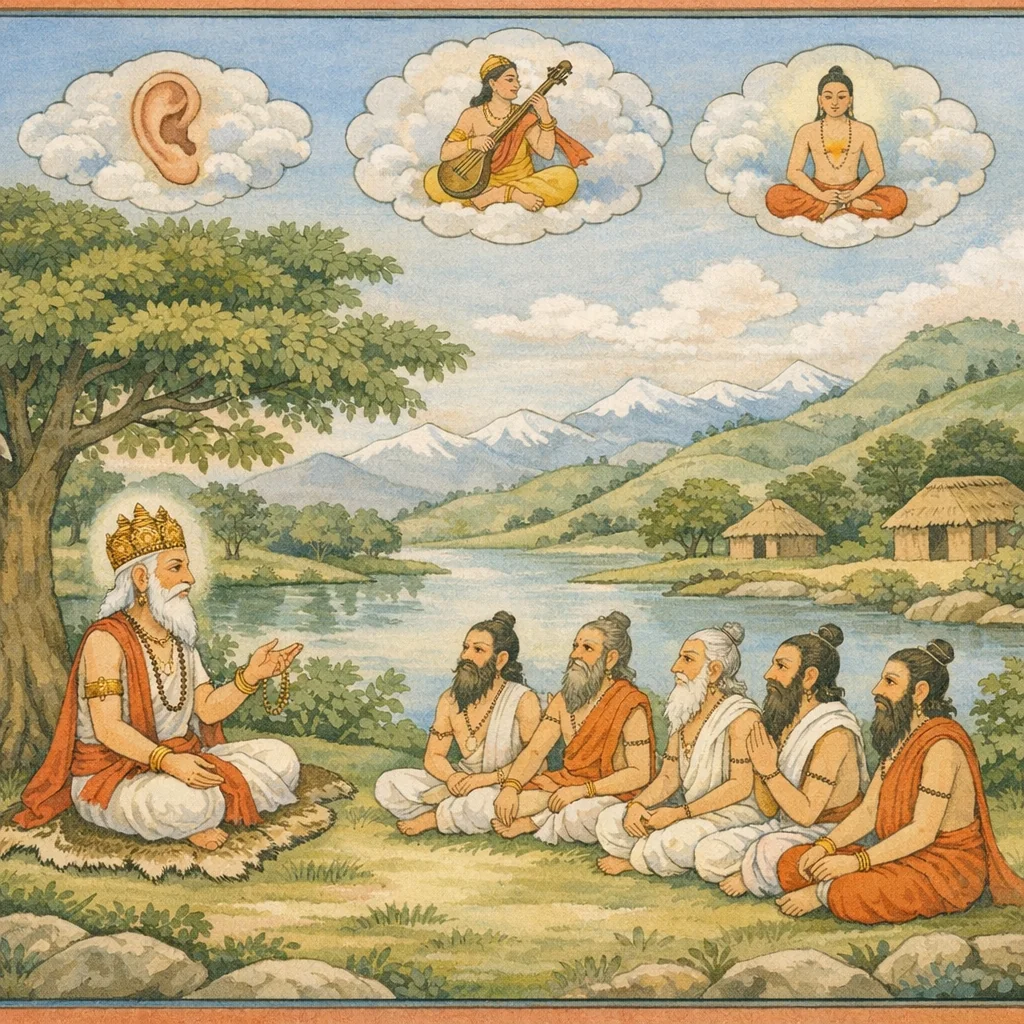
Śravaṇa–Kīrtana–Manana: Definitions and Hierarchy of Śaiva Sādhanā (श्रवणकीर्तनमनन-निरूपणम्)
Adhyāya 4 begins with the sages asking for a precise, ordered account of three key Śaiva disciplines—manana (reflective contemplation), śravaṇa (devotional hearing), and kīrtana (praise/recitation). Brahmā replies with clear definitions: manana is the continual purification of the mind through reasoned attention to Śiva’s worship, mantra-japa, qualities, forms, līlās, and names, and it is declared the foremost practice because it yields īśvara-dṛṣṭi (God-oriented perception). Kīrtana is described as articulate, aesthetically charged praise of Śambhu’s glory (guṇa–rūpa–vilāsa–nāman), expressed in song, Vedic phrasing, or common speech; it is a “middle” means that supports but remains subordinate to perfected reflection. Śravaṇa is intense, sense-anchored listening to Śiva-centered discourse with unwavering absorption, made practicable through the emphasis on sat-saṅga as its enabling condition. The chapter then shifts to Sūta’s narrative frame, promising an ancient illustration: Vyāsa’s tapas on the bank of the Sarasvatī and his meeting with the radiant Sanatkumāra, setting up a teaching on the hierarchy and efficacy of these sādhanās.
Shlokas
Verse 1
मुनय ऊचुः । मननं कीदृशं ब्रह्मञ्छ्रवणं चापि कीदृशम् । कीर्तनं वा कथं तस्य कीर्तयैतद्यथायथम्
The sages said: “O Brahman, what kind of contemplation (manana) is it? And what is true listening (śravaṇa) like? And how is His praise and recitation (kīrtana) to be performed? Please explain this, point by point, in the proper order.”
Verse 2
ब्रह्मोवच । पूजाजपेशगुणरूपविलासनाम्नां युक्तिप्रियेण मनसा परिशोधनं यत् । तत्संततं मननमीश्वरदृष्टिलभ्यं सर्वेषु साधनवरेष्वपि मुख्यमुख्यम्
Brahmā said: That which purifies the mind—delighting in right reasoning—through reflection on worship, mantra‑japa, the Lord’s qualities, His forms, His divine play, and His names: this continuous contemplation, by which the vision of Īśvara is attained, is the foremost of the foremost among all excellent spiritual means.
Verse 3
गीतात्मना श्रुतिपदेन च भाषया वा शंभुप्रतापगुणरूपविलासनाम्नाम् । वाचा स्फुटं तु रसवत्स्तवनं यदस्य तत्कीर्तनं भवति साधनमत्र मध्यम्
Whether through song, through Vedic utterance, or through ordinary speech—when one clearly and with devotional relish praises Śambhu’s majesty, virtues, forms, sportive manifestations, and sacred names, that praise becomes kīrtana. In this discipline, it is taught as the ‘middle’ (madhyama) means of spiritual practice.
Verse 4
इति श्रीशिवमहापुराणे प्रथमायां विद्येश्वरसंहितायं साध्यसाधनखण्डे चतुर्थोऽध्यायः
Thus ends the Fourth Chapter in the Sādhyasādhana Khaṇḍa of the Vidyeśvara Saṃhitā, in the First Part of the revered Śrī Śiva Mahāpurāṇa.
Verse 5
सत्संगमेन भवति श्रवणं पुरस्तात्संकीर्तनं पशुपतेरथ तद्दृढं स्यात् । सर्वोत्तमं भवति तन्मननं तदंते सर्वं हि संभवति शंकरदृष्टिपाते
From holy association (satsanga) arises, first of all, attentive listening; then the steadfast practice of chanting the praises of Paśupati becomes firm. Thereafter, the highest is deep contemplation upon that teaching. Indeed, all becomes possible when Śaṅkara bestows his gracious glance.
Verse 6
सूत उवाच । अस्मिन्साधनमाहत्म्ये पुरा वृत्तं मुनीश्वराः । युष्मदर्थं प्रवक्ष्यामि शृणुध्वमवधानतः
Sūta said: “O lordly sages, in this account of the greatness of spiritual discipline, an event that happened long ago is to be told. For your benefit I shall relate it—listen with attentive minds.”
Verse 7
पुरा मम गुरुर्व्यासः पराशरमुनेः सुतः । तपश्चचार संभ्रांतः सरस्वत्यास्तटे शुभे
Formerly, my preceptor Vyāsa—the son of the sage Parāśara—performed austerities (tapas) with intense, reverent resolve on the auspicious bank of the river Sarasvatī.
Verse 8
गच्छन्यदृछया तत्र विमानेनार्करोचिषा । सनत्कुमारो भगवान्ददर्श मम देशिकम्
Traveling there by chance in a celestial vimāna radiant with the splendor of the sun, the venerable Bhagavān Sanatkumāra beheld my spiritual preceptor.
Verse 9
ध्यानारूढः प्रबुद्धोऽसौ ददर्श तमजात्मजम् । प्रणिपत्याह संभ्रांतः परं कौतूहलं मुनिः
Rising from meditation, he awakened and beheld that wondrous, Unbegotten One. Overwhelmed, the sage bowed in prostration and spoke, filled with the highest curiosity.
Verse 10
दत्त्वार्घ्यमस्मै प्रददौ देवयोग्यं च विष्टिरम् । प्रसन्नः प्राह तं प्रह्वं प्रभुर्गंभीरया गिरा
Having offered him arghya—the water of reverential welcome—he also presented a seat befitting a deity. Pleased, the Lord then spoke to that bowed-down devotee in a deep and solemn voice.
Verse 11
सनत्कुमार उवाच । सत्यं वस्तु मुने दध्याः साक्षात्करणगोचरः । स शिवोथासहायोत्र तपश्चरसि किं कृते
Sanatkumāra said: “O sage, the Real is indeed to be grasped as the very object of direct realization. Here Śiva Himself stands as your helper—so for what purpose do you practice austerity?”
Verse 12
एवमुक्तः कुमारेण प्रोवाच स्वाशयं मुनिः । धर्मार्थकाममोक्षाश्च वेदमार्गे कृतादराः
Thus addressed by the Kumāra, the sage spoke his own intent: “Dharma, artha, kāma, and mokṣa are all to be pursued with reverence along the Vedic path.”
Verse 13
बहुधा स्थापिता लोके मया त्वत्कृपया तथा । एवं भुतस्य मेप्येवं गुरुभूतस्य सर्वतः
By your grace I have established (this worship/this liṅga) in the world in many ways. Thus, even for me—who seem to live sustained by you—you alone, everywhere, stand as my Guru and supreme guide.
Verse 14
मुक्तिसाधनकं ज्ञानं नोदेति परमाद्भुतम् । तपश्चरामि मुक्त्यर्थं न जाने तत्र कारणम्
The wondrous knowledge that is the direct means to liberation does not arise in me. Though I undertake austerities for the sake of mokṣa, I do not understand what the cause of this is.
Verse 15
इत्थं कुमारो भगवान्व्यासेन मुनिनार्थितः । समर्थः प्राह विप्रेंद्रा निश्चयं मुक्तिकारणम्
Thus the blessed Kumāra, earnestly requested by the sage Vyāsa, being fully capable, spoke to the foremost brāhmaṇas the decisive truth concerning the cause of liberation (mokṣa).
Verse 16
श्रवणं कीर्तनं शंभोर्मननं च महत्तरम् । त्रयं साधनमुक्तं च विद्यते वेदसंमतम्
Hearing the sacred accounts of Śambhu, singing His praises, and deeply contemplating Him—this triad is declared the spiritual means, truly in harmony with the Vedas.
Verse 17
पुराहमथ संभ्रांतो ह्यन्यसाधनसंभ्रमः । अचले मंदरे शैले तपश्चरणमाचरम्
Formerly, bewildered and stirred by the pursuit of other means of practice, I went to the immovable Mount Mandara and there undertook tapas, the discipline of austerity.
Verse 18
शिवाज्ञया ततः प्राप्तो भगवान्नंदिकेश्वरः । स मे दयालुर्भगवान्सर्वसाक्षी गणेश्वरः
Then, by Śiva’s command, the venerable Lord Nandikeśvara arrived. He is my compassionate Lord—the all-witnessing Gaṇeśvara, master of Śiva’s gaṇa attendants.
Verse 19
उवाच मह्यं सस्नेहं मुक्तिसाधनमुत्तमम् । श्रवणं कीर्तनं शंभोर्मननं वेदसंमतम्
With affectionate kindness, he told me the supreme means to liberation: listening to Śambhu’s glories, chanting and proclaiming them, and contemplative reflection upon Him—practices fully endorsed by the Vedas.
Verse 20
त्रिकं च साधनं मुक्तौ शिवेन मम भाषितम् । श्रवणादिं त्रिकं ब्रह्मन्कुरुष्वेति मुहुर्मुहुः
For liberation (mokṣa), Lord Śiva taught me a threefold discipline. Therefore, O Brahman, again and again practise the triad beginning with śravaṇa, sacred hearing.
Verse 21
एवमुक्त्वा ततो व्यासं सानुगो विधिनंदनः । जगाम स्वविमानेन पदं परमशोभनम्
Having spoken thus to Vyāsa, the son of Brahmā—accompanied by his attendants—departed in his own celestial chariot (vimāna) and went to that supremely radiant abode.
Verse 22
एवमुक्तं समासेन पूर्ववृत्तांतमुत्तमम् । ऋषय ऊचुः । श्रवणादित्रयं सूत मुक्त्योपायस्त्वयेरितः
Thus, having been told in brief the excellent account of what occurred before, the sages said: “O Sūta, you have declared the triad beginning with hearing (śravaṇa) as the means to liberation.”
Verse 23
श्रवणादित्रिकेऽशक्तः किं कृत्वा मुच्यते जनः । अयत्नेनैव मुक्तिः स्यात्कर्मणा केन हेतुना
If a person is incapable of the triad beginning with hearing (śravaṇa), then by doing what can he be freed? And if liberation can arise even without strenuous effort, then for what reason—by which action (karma)—does it occur?
Frequently Asked Questions
The theological argument is a ranked theory of practice: śravaṇa matures through sat-saṅga, kīrtana stabilizes devotion through articulate praise, and sustained manana is declared the highest because it purifies the mind and culminates in īśvara/śiva-dṛṣṭi; the chapter then introduces an exemplum via Vyāsa’s tapas and his encounter with Sanatkumāra.
The key ‘symbol’ is epistemic rather than iconographic: śiva-dṛṣṭi signifies a transformed mode of perception where all practices (pūjā, japa, praise, listening) are internalized into continuous contemplative clarity; sat-saṅga functions as the catalytic environment that converts mere hearing into stable absorption.
No single iconographic avatāra is foregrounded; instead, Śiva is invoked through functional epithets—Śambhu (auspicious lord), Paśupati (lord of beings), Śaṅkara (beneficent)—to emphasize devotional address (nāma–guṇa–rūpa–līlā) as the content of śravaṇa and kīrtana and the object of culminating manana.