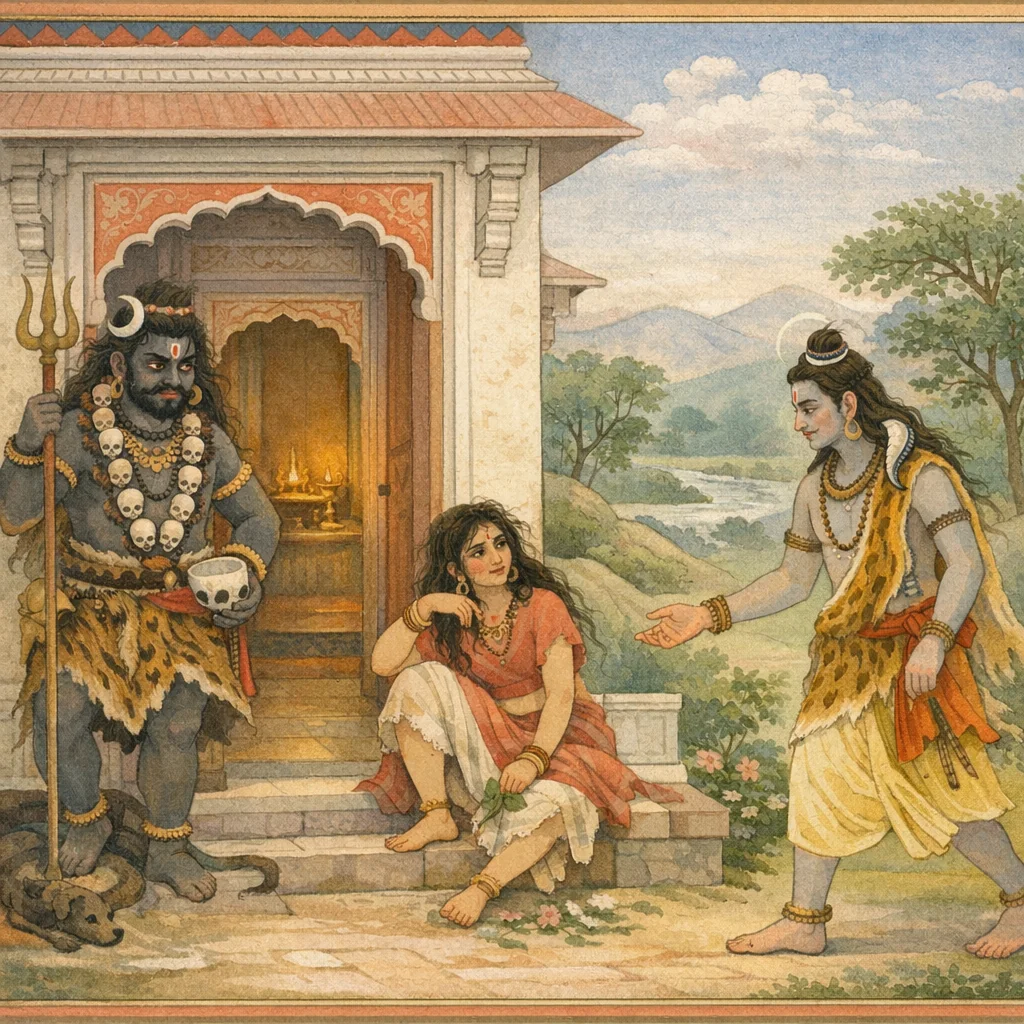
Bhairavaśāpavṛttāntaḥ (The Episode of Bhairava’s Curse and Consolation)
Framed as Nandīśvara’s instruction to a sage, this chapter introduces an avatāra-like episode praised as “sarvakāmadam,” fulfilling all desires for the attentive listener. Śiva and Girijā, acting in sovereign freedom (svatantra), enter the inner chamber after appointing Bhairava as dvārapāla, guardian of the threshold. By divine play (līlā), Girijā assumes at the doorway a female form that appears mad or errant, drawing forth Bhairava’s response through a gendered gaze (nārī-dṛṣṭi). Taking this as impropriety at a sacred liminal boundary, Śivā becomes angry and pronounces a corrective curse: Bhairava must take human birth on earth. The narrative then turns from judgment to restoration—Bhairava laments, and Śaṅkara swiftly arrives to console him with skillful persuasion—revealing a theological rhythm of transgression → karmic consequence → divine mitigation. Esoterically, the chapter encodes temple semiotics (door, guardian, inner sanctum), the ethics of perception, and how divine play can disclose and recalibrate dhārmic order even within Śiva’s own retinue.
Shlokas
Verse 1
नन्दीश्वर उवाच । अथ प्रीत्या शृणु मुनेऽवतारं परमं प्रभोः । शंकरस्यात्मभूपुत्र शृण्वतां सर्वकामदम्
Nandīśvara said: Now, O sage, listen with loving attention to the supreme descent of the Lord. O self-born son (of Brahmā), hear of Śaṅkara’s divine manifestation—whose very hearing grants all cherished aims to those who listen.
Verse 2
एकदा मुनिशार्दूल गिरिजाशंकरावुभौ । विहर्तुकामौ संजातौ स्वेच्छया परमेश्वरौ
Once, O tiger among sages, Girijā (Pārvatī) and Śaṅkara—those two Supreme Lords—of their own free will became desirous of sportive divine play (līlā).
Verse 3
भैरवं द्वारपालं च कृत्वाभ्यन्तरमागतौ । नानासखिगणैः प्रीत्या सेवितौ नरशीलितौ
Appointing Bhairava as the gatekeeper, they entered within. There, like noble persons of refined conduct, the two were gladly attended upon with affection by many bands of companions.
Verse 4
चिरं विहृत्य तत्र द्वौ स्वतन्त्रौ परमेश्वरौ । बभूवतुः प्रसन्नो तौ नानालीलाकरौ मुने
After sporting there for a long time, those two supremely independent Lords became gracious—O sage—manifesting many kinds of divine play (līlā).
Verse 5
अथोन्मत्ताकृतिर्देवी स्वतन्त्रा लीलया शिवा । आगता द्वारि तद्रूपा प्रभोराज्ञामवाप सा
Then the Goddess Śivā—self-willed and playful in her līlā—assumed the guise of a madwoman. In that very form she came to the doorway and thus received the Lord’s command.
Verse 6
तां देवीं भैरवस्सोथ नारीदृष्ट्या विलोक्य च । निषिषेध बहिर्गन्तुं तद्रूपेण विमोहितः
Then Bhairava, beholding that Goddess with a woman’s gaze, was deluded by her very form; and, thus bewildered, he forbade her to go out.
Verse 7
नारीदृष्ट्या सुदृष्टा सा भैरवेण यदा मुने । कुद्धाऽभवच्छिवा देवी तं शशाप तदांबिका
O sage, when Bhairava looked upon her with a “woman’s gaze”—a fixed, desirous look—the Goddess Śivā, Ambikā, became enraged and then cursed him.
Verse 8
शिवोवाच । नारीदृष्ट्या पश्यसि त्वं यतो मां पुरुषाधम । अतो भव धरायां हि मानुषस्त्वं च भैरव
Śiva said: “Since you behold Me with a woman’s gaze, O lowest among men, therefore become human upon the earth—yes, you too, Bhairava.”
Verse 9
नन्दीश्वर उवाच । इत्थं यदाऽभवच्छप्तो भैरवश्शिवया मुने । हाहाकारो महानासीद्दुःखमाप स लीलया
Nandīśvara said: “Thus, O sage, when Bhairava was cursed by Śivā, a great outcry arose; yet he accepted that sorrow as līlā, a divine play.”
Verse 10
ततश्च शंकरः शीघ्रं तमागत्य मुनीश्वर । अश्वासयद्भैरवं हि नानाऽनुनयकोविदः
Then Śaṅkara quickly approached him, O lord among sages, and consoled Bhairava, being skilled in many gentle persuasions and soothing words.
Verse 11
तच्छापाद्भैरवस्सोथ क्षिताववतरन्मुने । मनुष्ययोन्यां वैतालसंज्ञकश्शंकरेच्छया
O sage, as the fruit of that curse, Bhairava then descended upon the earth; by Śaṅkara’s own will he was born from a human womb, known by the name Vaitāla.
Verse 12
तत्स्नेहतः शिवः सोपि क्षिताववतरद्विभुः । शिवया सह सल्लीलो लौकिकीङ्गतिमाश्रितः
Moved by that loving affection, the all-pervading Lord Śiva also descended upon the earth. Accompanied by Śivā (Pārvatī), gracious and sportive, He adopted a worldly mode of conduct, enacting His līlā for the welfare of beings.
Verse 13
महेशाह्वः शिवश्चासीच्छारदा गिरिजा मुने । सुलीलां चक्रतुः प्रीत्या नाना लीला विशारदौ
O sage, Śiva—known as Maheśa—and Girijā, revered as Śāradā, joyfully performed a charming divine play, for both were supremely adept in manifold līlās.
Verse 14
इति ते कथितं तात महेशचरितं वरम् । धन्यं यशस्यमायुष्यं सर्वकामफलप्रदम्
Thus, dear child, I have narrated to you the excellent sacred account of Maheśa—an auspicious tale that brings blessedness, fame, and long life, and that bestows the fruits of all worthy desires.
Verse 15
य इदं शृणुयाद्भक्त्या श्रावयेद्वा समाहितः । स भुक्त्वेहाखिलान्भोगानन्ते मोक्षमवाप्नुयात्
Whoever listens to this with devotion—or, with a collected mind, causes it to be recited to others—enjoys all rightful pleasures in this world, and in the end attains liberation (moksha) through Lord Śiva’s grace.
Verse 21
इति श्रीशिव महापुराणे तृतीयायां शतरुद्रसंहितायां महेशावतारवर्णनं नामैकविंशोध्यायः
Thus, in the holy Śiva Mahāpurāṇa, in the Third Book—the Śatarudra Saṃhitā—ends the twenty-first chapter entitled “The Description of the Incarnation (Divine Manifestation) of Maheśa.”
Frequently Asked Questions
It presents the doorway-līlā in which Girijā assumes an “unmattā-kṛti” form, Bhairava (as dvārapāla) responds through a nārī-dṛṣṭi, and Śivā issues a śāpa sending him to human birth; the episode then balances punishment with Śaṅkara’s immediate consolation, modeling corrective justice tempered by grace.
The dvāra (threshold) signifies a liminal ritual boundary between outer and inner sanctity; the dvārapāla embodies disciplined guardianship of both space and attention. “Dṛṣṭi” becomes an ethical-ritual instrument: perception itself is treated as action with consequences, and the curse functions as a purificatory recalibration rather than mere retribution.
Gaurī appears in a deliberate līlā-form described as “unmattā-kṛti” (a transgressive/errant-looking guise) to test or reveal Bhairava’s response, while Śiva is emphasized as Śaṅkara—the swift, persuasive consoler—alongside the implied Bhairava-function as guardian who nonetheless becomes subject to corrective dharma.