Sukta 38
Sukta 4.38
Vāmadeva Gautama (traditional for RV 4.38)
Aśvins (Nāsatyā) as divine benefactors (dual 'vām')
Triṣṭubh (probable)
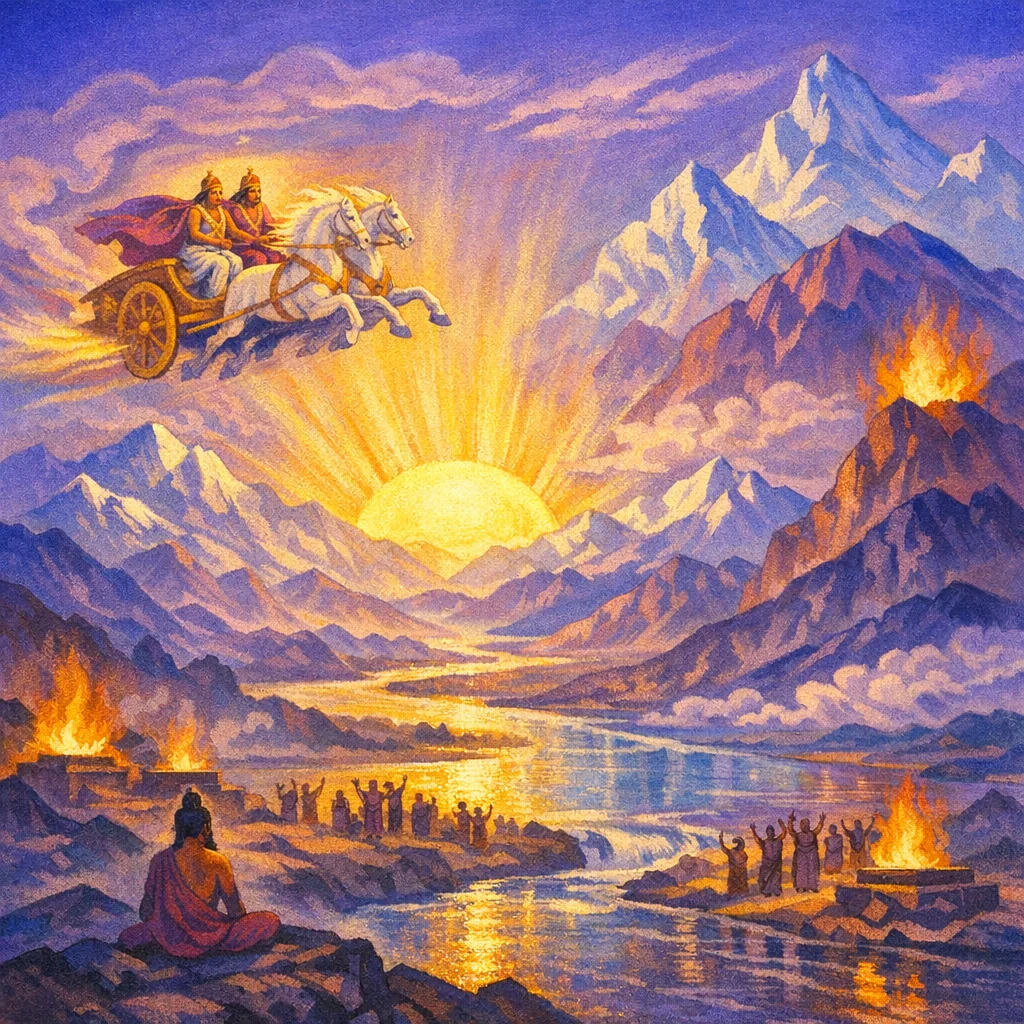
This hymn celebrates the swift, victorious power (Dadhikrā/Dadhikrāvan) moving at the head of chariots, scattering dust like streaming rays and bringing triumph and delight. It praises this radiant force as a giver of strength and expansion for the peoples, and asks it to fill the poet’s words with “honey” (inspiration, sweetness, success). The imagery blends martial speed, solar brilliance, and sacrificial auspiciousness into a single beneficent presence.
Mantras
Mantra 1
उतो हि वां दात्रा सन्ति पूर्वा या पूरुभ्यस्त्रसदस्युर्नितोशे । क्षेत्रासां ददथुरुर्वरासां घनं दस्युभ्यो अभिभूतिमुग्रम् ॥
For yours indeed are the ancient gifts—those by which Trasadasyu, for the Pūrūs, won firm settlement. You gave them fields and broad fertile spaces, and against the dark-hosts you set a crushing, overpowering force.
Mantra 2
उत वाजिनं पुरुनिष्षिध्वानं दधिक्रामु ददथुर्विश्वकृष्टिम् । ऋजिप्यं श्येनं प्रुषितप्सुमाशुं चर्कृत्यमर्यो नृपतिं न शूरम् ॥
And you gave the racer, Dadhikrāvan—manifold in his perfect achievements, belonging to all peoples. A straight-flying falcon, speckled and swift, tirelessly circling—like a noble lord of men, like a hero: so is that power you established.
Mantra 3
यं सीमनु प्रवतेव द्रवन्तं विश्वः पूरुर्मदति हर्षमाणः । पड्भिर्गृध्यन्तं मेधयुं न शूरं रथतुरं वातमिव ध्रजन्तम् ॥
He whom all the many peoples follow, rejoicing, as he rushes like a stream down a slope; the wise strength in him is desired by the feet (the powers of movement): a hero of understanding, conquering by the chariot-force, vibrating like the Wind.
Mantra 4
यः स्मारुन्धानो गध्या समत्सु सनुतरश्चरति गोषु गच्छन् । आविॠजीको विदथा निचिक्यत्तिरो अरतिं पर्याप आयोः ॥
He who, holding fast the firm line in the battles, moves ever forward, going among the Rays (cows); manifest in straight-going energy, he has perceived the workings of the sacrifice and passes beyond incapacity, encompassing the metal-strong might.
Mantra 5
उत स्मैनं वस्त्रमथिं न तायुमनु क्रोशन्ति क्षितयो भरेषु । नीचायमानं जसुरिं न श्येनं श्रवश्चाच्छा पशुमच्च यूथम् ॥
And the peoples cry after him in the clashes, as after a plunderer who tears away the covering; like a hawk swooping low, he presses forward—towards fame and towards the herd that is rich in the powers of life.
Mantra 6
उत स्मासु प्रथमः सरिष्यन्नि वेवेति श्रेणिभी रथानाम् । स्रजं कृण्वानो जन्यो न शुभ्वा रेणुं रेरिहत्किरणं ददश्वान् ॥
And among them he is the first to surge forward; he weaves down through the ordered lines of the chariots. Making a garland as it were, like a radiant warrior, he scatters the dust in streaming rays—one who has seen and mastered the play of the light.
Mantra 7
उत स्य वाजी सहुरिॠतावा शुश्रूषमाणस्तन्वा समर्ये । तुरं यतीषु तुरयन्नृजिप्योऽधि भ्रुवोः किरते रेणुमृञ्जन् ॥
And this vājī, the strong-enduring one, bearer of the Truth, eager in his body for the battle—he drives the swift among the goings; the straight-limbed one, as he rushes, flings dust above the brows, colouring himself with it.
Mantra 8
उत स्मास्य तन्यतोरिव द्योॠघायतो अभियुजो भयन्ते । यदा सहस्रमभि षीमयोधीद्दुर्वर्तुः स्मा भवति भीम ऋञ्जन् ॥
And like the Heaven that thunders, his onrush makes the assailants afraid. When he battles a thousand against him, the hard-passage becomes dreadful—he dyes it with terror and turns the way for victory.
Mantra 9
उत स्मास्य पनयन्ति जना जूतिं कृष्टिप्रो अभिभूतिमाशोः । उतैनमाहुः समिथे वियन्तः परा दधिक्रा असरत्सहस्रैः ॥
And the people celebrate his rush, the swift one’s overpowering victory that carries the communities forward. And they say of him, as he ranges in the battle: ‘Dadhikrā has sped beyond by thousands.’
Mantra 10
आ दधिक्राः शवसा पञ्च कृष्टीः सूर्य इव ज्योतिषापस्ततान । सहस्रसाः शतसा वाज्यर्वा पृणक्तु मध्वा समिमा वचांसि ॥
May Dadhikrā, by his might, spread out the five peoples, as the Sun spreads the waters by his light. The racer, winning by thousands and hundreds, may fill these our words together with honeyed delight.
Frequently Asked Questions
The hymn praises Dadhikrā (Dadhikrāvan), a swift, victorious power pictured like a radiant racer at the head of chariots, bringing success and delight.
It asks for victorious forward movement and strength, and it also prays for inner clarity—so that the poet’s words become “honeyed,” sweet, and effective.
It is especially fitting at dawn or before beginning an important journey, contest, or undertaking where speed, success, and confident inspired speech are desired.