Sukta 46
Sukta 10.46
Agni
Triṣṭubh (probable)
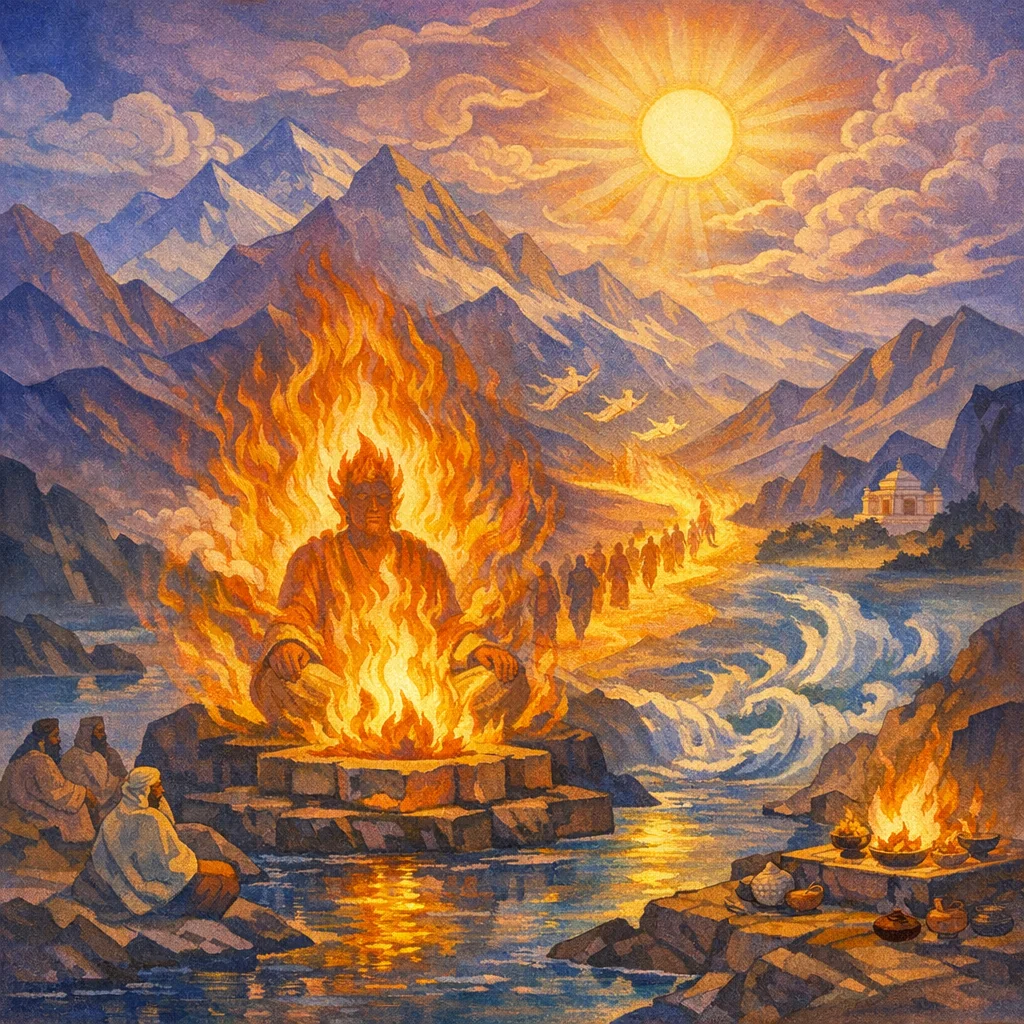
This hymn praises Agni as the primordial Hotṛ, established by gods and humans alike as the carrier of offerings and the organizer of right order (ṛta) in communal life. Agni is portrayed as seated “in the lap of the waters” and also hidden within homes and womb-like enclosures, drawing people together and moving them by the “yokes” of dharma toward prosperity and renewed ancestral glory.
Mantras
Mantra 1
प्र होता जातो महान्नभोविन्नृषद्वा सीददपामुपस्थे । दधिर्यो धायि स ते वयांसि यन्ता वसूनि विधते तनूपाः ॥
Born as the priest of the offering, great and a knower of the heights, he sits as the indwelling power among men, in the lap of the waters. He who is set firm as the foundation—he directs your movements and brings the riches to the worshipper, guarding the embodied being.
Mantra 2
इमं विधन्तो अपां सधस्थे पशुं न नष्टं पदैरनु ग्मन् । गुहा चतन्तमुशिजो नमोभिरिच्छन्तो धीरा भृगवोऽविन्दन् ॥
Fashioning this Fire in the common seat of the waters, they tracked him like a lost creature by his footprints. Hidden in the cavern, moving secretly, the flame-seekers found him—those steadfast ones, the Bhṛgus—by their reverent surrender.
Mantra 3
इमं त्रितो भूर्यविन्ददिच्छन्वैभूवसो मूर्धन्यघ्न्यायाः । स शेवृधो जात आ हर्म्येषु नाभिर्युवा भवति रोचनस्य ॥
This Fire Trita found in abundance while seeking, the wide-shining one, set at the head of the unviolable (cow of light). Born, he grows to wellbeing within the houses; he becomes the youthful navel-center of the luminous world.
Mantra 4
मन्द्रं होतारमुशिजो नमोभिः प्राञ्चं यज्ञं नेतारमध्वराणाम् । विशामकृण्वन्नरतिं पावकं हव्यवाहं दधतो मानुषेषु ॥
With acts of reverence the flame-seekers fashioned the gladdening Hotṛ, the forward-leading sacrifice, the guide of the paths of offering. They made him the purifier and true conductor for the peoples, establishing the bearer of the oblation among human beings.
Mantra 5
प्र भूर्जयन्तं महां विपोधां मूरा अमूरं पुरां दर्माणम् । नयन्तो गर्भं वनां धियं धुर्हिरिश्मश्रुं नार्वाणं धनर्चम् ॥
Forward they bring the great conquering Force, the wide home of the seer-vision; the strong ones bear the unbewildered, the ancient foundation of the many strongholds. Leading the hidden embryo of the woods, they set the thought in its yoke—like a tawny-bearded power that does not slacken, rich in the chant of plenitude.
Mantra 6
नि पस्त्यासु त्रितः स्तभूयन्परिवीतो योनौ सीददन्तः । अतः संगृभ्या विशां दमूना विधर्मणायन्त्रैरीयते नॄन् ॥
In the dwelling-places Trita, making firm, sits inwardly, wrapped about in the womb. From there, gathering the peoples, the lord of the house moves the men by the yokes of the right law—drawing them into the ordered working.
Mantra 7
अस्याजरासो दमामरित्रा अर्चद्धूमासो अग्नयः पावकाः । श्वितीचयः श्वात्रासो भुरण्यवो वनर्षदो वायवो न सोमाः ॥
His fires, ageless, are the pilots of the dwelling; they flame with their smoke, purifying. Bright in their kindling, swift in their going, eager in their surge, they sit in the forest-nature like winds—like Soma-powers moving through the being.
Mantra 8
प्र जिह्वया भरते वेपो अग्निः प्र वयुनानि चेतसा पृथिव्याः । तमायवः शुचयन्तं पावकं मन्द्रं होतारं दधिरे यजिष्ठम् ॥
With his tongue Agni bears forward the tremor of utterance; with the mind he brings forth the discernments of the earth-nature. Him the seekers set in place—purifying, bright— the rapturous Hotar, most capable of the sacrifice.
Mantra 9
द्यावा यमग्निं पृथिवी जनिष्टामापस्त्वष्टा भृगवो यं सहोभिः । ईळेन्यं प्रथमं मातरिश्वा देवास्ततक्षुर्मनवे यजत्रम् ॥
The Heaven and the Earth brought to birth that Agni; the Waters, Tvaṣṭṛ, and the Bhṛgus shaped him with their powers. The gods hewed out first the adorable one, and Mātariśvan carried him for Man—worthy of the offering: the fire meant for the human ascent.
Mantra 10
यं त्वा देवा दधिरे हव्यवाहं पुरुस्पृहो मानुषासो यजत्रम् । स यामन्नग्ने स्तुवते वयो धाः प्र देवयन्यशसः सं हि पूर्वीः ॥
You whom the gods established as the carrier of the offering—desired by many, worthy for men—give in your movement, O Agni, the plenitudes of life to the one who praises. Going godward, gather for him the many former glories: awaken the stored attainments of the past into the present ascent.
Frequently Asked Questions
It presents Agni as the sacred fire-priest who carries offerings to the gods and also as an inner, hidden power that brings order (ṛta/dharma), protection, vitality, and prosperity to human life.
This image points to Agni’s cosmic origin and subtle presence: fire is linked with the waters and the hidden seed of energy, suggesting Agni is both elemental and mysteriously concealed in creation.
Trita is an ancient Rigvedic figure often connected with a hidden or pressed-out fire/light. In this hymn the Trita motif emphasizes Agni as inwardly seated and concealed, yet capable of organizing and energizing human society when awakened.