Sarga 46
दितितपः-शक्रपरिचर्या-गर्भभेदः (Diti’s Penance, Indra’s Service, and the Severing of the Embryo)
बालकाण्ड
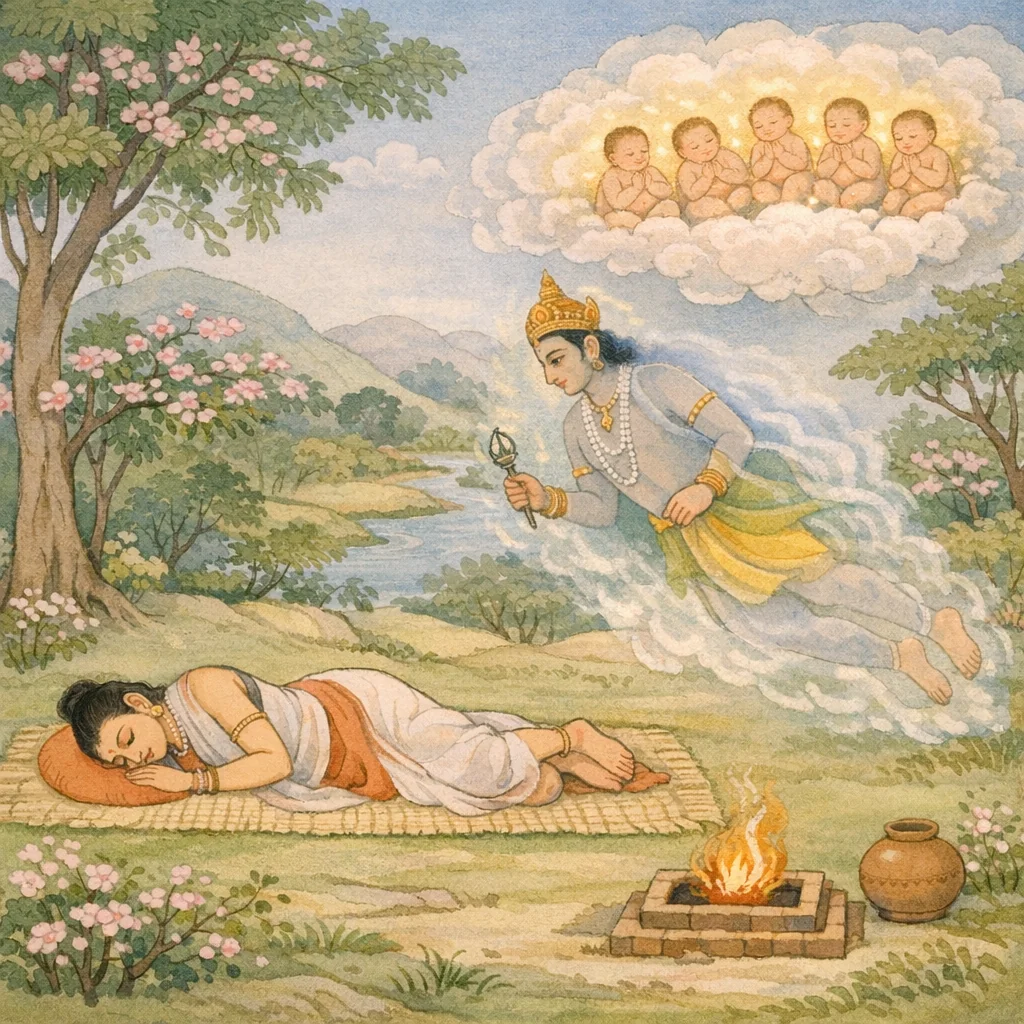
Sarga 46 portrays the deva–asura moral tension through Diti’s grief and vow. After her sons are slain by the devas, Diti petitions her husband Kaśyapa, son of Marīci, for a son powerful enough to slay Indra, promising severe tapas and seeking consent for such a birth. Kaśyapa grants the boon with a condition: if Diti maintains unwavering purity (śauca) for a thousand years, she will bear a son destined to lordship over the three worlds. Diti undertakes intense austerities at Kuśaplavana. Indra, aware of the looming threat, chooses strategic service over open conflict—providing ritual necessities (fire, kuśa grass, water, fruits, roots) and personally tending to Diti’s fatigue. Ten years before completion, Diti, pleased, foretells that Indra will gain a brother and share in victory. But at midday she falls asleep in an impure posture, with her feet toward her head; Indra seizes this lapse, enters her womb, and splits the embryo into seven while repeating “mā rudaḥ” (“do not weep”), an origin account for the Maruts. Diti awakens and forbids the killing; Indra withdraws, then confesses and seeks forgiveness, saying the opportunity arose from ritual impurity. The chapter thus juxtaposes tapas with śauca, and service with self-preservation, teaching how small breaches of discipline can redirect cosmic outcomes.
Shlokas
Verse 1
हतेषु तेषु पुत्रेषु दिति: परमदु:खिता। मारीचं काश्यपं राम भर्तारमिदमब्रवीत्।।1.46.1।।
When those sons had been slain, Diti—overwhelmed with grief—spoke these words to her husband Kaśyapa, son of Marīci, O Rāma.
Verse 2
हतपुत्राऽस्मि भगवंस्तव पुत्रैर्महाबलै:।शक्रहन्तारमिच्छामि पुत्रं दीर्घतपोऽर्जितम्।।1.46.2।।
“O Blessed One, your mighty sons have slain my sons. I desire a son—gained through long austerities—who will be capable of killing Indra.”
Verse 3
साऽहं तपश्चरिष्यामि गर्भं मे दातुमर्हसि।ईश्वरं शक्रहन्तारं त्वमनुज्ञातुमर्हसि।।1.46.3।।
“I shall undertake austerities; you should grant me a child—lordly in power and able to slay Indra—and you should consent to this,” said Diti.
Verse 4
तस्यास्तद्वचनं श्रुत्वा मारीच: काश्यपस्तदा।प्रत्युवाच महातेजा दितिं परमदु:खिताम्।।1.46.4।।
Then the radiant Kāśyapa, son of Marīci, having heard her words, replied to Diti, who was overwhelmed with grief.
Verse 5
एवं भवतु, भद्रं ते शुचिर्भव तपोधने।जनयिष्यसि पुत्रं त्वं शक्रहन्तारमाहवे।।1.46.5।।
“So be it. Blessings upon you, O lady whose wealth is austerity. Remain pure, and you shall bear a son who will slay Śakra (Indra) in battle.”
Verse 6
पूर्णे वर्षसहस्रे तु शुचिर्यदि भविष्यसि।पुत्रं त्रैलोक्यभर्तारं मत्तस्त्वं जनयिष्यसि।।1.46.6।।
“And if you remain pure until a full thousand years are completed, then through me you will bear a son who will become the lord and supporter of the three worlds.”
Verse 7
एवमुक्त्वा महातेजा: पाणिना स ममार्ज ताम्।समालभ्य ततस्स्वस्तीत्युक्त्वा स तपसे ययौ।।1.46.7।।
Having spoken thus, the radiant sage gently stroked her with his hand; then, after touching her in blessing and saying, “May there be well-being,” he departed to pursue austerities.
Verse 8
गते तस्मिन्नरश्श्रेष्ठ दिति: परमहर्षिता।कुशप्लवनमासाद्य तपस्तेपे सुदारुणम्।।1.46.8।।
O best of men, when he had departed, Diti—filled with great joy—reached Kuśaplavana and undertook exceedingly severe austerities.
Verse 9
तपस्तस्यां हि कुर्वन्त्यां परिचर्यां चकार ह।सहस्राक्षो नरश्श्रेष्ठ परया गुणसम्पदा।।1.46.9।।
O best of men, while she was indeed performing austerities, the thousand-eyed Indra attended upon her with great excellence of conduct and virtue.
Verse 10
अग्निं कुशान् काष्ठमप: फलं मूलं तथैव च।न्यवेदयत्सहस्राक्षो यच्चान्यदपि काङ्क्षितम्।।1.46.10।।
Indra of the thousand eyes supplied her with fire, kuśa grass, fuel-wood, water, fruits, and roots—and whatever else she desired.
Verse 11
गात्रसंवहनश्चैव श्रमापनयनैस्तथा।शक्रस्सर्वेषु कालेषु दितिं परिचचार ह ।।1.46.11।।
Śakra (Indra) attended on Diti at all times, massaging her limbs and easing her fatigue as well.
Verse 12
अथ वर्षसहस्रे तु दशोने रघुनन्दन ।दिति: परमसम्प्रीता सहस्राक्षमथाब्रवीत्।।1.46.12।।
Then, O joy of the Raghu line, when a thousand years of her observance lacked but ten years, Diti—greatly pleased—spoke to Indra of the thousand eyes.
Verse 13
याचितेन सुरश्रेष्ठ तव पित्रा महात्मना।वरो वर्षसहस्रान्ते दत्तो मम सुतं प्रति।।1.46.13।।
O best of the gods, your great-souled father, when petitioned, granted me a boon—concerning a son—at the completion of a thousand years.
Verse 14
तपश्चरन्त्या वर्षाणि दश वीर्यवतां वर।अवशिष्टानि भद्रं ते भ्रातरं द्रक्ष्यसे तत:।।1.46.14।।
O best among the valiant, ten years of my austerity still remain; after that, you will see a brother. May good be yours.
Verse 15
तमहं त्वत्कृते पुत्र समाधास्ये जयोत्सुकम्।त्रैलोक्यविजयं पुत्र सह भोक्ष्यसि विज्वर:।।1.46.15।।
My child, for your sake I shall fashion him, eager for victory; and you, my child, free from distress, will enjoy with him the conquest of the three worlds.
Verse 16
एवमुक्त्वा दितिश्शक्रं प्राप्ते मध्यं दिवाकरे।निद्रयाऽपहृता देवी पादौ कृत्वाऽथ शीर्षत:।।1.46.16।।
Having spoken thus to Indra, when the sun had reached midday, the goddess Diti—overcome by sleep—fell asleep with her feet placed toward her head.
Verse 17
दृष्ट्वा तामशुचिं शक्र: पादत: कृतमूर्धजाम्।शिरस्स्थाने कृतौ पादौ जहास च मुमोद च।।1.46.17।।
Seeing her in that impure posture—her hair fallen toward her feet and her feet placed where the head should be—Indra laughed and felt pleased.
Verse 18
तस्याश्शरीरविवरं विवेश च पुरन्दर:।गर्भं च सप्तधा राम बिभेद परमात्मवान्।।1.46.18।।
O Rāma, Purandara (Indra) entered the opening of her body and, with great resolve, split the embryo into seven parts.
Verse 19
भिद्यमानस्ततो गर्भो वज्रेण शतपर्वणा।रुरोद सुस्वरं राम ततो दितिरबुध्यत।।1.46.19।।
O Rāma, as the embryo was being split by the thunderbolt with a hundred joints, it cried out loudly; then Diti awoke.
Verse 20
मा रुदो मा रुदश्चेति गर्भं शक्रोऽभ्यभाषत।बिभेद च महातेजा रुदन्तमपि वासव:।।1.46.20।।
Indra addressed the embryo, saying, “Do not weep, do not weep,” yet mighty Vāsava still split it even as it cried.
Verse 21
न हन्तव्यो न हन्तव्य इत्येवं दितिरब्रवीत्।निष्पपात ततश्शक्रो मातुर्वचनगौरवात्।।1.46.21।।
“He must not be killed, he must not be killed,” Diti said. Then Indra withdrew, honoring his mother’s words.
Verse 22
प्राञ्जलिर्वज्रसहितो दितिं शक्रोऽभ्यभाषत।अशुचिर्देवि सुप्ताऽसि पादयो: कृतमूर्धजा।।1.46.22।।
With folded hands, still bearing the thunderbolt, Indra spoke to Diti: “O Goddess, you slept in an impure manner, with your hair fallen toward your feet.”
Verse 23
तदन्तरमहं लब्ध्वा शक्रहन्तारमाहवे।अभिदं सप्तधा देवि तन्मे त्वं क्षन्तुमर्हसि।।1.46.23।।
“Seizing that opportunity, O Goddess, I cut into seven parts the one who was to become Indra’s slayer in battle; therefore you should forgive me,” said Indra.
Frequently Asked Questions
The dilemma is Indra’s response to a foretold threat: instead of direct violence against an ascetic vow, he performs devoted service to Diti while waiting for a legally-actionable breach of śauca; when Diti sleeps in an impure posture, he exploits that lapse to neutralize the future “Indra-slayer” by splitting the embryo.
The chapter teaches that tapas is not merely endurance but disciplined purity and vigilance; even near-completion, a small deviation can redirect outcomes. It also presents a cautionary political theology: service and humility may conceal fear and self-interest, yet confession and seeking forgiveness remain necessary to restore moral order.
Kuśaplavana is named as Diti’s austerity-site, functioning as a mapped ascetic landscape; culturally, the chapter highlights ritual supports (agni, kuśa, water) and the purity codes around posture and conduct, which become narrative mechanisms for turning-point events.