Sarga 14
अश्वमेधप्रवृत्तिः — Commencement and Performance of Daśaratha’s Aśvamedha
बालकाण्ड
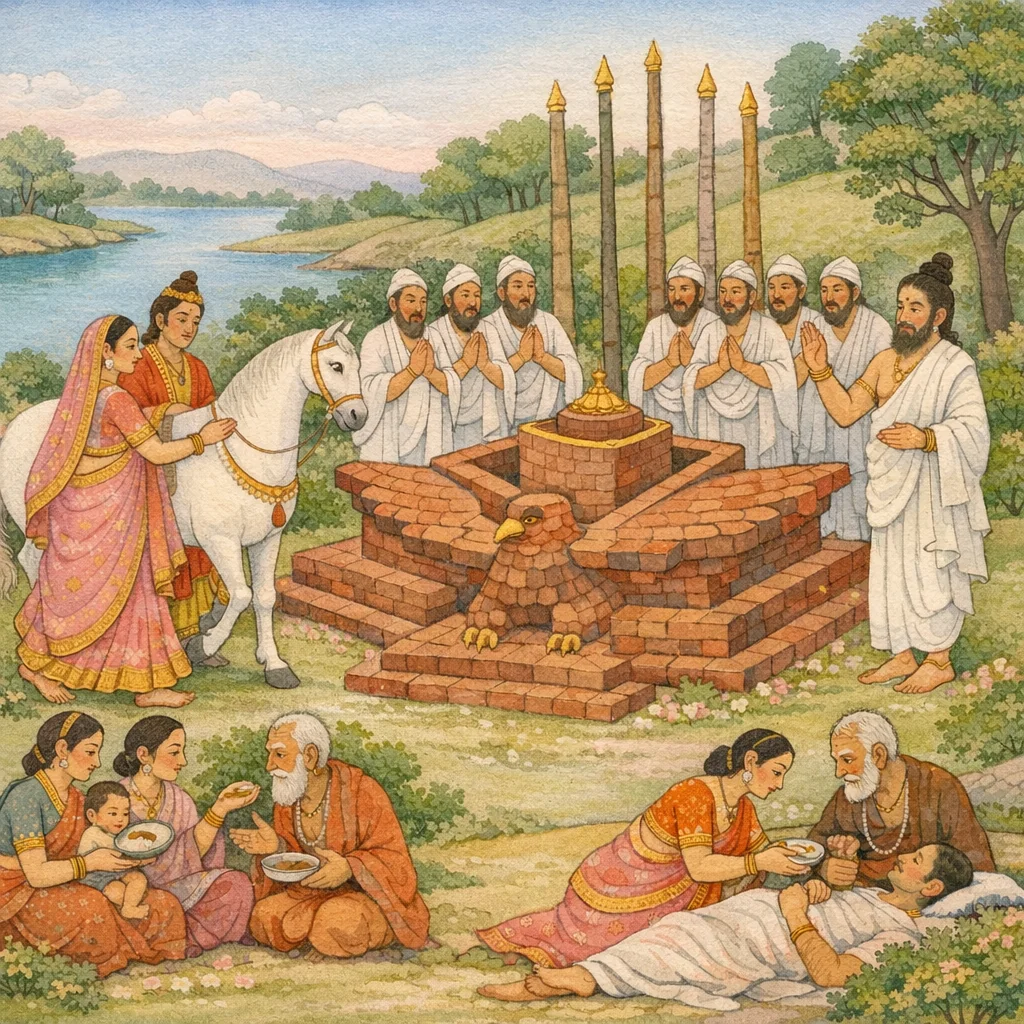
Sarga 14 records the orderly performance of Daśaratha’s Aśvamedha on the northern bank of the Sarayū, after the sacrificial horse returns at the completion of a year. Guided by Ṛśyaśṛṅga and carried out by Veda-mastered priests, the rite proceeds without omission—daily pressings (savana), pravargya and upasad, and offerings set in exact sequence. The chapter highlights public welfare and royal generosity: abundant food is distributed to all—brāhmaṇas, ascetics and monks, dependents, women, children, the aged, and the sick—portraying an inclusive sacrificial commons. It then details the ritual constructions: multiple yūpas of prescribed woods (bilva, khadira, parṇin, śleṣmātaka, devadāru) adorned with gold and measured precisely, and a brick-built fire-altar shaped like golden-winged Garuḍa with eighteen fire-places. Animals, birds, serpents, and aquatic beings are prepared according to śāstra; Kauśalyā performs the prescribed acts around the horse, and the officiants complete the offerings with mantras. At the close, the king offers the earth as dakṣiṇā, but the priests decline governance and ask for material gifts; Daśaratha bestows vast wealth and honors, and Ṛśyaśṛṅga blesses him with the promise of four sons, advancing the epic’s dynastic and theological course.
Shlokas
Verse 1
अथ संवत्सरे पूर्णे तस्मिन्प्राप्ते तुरङ्गमे।सरय्वाश्चोत्तरे तीरे राज्ञो यज्ञोऽभ्यवर्तत।।।।
Then, when the year was complete and the sacrificial horse had returned, the king’s yajña commenced on the northern bank of the Sarayū.
Verse 2
ऋश्यशृङ्गं पुरस्कृत्य कर्म चक्रुर्द्विजर्षभा:।अश्वमेधे महायज्ञे राज्ञोऽस्य सुमहात्मन:।।।।
Led by Ṛśyaśṛṅga, the foremost Brāhmaṇas carried out the rites of the great Aśvamedha sacrifice, the mahāyajña of this exceedingly magnanimous king.
Verse 3
कर्म कुर्वन्ति विधिवद्याजका वेदपारगा:।यथाविधि यथान्यायं परिक्रामन्ति शास्त्रत:।।।।
The officiating priests, fully accomplished in the Vedas, performed the rites in proper form, proceeding through each act by rule and law, exactly as the śāstras prescribe.
Verse 4
प्रवर्ग्यं शास्त्रत: कृत्वा तथैवोपसदं द्विजा:चक्रुश्च विधिवत्सर्वमधिकं कर्म शास्त्रत:।।।।
Having performed the Pravargya according to the śāstra, the brahmins likewise carried out the Upasad; and they duly completed all the additional rites as well, in strict accord with scriptural ordinance.
Verse 5
अभिपूज्य ततो हृष्टास्सर्वे चक्रुर्यथाविधि।प्रातस्सवनपूर्वाणि कर्माणि मुनिपुङ्गवा:।।।।
After duly worshipping, the eminent sages—gladdened at heart—performed, as prescribed, the rites beginning with the morning observances (prātaḥ-savana and related acts).
Verse 6
ऐन्द्रश्च विधिवद्दत्तो राजा चाभिषुतोऽनघ:।माध्यन्दिनं च सवनं प्रावर्तत यथाक्रमम्।।।।
Indra’s portion was duly offered, and the faultless Soma was pressed. The midday savana too proceeded, in proper order and sequence.
Verse 7
तृतीयसवनं चैव राज्ञोऽस्य सुमहात्मन:।चक्रुस्तेशास्त्रतो दृष्ट्वा तथा ब्राह्मणपुङ्गवा:।।।।
In the same manner, those eminent Brahmins—having carefully observed the scriptural injunctions—performed the third Soma-pressing for this exceedingly noble king.
Verse 8
न चाहुतमभूत्तत्र स्खलितं वापि किञ्चन ।दृश्यते ब्रह्मवत्सर्वं क्षेमयुक्तं हि चक्रिरे।।।।
In that sacrifice there was no omission in the offerings, nor any error whatsoever; everything appeared fully supported by proper mantras, and indeed they carried it out safely and flawlessly.
Verse 9
न तेष्वहस्सु श्रान्तो वा क्षुधितो वापि दृश्यते।नाविद्वान्ब्राह्मणस्तत्र नाशतानुचरस्तथा।।।।
On those days, no one was seen exhausted or hungry; nor was any Brahmin there unlearned, nor any lacking a retinue of a hundred attendants.
Verse 10
ब्राह्मणा भुञ्जते नित्यं नाथवन्तश्च भुञ्जते।तापसा भुञ्जते चापि श्रमणा भुञ्जतेतथा।।।।
The Brāhmaṇas ate continually; so too did those who lived under a master’s protection, and likewise ascetics and renunciant śramaṇas ate as well.
Verse 11
वृद्धाश्च व्याधिताश्चैव स्त्रियो बालास्तथैव च ।अनिशं भुञ्जमानानां न तृप्तिरुपलभ्यते।।।।
The aged and the sick, women and children as well—though eating continually—found no end to their satisfaction, so abundant was the provision.
Verse 12
दीयतां दीयतामन्नं वासांसि विविधानि च।इति सञ्चोदितास्तत्र तथा चक्रुरनेकश:।।।।
“Let food be given—let it be given—and garments of many kinds as well!” Thus urged there, they carried it out repeatedly and in great measure.
Verse 13
अन्नकूटाश्च बहवो दृश्यन्ते पर्वतोपमा:।दिवसे दिवसे तत्र सिद्धस्य विधिवत्तदा।।।।
There, day after day, many heaps of food—mountain-like—could be seen, prepared in due scriptural manner.
Verse 14
नानादेशादनुप्राप्ता: पुरुषास्स्त्रीगणास्तथा।अन्नपानैस्सुविहितास्तस्मिन्यज्ञे महात्मन:।।।।
Men and companies of women, arrived from many lands, were amply provided with food and drink at that yajña of the great-souled king.
Verse 15
अन्नं हि विधिवत्साधु प्रशंसन्ति द्विजर्षभा:।अहो तृप्ता: स्म भद्रं ते इति शुश्राव राघव:।।।।
Having tasted the food well prepared according to rite, the foremost Brahmins praised it, saying, “Ah, we are satisfied—may prosperity be yours!” Thus did Rāghava hear their words.
Verse 16
स्वलङ्कृताश्च पुरुषा ब्राह्मणान्पर्यवेषयन्।उपासते च तानन्ये सुमृष्टमणिकुण्डला:।।।।
Well-attired men served the Brahmins, while others, wearing gleaming jeweled earrings, stood by and assisted them.
Verse 17
कर्मान्तरे तदा विप्रा हेतुवादान्बहूनपि।प्राहुश्च वाग्मिनो धीरा: परस्परजिगीषया।।।।
Then, in the intervals between rites, eloquent and steady-minded Brahmins engaged in many reasoned debates, each wishing to prevail over the other.
Verse 18
दिवसे दिवसे तत्र संस्तरे कुशला द्विजा:।सर्वकर्माणि चक्रुस्ते यथाशास्त्रं प्रचोदिता:।।।।
Day after day there, at the sacrificial session, skilled Brahmins—urged on by their guides—performed every rite in accordance with the śāstras.
Verse 19
नाषडङ्गविदत्रासीन्नाव्रतो नाबहुश्रुत:।सदस्यास्तस्य वै राज्ञो नावादकुशला द्विजा:।।।।
In that sacrificial hall of the king, there was no assistant-priest unversed in the six auxiliaries, untrue to his vows, scant in learning, or unskilled in doctrinal debate; nor were there any brāhmaṇas among the assembly lacking such mastery.
Verse 20
प्राप्ते यूपोच्छ्रये तस्मिन्षड्बैल्वा: खादिरास्तथा।तावन्तो बिल्वसहिता: पर्णिनश्च तथापरे।।।।श्लेष्मातकमयस्त्वेको देवदारुमयस्तथा।द्वावेव विहितौ तत्र बाहुव्यस्तपरिग्रहौ।।।।
When the time came to raise the sacrificial posts (yūpa), six were set up of bilva and likewise six of khadira; as many more were arranged together with bilva, and still others of parṇi-wood. One post was of śleṣmātaka, and two were of devadāru; there they were placed with intervals measured by two outstretched arms.
Verse 21
प्राप्ते यूपोच्छ्रये तस्मिन्षड्बैल्वा: खादिरास्तथा।तावन्तो बिल्वसहिता: पर्णिनश्च तथापरे।।1.14.20।।श्लेष्मातकमयस्त्वेको देवदारुमयस्तथा।द्वावेव विहितौ तत्र बाहुव्यस्तपरिग्रहौ।।1.14.21।।
When the time came to raise the sacrificial posts (yūpa), six were set up of bilva and likewise six of khadira; as many more were arranged together with bilva, and still others of parṇi-wood. One post was of śleṣmātaka, and two were of devadāru; there they were placed with intervals measured by two outstretched arms.
Verse 22
कारितास्सर्व एवैते शास्त्रज्ञैर्यज्ञकोविदै:।शोभार्थं तस्य यज्ञस्य काञ्चनालङ्कृताऽभवन्।।।।
All these posts were fashioned by those who knew the śāstras and were expert in yajña; and, to enhance the splendor of that rite, they were adorned with gold.
Verse 23
एकविंशतियूपास्ते एकविंशत्यरत्नय:।वासोभिरेकविंशद्भिरेकैकं समलङ्कृता:।।।।
Those twenty-one sacrificial posts (yūpa), each measuring twenty-one aratnis in height, were beautifully adorned—each post wrapped with its own cloth.
Verse 24
विन्यस्ता विधिवत्सर्वे शिल्पिभिस्सुकृता दृढा:।अष्टाश्रयस्सर्व एव श्लक्ष्णरूपसमन्विता:।।।।
All those posts were duly set up according to rule—well-made by skilled craftsmen, strong, eight-sided, and finished with smooth, refined surfaces.
Verse 25
आच्छादितास्ते वासोभि: पुष्पैर्गन्धैश्च भूषिता:।सप्तर्षयो दीप्तिमन्तो विराजन्ते यथा दिवि।।।।
Covered with cloth and adorned with flowers and fragrant unguents, those posts shone with brilliant splendor—like the radiant Seven Ṛṣis gleaming in the sky.
Verse 26
इष्टकाश्च यथान्यायं कारिताश्च प्रमाणत:।चितोऽग्निर्ब्राह्मणैस्तत्र कुशलैश्शुल्बकर्मणि ।।।।
There, bricks were fashioned according to proper rule and exact measure, and the fire-altar was laid out by brāhmaṇas skilled in śulba—the science of measuring and constructing with cords.
Verse 27
सचित्यो राजसिंहस्य सञ्चित: कुशलैर्द्विजै:।गरुडो रुक्मपक्षो वै त्रिगुणोऽष्टादशात्मक:।।।।
The altar of that lion among kings was built up by skilled twice-born priests: it was shaped like Garuḍa with golden wings, arranged in three tiers, comprising eighteen components.
Verse 28
नियुक्तास्तत्र पशवस्तत्तदुद्दिश्य दैवतम्।उरगा: पक्षिणश्चैव यथाशास्त्रं प्रचोदिता:।।।।
There, animals were assigned and set apart for the respective deities; serpents and birds too were duly provided for, in accordance with the scriptures.
Verse 29
शामित्रे तु हयस्तत्र तथा जलचराश्च ये।ऋत्विग्भिस्सर्वमेवैतन्नियुक्तं शास्त्रतस्तदा।।।।
Then, at the śāmitra stage of the rite, the horse and the aquatic creatures as well were all duly bound and arranged by the officiating priests, strictly in accordance with the scriptures.
Verse 30
पशूनां त्रिशतं तत्र यूपेषु नियतं तदा।अश्वरत्नोत्तमं तस्य राज्ञो दशरथस्य च ।।।।
Then three hundred animals were bound to the sacrificial posts, and also King Daśaratha’s finest horse—the very jewel among steeds.
Verse 31
कौसल्या तं हयं तत्र परिचर्य समन्तत:।कृपाणैर्विशशासैनं त्रिभि: परमया मुदा ।।।।
There, Kauśalyā, having attended upon and circumambulated that horse, severed it with three strokes of a sword, with the greatest ceremonial joy.
Verse 32
पतत्रिणा तदा सार्धं सुस्थितेन च चेतसा।अवसद्रजनीमेकां कौशल्या धर्मकाम्यया।।।।
Then Kauśalyā, steadfast in mind and intent on fulfilling dharma, spent a single night in attendance beside the sacrificial horse.
Verse 33
होताऽध्वर्युस्तथोद्गाता हस्तेन समयोजयन्।महिष्या परिवृत्त्या च वावातां च तथापराम्।।।।
The Hotṛ, Adhvaryu, and Udgātṛ priests then, by the prescribed hand-contact, directed the Mahīṣī, the Parivṛtti, the Vāvātā, and another attendant woman to touch and attend the sacrificial horse.
Verse 34
पतत्रिणस्तस्य वपा मुद्धृत्य नियतेन्द्रिय:।ऋत्विक्परमसम्पन्न: श्रपयामास शास्त्रत:।।।।
Then the officiating priest—self-restrained and fully accomplished in the knowledge of the śāstras—removed the horse’s vapā and cooked it according to scriptural rule.
Verse 35
धूमगन्धं वपायास्तु जिघ्रति स्म नराधिप:।यथाकालं यथान्यायं निर्णुदन्पापमात्मन:।।।।
At the proper time and in the proper manner, the king inhaled the fragrant smoke rising from the vapā, thereby driving away sin from himself in accordance with rule.
Verse 36
हयस्य यानि चाङ्गानि तानि सर्वाणि ब्राह्मणा:।अग्नौ प्रास्यन्ति विधिवत्समन्त्राष्षोडशर्त्विज:।।।।
The sixteen officiating priests, reciting the proper mantras, duly offered into the fire all the limbs and portions of the horse, exactly as the rite requires.
Verse 37
प्लक्षशाखासु यज्ञानामन्येषां क्रियते हवि:।अश्वमेधस्य यज्ञस्य वैतसो भाग इष्यते।।।।
In other sacrifices, the oblation is offered using branches of the plakṣa tree; but for the Aśvamedha sacrifice, a portion is prescribed with vaitasa (cane) instead.
Verse 38
त्र्यहोऽश्वमेधस्सङ्ख्यात: कल्पसूत्रेण ब्राह्मणै:। 37चतुष्टोममहस्तस्य प्रथमं परिकल्पितम्।।।।
According to the Kalpasūtra as understood by the brahmins, the Aśvamedha is reckoned as a three-day rite; its first day is arranged as the Catuṣṭoma.
Verse 39
उक्थ्यं द्वितीयं संख्यातमतिरात्रं तथोत्तरम्।कारितास्तत्र बहवो विहिताश्शास्त्रदर्शनात्।।।।
The second day was declared the Ukthya, and the day that followed the Atirātra; and in that sacrifice many additional rites, enjoined by the teaching of the śāstra, were also performed.
Verse 40
ज्योतिष्टोमायुषी चैवमतिरात्रौ विनिर्मितौ।अभिजिद्विश्वजिच्चैवमप्तोर्यामो महाक्रतु:।।।।
Thus, within the Atirātra were duly set the Jyotiṣṭoma and the Āyuṣī; and likewise the Abhijit, Viśvajit, and Aptoryāma rites—constituting the great sacrificial undertaking—were performed as prescribed.
Verse 41
प्राचीं होत्रे ददौ राजा दिशं स्वकुलवर्धन:।अध्वर्यवे प्रतीचीं तु ब्रह्मणे दक्षिणां दिशम्।।।।उद्गात्रे च तथोदीचीं दक्षिणैषा विनिर्मिता।हयमेधे महायज्ञे स्वयंभूविहिते पुरा।।।।
To promote the prosperity of his lineage, King Daśaratha assigned as sacrificial gifts (dakṣiṇā) the eastern quarter to the Hotṛ priest, the western quarter to the Adhvaryu, and the southern quarter to the Brahman-priest.
Verse 42
प्राचीं होत्रे ददौ राजा दिशं स्वकुलवर्धन:।अध्वर्यवे प्रतीचीं तु ब्रह्मणे दक्षिणां दिशम्।।1.14.41।।उद्गात्रे च तथोदीचीं दक्षिणैषा विनिर्मिता।हयमेधे महायज्ञे स्वयंभूविहिते पुरा।।1.14.42।।
And likewise the northern quarter was assigned to the Udgātṛ as dakṣiṇā; such an arrangement of sacrificial gifts had long ago been fixed for the great Aśvamedha, as ordained in ancient times by the Self-born (Brahmā).
Verse 43
क्रतुं समाप्य तु तदा न्यायत: पुरुषर्षभ: ।ऋत्विग्भ्यो हि ददौ राजा तां धरां कुलवर्धन:।।।।
Then, having duly completed the sacrifice in accordance with dharma, the king—best of men and upholder of his line—gave that very earth as a sacred gift to the officiating priests.
Verse 44
ऋत्विजस्त्वब्रुवन्सर्वे राजानं गतकल्मषम्।भवानेव महीं कृत्स्नामेको रक्षितुमर्हति।।।।
But all the priests said to the king, now cleansed of sin: “You alone are worthy to protect this entire earth.”
Verse 45
न भूम्या कार्यमस्माकं न हि शक्तास्स्म पालने।रतास्स्वाध्यायकरणे वयं नित्यं हि भूमिप।।।।निष्क्रयं किञ्चिदेवेह प्रयच्छतु भवानिति। 4
“O ruler of the earth, we have no need of land, nor are we able to govern. Ever are we devoted to the study and practice of the Vedas. Therefore, please grant some other recompense here in exchange.”
Verse 46
मणिरत्नं सुवर्णं वा गावो यद्वा समुद्यतम्।तत्प्रयच्छ नरश्रेष्ठ धरण्या न प्रयोजनम्।।।।
“O best of men, give us precious gems, or gold, or cows—whatever is readily at hand; we have no need of the earth as a possession.”
Verse 47
एवमुक्तो नरपतिर्ब्राह्मणैर्वेदपारगै:।।।।गवां शतसहस्राणि दश तेभ्यो ददौ नृप:। 4शतकोटीस्सुवर्णस्य रजतस्य चतुर्गुणम् ।।।।
Thus addressed by Brahmins well-versed in the Vedas, the king bestowed on them a million cows, a hundred crores of gold, and four times that amount in silver.
Verse 48
एवमुक्तो नरपतिर्ब्राह्मणैर्वेदपारगै:।।1.14.47।।गवां शतसहस्राणि दश तेभ्यो ददौ नृप:। 4 शतकोटीस्सुवर्णस्य रजतस्य चतुर्गुणम् ।।1.14.48।।
Thus addressed by Brahmins well-versed in the Vedas, the king bestowed on them a million cows, a hundred crores of gold, and four times that amount in silver.
Verse 49
ऋत्विजश्च ततस्सर्वे प्रददुस्सहिता वसु।ऋश्यशृङ्गाय मुनये वसिष्ठाय च धीमते।।।।
Thereafter, all the priests together presented that wealth to the sage Ṛśyaśṛṅga and to the wise Vasiṣṭha.
Verse 50
ततस्ते न्यायत: कृत्वा प्रविभागं द्विजोत्तमा:।सुप्रीतमनसस्सर्वे प्रत्यूचुर्मुदिता भृशम्।।।।
Then those foremost brāhmaṇas, having made an equitable distribution, all—highly satisfied at heart—replied with great delight.
Verse 51
तत: प्रसर्पकैभ्यस्तु हिरण्यं सुसमाहित:।जाम्बूनदं कोटिसंख्यं ब्राह्मणेभ्यो ददौ तदा।।।।
Thereafter, with focused earnestness, he then bestowed on the brāhmaṇas gathered there jāmbūnada gold amounting to a crore in count.
Verse 52
दरिद्राय द्विजायाथ हस्ताभरणमुत्तमम्।कस्मैचिद्याचमानाय ददौ राघवनन्दन:।।।।
Then Rāghava’s father (Daśaratha) gave an excellent hand-ornament to a poor brāhmaṇa—one who was asking for alms.
Verse 53
तत: प्रीतेषु नृपतिर्द्विजेषु द्विजवत्सल:।प्रणाममकरोत्तेषां हर्षपर्याकुलेक्षण:।।।।
Then, when the brāhmaṇas were pleased, the king—ever devoted to the twice-born—bowed before them in reverence, his eyes trembling with joy.
Verse 54
तस्याशिषोऽथ विधिवद्ब्राह्मणैस्समुदीरिता:।उदारस्य नृवीरस्य धरण्यां प्रणतस्य च ।।।।
Thereupon, as that generous hero among men lay prostrate upon the earth, the brāhmaṇas duly pronounced blessings for him according to the rite.
Verse 55
तत: प्रीतमना राजा प्राप्य यज्ञमनुत्तमम्।पापापहं स्वर्नयनं दुष्करं पार्थिवर्षभै:।।।।
Thereafter the king, glad at heart, having successfully completed that unsurpassed sacrifice—sin-dispelling and heaven-leading, difficult even for the best of monarchs—was filled with satisfaction.
Verse 56
ततोऽब्रवीदृश्यशृङ्गं राजा दशरथस्तदा।कुलस्य वर्धनं त्वं तु कर्तुमर्हसि सुव्रत।।।।
Then King Daśaratha spoke to Ṛṣyaśṛṅga: “O you of steadfast vows, you are indeed fit to bring about the increase and continuance of my lineage.”
Verse 57
तथेति च स राजानमुवाच द्विजसत्तम:।भविष्यन्ति सुता राजंश्चत्वारस्ते कुलोद्वहा:।।।।
And that best of brāhmaṇas said to the king, “So be it. O King, four sons—upholders of your lineage—shall be born to you.”
Verse 58
Indra’s portion was duly offered, and the faultless Soma was pressed. The midday savana too proceeded, in proper order and sequence.
Frequently Asked Questions
A central dharmic transaction occurs at the conclusion: Daśaratha offers the entire earth as dakṣiṇā, but the priests refuse political possession—citing incapacity and disinterest in rule—and request substitute gifts (gems, gold, cows). The episode models ethical boundaries between spiritual authority and temporal governance, while affirming the king’s duty to protect the realm.
The Sarga teaches that yajña is not merely ceremonial but a disciplined public ethic: correctness (yathā-śāstra), welfare provisioning (anna-dāna and hospitality), and humility before learned persons. The promised birth of four sons is framed as the fruit of dharma-aligned action rather than coercive power.
The sacrifice is located on the northern bank of the Sarayū, anchoring Ayodhyā’s royal ritual geography. Culturally, the Sarga highlights Vedic sacrificial infrastructure—yūpas of specified woods, śulba-based measurements, Garuḍa-shaped altar design, and the three-day Aśvamedha schedule (Chatuṣṭoma, Ukthya, Atirātra) as a canonical ritual template.