Sarga 90
भरद्वाजाश्रमगमनम् (Bharata at Bharadvāja’s Hermitage)
अयोध्याकाण्ड
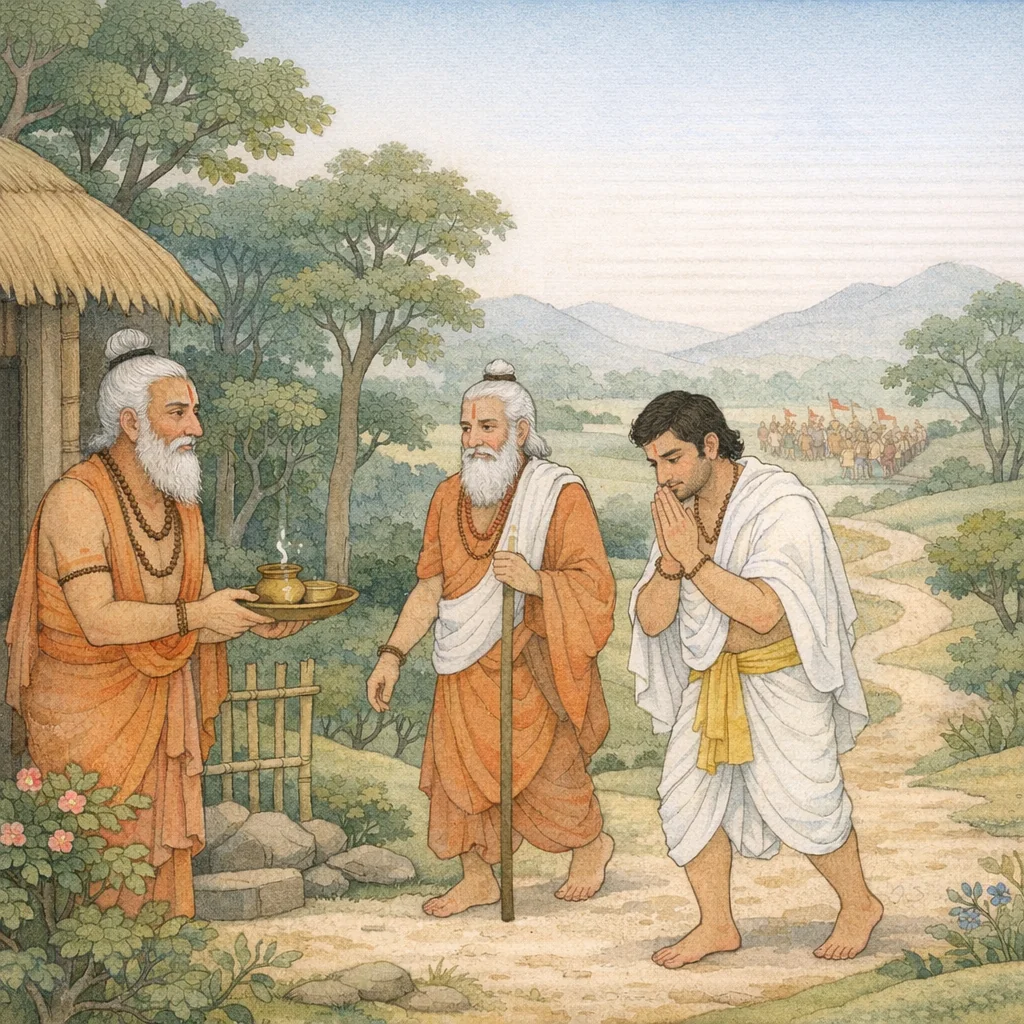
Sarga 90 portrays Bharata’s approach to Bharadvāja’s āśrama as a deliberate display of humility and transparent intent. Seeing the hermitage from one krośa away, he halts the entire army, lays aside royal weapons and insignia, and walks forward with his ministers, placing the family priest Vasiṣṭha in front to honor ritual authority and show he comes without coercion. Bharadvāja receives them by ascetic custom with arghya, pādya, and fruits, and asks after Ayodhyā’s welfare while pointedly not mentioning Daśaratha, as though aware of the king’s death. Out of love for Rāma, he presses Bharata for the reason for his arrival and voices the suspicion that Bharata might seek unobstructed rule by harming the exiled Rāma and Lakṣmaṇa. Bharata answers in grief, repudiates his mother’s deeds done in his absence, and declares his purpose: to worship Rāma’s feet and persuade him to return to Ayodhyā. Having tested and then affirmed Bharata’s inner disposition, Bharadvāja praises his self-restraint and guru-bhakti, reveals that Rāma is dwelling at Citrakūṭa with Sītā and Lakṣmaṇa, and asks Bharata to stay the night before departing the next day.
Shlokas
Verse 1
भरद्वाजाश्रमं दृष्ट्वा क्रोशादेव नरर्षभः।बलं सर्वमवस्थाप्य जगाम सह मन्त्रिभिः।।2.90.1।।पद्भ्यामेव हि धर्मज्ञो न्यस्तशस्त्रपरिच्छदः।वसानो वाससी क्षौमे पुरोधाय पुरोधसम्।।2.90.2।।
Seeing Bharadvāja’s hermitage from a distance of a krośa, Bharata—the best of men—halted his entire army and went forward with his ministers. That knower of dharma set aside his weapons and royal accoutrements, donned fine linen garments, and proceeded on foot, placing the family priest before him.
Verse 2
भरद्वाजाश्रमं दृष्ट्वा क्रोशादेव नरर्षभः।बलं सर्वमवस्थाप्य जगाम सह मन्त्रिभिः।।2.90.1।।पद्भ्यामेव हि धर्मज्ञो न्यस्तशस्त्रपरिच्छदः।वसानो वाससी क्षौमे पुरोधाय पुरोधसम्।।2.90.2।।
For the knower of dharma went on foot; laying aside his weapons and royal accoutrements, clothed in simple linen, and placing the family priest at the front.
Verse 3
तत स्सन्दर्शने तस्य भरद्वाजस्य राघवः।मन्त्रिणस्तानवस्थाप्य जगामानुपुरोहितम्।।2.90.3।।
Then Bharata, scion of the Raghu line, halted his ministers within sight of Bharadvāja’s hermitage and proceeded ahead, following his family priest.
Verse 4
वसिष्ठमथ दृष्ट्वैव भरद्वाजो महातपाः।सञ्चचाऽलासनात्तूर्णं शिष्यानर्घ्यमिति ब्रुवन्।।2.90.4।।
Seeing Vasiṣṭha, the great ascetic Bharadvāja at once rose from his seat and, addressing his disciples, said, “Bring the arghya offering.”
Verse 5
समागम्य वसिष्ठेन भरतेनाभिवादितः।अबुद्ध्यत महातेजास्सुतं दशरथस्य तम्।।2.90.5।।
After meeting Vasiṣṭha and receiving Bharata’s respectful salutation, the radiant Bharadvāja recognized him as Daśaratha’s son.
Verse 6
ताभ्यामर्घ्यं च पाद्यं च दत्वा पश्चात्फलानि च।आनुपूर्व्याच्छ धर्मज्ञः पप्रच्छ कुशलं कुले।।2.90.6।।
Having duly offered them arghya and water for washing the feet, and then fruits as well, Bharadvāja, knower of dharma, asked in proper order about the welfare of the royal family.
Verse 7
अयोध्यायां बले कोशे मित्रेष्वपि च मन्त्रिषु।जानन् दशरथं वृत्तं न राजानमुदाहरत्।।2.90.7।।
He asked about Ayodhyā—its army and treasury, and also its allies and ministers; yet, knowing what had occurred to King Daśaratha, he did not mention the king.
Verse 8
वसिष्ठो भरतश्चैनं पप्रच्छतुरनामयम्।शरीरेऽग्निषु वृक्षेषु शिष्येषु मृगपक्षिषु।।2.90.8।।
Vasiṣṭha and Bharata, in turn, asked him about his well-being—his health, his sacred fires, the trees, his disciples, and the animals and birds of the hermitage.
Verse 9
तथेति तत्प्रतिज्ञाय भरद्वाजो महातपाः।भरतं प्रत्युवाचेदं राघवस्नेहबन्धनात्।।2.90.9।।
Assuring him, “So be it,” the great ascetic Bharadvāja—bound by affectionate regard for Rāma—addressed Bharata with these words.
Verse 10
किमिहाऽगमने कार्यं तव राज्यं प्रशासतः।एतदाचक्ष्व मे सर्वं न हि मे शुद्ध्यते मनः।।2.90.10।।
What purpose brings you here, when you ought to be ruling the kingdom? Tell me everything, for my mind finds no peace in this matter.
Verse 11
सुषुवे यममित्रघ्नं कौसल्यानऽन्दवर्धनम्।भ्रात्रा सह सभार्यो यश्चिरं प्रव्राजितो वनम्।।2.90.11।।नियुक्तः स्त्रीनियुक्तेन पित्रा योऽसौ महायशाः।वनवासी भवेतीह समाः किल चतुर्दश।।2.90.12।।कच्छिन्न तस्यापापस्य पापं कर्तुमिहेच्छसि।अकण्टकं भोक्तुमना राज्यं तस्यानुजस्य च।।2.90.13।।
Rāma—slayer of foes and increaser of Kausalyā’s joy—has long been banished to the forest with his wife and his brother. That illustrious one was commanded by his father, urged on by a woman, to dwell in the forest here for fourteen years, so it is said. Do you intend to commit sin against that sinless man and his younger brother, so as to enjoy the kingdom without any obstacle?
Verse 12
सुषुवे यममित्रघ्नं कौसल्यानऽन्दवर्धनम्।भ्रात्रा सह सभार्यो यश्चिरं प्रव्राजितो वनम्।।2.90.11।।नियुक्तः स्त्रीनियुक्तेन पित्रा योऽसौ महायशाः।वनवासी भवेतीह समाः किल चतुर्दश।।2.90.12।।कच्छिन्न तस्यापापस्य पापं कर्तुमिहेच्छसि।अकण्टकं भोक्तुमना राज्यं तस्यानुजस्य च।।2.90.13।।
That illustrious Rāma was commanded by his father—under the prompting of a woman—to dwell here in the forest for fourteen years, so it is said.
Verse 13
सुषुवे यममित्रघ्नं कौसल्यानऽन्दवर्धनम्।भ्रात्रा सह सभार्यो यश्चिरं प्रव्राजितो वनम्।।2.90.11।।नियुक्तः स्त्रीनियुक्तेन पित्रा योऽसौ महायशाः।वनवासी भवेतीह समाः किल चतुर्दश।।2.90.12।।कच्छिन्न तस्यापापस्य पापं कर्तुमिहेच्छसि।अकण्टकं भोक्तुमना राज्यं तस्यानुजस्य च।।2.90.13।।
Surely you do not wish to commit a wrong against the sinless Rāma and his younger brother, seeking to enjoy the kingdom unobstructed?
Verse 14
एवमुक्तो भरद्वाजं भरतः प्रत्युवाच ह।पर्यश्रुनयनो दुःखाद्वाचा संसज्जमानया।।2.90.14।।
Thus addressed, Bharata replied to Bharadvāja—his eyes brimming with tears of grief, his words faltering as he spoke.
Verse 15
हतोऽस्मि यदि मामेवं भगवानपि मन्यते।मत्तो न दोषमाशङ्के नैवं मामनुशास्तु हि।2.90.15।।
If even you, venerable sir, think of me in this way, then I am undone. Suspect no wrongdoing in me; do not reprove me so.
Verse 16
न चैतदिष्टं माता मे यदवोचन्मदन्तरे।नाहमेतेन तुष्टश्च न तद्वचनमाददे।।2.90.16।।
Nor is it pleasing to me what my mother said in my absence. I am not satisfied by it, and I do not accept those words.
Verse 17
अहं तु तं नरव्याघ्रमुपयातः प्रसादकः।प्रतिनेतुमयोध्यां च पादौ तस्याभिवन्दितुम्।।2.90.17।।
I, for my part, have come to that tiger among men to seek his grace—to bow at his feet and to bring him back to Ayodhyā.
Verse 18
त्वं मामेवंगतं मत्वा प्रसादं कर्तुमर्हसि।शंस मे भगवन्रामः क्व सम्प्रति महीपतिः।।2.90.18।।
Considering me in these circumstances, be gracious, venerable sir, and tell me: where is Rāma now, the lord of the earth?
Verse 19
वशिष्ठादिभिः ऋत्विग्भिर्याचितो भगवांस्ततः।उवाच तं भरद्वाजः प्रसादाद्भरतं वचः।2.90.19।।
Then, requested by Vasiṣṭha and the other priests, the venerable Bharadvāja, pleased in heart, spoke these words to Bharata.
Verse 20
त्वय्येतत्पुरुषव्याघ्र युक्तं राघववंशजे।गुरुवृत्तिर्दमश्चैव साधूनामनुयायिता।।2.90.20।।
O tiger among men, born in the Rāghava line—this befits you: proper conduct toward teachers, self-restraint, and following the path of the virtuous.
Verse 21
जाने चैतन्मनस्थं ते दृढीकरणमस्त्विति।अपृच्छं त्वां तथाऽत्यर्थं कीर्तिं समभिवर्धयन्।।2.90.21।।
“I know what is firmly settled in your heart; yet I questioned you so that it might be strongly confirmed—and also to greatly enhance your good fame.”
Verse 22
जाने च रामं धर्मज्ञं ससीतं सहलक्ष्मणम्।असौ वसति ते भ्राता चित्रकूटे महागिरौ।।2.90.22।।
“I also know Rāma, knower of dharma—together with Sītā and Lakṣmaṇa. That brother of yours is dwelling on the great mountain, Citrakūṭa.”
Verse 23
श्वस्तु गन्तासि तं देशं वसाद्य सह मन्त्रिभिः।एतन्मे कुरु सुप्राज्ञ कामं कामार्थकोविद।।2.90.23।।
Tomorrow you shall go to that land; today stay here with your ministers. O supremely wise one, skilled in discerning desire and advantage—grant me this request.
Verse 24
ततस्तथेत्येवमुदारदर्शनः प्रतीतरूपो भरतोऽब्रवीद्वचः।चकार बुद्धिं च तदा तदाश्रमे निशानिवासाय नराधिपाऽत्मजः।।2.90.24।।
Then Bharata, of noble outlook, assented, saying, “So be it.” Thereupon the king’s son resolved to spend the night in that hermitage.
Frequently Asked Questions
The chapter frames a legitimacy test: Bharadvāja suspects Bharata’s arrival may conceal an ambition to enjoy the kingdom “without obstacles,” potentially by harming the exiled Rāma and Lakṣmaṇa; Bharata must publicly demonstrate non-violence, humility, and transparent intent.
Dharma is verified not only by lineage or claims but by observable conduct—restraint, reverence to preceptors, and willingness to submit motives to scrutiny; the sage’s probing becomes a method of moral clarification and reputational stabilization.
Bharadvāja’s āśrama functions as a ritual checkpoint where arghya–pādya hospitality is observed, and Citrakūṭa is identified as Rāma’s current residence—anchoring the narrative’s movement from Ayodhyā’s court to the forest geography.