Sarga 27
सीताया वनगमननिश्चयः (Sita’s Resolve to Accompany Rama to the Forest)
अयोध्याकाण्ड
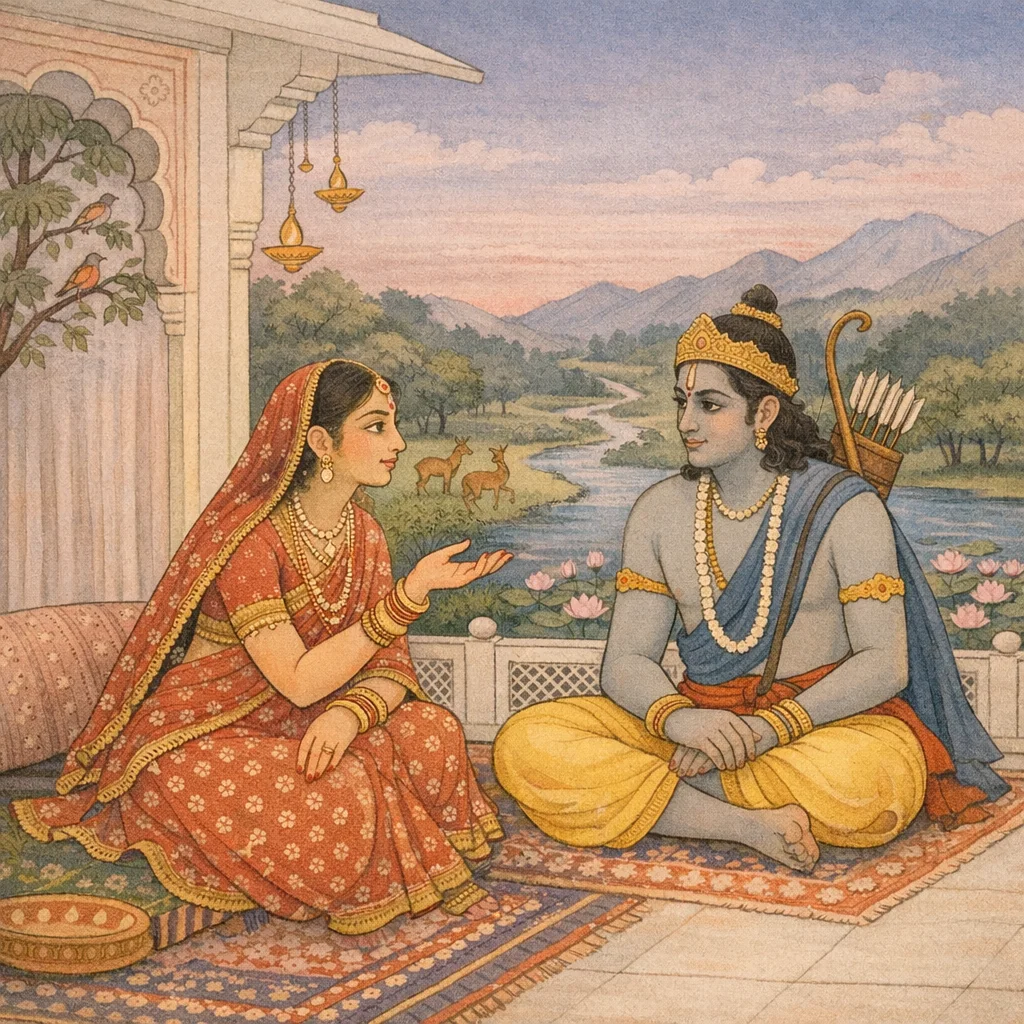
Sarga 27 records Sītā’s sustained reply to Rāma after he speaks in a way she feels dismisses her rightful share in his exile. She argues that only a wife truly shares her husband’s destiny (bhartṛ-bhāgya), and that the husband is a woman’s enduring refuge in this world and the next. Declaring herself already instructed in dharma by her parents, she insists she needs no further admonition about proper conduct. Sītā vows to go before Rāma into the harsh, unpeopled forest, even crushing thorns to ease his path. She promises disciplined living on fruits and roots, without becoming a burden. The sarga shifts from juridical reasoning to heartfelt commitment: separation from Rāma is intolerable—she rejects even heaven without him—while forest life is envisioned as joyful companionship amid rivers, mountains, lotus-lakes, and wildlife. The chapter ends with a turn in the dialogue: despite her appeals, Rāma remains reluctant and begins describing the hardships of forest dwelling to dissuade her, preparing the next exchange.
Shlokas
Verse 1
एवमुक्ता तु वैदेही प्रियार्हा प्रियवादिनी।प्रणयादेव संक्रुद्धा भर्तारमिदमब्रवीत्।।।।
Thus addressed, Vaidehī—gentle in speech and worthy of affection—angered only out of love, spoke these words to her husband.
Verse 2
किमिदं भाषसे राम वाक्यं लघुतया ध्रुवम्।त्वया यदपहास्यं मे श्रुत्वा नरवरात्मज।।।।
Why, Rāma, do you speak such words so lightly and with such certainty? O prince—were you to hear these very words spoken to you, you would surely find them laughable.
Verse 3
आर्यपुत्र पिता माता भ्राता पुत्रस्तथा स्नुषा।स्वानि पुण्यानि भुञ्जानाः स्वं स्वं भाग्यमुपासते।।।।
O noble prince, father, mother, brother, son, and even a daughter-in-law—each enjoys the fruits of their own merit and receives only their own allotted destiny.
Verse 4
भर्तुर्भाग्यं तु भार्यैका प्राप्नोति पुरुषर्षभ।अतश्चैवाहमादिष्टा वने वस्तव्यमित्यपि।।।।
O best of men, the wife alone shares in her husband’s destiny. Therefore I too am enjoined to dwell in the forest; your command is binding on me as well.
Verse 5
न पिता नात्मजो नात्मा न माता न सखीजनः।इह प्रेत्य च नारीणां पतिरेको गतिस्सदा।।।।
For a woman, neither father nor son, nor even her own self—nor mother nor friends—serves as a constant refuge; here and in the world beyond, the husband alone is always her sole resort.
Verse 6
यदि त्वं प्रस्थितो दुर्गं वनमद्यैव राघव।अग्रतस्ते गमिष्यामि मृद्नन्ती कुशकण्टकान्।।।।
If you set out this very day for the perilous, hard-to-traverse forest, O Rāghava, I will go ahead of you, trampling down the kuśa-grass and thorns.
Verse 7
ईर्ष्यारोषौ बहिष्कृत्य भुक्तशेषमिवोदकम्।नय मां वीर विस्रब्धः पापं मयि न विद्यते।।।।
Cast out jealousy and anger like leftover water after drinking; take me with you, O hero, without mistrust—for there is no fault in me.
Verse 8
प्रासादाग्रैर्विमानैर्वा वैहायसगतेन वा।सर्वावस्थागता भर्तुः पादच्छाया विशिष्यते।।।।
Whether atop palace-roofs, in splendid mansions, or even moving through the sky, in every condition the shelter of a husband’s feet is held to be the highest.
Verse 9
अनुशिष्टाऽस्मि मात्रा च पित्रा च विविधाश्रयम्।नाऽस्मि सम्प्रति वक्तव्या वर्तितव्यं यथा मया।।।।
My mother and my father have instructed me in many duties and in the proper ways of conduct; therefore now I need not be told how I ought to act.
Verse 10
अहं दुर्गं गमिष्यामि वनं पुरुषवर्जितम्।नानामृगगणाकीर्णं शार्दूलवृकसेवितम्।।।।
I too will go to the forest—hard to traverse, empty of men, crowded with herds of many kinds of beasts, and frequented by tigers and wolves.
Verse 11
सुखं वने निवत्स्यामि यथैव भवने पितुः।अचिन्तयन्ती त्रीन्लोकांश्च्चिन्तयन्ती पतिव्रतम्।।।।
I shall live happily in the forest, just as in my father’s palace—untroubled about the three worlds, thinking only of my vow of devotion to my husband.
Verse 12
शुश्रूषमाणा ते नित्यं नियता ब्रह्मचारिणी।सह रंस्ये त्वया वीर वनेषु मधुगन्धिषु।।।।
Ever serving you, self-restrained, observing the discipline of brahmacarya, I shall roam with you, O hero, through forests fragrant like honey.
Verse 13
त्वं हि शक्तो वने कर्तुं राम सम्परिपालनम्।अन्यस्यापि जनस्येह किं पुनर्मम मानद।।।।
For you, Rāma, are able to grant complete protection in the forest even to others—how much more, then, to me, O giver of honor.
Verse 14
सह त्वया गमिष्यामि वनमद्य न संशयः।नाहं शक्या महाभाग निवर्तयितुमुद्यता।।।।
There is no doubt: today I will go with you to the forest. O noble one, once resolved, I cannot be turned back.
Verse 15
फलमूलाशना नित्यं भविष्यामि न संशयः।न ते दुःखं करिष्यामि निवसन्ती सह त्वया।।।।
Have no doubt: I will live always on fruits and roots. Living with you, I will not become a cause of hardship to you.
Verse 16
इच्छामि सरितश्शैलान्पल्वलानि वनानि च।द्रष्टुं सर्वत्र निर्भीता त्वया नाथेन धीमता।।।।
With you—my wise lord—as my protector, I long to wander everywhere without fear and behold the rivers, mountains, lakes, and forests.
Verse 17
हंसकारण्डवाकीर्णाः पद्मिनीस्साधुपुष्पिताः।इच्छेयं सुखिनी द्रष्टुं त्वया वीरेण सङ्गता।।।।
Happy in your company, O heroic one, I yearn to behold lotus-ponds in full bloom, filled with swans and ducks.
Verse 18
अभिषेकं करिष्यामि तासु नित्यं यतव्रता।सह त्वया विशालाक्ष रंस्ये परमनन्दिनी ।।।।
Keeping my vows, I will bathe each day in those lotus-ponds; and with you, O large-eyed one, I will sport, filled with the highest joy.
Verse 19
एवं वर्षसहस्राणां शतं वाऽहं त्वया सह।व्यतिक्रमं न वेत्स्यामि स्वर्गोऽपि न हि मे मतः।।।।
Thus, even if I lived with you for a thousand years—or even a hundred thousand—I would not feel time passing; for me, not even heaven is desirable.
Verse 20
स्वर्गेऽपि च विना वासो भविता यदि राघव।त्वया मम नरव्याघ्र नाहं तमपि रोचये।।।।
O Rāghava—tiger among men—if I were to dwell even in heaven without you, I would not desire even that.
Verse 21
अहं गमिष्यामि वनं सुदुर्गमंमृगायुतं वानरवारणैर्युतम्।वने निवत्स्यामि यथा पितुर्गृहेतवैव पादावुपगृह्य संयता।।।।
I will go to the forest—hard to traverse, filled with wild beasts, and frequented by monkeys and elephants. In the forest I will live with discipline as though in my father’s house, taking refuge only at your feet.
Verse 22
अनन्यभावामनुरक्तचेतसंत्वया वियुक्तां मरणायनिश्चिताम्।नयस्व मां साधु कुरुष्व याचनाम्न ते मयाऽतो गुरुता भविष्यति।।।।
I am wholly fixed on you, my heart bound to you; if separated from you, I am resolved upon death. Take me, be gracious and grant my request—because of me, you will not be burdened.
Verse 23
तथा ब्रुवाणामपि धर्मवत्सलोन च स्म सीतां नृवरो निनीषति।उवाच चैनां बहु सन्निवर्तनेवने निवासस्य च दुःखितां प्रति।।।।
Even as Sītā pleaded in this way, Rāma—devoted to dharma—still would not take her along. Seeking to dissuade her, he spoke at length to the grieving Sītā about the many hardships of living in the forest.
Verse 24
I shall live always on roots and fruits—of this there is no doubt. And dwelling with you, I will not bring you any sorrow or distress.
Verse 25
एवमुक्ता तु वैदेही प्रियार्हा प्रियवादिनी।प्रणयादेव संक्रुद्धा भर्तारमिदमब्रवीत्।।2.27.1।।
Thus addressed, Vaidehī Sītā—worthy of affection and gentle in speech—became angry only out of love, and she spoke these words to her husband.
Verse 26
एवमुक्ता तु वैदेही प्रियार्हा प्रियवादिनी।प्रणयादेव संक्रुद्धा भर्तारमिदमब्रवीत्।।2.27.1।।
Thus addressed, Vaidehī Sītā—worthy of affection and gentle in speech—became angry only out of love, and she spoke these words to her husband.
Verse 27
एवमुक्ता तु वैदेही प्रियार्हा प्रियवादिनी।प्रणयादेव संक्रुद्धा भर्तारमिदमब्रवीत्।।2.27.1।।
Thus addressed, Vaidehī Sītā—worthy of affection and gentle in speech—grew angry only out of love, and spoke these words to her husband.
Verse 28
एवमुक्ता तु वैदेही प्रियार्हा प्रियवादिनी।प्रणयादेव संक्रुद्धा भर्तारमिदमब्रवीत्।।2.27.1।।
Thus addressed, Vaidehī Sītā—worthy of affection and gentle in speech—grew angry only out of love, and spoke these words to her husband.
Verse 29
एवमुक्ता तु वैदेही प्रियार्हा प्रियवादिनी।प्रणयादेव संक्रुद्धा भर्तारमिदमब्रवीत्।।2.27.1।।
Thus addressed, Vaidehī Sītā—worthy of affection and gentle in speech—grew angry only out of love, and spoke these words to her husband.
Verse 30
एवमुक्ता तु वैदेही प्रियार्हा प्रियवादिनी।प्रणयादेव संक्रुद्धा भर्तारमिदमब्रवीत्।।2.27.1।।
Thus addressed, Vaidehī Sītā—worthy of affection and gentle in speech—grew angry only out of love, and spoke these words to her husband.
Frequently Asked Questions
The dilemma is whether Sītā should remain in Ayodhyā for safety and propriety or accompany Rāma into exile; she asserts that marital dharma requires sharing his fate and refuses separation even at the cost of hardship.
The sarga frames dharma as embodied commitment: duty is not merely rule-following but steadfast relational responsibility, where discipline (saṃyama) and love-informed resolve can coexist with renunciation.
The ‘vana’ is mapped through poetic ecology—rivers, mountains, lotus-ponds with swans/ducks, and dangerous fauna (tigers, wolves, monkeys, elephants)—contrasting palace life with a culturally charged forest-as-ashrama landscape.