Sarga 75
पम्पादर्शनम् — Vision of Lake Pampā and the Turn toward Sugrīva
अरण्यकाण्ड
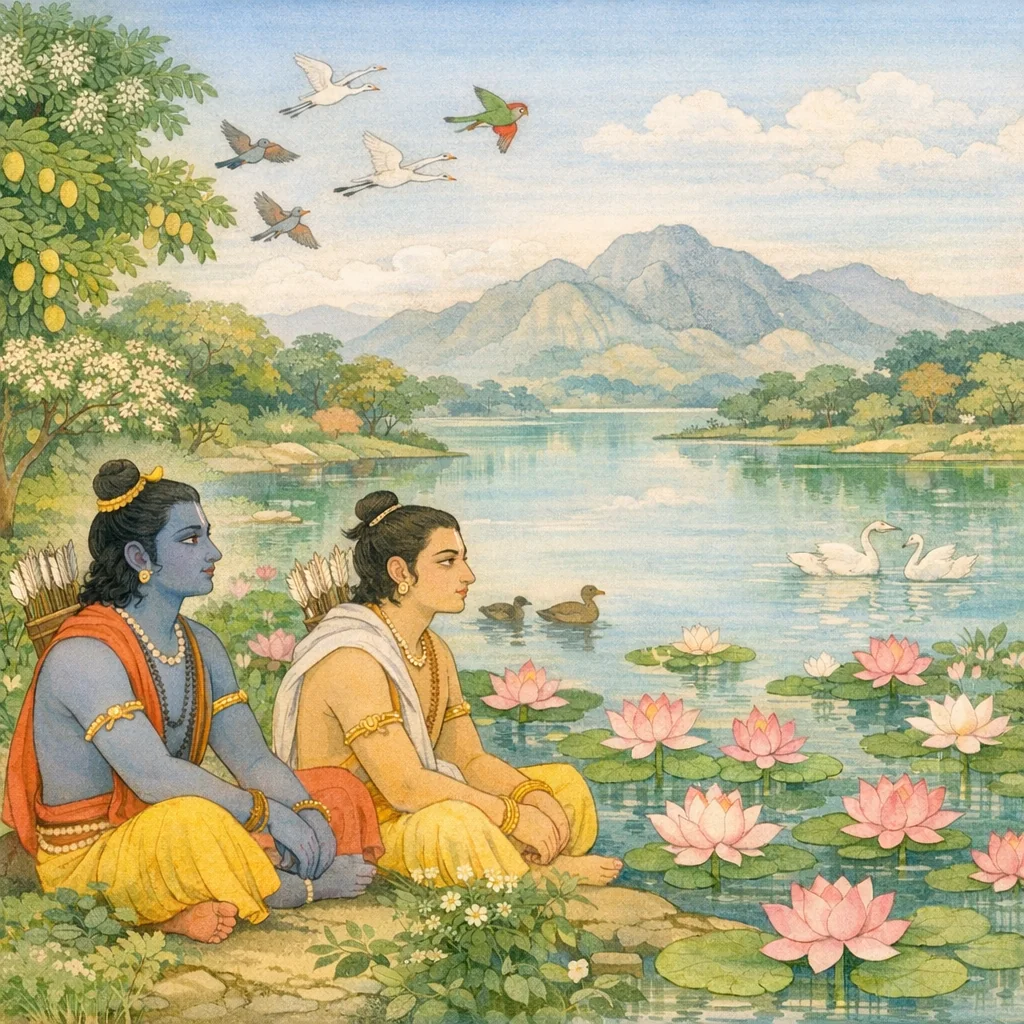
After Śabarī ascends to heaven through the radiance born of her own tapas, Rāma reflects on the prabhāva of great sages and speaks to Lakṣmaṇa with calm urgency. The brothers leave the hermitage and proceed to the sacred region of Lake Pampā. The sarga dwells on the land itself: Pampā’s cool, crystal-clear waters; soft, gleaming sands; and lotus-fields of many hues—red, white, and blue—surrounded by pleasure-groves. A rich flora is named—mango, tilaka, aśoka, punnāga, vakula, uddāla, dhava, karavīra, jasmine/kunda—while peacocks, parrots, and varied birds fill the air with sound. Yet the beauty repeatedly draws Rāma’s gaze only to sharpen his kāma-śoka, grief intensified by love and separation from Sītā. Then geography turns to strategy: on Pampā’s bank rises the sacred, mineral-adorned Ṛṣyamūka mountain, where Sugrīva (here transmitted as of the solar line) dwells in fear of Vāli with four vānaras. Rāma instructs Lakṣmaṇa to approach Sugrīva, for the search for Sītā depends upon this alliance. The sarga ends with Rāma entering the lotus-lake Pampā—sorrow held in check, yet moving decisively toward the epic’s next political and religious junction.
Shlokas
Verse 1
दिवं तु तस्यां यातायां शबर्यां स्वेन तेजसा।लक्ष्मणेन सह भ्रात्रा चिन्तयामास राघवः।।3.75.1।।
When Śabarī had departed to heaven by the radiance of her own spiritual power, Rāghava (Rāma), together with his brother Lakṣmaṇa, reflected upon the extraordinary potency of ascetics and their dharma.
Verse 2
स चिन्तयित्वा धर्मात्मा प्रभावं तं महात्मनाम्।हितकारिणमेकाग्रं लक्ष्मणं राघवोऽब्रवीत्।।3.75.2।।
Having reflected on the spiritual power of the great ṛṣis, righteous Rāma spoke to Lakṣmaṇa—his devoted well-wisher, intent and single-minded.
Verse 3
दृष्टोऽयमाश्रमस्सौम्य बह्वाश्चर्यो महात्मनाम्।विश्वस्तमृगशार्दूलो नानाविहगसेवितः।।3.75.3।।
O gentle one, we have seen this hermitage of the great sages—truly wondrous—where deer and tigers dwell together in trust, and where birds of many kinds abound.
Verse 4
सप्तानां च समुद्राणामेषु तीर्थेषु लक्ष्मण।उपस्पृष्टं च विधिवत्पितरश्चापि तर्पिताः।।3.75.4।।
O Lakshmana, by bathing in these sacred waters—as though at the holy fords of the seven seas—we have duly performed the rite, and the ancestors too have been satisfied with offerings according to tradition.
Verse 5
प्रणष्टमशुभं तत्तत्कल्याणं समुपस्थितम्।तेन तत्त्वेन हृष्टं मे मनो लक्ष्मण सम्प्रति।।3.75.5।।हृदये हि नरव्याघ्र शुभमाविर्भविष्यति।
The inauspicious has passed away, and auspicious signs have arrived. Knowing this to be true, my heart is glad now, O Lakshmana; indeed, O tiger among men, good fortune will soon manifest from within.
Verse 6
तदागच्छ गमिष्यामि पम्पां तां प्रियदर्शनाम्।।3.75.6।।ऋष्यमूको गिरिर्यत्र नातिदूरे प्रकाशते।यस्मिन्वसति धर्मात्मा सुग्रीवोंऽशुमतस्सुतः।।3.75.7।।नित्यं वालिभयात्त्रस्तश्चतुर्भिस्सह वानरैः।
Come—let us go to lovely Pampa. Not far from here shines Mount Ṛṣyamūka, where righteous Sugrīva, son of the Sun, dwells—ever afraid of Vālī—together with four monkeys.
Verse 7
तदागच्छ गमिष्यामि पम्पां तां प्रियदर्शनाम्।।3.75.6।।ऋष्यमूको गिरिर्यत्र नातिदूरे प्रकाशते।यस्मिन्वसति धर्मात्मा सुग्रीवोंऽशुमतस्सुतः।।3.75.7।।नित्यं वालिभयात्त्रस्तश्चतुर्भिस्सह वानरैः।
Come—let us go to lovely Pampa. Not far from here shines Mount Ṛṣyamūka, where righteous Sugrīva, son of the Sun, dwells—ever afraid of Vālī—together with four monkeys.
Verse 8
अभित्वरे च तं द्रष्टुं सुग्रीवं वानरर्षभम्।।3.75.8।।तदधीनं हि मे सौम्य सीतायाः परिमार्गणम्।
I hasten to see Sugrīva, the bull among monkeys; for, gentle one, the search for Sītā depends upon him.
Verse 9
एवं ब्रुवाणं तं धीरं रामं सौमित्रिरब्रवीत्।।3.75.9।।गच्छावस्त्वरितं तत्र ममापि त्वरते मनः।
As steadfast Rama spoke thus, Saumitri replied: “Let us go there quickly; my own mind too urges haste.”
Verse 10
आश्रमात्तु तत स्तस्मान्निष्क्रम्य स विशाम्पतिः।।3.75.10।।आजगाम ततः पम्पां लक्ष्मणेन सह प्रभुः।
Then that lord of men set out from that hermitage and, accompanied by Lakṣmaṇa, proceeded to Lake Pampā.
Verse 11
स ददर्श ततः पुण्यामुदारजनसेविताम्।।3.75.11।।नानाद्रुमलताकीर्णां पम्पां पानीयवाहिनीम्।पद्मैस्सौगन्धिकैस्ताम्रां शुक्लां कुमुदमण्डलैः।।3.75.12।।नीलां कुवलयोद्घाटैर्बहुवर्णां कुथामिव।
Thereafter he beheld the sacred Lake Pampā, frequented by noble folk, rich with many kinds of trees and creepers and filled with flowing waters. In places it gleamed red with fragrant lotuses, elsewhere white with clusters of kumuda-lilies, and elsewhere blue with blossoming water-lilies—like a many-colored woven carpet spread out.
Verse 12
स ददर्श ततः पुण्यामुदारजनसेविताम्।।3.75.11।।नानाद्रुमलताकीर्णां पम्पां पानीयवाहिनीम्।पद्मैस्सौगन्धिकैस्ताम्रां शुक्लां कुमुदमण्डलैः।।3.75.12।।नीलां कुवलयोद्घाटैर्बहुवर्णां कुथामिव।
Reaching the water-rich lake visible from afar, Rāma entered and bathed in the pond known as Mataṅga-sarasa.
Verse 13
स तामासाद्य वै रामो दूरादुदकवाहिनीम्।।3.75.13।।मतङ्गसरसं नाम ह्रदं समवगाहत।
Reaching the water-rich lake visible from afar, Rāma entered and bathed in the pond known as Mataṅga-sarasa.
Verse 14
अरविन्दोत्पलवतीं पद्मसौगन्धिकायुताम्।।3.75.14।।पुष्पिताम्रवणोपेतां बर्हिणोद्घुष्टनादिताम्।तिलकैर्बीजपूरैश्च धवैश्शुक्लद्रुमैस्तथा।।3.75.15।।पुष्पितैः करवीरैश्च पुन्नागैश्च सुपुष्पितैः।मालतीकुन्दगुल्मैश्च भाण्डीरैर्निचुलैस्तथा।।3.75.16।।अशोकैस्सप्तपर्णैश्च केतकैरतिमुक्तकैः।अन्यैश्च विविधैर्वृक्षैः प्रमदामिव भूषिताम्।।3.75.17।।समीक्षमाणौ पुषपाढ्यं सर्वतो विपुलद्रुमम्।कोयष्टिकैश्चार्जुनकैश्शतपत्रैश्च कीरकैः।।3.75.18।।एतैश्चान्यैश्च विहगैर्नादितं तु वनं महत्।ततो जग्मतुरव्यग्रौ राघवौ सुसमाहितौ।।3.75.19।।तद्वनं चैव सरसः पश्यन्तै शकुनैर्युतम्।
They beheld the lake and its woodland, filled with lotuses and water-lilies and permeated with lotus-fragrance; its groves were adorned with flowering mangoes and echoed with the calls of peacocks. It was beautified by tilaka trees, bījapūra (citron) trees, dhava and pale-barked trees, and by flowering karavīra and punnāga; by thickets of mālatī and kunda, by bhāṇḍīra and nicula; by aśoka, saptaparṇa, ketaka, and atimukta, and many other diverse trees—like a woman richly ornamented. As the two Rāghavas looked upon this flower-laden forest with its great trees, resounding with many birds—such as śatapatra and kīraka—they moved on, unagitated and well-composed, observing the lake-side woods filled with birds.
Verse 15
अरविन्दोत्पलवतीं पद्मसौगन्धिकायुताम्।।3.75.14।।पुष्पिताम्रवणोपेतां बर्हिणोद्घुष्टनादिताम्।तिलकैर्बीजपूरैश्च धवैश्शुक्लद्रुमैस्तथा।।3.75.15।।पुष्पितैः करवीरैश्च पुन्नागैश्च सुपुष्पितैः।मालतीकुन्दगुल्मैश्च भाण्डीरैर्निचुलैस्तथा।।3.75.16।।अशोकैस्सप्तपर्णैश्च केतकैरतिमुक्तकैः।अन्यैश्च विविधैर्वृक्षैः प्रमदामिव भूषिताम्।।3.75.17।।समीक्षमाणौ पुषपाढ्यं सर्वतो विपुलद्रुमम्।कोयष्टिकैश्चार्जुनकैश्शतपत्रैश्च कीरकैः।।3.75.18।।एतैश्चान्यैश्च विहगैर्नादितं तु वनं महत्।ततो जग्मतुरव्यग्रौ राघवौ सुसमाहितौ।।3.75.19।।तद्वनं चैव सरसः पश्यन्तै शकुनैर्युतम्।
They beheld a forest and lake-region rich with lotuses and water-lilies, permeated with the fragrance of lotus-blooms, and bordered by mango trees in flower, echoing with the calls of peacocks. It was adorned with tilaka trees, citron, dhava, and pale-barked trees, with karavīra and punnāga in full bloom, with thickets of mālatī and kunda, with bhāṇḍīra and nicula, with aśoka, saptaparṇa, ketaka, and atimuktaka, and with many other varied trees—like a woman ornamented on every side. As the two Rāghavas looked on that flower-laden woodland, vast with great trees, it rang with the sounds of many birds—koyaṣṭika, arjuna-dwellers, śatapatra, parrots, and others. Then, calm and untroubled, Rāma and Lakṣmaṇa went on, still watching that forest and the lake, filled with birds.
Verse 16
अरविन्दोत्पलवतीं पद्मसौगन्धिकायुताम्।।3.75.14।।पुष्पिताम्रवणोपेतां बर्हिणोद्घुष्टनादिताम्।तिलकैर्बीजपूरैश्च धवैश्शुक्लद्रुमैस्तथा।।3.75.15।।पुष्पितैः करवीरैश्च पुन्नागैश्च सुपुष्पितैः।मालतीकुन्दगुल्मैश्च भाण्डीरैर्निचुलैस्तथा।।3.75.16।।अशोकैस्सप्तपर्णैश्च केतकैरतिमुक्तकैः।अन्यैश्च विविधैर्वृक्षैः प्रमदामिव भूषिताम्।।3.75.17।।समीक्षमाणौ पुषपाढ्यं सर्वतो विपुलद्रुमम्।कोयष्टिकैश्चार्जुनकैश्शतपत्रैश्च कीरकैः।।3.75.18।।एतैश्चान्यैश्च विहगैर्नादितं तु वनं महत्।ततो जग्मतुरव्यग्रौ राघवौ सुसमाहितौ।।3.75.19।।तद्वनं चैव सरसः पश्यन्तै शकुनैर्युतम्।
They beheld a forest and lake-region rich with lotuses and water-lilies, permeated with the fragrance of lotus-blooms, and bordered by mango trees in flower, echoing with the calls of peacocks. It was adorned with tilaka trees, citron, dhava, and pale-barked trees, with karavīra and punnāga in full bloom, with thickets of mālatī and kunda, with bhāṇḍīra and nicula, with aśoka, saptaparṇa, ketaka, and atimuktaka, and with many other varied trees—like a woman ornamented on every side. As the two Rāghavas looked on that flower-laden woodland, vast with great trees, it rang with the sounds of many birds—koyaṣṭika, arjuna-dwellers, śatapatra, parrots, and others. Then, calm and untroubled, Rāma and Lakṣmaṇa went on, still watching that forest and the lake, filled with birds.
Verse 17
अरविन्दोत्पलवतीं पद्मसौगन्धिकायुताम्।।3.75.14।।पुष्पिताम्रवणोपेतां बर्हिणोद्घुष्टनादिताम्।तिलकैर्बीजपूरैश्च धवैश्शुक्लद्रुमैस्तथा।।3.75.15।।पुष्पितैः करवीरैश्च पुन्नागैश्च सुपुष्पितैः।मालतीकुन्दगुल्मैश्च भाण्डीरैर्निचुलैस्तथा।।3.75.16।।अशोकैस्सप्तपर्णैश्च केतकैरतिमुक्तकैः।अन्यैश्च विविधैर्वृक्षैः प्रमदामिव भूषिताम्।।3.75.17।।समीक्षमाणौ पुषपाढ्यं सर्वतो विपुलद्रुमम्।कोयष्टिकैश्चार्जुनकैश्शतपत्रैश्च कीरकैः।।3.75.18।।एतैश्चान्यैश्च विहगैर्नादितं तु वनं महत्।ततो जग्मतुरव्यग्रौ राघवौ सुसमाहितौ।।3.75.19।।तद्वनं चैव सरसः पश्यन्तै शकुनैर्युतम्।
They beheld a forest and lake-region rich with lotuses and water-lilies, permeated with the fragrance of lotus-blooms, and bordered by mango trees in flower, echoing with the calls of peacocks. It was adorned with tilaka trees, citron, dhava, and pale-barked trees, with karavīra and punnāga in full bloom, with thickets of mālatī and kunda, with bhāṇḍīra and nicula, with aśoka, saptaparṇa, ketaka, and atimuktaka, and with many other varied trees—like a woman ornamented on every side. As the two Rāghavas looked on that flower-laden woodland, vast with great trees, it rang with the sounds of many birds—koyaṣṭika, arjuna-dwellers, śatapatra, parrots, and others. Then, calm and untroubled, Rāma and Lakṣmaṇa went on, still watching that forest and the lake, filled with birds.
Verse 18
अरविन्दोत्पलवतीं पद्मसौगन्धिकायुताम्।।3.75.14।।पुष्पिताम्रवणोपेतां बर्हिणोद्घुष्टनादिताम्।तिलकैर्बीजपूरैश्च धवैश्शुक्लद्रुमैस्तथा।।3.75.15।।पुष्पितैः करवीरैश्च पुन्नागैश्च सुपुष्पितैः।मालतीकुन्दगुल्मैश्च भाण्डीरैर्निचुलैस्तथा।।3.75.16।।अशोकैस्सप्तपर्णैश्च केतकैरतिमुक्तकैः।अन्यैश्च विविधैर्वृक्षैः प्रमदामिव भूषिताम्।।3.75.17।।समीक्षमाणौ पुषपाढ्यं सर्वतो विपुलद्रुमम्।कोयष्टिकैश्चार्जुनकैश्शतपत्रैश्च कीरकैः।।3.75.18।।एतैश्चान्यैश्च विहगैर्नादितं तु वनं महत्।ततो जग्मतुरव्यग्रौ राघवौ सुसमाहितौ।।3.75.19।।तद्वनं चैव सरसः पश्यन्तै शकुनैर्युतम्।
They beheld a forest and lake-region rich with lotuses and water-lilies, permeated with the fragrance of lotus-blooms, and bordered by mango trees in flower, echoing with the calls of peacocks. It was adorned with tilaka trees, citron, dhava, and pale-barked trees, with karavīra and punnāga in full bloom, with thickets of mālatī and kunda, with bhāṇḍīra and nicula, with aśoka, saptaparṇa, ketaka, and atimuktaka, and with many other varied trees—like a woman ornamented on every side. As the two Rāghavas looked on that flower-laden woodland, vast with great trees, it rang with the sounds of many birds—koyaṣṭika, arjuna-dwellers, śatapatra, parrots, and others. Then, calm and untroubled, Rāma and Lakṣmaṇa went on, still watching that forest and the lake, filled with birds.
Verse 19
अरविन्दोत्पलवतीं पद्मसौगन्धिकायुताम्।।3.75.14।।पुष्पिताम्रवणोपेतां बर्हिणोद्घुष्टनादिताम्।तिलकैर्बीजपूरैश्च धवैश्शुक्लद्रुमैस्तथा।।3.75.15।।पुष्पितैः करवीरैश्च पुन्नागैश्च सुपुष्पितैः।मालतीकुन्दगुल्मैश्च भाण्डीरैर्निचुलैस्तथा।।3.75.16।।अशोकैस्सप्तपर्णैश्च केतकैरतिमुक्तकैः।अन्यैश्च विविधैर्वृक्षैः प्रमदामिव भूषिताम्।।3.75.17।।समीक्षमाणौ पुषपाढ्यं सर्वतो विपुलद्रुमम्।कोयष्टिकैश्चार्जुनकैश्शतपत्रैश्च कीरकैः।।3.75.18।।एतैश्चान्यैश्च विहगैर्नादितं तु वनं महत्।ततो जग्मतुरव्यग्रौ राघवौ सुसमाहितौ।।3.75.19।।तद्वनं चैव सरसः पश्यन्तै शकुनैर्युतम्।
They beheld a forest and lake-region rich with lotuses and water-lilies, permeated with the fragrance of lotus-blooms, and bordered by mango trees in flower, echoing with the calls of peacocks. It was adorned with tilaka trees, citron, dhava, and pale-barked trees, with karavīra and punnāga in full bloom, with thickets of mālatī and kunda, with bhāṇḍīra and nicula, with aśoka, saptaparṇa, ketaka, and atimuktaka, and with many other varied trees—like a woman ornamented on every side. As the two Rāghavas looked on that flower-laden woodland, vast with great trees, it rang with the sounds of many birds—koyaṣṭika, arjuna-dwellers, śatapatra, parrots, and others. Then, calm and untroubled, Rāma and Lakṣmaṇa went on, still watching that forest and the lake, filled with birds.
Verse 20
स ददर्श ततः पम्पां शीतवारिनिधिं शुभाम्।।3.75.20।।तिलकाशोकपुन्नागवकुलोद्दालकाशिनीम्।
Then he beheld auspicious Pampā, a reservoir of cool waters, made radiant by groves of tilaka, aśoka, punnāga, vakula, and uddāla trees.
Verse 21
स रामो विविधान्वृक्षान्सरांसि विविधानि च।।3.75.21।।पश्यन्कामाभिसन्तप्तो जगाम परमं ह्रदम्।
Beholding the many kinds of trees and the various lakes, Rāma—burning with longing—went on to that excellent lake.
Verse 22
पुष्पितोपवनोपेतां सालचम्पकशोभिताम्।।3.75.22।।षट्पदौघसमाविष्टां श्रीमतीमतुलप्रभाम्।स्फटिकोपमतोयाढ्यां श्लक्ष्णवालुकसन्तताम्।।3.75.23।।स तां दृष्ट्वा पुनः पम्पां पद्मसौगन्घिकैर्युताम्।इत्युवाच तदा वाक्यं लक्ष्मणं सत्यविक्रमः।।3.75.24।।
Pampā was bordered by pleasure-groves in bloom, beautified by sāla and campaka; swarming with hosts of bees, splendid and of incomparable radiance; rich in crystal-clear waters, and lined with stretches of smooth, shining sand. Seeing that Pampā again—fragrant with lotuses—Rāma, whose prowess is bound to truth, then spoke these words to Lakṣmaṇa.
Verse 23
पुष्पितोपवनोपेतां सालचम्पकशोभिताम्।।3.75.22।।षट्पदौघसमाविष्टां श्रीमतीमतुलप्रभाम्।स्फटिकोपमतोयाढ्यां श्लक्ष्णवालुकसन्तताम्।।3.75.23।।स तां दृष्ट्वा पुनः पम्पां पद्मसौगन्घिकैर्युताम्।इत्युवाच तदा वाक्यं लक्ष्मणं सत्यविक्रमः।।3.75.24।।
Pampā was bordered by pleasure-groves in bloom, beautified by sāla and campaka; swarming with hosts of bees, splendid and of incomparable radiance; rich in crystal-clear waters, and lined with stretches of smooth, shining sand. Seeing that Pampā again—fragrant with lotuses—Rāma, whose prowess is bound to truth, then spoke these words to Lakṣmaṇa.
Verse 24
पुष्पितोपवनोपेतां सालचम्पकशोभिताम्।।3.75.22।।षट्पदौघसमाविष्टां श्रीमतीमतुलप्रभाम्।स्फटिकोपमतोयाढ्यां श्लक्ष्णवालुकसन्तताम्।।3.75.23।।स तां दृष्ट्वा पुनः पम्पां पद्मसौगन्घिकैर्युताम्।इत्युवाच तदा वाक्यं लक्ष्मणं सत्यविक्रमः।।3.75.24।।
Pampā was bordered by pleasure-groves in bloom, beautified by sāla and campaka; swarming with hosts of bees, splendid and of incomparable radiance; rich in crystal-clear waters, and lined with stretches of smooth, shining sand. Seeing that Pampā again—fragrant with lotuses—Rāma, whose prowess is bound to truth, then spoke these words to Lakṣmaṇa.
Verse 25
अस्यास्तीरे तु पूर्वोक्तः पर्वतो धातुमण्डितः।ऋष्यमूक इति ख्यातः पुण्यः पुष्पितपादपः।।3.75.25।।
On this lake’s bank stands the mountain mentioned earlier—adorned with minerals—famed as Ṛṣyamūka, sacred and covered with trees in bloom.
Verse 26
हरेः ऋक्षरजोनाम्नः पुत्रस्तस्य महात्मनः।अध्यास्ते तं महावीर्यस्सुग्रीव इति विश्रुतः।।3.75.26।।
There dwells the famed Sugrīva, of great valor—son of the Sun, and of that great-souled Ṛkṣarāja.
Verse 27
सुग्रीवमभिगच्छ त्वं वानरेन्द्रं नरर्षभ।इत्युवाच पुनर्वाक्यं लक्ष्मणं सत्यविक्रमम्।।3.75.27।।
“Go and approach Sugrīva, the lord of the monkeys, O best of men.” Thus Rāma spoke again to Lakṣmaṇa—whose valor is grounded in truth.
Verse 28
राज्यभ्रष्टेन दीनेन तस्यामासक्तचेतसा।कथं मया विना शक्यं सीतां लक्ष्मण जीवितुम्।।3.75.28।।
O Lakṣmaṇa, cast out from my kingdom and brought low, my mind bound to her—how could Sītā live without me?
Verse 29
इत्येवमुक्त्वा मदनाभिपीडितः स लक्ष्मणं वाक्यमनन्यचेतसम्।विवेश पम्पां नलिनीं मनोरमां रघूत्तमश्शोकविषादयन्त्रितः।।3.75.29।।
Having spoken thus to Lakṣmaṇa, whose attention did not stray, Rama—the best of the Raghus—oppressed by love and driven by grief and despair, entered Pampa, the lovely lotus-filled lake.
Verse 30
ततो महद्वर्त्म सुदूरसङ्क्रमं क्रमेण गत्वा प्रविलोकयन्वनम्।ददर्श पम्पां शुभदर्शकाननामनेकनानाविधपक्षिजालकाम्।।3.75.30।।
Then, going step by step along a great path that stretched far away, and surveying the forest, he beheld Pampa—encircled by fair woods and filled with flocks of birds of many kinds.
Frequently Asked Questions
The pivotal action is Rāma’s choice to convert personal grief into purposeful action: despite being love-stricken and sorrowful, he prioritizes dharma-driven strategy by directing Lakṣmaṇa to approach Sugrīva, recognizing that Sītā’s search depends on disciplined alliance.
The sarga frames tapas and saintly prabhāva as real forces in the moral universe (Śabarī’s heavenly departure), while also teaching that emotional suffering need not paralyze agency; it can be integrated into righteous decision-making and timely initiative.
Key landmarks include Pampā (with lotus-rich waters, groves, and birdlife), Matanga-sarasa where Rāma bathes, and Ṛṣyamūka mountain on Pampā’s bank—identified as Sugrīva’s refuge due to fear of Vāli, thus linking geography to the epic’s alliance network.