Sarga 52
सीताहरण-विलापः / The Lament at Jatāyu and the Abduction of Sītā
अरण्यकाण्ड
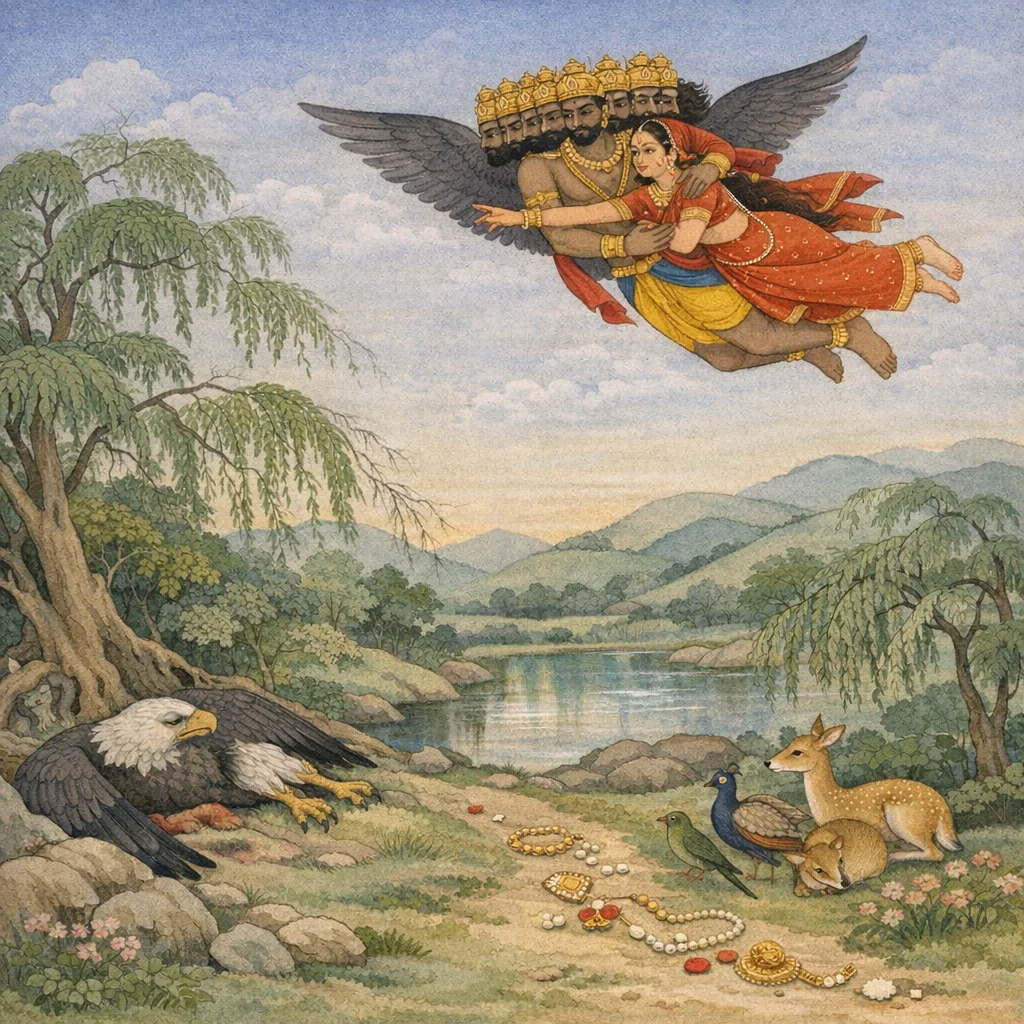
Sarga 52 depicts the immediate aftermath of the abduction and its cosmic reverberations. Sītā beholds Jaṭāyu, the king of vultures (gṛdhrarāja), struck down by Rāvaṇa, and laments in piercing grief. The narrative frames this human calamity through nimitta and śakuna—portents and ominous bird-calls—teaching that joy and sorrow are preceded by signs that can be perceived. As Rāvaṇa seizes Sītā, she cries out for Rāma and Lakṣmaṇa, clings to the trees, and is forcibly borne into the sky; the text marks the deed as leading to Rāvaṇa’s own self-destruction (ātmavināśāya). Nature and the cosmos mirror the rupture of dharma: darkness spreads, the wind falls still, the sun grows dim, and beings, forests, ponds, mountains, and animals appear to mourn. A dense chain of poetic similes portrays Sītā’s radiance and dislocation—lightning within cloud, the moon veiled by dark rainclouds, a lotus without its stalk—while her ornaments and flowers fall and scatter as trace-objects mapping the path of the abduction. In a divine, omniscient register, Brahmā witnesses the assault upon Sītā and declares the “task accomplished,” and the forest seers feel sorrow mingled with anticipatory relief, knowing that Rāvaṇa’s destruction is now near.
Shlokas
Verse 1
सा तु ताराधिपमुखी रावणेन समीक्ष्य तम्।गृध्रराजं विनिहतं विललाप सुदुःखिता।।।।
But Sītā, moon-faced, seeing the king of vultures struck down by Rāvaṇa, lamented in overwhelming sorrow.
Verse 2
निमित्तं लक्षणज्ञानं शकुनिस्वरदर्शनम्।अवश्यं सुखदुःखेषु नराणां प्रतिदृश्यते।।।।
For people, in times of joy and sorrow, signs are surely perceived—knowledge of omens, and the hearing or sighting of birds whose cries foretell what is to come.
Verse 3
नूनं राम न जानासि महद्व्यसनमात्मनः।धावन्ति नूनं काकुत्स्थं मदर्थं मृगपक्षिणः।।।।
Surely, Rāma, you do not yet know the great calamity that has come upon you. For my sake, O scion of the Kakutsthas, beasts and birds are surely running to you, as if to report what is happening to me.
Verse 4
अयं हि पापचारेण मां त्रातुमभिसङ्गतः।शेते विनिहतो भूमौ ममाभाग्याद्विहंगमः।।।।
“This bird, who came forward to rescue me, has been struck down by that sinful one; through my ill-fortune he lies upon the ground.”
Verse 5
त्राहि मामद्य काकुत्स्थ लक्ष्मणेति वराङ्गना।सुसन्त्रस्ता समाक्रन्दच्छृण्वतां तु यथान्तिके।।।।
Terribly frightened, the noble lady cried out in anguish, “Save me today—O Kākutstha! O Lakṣmaṇa!” as though they were nearby and could hear her.
Verse 6
तां क्लिष्टमाल्याभरणां विलपन्तीमनाथवत्।अभ्यधावत् वैदेहीं रावणो राक्षसाधिपः।।।।
Rāvaṇa, lord of the rākṣasas, rushed toward Vaidehī as she wept like one without any protector, her garlands crushed and her ornaments disordered.
Verse 7
तां लतामिव वेष्टन्तीमालिङ्गन्तीं महाद्रुमान्।मुञ्च मुञ्चेति बहुशः प्रवदन्राक्षसाधिपः।।।।क्रोशन्तीं राम रामेति रामेण रहितां वने।जीवितान्ताय केशेषु जग्राहान्तकसन्निभः।।।।
As she clung to the great trees, winding about them like a creeper and embracing them, the lord of the rākṣasas cried again and again, “Let go, let go!”
Verse 8
तां लतामिव वेष्टन्तीमालिङ्गन्तीं महाद्रुमान्।मुञ्च मुञ्चेति बहुशः प्रवदन्राक्षसाधिपः।।3.52.7।।क्रोशन्तीं राम रामेति रामेण रहितां वने।जीवितान्ताय केशेषु जग्राहान्तकसन्निभः।।3.52.8।।
Crying again and again, “Rāma! Rāma!”, alone in the forest without Rāma, she was seized by the hair by one who seemed like Death itself—an act that would bring about his own end.
Verse 9
प्रधर्षितायां सीतायां बभूव सचराचरम्।जगत्सर्वममर्यादं तमसान्धेन संवृतम्।।।।न वाति मारुतस्तत्र निष्प्रभोऽभूद्दिवाकरः।
When Sītā was assaulted, the whole world—moving and unmoving—seemed to transgress all bounds of right order and was veiled in blinding darkness. No wind blew there, and the sun’s radiance grew dim.
Verse 10
दृष्ट्वा सीतां परामृष्टां दीनां दिव्येन चक्षुषा।।।।कृतं कार्यमिति श्रीमान्व्याजहार पितामहः।
With his divine sight, the glorious Grandfather, Pitāmaha (Brahmā), beheld Sītā—assaulted and left in misery—and declared, “The task has been accomplished.”
Verse 11
प्रहृष्टा व्यथिताश्चासन्सर्वे ते परमर्षयः।।।।दृष्ट्वा सीतां परामृष्टां दण्डकारण्यवासिनः।रावणस्य विनाशं च प्राप्तं बुद्ध्वा यदृच्छया।।।।
All those great seers dwelling in the Daṇḍaka forest were at once delighted and pained: pained on seeing Sītā seized, yet delighted in knowing—by the course of events—that Rāvaṇa’s destruction had now drawn near.
Verse 12
प्रहृष्टा व्यथिताश्चासन्सर्वे ते परमर्षयः।।3.52.11।।दृष्ट्वा सीतां परामृष्टां दण्डकारण्यवासिनः।रावणस्य विनाशं च प्राप्तं बुद्ध्वा यदृच्छया।।3.52.12।।
All the great seers of the Daṇḍaka forest felt both joy and anguish—anguish at Sītā’s seizure, and joy in understanding that, as events unfolded, Rāvaṇa’s ruin had come within reach.
Verse 13
स तु तां राम रामेति रुदन्तीं लक्ष्मणेति च।जगामादाय चाकाशं रावणो राक्षसाधिपः।।।।
But Rāvaṇa, lord of the rākṣasas, seized her and rose into the sky, while she wept, crying, “Rāma! Rāma!” and “Lakṣmaṇa!”
Verse 14
तप्ताभरणजुष्टाङ्गी पीतकौशेयवासिनी।रराजराजपुत्री तुविद्युत्सौदामिनी यथा।।।।
Adorned with gleaming gold ornaments and clad in yellow silk, the princess shone like a flash of lightning.
Verse 15
उद्धूतेन च वस्त्रेण तस्याः पीतेन रावणः।अधिकं परिबभ्राज गिरिर्दीप्त इवाग्निना।।।।
With her yellow garment streaming in the wind, Rāvaṇa glittered all the more—like a mountain blazing with fire.
Verse 16
तस्याः परमकल्याण्यास्ताम्राणि सुरभीणि च।पद्मपत्राणि वैदेह्या अभ्यकीर्यन्त रावणम्।।।।
From Vaidehī, the most auspicious lady, copper-red and fragrant lotus petals scattered down upon Rāvaṇa.
Verse 17
तस्याः कौशेयमुद्धूतमाकाशे कनकप्रभम्।बभौ चादित्यरागेण ताम्रमभ्रमिवातपे।।।।
Her silk, blown aloft in the sky and glowing like gold, appeared—tinted by the sun’s redness—like a copper-hued cloud in the light.
Verse 18
तस्यास्तत्सुनसं वक्त्रमाकाशे रावणाङ्कगम्।न रराज विना रामं विनालमिव पङ्कजम्।।।।
Her lovely, fine-nosed face, borne aloft in the sky upon Rāvaṇa’s lap, did not shine without Rāma—like a lotus without its stalk.
Verse 19
बभूव जलदं नीलं भित्त्वा चन्द्र इवोदितः।सुललाटं सुकेशान्तं पद्मगर्भाभमव्रणम्।।।।शुक्लैस्सुविमलैर्दन्तै प्रभावद्भिरलङ्कृतम्।तस्यास्तद्विमलं वक्त्रमाकाशे रावणाङ्कगम्।।।।रुदितं व्यपमृष्टास्रं चन्द्रवत्प्रियदर्शनम्।सुनासं चारुताम्रोष्ठमाकाशे हाटकप्रभम्।।।।
Her pure face—smooth-browed, framed by lovely hair, spotless and radiant like the heart of a lotus, adorned with bright, clean white teeth—rested aloft in the sky upon Rāvaṇa’s lap. Though she wept and wiped away her tears, it remained pleasing like the moon, as if the moon had risen by breaking through a dark rain-cloud. With a fine nose and lovely copper-red lips, it gleamed in the sky with a golden luster.
Verse 20
बभूव जलदं नीलं भित्त्वा चन्द्र इवोदितः।सुललाटं सुकेशान्तं पद्मगर्भाभमव्रणम्।।3.52.19।।शुक्लैस्सुविमलैर्दन्तै प्रभावद्भिरलङ्कृतम्।तस्यास्तद्विमलं वक्त्रमाकाशे रावणाङ्कगम्।।3.52.20।।रुदितं व्यपमृष्टास्रं चन्द्रवत्प्रियदर्शनम्।सुनासं चारुताम्रोष्ठमाकाशे हाटकप्रभम्।।3.52.21।।
Her pure face—adorned with clean, white, shining teeth—was seen aloft in the sky, resting upon Rāvaṇa’s lap.
Verse 21
बभूव जलदं नीलं भित्त्वा चन्द्र इवोदितः।सुललाटं सुकेशान्तं पद्मगर्भाभमव्रणम्।।3.52.19।।शुक्लैस्सुविमलैर्दन्तै प्रभावद्भिरलङ्कृतम्।तस्यास्तद्विमलं वक्त्रमाकाशे रावणाङ्कगम्।।3.52.20।।रुदितं व्यपमृष्टास्रं चन्द्रवत्प्रियदर्शनम्।सुनासं चारुताम्रोष्ठमाकाशे हाटकप्रभम्।।3.52.21।।
Weeping, yet wiping away her tears, her face—moonlike and dear to behold—showed a fine nose and lovely reddish lips, glowing in the sky with a golden radiance.
Verse 22
राक्षसेन समाधूतं तस्यास्तद्वदनं शुभम्।शुशुभे न विना रामंदिवा चन्द्र इवोदितः।।।।
Shaken by the rākṣasa, her auspicious face did not shine without Rāma—like the moon risen in daytime, bereft of its radiance.
Verse 23
सा हेमवर्णा नीलाङ्गं मैथिली राक्षसाधिपम्।शुशुभे काञ्चनी काञ्ची नीलं मणिमिवाश्रिता।।।।
Golden-complexioned Maithilī, held by the dark-bodied lord of rākṣasas, shone like a golden girdle resting upon a deep-blue gem.
Verse 24
सा पद्मगौरी हेमाभा रावणं जनकात्मजा।विद्युद्घनमिवाविश्य शुशुभे तप्तभूषणा।।।।
Janaka’s daughter, fair as a lotus and golden-hued, adorned with gleaming ornaments, clung to Rāvaṇa and shone like lightning entering a dark cloud.
Verse 25
तस्या भूषणघोषेण वैदेह्या राक्षसाधिपः।बभौ सचपलो नीलस्सघोष इव तोयदः।।।।
Because of Vaidehī’s tinkling ornaments, the dark lord of rākṣasas appeared like a rain-cloud—complete with lightning and thunder.
Verse 26
उत्तमाङ्गाच्च्युता तस्याः पुष्पवृष्टिस्समन्ततः।सीताया ह्रिममाणायाः पपात धरणीतले।।।।
As Sītā was being carried off, the shower of flowers that had fallen from her head scattered all around and dropped onto the surface of the earth, as she shrank in modest shame.
Verse 27
सा तु रावणवेगेन पुष्पवृष्टिः समन्ततः।समाधूता दशग्रीवं पुनरेवाभ्यवर्तत।।।।
But that shower of flowers, whirled on every side by the force of Rāvaṇa’s speed, turned back again toward Daśagrīva.
Verse 28
अभ्यवर्तत पुष्पाणां धारा वैश्रवणानुजम्।नक्षत्रमाला विमला मेरुं नगमिवोन्नतम्।।।।
The stream of flowers moved back toward the younger brother of Vaiśravaṇa, as a bright, pure garland of stars seems to wheel toward lofty Mount Meru.
Verse 29
चरणान्नूपुरं भ्रष्टं वैदेह्या रत्नभूषितम्।विद्युन्मण्डलसङ्काशं पपात मधुरस्वनम्।।।।
From Vaidehī’s foot her gem-studded anklet slipped and fell—brilliant like a circle of lightning—sounding softly as it struck.
Verse 30
तरुप्रवालरक्ता सा नीलाङ्गं राक्षसेश्वरम्।प्राशोभयत वैदेही गजं कक्ष्येव काञ्चनी।।।।
Vaidehī, ruddy like tender shoots, made the dark-bodied lord of rākṣasas appear adorned—like a golden tethering-chain placed upon an elephant.
Verse 31
तां महोल्कामिवाकाशे दीप्यमानां स्वतेजसा।जहाराऽकाशमाविस्य सीतां वैश्रवणानुजः।।।।
The younger brother of Vaiśravaṇa seized Sītā—blazing with her own radiance like a great meteor in the sky—and, entering the open firmament, bore her away.
Verse 32
तस्यास्तान्यग्निवर्णानि भूषणानि महीतले।सघोषाण्यवकीर्यन्त क्षीणास्तारा इवाम्बरात्।।।।
Her ornaments, bright like fire, scattered down upon the earth with a tinkling sound—like dim stars dropping from the sky.
Verse 33
तस्यास्स्तनान्तराद्भ्रष्टो हारस्ताराधिपद्युतिः।वैदेह्या निपतन्भाति गङ्गेव गगनाच्च्युता।।।।
From between Vaidehī’s breasts her necklace slipped—shining with the moon’s splendor—and, as it fell, it looked like the Gaṅgā herself dropping from the sky.
Verse 34
उत्पातवाताभिहता नानाद्विजगणायुताः।माभैरिति विधूताग्रा व्याजह्रुरिव पादपाः।।।।
Struck by ominous gusts of wind, and filled with flocks of many kinds of birds, the trees—shaken at their tops—seemed as though they were crying out, “Do not be afraid!”
Verse 35
नलिन्यो ध्वस्तकमलास्त्रस्तमीनजलेचराः।सखीमिव गतोच्छ्वासामन्वशोचन्त मैथिलीम्।।।।
The lotus-ponds—whose lotuses were ruined and whose fish and water-creatures were frightened—seemed to mourn Maithilī as one mourns a companion left gasping for breath.
Verse 36
समन्तादभिसम्पत्य सिंहव्याघ्रमृगद्विजाः।अन्वधावंस्तदा रोषात्सीतां छायानुगामिनः।।।।
Then, converging from every side, lions, tigers, deer, and birds—stirred by wrath—ran after Sītā, following only her shadow.
Verse 37
जलप्रपातास्रमुखाश्शृङ्गैरुच्छ्रितबाहुभिः।सीतायां ह्रियमाणायां विक्रोशन्तीव पर्वताः।।।।
As Sītā was being carried away, the mountains seemed to wail—pouring forth tears as waterfalls and lifting their peaks like upraised arms.
Verse 38
ह्रियमाणां तु वैदेहीं दृष्ट्वा दीनो दिवाकरः।प्रतिध्वस्तप्रभश्श्रीमानासीत्पाण्डरमण्डलः।।।।
Seeing Vaidehī being carried away, the glorious Sun grew sorrowful; his radiance seemed dimmed, and a pale halo formed around his disk.
Verse 39
नास्ति धर्मः कुतस्सत्यं नार्जवं नानृशंसता।यत्र रामस्य वैदेहीं भार्यां हरति रावणः।।।।इति सर्वाणि भूतानि गणशः पर्यदेवयन्।
“Where Rāvaṇa carries off Rāma’s wife Vaidehī, there is no dharma—how could there be truth, uprightness, or compassion?” Thus all beings, in groups, lamented.
Verse 40
वित्रस्तका दीनमुखा रुरुदुर्मृगपोतकाः।।।।उद्वीक्ष्योद्वीक्ष्य नयनैरस्रपाताविलेक्षणाः।
The fawns, frightened and sorrow-faced, wept; again and again they looked up in that direction, their eyes blurred by streaming tears.
Verse 41
सुप्रवेपितगात्राश्च बभूवुर्वनदेवताः।।।।विक्रोशन्तीं दृढं सीतां दृष्ट्वा दुःखं तथा गताम्।
The forest deities trembled all over; seeing Sītā crying out intensely and fallen into such grief, they were shaken.
Verse 42
तां तु लक्ष्मण रामेति क्रोशन्तीं मधुरस्वरम्।।।।अवेक्षमाणां बहुशो वैदेहीं धरणीतलम्।स तामाकुलकेशान्तां विप्रमृष्टविशेषकाम्।।।।जहारात्म विनाशाय दशग्रीवो मनस्स्विनीम्।
As Vaidehī cried out in a sweet voice, “O Lakṣmaṇa! O Rāma!”, and again and again looked down to the earth, her hair dishevelled and her auspicious brow-mark erased, Daśagrīva carried away that high-minded lady—bringing ruin upon himself.
Verse 43
तां तु लक्ष्मण रामेति क्रोशन्तीं मधुरस्वरम्।।3.52.42।।अवेक्षमाणां बहुशो वैदेहीं धरणीतलम्।स तामाकुलकेशान्तां विप्रमृष्टविशेषकाम्।।3.52.43।।जहारात्म विनाशाय दशग्रीवो मनस्स्विनीम्।
The forest deities trembled all over; seeing Sītā crying out intensely and fallen into such grief, they were shaken.
Verse 44
ततस्तु सा चारुदती शुचिस्मिता विनाकृता बन्धुजनेन मैथिली।अपश्यती राघवलक्ष्मणावुभौ विवर्णवक्त्राभयभारपीडिता।।।।
Then Maithilī—fair-toothed and pure-smiling—was severed from her kinsfolk; unable to see either Rāghava or Lakṣmaṇa, her face grew pale, crushed beneath the burden of fear.
Frequently Asked Questions
The pivotal action is Rāvaṇa’s forcible abduction of Sītā—an explicit violation of protection owed to a dependent in exile and a breach of maryādā. The sarga also highlights Jatāyu’s protective intervention and injury, framing resistance to adharma as costly yet normative within rakṣaṇa-dharma.
The chapter teaches that moral transgression is not merely personal but world-disordering: nature, celestial light, and communal beings react as if dharma itself is shaken. It also encodes a teleology of justice—Brahmā’s declaration and the seers’ mixed emotions indicate that adharma initiates the conditions of its own downfall (Rāvaṇa’s ātmavināśa).
Daṇḍakāraṇya and its ascetic milieu are foregrounded through the presence of forest seers and responsive landscapes (trees, lotus-ponds, mountains with waterfalls). The falling ornaments (nūpura, hāra, flowers, garments) function as culturally meaningful trace-objects, marking the abduction route and preserving memory within the forest geography.