Sarga 23
महोत्पात-लक्षणानि (Omens before Khara’s Assault)
अरण्यकाण्ड
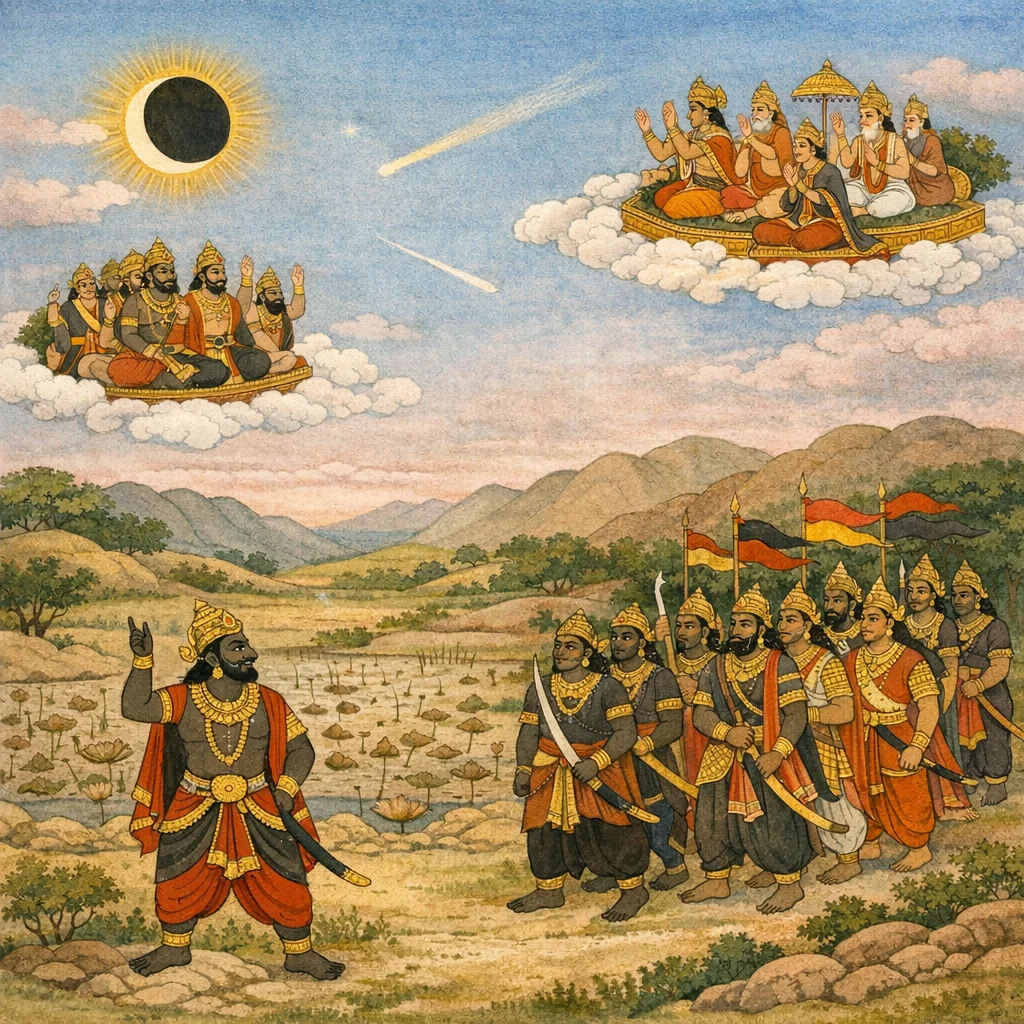
In this sarga, as Khara marches out from Janasthana at the head of the rakshasa host, great portents (mahotpātas) appear one after another: rain like blood, a halo around the sun, Rahu’s eclipse at an untimely hour, the sighting of Ketu, stars rising out of season, fish and birds falling silent and hiding, lotus-ponds drying up, dust whirling without wind, meteors falling, and the earth trembling. Ominous cries of owls, jackals, and vultures also resound. These signs, as divine marks before battle, proclaim the rakshasas’ destruction to be near. Yet Khara, swollen with pride in his own might, scorns the omens and declares he has no concern, boasting as though he could cast down stars and bend even death to his will. Devas, rishis, gandharvas, siddhas, and charanas gather to witness the combat and utter blessings for Raghava’s victory. From their vimanas the gods behold the rakshasa army as if its lifespan were already spent. At the close, Khara surrounded by twelve champions, and Dushana with four commanders, suddenly advance upon Rama and Lakshmana—likened to the sun and moon encircled by a garland of planets.
Shlokas
Verse 1
तस्मिन्याते बले घोरमशिवं शोणितोदकम्।अभ्यवर्षन्महामेघस्तुमुलो गर्दभारुणः।।।।
As that fearsome host marched, a huge cloud—dark as a donkey’s hue—burst forth and rained a dreadful, inauspicious shower, red like blood.
Verse 2
निपेतुस्तुरगास्तस्य रथयुक्ता महाजवाः।समे पुष्पचिते देशे राजमार्गे यदृच्छया।।।।
Though yoked to his chariot and swift, his horses stumbled of their own accord on the level royal road strewn evenly with flowers.
Verse 3
श्यामं रुधिरपर्यन्तं बभूव परिवेषणम्।अलातचक्रप्रतिमं परिगृह्य दिवाकरम्।।।।
Then a dark halo with blood-red edges appeared, encircling the Sun; it looked like the ring traced by a whirling firebrand, as though it had seized the solar orb.
Verse 4
ततो ध्वजमुपागम्य हेमदण्डं समुच्छ्रितम्।समाक्रम्य महाकायस्तस्थौ गृध्रस्सुदारुणः।।।।
Then a huge, terrifying vulture flew up to the raised banner with its golden staff, seized the top of it, and perched there—an omen of impending calamity.
Verse 5
जनस्थानसमीपे तु समागम्य खरस्वनाः।विस्वरान्विविधांश्चक्रुर्मांसादा मृगपक्षिणः।।।।
Near Jana-sthāna, flesh-eating beasts and birds gathered together and raised many kinds of harsh, discordant cries—another warning of approaching ruin.
Verse 6
व्याजह्रुश्च प्रदीप्तायां दिशि वै भैरवस्वनम्।अशिवं यातुधानानां शिवा घोरा महास्वनाः।।।।
And the frightful jackals, with loud and dreadful howls, cried toward the blazing quarter—signaling inauspiciousness for the rākṣasas.
Verse 7
प्रभिन्नगिरिसङ्काशास्तोयशोणितधारिणः।आकाशं तदनाकाशं चक्रुर्भीमा वलाहकाः।।।।
Terrifying clouds, like shattered mountains, poured down water that seemed like blood, making the sky appear no longer sky—strange and dreadful.
Verse 8
बभूव तिमिरं घोरमुद्धतं रोमहर्षणम्।दिशो वा विदिशो वापि न च व्यक्तं चकाशिरे।।।।
A dreadful darkness arose, fierce and hair-raising; neither the main quarters nor the intermediate directions shone forth clearly.
Verse 9
क्षतजार्द्रसवर्णाभा सन्ध्याकालं विना बभौ।खरस्याभिमुखा नेदुस्तदा घोरमृगाः खगाः।।।।कङ्कगोमायुगृध्राश्च चुक्रुशुर्भयशंसिनः।
Even before twilight, a dusk appeared, the color of a fresh, wet wound. Then dreadful beasts and birds, facing Khara, cried out; kanka-birds, jackals, and vultures screeched, foretelling fear and disaster.
Verse 10
नित्याशुभकरा युद्धे शिवा घोरनिदर्शनाः।।।।नेदुर्बलस्याभिमुखं ज्वालोद्गारिभिराननैः।
Jackals—ever in war the bringers of ill—appeared as dreadful omens; facing the host, they howled, their mouths as though they breathed forth flame.
Verse 11
कबन्धः परिघाभासो दृश्यते भास्करान्तिके।।।।जग्राह सूर्यं स्वर्भानुरपर्वणि महाग्रहः।प्रवाति मारुतश्शीघ्रं निष्प्रभोऽभूद्दिवाकरः।।।।
Ketu, gleaming like an iron bar, was seen near the sun; though it was no appointed parvan, Svarbhānu (Rāhu), that mighty graha, seized the sun in eclipse. A swift wind blew, and the day-maker stood bereft of radiance.
Verse 12
कबन्धः परिघाभासो दृश्यते भास्करान्तिके।।3.23.11।।जग्राह सूर्यं स्वर्भानुरपर्वणि महाग्रहः।प्रवाति मारुतश्शीघ्रं निष्प्रभोऽभूद्दिवाकरः।।3.23.12।।
Ketu, like an iron bar, appeared near the sun; and though it was no proper parvan time, Rāhu eclipsed the sun. A swift wind blew, and the sun lost its luster.
Verse 13
उत्पेतुश्च विना रात्रिं ताराः खद्योतसप्रभाः।संलीनमीनविहगा नलिन्यश्शुष्कपङ्कजाः।।।।तस्मिन् क्षणे बभूवुश्च विना पुष्पफलैर्द्रुमाः।
Even without nightfall, stars arose, glittering like fireflies. Fish and water-birds vanished from sight; lotus-ponds bore withered lotuses; and in that very moment the trees stood stripped of flowers and fruits.
Verse 14
उद्धूतश्च विना वातं रेणुर्जलधरारुणः।।।।वीचीकूचीति वाश्यन्त्यो बभूवुस्तत्र शारिकाः।
Though no wind blew, dust billowed up, brown as a rain-cloud; and there the śārikā birds cried out “vīcīkūcī,” heedlessly.
Verse 15
उल्काश्चापि सनिर्घाता निपेतुर्घोरदर्शनाः।।।।प्रचचाल मही सर्वा सशैलवनकानना।
Meteors, with thunderous crashes, fell—terrible to behold; the whole earth shook, with its mountains, groves, and forests.
Verse 16
खरस्य च रथस्थस्य नर्दमानस्य धीमतः।।।।प्राकम्पत भुजस्सव्यस्स्वरश्चास्यावसज्जत।
And for Khara—mounted on his chariot and roaring—his left arm trembled violently, and his voice faltered in his throat.
Verse 17
सास्रा सम्पद्यते दृष्टिः पश्यमानस्य सर्वतः।।।।ललाटे च रुजा जाता न च मोहान्यवर्तत।
As he looked about on every side, his sight filled with tears and a pain arose in his forehead; yet, driven by delusion, he did not turn back.
Verse 18
तान्समीक्षय महोत्पातानुत्थितान्रोमहर्षणान्।।।।अब्रवीद्राक्षसान्सर्वान्प्रहसन्सखरस्तदा।
Having observed those dreadful, hair-raising portents as they arose, Khara laughed and spoke to all the rākṣasas.
Verse 19
महोत्पातानिमान्सर्वानुत्थितान्घोरदर्शनान्।।।।न चिन्तयाम्यहं वीर्याद्बलवान्दुर्बलानिव।
I do not concern myself with all these portents, dreadful though they are to behold, for I rely on my own prowess—just as a strong man disregards the weak.
Verse 20
तारा अपि शरैस्तीक्ष्णैः पातयामि नभस्स्थलात्।।।।मृत्युं मरणधर्मेण सङ्क्रुद्धो योजयाम्यहम्।
With my sharp arrows I could bring down even the stars from the sky; and if enraged, I could subject even Death himself to the law of mortality.
Verse 21
राघवं तं बलोत्सिक्तं भ्रातरं चास्य लक्ष्मणम्।।।।अहत्वा सायकैस्तीक्ष्णैर्नोपावर्तितुमुत्सहे।
I will not turn back unless I strike down with sharp arrows that Rāghava, swollen with strength, and his brother Lakṣmaṇa as well.
Verse 22
सकामा भगिनी मेऽस्तु पीत्वा तु रुधिरं तयोः।।।।यन्निमित्तस्तु रामस्य लक्ष्मणस्य विपर्ययः।
Let my sister have her desire fulfilled by drinking the blood of those two—Rāma and Lakṣmaṇa—because of whom this misfortune has befallen us.
Verse 23
न क्वचित्प्राप्तपूर्वो मे संयुगेषु पराजयः।।।।युष्माकमेतत्प्रत्यक्षं नानृतं कथयाम्यहम्।
Never have I met defeat in battle—this you have yourselves witnessed directly; I am not speaking falsehood.
Verse 24
देवराजमपि क्रुद्धो मत्तैरावतयायिनम्।।।।वज्रहस्तं रणे हन्यां किं पुनस्तौ कुमानुषौ।
If wrath should rise in me, I would slay even the king of the gods in battle—vajra in hand, riding the intoxicated Airāvata; what then of those two mere humans?
Verse 25
सा तस्य गर्जितं श्रुत्वा राक्षसस्य महाचमूः।।।।प्रहर्षमतुलं लेभे मृत्युपाशावपाशिता।
Hearing the rākṣasa’s roar, that vast host—already ensnared in Death’s noose—was seized by immeasurable exhilaration.
Verse 26
समीयुश्च महात्मानो युद्धदर्शनकाङ्क्षिणः।।।।ऋषयो देवगन्दर्वास्सिद्धाश्च सहचारणैः।
Great souls—sages, gods, Gandharvas, Siddhas, and the Cāraṇas—gathered together, eager to witness the coming battle.
Verse 27
समेत्य चोचुस्सहितास्तेऽन्योन्यं पुण्यकर्मणः।स्वस्ति गोब्राह्मणेभ्योऽस्तु लोकानां येऽभिसङ्गताः।।।।
Gathered together, those holy men spoke to one another: “Let there be well-being for cows and for brāhmaṇas, and for the worlds of beings who are assembled here.”
Verse 28
जयतां राघवस्संख्ये पौलस्त्यान् रजनीचरान्।।।।चक्रहस्तो यथा युद्धे सर्वानसुरपुङ्गवान्।
“May Rāghava be victorious in battle over the night-ranging Paulastyas, just as the wielder of the discus once overcame all the foremost asuras in war.”
Verse 29
एतच्चान्यच्च बहुशो ब्रुवाणाः परमर्षयः।।।।जातकौतूहलास्तत्र विमानस्थाश्च देवताः।ददृशुर्वाहिनीं तेषां राक्षसानां गतायुषाम्।।।।
As the great seers spoke again and again of this and much besides, the gods—curious and seated in their vimānas—beheld the host of those rākṣasas whose span of life was already ebbing, doomed to fall.
Verse 30
एतच्चान्यच्च बहुशो ब्रुवाणाः परमर्षयः।।3.23.29।।जातकौतूहलास्तत्र विमानस्थाश्च देवताः।ददृशुर्वाहिनीं तेषां राक्षसानां गतायुषाम्।।3.23.30।।
Thus, and much else besides, the great seers spoke at length; and the gods, eager to behold and seated in their vimānas, looked upon the rākṣasa host whose lives were nearing their end, destined to perish.
Verse 31
रथेन तु खरो वेगादुग्रसैन्यो विनिस्सृतः।तं दृष्ट्वा राक्षसं भूयो राक्षसाश्च विनिस्सृताः।।।।
Then Khara, with his fierce host, burst forth at great speed upon his chariot; seeing that rākṣasa leader, still more rākṣasas poured out as well.
Verse 32
श्येनगामी पृथुग्रीवो यज्ञशत्रुर्विहङ्गमः।दुर्जयः करवीराक्षः परुषः कालकार्मुकः।।।।मेघमाली महामाली सर्वास्यो रुधिराशनः।द्वादशैते महावीर्याः प्रतस्थुरभितः खरम्।।।।
Śyenagāmī, Pṛthugrīva, Yajñaśatru, Vihaṅgama, Durjaya, Karavīrākṣa, Paruṣa, Kālakārmuka, Meghamālī, Mahāmālī, Sarvāsya, and Rudhirāśana—these twelve warriors of great might—marched forth, surrounding Khara on every side.
Verse 33
श्येनगामी पृथुग्रीवो यज्ञशत्रुर्विहङ्गमः।दुर्जयः करवीराक्षः परुषः कालकार्मुकः।।3.23.32।।मेघमाली महामाली सर्वास्यो रुधिराशनः।द्वादशैते महावीर्याः प्रतस्थुरभितः खरम्।।3.23.33।।
Here the same are repeated: Śyenagāmī, Pṛthugrīva, Yajñaśatru, Vihaṅgama, Durjaya, Karavīrākṣa, Paruṣa, Kālakārmuka, Meghamālī, Mahāmālī, Sarvāsya, and Rudhirāśana—these twelve mighty rākṣasa champions advanced, forming a close encircling guard around Khara.
Verse 34
महाकपालिस्स्थूलाक्षः प्रमाथी त्रिशिरास्तथा।चत्वार एते सेनान्यो दूषणं पृष्ठतो ययुः।।।।
And behind Dūṣaṇa went four commanders—Mahākapāli, Sthūlākṣa, Pramāthī, and Triśirā—following in his rear.
Verse 35
सा भीमवेगा समराभिकामा महाबला राक्षसवीरसेना।तौ राजपुत्रौ सहसाभ्युपेता माला ग्रहाणामिव चन्द्रसूर्यौ।।।।
That mighty host of heroic rākṣasas—swift in onset and eager for battle—suddenly closed in upon the two princes, like a garland of heavenly bodies encircling the sun and the moon.
Frequently Asked Questions
The pivotal action is Khara’s conscious rejection of warning signs (mahotpāta) and his decision to proceed to violence against Rama and Lakshmana, illustrating an ethical failure: pride-driven agency overriding prudent restraint and moral reflection.
The sarga contrasts cosmic संकेत (omens) with human choice: when adharma is pursued, the world’s order appears inverted, yet the decisive factor remains the actor’s intention; Khara’s boasts exemplify how hubris can convert signs meant for correction into fuel for self-deception.
Janasthana is the key geographic marker, functioning as the rākṣasa operational base; culturally, the sarga foregrounds omen-literacy (nimitta traditions), celestial witnessing (vimāna-stha devas), and public benedictions for ‘go-brāhmaṇa’ welfare as a civilizational value-statement.