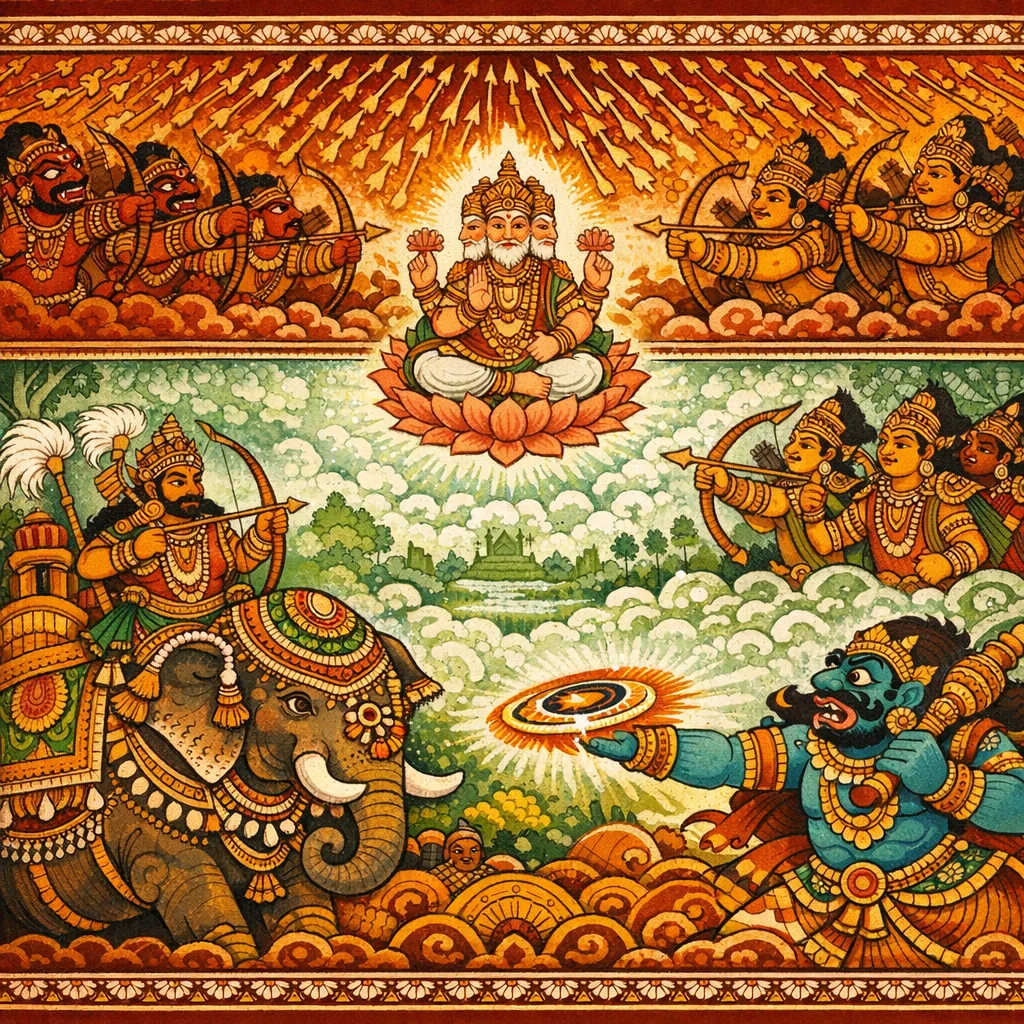
Adhyaya 151: Vishnu’s Battle with the Daityas: Astra-Combat, Counter-Weapons, and the Slaying of Grasana
विष्णु-दैत्ययुद्धे ग्रसनवधः (कालदण्ड-रौद्रास्त्र-प्रशमनम्)
Speaker: Sūta
Sūta continues the war account: the Daityas, led by Nimi and other chiefs (Mathana, Jambhaka, Śumbha, Mahiṣa, Jambha, Grasana), assail Viṣṇu with many kinds of weapons. Missiles strike Hari, yet his composure remains unshaken; he answers with bow and serpent-like arrows, and when his bow is cut he takes up the mace. The astra-battle escalates: Viṣṇu’s Raudra weapon veils the sky and all directions with arrows, and Grasana releases the Brahmāstra to pacify it. Viṣṇu responds with the Kāla-daṇḍa, drawing forth Daitya counter-astras (including the Nārāyaṇāstra and Aiṣīka). In the exchange, Viṣṇu slays vast numbers of Daitya kings. At last he hurls Sudarśana at commander Grasana’s throat; the chakra splits his neck and returns to Janārdana’s hand.
Key Concepts
Shlokas in Adhyaya 151
Verse 1
*सूत उवाच तं दृष्ट्वा दानवाः क्रुद्धाश्चेरुः स्वैः स्वैर्बलैर्वृताः / सरघा इव माक्षीकहरणे सर्वतोदिशम् //
Sūta said: Seeing him, the Dānavas, enraged and surrounded by their own troops, rushed about in every direction—like swarming bees when honey is being taken away.
Verse 2
कृष्णचामरजालाढ्ये सुधाविरचिताङ्कुरे चित्रपञ्चपताके तु प्रभिन्नकरटामुखे //
It should be adorned with a net-like arrangement of black chāmaras (yak-tail whisks), with sprout-like scrollwork fashioned in fine sudhā (lime-plaster); it should bear five variegated pennants, and have elephant-faced ornaments as though rut were flowing forth.
Verse 3
पर्वताभे गजे भीमे मदस्राविणि दुर्धरे आरुह्याजौ निमिर्दैत्यो हरिं प्रत्युद्ययौ बली //
Mounting a terrifying, mountain-like elephant—oozing rut and hard to restrain in battle—the mighty Daitya Nimi advanced to confront Hari (Viṣṇu).
Verse 4
तस्यासन्दानवा रौद्रा गजस्य पदरक्षिणः सप्तविंशतिसाहस्राः किरीटकवचोज्ज्वलाः //
His fierce attendants—protectors at the elephant’s feet—numbered twenty-seven thousand, shining with helmets and armor.
Verse 5
अश्वारूढश्च मथनो जम्भकश्चोष्ट्रवाहनः शुम्भो ऽपि विपुलं मेषं समारुह्याव्रजद्रणम् //
Mathana, mounted on a horse, and Jambhaka, riding a camel, set out; and Śumbha too, having mounted a huge ram, marched forth to the battlefield.
Verse 6
अपरे दानवेन्द्रास्तु यत्ता नानास्त्रपाणयः आजघ्नुः समरे क्रुद्धा विष्णुमक्लिष्टकारिणम् //
Other lordly Dānava chiefs, fully prepared and bearing many kinds of weapons, angrily struck at Viṣṇu in the battle—Viṣṇu, the tireless doer of deeds, unwearied in action.
Verse 7
परिघेण निमिर्दैत्यो मथनो मुद्गरेण तु शुम्भः शूलेन तीक्ष्णेन प्रासेन ग्रसनस्तथा //
The Daitya Nimi was struck with an iron club (parigha); Mathana with a mace (mudgara); Śumbha with a sharp śūla; and likewise Grasana with a prāsa, a javelin.
Verse 8
चक्रेण महिषः क्रुद्धो जम्भः शक्त्या महारणे जघ्नुर्नारायणं सर्वे शेषास्तीक्ष्णैश्च मार्गणैः //
In that great battle, the enraged Mahiṣa struck with the cakra, Jambha struck with the śakti (spear), and all the remaining warriors assailed Nārāyaṇa with sharp arrows.
Verse 9
तान्यस्त्राणि प्रयुक्तानि शरीरं विविशुर्हरेः गुरूक्तान्युपदिष्टानि सच्छिष्यस्य श्रुताविव //
Those missiles, once discharged, entered into Hari’s body—just as teachings spoken by a guru, when properly imparted, enter and settle in the hearing of a worthy disciple.
Verse 10
असम्भ्रान्तो रणे विष्णुर् अथ जग्राह कार्मुकम् शरांश्चाशीविषाकारांस् तैलधौतानजिह्मगान् //
Unperturbed in the battle, Viṣṇu then took up his bow, and also took arrows like venomous serpents—oil-polished and perfectly straight, without any bend.
Verse 11
ततो ऽभिसंध्य दैत्यांस्तान् आकर्णाकृष्टकार्मुकः अभ्यद्रवद्रणे क्रुद्धो दैत्यानीके तु पौरुषात् //
Then, taking aim at those Daityas and drawing his bow back to the ear, he rushed into the battle in wrath, charging straight into the Daitya host through sheer valor.
Verse 12
निमिं विव्याध विंशत्या बाणानामग्निवर्चसाम् मथनं दशभिर्बाणैः शुम्भं पञ्चभिरेव च //
Nimi pierced his foe with twenty arrows blazing like fire; he struck Mathana with ten arrows, and Śumbha with five as well.
Verse 13
एकेन महिषं क्रुद्धो विव्याधोरसि पत्त्रिणा जम्भं द्वादशभिस्तीक्ष्णैः सर्वांश्चैकैकशो ऽष्टभिः //
Enraged, he pierced Mahiṣa in the chest with a single feathered arrow; Jambha he struck with twelve sharp arrows, and all the others, one by one, with eight each.
Verse 14
तस्य तल्लाघवं दृष्ट्वा दानवाः क्रोधमूर्छिताः नर्दमानाः प्रयत्नेन चक्रुरत्यद्भुतं रणम् //
Seeing his remarkable swiftness, the Dānavas—overwhelmed and maddened with anger—roared aloud and, with all their effort, waged a most astonishing battle.
Verse 15
चिछेदाथ धनुर्विष्णोर् निमिर्भल्लेन दानवः संध्यमानं शरं हस्ते चिछेद महिषासुरः //
Then the Dānava Nimi severed Viṣṇu’s bow with a sharp arrow; and Mahīṣāsura, while a missile was being fitted, cut the arrow in the hand.
Verse 16
पीडयामास गरुडं जम्भस्तीक्ष्णैस्तु सायकैः भुजं तस्याहनद्गाढं शुम्भो भूधरसंनिभः //
Jambha tormented Garuḍa with keen arrows; and Śumbha—massive like a mountain—struck him hard upon the arm.
Verse 17
छिन्ने धनुषि गोविन्दो गदां जग्राह भीषणाम् तां प्राहिणोत्स वेगेन मथनाय महाहवे //
When his bow was cut, Govinda seized a fearsome mace; and in that great battle he hurled it with speed at Mathana.
Verse 18
तामप्राप्तां निमिर्बाणैश् चिछेद तिलशो रणे तां नाशमागतां दृष्ट्वा हीनाग्रे प्रार्थनामिव //
When she came within his reach, Nimi, in battle, cut her to pieces with his arrows. Seeing her brought to ruin, she became like a prayer whose beginning has been cut off—left incomplete and powerless.
Verse 19
जग्राह मुद्गरं घोरं दिव्यरत्नपरिष्कृतम् तं मुमोचाथ वेगेन निमिमुद्दिश्य दानवम् //
He seized a fearsome mace, adorned with divine gems, and then hurled it with great speed, aiming at Nimi—the Dānava.
Verse 20
तम् आयान्तं वियत्येव त्रयो दैत्या न्यवारयन् गदया जम्भदैत्यस्तु ग्रसनः पट्टिशेन तु //
As he advanced, as though moving through the open sky, three Daityas checked him: the Daitya Jambha with a mace, and Grasana with a patṭiśa (a bladed spear or halberd).
Verse 21
शक्त्या च महिषो दैत्यः स्वपक्षजयकाङ्क्षया निराकृतं तमालोक्य दुर्जने प्रणयं यथा //
Then the Daitya Mahiṣa, longing for his own side to prevail, took up the śakti (spear); and seeing one who had been cast off, he offered friendship—like a fool who shows affection to a wicked man.
Verse 22
जग्राह शक्तिमुग्राग्राम् अष्टघण्टोत्कटस्वनाम् जम्भाय तां समुद्दिश्य प्राहिणोद्रणभीषणः //
Terrible in battle, he seized a fierce śakti whose harsh clang was like eight bells striking; aiming it at Jambha, he hurled it forth.
Verse 23
तामम्बरस्थां जग्राह गजो दानवनन्दनः गृहीतां तां समालोक्य शिक्षामिव विवेकिभिः //
Seeing it poised in midair, Gaja—the beloved son of a Dānava—seized it; and the discerning, beholding it thus taken, regarded it as though it were a lesson in proper conduct.
Verse 24
दृढं भारसहं सारम् अन्यदादाय कार्मुकम् रौद्रास्त्रमभिसंधाय तस्मिन्बाणं मुमोच ह //
Then, taking up another bow—firm, weight-bearing, and well-tempered—he invoked the dreadful Raudrāstra and released an arrow at him.
Verse 25
ततो ऽस्त्रतेजसा सर्वं व्याप्तं लोकं चराचरम् ततो बाणमयं सर्वम् आकाशं समदृश्यत //
Then, by the blazing potency of the missile-weapons, the entire world—moving and unmoving—was pervaded; and the whole sky appeared completely filled with arrows.
Verse 26
भूर्दिशो विदिशश्चैव बाणजालमया बभुः दृष्ट्वा तदस्त्रमाहात्म्यं सेननीर् ग्रसनो ऽसुरः //
The earth—and the quarters and intermediate directions as well—became as though woven into a net of arrows. Seeing the might of that missile, the Asura commander, Grasana, was seized with dread.
Verse 27
ब्राह्ममस्त्रं चकारासौ सर्वास्त्रविनिवारणम् तेन तत्प्रशमं यातं रौद्रास्त्रं लोकघस्मरम् //
He then deployed the Brahma-weapon, the countermeasure that restrains all other weapons; by it, the world-devouring Raudra-weapon was brought to calm and cessation.
Verse 28
अस्त्रे प्रतिहते तस्मिन् विष्णुर्दानवसूदनः कालदण्डास्त्रमकरोत् सर्वलोकभयंकरम् //
When that weapon had been countered, Viṣṇu—the slayer of the Dānavas—then deployed the Kāla-daṇḍa missile, terrifying to all the worlds.
Verse 29
संधीयमाने तस्मिंस्तु मारुतः परुषो ववौ चकम्पे च मही देवी दैत्या भिन्नधियो ऽभवन् //
But as that engagement was being joined, a harsh wind blew; the goddess Earth shook, and the Daityas became unsettled—of divided and confounded resolve.
Verse 30
तदस्त्रमुग्रं दृष्ट्वा तु दानवा युद्धदुर्मदाः चक्रुरस्त्राणि दिव्यानि नानारूपाणि संयुगे //
But when the Dānavas—made reckless by the frenzy of battle—beheld that terrible weapon, they, in the thick of combat, unleashed divine missiles of many different forms.
Verse 31
नारायणास्त्रं ग्रसनो गृहीत्वा चक्रं निमिः स्वास्त्रवरं मुमोच ऐषीकमस्त्रं च चकार जम्भस् तत्कालदण्डास्त्रनिवारणाय //
Having seized the Nārāyaṇa-weapon (Nārāyaṇāstra), Grasana released his own excellent discus; and Jambha, to check the instantly arriving “Rod of Time” (Kāla-daṇḍa) missile, employed the Aiṣīka weapon.
Verse 32
यावन्न संध्या न दशां प्रयान्ति दैत्येश्वराश्चास्त्रनिवारणाय तावत्क्षणेनैव जघान कोटीर् दैत्येश्वराणां सगजान्सहाश्वान् //
So long as twilight had not yet come, and while the lords of the Daityas were still making ready to ward off the weapons, in that very instant he struck down crores of Daitya kings—together with their elephants and horses.
Verse 33
अनन्तरं शान्तमभूत्तदस्त्रं दैत्यास्त्रयोगेण तु कालदण्डम् शान्तं तदालोक्य हरिः स्वशस्त्रं स्वविक्रमे मन्युपरीतमूर्तिः //
Thereafter that missile—terrible as the Rod of Time—was quelled by the demons’ counter-weapon. Seeing it pacified, Hari, his form enveloped in wrath at his own prowess, took up his own weapon.
Verse 34
जग्राह चक्रं तपनायुताभम् उग्रारमात्मानमिव द्वितीयम् चिक्षेप सेनापतये ऽभिसंध्य कण्ठस्थलं वज्रकठोरमुग्रम् //
He seized a discus blazing like ten thousand suns—like a second fierce embodiment of himself—and, taking aim at the army-commander, hurled it at his throat, dreadful and hard as a vajra.
Verse 35
चक्रं तदाकाशगतं विलोक्य सर्वात्मना दैत्यवराः स्ववीर्यैः नाशक्नुवन्वारयितुं प्रचण्डं दैवं यथा कर्म मुधा प्रपन्नम् //
Seeing that discus moving through the sky, the foremost of the Daityas, with all their might and heroism, could not restrain that fiercely impetuous divine force—just as fate cannot be held back when one’s own karma has vainly brought it upon oneself.
Verse 36
तमप्रतर्क्यं जनयन्नजय्यं चक्रं पपात ग्रसनस्य कण्ठे द्विधा तु कृत्वा ग्रसनस्य कण्ठं तद्रक्तधारारुणघोरनाभि जगाम भूयो ऽपि जनार्दनस्य पाणिं प्रवृद्धानलतुल्यदीप्ति //
Making itself beyond anticipation and irresistible in force, the discus fell upon Grasana’s throat. Splitting his neck in two, that Sudarśana—its dreadful hub reddened by streaming blood—returned again to Janārdana’s hand, blazing like a greatly kindled fire.
Frequently Asked Questions
The chapter teaches that disciplined divine force operates within an intelligible order: every overwhelming weapon (astra) has a restraining countermeasure (pratyastra), and outcomes ultimately align with dharma and karma. This is reinforced through similes—missiles entering Hari like guru-teaching entering a worthy disciple, and the inability to stop Sudarśana like the inevitability of fate shaped by one’s own actions.
The focus is primarily Dharma through the lens of cosmic protection and righteous warfare (daitya-suppression, restoration of order). Vastu is not taught as formal architecture here, but there is descriptive material relevant to royal/ceremonial aesthetics (elephant adornment, pennants, ornamental motifs). Genealogy is not a chapter focus; the narrative is martial and theological.