Adhyaya 115: The Karmic Cause of Purūravas’ Beauty and Fortune (and the Rule on Abhyaṅga During Fasting)
पुरूरवसो रूपसौभाग्यहेतुनिर्णयः
Speaker: Vaivasvata Manu, Lord Matsya (Janārdana/Keśava), Sūta, Ṛṣis
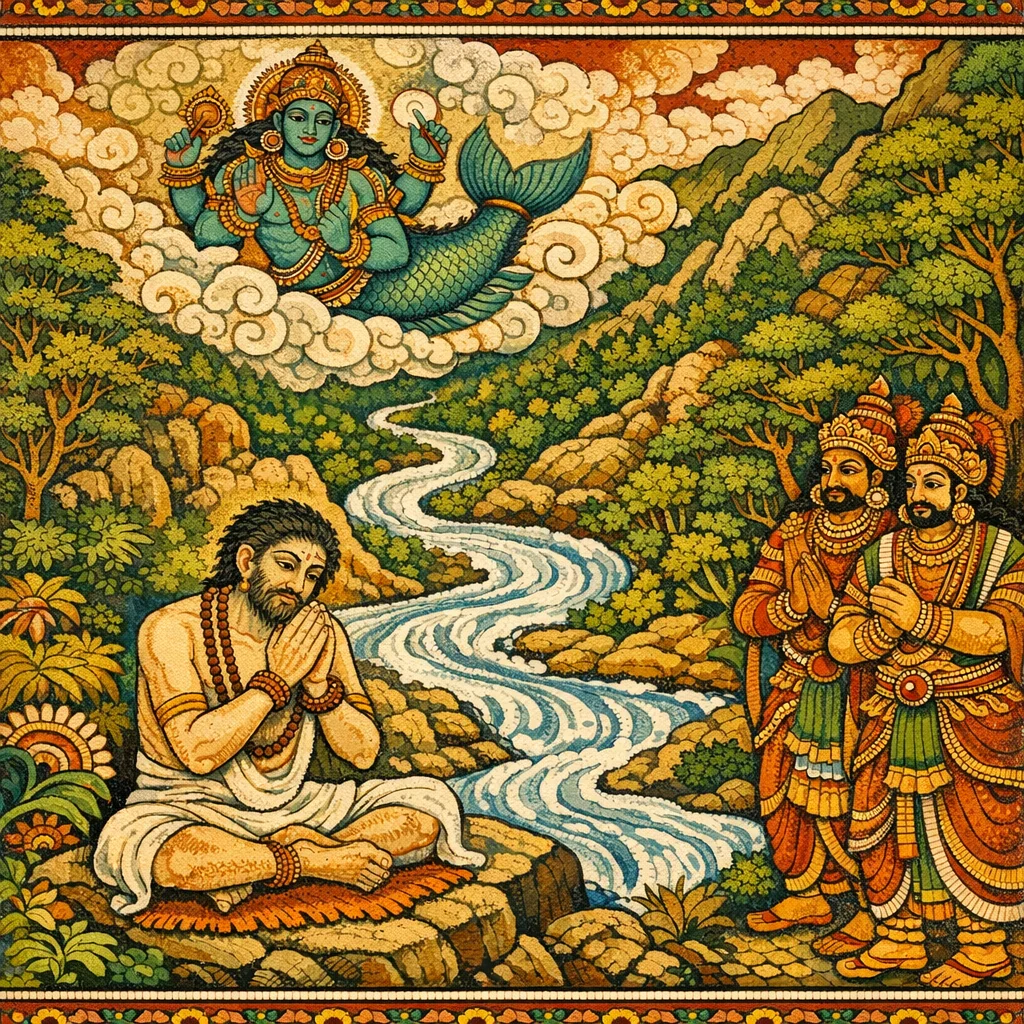
Manu addresses Janārdana: having heard the Śrāddha procedure and the gifts of great merit, he asks what past deeds granted Purūravas such extraordinary beauty and fortune that Urvaśī chose him over celestial beings. Matsya begins the karmic account: in a former birth Purūravas was connected with Madra rulership; and, in a Sūta/Ṛṣi framing, a brāhmaṇa named Purūravas undertook fasting and worship of Janārdana to obtain sovereignty. The vow yielded secure kingship, but oil-anointing before bathing while fasting (abhyaṅga-snāna) produced a contrary result—diminished beauty. Matsya states the general rule: those who fast should avoid abhyaṅga-snāna, for it is “rūpa-ghna” (beauty-destroying). The narrative then turns to the king’s remedy: he entrusts rule to ministers, goes to the Himālaya, and reaches the delightful tīrtha of the Airāvatī river, setting up the next chapter’s austerity and sacred geography.
Key Concepts
Shlokas in Adhyaya 115
Verse 1
*मनुर् उवाच चरितं बुधपुत्रस्य जनार्दन मया श्रुतम् श्रुतः श्राद्धविधिः पुण्यः सर्वपापप्रणाशनः //
Manu said: “O Janārdana, I have heard the account of the son of Budha; and I have also heard the sacred procedure of Śrāddha—meritorious and destructive of all sins.”
Verse 2
धेन्वाः प्रसूयमानायाः फलं दानस्य मे श्रुतम् कृष्णाजिनप्रदानं च वृषोत्सर्गस्तथैव च //
I have heard of the reward that comes from gifting a cow at the time she is about to give birth; likewise I have heard of the merit of giving a black antelope-skin (kṛṣṇājina) and of releasing a bull (vṛṣotsarga) in consecrated donation.
Verse 3
श्रुत्वा रूपं नरेन्द्रस्य बुधपुत्रस्य केशव कौतूहलं समुत्पन्नं तन्ममाचक्ष्व पृच्छतः //
O Keśava, having heard of the beauty and form of that king—the son of Budha—great curiosity has arisen in me. Tell me about him, as I ask.
Verse 4
केन कर्मविपाकेन स तु राजा पुरूरवाः अवाप तादृशं रूपं सौभाग्यमपि चोत्तमम् //
By the fruition of which past actions did King Purūravas attain such beauty of form, and also the highest good fortune?
Verse 5
देवांस्त्रिभुवनश्रेष्ठान् गन्धर्वांश्च मनोरमान् उर्वशी संमता त्यक्त्वा सर्वभावेन तं नृपम् //
Urvashī—celebrated and admired—set aside even the gods, the finest in the three worlds, and the delightful Gandharvas, and with her whole heart chose that king alone.
Verse 6
*मत्स्य उवाच शृणु कर्मविपाकेन येन राजा पुरूरवाः अवाप तादृशं रूपं सौभाग्यमपि चोत्तमम् //
Matsya said: Listen—by the fruition of which deeds (karmic results) did King Purūravas attain such a form and also the highest good fortune?
Verse 7
अतीते जन्मनि पुरा यो ऽयं राजा पुरूरवाः पुरूरवा इति ख्यातो मद्रदेशाधिपो हि सः //
In a former birth long ago, this very king—Purūravas, famed by the name “Purūravas”—was indeed the ruler of the Madra country.
Verse 8
चाक्षुषस्यान्वये राजा चाक्षुषस्यान्तरे मनोः स वै नृपगुणैर्युक्तः केवलं रूपवर्जितः //
In the lineage of Cākṣuṣa Manu, during the Manvantara of Cākṣuṣa, there was a king endowed with all the virtues of a ruler, yet he alone was devoid of physical beauty.
Verse 9
*ऋषय ऊचुः पुरूरवा मद्रपतिः कर्मणा केन पार्थिवः बभूव कर्मणा केन रूपवांश्चैव सूतज //
The sages said: “By what meritorious deed did Purūravas, lord of Madra, become a king? And by what deed did that son of a sūta become handsome as well?”
Verse 10
*सूत उवाच द्विजग्रामे द्विजश्रेष्ठो नाम्ना चासीत्पुरूरवाः नद्याः कूले महाराजः पूर्वजन्मनि पार्थिवः //
Sūta said: In a village of brāhmaṇas there lived a foremost brāhmaṇa named Purūravas. O great king, on the bank of a river he had been a ruler in a former birth.
Verse 11
स तु मद्रपती राजा यस्तु नाम्ना पुरूरवाः तस्मिञ्जन्मन्यसौ विप्रो द्वादश्यां तु सदानघ //
That king—lord of Madra—was renowned by the name Purūravas. In that very birth, that brāhmaṇa was ever sinless, O faultless one, and was associated with Dvādaśī, the twelfth lunar day.
Verse 12
उपोष्य पूजयामास राज्यकामो जनार्दनम् चकार सोपवासश्च स्नानम् अभ्यङ्गपूर्वकम् //
Desiring sovereignty, he observed a fast and worshipped Janārdana (Viṣṇu). While maintaining the fast, he also performed a bath preceded by oil-anointing (abhyaṅga).
Verse 13
उपवासफलात्प्राप्तं राज्यं मद्रेष्वकण्टकम् उपोषितस् तथाभ्यङ्गाद् रूपहीनो व्यजायत //
By the merit born of fasting, he obtained an untroubled kingship among the Madras; yet, because he had fasted and then performed oil-anointing (abhyaṅga), he was born lacking in beauty.
Verse 14
उपोषितैर्नरैस् तस्मात् स्नानम् अभ्यङ्गपूर्वकम् वर्जनीयं प्रयत्नेन रूपघ्नं तत्परं नृप //
Therefore, O king, men who are observing a fast should diligently avoid bathing preceded by oil-anointing (abhyanga), for it is said to diminish the body’s radiance and beauty.
Verse 15
एतद्वः कथितं सर्वं यद्वृत्तं पूर्वजन्मनि मद्रेश्वरत्वचरितं शृणु तस्य महीपतेः //
All this has been told to you—what occurred in a former birth. Now, O king, hear the account of how that ruler became the Lord of Madra (Madreśvara).
Verse 16
तस्य राजगुणैः सर्वैः समुपेतस्य भूपतेः जनानुरागो नैवासीद् रूपहीनस्य तस्य वै //
Though that king was endowed with every royal virtue, the people felt no affection for him, for in truth he lacked outward beauty and commanding presence.
Verse 17
रूपकामः स मद्रेशस् तपसे कृतनिश्चयः राज्यं मन्त्रिगतं कृत्वा जगाम हिमपर्वतम् //
That ruler of Madra, longing for beauty, resolved to undertake austerities (tapas); entrusting the kingdom to his ministers, he departed for the Himālaya mountains.
Verse 18
व्यवसायद्वितीयस्तु पद्भ्यम् एव महायशाः द्रष्टुं स तीर्थसदनं विषयान्ते स्वके नदीम् //
Then the illustrious one, steadfast in resolve, set out on foot to behold that sacred ford (tīrtha) and shrine, situated at the edge of his own realm beside his own river.
Verse 19
ऐरावतीति विख्यातां ददर्शातिमनोरमाम् //
He beheld an exceedingly charming place, renowned by the name “Airāvatī.”
Verse 20
तुहिनगिरिभवां महौघवेगां तुहिनगभस्तिसमानशीतलोदाम् //
Born from the snowy mountains, she rushes with the force of a mighty flood; her waters are cool and refreshing, like the chill of snow-laden rays.
Verse 21
तुहिनसदृशहैमवर्णपुञ्जां तुहिनयशाः सरितं ददर्श राजा //
King Tuhinayaśā beheld the river—its mass of golden hue resembling snow.
Frequently Asked Questions
The chapter’s practical instruction is a vrata rule: a person observing a fast (upavāsa) should avoid bathing preceded by oil-anointing (abhyaṅga), because it is described as “rūpa-ghna”—diminishing bodily radiance/beauty. In the narrative, this explains why a devotee who gained kingship by fasting and worshipping Janārdana was nevertheless reborn lacking physical beauty.
This adhyāya is primarily about Dharma and Genealogy through karma-vipāka: it links ritual discipline (vrata conduct), merit and demerit results, and Purāṇic lineage/identity transmission (Purūravas across births and narrators). It also touches Rajadharma indirectly by noting that royal virtues alone did not win public affection without outward presence, prompting the king’s tapas and pilgrimage to a tīrtha.