Adhyaya 110: The Greatness of Prayaga and Allied Tirthas (Pilgrimage-Merit Teachings)
प्रयागादि-तीर्थमाहात्म्यवर्णनम्
Speaker: Mārkaṇḍeya (speaker), Yudhiṣṭhira (listener/inquirer)
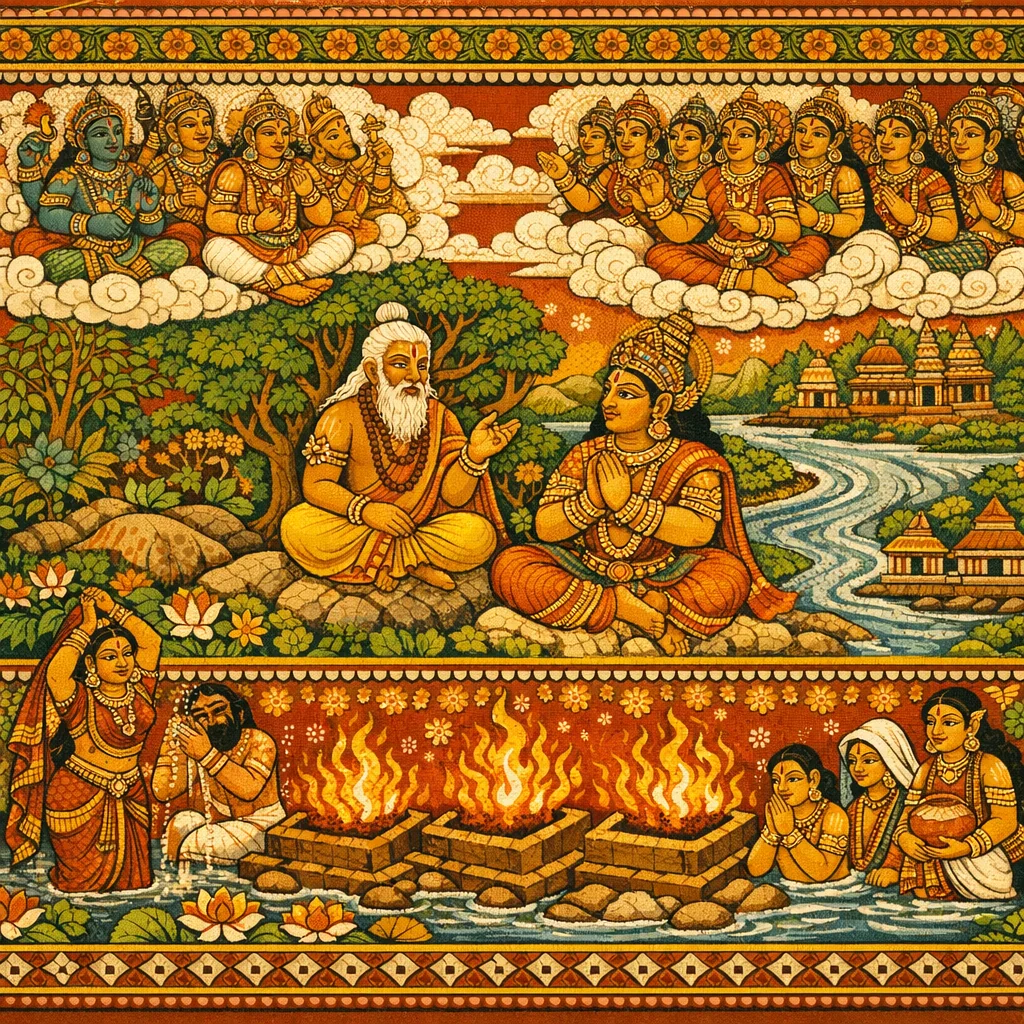
In dialogue form, Mārkaṇḍeya answers Yudhiṣṭhira by revisiting a catalogue of renowned pilgrimage sites and then focusing on Prayāga’s unrivaled supremacy. He portrays the sacred landscape: three Agni-kuṇḍas with the Jāhnavī (Gaṅgā) flowing between them, and the Yamunā joining the Gaṅgā at the confluence. Prayāga’s eminence is magnified by vast enumerations of ever-present tīrthas and by citing Vāyu’s declaration that the tīrtha-presence identified with Jāhnavī extends across the three worlds. The account then turns from place to doctrine: land touched by the Gaṅgā is a siddha-kṣetra; the teaching should be whispered to a devoted disciple; hearing and study purify, destroy sins, and grant heavenly reward and remembrance of past births. The chapter ends with a hierarchy of merits, asserting that Prayāga surpasses the combined fruits of vratas, dāna, tapas, yajñas, yoga, Sāṃkhya, and other knowledge-causes, while urging straightforwardness of mind and bathing at the tīrtha.
Key Concepts
Shlokas in Adhyaya 110
Verse 1
*मार्कण्डेय उवाच शृणु राजन्प्रयागस्य माहात्म्यं पुनरेव तु नैमिषं पुष्करं चैव गोतीर्थं सिन्धुसागरम् //
Mārkaṇḍeya said: Listen, O King—once again I shall relate the sacred greatness (māhātmya) of Prayāga, as well as that of Naimiṣa, Puṣkara, Go-tīrtha, and the ocean at the mouth of the Sindhu.
Verse 2
गया च चैत्रकं चैव गङ्गासागरमेव च एते चान्ये च बहवो ये च पुण्याः शिलोच्चयाः //
Gayā, Caitraka, and also Gaṅgā-sāgara—these and many other sacred rocky hill-shrines are declared to be holy places of pilgrimage.
Verse 3
दश तीर्थसहस्राणि त्रिंशत्कोट्यस्तथा पराः प्रयागे संस्थिता नित्यम् एवमाहुर्मनीषिणः //
The sages declare that in Prayāga there are ever-present ten thousand tīrthas (sacred fords), and moreover thirty crores besides—abiding there perpetually.
Verse 4
त्रीणि चाप्यग्निकुण्डानि येषां मध्ये तु जाह्नवी प्रयागादभिनिष्क्रान्ता सर्वतीर्थनमस्कृता //
There are also three Agni-kuṇḍas (sacred fire-pits); and in their midst flows the Jāhnavī (Gaṅgā). Emerging from Prayāga, she is revered—one to whom all tīrthas (holy fords) offer homage.
Verse 5
तपनस्य सुता देवी त्रिषु लोकेषु विश्रुता यमुना गङ्गया सार्धं संगता लोकभाविनी //
The goddess Yamunā, daughter of Tapana (the Sun), renowned throughout the three worlds, unites with the Gaṅgā, the benefactress of the world.
Verse 6
गङ्गायमुनयोर्मध्ये पृथिव्या जघनं स्मृतम् प्रयागं राजशार्दूल कलां नार्हति षोडशीम् //
Between the Gaṅgā and the Yamunā is remembered the “hip” of the Earth—Prayāga, O tiger among kings; it falls short not even by a sixteenth part in excellence.
Verse 7
तिस्रः कोट्यो ऽर्धकोटिश्च तीर्थानां वायुरब्रवीत् दिवि भुव्यन्तरिक्षे च तत्सर्वं जाह्नवी स्मृता //
Vāyu declared that there are three crores and a half-crore of tīrthas; and in heaven, on earth, and in the mid-region, all of that is remembered as Jāhnavī (the Gaṅgā).
Verse 8
प्रयागं समधिष्ठानं कम्बलाश्वतरावुभौ भोगवत्यथ या चैषा वेदिरेषा प्रजापतेः //
Prayāga is the supreme sacred seat; so too are both Kambala and Aśvatara, and Bhogavatī; and also this altar (vedī) of Prajāpati.
Verse 9
तत्र वेदाश्च यज्ञाश्च मूर्तिमन्तो युधिष्ठिर प्रजापतिम् उपासन्ते ऋषयश्च तपोधनाः //
There, O Yudhiṣṭhira, the Vedas and the sacrifices—having assumed embodied form—worship Prajāpati; and so too do the sages, rich in austerity.
Verse 10
यजन्ते क्रतुभिर् देवास् तथा चक्रधरा नृपाः ततः पुण्यतमं नास्ति त्रिषु लोकेषु भारत //
The gods worship through Vedic sacrifices (kratus), and likewise do the wheel-bearing kings. O Bhārata, in the three worlds there is nothing more supremely meritorious than that.
Verse 11
प्रभावात्सर्वतीर्थेभ्यः प्रभवत्यधिकं विभो दश तीर्थसहस्राणि तिस्रः कोट्यस्तथा पराः //
O mighty one, by its spiritual potency it surpasses all other sacred fords (tīrthas): it yields merit greater than ten thousand tīrthas, and even beyond three crores besides.
Verse 12
यत्र गङ्गा महाभागा स देशस्तत्तपोधनम् सिद्धक्षेत्रं च विज्ञेयं गङ्गातीरसमन्वितम् //
Wherever the greatly blessed Gaṅgā is present, that land is to be regarded as a true treasure of austerity; it should be known as a perfected sacred field (siddha-kṣetra), endowed with the banks of the Gaṅgā.
Verse 13
इदं सत्यं विजानीयात् साधूनामात्मनश्च वै सुहृदश्च जपेत्कर्णे शिष्यस्यानुगतस्य च //
Know this to be true: for the welfare of the virtuous, for oneself, and for one’s well-wishing friend, one should whisper (this teaching) into the ear of a devoted disciple who follows the teacher’s guidance.
Verse 14
इदं धन्यमिदं स्वर्ग्यम् इदं सत्यमिदं सुखम् इदं पुण्यमिदं धर्म्यं पावनं धर्ममुत्तमम् //
This is auspicious; this leads to heaven. This is truth; this is happiness. This is merit; this is righteous. This is purifying—the supreme Dharma.
Verse 15
महर्षीणामिदं गुह्यं सर्वपापप्रणाशनम् अधीत्य च द्विजो ऽप्येतन् निर्मलः स्वर्गमाप्नुयात् //
This secret teaching of the great sages destroys all sins. Even a twice-born (dvija), having studied it, becomes purified and attains heaven.
Verse 16
य इदं शृणुयान्नित्यं तीर्थं पुण्यं सदा शुचिः जातिस्मरत्वं लभते नाकपृष्ठे च मोदते //
Whoever, ever pure, listens daily to this sacred and meritorious account of the tīrtha gains remembrance of past births and rejoices upon heaven’s summit.
Verse 17
प्राप्यन्ते तानि तीर्थानि सद्भिः शिष्टानुदर्शिभिः स्नाहि तीर्थेषु कौरव्य न च वक्रमतिर्भव //
Those tīrthas are attained by the good—by those who follow the guidance of the cultured and disciplined. O Kauravya, bathe at the tīrthas, and do not become crooked in mind.
Verse 18
त्वया च सम्यक्पृष्टेन कथितं वै मया विभो पितरस्तारिताः सर्वे तथैव च पितामहाः //
O Lord, because you questioned rightly, I have indeed explained it; thereby all the fathers (ancestors) have been delivered—likewise the grandfathers as well.
Verse 19
व्रतं दानं तपस्तीर्थं यागाः सर्वे सदक्षिणाः योगाः सांख्यं सदाचारो ये चान्ये ज्ञानहेतवः प्रयागस्य तु सर्वे ते कलां नार्हन्ति षोडशीम् //
Vows (vrata), charity (dāna), austerity (tapas), other holy places, and all sacrifices (yajña) performed with due dakṣiṇā; yoga, Sāṃkhya, good conduct, and whatever else serves as a cause of knowledge—none of these, even together, equals even a sixteenth part of the merit of Prayāga.
Verse 20
एवं ज्ञानं च योगश्च तीर्थं चैव युधिष्ठिर बहुक्लेशेन युज्यन्ते तेन यान्ति परां गतिम् त्रिकालं जायते ज्ञानं स्वर्गलोकं गमिष्यति //
Thus, O Yudhiṣṭhira, knowledge, yoga, and pilgrimage to the tīrtha are attained only through great exertion; by them one reaches the supreme state. When knowledge ripens through the three times (past, present, and future—or through sustained practice at the three daily periods), one will go to the world of heaven.
Frequently Asked Questions
The chapter teaches that Prayāga—especially the Gaṅgā–Yamunā confluence—functions as a supreme siddha-kṣetra whose spiritual potency exceeds other tīrthas. It instructs that bathing at tīrthas, hearing/studying the tīrtha-māhātmya, and maintaining a straight (non-crooked) mind lead to purification, sin-destruction, and heavenly attainment; it even promises jātismaratva (memory of past births) for one who listens daily.
Adhyaya 110 is primarily Dharma-focused through tīrtha-māhātmya (pilgrimage merit), sacred geography, and ritual theology (yajñas/kratus, dakṣiṇā, tapas). It does not present Vāstu-śāstra measurements or genealogical lists here; instead it ranks pilgrimage merit above vratas, dāna, tapas, yoga, Sāṃkhya, and sacrifices.
The chapter names Naimiṣa, Puṣkara, Go-tīrtha, Sindhu-sāgara (ocean at the Sindhu’s mouth), Gayā, Caitraka, and Gaṅgā-sāgara, indicating a wider tīrtha network while emphasizing Prayāga’s supremacy.
It states that wherever the greatly blessed Gaṅgā is present, that land should be regarded as a treasure of austerity and known as a perfected sacred field (siddha-kṣetra), specifically characterized by being endowed with Gaṅgā’s banks.