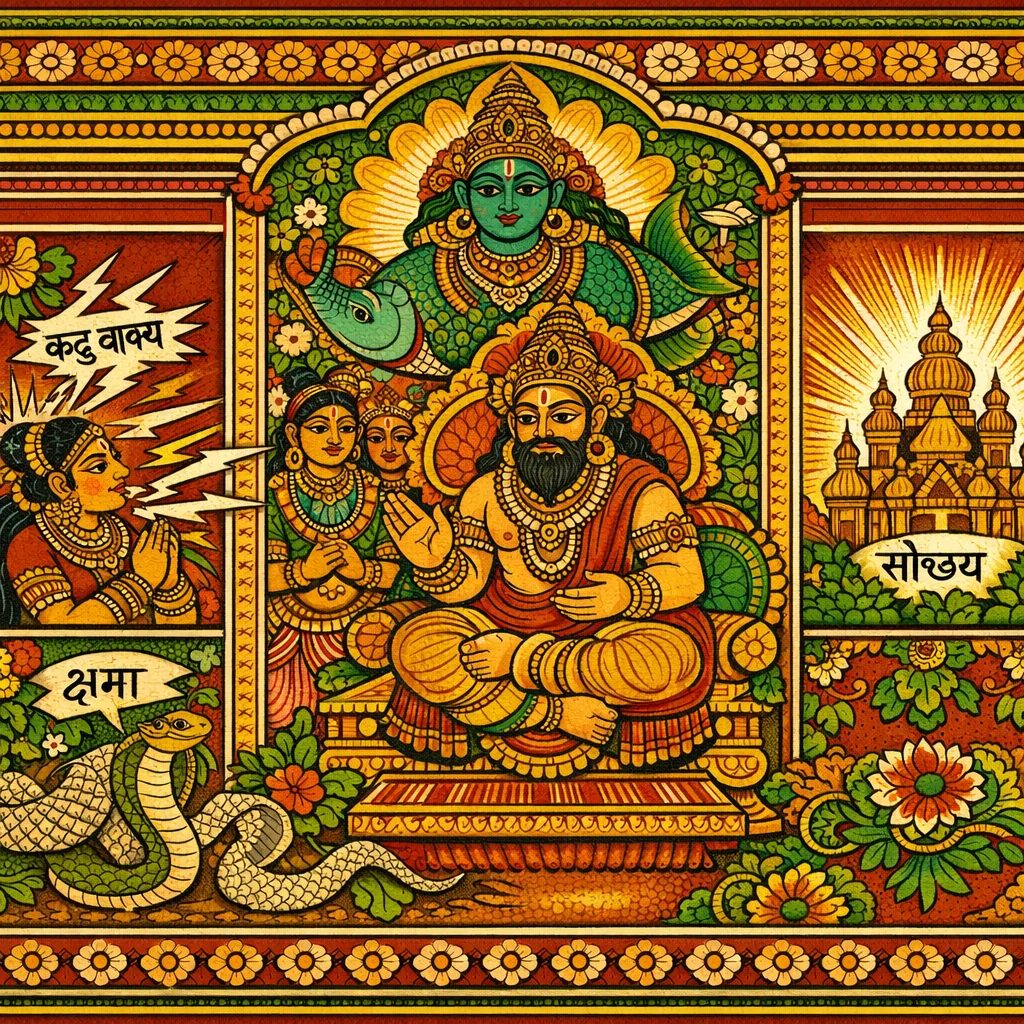
Adhyaya 28: The Chapter on Conquering Anger: Forbearance, Forgiveness, and Right Association
अक्रोध-क्षमाध्यायः
Speaker: Śukra, Devayānī
Śukra teaches that enduring harsh words and restraining anger is the devayāna—the inner conquest—surpassing even grand sacrifices. With vivid similes—anger as a bolting horse, forgiveness as a serpent shedding its skin—he exalts akrodha above repeated Aśvamedha rites. He then turns to social ethics: the wise should not take up childish enmity, should not tolerate the conduct of an unworthy disciple, and should avoid living among those of mixed morals or sin-bent minds; dwelling among sādhus is declared best. Devayānī replies that, though young, she has discernment, and the emotional strain rises as she describes the burning sting of Vṛṣaparvan’s daughter’s harsh speech and the hardship of witnessing a rival’s blazing prosperity.
Key Concepts
Shlokas in Adhyaya 28
Verse 1
*शुक्र उवाच यः परेषां नरो नित्यम् अतिवादांस्तितिक्षति देवयानि विजानीहि तेन सर्वमिदं जितम् //
Śukra said: The man who continually endures the harsh and excessive words of others—know this to be the divine path (devayāna); by it, indeed, all this is conquered.
Verse 2
यः समुत्पतितं क्रोधं निगृह्णाति हयं यथा स यन्तेत्युच्यते सद्भिर् न यो रश्मिषु लम्बते //
One who restrains anger as one would rein in a horse that has suddenly bolted—such a person is called a true charioteer by the virtuous, not one who merely hangs on to the reins.
Verse 3
यः समुत्पतितं क्रोधम् अक्रोधने नियच्छति देवयानि विजानीहि तेन सर्वमिदं जितम् //
Know this as the divine path (devayāna): whoever restrains anger as it suddenly arises and establishes it in a state of non-anger—by that person, indeed, all this is conquered.
Verse 4
यः समुत्पतितं कोपं क्षमयैव निरस्यति यथोरगस्त्वचं जीर्णां स वै पुरुष उच्यते //
He who casts away anger the moment it arises—by forgiveness alone—just as a serpent sheds its worn-out skin, is truly called a real man.
Verse 5
यस्तु भावयते धर्मं यो ऽतिमात्रं तितिक्षति यश्च तप्तो न तपति भृशं सो ऽर्थस्य भाजनम् //
But one who nurtures and strengthens Dharma, who endures beyond measure, and who—though afflicted—does not burn with excessive resentment: such a person becomes a fit vessel for artha (prosperity).
Verse 6
यो यजेदश्वमेधेन मासि मासि शतं समाः यस्तु कुप्येन्न सर्वस्य तयोरक्रोधनो वरः //
Even if one were to perform the Aśvamedha sacrifice month after month for a hundred years, and another—toward everyone—never became angry, between the two, the one free from anger is superior.
Verse 7
ये कुमाराः कुमार्यश्च वैरं कुर्युरचेतसः नैतत्प्राज्ञस्तु कुर्वीत विदुस्ते न बलाबलम् //
Boys and girls, being undiscerning, may take up enmity; but a wise person should not do so—because they do not understand what is strength and what is weakness.
Verse 8
*देवयान्युवाच वेदाहं तात बालापि कार्याणां तु गतागतम् क्रोधे चैवातिवादे वा कार्यस्यापि बलाबले //
Devayānī said: “Father, though I am young, I understand the course of affairs—how things turn out. And in anger or in excessive dispute, I also know what has strength or weakness in a matter.”
Verse 9
शिष्यस्याशिष्यवृत्तं हि न क्षन्तव्यं बुभूषुणा असत्संकीर्णवृत्तेषु वासो मम न रोचते //
A seeker who wishes to truly become (wise and established) should not tolerate the conduct of an unworthy disciple. Living among people whose ways are mixed with the wicked is not pleasing to me.
Verse 10
पुंसो ये नाभिनन्दन्ति वृत्तेनाभिजनेन च न तेषु निवसेत्प्राज्ञः श्रेयोर्थी पापबुद्धिषु //
Those who do not appreciate a man for his good conduct and for his noble lineage—among such sinful-minded people, a wise person who seeks true welfare should not dwell or keep company.
Verse 11
ये नैनमभिजानन्ति वृत्तेनाभिजनेन च तेषु साधुषु वस्तव्यं स वासः श्रेष्ठ उच्यते //
Among those who do not judge a person by conduct or by lineage—among such virtuous people one should dwell; that dwelling is said to be the best.
Verse 12
तन्मे मथ्नाति हृदयम् अग्निकल्पमिवारणम् वाग्दुरुक्तं महाघोरं दुहितुर्वृषपर्वणः //
That dreadful, harsh utterance of Vṛṣaparvan’s daughter churns my heart—like a raging fire in the forest.
Verse 13
न ह्य् अतो दुष्करं मन्ये तात लोकेष्वपि त्रिषु यः सपत्नश्रियं दीप्तां हीनश्रीः पर्युपासते //
My child, I do not think there is anything more difficult—even across the three worlds—than for one of diminished fortune to stand in attendance upon the blazing prosperity of his rival.
Frequently Asked Questions
The core instruction is that akrodha (freedom from anger) and kṣamā (forgiveness) are the “devayāna” (divine path). Śukra teaches that one should restrain anger the moment it arises—like controlling a bolting horse—and establish oneself in non-anger. This inner conquest is said to “conquer all,” and it is valued even above repeated performance of the Aśvamedha sacrifice.
This chapter is primarily Dharma/Nīti (ethical self-governance) rather than Vastu or creation/genealogy. It addresses anger-control, forgiveness, endurance of harsh speech, the superiority of inner virtue over ritual display, and guidance on association—avoiding wicked company and dwelling among sādhus. It also sits within an Itihasa-linked narrative setting involving Śukra and Devayānī, with references to Vṛṣaparvan’s daughter and the pain of rivalry.